Sharif University of Technology
Scientia IranicaTransactions A: Civil Engineering www.scientiairanica.com
The objective design of triangular bucket for dam's
spillway using Non-dominated Sorting Genetic
Algorithm II: NSGA-II
S.H. Hojjati
a;1, S.H. Hojjati
band S.A.A. Salehi Neyshabouri
c; a. Faculty of Civil and Environmental Engineering, Tarbiat Modares University, Tehran, Iran. b. Faculty of Electrical and Computer Engineering, Babol University of Technology, Babol, Iran.c. Water Engineering Research Institute, Faculty of Civil and Environmental Engineering, Tarbiat Modares University, Tehran, Iran.
Received 10 August 2014; received in revised form 23 September 2015; accepted 24 November 2015
KEYWORDS Triangular ip bucket; Chute spillway width; Ski jump;
NSGA-II algorithm; Karoon III dam.
Abstract. Ski jump is one of the most eective structures in energy dissipation over spillways. Spillways have long been of practical importance to safety of dams. The major criteria in hydraulic design are based on the analytical and empirical methods. In the current study, in order to increase chute spillway eciency, a multi-objective evolutionary algorithm known as the Non-dominated Sorting Genetic Algorithm II (NSGA-II) has been utilized to design the optimal triangular bucket angle and chute width. In design method, two separate objective functions have been used. In the rst objective function, equations of dynamic pressure of the bucket, the jet length after bucket, and the scour depth have been used. The second objective function is related to construction volume of chute spillway. For calibrating the rst objective function, characteristics of Karoon III dam have been used as a case study. The dierence between design parameters of Karoon III spillway and those from NSGA-II algorithm method is less than 12 percent. According to the results, if the jet length is considered as the most impressive parameter in the rst objective function, design of the spillway becomes frugal.
© 2017 Sharif University of Technology. All rights reserved.
1. Introduction
In hydraulic engineering, structures like stilling basins, baed aprons, and vortex shafts are used as energy dissipaters [1]. The main role of these structures is to transform or dissipate excessive energy of uid ow. Ski-jump dissipaters are utilized in situations where the kinetic energy of ow is high and can cause
1. Present address: Faculty of Civil and Environmental Engineering, Amirkabir University, Tehran, Iran. *. Corresponding author. Tel.: +98 21 82883316;
Fax: +98 21 82884914
E-mail addresses: [email protected] (S.H. Hojjati); [email protected] (S.H. Hojjati);
[email protected] (S.A.A. Salehi Neyshabouri)
damages like erosion in the tail water channel, abrasion of hydraulic structures, and production of destructive waves downstream.
Most researches on this eld have been done on circular buckets. Juan and Hager [2] experimen-tally investigated the eect of Froude number and bucket geometry on dynamic pressure distribution for circular ip buckets and compared the results with theoretical equations. Heller et al. [3] extended Juan and Hager's [2] circular ip buckets experiments in order to study pressure distribution at the bottom of bucket, ow characteristics for dierent geometries, and Froude numbers. Their attempts resulted in pro-viding equations for calculation of value and location of maximum pressure. Moreover, they computed jet
prole downstream of ip bucket and investigated the eect of the both inlet Froude number and bucket radius on jet trajectory. Steiner et al. [4] conducted similar experiment to that of Heller et al. on trian-gular ip bucket. They compared parameters like the dynamic pressure on bucket and dissipation of energy between the triangular and circular buckets. In another research, Pster [5] considered dierent slopes of upstream and downstream channels in his experi-ments and proposed an equation for length of ski-jump. Pster [6] assessed the jet takeo angle and developed an equation by considering the eect of chute spillway slope. Hojjati [7] validated a numerical model (triangu-lar bucket) with Steiner et al. [4] data. Then, he studied dynamic pressure on the bucket, length of jet after the bucket, the energy dissipation, and scour depth.
As one of the valuable researches using genetic theory for ip buckets, it can be referred to studies of Azamthulla et al. [8] who could successfully employ Ge-netic Programming (GP) in estimation of downstream scour depth. A general multi-objective optimization problem includes a series of objectives and it is related to a number of inequality and equality constraints. Non-dominated Sorting Genetic Algorithm (NSGA) which was suggested by Srinivas and Deb [9] was one of the rst evolutionary algorithms. Deb et al. [10] proposed a far more improved version of NSGA called NSGA-II. They said that \because of NSGA-II's low computational requirements, elitist approach, and parameter-less sharing approach, NSGAII should nd increasing applications in the years to come". In this paper, NSGA-II method is utilized for optimization of multi-objective function. This method has been implemented for some successful studies: Reddy and Kumar [11] used Multi-Objective Dierential Evolution (MODE) method for optimization of reservoir and compared it to NSGA-II. Considering the eect of resource leveling and allocation of strategies on total time and costs of projects, Zahraei and Tavakolan [12] applied two concepts of time-cost trade-o and resource leveling and allocation in a stochastic multi-objective optimization model minimizing the total project time, cost, and resource moments. NSGA-II algorithm has been used to solve the optimization problem. Malek-mohammadi et al. [13] optimized series reservoir with short-term objective of ood control and long-term ob-jective of supplying series of river-reservoir by NSGA-II algorithm. For ranking the model results, TRI is used. According to the results, ELECTRE-TRI is capable of ranking the results of multi-objective optimization model. Behzadian et al. [14] presented a new method for water quality management in water distribution systems by applying NSGA-II algorithm for multi-objective booster chlorination.
Regarding ski-jump spillways, it can be concluded that, so far, most researches have been carried out
experimentally; they were related to circular buckets. These buckets are usually designed based on empirical equations and with the help of a costly-scaled model. The triangular bucket was rst introduced by Steiner et al. [4]. Due to its simple construction, it can be a proper substitute for circular shaped buckets. The angle of deection is one of the main parameters in bucket design due to the fact that it aects some other important variables, like dynamic pressure distribution on a bucket, jet length, energy dissipation, and scour depth. In this article, a novel approach is provided for designing a ip-bucket. In this method, bucket angle and width of chute spillway are obtained by NSGA-II multi-objective optimization algorithm. In NSGA-II algorithm, it has been attempted to decrease dynamic pressure, scour depth, volume of material which are used in spillway construction and increase jet length in an optimal way. In order to design based on the suggested method, some inputs including design discharge of the spillway and downstream depth for calibrating the equation are needed. This method is completely general and applicable to all triangular bucket spillways. Also, if dynamic pressure, scour depth, and jet length equation of circular ip-bucket are used in the rst objective function, this method can be used for this kind of ip-bucket as well.
2. Tools and methods
The underlying aim of all optimization problems is to decrease the cost and increase the benet. This cost and benet analysis can be dened as a function of decision variables.
Among all optimization methods inspired from nature, the Genetic Algorithm is one of the most fully-edged approaches. In this algorithm, the process starts by generation of an initial population using random initial search points [15].
Non-dominated Sorting Genetic Algorithm NSGA-II is a kind of multi-objective genetic algorithm that was introduced by Deb et al. [10]. In NSGA-II algorithm, multi-objective evolutionally classic algo-rithm's mistakes were corrected by non-dominated sorting and sharing parameters. Their mistakes are as follows: 1) computational complexity (mN3) in
which m is number of objectives and N is population size. In other words, by increasing population and sorting each generation, computational cost of evolu-tionary classic algorithms will severely be increased. NSGA-II method uses non-dominated sorting with computational complexity mN2. 2) To reach optimal
results, elitism method is not used. In this method, for creation of a new generation, good population of the previous generation was used. This approach has a better performance and converges faster to optimal result. 3) The need for specifying a sharing parameter.
Since NSGA-II algorithm has been explained elsewhere, the details are not discussed in this paper.
In this research, in order to obtain an optimum angel of bucket and chute spillway width, a Non-dominated Sorting Genetic Algorithm II (NSGA-II) has been used. The multi-objective algorithm NSGA-II code is written in Matlab programming language. By getting inputs including design discharge of spillway, Froude number in chute spillway, upstream and down-stream depth, this algorithm obtains the optimal value of input depth (h0), input velocity (V0), and bucket
angle (). Finally, chute spillway width is calculated by (B = Q
h0V0).
3. Case study
In this paper, to form the objective function, Hoj-jati's [7] equations are used. As characteristics of his numerical model were in accordance with geometrical and hydraulic properties of the largest spillway of Karoon III, the results have been compared to features of this dam. Karoon III dam (Figure 1) has been built on Karoon River in south of Iran. The dam is a concrete arch structure with height and storage capacity of 205 m and 2750 million cubic meters, respectively [16]. It consists of 3 spillways: 1) gated chute spillway as the main spillway located on the right-hand side; 2) orice spillway provided as maintenance spillway which is located on the dam body; 3) crest spillway without an embedded gate for emergency conditions [16].
The initial design values for the largest chute spill-way discharge rate and Froude number, respectively, are 4917 m3/sec and 2.2. The chute spillway length
and width are 117 and 15 meters, respectively. As the bucket of this dam is circular, the pa-rameters have to be modied for triangular buckets according to the following steps:
1. For transforming R and (radius and angle of the circular bucket) to w and (height and angel of bucket), Eq. (1), which is obtained through geometrical relation, is used (as shown in Figure 2).
Figure 1. Karoon III dam.
Figure 2. Conversion of triangular ip bucket to circular ip bucket with identical deector.
Figure 3. Comparison of dynamic pressure on triangular and circular buckets [4].
Note that all the angles in this article are in degrees: w = R(1 cos ) and = : (1) Putting Karoon III spillway dimensions in Eq. (1) (R = 30 m, = 30), the triangular bucket height and angle would become 4 m and 30 degrees, respectively.
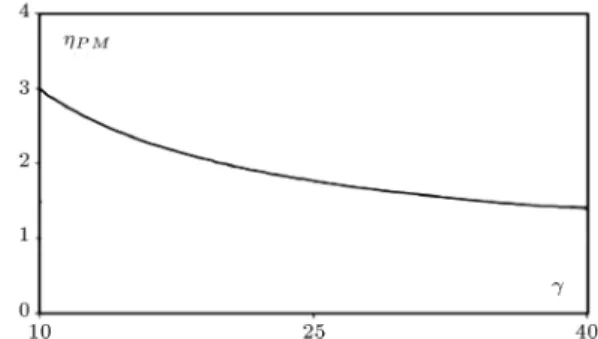
2. To nd equivalent dynamic pressure for triangular bucket, maximum hydrodynamic pressure of the circular bucket is multiplied by parameter pm(the
ratio of maximum pressure of the triangular to circular bucket) [4]. Value of pm for the largest
chute spillway of Karoon III, as it is indicated in Figure 3, is equal to 1.75. Using this coecient, the maximum dynamic pressure head for a triangular bucket becomes 56.55 m.
4. The objective functions denition
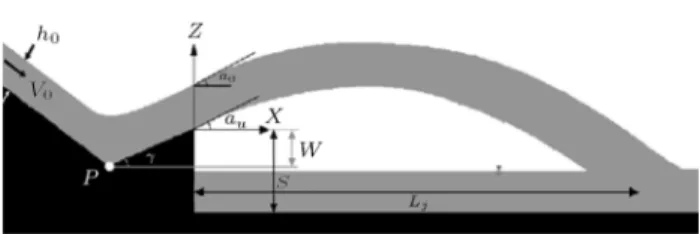
Figure 4 shows the sketch of experimental set up performed at Water Research Centre [16] in which is the deector angle, w is the bucket height, s is the distance from the edge of bucket to the bottom of tail water channel, V0 is the approach ow velocity, h0 is
Figure 4. Schematic view of ski jump ow over a triangular ip-bucket.
upper jet takeo angles. Also, the elevation dierence (s w) between the approach ow and the tail water is constant.
In this research, a multi-objective optimization algorithm (NSGA-II) of Deb et al. [10] is used.
Here, two independent objective functions are used for designing chute spillway width and angle of triangular bucket. The rst function, f1, consists of
scour depth, dynamic pressure head over bucket and jet length, while the second function, f2, is related
to construction volume of chute spillway. Objective function, f1, is dened as follows:
f1= whhp=hpmax+ wzze=zemax wllj=ljmax: (2)
Here, f1 represents the objective function, hp
rep-resents the maximum dynamic pressure head on the bucket, ze represents scour depth, and lj represents the jet length. Subsequently, these parameters have been dened. Other parameters including wh, wz, and wl
are related to the maximum dynamic pressure weight, scour depth weight, and jet length weight, respectively. Hojjati [7] proposed three equations as the out-come of study on 81 test cases:
I. Maximum dynamic pressure head equation on the bucket:
hp h0 = c:Fr
a:(tan())b: (3)
where Fr is the Froude number of chute spillway at start point and a, b, c are obtained by Eqs. (4), (5), and (6), respectively:
a = 59:5 h0 L 2 + 13:43 h0 L
+ 1:01; (4)
b = 12:22 h0 L 2 + 3:17 h0 L
+ 0:27; (5)
c = 351:03 h0 L 2 + 99:45 h0 L
+ 10:87: (6)
Eq. (3) shows that when Froude number, the inlet ow depth, and bucket angle increase, the maxi-mum dynamic pressure on the bucket increases (as these parameters increase, the velocity gradient along the bucket becomes larger).
II. Jet length: lj h0 = d:Fr
e: (tan())f; (7)
where lj is jet length, d, e, and f are presented by Eqs. (8), (9), and Eq. (10), respectively:
d = 67:46 h0 L 2 14:72 h0 L
+ 1:07; (8)
e = 2:14
h0
L
+ 0:52; (9)
f = 744:5 h0 L 2 + 52:81 h0 L
+ 16:75: (10) According to the equation V0 = Fr:pgh0 (V0 is
upstream velocity and g is acceleration due to gravity), with increase in Fr or h0, the velocity
of ow, and consequently the jet length would increase. Also, it is obvious for jet length to be independent of bucket height, because height variation just changes bucket length whose eect on energy dissipation is negligible.
III. Scour depth:
For estimation of scour depth and geometry, many empirical equations have been proposed from which Sen's [17] equation was used. The aforementioned formula was developed after ex-amining several ip bucket prototypes in India and Russia. The equation in Metric system is presented as [17]:
ze = 0:9
q2
g 1
3
H14
T
1; (11)
where ze represents nal scour depth, represents jet impact angle, HT represents downstream head,
q represents discharge per unit width, and 1 is
angle of jet impact at upstream side (Figure 5). These parameters belong to circular buckets; therefore, they are modied by Hojjati [7] for triangular buckets according to the following steps:
1. The jet impact angle at downstream () is calcu-lated by:
= 0:586:Fr 0:308:
s + w h0
0:4
: (tan()) 0:774: (12)
Figure 6. Calculation of 1 using Jet takeo angle [17].
Table 1. Limitation of the present study.
h0
L (degree) Fr wL
0.385-0.1155 0-30 1.14-3.14 0.0288-0.0692
According to this equation, jet impact angle is a function of bucket geometry and upstream hy-draulic conditions.
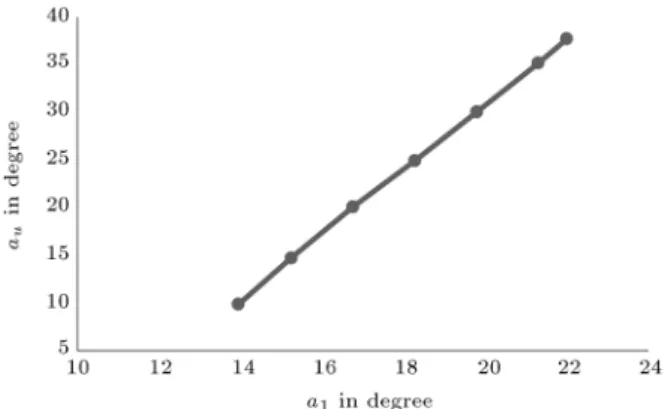
2. As it is shown in Figure 6, calculation of 1requires
u to be available. The latter variable can be
yielded from Eq. (13). The equation for achieving lower jet trajectory angle is calculated by:
u= 47:106: (tan())0:856: (13)
Note that in Table 1, the limitations of the present study are listed as dimensionless parameters.hpmax,
ljmax and zemax are the maximum values of hp, ze
and lj in Eqs. (3), (7), and (11), respectively. To calculate hpmax, ljmax, zemax due to complicated
equations of hp, lj and ze, a single objective optimization method is applied by adopting Ge-netic Algorithm approach. Parameters of GeGe-netic Algorithm are determined as: initial population = 20 chromosomes, crossover probability = 0.9, number of genetic algorithm generations = 100. At last, hpmax, ljmax, and zemax are obtained as
65,143.9, and 28.8 meters, respectively. Note that the values of q and Htin Eq. (11) are implemented
by considering spillway dimensions of Karoon III dam.
The second function, f2, is related to
normal-ized volume of construction materials of chute spill-way. In the second objective function, this volume has been implemented and this parameter directly aects cost of spillway construction. This function is calibrated as a division of construction volume of chute spillway (V ) by construction volume of chute spillway of Karoon III (Vk):
V =
L+ w sin
(((k+h0+f):2t) + (b:k)) ; (14)
Figure 7. Cross section of spillway and bucket.
f2= V=Vk; (15)
where L = 117 m and other parameters (Figure 7) are as follows: t = 1:8 m, k = 9 m, B = 15 m (chute width), and f = 0:1 h0. Vk is obtained as 27549 m3
(with h0= 13:38 m, w = 4 m, and = 30).
5. Results and discussion
After sensitivity analysis, parameters of NSGA-II are determined as: initial population = 20 chromosomes. This value is obtained through trial and error. It is the minimum initial population by which the most optimal answer can be attained. It means that if the initial population is increased, program application will take more time, but the optimal result will not change. Also, crossover probability = 0.9, SBX index in NSGA-II algorithm = 0.5, number of genetic algorithm generations = 150. According to Table 2, ve states have been considered for analyzing the data.
According to Table 2, ve dierent states have been taken into consideration for analyzing the ob-tained data.
Table 3 shows the results of state no. 1 (consider-ing equal weights for parameters of objective function f1). In this table, the least value of the second
objective function (f2) is estimated as 0.93. It means
that by using NSGA-II algorithms in spillway design, material volume can be reduced by 7%. The amount of dynamic pressure and scour depth in this state is
Table 2. Dierent investigated states. Satate
no: wz wh wl Fr
Q (m3/s)
1 0.333 0.333 0.333 2.2 4917
2 0.1 0.1 0.8 2.2 4917
3 0.1 0.8 0.1 2.2 4917
4 0.8 0.1 0.1 2.2 4917
Table 3. Results of optimizing by genetic method for state no. 1.
f2
(degree) h0
(m) V0
(m/s) B (m)
hp (m)
lj (m)
ze (m) 0.93 30 13.35 25.18 14.63 63.88 131.2 25.29 1.06 30 11.13 22.99 19.22 51.9 143.61 22.66 0.6 30 10.18 21.99 21.97 49.19 142.44 21.47 1.2 30 9.36 21.08 24.92 47.63 139.41 20.43 1.32 30 8.74 20.37 27.62 46.76 136.05 19.61 1.41 30 8.25 19.79 30.11 46.22 132.85 18.94 1.5 30 7.78 19.22 32.88 45.76 129.27 18.28 1.59 30 7.41 18.76 35.38 45.45 126.26 17.76 1.69 30 7.03 18.27 38.28 45.12 122.86 17.2 Table 4. Comparison of model and optimization results of Karoon III spillway.
h0
(m) V0
(m/s) hp (m)
(degree)
B (m)
Hydraulic model 13.38 24.5 56.55 30 15
Design by genetic algorithm 13.35 25.17 63.88 30 14.63 Dierence with current spillway 0.2% 2.7% 12% 0% 2.5%
close to maximum values for Fr = 2:2 which does not sound satisfactory. The jet length is only 9% less than its maximum value. The table shows that increasing the materials volume (increasing the cost) will improve parameters of the rst objective function (f1). Evaluation of the bucket angle demonstrates that
with equal weighting coecients, the optimum angle of bucket becomes 30 degrees. The reason behind the invariable angle, despite variable cost and approach depth, comes from the eect of dynamic pressure. Keeping weighting coecients constant reduces the pressure head by 45 m. This amount can be satised with 30 degrees bucket angle. However, the least pressure head occurs at Fr = 2:2 which is 36 m (the value has been obtained through minimizing the objective function, hp, by NSGA-II algorithm). Table 3 indicates reduction of scour depth and pressure on the bucket due to an increase in spillway depth. This increase is restricted because of its eect on increasing f2 and decreasing jet length, so a proper width will be
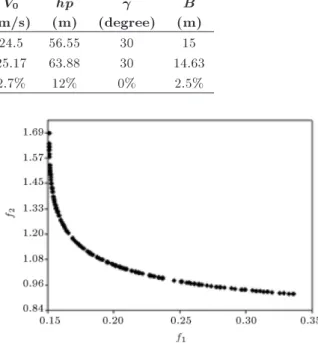
chosen on the basis of project's nancial condition. Figure 8 shows the curve corresponding to inter-action of functions f1and f2for state no. 1 in Table 2.
According to this gure, equal weights in the objective function (f1) can produce maximum value of 1.69 for
the second objective function (f2).
In order to validate the design method, the results of state no. 1 have been compared to design character-istics of Karoon III dam. Results presented in the rst row of Table 3 are very similar to the design parameters of Karoon III spillway. This row indicates that spillway design using NSGA-II algorithms reduces the volume of materials by seven percent (f2= 0:93). The results of
Figure 8. Optimized outcomes of NSGA-II algorithm.
this row are compared with the design characteristics of this spillway in Table 4. This table shows small and reasonable dierence between design parameters of NSGA-II approach and a real case (less than 12%). The largest discrepancy is seen in pressure parameter which should be due to the process of transforming the circular bucket dimensions to triangular one with the use of empirical equations (for example, using pm
for computing the dynamic pressure of triangular ip bucket).
According to Table 5, with increasing wL, while
the eective parameter in objective function is Lj
(state no. 2), the jet length ranges from 130.8 to 143.3 meters (the maximum jet length for Fr = 2:2 is 143.9 m). Assessing the rst and fourth rows of this table indicates that the rise of the second objective function by 14% leads the jet length to increase by 10%, whereas the pressure and scour depth go down
Table 5. Results of optimization by genetic method for state no. 2.
f2
(degree) h0
(m) V0
(m/s) B (m)
hp (m)
lj (m)
ze (m) 0.92 30 13.38 25.20 14.58 64.18 130.82 25.31 0.97 30 12.26 24.13 16.62 57.91 139.4 24.25 1.01 30 11.74 23.61 17.74 54.26 142.68 23.39 1.06 30 11.1 22.96 19.30 51.81 143.62 22.63 1.1 30 10.59 22.42 20.71 50.23 143.31 21.99 Table 6. Results of optimization by genetic method for state no. 3.
f2
(degree) h0
(m) V0
(m/s) B (m)
hp (m)
lj (m)
ze (m) 0.92 29 13.41 25.23 14.53 64.27 129.95 25.51 1.46 17.44 8.3 19.85 29.84 44.03 109.46 21.73 1.86 10.42 7.1 18.36 37.72 40.5 82.63 19.86 2.2 8.27 6.36 17.38 44.49 38.39 69.87 18.91 2.65 8 5.53 16.20 54.87 36.61 61.72 17.48 3.1 8 4.92 15.28 65.39 35.12 56.13 16.31 3.5 8 4.5 14.62 74.75 33.18 52.12 15.46 Table 7. Results of optimization by genetic method for state no. 4.
f2
(degree) h0
(m) V0
(m/s) B (m)
hp (m)
lj (m)
ze (m) 0.92 30 13.34 25.17 14.65 63.87 131.31 25.27 0.97 30 12.49 24.35 16.17 58.07 139.22 24.28 1.76 30 6.79 17.96 40.33 44.91 120.61 16.85 2.21 30 5.56 16.25 54.43 43.65 108.36 15.09 2.64 30 4.94 15.32 64.99 42.42 99.43 13.92 2.91 30 4.59 14.76 72.56 41.64 94.75 13.33
by 10% which seems to be not cost-eective. Based on the results of this table, by considering the second state for weight of objective function, f1, the bucket
and spillway design becomes more satisfactory. In this state, due to small weight for pressure parameter, the bucket angle becomes 30 degrees again.
A closer look at Table 6 (state no. 3) demonstrates the fact that by increasing wh, as the main parameter
in the objective function, hp, the pressure head ranges from 64.2 to 33.9 meters (minimum dynamic pressure head for Fr = 2:2 is 33.9 m). The results of this table show that getting a pressure head less than 45 meter requires the bucket angle to be smaller than 30 degrees. It can also be noticed from the results of Section 3 (in this section, the reduction of bucket angle and approach ow depth caused the dynamic pressure on bucket drop down) that if minimizing the pressure parameter is desired, depth of the angle and inlet ow will become less than their values in state no. 2, and this makes the spillway become remarkably wide.
Additional information that can be deduced from
Table 6 includes conditions of a state with pressure head below 40.5 m in which the spillway width exceeds 34.2 m. It indicates that in such conditions, wider spillway is needed to be designed which is not economic. However, reduction of scour depth (due to reduction of bucket angel and ow velocity) is frugal. As a result of decline in velocity and pressure of the ow, the bucket maintenance costs would go down (velocity decline reduces the risk of cavitation and consequent damages). One should notice that by reducing the bucket angle and the ow depth, the jet length becomes shorter. It is not appropriate and should be taken into consideration in process of the design.
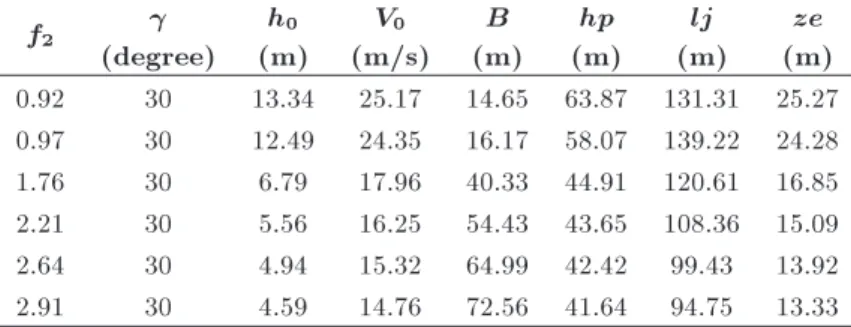
Table 7 illustrates that if the eective parameter, wz, in the rst objective function, ze, rises (state no.
4), the scour depth will change from 25.2 to 13.33 m. The table shows that in order to have a shallow scour hole, a wide spillway is needed which is not a cost-eective solution. In this state, the low weight for pressure parameter results in bucket angle of 30 degrees for dierent cases. This set up presents a 36.5 m wide
Table 8. Results of optimization by genetic method for state no. 5.
f2
(degree) h0
(m) V0
(m/s) B (m)
hp (m)
lj (m)
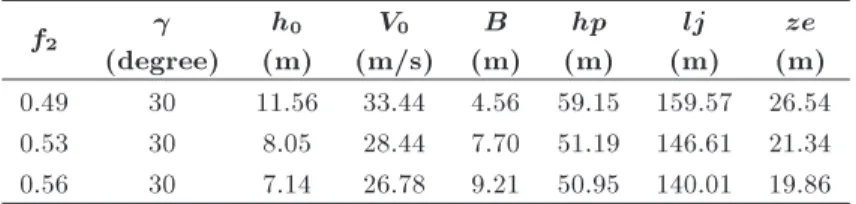
ze (m) 0.49 30 11.56 33.44 4.56 59.15 159.57 26.54 0.53 30 8.05 28.44 7.70 51.19 146.61 21.34 0.56 30 7.14 26.78 9.21 50.95 140.01 19.86
spillway and scours depths of less than 16.85 m which is not a cost-eective design.
Table 8 contains design values for a spillway with weighting coecients of state no. 5: Q = 1762 m3/sec,
Fr = 3:2, and w = 4 m. By using single objective optimization method, the values of hpmax, ljmax, and
zemax become 73.8, 162, and 33.3 meters, respectively.
The cost (construction volume of chute spillway) and width of chute spillway are expected to decrease the designed discharge which is reduced by 70%. Also, due to constant weighting coecients, the bucket angle changes according to state no. 1.
6. Conclusions
In this paper, a NSGA-II algorithm, which solves multi-objective problems, is utilized in optimal design of the width of a chute spillway and angle of a triangular ip bucket. A design method is introduced which performs a two-objective optimization through dening two separate objective functions. For validation process, results of objective function, f1, with equal weighting
coecients are compared with design conditions of Ka-roon III dam. Investigation of equally chosen weighted parameters in objective function, f1, shows that the
optimum bucket angle obtained by NSGA-II algorithm is equal to 30 degrees for dierent costs and inlet ow depths. The dierences are less than 12% which go to the pressure parameter. According to the investigation results, giving more weight to the jet length parameter in objective function will make the design of the bucket and spillway more suitable. If the pressure head is considered as the most eective parameter in the rst objective function, it is not a cost-eective approach; however, the reduction in scour depth brings about a positive nancial outcome. Moreover, this decline in velocity and pressure causes the maintenance cost to decrease. Finally, if the most eective parameter in objective function, f1, is considered to be the scour
depth, it is observed that to have a shallower scour depth, a wider spillway is needed which is not cost-eective.
Acknowledgment
The authors thank Dr. Jafar Yazdi for assistance with Optimization part that greatly improved the manuscript.
Nomenclature
Deector angle W Bucket height B Chute spillway width
S Distance from the edge of bucket to the bottom of tail water channel V0 Approach ow velocity
h0 Approach ow depth
a0 Upper jet takeo angles
au Lower jet takeo angles
f1 and f2 Objective functions
wh Maximum dynamic pressure weight
wz Scour depth weight
wl Jet length weight
hp Maximum dynamic pressure head ze Scour depth
lj Jet length
hpmax Maximum value of maximum dynamic
pressure head in Eq. (3)
zemax Maximum value of scour depth in
Eq. (11)
ljmax Maximum value of jet length in Eq. (7)
Fr Froude number Jet impact angle HT Downstream head
Q Discharge per unit width
1 Angle of jet impact at upstream side
G Acceleration due to gravity L Chute length
R Radius of circular bucket Angle of circular bucket Q Discharge
V Construction volume of chute spillway Vk Construction volume of chute spillway
of Karoon III References
1. Vischer, D.L. and Hager, W.H. \Energy dissipators", IAHR Hydr. Struct. Des. Manual 9, Balkema, Rotter-dam, the Netherlands (1995).
2. Juon, R. and Hager, W.H. \Flip bucket with-out and with deectors", Journal of Hydraulic Engineering, 126(11), pp. 837-845, (2000). DOI: 10.1061/(ASCE)0733-9429(2000)126:11(837),
3. Heller, V., Hager, W.H. and Minor, H.-E. \Ski jump hydraulics", J. Hyd. Eng., 131(5), pp. 347-355 (2005). DOI: 10.1061/ (ASCE) 0733-9429(2005)131:5(347),
4. Steiner, R., Heller, V., Hager, W.H. and Minor, H.-E. \Deector ski jump hydraulics", Journal of Hy-draulic Engineering, 134(5), pp. 562-571 (2008). DOI: 10.1061/(ASCE)0733-9429(2008)134:5(562),
5. Pster, M. \Chuteaerators: Air transport due to inter-nal ow features (Schussrinnenbelufter: Lufttransport ausgelost durch interne bussstruktur)", Laboratory of Hydraulics, Hydrology and Glaciology (VAW), H.-E. Minor, Ed., ETH: Zurich (in German) (2008).
6. Pster, M. \Jet impact angle on chute downstream of aerator", Proc., 4th IAHR Int., Symp., on Hydraulic Structures, Porto, Portugal (2012).
7. Hojjati, S.H. \Numerical investigation of ow hy-draulics in triangular ip buckets", M.S. Thesis, Tar-biat Modares University, Tehran, Iran (2013).
8. Azamathulla, H.MD., Ghani, A.AB., Zakaria, N.A., Lai, S.H., Chang, C.K., Leow, C.S. and Abuhasan, Z. \Genetic programming to predict ski-jump bucket spill-way scour", Journal of Hydrodynamics, Ser. B, 20(4), pp. 477-484, (2008). DOI: 10.1016/S1001-6058(08)60083-9,
9. Srinivas, N. and Deb, K. \Multi-objective function optimization using non-dominated sorting genetic al-gorithms", Evolutionary Computation, 2(3), pp. 221-248 (1995).
10. Deb, K., Agrawal, S., Pratap, A. and Meyarivan, T. \A fast elitist non-dominated sorting genetic algorithm for multi-objective optimization: NSGA-II", Lecture Notes in Computer Science 1917/2000, pp. 849-858 (2000). DOI: 10.1007/3-540-45356-3 83,
11. Reddy, M.J. and Kumar, D.N. \Multi-objective dierential evolution with application to reservoir system optimization", Journal of Computing in Civil Engineering, 21(2), pp. 136-146 (2007). DOI: 10.1061/(ASCE)0887-3801(2007)21:2(136),
12. Zahraie, B. and Tavakolan, M. \Stochastic time-cost-resource utilization optimization using non-dominated sorting genetic algorithm and discrete fuzzy sets", Journal of Construction Engineering and Management, 135(11), pp. 1162-1171 (2009). DOI: 10.1061/(ASCE)CO.1943-7862.0000092,
13. Malekmohammadi, B., Zahraie, B. and Kerachian, R. \Ranking solutions of multi-objective reservoir opera-tion optimizaopera-tion models using multi-criteria decision
analysis", Expert Systems with Applications, 38(6), pp. 7851-7863 (2011).
14. Behzadian, K., Alimohammadnejad, M., Ardeshir, A., Jalilsani, F. and Vasheghani, H. \A novel approach for water quality management in water distribution systems by multi-objective booster chlorination", In-ternational Journal of Civil Engineering, 10(1), pp. 51-60 (2012).
15. Goldberg, D.E. \Genetic algorithms in search", Opti-mization and Machine Learning, ISBN: 0-201-15767-5 (1998).
16. Water. Res. Center. \Final report on: Hydraulic model study on Karoon III spillway" Rep. No. 198, Tehran, Iran (1996).
17. Sen, P. \Spillway scour and design of plunge pool", Water and Energy International, 41(1), pp. 51-68 (1984).
Biographies
Seyed Hami Hojjati received his BSc degree in Civil Engineering from Mazandaran University, Babol, Iran and his MS degree in Hydraulic Engineering from Tarbiat Modares University, Tehran, Iran. He is currently a PhD student of Hydraulic Engineering in Amirkabir University, Tehran, Iran. His research inter-ests include ow control structures, ow and sediment transport in rivers, energy dissipation structures, and soft computing.
Seyed Hani Hojjati received the BSc degree in Power Engineering from Mazandaran University, Babol, Iran, and the MSc degree in Communication Systems Engi-neering from Babol University of Technology, Babol, Iran. He is currently pursuing the PhD degree in Communications in the Babol University of Technol-ogy, Babol, Iran. His current research interests include sensor networks, soft computing, pattern recognition, and machine learning.
Seyed Ali Akbar Salehi Neyshabouri received his BSc degree in Structural Engineering from Sharif University, Tehran, Iran, his MSc degree in Hydraulic Engineering from Newcastle University, Newcastle, UK, and his PhD Degree in Hydraulic Engineering from Liverpool University, Liverpool, UK. He is currently a Professor of Hydrualic Structures in Tarbiat Modares University, Tehran, Iran. His research interests include hydrodynamics, sediment transport, and computa-tional uid dynamic.