ISSN: 2252-8938, DOI: 10.11591/ijai.v9.i1.pp58-64 58
Iris segmentation using a new unsupervised neural approach
Hicham Ohmaid1, S. Eddarouich2, A. Bourouhou3, M. Timouyas4
1National School of Computer Science and Systems Analysis (ENSIAS), Mohammed V University, Rabat/10112,
Morocco.
2Regional Educational Center, Rabat/10112, Morocco
3,4Higher Normal School of Technical Education (ENSET), Mohammed V University, ENSET, Rabat/10112, Morocco
Article Info ABSTRACT
Article history: Received Jul 7, 2019 Revised Oct 18, 2019 Accepted Dec 3, 2019
A biometric system of identification and authentication provides automatic recognition of an individual based on certain unique features or characteristic possessed by an individual. Iris recognition is a biometric identification method that uses pattern recognition on the images of the iris. Owing to the unique epigenetic patterns of the iris, Iris recognition is considered as one of the most accurate methods in the field of biometric identification. One of the crucial steps in the iris recognition system is the iris segmentation because it significantly affects the accuracy of the feature extraction the iris. The segmentation algorithm proposed in this article starts with determining the regions of the eye using unsupervised neural approach, after the outline of the eye is found using the Canny edge, The Hough Transform is employed to determine the center and radius of the pupil and the iris.
Keywords: Biometric Hough transform Iris segmentation Mahalanobis distance
Unsupervised neural approach This is an open access article under the CC BY-SA license.
Corresponding Author: Hicham Ohmaid,
National School of Computer Science and Systems Analysis (ENSIAS), Mohammed V University,
Rabat/10112, Morocco.
Email: [email protected]
1. INTRODUCTION
Nowadays, biometric recognition has become a reliable way for the identification and recognition of individuals, based on physiological or behavioral characteristics of these people. Conventional methods identity check like password and identification card are not always credible because these methods can be forgotten or stolen. The identification based on biometrics has been used for security systems, such as authentication and information protection. The biometric technologies [1-4] utilize behavioral characteristics (such as handwriting) or physiological characteristics (such as fingerprint, face and iris) to accurately authenticate personal identity. Among these biometric technologies, iris recognition offers the highest accuracy in identifying individuals as compared to any other biometric approaches. The iris is the colored region of the eye bounded by the pupil and white sclera, it is so unique that no two irises are alike, even among identical twins or even between the left and right eye of the same person [5]. These visible characteristics are thought to be highly discriminatory and unique to each eye, as well as stable over an individual’s lifetime. This makes the iris a very useful biometric identifier when it is possible to capture iris images of reasonable quality.describe the step of research and used in the chapter "Results and Discussion" to support the analysis of the results [2]. If the manuscript was written really have high originality, which proposed a new method or algorithm, the additional chapter after the "Introduction" chapter and before the "Research Method" chapter can be added to explain briefly the theory and/or the proposed
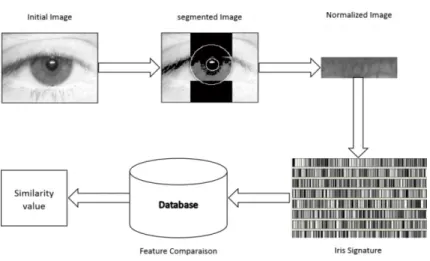
method/algorithm [4]. The system is inspired by Daugman works [5]. It is composed of a number of sub systems shown in Figure 1 that contains stages of iris detection system:
Figure 1. Iris detection system
The segmentation step allows you localize the iris region in an eye image, this consists of finding two contours of iris (pupil and iris), That is to say, locate the Internal contour (pupil/iris) and outer (iris/sclera). Once the iris region is segmented, the next stage is to normalize this part. The normalization Allows to transform the iris texture from Cartesian to polar coordinates, In order to limit the problems of variations in the eye (like the optical size of the iris, the position of a pupil in the iris), this step is based on Daugman's rubber-sheet model [5]. Feature extraction is a technique used to extract the information from the iris image, In order to lower the size of iris models and improve classifier accuracy. These features can not be used for reconstruction of images, but these values are used in classification. Finally, matching is performed by comparing the feature of template iris with the feature vectors of templates in the database and decision is formulated [6]. Figure 2 shows typical stages of iris recognition.
Figure 2. Typical stages of iris recognition
The main motivation in this research is to propose a new effective and robust algorithm to segment the clear or noisy iris images [7]. The proposed algorithm added a new pre-processing step using a new unsupervised neural approach to divide the iris image in two regions namely iris and eyelashes region, sclera and skin, in order to facilitate the determination of the iris contour in the phase Canny edge detection [6]. Unlike other iris segmentation algorithms, that process the whole image of the eye (which contains the non-iris regions that generate segmentation errors) such as Daugman algorithms [5].
2. IRIS SEGMENTATION
The segmentation stage is critical to the success of an iris recognition system since data that is falsely represented as iris pattern data will corrupt the biometric templates generated, resulting in poor recognition rates. The main motivation in this paper is to propose a robust iris segmentation algorithm able to process captured iris images non ideal environments conditions. In this section, we present a new iris segmentation approach used as a pre-processing step, based on neural competitive concepts. This approach is divided into four phases respectively called namely:
The Estimation of Underlying Probability Density Function,
Extraction of local maxima,
The modes detection,
The classification procedure.
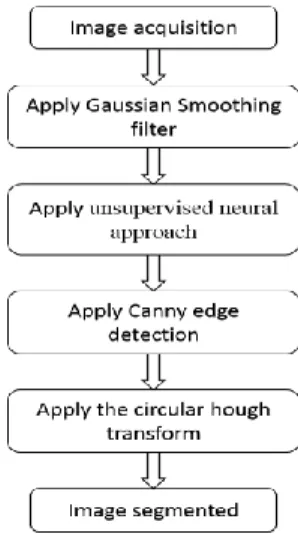
The segmentation approach allows partitioning the iris image in two regions namely iris and eyelashes region, sclera and skin. Then, the outline of the eye is found using the Canny edge, The Hough Transform is employed to determine the center and radius of the pupil and the iris. Figure 3 shows algorithm used for iris recognition.
Figure 3. Algorithm used for iris recognition
2.1. Iris segmentation using the unsupervised neural approach
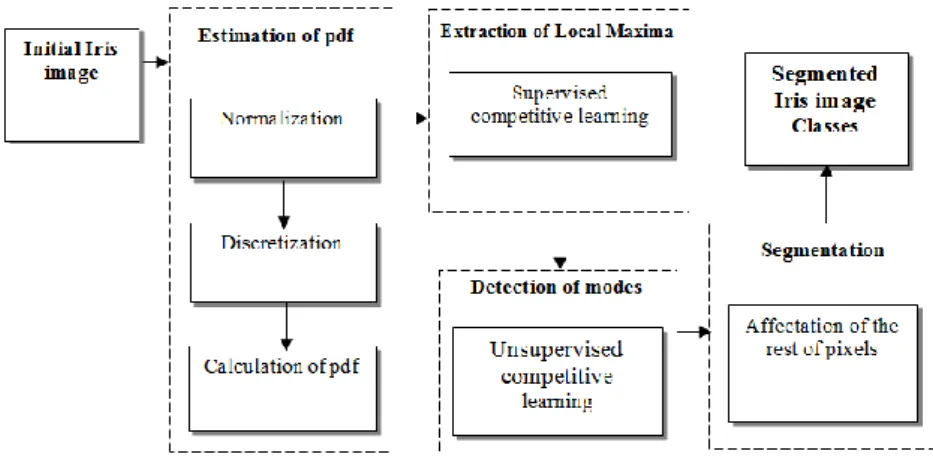
In an unsupervised context, that means when no prior information about the data sample, we involve the neural competitive clustering procedure to the Iris segmentation. The objective of these approaches to classifying the image pixels according to their distribution in the representation space and to assign them a label. It starts first, by the organization of the pixels of Iris image in an observation matrix (each row represents a pixel and each column represents an attribute) to estimate the underlying probability density function (pdf) of the pixels distribution using a non-parametric estimator. In the second step, the procedure uses an artificial neural network with competitive training (NNCT) to extract the local maxima of the pdf. Following a modes detection method using a technique to detect the existing interneural connection [8]. The last step is for affecting the remaining pixels to their classes.
2.1.1. The estimation of underlying probability density function
After constructing the observation matrix of an Iris image pixelsΓ = {𝑋1, 𝑋2, … , 𝑋𝑄}considering as a
set of Q N-dimensional observations (in this case N=3) With X𝑞= [𝑥𝑞,1, 𝑥𝑞,2, … , 𝑥𝑞,𝑛, … , 𝑥𝑞,𝑁], q=1,2,...,Q
and a probability density function P(X), anon-parametric method based on The Parzen [9] window using to estimate this underlying density function. The technique is a fast estimation algorithm that is proposed [10]. First, the range of variation of each component of these observations is normalized to the interval [0, R], where R is an integer such as 𝑅 ≥ 2, by means of the transformation defined as:
𝑦𝑛,𝑞=
(𝑥𝑛,𝑞−𝑚𝑖𝑛
𝑞 𝑥𝑛,𝑞)
(𝑚𝑎𝑥
𝑞 𝑥𝑛,𝑞−𝑚𝑖𝑛𝑞 𝑥𝑛,𝑞)
Each axis of the so normalized data space is then partitioned into R exclusive intervals of unit width. This discretization defines a set of 𝑅𝑁hypercube of unit side length. Each hypercube noted 𝐻(𝑋), is a site defined
by its N coordinates 𝑥1, 𝑥2, … , 𝑥𝑛, … , 𝑥𝑁 which are the integer parts of the coordinates of its centre X. To be
more specific, let 𝑌𝑞= [𝑦1,𝑞, 𝑦2,𝑞, … , 𝑦𝑛,𝑞, … , 𝑦𝑁,𝑞], q=1, 2, Q be the Q observations in the normalized space.
Each observation Yq is found inside a non-empty hypercube with the coordinates 𝑥𝑛= 𝑖𝑛𝑡(𝑦𝑛,𝑞), n=1, 2, N,
where 𝑖𝑛𝑡(𝑦𝑛,𝑞) designates the integer parts of 𝑦𝑛,𝑞. If several observations fall in the same hypercube, this
one appears many times on the list of non–empty hypercubes. Furthermore, the number of times the hypercube H(X) appears in that list indicates the number of data points q[H(X)] which falls in this hypercube. Subsequently, the value of the local density estimated is:
𝑝(𝑋) =𝑞[𝐻(𝑋)]
𝑄 (2)
Since the volume of H(X) is equal to unity. So, this fast procedure allows only the estimation of the underlying probability density function at the centers of the non-empty hypercube whose number never exceeds the number Q of available observations (pixels). At the centers of the hypercube cells, which are not on that list, the density estimates are known to be null. At the end of this fast algorithm, all the available information for clustering is in the discrete set 𝑋 of estimated values of the underlying probability density function 𝑃(𝑋). Figure 4 shows architecture of the segmentation procedure
Figure 4. Architecture of the segmentation procedure
2.1.2. The extraction of local maxima by neural network
Assimilating the modes to the local maxima of the pdf, the proposed approach uses the Neural Networks with Competitive Training (NNCT) [11]. In the training algorithm, we work only on the pdf by presenting sequentially, the centers of the non-empty hypercube of the set X to the network, instead of the Q observations. The neural network is composed of two layers: the input layer and the output layer. The first one is made of N units 𝐼𝑛, n=1,2,...,N, such that unit 𝐼𝑛 is solicited by the attribute XN of the non-empty
hypercube H(X) when this one is presented to the network. However, each output neuron materializes a hypercube which represents the site of one local maximum of the pdf in the set X, and presents its weight by the mean vector 𝜇𝑘(𝑋), k=1,2,…,K. The number of the output neuron is first initialized arbitrarily. During
the training phase, the output neurons enter into competition with each other by comparing the distance 𝐷[𝜇𝑘(𝑋) , 𝐻(𝑋)], k=1,2,…,K, between the input hypercube H(X) and each output neuron 𝜇𝑘(𝑋), the winner
is the closest one to the hypercube, then we compare the values of the pdf associated to the winner neuron 𝜇𝑔(𝑋) and to H(X). The distance measure used in this training algorithm is Mahalanobis distance that gives
the best results for the non-Gaussian distribution [12] instead of Euclidian distance as in the (NNCT). 2.1.3. Detection of significant modes of pdf
The aim of this phase is to connect each group of the closest modes in such a way that we get a map which preserves the shape and structure of the classes existing in the image, by an improved Competitive Hebbian Learning method (CHLim) [8] which allows eliminating the influence of the output neural number. To generate the induced Delaunay triangulation, the CHLim, given the K modes detected by CNN as
prototypes in RN, successively adds connections among them. The method does not change the weight of prototypes, but only generates topology according to these prototypes. For each mode H(𝑋𝑘), can be
connected to the two closest prototypes by an edge using Mahalanobis distance as a measure of resemblance instead of Euclidian distance, it works as an activation function for competition between neurons. This leads to the induced Delaunay triangulation, which is limited to those regions of the input space 𝑅𝑁.
2.1.4. Classification procedure
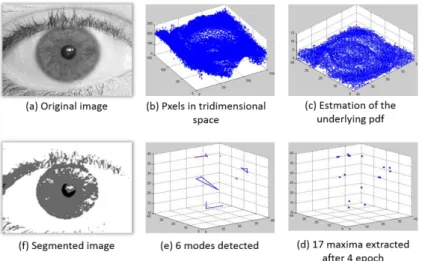
Once the different modes are identified, the classification method [13] that we use in the present work consists first, in defining the pixels falling into any mode of a connected set as the prototype of one cluster. Then, the remaining pixels, which do not fall in one of the detected modes, are assigned to the clusters attached to their nearest neighbor among these prototypes by means of Mahalanobis distance. Figure 5 shows illustration of the Iris segmentation procedure.
Figure 5. Illustration of the Iris segmentation procedure
2.2. Hough transform
Hough transform is a standard image analysis tool for finding curves that can be defined in a parametrical form such as lines, circles, parabolas, and hyperbolas [14]. The edge map is then used in a voting process to maximize the defined Hough transform for the desired contour. Considering the obtained edge points as (xj ; yj), j = 1; 2; ……, n, a Hough transform can be written as:
𝐻(𝑥𝑐, 𝑦𝑐, 𝑟) = ∑𝑛𝑗=1ℎ(𝑥𝑗, 𝑦𝑗, 𝑥𝑐, 𝑦𝑐, 𝑟) (3)
Where
ℎ(𝑥𝑗, 𝑦𝑗, 𝑥𝑐, 𝑦𝑐, 𝑟) = {1 𝑖𝑓 𝑔(𝑥𝑗, 𝑦𝑗, 𝑥𝑐, 𝑦𝑐, 𝑟) = 0
0 𝑜𝑡ℎ𝑒𝑟𝑤𝑖𝑠𝑒 (4)
The limbus and pupil are both modeled as circles and the parametric function g is defined as:
𝑔(𝑥𝑗, 𝑦𝑗, 𝑥𝑐, 𝑦𝑐, 𝑟) = (𝑥𝑗− 𝑥𝑐)2+ (𝑦𝑗− 𝑥𝑐)2− 𝑟2 (5)
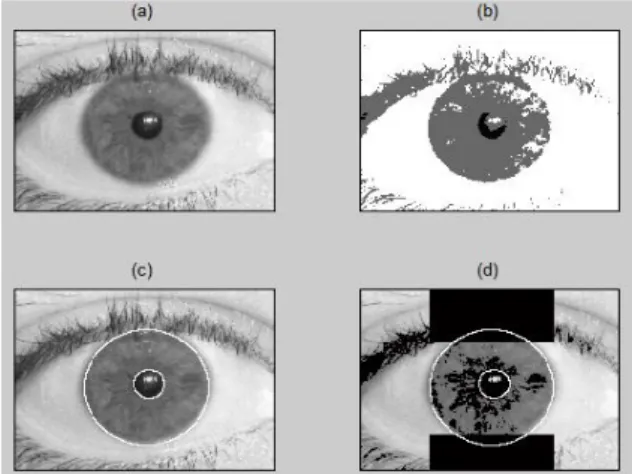
Assuming a circle with the center (xc; yc) and radius r, the edge points that are located over the circle result in a zero value of the function. The value of g is then transformed to 1 by the h function, which represents the local pattern of the contour. The local patterns are then used in a voting procedure using the Hough transform, H, in order to locate the proper pupil and limbus boundaries. In order to detect limbus, only vertical edge information is used. The upper and lower parts, which have the horizontal edge information, are usually covered by the two eyelids. The horizontal edge information is used for detecting the upper and lower eyelids, which are modeled as parabolic arcs [6-14]. Figure 6 shows examples of the segmented iris.
Figure 6. Examples of the segmented iris, (a) Real images, (b) Detection of iris regions, (c) segmented images from UBIRIS, (d) Noise detection and removal using linear Hough transform
3. RESULTS
The first stage of iris recognition is to isolate the actual iris region in a digital eye image. The iris region can be approximated by two circles, one for the iris/sclera boundary and another, interior to the first, for the iris/pupil boundary. The eyelids and eyelashes normally occlude the upper and lower parts of the iris region. The successes of segmentation depend on the imaging quality of eye images. The database of the eye images for this project has been taken from the UBIRIS database to evaluate the effectiveness of the proposed method. in order to make the circle detection step more accurate and efficient, The proposed algorithm starts with determining the regions of the eye using unsupervised neural approach, the Hough transform for the iris/sclera boundary was performed, then the Hough transform for the iris/pupil boundary was performed within the iris region, instead of the whole eye region, since the pupil is always within the iris region. After this process was complete, six parameters are stored, the radius and x and y center coordinates for both circles. Eyelids were isolated by first fitting a line to the upper and lower eyelid using the linear Hough transform. A second horizontal line is then drawn, which intersects with the first line at the iris edge that is closest to the pupil. This process is done for both the top and bottom eyelids. The second horizontal line allows maximum isolation of eyelid regions. Figure 7 shows examples of correct segmented irises.
Figure 7. Examples of correct segmented irises
UBIRIS iris database is used to evaluate the proposed segmentation algorithm. This database is composed of 1210 mages collected from 242 eyes. Table 1 presents a comparison between the accuracy of the segmentation for the proposed algorithm and some previous algorithms [15].
Table 1. Comparison between the accuracy of proposed algorithm and some previous algorithms
Method Accuracy (%)
Daugman 95.22
Camus and Wildes 96.78
Martin-Roche Proposed
77.18 97.83
4. CONCLUSIONS
Iris patterns have been proven to be useful and accurate in recognition of the persons [6]. Automating the process requires robust implementation of the iris segmentation, normalization, and recognition phases. If one phase is lacking in accuracy or precision, the effectiveness of the system as a whole is decreased. The proposed algorithm of segmentation added a new pre-processing step to segmentation steps which is clustering the iris image using unsupervised neural approach. After, The Hough Transform is employed to determine the center and radius of the pupil and the iris. Finally, Eyelids (upper and lower) were isolated using the linear Hough transform. The algorithm of segmentation presented in this paper performs well on most iris images, the segmentation system fails when images have severe occlusion.
REFERENCES
[1] FANG, Bin et TANG, Yuan Yan. Improved class statistics estimation for sparse data problems in offline signature verification. IEEE Transactions on Systems, Man, and Cybernetics, Part C (Applications and Reviews), 2005, vol. 35, no 3, p. 276-286.
[2] GAO, Xinbo, ZHONG, Juanjuan, LI, Jie, et al. Face sketch synthesis algorithm based on E-HMM and selective ensemble. IEEE Transactions on Circuits and Systems for Video Technology, 2008, vol. 18, no 4, p. 487-496. [3] YU, Li, ZHANG, David, et WANG, Kuanquan. The relative distance of key point based iris recognition. Pattern
Recognition, 2007, vol. 40, no 2, p. 423-430.
[4] ZHANG, Taiping, FANG, Bin, LIU, Weining, et al. Total variation norm-based nonnegative matrix factorization for identifying discriminant representation of image patterns. Neurocomputing, 2008, vol. 71, no 10, p. 1824-1831. [5] DAUGMAN, J. Biometric personal identification system based on iris analysis, United States Patent, US 5291560.
1994.
[6] MASEK, Libor, et al. Recognition of human iris patterns for biometric identification. 2003.
[7] SAHMOUD, Shaaban A. et ABUHAIBA, Ibrahim S. Efficient iris segmentation method in unconstrained environments. Pattern Recognition, 2013, vol. 46, no 12, p. 3174-3185.
[8] Timouyas M., Eddarouich S. and Hammouch A. (2017). “Mode region detection using improved Competitive Hebbian Learning for unsupervised clustering”, Engineering Science and Technology: An International Journal (ESTIJ), ISSN: 2250-3498 Vol.7, No.4, pp. 26-35.
[9] Parzen, E. (1962) ‘An Estimation of a Probability Density Function and Mode’, Ann. Math. Stat., vol. 33, pp.1065-1076.
[10] Postaire, J.-G., & Vasseur, C. P. A. (1982) ‘A fast Algorithm for non Parametric Probability Density Estimation’,
IEEE, Trans. on Pattern Anal. and Machine Intel. PAMI-4, n°6, pp. 663-666.
[11] Eddarouich, S., & Sbihi, A. (2007) ‘Neural Network for Modes Detection in Pattern Classification’. ICTIS’07, Morocco, Fez, 3-5 pp. 300-303.
[12] Timouyas, M., Eddarouich, S., & Hammouch, A. (2012). A new approach of classification for non-Gaussian distribution upon competitive training, (ICCS’12), Agadir, Morocco, pp.1-6.
[13] Eddarouich, S., & Sbihi, A. (2002) ‘Détection des Modes par Approche Neuronale pour la Classification des Données d’un Mélange des Distributions Normales’, Proceeding of the 6th African Conference on Research in Computer Science (CARI’02), Yaoundé, Cameroon, pp. 61-68
[14] WILDES, Richard P. Iris recognition: an emerging biometric technology. Proceedings of the IEEE, 1997, vol. 85, no 9, p. 1348-1363.
[15] Hugo Proenca, Towards non-cooperative biometric iris recognition (PhD thesis), University of Beira Interior, October 2006.