Synthesis and Structural Characterization of Some Cobalt (II)
Complexes with a Mannich Base Derived From Morpholine and
Maleic Hydrazide
P.R.Santhi
1, G.Selvanathan
1, G.Poongothai
21Department of chemistry,A.V.C College(Autonomous),Mannampandal-609305, Tamil Nadu, (INDIA) 2Department of chemistry,Government Arts College for Men(Autonomous),Nandanam,Chennai-35,Tamil Nadu,
(INDIA)
INTRODUCTION
The Mannich reaction is a three component- condensation in which a new base produced is known as a Mannich base.The mannich reaction of maleichydrazide and related compounds are reported in the literature1.Maleichydrazide is a structural isomer of Uracil and it was found to be a potent inhibitor of leukemia2,its derivatives are used as novel bioactive agents3 and especially Mannich–N-bases were proved to be pharmacologically more active than maleichydrazide4,5.The present work the N-mannich base,Morpholino Methyl Maleic Hydrazide(MMMH) was synthesized by introducing morpholinomethyl moiety in place of active hydrogen atom attached to nitrogen of maleic hydrazide through mannich reaction.By using the ligand MMMH coloured complexes of cobalt(II) chloro,bromo and nitrato complexes have been prepared.The structure of newly synthesized mannich base is given in Fig:1.
EXPERIMENTAL
All the solvents used for the synthesing ligand and the complexes were of analar grade and used as such.The elemental analysis were performed using LECO-CHN600 Elemental Analyser and was calibrated using standard EDTA prier to the determination.The conductance data were obtained in 10-3m DMF solutions of the complexes at room temperature using Systronics Direct –Reading Digital conductivity Meter304 with a dip type conductivity cell.
The UV-VIS spectra11 were recorded using JASCO-UVIDEC-430B double beam spectrophotometer provided with the quartz cells.DRS for solid state complexes were recorded in MgCO3 medium using Hitachi UV-VIS-NIR
Spectrophotometer.IR spectral measurements were for free ligand and their metal complexes as KBr pellets using Perkin Elmer 1430 Ratio Recording Sectrophotometer.
Far IR were recorded on a polytech PE983 and Bruker IFS66v FT-IR Spectrometer in polyethylene support.Magnetic measurements of the complexes at room temperature were made by using a Guoy Magnetic Balance and the Guoy tube was calibrated using Mercury(II)tetrathiocyanatocobaltate(II).
The 1 H and 13C NMR of the ligand11were recorded on Bruker 400 Mhz Spectrometer.The mass spectral12 study of the ligand were carried out using Finningn MAT-8230 mass spectrometer.
2.1.Synthesis of Mannich base
An equimolar mixture of maleichydrazide(11.20g),formaldehyde(3.0g) and morpholine (8.7g) was dissolved in 400ml of ethanol and refluxed for about 5 hours. The formation of the product MMMH and the completion of the reaction was identified by the formation of a clear solution.The resulting solution was concentrated to 200ml by distillation under reduced pressure.The concentrate on cooling yielded a colourless solid and recrystallized from ethanol.(Yield:98% : m.p:2980C)
2.2. Synthesis of Metal complexes
The MMMH complexes of the Cobalt(II) chloride,bromide and nitrate were prepared by solvating the metal salt in ethanol and the ligand in ethanol.A hot solution of the ligand (MMMH) was added slowly with constant stirring to a hot solution of the metal salt(1:1mole ratio) when an insoluble complex was formed.This was then washed with hot
Abstract:
A new Mannich base N-(1-morpholinomethylmaleichydrazide) ,(MMMH) was synthesized through Mannich reaction and its Cobalt(II) chloro, bromo and nitrato complexes have been prepared. Their structures have been elucidated on the basis of analytical, elemental analyses, electrical conductivity, magnetic moment and spectral studies such as UV,IR,NMR and Mass spectra for elucidating the structure of ligand (MMMH),DRS,IR and Far IR for cobalt(II) coloured complexes. The complexes exhibit monomeric as well as polymeric structure.
ethanol to remove the unreacted metal and ligand.The precipitated complexes were filtered ,washed with ethanol and dried in vacuo.
RESULTS AND DISCUSSION
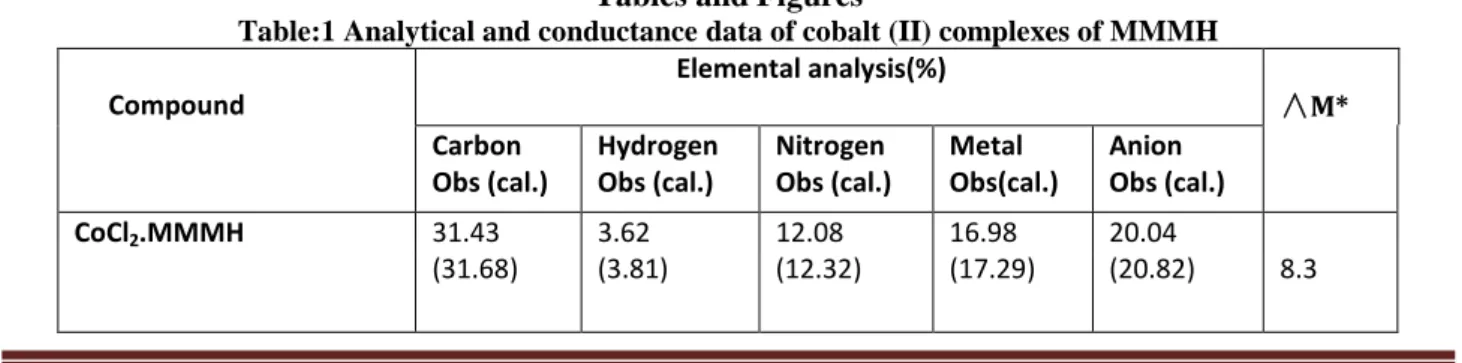
Analytical and conductance data of the complexes is given Table.1 which indicate the stoichiometry of the complex as MX2.MMMH.2H2O,where M = CoII and X= Cl,Br and NO3 except for chloro and bromo complex of cobalt(II).The
stoichiometry of the cobalt(II) chloro and bromo complexes are CoCl2.MMMH and CoBr2.MMMH.The molar
conductance values(∧M) exhibited that all the complexes are non-electrolytes6,12.
3.1.IR and Far IR Spectra7,8,11
The IR spectra of cobalt (II) chloro,bromo and Nitrato complexes complexes are given in Table.2.(Figures:2,3,4).The appearance of very broad band in the region 3040-3600 cm-1 for cobalt (II) nitrato complex indicate the presence of co-ordinated water molecules.The chloro and nitrato complexes experience negative shifts in δOH and νCNC when compared with those of free ligand frequencies.In cobalt (II) bromo complex the δOH and νC=O are lowered from 1711 to 1660 and 1612 to 1547 when compared to free ligand.Three new strong bands appear at 1270 (ν5),1201(ν1) and
1126(ν2)cm-1 in cobalt nitrato complex,which point to the unidatebehavior of nitrato group.
In far IR the absorptions around 382 and 327 are assigned to νCo-o and νCo-N respectively.The additional bands at 273 and 244 cm-1 for cobalt(II) chloro and bromo complexes are due to νCo-Cl and νCo-Br .The far IR cobalt complexes are shown in Figures-5,6.
3.2.Electronic absorption spectra9,10,12
The diffuse reflectance spectra of cobalt(II) chloro,bromo and nitrato complexes were recorded to cover the range of 200-2000nm.The absorption bands are listed in Table.3. and the ligand field parameters of cobalt (II) complexes are given in Table.4.
The cobalt(II) nitrato complex recorded three bands at 7513(ν1)cm-1,16694(ν2) and 19120(ν3) cm-1
respectively.The cobalt(II) nitrato complex has three spin allowed transitions are characteristic of octahedral environment around cobalt(II) ion.
The cobalt(II) chloro complex exhibits two absorption bands 8695 cm-1(ν2) and 14999(ν3) cm-1.They are
assigned (ν2) 4T1(F) ← 4
A2 , (ν3) 4T1(P) ← 4
A2 transitions respectively. These transitions are characteristic of cobalt ion
in a tetrahedral environment.For a cobalt (II) ion in a tetrahedral environment the (ν1) band is not usually observed as it
lies in the near IR region.
The cobalt (II) bromo complex also exhibits two bands 6939 and 16260 cm-1.The first band certainly cannot be assigned to ν1 transition because the resulting (Dq)Td will be too high for a Td geometry.Therefore,the possible
assignment is ν2,so that (Dq) Td=386cm-1.Taking the transition at 16260cm-1 as ν3,we arrive at B=775cm-1 since
Bo=971cm-1.We have β=0.79 and the percentage of β= 14.The ratio ν3/ν2 was determined using the Tanabe-Sugano
diagram to get the information regarding ν1 .The results of the calculation indicate that the transition energy for “ν1“
lies in the near IR region and cannot be easily located because of vibrational effects.
The magnetic moment value for the cobalt(II) nitrato complex point to a six coordinate geometry,whereas in the case of cobalt(II) chloro and bromo the μeff value supports a four coordinate geometry.On the basis of analytical and spectral data the MMMH complexes of CoII has been assigned tentatively the monomeric structures for CoCl2.MMMH, Co(NO3)2.MMMH.2H2O and polymeric structure for CoBr2.MMMH. The structures are shown in
Figs:7,8,9.
CONCLUSION
A new Mannich base N-(morpholinomethylmaleichydrazide) and its cobalt (II) chloro,bromo and nitrato complexes have been synthesized and characterized by analytical and spectral study.It is concluded from the study that the chloro and nitrato complexes are monomer and cobalt(II) bromo complex has a polymeric structure.
Tables and Figures
Table:1 Analytical and conductance data of cobalt (II) complexes of MMMH
Compound Elemental analysis(%) ∧M* Carbon Obs (cal.) Hydrogen Obs (cal.) Nitrogen Obs (cal.) Metal Obs(cal.) Anion Obs (cal.)
CoBr2.MMMH 25.19 (25.13) 2.36 (3.03) 9.15 (9.77) 14.05 (13.71) 36.94
(37.18) 6.7
Co(NO3)2.MMMH.2H2O 24.58 (25.12) 2.93 (3.02) 9.68 (9.77) 14.15 (13.71) -
(28.84) 9.0
Table:2 Important IR absorption bands(cm-1) of MMMH complexes of cobalt(II)
Compound ν OH ν CH ν CO δOH ν CNC
MMMH 3021 2956 1711 1612 1109
CoCl2.MMMH 3066 2959 1663 1550 1002
CoBr2.MMMH 3024 2958 1660 1547 1006
Co(NO3)2.MMMH.H2O 3680-3040 2960 1661 1547 1005
Table: 3.Colour,electronic spectral bands,transitionassignments,metal environment and magnetic moment values of cobalt(II) complexes of MMMH
Complex Colour (μeff)BM
Environment Absorption maxima(cm-1)
Transition assignment CoCl2.MMMH Blue
(4.15)
1O,2Cl,1N 8695 14999
4
T1(F)←4A2 4
T1(P)←4A2
CoBr2.MMMH Blue (4.05)
2O,Br 3855 6939 16260
4
T1(F)←4A2 4T
1(P)←4A2
Co(NO3)2.MMMH.2H2O Pink (5.38)
5O,1N 7513 16,694 19,120
4
T2g(F)←4T1g(F) 4
A2g(F)←4T1g(F) 4
T1g(P)←4T1g(F)
Table:4.Ligand field parameters of CoIIComplexes of MMMH
Parameter CoCl2.MMMH CoBr2.MMMH Co(NO3)2.MMMH.2H2O
ν3/ν2 1.725 2.343 1.145
ν2/ν1 1.800 1.800 2.222
ν3/ν1 3.105 4.218 2.545
ν3/B 24.428 20.98 21.60
B(cm-1) 614 775 885
Dq(cm-1) 483 386 939
Dq/B 0.786 0.49 1.06
Β 0.63 0.79 0.91
LFSEcal mol-1 16.56 13.23 32.19
MMMH-Morpholinomethylmaleichydrazide, Free ion value for CoII=971cm-1 , LFSE=12Dq; 1Kcal/mol=350cm-1
Fig:2 IR Spectrum of CoCl2.MMMH
Fig:3 IR Spectrum of CoBr2.MMMH
Fig:4 IR Spectrum of Co(NO3)2.MMMH.2H2O
Fig:6 Far IR Spectrum of Co(NO3)2.MMMH.2H2O
Fig:7,8 Monomeric structure of CoCl2.MMMH Co(NO3)2.MMMH.2H2O
REFERENCES
[1] Kamia et al., Natl.Inst.Hug.Scis.,Tokyo,Japan,Yakugaku Zasshi,1966,86,1099.
[2] Heinish and Gottreid. Synthesis and Pharmacological activity of Pyridazines.Acta Pharm.Hung.,1996,66(Suppl.),S9(Eng). [3] Strumillo,J.,.Synthesis of Mannich-N-baseswith potential Pharmacologicalaction.Acta
Pol.Pharm.,1975,32,282;Chem.Abstr.,1976,84,150580.
[4] Werner W and Frietzsche H.Potentielle Cytostatika durch Aminomethylierung NH-acider Hypnotika.Arch.Pharm.,1969,302,188-196.
[5] Dorgham C,Richard B,Richard M and Lenzi.Synthese de certains derives mono-et dialkyles de 1’acide cyanuique par reactions d’aminomethylation.,Bull.Soc.Chim.Fr.,1991,414-417.
[6] Govindharaju R,Balasubramanium S,Rajasekar K and Ramachandramoorthy T.Preparation,Spectroscopic characterization and Biological Activities of Co(II) and Ni(II) complexes with 2-Aminobenonitrile and Octanoate Ligands.Int. J.Pharma Research and Review,2014;3(10):8-13.
[7] Nakamoto K. Infrared Spectra of Inorganic and Coordination compounds,Wiley Interscience:New York;1970.
[8] Palanivelan L,Balasubramaniyan S, Rajasekar T and Ramachandramoorthy T.Preparation,Analytical and Spectral Characterization of Cr(III) complex with 2,4-Thiazolidinedione and Benzoate ion.Int.J.of Advances in Pharmacy,Biology and Chemistry,2015;4(2):439-442.
[9] Rai B.K, Vineeta Singh ,Puja Sinha ,Vidyarthi S.N, Shashi Bhushan Sahi, Ashok Pandey and Amit.Synthesis and characterization of Cobalt(II) ,Nickel(II) and Copper(II) complexes with Nitrogen-Oxygen donor ligand.Orient.J.Chem,2014,Vol.30(3):1411-1455.
[10] Pradeep Kumar.Synthesis and characterization of Co(II),Cu(II) and Fe(III) Macrocyclic complex.Int.J.of Multiplinary and Current research,2014;Vol.2.900-904.
[11] Dilek CANAKCI, OguzYunus SARIBIYIK and Selahattin SERIN. Synthesis Structural characterization of Co(II),Ni(II) and Cu(II) complexes of azo dye ligands derived from dihydroxynaphthalene.Int.J.of Scientific Research and Innovative Technology,2014;Vol.1.(2):52-72.