AENSI Journals
Australian Journal of Basic and Applied Sciences
ISSN:1991-8178Journal home page: www.ajbasweb.com
Corresponding Author: Marlisa Abdul Rahim, School of Management, Faculty of Economy & Business Management, Universiti Sultan Zainal Abidin, Gong Badak Campus, 21300 Kuala Terengganu, Malaysia.
Ph:+6019-3813887 E-mail:[email protected].
Developing a Model of Islamic Leadership Quality Using Multiple Case Studies for
Takaful Performance
1
Wan Norhayate Wan Daud, 2Marlisa Abdul Rahim, 3Fakhrul Anwar Zainol, 4Abdul Ghafar Ismail
1School of Finance and Banking, Faculty of Economy & Business Management, Universiti Sultan Zainal Abidin, Terengganu, Malaysia 2,3School of Management, Faculty of Economy & Business Management, Universiti Sultan Zainal Abidin, Terengganu, Malaysia 4Islamic Research and Training Institute, Islamic Development Bank, Jeddah, Saudi Arabia
A R T I C L E I N F O A B S T R A C T Article history:
Received 30 September 2014 Received in revised form 17 November 2014 Accepted 25 November 2014 Available online 13 December 2014
Keywords:
Quality, Islamic leadership, performance, multiple case studies, Takaful industry
Background: Successful organizations represent a key ingredient for nations around the globe. Although a substantial body of research has focused on the predictors of organizational performance, studies involving its predictors within the context of developing Muslim countries like Malaysia are rather limited. This paper intends to illustrate how Islamic leadership can enhance an organization’s goal accomplishment. Objective: The main objective of the study is to examine the effect of quality of Islamic leadership on organizational performance from Takaful business’ perspectives in Malaysia. Results: Findings from the study found that Islamic leadership qualities have positive effect with Takaful performance. Conclusion: The results further demonstrate that quality of Islamic leadership contribute to the higher performance of Takaful operators in Malaysia.
© 2014 AENSI Publisher All rights reserved. To Cite This Article: Wan Norhayate Wan Daud, Marlisa Abdul Rahim, Fakhrul Anwar Zainol, Abdul Ghafar Ismail. Developing a model of Islamic leadership quality using multiple case studies for Takaful performance. Aust. J. Basic & Appl. Sci., 8(24): 67-75, 2014
INTRODUCTION
Islamic insurance (Takaful) is increasingly being regarded as vital to enhance in the Islamic financial markets around the world. The global Takaful industry is bearing for better dynamism and growth within the expanded domestic and international edge of the Islamic financial system. In recent year, performance becomes a challenge for Takaful operators in Gulf Cooperation Council (GCC), Europe and South East Asian market. Higher competition, evolving regulations and shortage of Takaful human resource expertise are key contemporary business risks for Takaful performance (Ernst & Young, 2012). Thus, organizational performance becomes important agenda to industry players in the development of Takaful industry.
Organizational performance is the eventual relevant to researchers to do the management research. Study by Richard, Devinney, Yip, and Johnson (2009) reveals a multidimensional conceptualization of organizational performance. By referring to past scholars, there are two dimensions of organizational performance, which include financial and non-financial performance (Venkatraman & Ramanujam, 1986; Shen & Cannella, 2002; Behery & Paton, 2008; Ismail, Alhabshi & Bacha 2011). Both financial and non-financial performances are important in determining the success of organizations.
Financial performance is defined as the economic outcome, such as market share and profitability (Delaney & Huselid, 1996). Generally, financial performance measure in terms of profitability, return on sales, return on equity, return on investment and return on assets. Meanwhile, non-financial performance is defined as the effectiveness of behavior to enhance productivity in organization (Abbasi, 2008). He proposed that non-financial performance can be evaluated through customer satisfaction, internal business process, learning and growth. For the purpose of this study, organizational performance is refers to the non-financial performance and definition by Abbasi (2008) has been selected.
suffers in terms of financial or non-financial performance (Halim, 2012). In a recent research conducted by Ernst and Young (2012), shareholder’s returns on equity of conventional insurance companies are higher than the Takaful shareholder’s returns in Malaysia. The average return on equity for insurance companies and Takaful operators in Malaysia was 17% and 4% respectively. In terms of return on investment, Takaful operators showed lower investment returns than conventional insurance companies with a 12% of return on investment of insurance companies and an 8% of return on investment for Takaful operators. These figures showed that the financial performance of Takaful operators has not yet achieve optimum business volume compared to the conventional insurance companies in Malaysia. Given the rise in competition and the need for Takaful operators to achieve competitive advantage, a few studies have tried to investigate the relevant predecessors of Takaful performance such as individual factors (Saad et al., 2006; Saad, 2012; Yazid et al., 2012) and organizational structure (Rahman, 2009). However, there is still many unexplored research areas such as the quality of Islamic leadership that may influence organizational performance of Takaful operators.
Studies related to the quality of Islamic leadership and its relationship with organizational performance in the service industry such as Takaful in Malaysia context has been scarce (Mahadi, 2011). Thus, the objective of the current paper is to review the existing literature relating to the quality of Islamic leadership and performance of organizations within the Takaful industry in Malaysia. Therefore, this paper is organized as follows: first, a summary of the underlying theory; second, a review of the literature on organizational performance and quality of Islamic leadership is provided; third, discusses the methodology, fourth, presents the results and discussion and finally, the implications and conclusion of the paper.
Literature Review: Underlying Theory:
Islamic Leadership Theory founded by spiritual traits and practices (Aabed, 2005). There are five pillars of Islam; first, bearing witness that there is no God but Allah Subhanahu wa Ta'ala (SWT) and Muhammad Sallallahu Alayhi Wasallam (SAW) is His prophet, second, establishing the prayers, third, giving zakat, fourth, fasting during Ramadhan and fifth performing hajj. It sources of wisdom collectively structure the ethical and moral system that guides the leadership process from Islamic perspectives.
Islamic Leadership Theory is chosen as the underlying theory for the proposed model since it entails Islamic leaders and followers, spiritual variables, and leadership outcomes. Islamic leaders and followers should surrender to Allah (SWT), shariah compliance, and strive positively in terms of self-awareness, self-regulation, and self-development (Toor, 2008). The Islamic Leadership Theory suggests that the quality of Islamic leadership can positively influence the attitudes of followers and bring higher levels of satisfaction, motivation, performance, positive energy, and organizational loyalty (Aabed, 2005). It will also result in amplified fulfillment, commitment, and constructive energy on part of the leaders. However, in order to maintain Islamic leadership and organizational goal, it is advisable to get the support from stakeholders, followers, and at the same time fully comply with the Islamic teachings and principles.
Quality of Islamic Leadership and Organizational Performance Relationship:
Quality of Islamic leadership refer to attributes of effective leader in organizes, provides guidance and influences others to reach the goals and compete to be ahead of others to seek the pleasure of Allah and success in hereafter (Yunus, 2008). According to Majali (1990), the Islamic leadership qualities refer to ability of a leader to guide, influence and show the right way to others. In business point of view, Asaf (1987) suggested two categories of traits and qualities that Islamic leader must have. It consists of moral discipline and kindness in conversation. Furthermore, the traits of Islamic leader estimated to be essential for effective conduct in business consists of caring, experience and knowledge, exemplary behavior, justice, willingness to consult, persuasiveness through goodness and a trust in Allah (SWT) (Ali, 2009). Those Islamic leaders who demonstrate these qualities are assumed to show moderation, kindness, a willingness to consult and not to impose intentional damage on others, as well as a commitment to the development and growth of the organization.
Deris (2012) revealed that quality of Islamic leadership consist of four main attributes; truthfulness ( al-sidq), trust (amanah), knowledge (fathonah) and communication (tabligh). In addition, Deris also stressed that in order to achieve high organization performance, practical leadership qualities are important such as ability to help understand efficiently, ability to answer questions adequately, ability to acquire love and affection of the members, habit of making decisions after consultation, courage to encourage criticism, dynamic, serious and keen perception.
truthfulness (al-sidq), trust (amanah), knowledge (fathonah) and communication (tabligh) need to fulfill by the leaders in order to improve the organization performance (Lannai, Sudarma, Irianto & Ludigdo, 2014).
In addition, Dessler (2006) stated that the success of an organization depends greatly on the qualities of its leadership. In another study of Islamic leadership and performance by Majeed, Khalid and Khan (2011), it found that there is positive and significant relationship between Islamic leadership components (values or ethics and management by example) and organizational performance. It discovered that Islamic leadership practices exert a crucial influence of performance (Abbasi, 2008).
Methodology: Research Design:
Research design provides an overall structure and strategy of the research. The study used qualitative approach and it specific on case studies. Creswell (2005); Guba and Lincoln (1981) and Merriam (1988) explain that qualitative research approaches from a holistic perception with a centre of attention on discovery and understanding meaning with the assumption that meaning, or reality, is socially constructed and interpreted by individuals in interaction with their natural world and experiences.
The qualitative approach typically produces a wealth of rich information about small numbers of people and cases. This increases understanding of the cases and situation studied (Grix, 2004). Qualitative research design is employed in this study because of the researcher interested to gain holistic perspective regarding Islamic leadership qualities and Takaful performance with a focus on discovery and understanding meaning and interpreted by Islamic leaders in interaction with their natural world and experiences.
Case Study:
Consistent with common characteristics of case study research, this study adopts Yin’s (2003) definition of a case study as empirical inquiry that investigates a contemporary phenomenon within its real-life context when the boundaries between phenomenon and context are not clearly evident and in which multiple sources of evidence are used. These definitions used to guide through the implementation of the study. The phenomenon of Islamic leadership qualities and performance of the selected Takaful industry leaders examined through the perspective of literacy coaches within their real-life setting using multiple sources of evidence.
There are several types of case studies according to Yin (2003) and Winston (1997). These include exploratory, explanatory, and descriptive cases studies. This study used exploratory case study, which aims to define the research questions and to determine the feasibility of the research. Yin (2003) subdivides case studies into single or multiple studies with holistic or embedded unit of analysis. This combination produces 2 X 2 matrixes which Yin uses to suggest a fourfold typology. The resulting four types of designs for case studies are (Type 1) single-case – holistic designs, (Type 2) single case – embedded designs, (Type 3) multiple-case – holistic designs and (Type 4) multiple-case – embedded designs. With reference to Yin’s typology, the case study design of this research falls into (Type 3) multiple case and holistic designs. Multiple case study is stronger arguments for validity of study and the evidence often considered more convincing (Farquhar, 2012). Next, the population and sample of the study is determined and it followed by the development of case study protocol before the data collection begin.
Population and Sample:
The targeted populations were 11 Malaysian Takaful operators and they licensed by Bank Negara Malaysia. However, there are six Takaful operators that willing to participate in this study. It consist of (i) Great Eastern Takaful Berhad, (ii) AIA Public Takaful Berhad, (iii) Syarikat Takaful Malaysia Berhad, (iv) Takaful Ikhlas Berhad, (v) Prudential BSN Takaful Berhad, and (vi) Etiqa Takaful Berhad. In this study, the samples are likely to be chosen in a deliberate manner know as purposive sampling. The purpose for selecting the specific study unit is to have those that yield the most relevant and plentiful data (Yin, 2011). The participants of this study were the leaders (CEO and head of department) in Malaysian Takaful operators.
Case Study Protocol:
Case study protocol has been used in this study purposely to provide guideline to the researcher as the investigator in carrying the research. This protocol composes the standardized plan for the researcher to follow and accomplish the research objectives. Therefore, the reliability of the case study method across researcher and cases can be ensured by adhering to the case study protocol.
Data Collection:
or the storied experiences (Creswell, 2007). The data collected through six individuals, face-to-face and semi-structured interviews (Fontana & Frey, 1994).
The interviews conducted in the English language inside the leaders’ offices. In order to make the documentation of the data independent, the interviews session were recorded by using a tape recorder (Flick, 1998). Each interview session that has been conducted was less than one hour. The interview included of several questions adapted from Aabed (2005), Kasturi (2006), Willet (2009) and self-developed. These questions were open-ended. The interview that use open-ended questions aims at understanding participants on their own terms and how they make mean of their own lives, experience and cognitive processes (Brenner, 2006).
Data Analysis:
Content analysis has been chosen for the study in order to conduct the data analysis. Content analysis is a powerful empirical method for analyzing content or text and as a method that technical communicators can use on the research (Thayer, Evans, McBride, Queen & Spyridakis, 2007). It also can expose hidden connections among concepts, inform the decision-making processes associated with many communication practices and disclose relationships among ideas that initially seem unconnected.
Case study engaged a detailed description of the setting or individuals, followed by analysis of the data for themes or issues (Stake, 1995). The researcher starts with a general sorting of cases into specified class, called as open coding. In the context of case study, content analysis is accomplished with coding frames. Then, according to Strauss (1987), coding frame occurs after open coding is completed and consists of intensive coding around one category. The next level of analysis Merriam (1998) mentioned involves making inferences, developing models or generating theory. At this phase of analysis, the researcher needs to move back and fort between the details and a landscape view of concepts occurs, as described by Miles and Huberman (1994). The data from interviews analyzed using the Atlas.ti 7 software program. Atlas.ti 7 assists in the process of qualitative analyzing data collected through unstructured and semi-structured methods of data collection (Friese, 2013).
RESULTS AND DISCUSSION
Each case study has been designed to provide answer to the central research questions. The research questions analyze by examining the following issues:
1. What are the qualities of Islamic leadership in Malaysian Takaful industry?
2. What is the effect of Islamic leadership qualities on Takaful performance in Malaysia?
Profile of Participants:
From the data gathering, out of six participants in this study, 100% of the respondents were male. The age of respondents from the range between 30 to 40 years old representing 50% (3 respondents) of the respondents and the range between 41 to 50 years old also represents 50% (3 respondents) of the respondents. In terms of respondents’ ethnicity, it found that 83% (5 respondents) of the respondents are Malays and 17% (1 respondent) of the respondents is Indian. All of the six respondents’ religion is Islam (100% of the respondents). Most of the respondents’ job tenure in the industry was in between 20 to 25 years which representing 33% (2 respondents) of the respondents. It followed from the range of 1 to 5 years, 6 to 10 years, 11 to 15 years and 16 to 20 years which representing 17% (1 respondent) respectively. Most of the respondents’ job tenure in the current Takaful operators was in between 1 to 3 years which representing 50% (3 respondents) of the respondents. This followed from the range of 4 to 6 years which representing 33% (2 respondents) and 7 to 10 years representing 17% (1 respondent) of the respondents. Out of six respondents, 83% (5 respondents) possessed Bachelor degree and 17% (1 respondent) possessed Master degree. In term of major qualification, 33% (2 respondents) of the respondents majored in Islamic studies. The respondents that majored in Law, Physics, Project Management and Science Genetic represent 17% (1 respondent) of the respondents respectively. It was found that 33% (2 respondents) of the respondents were CEO of the Takaful operators and 67% (4 respondents) the head of department.
What are the qualities of Islamic leadership in Malaysian Takaful industry?:
Based on the results analysis, most of the leaders perceived that Islamic leadership quality is the qualities that based on Nabi Muhammad (SAW) attributes. The attributes consist of al-sidq, amanah, fathonah and tabligh. For example, Leader 1 believed that people who want to be a good leader should have Prophet Muhammad’s (SAW) attributes. Leader 1 stated:
I look at Nabi Muhammad attributes (truthfulness (al-sidq), trust (amanah), knowledge (fathonah) and communication (tabligh) as Islamic leadership qualities. He is a religious, fairness and leading by example. So, to me, the Islamic leadership quality is actually whatever quality you can follow Nabi Muhammad attributes.
Islamic leader, he or she also should have attributes like religious, fairness, convincing power and strong leadership charismatic to manage the organization in a good way. In this case, Leader 6 said:
Al-sidq, amanah, tabligh and fathonah are the basic aspect qualities needed by a leader. A leader must truth, honest, and good in communication. What leader says, it should understand by followers. A leader needs to show by example; it means the quality of leader that the follower can follow through what the leader doing. At the same time, if we talk about Islamic leadership, of course we need refer to Rasulullah (SAW). Because from that, we know, what it means by leadership that based on Islam. In addition, a leader should have convincing power and strong charisma.
According to the Leader 3, the different in Islamic and western leadership is based on aqidah. The process of Islamic leadership is according to shariah and it purposely to produce good akhlak. Leadership is about coach people and guide follower based on lead by example. Leader must have Islamic attributes, Islamic process and the goals. Furthermore, the leaders also perceived that Islamic leadership qualities are link with Islamic values. As a leader and businessman, he or she needs to have ethic, integrity, transparent, empathy, groovy, mutual assistant and openness in order to pursue other people join the Takaful business. In contrast, the leaders agreed that there are gaps in the Islamic leadership qualities of Takaful industry in Malaysia. Some of the leaders look at profit such as material. It is important for Islamic leaders get closer to Allah (SWT), but some of the Takaful companies are more focus on duniawi (world) only and ukhrawi (pertaining to the hereafter) still far from the target.
In order to close the gaps, Islamic leadership qualities play important role in adding inspiration to motivate followers and guide them through Islamic approach to achieve organizational goals. One interpretation of this finding is that, Takaful companies need to improve and practice more effective Islamic leadership qualities in order toachieve superior performance.
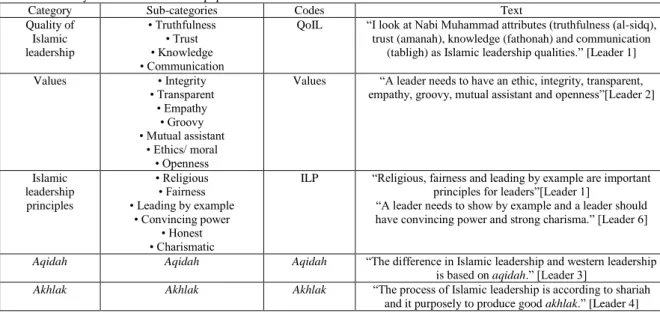
In summary (Table 1), the Islamic leadership qualities consist of truthfulness (al-sidq), trust (amanah), knowledge (fathonah) and communication (tabligh). The results revealed that Islamic leadership qualities supported by elements of aqidah, values, Islamic leadership principles and akhlak. Thus, the first research question of what are the qualities of Islamic leadership in Malaysian Takaful industry has been answered.
Table 1: Summary of the Islamic leadership qualities.
Category Sub-categories Codes Text
Quality of Islamic leadership
• Truthfulness • Trust • Knowledge • Communication
QoIL “I look at Nabi Muhammad attributes (truthfulness (al-sidq), trust (amanah), knowledge (fathonah) and communication
(tabligh) as Islamic leadership qualities.” [Leader 1]
Values • Integrity • Transparent
• Empathy • Groovy • Mutual assistant
• Ethics/ moral • Openness
Values “A leader needs to have an ethic, integrity, transparent, empathy, groovy, mutual assistant and openness”[Leader 2]
Islamic leadership principles
• Religious • Fairness • Leading by example
• Convincing power • Honest • Charismatic
ILP “Religious, fairness and leading by example are important principles for leaders”[Leader 1]
“A leader needs to show by example and a leader should have convincing power and strong charisma.” [Leader 6]
Aqidah Aqidah Aqidah “The difference in Islamic leadership and western leadership is based on aqidah.” [Leader 3]
Akhlak Akhlak Akhlak “The process of Islamic leadership is according to shariah and it purposely to produce good akhlak.” [Leader 4]
What is the effect of Islamic leadership qualities on Takaful performance in Malaysia?:
The leaders perceived that Takaful companies acts as trusteeship in managing participants’ funds. It is important to the companies to follow shariah and Islamic principles as foundation of sustainable the business and performance. Furthermore, the leaders perceived that organizational performances are draw closer from companies’ values such as integrity, transparency, empathy, groovy and mutual assistant. By having these attributes and practice, it shows that the organization take seriously regarding Islamic leadership qualities, Islamic principles and values that contribute toward the organizational performance.
From the data gathering, Islamic leadership qualities are supported by values in order to gain better performance. A leader with ordinary business personalities and positive values will catch the attention of more people to join the business. However, the Takaful companies need time to grow, expand and develop the leadership qualities in order to achieve higher performance. For example, Leader 2 explained:
The implementation of Islamic leadership qualities do exist in the Takaful companies. Leaders agreed that the current Islamic leadership practices in Takaful companies are developing and the leaders need to improve their leadership qualities in order to survive in the industry. Leader 5 said:
In terms of leadership qualities, the organization will identify individual strengths and weaknesses. Then, we build that strength, work for weaknesses, and put together in the development plan. So, that is how we improve leader knowledge through the development plan. There are several elements in the development plan. For example, we have external training, internal training and on-the-job training. Some people may cover specific job skills, some people may cover technical knowledge and others may cover soft skill. So, we look at the whole range of skills that employees should have in order to improve their work ability. We also have LDP (Leadership Development Program) to make sure that we give them a necessary skill to be effective in the next level.
In addition, the relationship between leaders and followers are satisfactory in the Takaful companies. In the organization, good and transparent communication between leaders and followers are important to achieve organizational goals.
Moreover, the leaders in the Takaful companies try to put effort on quality and give the best to all staff and stakeholders. The Takaful companies also encourage Islamic activities in order to close the gaps between leaders and followers. Leaders also perceived that a leader who has good qualities would drive the companies in good way and increase the Takaful performance in terms of customer satisfaction, internal business process, learning and growth, human capital talent, employees attitudes, employees satisfaction and market penetration. Leader 4 believed that by following the IQRA’ values, the leaders will contribute to the higher performance of organization. Leader 4 stated:
From the CEO, senior management and all staffs, they must be guided by shariah. In this organization, we have Ikhlas values that we took from Rasulullah’s (SAW) qualities. The core value is IQRA’, it means “I” stand for Ikhlas values, “Q” for quality mind set, “R” stand for result driven and “A” is attitude. In Ikhlas values, it covers all the Islamic leadership qualities (al-sidq, amanah, tabligh and fathonah). To me, quality of Islamic leadership is very important to the organizational performance because we believe on that way.
In summary, the results revealed that there is an effect between Islamic leadership qualities and organizational performance within Takaful industry in Malaysia. Hence, the second research question is answered. The model of Islamic leadership qualities and Takaful performance in Malaysia has shown in Figure 1.
Fig. 1: The model of Islamic leadership qualities and Takaful performance in Malaysia. Aqidah
Islamic Leadership Principles:
1. Religious
2. Fairness
3. Leading by
example
4. Convincing
power
5. Honest
6. Charismatic
Values:
1. Integrity
2. Transparent
3. Empathy
4. Groovy
5. Mutual
assistant
6. Ethics/
moral
7. Openness
Quality of Islamic Leadership:
1. Truthfulness
2. Trust
3. Knowledge
4. Communication
Akhlak
Organizational Performance:
Customer
satisfaction
Internal business
process
Learning and
growth
Human capital
talent
Employees
attitudes
Employees
satisfaction
Market
penetration
Theoretical implications:
This study sheds new light on Islamic leadership qualities and the organizational performance as an interrelated variable in Takaful industry. This study adds insight to and provides a deeper understanding of Islamic leadership qualities in developing countries through the exploration of Takaful performance in Malaysia.
Islamic Leadership Theory explained that Muslim leaders that have positive attributes and values, right aqidah and holding Islamic principles will lead to the successful of organization. The study extended the theory by examining the relationship between quality of Islamic leadership and organizational performance of Takaful industry in Malaysia.
Practical implications:
The results of this study revealed that Islamic leadership qualities are related with performance of the Takaful business in Malaysia. The results indicated the importance of having Islamic leadership qualities that consist of truthfulness (al-sidq), trust (amanah), knowledge (fathonah) and communication (tabligh) within the organization in order to achieve the organizational goals. Thus, Takaful operators should consider the implementation of Islamic leadership qualities elements in the organization. This is practical and appropriate approach as there is an empirical study that emphasized on the importance of Islamic leadership qualities and performance (Mahadi, 2011).
Conclusion:
The study examined the relationship between quality of Islamic leadership and organizational performance in Malaysian Takaful industry. Based on the six case studies, this study affirmed that Takaful operators in Malaysia moving towards a better performance. The result of this study signifies that Islamic leadership qualities have relationship with Takaful performance. Aqidah, Islamic leadership principles and values were important variables that support strong Islamic leadership qualities and purposely to produce good leaders’ akhlak. The adaption of Islamic leadership qualities were not only affected organizational performance, but also, it brought barakah to the organizations.
REFERENCES
Aabed, A., 2005. A study of Islamic Leadership Theory and practice in K-12 Islamic schools in Michigan. Unpublished Thesis, Brigham Young University.
Abbasi, A.S., 2008. Role of Islamic leadership in value based corporate management. Unpublished Thesis, National University of Modern Language, Islamabad.
Ali, A.J., 2009. Islamic perspectives on leadership: A model. International Journal of Islamic and Middle Eastern Finance and Management, 2(2): 160-180.
Bass, B.M. and R.E. Riggio, 2006. Transformational leadership (2nd ed.). Mahwah, NJ: Lawrence Erlbaum Associates Inc.
Beekun, R. and J. Badawi, 1999. The leadership process in Islam. Beltsville, MD: Amana Publications. Behery, M.H. and R.A. Paton, 2008. Performance appraisal-cultural fit: Organizational outcomes within the UAE. Education, Business and Society: Contemporary Middle Eastern Issues, 1(1): 34-49.
Brenner, M.E., 2006. Interviewing in educational research in Handbook of complementary methods in education research (pp. 357-370). Washington, DC: American Educational Research Association.
Corden, A. and R. Sainsbury, 2005. Verbatim quotations: Whose views count? Qualitative Researcher, 1: 4-6.
Creswell, J.W., 2007. Qualitative inquiry and research design: Choosing among five approaches (2nd ed.). Thousand Oaks, CA: Sage Publications.
Creswell, J.W., 2005. Educational research: Planning, conducting, and evaluating quantitative and qualitative research. Upper Saddle River, New Jersey: Pearson Education, Inc.
Delaney, J.T. and M.A. Huselid, 1996. The impact of human resource management practices on perceptions of organizational performance. The Academy of Management Journal, 39(4): 949-969.
Deris, S.M., 2012. Muhammad the intelligent prophet: Four mandatory attributes. Available: http://smderis.blogspot.com/2012/05/muhammad-intelligent-prophet-four.html. [Accessed: Dec, 2013].
Dessler, G., 2006. A framework for human resource management. Upper Saddle River, NJ: Prentice Hall. Economic Transformation Programme., 2012. Financial services - EPP 10: Becoming the indisputable global hub for Islamic finances. Available: http://etp.pemandu.gov.my/Financial_Services-@-Financial_Services_-_EPP_10-;Becoming_the_indisputable_global_hub_for_Islamic_finances.aspx. [Accessed: May, 2013].
Ernst and Young, 2012. Industry growth and preparing for regulatory change: The World Takaful Report 2012. Dubai.
Fontana, A. and J. Frey, 1994. Interviewing. In N. Denzin & Y. Lincoln (Eds.), Handbook of qualitative research (pp. 361-376). Thousand Oaks, CA: Sage Publications.
Friese, S., 2013. Atlas.ti 7: User guide and reference. Berlin: ATLAS.ti Scientific Software Development GmbH.
Gradwell, S.S., 2004. Communicating planned change: A case study of leadership credibility. Unpublished Thesis, Drexel University.
Grix, J., 2004. The foundations of research. London: Palgrave Macmillan.
Guba, E.G. and Y.S. Lincoln, 1981. Effective evaluation: Improving the usefulness of evaluation results through responsive and naturalistic approaches. San Francisco, CA: Jossey-Bass.
Halim, N., 2012. Islamic finance news: The Takaful and re-Takaful industry. Kuala Lumpur: Red Money Group.
Ismail, A., S. Bongogoh, S.C.C. Segaran, R. Tudin, M.N. Ajis and W.K.W. Ismail, 2009. Supervisor communication and motivation to learn as a predictor of positive individual attitudes and behaviors: A study in one city-based local authority. Jurnal Kemanusiaan, 13: 19-29.
Ismail, N., S.O. Alhabshi and O.I. Bacha, 2011. Organizational form and efficiency: The coexistence of family Takaful and life insurance in Malaysia. Paper presented at the 2nd International Conference on Business and Economic Research, 14-16 March 2011, Langkawi, Malaysia.
Kasturi, R., 2006. Performance management in insurance corporation. Journal Business Administration Online, 5(1): 157-163.
Lannai, D., M. Sudarma, G. Irianto and U. Ludigdo, 2014. Phenomenology study about performance meaning At Indonesia foundation (Case Studies at Wakaf Foundation of Indonesian Muslim University). International Journal of Business and Management Invention, 3(5): 8-16.
Mahadi, N., 2011. The role of emotional intelligence in the quality of leader-follower relationship. Unpublished Thesis, University of Southampton.
Majali, A.S., 1990. A proposal for the establishment of an Islamic leadership institution. Journal Islamic Academic Science, 3(4): 251-254.
Majeed, Y., Z. Khalid and M.A. Khan, 2011. The impact of Islamic leadership on organizational objectives. Far East Journal of Marketing and Management, 1(1): 54-65.
Merriam, S.B., 2009. Qualitative research: A guide to design and implementation. San Francisco: John Wiley and Sons.
Merriam, S.B., 1998. Qualitative research and case study application in education. San Francisco: Jossey-Bass Publishers.
Merriam, S.B., 1988. Case study research in education: A qualitative approach. San Francisco: Jossey-Bass Publishers.
Miles, M.B. and A.M. Huberman, 1994. Qualitative data analysis: A sourcebook of new methods (2nd ed.). Thousand Oaks, CA: Sage Publications.
Poland, B., 1995. Transcription quality as an aspect of rigor in qualitative research. Qualitative Inquiry, 1(3): 290-310.
Rahman, M. and M.A. Buraey, 2009. An Islamic perspective of organizational controls and performance evaluation. The American Journal of Islamic Social Sciences, 499-514.
Rashid, A.A. and A. Mamat, 2013. Educational view of the Islamic leadership: Are the Islamic leaders performing their responsibilities? International Journal of Humanities and Social Science, 3(3): 178-185.
Ricardo, R. and D. Wade, 2001. Corporate performance management: How to build a better organization through measurement driven strategies alignment. New York: Taylor & Francis.
Richard, P., T. Devinney, G. Yip and G. Johnson, 2009. Measurement organizational performance: Towards methodological best practice. Journal of Management, 35: 718-804.
Saad, N.M., 2012. An analysis on the efficiency of Takaful and insurance companies in Malaysia: A non-parametric approach. Review of Integrative Business Economy Research, 1(1): 33-56.
Saad, N. M., M.S.A. Majid, R.M. Yusof, J. Duasa and A.R.A. Rahman, 2006. Measuring efficiency of insurance and Takaful companies in Malaysia using data envelopment analysis (DEA). Review of Islamic Economics, 10(2): 5-26.
Shen, W. and A.A.J. Cannella, 2002. Revisiting the performance consequences of CEO succession: The impacts of successor type, postsuccession senior executive turnover, and departing CEO tenure. Academy of Management Journal, 45(4): 717-733.
Stake, R., 1995. The art of case study research. Thousand Oaks, CA: Sage Publications.
Strauss, A., 1987. Qualitative analysis for social scientists. New York: Cambridge University Press. Thayer, A., M. Evans, A. McBride, M. Queen and J. Spyridakis, 2007. Content analysis as a best practice in technical communication research. Journal Technical Writing and Communication, 37(3): 267-279.
Venkatraman, N. and V. Ramanujam, 1986. Measurement of business performance in strategy research: A comparison of approaches. Academy of Management Review, 1(4): 801-808.
Willet, S. R., 2009. Organizational climate, transformational leadership and leading organizational change: A study of senior business leaders in the life insurance industry. Unpublished Thesis, Capella University, USA.
Winston, T., 1997. Application of a case study methodology. Available: http://www. nova.edu/sss/QR/QR3-3/tellis2.htm. [Accessed: July, 2013].
Yazid, A.S., J. Arifin, M.R. Hussin and W.N.W. Daud, 2012. Determinants of family Takaful (Islamic Life Insurance) demand: A conceptual framework for a Malaysian study. International Journal of Business and Management, 7(6): 115-127.
Yin, R.K., 2003. Applications of case study research (2nd ed.). United State: Sage Publications. Yin, R.K., 2011. Qualitative research from start to finish. New York: The Guilford Press.