International Journal of Applied Linguistics & English Literature ISSN 2200-3592 (Print), ISSN 2200-3452 (Online) Vol. 5 No. 5; September 2016
Australian International Academic Centre, Australia
The Impact of Embedded Story Structures versus Sequential
Story Structures on Critical Thinking of Iranian Intermediate
EFL Learners
Sara Samadi (Corresponding author)
Research and Science Centre, Islamic Azad University, Karaj Branch, Karaj, Iran E-mail: [email protected]
Farid Ghaemi
Faculty of Literature and Foreign Languages, Islamic Azad University, Karaj Branch, Iran E-mail: [email protected]
Received: 10-04-2016 Accepted: 23-06-2016 Advance Access Published: July 2016
Published: 01-09-2016 doi:10.7575/aiac.ijalel.v.5n.5p.171 URL: http://dx.doi.org/10.7575/aiac.ijalel.v.5n.5p.171
Abstract
Confirming the constructive effects of reading comprehension on critical thinking, this paper attempted to investigate the impact of story structures on critical thinking of Iranian EFL learners. In doing so, the researcher utilized a quasi– experimental design with 60 intermediate students who were divided into two embedded story structures and sequential story structures groups (experimental groups). After taking PET, a critical thinking questionnaire was employed as a pre-test. The two groups received 16 sessions of treatment. All participants received similar amount of instruction but one group was given embedded short stories and the other group sequential short stories. To compare the two groups, they were received the parallel critical thinking questionnaire as a post-test. The two null hypotheses in this study were rejected due to different performance of the two groups. Statistical results did not support the superiority of neither structures. Therefore, the researcher was not able to suggest which structure caused a better or higher impact on critical thinking. However, the findings reveal that teaching story structures in EFL context can develop critical thinking of intermediate EFL learners. The study have some implications for test-designers, teachers, and students.
Keywords: Critical thinking, Embedded story structure, Sequential story structure, Reading comprehension
1. Introduction
Findings have mentioned that learners cannot receive certain information passively without any changes in learning environments that activate their thinking skills. Accordingly, schools have better to teach students how to learn and think for themselves.
Richard Paul & Linda Elder (2008) assert that it is the nature of human to think. But much of our thinking is not complete, it is partial, one-sided, uninformed, and distorted. To improve the quality of our life we need to improve our thinking skills. In brief, thinking is a necessary part of our social and intellectual lives.
As Paul (2004) claims, there is a close relationship between reading comprehension and critical thinking. Those who can improve their reading skill, have a reflective mind and those with higher reading ability, can think more critically and creatively.
Therefore, critical thinking is important in education; learners who are able to think about reasons in logical manner are successful. Many researchers believe that there is a necessity for everyone to become a better critical thinker. They all come to an agreement that enriched critical thinking has a significant effect among all different classes of the society and social groups. Therefore, for all students and teachers it is necessary to learn critical thinking for their own educational development and understand its role in their future life.
Consequently, reading is one of the most significant skills in our daily life. It helps people to learn, acquire knowledge, and experience everywhere at any time. The importance of reading is under consideration in second or foreign language. The role of text structure in clarifying meaning of text is significant. Knowledge of narratives structure thus can be beneficial in furnishing literary reading skills.
Until recently, language teachers and learners did not show much interest in using stories to improve critical thinking and those who were interested did not use them seriously. Majority of students used these instruments as a means of entertainment and did not pay attention to stories as a helpful way for improving their thinking.
Some researchers find a number of effective and useful points with regard to the use of stories in improving critical thinking; in contrast, others show that using stories do not affect critical thinking. While several studies have been conducted to investigate the effects of embedded and sequential story structures, relatively few have been done on the effects of these story structures on critical thinking and there is not any research about the effects of embedded and
sequential story structures on critical thinking of learners and the role of regular practices have been neglected for a long time. Accordingly, most of teachers have failed to teach students to think critically.
Al-Dersi (2013) states that the use of short-stories can be the best method to achieve this goal. All stories contain elements that can determine structure and each is present in every story, there is generally one that the author cares about most dominates the others.
All the story events and states were virtually identical in the two structures; however, the sequencing of the events and states was manipulated to produce sequential causal chain and embedded causal network structures.
Riedl & Young (2006) maintains that sequential narrative, unlike the embedded narrative, is a form of narrative in which events are sequenced from beginning to ending.
As narrative form is an intrinsic tendency of human mind to construct meaning, it is significant in people lives. Our mind prefers to process whatever we experience in a narrative form rather than as discrete facts in logical relationships (Pearson, 2008).
Based on the above-mentioned points, this study would aim to show that the embedded story structures and sequential story structures have significant effect on critical thinking of Iranian EFL learners. To this end, this study attempts to shed light on the effects of these story structures on critical thinking of intermediate EFL learners and try to improve critical thinking of EFL learners in a different way. It also intends to signify how short story structures guide the process of understanding texts.
In fact, the proposed study was done to improve critical thinking of students and in this way help them to increase stress-management skills and help them to reflect and learn effectively. In the following, we represent the research questions that led this study.
Q1: Do embedded story structures have any significant effect on critical thinking of EFL learners? Q2: Do sequential story structures have any significant effect on critical thinking of EFL learners?
2. Literature review
According to Kabilan (2000), students can improve their thinking skills through different teaching methods and materials. For example reading text books which activate learners’ thinking, help them to become critical thinkers. Grabe (1991) affirms that there are some skills in critical thinking that can be applied to reading comprehension such as analysis, deduction, and evaluation.
Reading comprehension is one of the most significant components in English language learning for all learners because it the root of knowledge in education (Alverman & Earle, 2003). Reading proficiency is the constructing meaning and thinking before, during and after reading by mixing reader's background knowledge with the existing information by the writer in the context (Sweet & Snow, 2003).
Rauch and Weinstein (1968) prove that reading is a complicated skill. It has intellectual outcomes that spread beyond its instant task of conveying meaning from a specific passage. Furthermore, these outcomes are naturally mutual and exponential. The reading comprehension process happens when the reader comprehends the information in a text and deduces it appropriately (Ahmadi & Hairul, 2012). Reading is the mixture of perception and comprehension between the readers and the setting (Eskey, 2005).
Farhady (2005) states that people usually read because they want to gain information about a specific subject.
Studying the purposes and effects of reading, Grellet (1996) has separated reading into two key parts: reading for pleasure or reading for information.
Rosenblatt (1938) states that many people read anything written to gather information. According to Grellet (1996), people read books to do something with the data they gather from the reading part.
Considering reading comprehension as an important skill in second language syllabus, Barnett (1989) defines numerous explanations for its importance: It could be continued when learners improve language learning; it continues as a significant objective in lots of programs; and it helps the improvement of learning skills.
Storytelling and story reading also have the power to combine the arts and education and persuade students to connect them with their learning.
Mottley and Telfer (1997) do a research to clarify what teachers’ experiences with story reading, both as readers and as tellers, has been. The researchers come to an agreement that the most of teachers could remember events with storytelling, signifying that these events have a long-lasting influence on them.
Barthes and Duisit (1975) claim that there are a lot of types of narrative in the world. Narrative exists in myth, legend, tales, short stories, history, tragedy, drama, comedy, pantomime, paintings, movies, local news, and conversation. Additionally, with these different types, it always exists in all places, in all cultures; certainly narrative begins with the history of human being; there is certainly not and there has never been any place, any societies without narrative; all human groups with all classes, have their own stories, and generally those stories are liked by men with another and even opposite cultural backgrounds.
The sequential story could be defined as an ordered network of story categories and logical relations linking the categories. Categories show the different kinds of information that recur in a lot of stories. The logical relations joining the categories show the degree to which information in one category effects the happenings of events in following categories. The primary separation in the story structure contains two parts: the setting category and the episode. The episode is the key higher order unit of analysis in a story and comprises specific kinds of information and work for a different function in the schema (Stein and Trabasso, 1981).
Story structure straight instruction consists of improving the learners’ abilities to differentiate the elements of narrative text and use these elements to expand their understanding of the story (Beck, 1984).
In spite of all attempts and prices of foreign language teaching in Iran, the problem seems to be in educational system, in that teachers try to clarify what to think instead of how to think.
Currently critical thinking has become one of the catchwords. Its modern origins can be traced back to the early 20th
century which educator John Dewey presented the concept of reflective thinking.
A lot of researchers have defined critical thinking throughout the years. Its roots are in psychology and philosophy from the time of Socrates.
Bailin (1998) classifies two types of approaches to critical thinking: the normative (philosophical) approach that emphases on critical practices and the descriptive (psychological) approach that emphases on abilities, procedures and techniques.
In spite of all opposing thoughts and opinions on teaching critical thinking skills, everyone come to an agreement that thinking critically is the most important subject in education (Reed, 1998).
Teaching critical thinking in a strong sense is one of the important issues in the foundation for critical thinking (Paul and Elder, 2008).
The matter of integrating critical thinking skills in teaching has increased numerous inconsistent thoughts about whether critical thinking can be trained or not.
3. Methodology 3.1 Participants
A total of 60 Iranian female EFL learners at the intermediate level of English proficiency, studying at Karaj Simin language institute in Iran took part in this study in October and November 2015. The study was carried out for 32 sessions (each group had 16 sessions). All the candidates were homogenized for their level of language proficiency with the PET reading task.
3.2 Instruments
The following data collection instruments were applied in this study.
A Preliminary English Test (PET, reading part), was utilized to find out the homogeneity of the groups. Preliminary (PET) qualification indicates that learners have learnt the basics of English and now have practical language skills for routine lives' use.
Preliminary was reintroduced in 1980 and offered to candidates throughout the 1980s in limited entry form. It appeared as a good exam in the 1990s, getting updates in 1994. In 1999, the exam was reviewed with participants and the modern version was presented in March 2004.
Four skills of reading, writing, listening, and speaking are included in PET. But in this study candidates are tested for their ability to understand the meaning and structure of reading passages at sentential and discourse level. The Reading paper has five parts and 35 questions. Parts 1 to 5 concentrate on reading skills, comprising basic knowledge of vocabulary and grammar. The exam comprises answering multiple choice questions, choosing descriptions which match different texts, and recognizing true or false information. Candidates are supposed to read and understand different varieties of short texts and longer scientific texts. Text sources might consist of symbols, brochures, newspapers, magazines and messages such as notes, emails, cards and postcards.
To accomplish the task, Watson Glaser Critical Thinking Test was utilized as both pre-test and post-test. The test included 85 multiple choice items and participants should correctly answer questions within 40 minutes.
The Watson Glaser Critical Thinking Test is an assessment instrument considered as a way to measure an individual's critical thinking skills. It is one of the strongest predictors of job and educational success.
Reliability of this questionnaire was measured via Cronbach's Alpha because the formula also represents internal consistency of the test which partially reflects its validity. The value of Cronbach's Alpha was .687, which was considered a relatively acceptable value; therefore, it was concluded that the utilized critical thinking questionnaire enjoys satisfactory level of reliability and internal consistency.
In addition, in the task of facilitating students’ thinking skill, one group was given embedded short stories and the other group was given sequential short stories.
The teaching materials chosen by the researcher included twelve intermediate short stories (six embedded short stories and six sequential short stories), each of which was presented to the participants at the end of the class time (the last half hour). The selection of those stories was based on the subsequent three main conditions recommended by Nuttall (1996):
· The stories were supposed to draw the participants' attention as the issues relate to real circumstances and
· The length of the stories was considered appropriate for the prearranged period of time for each one, avoiding the students from being bored.
· The stories were considered to be at an ideal level of language difficulty in terms of linguistic features and the
number of new words.
3.3 Procedure
As mentioned, 60 intermediate EFL learners participated in this study. Participants were assigned into two experimental groups. All students participated in a modified version of PET in order to make sure there was no meaningful difference between the two groups before receiving the treatment and to make sure that the participants were at the same level of language proficiency.
At the first session, the critical thinking questionnaire was given to students as a pre-test.
Embedded and sequential story structures were described by the teacher and participants were informed that they were going to learn story structures.
The researcher explained the importance of using short stories in improving critical thinking. The students were ask one question:
How do you think embedded or (in another group) sequential story structures might help learners improve their critical thinking?
Goals and objectives were written on the board to encourage students' participation as collaborators in the learning process.
During this stage, students practiced and paid attention to the sequence of stories for answering the questions.
Lastly, researcher provided feedback to the students' performance. Students had to select a topic followed by generating summaries with sequential or embedded structures.
After teaching this strategy in the classroom, the teacher conducted a parallel critical thinking to see whether this was an effective intervention. The allocated time for the completion of the post-test was 40 minutes. After that, the researcher scored them according the tests' answer keys. All activities were performed individually.
3.4 Design
As a random sampling method was not conducted by the researcher, the design of the research was quasi-experimental.
4. Results and Discussion
The quantitative data was collected through critical thinking questionnaire as a pre-test and post-test and analyzed statistically; percentages and graphs were made to compare these two groups. It lasted for two months.
Application of parametric statistical analyses is acceptable if a number of assumptions are recognized. Besides the assumption of normality of the analyzed data which is tested through a one sample Kolmogorov-Smirnov test in the
present study, it is required to verify homogeneity of variances of the data sets. Indeed, for parametric sample-sample
comparisons to be valid, it is to be statistically verified that the difference between the variances of the samples from which the data is collected is not statistically significant. This, in turn, indicates that the members of the samples have been selected from the same population. In this study, the assumption of homogeneity of variances is tested through Levene's Test for Equality of Variances which is clear in the t-tables.
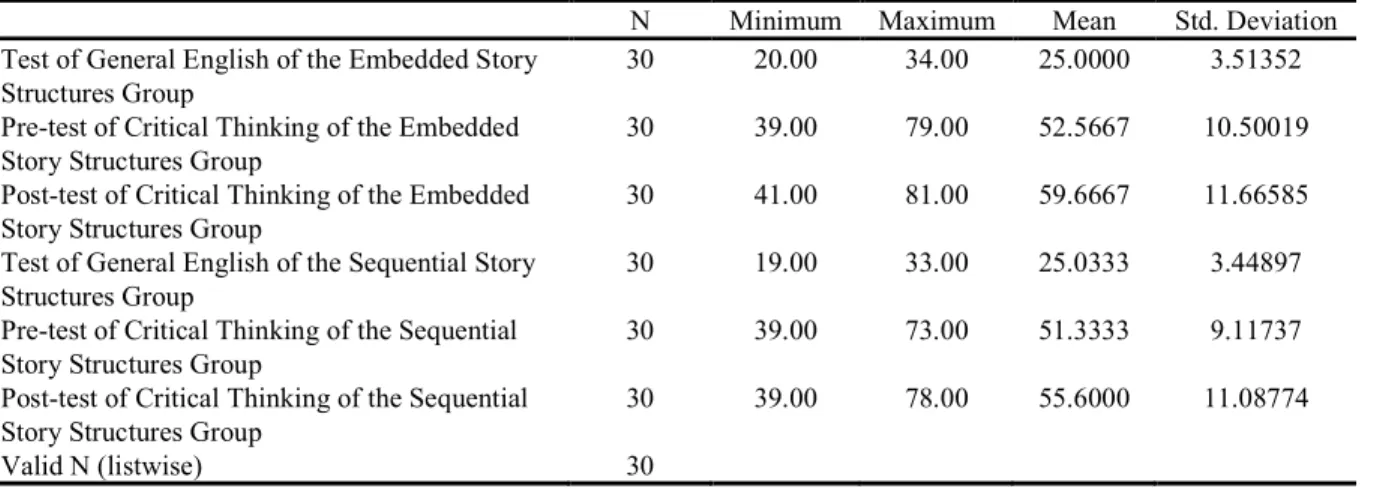
Table 1. Descriptive statistics of the PET, pre-test and post-test of critical thinking of the two groups
N Minimum Maximum Mean Std. Deviation
Test of General English of the Embedded Story Structures Group
30 20.00 34.00 25.0000 3.51352
Pre-test of Critical Thinking of the Embedded
Story Structures Group 30 39.00 79.00 52.5667 10.50019
Post-test of Critical Thinking of the Embedded Story Structures Group
30 41.00 81.00 59.6667 11.66585
Test of General English of the Sequential Story Structures Group
30 19.00 33.00 25.0333 3.44897
Pre-test of Critical Thinking of the Sequential Story Structures Group
30 39.00 73.00 51.3333 9.11737
Post-test of Critical Thinking of the Sequential Story Structures Group
30 39.00 78.00 55.6000 11.08774
Valid N (listwise) 30
The results of the one sample Kolmogorov-Smirnov test of normality of the sets of scores from the PET, pre-test and post-test of critical thinking of the embedded story structures group and the sequential story structures group reveals that for none of the sets of scores the recommended asymptotic level of significance is smaller than the standard .05 level of significance. Consequently, it is resolved that all of the data sets are normal and application of parametric tests is justified.
modification. On the other hand, SPSS suggested .971, which is more than .05, as the two-tailed level of significance of the independent samples t (-.037); accordingly, it is verified that the two groups are not statistically different in terms of their participants’ knowledge of English.
The value of Cronbach’s Alpha is .687, which is considered a relatively acceptable value; therefore, it is determined that the applied critical thinking questionnaire has a satisfactory level of reliability and internal consistency.
Table 2. Paired-samples t test of the pretest and post-test of critical thinking of the embedded story structures group
Paired Differences T df Sig.
(2-tailed)
Mean Std.
Deviation
Std. Error Mean
95% Confidence Interval of the
Difference
Lower Upper
Pair 1
Pre-test of Critical Thinking of the Embedded Story Structures Group – Post-test of Critical Thinking of the Embedded Story Structures Group
-7.10000 6.91999 1.26341 -9.68397 -4.51603 -5.620 29 .000
Table 2. demonstrates that the difference between the pre-test and post-test mean scores of the embedded story structures group is statistically significant since the proposed level of significance of the t, which is .000, is less than the standard level of significance (i.e. .05). Subsequently, it is resolved that the treatment given in this experimental group has successfully improved the participants’ critical thinking ability.
Table 3. Paired-samples t test of the pre-test and post-test of critical thinking of the sequential story structures group
Paired Differences t df Sig.
(2-tailed)
Mean Std.
Deviation
Std. Error Mean
95% Confidence
Interval of the
Difference
Lower Upper
Pair 1
Pre-test of Critical Thinking of the Sequential Story Structures Group – Post-test of Critical Thinking of the Sequential Story Structures Group
-4.26667 6.39468 1.16750 -6.65448 -1.87885 -3.655 29 .001
The paired-samples t (i.e. -3.655) which signifies the difference between the mean of the pre-test and post-test of critical thinking of the sequential story structures group is statistically significant because, as stated in Table 3., the calculated level of significance of t, which is .001, is less than the .05 standard level of significance. Therefore, it is determined that critical thinking ability of the members of the sequential story structures group has improved significantly from the pre-test to the post-test. In other words, the treatment given in this group has enhanced the participants’ critical thinking ability.
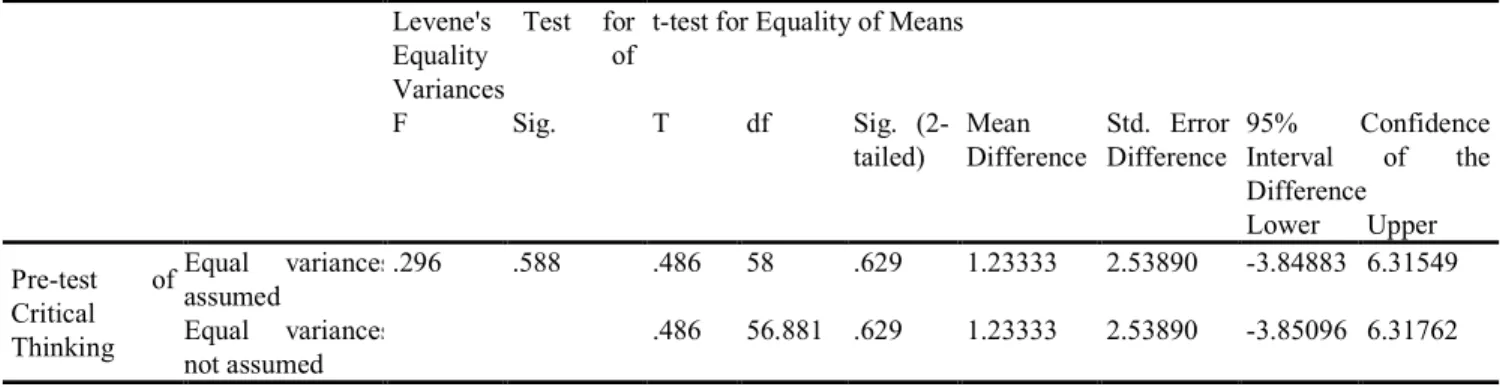
Table 4. Independent-samples t test of the pre-test of critical thinking of the two experimental groups Levene's Test for
Equality of
Variances
t-test for Equality of Means
F Sig. T df Sig.
(2-tailed)
Mean Difference
Std. Error Difference
95% Confidence
Interval of the
Difference
Lower Upper
Pre-test of
Critical Thinking
Equal variances assumed
.296 .588 .486 58 .629 1.23333 2.53890 -3.84883 6.31549
Equal variances not assumed
Table 4. verifies homogeneity of variances of the two sets of scores since the level of significance of Levene's estimate of equality of variances (.588) is more than .05. Furthermore, it is demonstrated that the difference between the mean of the pre-test of critical thinking of the embedded story structures group and that of the sequential story structures group is not significant as the suggested two-tailed level of significance, which is .629, is larger than the standard level of significance. This means that although the two groups performed differently in the pre-test of critical thinking, this difference is not statistically meaningful.
Table 5. Independent-samples t test of the post-test of critical thinking of the two experimental groups Levene's Test for
Equality of Variances
t-test for Equality of Means
F Sig. T df Sig.
(2-tailed)
Mean Difference
Std. Error Difference
95% Confidence Interval of the
Difference
Lower Upper
Post-test of Critical Thinking
Equal variances assumed
.000 .991 1.384 58 .172 4.06667 2.93842 -1.81523 9.94856
Equal variances not assumed
1.384 57.851 .172 4.06667 2.93842 -1.81555 9.94888
In table 5., since homogeneity of variances of the critical thinking post-test scores is established and the calculated level of significance of Levene's estimate of equality of variances (i.e. .991) is larger than the standard level of significance, the degree of freedom of t does not necessitate any adjustment and the level of significance of t (.172) is reported from the first row of the table.
Just like the case with the pre-test of critical thinking of the two groups, the difference between performance of the participants of the embedded story structures group and that of the participants of the sequential story structures group is not statistically significant. This means that the difference between the mean scores is not large enough to be considered meaningful. Therefore, it is determined that the effects caused by the two different types of treatment is statistically similar.
Table 6. Effect size of the treatments provided in the two experimental groups
Eta Eta Squared
Post-test of Critical Thinking * Group Membership
.179 .032
The two treatments are effective; yet, they are similar and none of them is more effective than the other. This is exactly what the weak and inconsiderable effect size signified by the eta squared (.032) reported in Table 6.
6. Conclusion and Implications
The purpose of this study was to examine the impact of embedded story structures versus sequential story structures on critical thinking of Iranian EFL learners. To pursue this objective the researcher offered two null hypotheses:
H01: Embedded story structures do not have any significant effect on EFL learners’ critical thinking. H02: Sequential story structures do not have any significant effect on EFL learners’ critical thinking.
Having verified normality of the collected data and homogeneity of the samples in terms of the subjects’ knowledge of English, in order to make it easier for the researcher to prove the proposed null hypotheses in this Chapter, significance of the difference between results of the pre-test and post-test of critical thinking of the subjects from the embedded story structures group and the sequential story structures group put to a statistical test.
It is resolved that the effects caused by the two different types of treatment were statistically similar. The two treatments were effective; but, they were similar and none of them was more favorable than the other.
Based on the results, it became obvious that the treatment given in the embedded story structures group has formed a significant effect. Therefore, embedded story structures have significant effect on EFL learners' critical thinking and it is possible to reject the first null hypothesis:
“Embedded story structures do not have any significant effect on EFL learners’ critical thinking.”
According to the results, it concluded that the treatment given in the sequential story structures group has significantly affected the subjects’ critical thinking ability. Thus, the researcher is to reject the first null hypothesis:
This study concluded that learning short story structures are effective and can support the EFL learners improve their critical thinking.
This study has practical implications for language teaching in EFL context. Two embedded and sequential story structures are approved to be effective tools in improvement of critical thinking of EFL learners and results suggested that despite previous assumptions, none of them is more favorable than the other.
Beyer (1987) believes that thinking skills should be taught in order to be improved. Teaching students to think should be main concern of our schools today. In any thinking process we employ critical and creative thinking. The term critical thinking is common in education, psychology, and philosophy. Developing critical thinking skills is an old idea. Osborne (1932) declared that one of the main purposes in education is development of thought power. Dressel and Mayhew (1954) claimed that teachers and educational settings are responsible for teaching students to think critically and creatively.
Students should learn thinking and reasoning skills to reach their fullest potential in today's society because teachers can no longer be information givers (Meyers, 1986). Learners require text books that stimulate their critical thinking and teachers should be qualified to change their approaches toward students and themselves (Kabilan, 2000).
This study is also addressed test developers. Having in mind that the goal of testing is to assess the teaching program and the progress of the learners, this study motivates the test developers to make changes in testing, developing tests to teaching as well as improving the students' ability to be creative in performing the tests.
References
Ahmadi, M. R., & Hairul, N. I. (2012). Reciprocal teaching as an important factor of improving reading comprehension.
Journal of studies in education, 2(4), 153-173.
Al-Dersi, Z. E. M. (2013). The Use of Short-Stories for Developing Vocabulary of EFL Learners. International
Refereed & Indexed Journal of English Language & Translation Studies, 2308-5460.
Alvermann, D., & Earle, J. (2003). Comprehension instruction. In A. P. Sweet, & C. Snow (Eds.), Rethinking reading
comprehension (pp. 12-30). New York: Guilford.
Bailin, S. (1998). Education, knowledge and critical thinking. In D. Carr. (Ed.), Education, Knowledge and Truth (pp.
204-220). London: Routledge.
Barnett, M. (1989). More than Meets the Eye: Foreign Language Reading. Language in Education: Theory and practice,
No.73. CAL/ERIC Series on Language and Linguistics. Englewood Cliffs, NJ: Prentice Hall, Inc.
Barthes, R., & Duisit, L. (1975). An introduction to the structural analysis of narrative. New Literary History, 6(2),
237-272.
Beck, I. L. (1984) Developing comprehension: The impact of the direct reading lesson. In R. C. Anderson, J. Osborn
and R. Tierney (Eds.), Learning to read in American schools: Basal readers and content texts. Hillsdale, NJ: Lawrence
Associates.
Beyer, B.K. (1987). Practical strategies for the teaching of thinking. Boston MA: Allyn and Bacon, Inc.
Carroll, D. (2008). Psychology of language. (5th ed.). Thomson Corp., (Chapter 6).
Dressel, P. L., & Mayhew, L. B. (1954). General education: Exploration in education (pp. 215-229). Washington, DC:
American Council on Education.
Eskey, D. E. (2005). Reading in a second language. In E. Hinkel (Ed.), Handbook of research on second language
teaching and learning (pp. 563-580). Mahwah, NJ: Lawrence Erlbaum.
Farhady, H. (2005). Reflections on and Directions for ESP Materials Development in SAMT. In Proceedings of the
First National ESP/EAP Conference (Vol. 3, No. 1, pp. 2-32).
Garner, R. (1988) Metacognition and reading comprehension. Ablex Publishing Corporation.
Grabe,W.(1991). Current development in second language reading research. TESOL Quarterly 25(3), 375-406
Grellet, F. (1996). Developing Reading Skills: A practical guide to reading comprehension exercises. Cambridge
University Press.
Kabilan, M. K. (2000). Creative and critical thinking in language classroom. The Internet TESL Journal 6(6). Retrieved
September 14, 2008, from http://iteslj.org/Techniques/
Mottley, R., & Telfer, R. (1997). Storytelling to promote emergent literacy: Prospective teachers’ storytelling
experiences and expectations. In Yearbook of the American Reading Forum (Vol. 17, pp. 127-149).
Osborne, W.J. (1932). Testing Thinking. Journal of Educational Research, 27 (1), 402.
Paul, R. (1993). Critical Thinking – what every person needs to survive in a rapidly changing world. (3rd ed.). Santa
Rosa, CA: Foundation for Critical Thinking.
Paul, R., & Elder, L. (2008). Critical Thinking. (5th ed.). The Foundation for Critical Thinking.
Pearson, C. (2008). What is narrative? Retrieved from Narrati.com: http://narrati.com/Narrative/What_is_Narrative.htm
Rauch, S. J., & Weinstein, A. B. (1968). Mastering Reading Skills: By Sidney J. Rauch and Alfred B. Weinstein. Van
Nostrand Reinhold Company.
Reed, J. H. (1998). Effect of a model for critical thinking on students' achievement in primary source document analysis
(Doctoral dissertation). University of south Florida. Retrieved March 28, 2008 from www.criticalthinking.org
Ripley, W. H. and Blair, T. R. (1989). Reading diagnosis and remediation. Glencoe/McGraw-Hill School Publishing
Company.
Rosenblatt, L. (1938). The Reader, the Text, the Poem. Carbondale, iii: Southern University Press.
Stein, N. L., & Trabasso, T. (1981). What's in a story: An approach to comprehension and instruction. Center for the
Study of Reading Technical Report; No. 200.