Ashlyn Velte. Activist Social Media Archiving: Practices, Challenges, and Opportunities. A Master’s Paper for the M.S. in L.S. degree. April, 2016. 84 pages. Advisor: Stewart Varner
Social media has played a significant role in recent activist movements. It empowers activists to organize and communicate their experiences. Archival efforts to document narratives that are historically silenced makes activist material an attractive collecting area. However, archives trying to preserve digital ephemera like social media from activist movements face digital preservation challenges as well as ethical considerations. By conducting online surveys and semi-structured interviews with archivists working on projects collecting activist social media this study found that activist social collecting projects: 1) face ethical and collection development challenges, 2) usually follow
traditional models for acquisition, description, and access, and 3) increase donor and user engagement with collections. This suggests that in the future the profession would benefit from the development of best practices surrounding ethical collection development and use of activist social media.
Headings:
Web Archives
Appraisal of archival material Social Media
Digital Preservation Metadata
ACTIVIST SOCIAL MEDIA ARCHIVING: PRACTICES, CHALLENGES, AND OPPORTUNITIES
by Ashlyn Velte
A Master’s paper submitted to the faculty of the School of Information and Library Science of the University of North Carolina at Chapel Hill
in partial fulfillment of the requirements for the degree of Master of Science in
Library Science.
Chapel Hill, North Carolina April 2016
Approved by
Table of Contents
Introduction ... 3
Literature Review... 8
1.1 Archival Silences... 8
1.2 Digital Preservation ... 16
1.3 Web Archiving and Social Media ... 20
1.3.1 Collection Development ... 23
1.3.2 Social media collection tools ... 24
1.3.3 Access ... 26
1.3.4 Legal and Ethical Concerns... 27
1.3.5 Issues specific to activist groups ... 28
1.4 Research Questions ... 29
Methods... 31
1.5 Participants ... 31
1.6 Data Collection ... 32
1.7 Data Analysis ... 33
Survey Results ... 36
1.8 Digital Projects ... 36
1.9 Process and Workflows ... 36
1.10 Project Management ... 41
1.11 Challenges ... 43
1.12 Outcomes ... 44
1.13 Areas of ambiguity ... 46
Interview results ... 48
1.14 Project 1... 48
1.15 Project 2... 49
1.16 Project 3... 49
1.17 Collection Development ... 50
1.18 Access... 51
1.20 Acquiring permission or consent... 54
1.21 Challenges ... 55
1.22 Outcomes ... 58
1.23 Areas of future research for activist social media ... 59
Discussion ... 61
1.24 Challenges in Ethics and Collection Development ... 61
1.25 Practices for Harvesting, Describing, and Access ... 63
1.26 Outcomes in donor and user engagement ... 66
1.27 Limitations and Areas of Future Research ... 67
Conclusion ... 69
References ... 71
Appendix A: Archivists Survey ... 79
Introduction
The last several years have seen an increase in activist activity within the United States. For activist groups online digital tools, like social media, play an important role in proliferating and spreading their organizing efforts. Without social media it would have been much more difficult for recent police violence protests to garner recognition by the main stream. Kimberly Springer (2015) says that it is “indisputable” that social media played a significant role in bringing police violence against African Americans into recent public consciousness. Indeed, Bergis Jules (2014) confirms that leaders of the Black Lives Matter movement against police violence value social media platforms in “organizing and curating the Ferguson story.” Some academic research has started exploring links between social media and social movements, or “protest networks” as W. Lance Bennett and Alexandra Segerberg (2011) call them.
Jules (2015) writes about how the storm of social media posts during the
social movements, then it naturally falls under the collecting scopes of many cultural heritage institutions, such as libraries, archives, and museums. Particularly since social media usually reflects public sentiments on significant events, then it is important for these collecting institutions to preserve social media for researchers interested in today’s events. However, the relative newness of the format makes it daunting work for some institutions since there is a lack of consensus on best practices for activist social media.
Despite its apparent newness, there are several widely discussed projects that test the waters for collections of social media from activist events and organizations. For instance, there are at least three different digital projects collecting digital ephemera from the Occupy Wall Street Project. Emory Libraries’ Archive of Occupy Wall Street Tweets contains over 10 million tweets documenting the movement against economic inequality in New York City. Its aim was to provide data visualization to help researchers
understand the role social media plays in social movements (King, 2012). The Occupy movement also has its own digital archive hosted by volunteers at George Mason University and the Roy Rosenzweig Center for History and New Media (Erde, 2014). Though not specifically focused on social media, their archive maintains the “digital evidence and stories from the Occupy project” (Roy Rosenzweig Center…, 2011).
Documenting Ferguson project at Washington University in St. Louis provides an online access and donation portal for digital content related to the Ferguson protests. This digital archive partnered with other institutions in the St. Louis area to be sure it was adequately representing the need of the community (Buck et al., 2014). Other archives focused specifically on the social media content generated by people involved in the protests. Ed Summers at the Maryland Institute of Technology in the Humanities has harvested a data set of Ferguson related hashtags from Twitter (Jules, 2015).
After the death of Michael Brown a series of protests erupted nationwide against acts of police violence. One of the more heavily covered protests occurred in Baltimore after the death of Freddie Gray on April 12, 2015. During the protests, the city of Baltimore called in support from the National Guard. The Maryland Historical Society, the University of Baltimore, and the University of Maryland Baltimore County created an Omeka site (baltimoreuprising2015.org) where users could directly contribute their social media content to help tell the story. The Maryland Historical Society says that they “believe that it is important that the materials are preserved in a historical repository so they are not lost” (Maryland Historical Society, 2015). They already have over forty individuals who have contributed their collections to the site.
president agreed to step down in the summer of 2017 (Maycon, 2016), and at Claremont McKenna College the dean of students stepped down. (“Student Activists
Nationwide…”, 2015). This increase in activism around campus diversity has generated conversations about the state of racial equality in U.S. Several large institutions with well-established archives started collecting initiatives around student activism (e.g. Drake, 2015; Farrell, 2016; Kolachina, 2015). Developing these collecting areas has been at least partially inspired by the increase in the activity seen on campuses.
These examples of activist organizing from the last 10 years coincide with a significant social media presence behind their causes. Additionally, their activities have significant impact on the conversations happening in the media and the government. If significant evidence of these events occurs online then libraries, museums, and archives have a role in preserving it for future generations. Without archives of the Occupy
movement, Ferguson protests, and the Baltimore Uprising, the digital ephemera related to the events would have disappeared. Their materials have pushed the bounds of what archives traditionally a record; digital content, especially social media content, is not traditionally collected by repositories, and these institutions have not established best practices for this new form of digital media. Significant risk for loss of this materials has entered into the professional awareness.
In recognizing the risk for loss Jeffrey (2012) identifies the potential for a second ‘digital dark age’ in regard to social media. The first Digital Dark Age, he claims, occurred with the widespread adoption of computing systems without the proper
and inadequate metadata. Though standards and systems addressing these problems have been identified, he claims that similar problems currently face newer online technologies like social media. The risk of loss for online materials has entered mainstream
consciousness as both The Gaurdian and NPR published stories about the risk of data loss from new technologies (Sample, 2015; Morning Edition, 2016).
Loss of online records is a great risk for activist groups who typically have limited power within the social structure. Kimberly Springer (2015) notes the importance that ephemeral records play in documenting cycles of contention (where people realize that the problems they face are systematic rather than isolated incidents.) For activists and organizing groups archives serve to explain their work without relying on the mainstream media or politics which sometimes “criminalize and capitalize on dissent” (Springer, 2015) She cites work by Howard Besser (and his activist-archivists.org) that explains to activists that archives provide accountability for those in power, accessibility to their records, self-determination in defining their social movements, education materials for tomorrows classes, and continuity through lessons for future activism.
If the risk of loss has higher stakes for activist organizations, archivists must understand what is currently being done to preserve online activism so that we know what works and what can be improved. This research study seeks to examine the current practices of some of the institutions collecting activist social media in order to identify common practices, challenges, concerns, and outcomes. In order to suggest possible areas of future growth for activist social media archives, current practices must first be
Literature Review
Understanding where activist social media archives are situated in the
professional literature involves reviewing a complicated interplay of archival theories and practices. It first means defining archives’ role in building historical narratives, by
explaining defining archival silences and collection strategies to overcome them.
Primarily, archival collections turn to community archives to fill in gaps in the historical narrative. Activist collections, as another type of community archive, are now also being used to address missing histories. The examples in the introduction demonstrate that an increasing number of activist records are being created online. In order to understand how cultural memory institutions might best engage with born-digital content from activist groups, we must also review digital preservation and web archiving strategies. Lessons from community archiving and digital preservation impact the way that archives approach and collect both analog and digital materials from activists.
1.1 Archival Silences
2010). Newcomers to archives often arrive with the assumption that the preserved collections accurately reflect historical reality. Discussions of archives and archivists’ role over the past fifty years indicate that the archivists’ traditional viewpoint was that they were the neutral documenters of the past. Cook (2013) names four archival
paradigms that describe the dominant thought processes of the profession throughout the history. He defines his paradigms as professional “frameworks for thinking about
archives, or archival mindsets.” (p. 97). The earliest paradigm he identifies, “evidence” refers to a period in the late 19th and early 20th century, where archives were perceived as the primary way to guard “truth.” Despite archives having progressed through three other of Cook’s (2013) paradigms, this traditional view of archival records persists within areas archival thinking. Other authors have remarked that many consider archives to be a place for objective recordkeeping. Indeed, Verne Harris (2002) says that as “many archivists are wont to argue, the repositories of archives are the world’s central memory
institutions… the idea is that archives reflect reality” (p. 65).
However in the 1970s archivists began discussing the possibility that archives are not the bastions of objective truth that they were assumed. Archivists began to understand the role they play in shaping historical narratives when Howard Zinn (1970) asked
Five years later, Ham (1975) gave the presidential address to the SAA. Following Zinn’s (1970) shattering claims on archival neutrality, Ham (1975) made a call for the profession to live on the “archival edge,” outside of mainstream culture to better document the breadth of human experience rather than limiting the documented past to mainstream culture. This means that traditional passive collecting with a limited view on the definition of what constitutes a record will not accomplish what archives have always tried to do: “hold up a mirror to mankind” (p. 13). He says that if archivists do not reflect reality human kind they cannot learn from the past.
Africa, created after the end of apartheid, recognize the active role archivists play in memory construction. Recognizing that archives are situated within existing power structures, they seek records from previously undocumented groups.
The gaps in the historical record created consciously or unconsciously by the dominant group (the group that has the most social, political, or economic power) are known as archival silences (Carter, 2006, p. 217). Carter (2006) explains that groups silenced by archives are prevented from participating in historical and societal dialogues. As he explains “archivists are constantly confronted with choices about what to include and what to exclude… Limited resources and/or a lack of understanding ensure that all records are not given equal attention” (p. 219). To Carter (2006) silence results in the loss of societal memory, failure to form a collective identity particularly for the marginalized, and produces further victimization.
The third of Cook’s (2013) archival paradigms was a search for professional identity. During this search, archivists recognized the pluralistic nature of records where one historical perspective does not capture ‘reality.’ Though his discussion of this
paradigm mostly focused on building the identity of the profession by identifying areas of expertise and common values, this paradigm also involved recognizing that archivists are influenced by dominant groups within society. Meaning that the profession considered part of its identity as being unwittingly responsible for shaping societal narratives for history and memory.
libraries passively support existing oppressive power structures by failing to recognize the different experiences of their patrons. They provided support and resources on the Ferguson protests and institutional racism which positively impacted their patrons. Their “Black Lives Matter” library guide has received much campus support, and has deepened ties between faculty, students and the library on their campus (University of Arizona). They explain that libraries have an obligation to provide support to underrepresented groups rather than remain “neutral” and silent. Compellingly, they claim “Systemic racism can’t be confronted or resolved unless everyone is involved in its interrogation” (p. 199). Their argument adds importance and immediacy for archives to document those existing on Ham’s (1975) archival edge. As archivists recognize how easy it is to miss societies’ pluralism, seek ways to actively collect from groups that are historically underrepresented in society.
The recent focus on community archiving is the most recent archival paradigm experienced by the profession (Cook, 2013). Archivists’ working for and within community archives addresses the problems first articulated by Zinn (1970) and Ham (1975). Indeed, Flinn (2007) says that community archives provide a place for archivists to “leave behind the idea of archivist as a neutral, passive, reactive figure and instead embraces a much more active or proactive role, one which acknowledge the power and influence which the archives has over framing our archival heritage and social memory” (p. 168).
no one definition of community” as each community differs depending on context (p. xxii). Some communities might be based on locality, on identity, or on shared values and beliefs (Flinn, 2007). Because of these challenges inclusive and broad definition of ‘community’ work best. For instance a community is a “group who define themselves on the basis of locality, culture, faith, background or other shared identity or interest” (Flinn, 2007, p. 153). For the same reasons, defining a community archive is also difficult. To Flinn, Stevens, and Shepard (2009) community archives are “collections of material gathered primarily by members of a given community and over whose use community members exercise some level control” (p. 73). The process of gathering material is largely a grassroots effort, meaning that much of the work begins, and often remains, outside of established institutions (Flinn, 2007).
Because community groups often have a common sense of place or locality it might be initially difficult to differentiate them local historical societies. The defining difference is that among community archives’ motivations arise from a need to document the marginalized; existing power imbalances inform both their identities and their
time describing them. However, two of these principles most directly relate to this study, the principles of multiplicity and activism, which I will elaborate on more fully.
Caswell’s (2014) next principle, multiplicity, refers to two different aspects of community archives. First, community members rarely agree all the time. This means that there are many different and conflicting perspectives among members of a community. Thus community archives do not just capture commonalities within the group but also its differences. The acknowledgement of diversity can be liberating for communities that have been viewed by the mainstream as one clearly defined group (Caswell, 2014). Having diverse viewpoints then is a shared characteristic across many community archives. The other way in which community archives have multiplicity is in format. For instance, most community archives push the bounds of what has been
traditionally defined as a record (Bastion & Alexander, 2009; Flinn, et al., 2010; Caswell, 2014). Preserving previously undocumented kinds of material means that the archive better reflects the communities they originate in. However, for mainstream repositories this multiplicity of format can introduce preservation challenges.
movements. They serve as a way to challenge dominant understandings of heritage and also act as a way for groups to create their own identities. Since mainstream institutions often fail to collect marginalized stories, independent archives act as a way to subvert dominant historical narratives; they seek to build a more complex social understanding of history. Similarly, Flinn, et al. (2010) discuss community archives as a way to share voice among communities that otherwise are not reflected in official records. These
characteristics of community archiving should inform archival projects that document activist groups.
1.2 Digital Preservation
Based on recognition of and efforts to reduce archival silences, perhaps it is no surprise that archivists turned their attention to recent activist movements. Collecting from activist or advocacy groups overlaps with community archives as demonstrated by Caswell (2014). Yet, recent records of activism include an increasing amount of born-digital materials from the open web; activists use social media to organize and
communicate their message. This means that archivists face the challenge of preserving this born-digital content.
Born-digital material, is content that is “created and managed in digital form” (Erway, 2010, p. 1), meaning that it never had an analog incarnation during its use. Social media, also called Web 2.0 or social networking, are born-digital records of large scale communication between communities and individuals on the internet. Web 2.0
content. There are platforms for video sharing (such as YouTube and Vimeo), platforms for photo sharing (Flickr and Instagram), platforms for social networking (Facebook and LinkedIn), platforms for blogging (WordPress and Tumblr), and for microblogging (Twitter) (Jeffrey, 2012).
Digital media changes faster than archivists and researchers can create tools to adequately preserve it. As mentioned earlier, Jeffrey (2012) describes that a lack of methods to preserve early digital documents led to a ‘Digital Dark Age,’ where the rapid change in technology led to 1) data corruption, 2) media and software obsolescence, and 3) inadequate metadata. Social media, as a form of digital material, also faces these risks. Preserving social media content involves implementing digital preservation best practices to combat these risks. Archivists have developed methodologies and practices to protect against each of the risks that Jeffrey (2012) identifies which also apply to the preservation of social media.
Firstly, digital preservationists identify ways to combat both data corruption and media obsolescence. Digital material has specific preservation concerns like bit rot, obsolescence, and authenticity (Erway, 2010). The OCLC have resources documenting steps a digital repository should implement to preserve digital content including tools and procedures used to combat these issues (Erway, 2010). For example, obsolescence can be managed by creating specific metadata regarding how a file should be read, while
authenticity can be assured by installing write-blockers and creating checksums for the files (Barrera-Gomez & Erway, 2013). These practices should also apply to the
Social media corruption and obsolescence occurs because content changes quickly and is susceptible to loss. Social media loss could occur for two reasons. Firstly, loss might occur due to the commercial nature of the platforms on which the data lives (Jeffrey, 2012, p. 560). For example, Flickr once accidentally lost 4,000 photographs (Wauters, 2011, cited by Jeffrey, 2012). In another case the platform of GeoCities shutdown without a preservation plan, and resulted in the loss of a massive amount of information (Thomson, 2016, p. 17). Another reason loss might occur is because a user or some other third party removes or edits posts. This data might be important to
preserve, but before an archive decides to maintain deleted social media content a
repository may need to contend the ethical issues regarding privacy described below. For instance, Twitter has policies in place to protect the privacy of users who have deleted Tweets (p. 21).
Digital preservation strategies also identify suggestions for the creation of
one or more of these specific purposes. Archives and libraries use several common metadata standards to describe born-digital material, such as:
Dublin Core. The Dublin Core Metadata Element Set is meant to be a metadata
scheme that could apply to any web based resource. It provides a simple set of elements that can be applied by both cataloguers and non-cataloguer. Its element set is simple and concise, and each element is optional or repeatable. It is used by those both in and outside of the library community (NISO, 2004, p. 3).
Metadata Encoding and Transmission Standard (METS). METS is an XML
schema for defining the structure and description of objects in a digital library. It includes technical metadata about the digital objects to ensure the interoperability in case of future migration. It is more technical and more extensive than Dublin Core (NISO, 2004, p. 4-5).
Metadata Object Description Standard (MODS). MODS is also an XML
schema based on MARC 21 records. It is hierarchical and descriptive and also more detailed than METS. For this reason it works well in concert with the structural elements of METS (NISO, 2004, p. 5-6).
Encoded Archival Description (EAD). EAD is an XML structural schema for
elements of archival finding aids. It allows for easy online display and searching (NISO, 2004, p. 6).
Describing Archives: A Content Standard (DACS). DACS is the official
These practices to preserve born-digital content also apply to web archives and social media archives. However, social media introduces format specific preservation practices and challenges.
1.3 Web Archiving and Social Media
Web archiving is the process of collecting and preserving portions of the World Wide Web in an archival format for future use (International Internet Preservation Consortium, 2012). Web archives are a specific type of born-digital record, where the data generated by harvesting web content is preserved following best practices described in the previous section. This usually means using specific URLs to capture web pages and display them to users as they existed at the time that they were captured (as with the Internet Archive’s Wayback Machine). Yet, as a relatively new practice within digital archiving, there remain a few determined best practices.
respondents used Archive-It (the Internet Archive’s contract service for web archiving) to crawl and host their web archives. Additionally, the tools used for web archiving varied greatly. Many tools have been built for granular processes of web archiving related to any stage of the information lifecycle. Truman (2016) stopped counting the variety of tools after reaching 77.
The report identified 22 ways that archivists can move web archiving forward. Yet, some of the overarching themes signify the present trends in web archiving. Specifically, that institutions find it difficult to choose what to include in their web collections because they worry about the potential for duplication of effort between collections. The report suggests better collaboration, and communication about collection development policies. In addition, there is concern about the reliance on third party vendors to host archived web content. Some of the interviewed archivists fear that reliance on vendors does not guarantee the longevity of the data. Some institutions combat this concern by downloading .warc files from a service like Archive-It and
storing them on their in their local digital repositories. Truman (2016) suggests partnering with other institutions as well as these service providers for consistent access and reduce reliance on outsourcing.
Social media generates large amounts of data that can be useful for researchers across a variety of disciplines. As a report on preserving social media published by the Digital Preservation coalition explains, social media data sets “will be of use on a large scale to data-driven researchers in the social sciences and other disciplines” (Thomson, 2016, p. 4). The Social Media Archiving Toolkit released by North Carolina State University Libraries identifies several research studies where large scale social media was used (2015a). For instance research using social media data has been conducted in fields as disparate as medicine (Young, Rivers, & Lewis, 2014), social science (Collins et al., 2014), linguistics (Squires, 2014) and economics (Haustein et al., 2014). Recognizing the importance of large sets of social media data, Twitter created its “Data Grants” initiative that provides researchers with access to public Tweets to answer their research questions. The grant was awarded to a wide range of projects including, “Foodborne
Gastrointestinal Illness Surveillance using Twitter Data,” “Disaster Information Analysis System,” “The Diffusion and Effectiveness of Cancer Early Detection Campaigns on Twitter,” “Do Happy People Take Happy Images? Measuring Happiness of Cities,” “Using GeoSocial Intelligence to Model Urban Flooding in Jakarta, Indonesia,” and “Exploring the Relationship Between Tweets and Sports Team Performance” (Krikorian, 2014). The variety in current research use of social media data implies an importance in its preservation for historical and longitudinal studies.
access, curation, and sharing that accommodate the particular curatorial, legal, and technical frameworks of large aggregates of machine readable data.” While web archiving works well for static sites that change infrequently, the dynamic content on social media platforms introduce greater ambiguity (p. 4). Most institutional archives and libraries who use social media for outreach purposes have not tried to preserve it in any way citing the challenges to doing so as a deterrent (Liew, King, and Oliver, 2015). Explorations in the literature provide some initial insight into what issues, challenges and practices currently face social media archives.
1.3.1 Collection Development
Part of any collecting initiative involves deciding what to include in the archive as part of the appraisal process. As we have seen, historically this had led to gaps in the historical records. So naturally this is a difficult task to approach when starting a collection intended to address some of these gaps. In her report on web archiving, Truman (2016) found that “collections based on specific themes or topics require more scoping effort to determine which sites are to be collected” (p. 17). The respondents were frustrated that there was not better communication about what had been collected by other institutions. They explained that a lack of collaboration and communication resulted in “fragmentation of collections or potential duplication of effort.” (p. 17). Other
greater risk of being taken down (Truman, 2016, p. 19). These curatorial issues could easily apply to social media content specifically as well as to web archiving in general.
Indeed, Thomson’s (2016) report on social media archiving remarks that “The ‘conversation’ of social media, particularly of social networking sites, makes it difficult to identify the boundaries of a collection and to establish selection criteria” (p. 23). She says that there are a few ways that collections handle this ambiguity. One is by creating a narrow--or restrictive--selection policy. For example limiting the scope to particular accounts which ensures an institutions only collects relevant data. Another way is to create a broad set of selection policies, for example allowing the scope to include a certain location or hashtag which will ensure that more of the conversation is captured. Either way some content might be lost. Selection difficulties for social media face a double edged sword, “While capturing enough relevant content poses one difficulty, ensuring that you do not capture too much also poses a challenge. Without a carefully planned and systematic strategy for de-duplication, an archive may end up with an abundance of redundant content that can cause increased difficulties for storage and search” (p. 24). In addition, these concerns about what content to collect from social media overlaps with some of the legal and ethical concerns described below.
1.3.2 Social media collection tools
Archive-It. A web archiving tool run by Internet Archive. Its use requires a
subscription fee to harvest seed websites assigned by the subscriber. Subscribers can also set a crawl schedule to regularly harvest websites. Archive-It also supports storage and discovery, through their layer known as the Wayback Machine.
ArchiveSocial. Also a subscription service run through the Internet Archive.
ArchiveSocial collects original posts and associated comments on Facebook, Instagram, Twitter, LinkedIn, and YouTube. It continually harvests throughout the day so that it does not miss any changing content. It supports preservation and searching, while also allowing users to interact with preserved content.
Social Feed Manager. An open sourced tool created by Dan Chudnov and team
at George Washington University harvests Tweets through its public API. It supports harvesting using hashtags, keywords, users or geolocations. Its datasets can be downloaded as CSV files.
Twarc. An open sourced Twitter archiving tool developed by Ed Summers at the
Maryland Institute for Technology in the Humanities, Twarc is a command line tool that harvests Tweets as JSON data.
Twitter Archiving Google Sheet (TAGS). This free Google sheet, created by Martin Hawksey, runs through Twitter’s API to collect tweets on selected hashtags.
Perma.cc. A free tool that captures and provides a link to a single static page. It is
not schedule crawls or follow links or documents that are embedded into the site like Archive-It or other web capturing tools. (http://perma.cc).
Lentil. An open-sourced Instagram harvesting tool created by North Carolina
State University Libraries and harvests images from Instagram. It also provides an access layer that supports browsing and sharing images. It has a built in
moderating and harvesting system for content.
Additionally, some platforms, like Facebook and Twitter, provide their own personal archiving tools to for individuals’ data.
1.3.3 Access
Regarding social media content specifically, it is important to provide enough metadata for a social media dataset to preserve its context (Thomson, 2016, p. 24). This metadata should provide information about how a dataset was harvested, when it was harvested, and what the Terms of Service were at the time of its collection. This not only ensures adequate preservation, but also makes searching easier for users. However, the size of social media dataset can actually be an impediment for its use. For example, the Twitter Archive at the Library of Congress (which houses all Tweets), is so large that there has been no way to index the collection to facilitate quick searches (Thomson, 2016, p. 25).
Some tools that have been used to provide access to social media include traditional content management software like ContentDM, online content management software like Omeka, or the Internet Archive’s access platform known as the Wayback Machine (Truman, 2016).
1.3.4 Legal and Ethical Concerns
Fair Use (17 U.S. Code §107). Especially, in the case of research analyzing large
aggregates of data, copyright concerns are minimal to none (Thomson, 2016, p. 17). The ambiguity remains over Terms of Service which are different for each platform, and change frequently making it necessary to frequently review them to assure compliance. Often though, platforms limit how much data can be harvested at a time through their API. This technical limitation is usually built into the API in order to satisfy the conditions of their Terms and Service (Thomson, 2016, p15-16).
More difficult questions arise when considering the ethics of collecting social media data. Many of these concerns regard users’ privacy, and consent regarding their research use in large data sets. If an institution selects social media content using hashtags, for example, then it would be very difficult to seek permission for long-term preservation and use from each user. Summers (2014) discusses a good way to ethically provide access to social media content using an activist archive via a method known as hydration. By going through the Twitter API, researchers can “hydrate” archived Tweet IDs with rest of the data for that Tweet. Hydration reflect users’ choices to delete content after the TweetID was archived. This means that any deleted content will also be
removed from the archive.
1.3.5 Issues specific to activist groups
wary that archiving opens up an opportunity for surveillance. Additionally, activist events may involve acts of disobedience or illegal activity that they may not want known. Carter (2006) explains that organizations may choose to assert power over a dominant group by invoking silence. Filling silences may introduce further harm to a group as “records may no longer have the function or meaning intended by the original record creator (p. 226). As we learned earlier, community archives are first and foremost generated and defined by the community itself to challenge the dominant historical understanding (Caswell, 2014). Protecting privacy and the wishes of individual organizations is important to engender good will, as archives are often situated within institutions that hold social or political power.
1.4 Research Questions
The challenges faced by collecting social media and the records from activist organizations speaks for the need to study the practices, challenges, and solutions used to create and maintain collections of activist social media content. Some specific questions this exploratory study aims to answer include:
What tools (software or otherwise) are most commonly used to harvest, preserve
and provide access to social media content?
What challenges, if any, are associated with an activist oriented collecting
initiative?
What metadata, if any, are being used to make social media data accessible in the
long term?
a mainstream institution, difficulty understanding the legal and ethical considerations present, or lack of resources available to support the project. How do the collections approach solving identified problems?
What outcomes did repositories experience as a result of their collecting activist
social media content?
What areas do archivists need more guidance on that could be the focus of future
research and professional attention?
Methods
Since the goal of this study is to conduct exploratory research to identify common practices, tools used, and challenges for activist social media collections, the methods used assessed both what is being done to archive activist social media content and why it is being done that way. Determining the practices used across similar projects indicates commonalities of practice for similar projects harvesting, preserving and providing access to activist social media collections. To accomplish this goal data for the study was collected using surveys and semi-structured interviews. According to Babbie (2010) one strength of survey research is that it allows researchers to describe participants’
characteristics. In contrast, the data acquired via semi-structured interviews evaluates why these characteristics occur. This is because one strength of qualitative research is that it captures nuance and allows for depth of understanding (Babbie, 2010). Semi-structured interviews are one way to conduct qualitative research.
2.1 Participants
semi-structured interviews, all survey participants were asked if they were willing to
participate in an interview with the researcher. I then contacted those people to schedule an interview who indicated that they were willing to be interviewed.
Thirteen archivists completed the survey, and three archivists participated in semi-structured interviews. Based on the qualitative responses to both data collection methods, at least some if not most of the participants were employed by a large library system usually at a college or university but not always. One respondent stated “we are not a library,” implying that they may be from a museum or other similar cultural heritage institution. More specific information about archivists’ employing institution was not asked in order to preserve anonymity. So few libraries and archives collect activist social media content, that it might have been possible to match responses to particular institutions, or even particular individuals at those institutions.
2.2 Data Collection
All participants were asked to consent to participate in both the survey and interview portions of this study. The surveys and interviews were loosely based on the survey and interview guide developed by Zach and Perri (2010). Their survey and guide for a semi-structured interview was used to determine the electronic records management practices in colleges and universities. I chose this this study as a model for developing my survey and interview questions for two reasons. Firstly, they explored the practices
also served as a model for the type of questions asked during the semi-structured interviews, because of its similar subject area.
Participants first took the 10-20 minute online survey. The survey evaluated whether or not the patterns and practices found in the existing literature hold true across activist social media collections. Questions cover topics such as the size of the collection, what software or web tools have they used to harvest, preserve and provide access to web content, what social media platforms they have collected, their communication style with the activist group they are archiving, what the biggest challenges they faced were, and their funding sources (See Appendix A). These questions placed responses within their context (e.g. type of materials, resources at their disposal) and identified basic procedures for handling social media content within that particular repository.
After completing the survey, I provided participants with an option to participate in 30-60 minute structured interview via telephone. With consenting
semi-structured interview participants I asked questions based on concepts and patterns mentioned in the literature review. Questions covered project workflows, ethical considerations, why and how they faced challenges, and any outcomes they have seen from the project (See Appendix B).
2.3 Data Analysis
To conduct data analysis on the semi-structured interview responses I followed Zhang and Wildemuth’s (2009) suggested practice for the analysis of qualitative data. They outline eight steps for analyzing qualitative data.
Prepare the Data. To prepare data for analysis I will obtain permission to
record interviews from both participant groups using a digital recording device. From the recordings, I will transcribe the interviews.
Define the Unit of Analysis. A unit of analysis refers to the “basic unit of text to be classified during content analysis” (Zhang & Wildemuth, 2009, p. 310). For the interview results, I used a single theme identified in the transcripts. Develop Categories and a Coding Scheme. I used inductive reasoning to
develop categories and code for the data because this is exploratory research rather than proving a hypothesis. These categories matched areas of interest as well as common themes that developed across participants’ data. These themes are included in the results section of the study.
Test Coding Scheme on a Sample of Text. To determine the appropriateness of
the coding scheme I use, I tested it on a sample of my data to ensure its effectiveness. This was an iterative process.
Code all the text. I will use the coding scheme developed in the previous step
to code all of the interview transcriptions I will collect.
Assess coding consistency. Though I did not have to worry about interrater
Draw conclusions from coded data. Coding the data in the previous step
allowed me to analyze descriptive statistics as described for the survey data collected in this study. It helped assess what practices have been successful across the repositories, what strategies they used to overcome those
challenges, as well as their assessment of the outcomes for their projects. Report methods and findings, which I have done in this section and in the
Survey Results
Participants responded to survey questions that assessed nine different variables related to their institutions collecting initiative that resulted in the acquisition of activist social media content. Participants were given a chance to clarify their responses to each question. The following are the descriptive statistics for each variable integrated with their qualitative responses to provide further clarity.
3.1 Digital Projects
Eleven out of eleven respondents already had digital collections programs at their employing institution. In many cases, these digital collections were sizable. Based on their open-ended responses when asked to describe the digital collections at their
institutions, the size of respondents digital collections range from a few thousand digital files (e.g. “I believe we have 10K items in ContentDM”) to very large (“The web archiving portion is around 750TB”). Since these archivists already had digital collections at their archives, it implies that there is already some process in places for ingesting, preserving, and providing access to digital content. This may have alleviated some of the barriers to starting an activist collection project with a social media
component for the respondents.
3.2 Process and Workflows
that want to start similar programs but are daunted by perceived complexity or technological difficulty.
FIGURE 1: Number of participants that collect different social media platforms. To determine what social media platforms are currently being collected by archivists, I asked respondents which platforms they collect for their project. Twitter and blogs sites are the two most commonly collected social media. Of the ten responses to this question, seven archivists collect Twitter (70%), seven archivists collect blogs (70%), five archivists collect Facebook (50%), four archivists collect Instagram (40%), three archivists collect Tumblr (30%), three archivists collect Vimeo (30%), two archivists collect Vine (20%), two archivists collect YouTube (20%), two archivists collect Flickr (20%), one archivist collects Pinterest (10%), and one archivist collects LinkedIn (10%).
Two participants chose to explain their answers in the space left to specify other social media responses. Both explained that they were technologically unable to capture
7 7
5
4
3 3
2 2 2
1 1
0 1 2 3 4 5 6 7 8
“Twitter and Facebook feeds” because they do not have an installation of any web archiving software. Currently, both participants only capture blogs. This implies that blogs are the easiest social media platform for respondents who did not have access to more versatile tools, such as Archive-It.
FIGURE 2: Number of participants by Social Media Harvesting Tools
Of the tools available for harvesting web content, Archive-It was the most commonly used among participants for capturing social media. Of the eight archivists that answered this question, four responded that they use Archive-It (50%), one uses Twarc (13%), one uses Lentil (13%), one uses Social Feed Manager (13%), one uses Twitter Arching Google Sheet (TAGS) (13%), and two use personal archives that have been downloaded by the user and donated (25%). No respondents use ArchiveSocial (0%). The second most frequently chosen by archivists was ‘other’ (38%). When asked to explain what other tools they use to harvest social media, one archivist (13%) said that
0 1 2 3 4
Archive-It Personal Archives
Twarc Lentil Social Feed Manager
Twitter Archiving
Google Sheet (TAGS)
Archive Social
Other
they “Use the Internet Archive as a contractor for web archiving, which is much like Archive-It but not the same thing.” The other two archivists responded that they use perma.cc (25%).
The metadata used for the social media content they harvest reveals more about how each institution preserves and describes the social media content they collect. Of the eight archivists that answered the question about what metadata standards they apply to their activist social media collections, four responded that they do not use any metadata standard. Three of these four did not specify what if any metadata they collect. However, one explained that their harvesting tool (perma.cc) does not provide the option to provide additional metadata other than what it automatically generates.
FIGURE 3: Number of participants using metadata standards
None of the archivist respondents reported using the MARC to describe their data. One archivist reported using Dublin Core (13%). One reported using a combination
0 0.5 1 1.5 2
Library of Congress Subject Headings, Metadata Encoding and Transmission Standard (METS), and Metadata Object Description Standard (MODS) (13%). Another archivist reported using a folksonomy such as user generated tags (13%), while two archivists reported using both Describing Archives a Content Standard (DACS) as a descriptive standard and Encoded Archival Description (EAD) as the encoding standard for the finding aids where the social media content is described (25%). Overall, the lack of consistency implies that there is not one specific standard best used for social media data. An institution with a social media collecting program would not have to adopt a new metadata standard to fit it into their existing digital preservation structures.
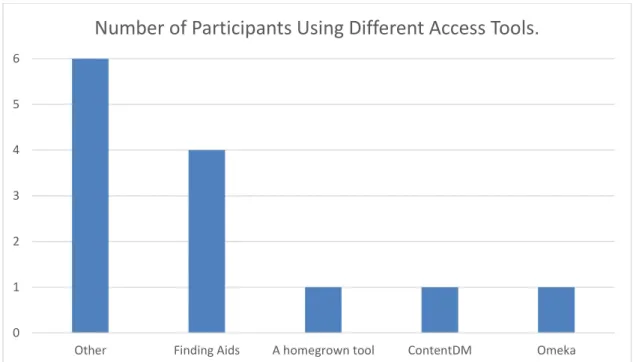
By far the most common way archivist provide access to activist social media is through archival finding aids. Four of the eight archivists reported using finding aids (50%). All four of them provided more information about how access would occur in the open response section available after this after this question. One of these revealed that they have not begun providing access to social media content, but that it will be
discoverable in a finding aid, and access will likely occur onsite in a reading room. Another of these respondents revealed that they do not have a way of providing access to born-digital material through the finding aid, but they are able to for digitized collections at their repository. The way she/he described it is, “We provide access to digital imager and some documents through finding aids, but we do not have method for serving up born digital material in any meaningful way, yet (especially not social media content).” Two of these respondents explained that they have another discoverability tool in addition to finding aids. One uses the Wayback Machine, which is the publically
FIGURE 4: Number of Participants Using Different Access Tools
Other methods for providing access included one respondent who uses Omeka (13%), one respondent who uses ContentDM (13%), one respondent who uses a homegrown tool (13%), and one respondent who described using another tool not provided as an option on the survey (13%). This last respondent clarified by explaining that “perma.cc is public,” perma.cc being their harvesting tool.
3.3 Project Management
Adding a new collecting initiative at an existing archive or cultural heritage institution would naturally require aspects of project management, like managing staff time and available funds. Questions regarding project management reveal how much, if any, extra staff or time social media collecting activity accrued for these projects. In the surveys participants were only asked about the source of their funds. More information regarding project management issues came out during the interviews.
0 1 2 3 4 5 6
Other Finding Aids A homegrown tool ContentDM Omeka
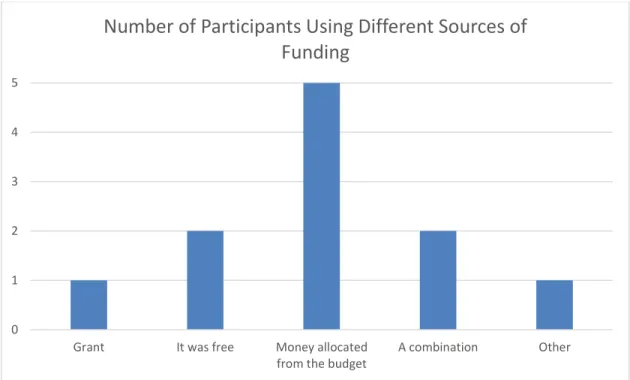
FIGURE 5: Number of Participants Using Different Sources of Funding
Eleven participants answered this question. The most common source for the projects funding was “Money allocated from the library or department budget.” Five archivists chose this answer (45%). Presumably, this response could mean that it fell within the normal work activity supported by their unit, or that more money was provided by the department for the project, as one participant clarified the project was “part of the web archiving service already in place for the library.” Two archivists reported that it was free (18%). Perhaps indicating that it fell within their normal work responsibilities and/or used free tools. One respondent had the work supported by a grant (9%). The one
respondent who marked “other” explained that he/she “shifted priorities to focus on this work in my day to day role.” This is similar to how respondents interpreted the option: “Money allocated from the library or department budget.” Finally, two respondents indicated that it was supported using a combination of these methods (18%).
0 1 2 3 4 5
Grant It was free Money allocated from the budget
A combination Other
3.4 Challenges
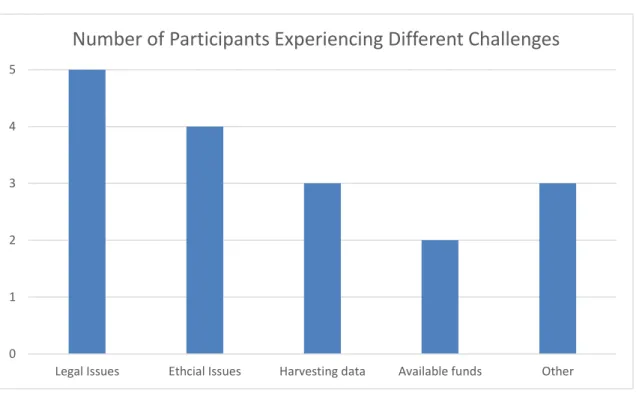
Eight participants chose from a list of possible broad-challenges that could occur when collecting activist social media. The most commonly reported challenge was concerns over Legal Issues. Five participants claimed that this had been a challenge for their project (63%). Four participants reported that ethical issues had been a concern (50%), while three people reported that harvesting data was a challenge (38%). Finally, only two people found funding their project difficult (25%).
FIGURE 6: Number of Participants Experiencing Different Challenges
Three people claimed other challenges, which they elaborated on. Two of these participants described issues that might be described as “curatorial.” For example, one respondent explains that for them it is difficult to determine the value of different platforms taking into consideration how different activist groups use them. She/he explains that for sites like Twitter of Facebook sometimes it is enough to capture a small sample of what is there; accurately capturing the whole page does not add more value.
0 1 2 3 4 5
Legal Issues Ethcial Issues Harvesting data Available funds Other
Whereas, for him/her, “a separate problem exists with YouTube and Vimeo, which are usually lumped in as ‘social media’ but can be carriers for serious content not available elsewhere.” For social media related to a particular activist organization that they capture “it can be a problem to identify them in the first place…Again, the problem with this is mostly knowing it is there to go after.” Similarly another respondent explicitly describes their challenges as “curatorial, like time and awareness to develop a comprehensive profile of accounts to be tracked.”
The third person described their main challenge being that their institution is expected to adopt Archive-It but has taken a long time to do it. As a result the current tool they use is good at capturing simple pages but dynamic pages do not work as well. So they are having trouble capturing a wide variety of pages because they are waiting for an institution-wide tool adoption.
3.5 Outcomes
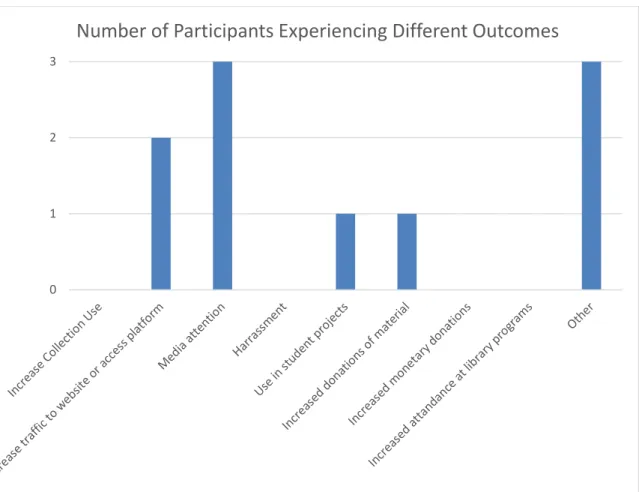
FIGURE 7: Number of Participants Experiencing Different Outcomes
Three respondents indicated that they had received media attention regarding their activist oriented collecting initiative (60%). Two respondents cited increased traffic to their website or access platform as a result (40%). One respondent indicated that the collection was used in a student project (20%), and one respondent claimed an increase in donations of material to their repository (20%).
Three respondents named other as one outcome of their activist social media collection. In the space provided to clarify this response, one participant explained that before they had no web archives so in that way usage has increased, “but usage is moderate at this point.” Another participant explained that there has been “increased student awareness of the archives and its mission. One student even offered to help
0 1 2 3
promote the archives even more to the student body.” The last participant that marked other explained that they have not promoted the project so they have not experienced any outcome yet. Two other participant who did not check the “other” option also explained a lack of outcomes because the project had not been promoted yet.
3.6 Areas of ambiguity
The participants responded to a free response question asking them what aspects of social media collecting needs to be examined further by professionals and the
professional literature.
TABLE 1: Areas of future research identified by Participants. Mainly of the tools are evolving in use and value.
I myself am curious about what the use cases in the future for Facebook pages will be. Is it going to be drilling down and seeing the exchanges of annoyance and anger about social issue X on the Facebook of some organization? Or use of a large set of Facebook pages for text analysis? Or evidentiary, that is, to demonstrate that despite statements to the contrary, organization X did say Y on date Z. For a particular organization, I can see that having an accurate archive of the organization's own Facebook etc can be useful if not critical for evidentiary and records management type reasons. However if we are talking about large publishing organizations, I am not so sure (as I have already
suggested) that worrying about social media isn't a distant second to the need to archive the organization's site fully and accurately, which I think is assumed to be simpler than it often is for organizations with big sites.
Data preservation and privacy issues are always tough
More attention needs to be invested into obtaining consent of content creators.
We'd like to perform a more thorough analysis of the ethical considerations of harvesting and preserving social media data, especially of social media users who are not aware of our collecting initiative. Generally speaking, the archival community could develop some "better practices" when it comes to collecting, describing, and providing access to these sorts of data.
As Table 1 indicates, only one participant was curious about the usability and value in different harvesting tools. The most mentioned area of future study was the ethics of collecting social media, particularly activist social media. Whereas, the most common area where people would like to see more research was on ethical issues surrounding consent and privacy for the people or groups whose social media they
Interview results
I conducted three interviews with archivists collecting social media from activist groups. Some commonalities exist between the settings and the projects, while there are some differences as well. Overall, the experiences of these archivists provide some insight into challenges, concerns, and continued areas of ambiguity for archivists collecting activist social media. The similarities in the way they have imagined their projects may provide some guidance for similar projects at other places.
All three interviewees are digital archivists at universities with large library systems. Each project is referred to by an assigned project number. I have done my best leave out information that might identify the specific project, or the people who work on the project. I will first describe the major contextual aspects of their activist collecting initiative or social media project, followed by a discussion of each projects responses on seven themes that developed. The main themes I identified were 1) collection
development, 2) access, 3) project management, 4) acquiring permission or consent, 5) challenges, 6) outcomes, and 7) areas for future research.
4.1 Project 1
The institution where Project 1 is held has been collecting social media for several years. The university library collected Instagram photos related to student engagement with the library. After completing this project, they applied for and received a grant to explore social media collecting further. During work on the grant, a violent event
and Instagram data from a specific hashtag related to this event. Because of the hatred involved with the event, there were many posts under these hashtags that related to activist or advocacy messages documenting both sides of the social conflict. So unlike other two projects, Project 1 did not start as a specific activist-oriented collecting initiative, and is not focused on a particular group.
4.2 Project 2
At the university where Project 2 is hosted, there was increase in activism on campus during 2014 and 2015. This was not the only university to experience an increase in activism that year. One or two student groups held sit-ins on campus in the Fall of 2015. Frequent turnover in leadership for these student groups due to graduation, meant that it was important to collect their records soon. The university archive launched an initiative to collect the records of activist student organizations at the University. The archives held two collection drives, one in the student center and one in the archives which is farther away from the center of campus and would offer group members some anonymity. When they advertised these drives they explained that they would take any kind of record, from traditional analog material to email archives and social media accounts. They had a better turn out at the drive held in archive, which surprised them because much fewer students visit the building or know much about the archives.
4.3 Project 3
this initiative though they began collecting the blogs of these student groups, they have only recently began outreach efforts publicizing their activist student group collecting initiative and have not received any new materials yet.
4.4 Collection Development
Project 1. The university archives at this institution collects social media using a variety of methods including Social Feed Manager, Twarc, and a home-grown software tool. Social Feed Manager collects social media accounts, which they use to collect the accounts of different University affiliated accounts. However, most of their activist content comes through their hashtag based collecting. The other two tools also generate a dataset.
Project 1 was also very clear about how they decide what social media content to collect:
The way that we’ve tried to approach our collecting is to align decisions about what data to harvest, to align those with established collecting strengths… [we] build collections in those areas, and the accounts, and keywords, and hashtags should ideally map to one or more of those existing collecting areas… we’re not collecting all of Twitter which was not the work we wanted to do.. So how do you cut into this social media? Well, what do your researchers want to see? What your researchers might be expecting is just the content you’re already collecting.
Project 2. The archivist on this project said, “I could see a case where someone
accounts using Archive-It. This specific project was the first time that they had crawled a Facebook page.
Project 2 did also identify some relevant social media content to be included in their collection. They crawled relevant social media feeds from on campus news
organizations that provided coverage of activist events, especially during two very active days in Fall 2015, however they hid the crawled content from public view. Afterwards they sought permission from these organizations to preserve and provide access what they harvested.
Project 3. When they were deciding what content to harvest they focused on student blogs. They said, “Student blogs have been a really big part of the longer form conversation around what’s going on.” This project was one way that Martin imagined trying to diversify the collection as they have no other material related to student activism in their school’s library. An activist oriented collection diversifies the collection, “in the sense of who racially is represented but also by the types of materials we’re pulling together.” Their archive has always said that it would collect student papers, but has not done so up until now. Their archive uses perma.cc because it is a free tool that easily and accurately captures web content. They are hoping to begin working with Archive-It soon, once their whole library system adopts its use.
4.5 Access
collection. They know that it would be difficult and time consuming to get express permission from every social media user who posted using the hashtag they are harvesting. For this reason, they do not feel comfortable sharing the data on the open web. Additionally, there are social media Terms of Service conditions they might be violating providing that much content online. They are imagining moderated access where, though the content might be publically available, a researcher would only be able to view the data in their reading room, or by providing Tweet IDs that the researcher could then “hydrate” themselves through the Twitter API. The archivist on Project 1 says, “I don’t think we would make the Instagram content available on the open web except for cases where we got permission from the people who either took or posted the photos.” The data that they collect would be discoverable through the university’s EAD and DACS compliant finding aids once they do begin providing access.
Project 2. To provide access to the collections Project 2’s archive is using
Finding Aids and the Internet Archive’s Wayback Machine. That means that people can discover the social media content through the finding aids at the University or through keyword searches on the Wayback Machine. They have mirrored the metadata about each collection on both the Finding Aids (using EAD and DACS) and the Wayback Machine (using Dublin Core). Four collections from different activist student groups have already been made available at his University.
Project 3. Similarly, the archive at this university plans to provide access through their archive’s finding aids (using EAD and DACS), which are also found in their
student organization and receive any other material from them. They say that they are, “open to trying a lot of different access points,” but has had a chance to give it much thought so he was not sure what form it might take for social media.
4.6 Project Management
Project 1. The project was mostly funded via the grant that they received with the rest of the cost being absorbed by existing library funds. There have been about five staff members and number of students working on the project. The staff includes three digital project staff from different departments, the University Archivist who is the curator for the collection, and a legal expert. These last two people are only involved on areas of the project that match their expertise when needed. Two of the digital project staff dedicate the most time to the project with support from the third staff member and the other students. The staff members mostly work on developing the software to harvest social media data, since they are using homegrown open-sourced methods to collect the data.
Project 2. There have been a total of five staff members supporting this initiative across the rare books and special collections library at this university. Four of them work in the University Archives and one other person from a different department who helped reach out to student groups to publicize the collection drives. They also have a student who recently started to help out with the outreach efforts among student groups. They consider the work to be part of their normal responsibilities and they have not received additional monetary support for the work.
beginning a web archiving program since they could not wait for Archive-It to be
implemented at their institution to capture this content. They also have the support of the outreach working group at their archive, which is led by the outreach librarian and made up of people throughout the library. They spread news of new projects or programs over social media and other outlets. They also have one student worker helping them harvest blog content. There has been no additional funds given to their department to support this work. They have absorbed it as part of their normal responsibilities.
4.7 Acquiring permission or consent
Project 1. The staff on this project know that it would be difficult and time consuming to get express permission from every social media user who posted using the hashtag they are harvesting. For this reason, they do not feel comfortable sharing the data on the open web. Additionally, there are social media Terms of Service conditions they might be violating providing access to large datasets online. They are imagining
moderated access, where though the content might be publically available, a researcher would only be able to view the data in their reading room, or by providing Tweet IDs that the researcher could then “hydrate” themselves through the Twitter API. They say “I don’t think we would make the Instagram content available on the open web except for cases where we got permission from the people who either took or posted the photos.”
Because the project did not start as a specific initiative to collect activist records and because they are harvesting hashtags, they have not so far worked closely with the advocacy groups on either side of the conflict they are documenting.
Project 2. Staff on this project “didn’t want to capture without their consent,” but