Religious Cognition and Moral Cognition
Alex Martin
1, Joshua Conrad-Jackson
1, Kurt Gray
1IRB Approval: 9/27/17
Abstract
Previous research has shown a connection between religious belief and morality— primarily that religious people both (a) tend to be more prosocial in their behavior, and (b) tend to judge moral infractions in a more categorical or deontological way. The current research looks to further explore the extent to which religious and non-religious people differ in moral
judgements of immoral actions, as well as evaluate the evidence for theoretical explanations of these differences. We found that religious people rated all moral infractions as more severe than non-religious people and were less sensitive to the severity of actions. These results conflict with previous theories for differences in moral cognition. Limitations and future directions are
Acknowledgements
I would like to acknowledge those that have been tremendously helpful in finishing this thesis and vital to my growth as a researcher, as this is the culmination of many people’s work. First and foremost, I would like to thank my faculty and graduate student advisers on this project, Dr. Kurt Gray and Joshua Jackson, for helping me learn the research process and for all of their hard work towards the completion of this project. Second, I would like to thank Dr. Viji Sathy for teaching me the statistical underpinnings of all psychological research, as well as providing me the opportunity to test my research skills in our Makerspace project where she has been an outstanding adviser and fellow collaborator. Third, I would like to thank Dr. Jonathan Abramowitz, Jennifer Buchholz, and Lillian Reuman for introducing me to the area of
psychology on which I wish to eventually focus my career and for helping me develop
professionally. Everyone mentioned above has challenged me to think critically about my work, and that has helped me improve as a researcher. Without them, I would not be where I am today.
I would also like to acknowledge my friends and family for always being there for me, keeping me honest about my schooling, and pushing me to grow as a person. Angela, Todd, Eric, Miriam, Alexandra, Jacob, and Jeremy have all been vital to my success here at Carolina.
Without all of their encouragement, support, and advice, I would not have been able to
accomplish all that I have during my time as an undergraduate—and for that I am truly grateful. Lastly, I would like to thank the Tom and Elizabeth Long Excellence Fund for Honors administered by Honors Carolina. Without their support, I would not have been able to run my study and complete my project.
Religious Cognition and Moral Cognition
How does religious belief influence our moral convictions? This question is rooted in the history of philosophy and religious thought, recurring across the writings of various theologians and modern philosophers of religion, but it has recently become an issue of much broader public interest due to recent increases in secularization in Western countries. Secularization in the West has now led many people to question whether religious belief is necessary to be a good person, but the vast majority of people around the world still believe that morality is impossible without religious belief (Gervais, Shariff, & Norenzayan, 2011; Shariff, Piazza, & Kramer, 2014). This debate over religion and morality has produced a surge of recent psychological research on religion and morality, which largely show that religious people are stricter moral judges than non-religious people.
There have been two popular explanations for these findings. In one, religious people are stricter moral judges because the rule-based moral tenets of many religions encourage
deontological thinking—a categorical discrimination between right and wrong. In the other, religious people are stricter moral judges because they fear supernatural retribution for immoral thoughts and behaviors. Here, we evaluate support for the first of these theories by testing the relationship between religious cognition and moral judgment across 100 moral transgressions that vary in their severity. We first test whether religious people have higher moral standards when evaluating these acts. We then evaluate evidence that these concerns are driven by deontological thinking. Our results shed light on the reasons why religion encourages harsher moral judgments.
A lot of the early research on religion’s psychological effects had focused on whether religion made you more prosocial—or outwardly moral towards others. Research actually showed that religious people tended to do things like give more to charity than non-religious people (Brewer, 1999; Graham & Haidt, 2010). Aside from naturalistic or behavioral studies on religion’s effects, researchers started to introduce laboratory studies into the mix to give more experimental (or causal) results. In these studies, researchers would subject participants to religious ideas (like church or God), which would make these concepts more mentally available, and then they would see how primed participants reacted differently to study-related tasks when compared to participants that did not receive the religious prime (Pichon, Boccato, & Saroglou, 2007). And in these religious priming studies, participants primed with religious concepts tended to express more positive traits like not cheating on study-related tasks (Randolph-Seng &
Nielsen, 2007), greater honesty (Aveyard, 2014), greater generosity (Shariff & Norenzayan, 2007), and greater self-control (Rounding, Lee, Jacobson, & Ji, 2012). Another prosocial characteristic one may have includes one’s submissiveness, which has been shown to be linked with religion through priming and general experimental manipulation (Baumeister, Masicampo, & DeWall, 2009; Saroglou, Corneille, & Cappellen, 2009).
A popular explanation for the prosocial effects of religion and how they might influence one’s moral judgments comes from the idea that God monitors everyone’s behavior and
monitoring the behavior of community members. In fact, people that believe in a harsher and more punitive God tend to minimize self-responsibility for punishing others for misdeeds as well as minimize endorsement of state-sponsored punishment for criminals (Laurin, Shariff, Henrich, & Kay, 2012). It is thought that this is because people feel that God will eventually punish wrongdoers in the afterlife, so it is less necessary to punish them now (especially at the expense of one’s own moral standing should they feel personally responsible for punishing another person). But punishment is a very salient issue for people, especially when power dynamics are in play. This can be seen particularly in children who are told that there is someone watching over them making them less likely to cheat on a study-related task (Piazza, Bering, & Ingram, 2011). Piazza, Bering, and Ingram (2011) found that children cheated on a task at similar rates if they were told that there was an invisible princess, Alice, in the room with them as they did when told that an actual adult was watching over them. Both cheating rates were lower than children who were not told anything about someone watching over them.
Another popular explanation for these effects is what we will call the “Deontological Hypothesis.” Essentially, religion causes people to think differently about morality such that they 1) hold genuinely different opinions about moral matters than non-religious people, and 2) behave differently as a result of these altered views of morality. The reason we are calling it the “Deontological Hypothesis” is because religious people tend to be more deontological in their moral reasoning (i.e. they follow explicit rules and are less likely to justify certain acts regardless of circumstances), whereas non-religious people tend to be more consequentialist and are,
religious—then it is probably because your moral cognitions differ in such a way as to make immoral things seem more immoral to you than how a non-religious person might see them from their perspective.
But if religion were to have this supposedly uniform effect on our moral cognitions as is predicted by the deontological hypothesis, we would be able to predict how people or countries would behave based on how religious they are (especially for similar religion types, like
Christianity, Judaism, etc.). However, this is not the case. While some research does show that general religious belief flourishes in countries where economic security is low (Paul, 2010), research has actually shown that, on a nation level, what specific beliefs or tenets are emphasized by the population matters in things like how much crime occurs in that particular country
(Shariff & Rhemtulla, 2012). Shariff and Rhemtulla (2012) found that when comparing belief in Hell to belief in Heaven, (% Believe in Heaven – % Believe in Hell), for 67 countries, the greater focus a country’s population puts on Heaven over Hell, the more crime they experience.
Additionally, these proportions of Heaven/Hell belief predicted most crimes far and above other predictors like GDP or societal happiness. These effects of Hell versus Heaven beliefs do not only occur on national levels, either. Individuals in a cheating task study tended to cheat less on the task if their conception of God was more negative or punitive (Shariff & Norenzayan, 2011). For young adults and adults, this trend is suggested to be related to a lack of wanting to be punished supernaturally (even for innocuous immoral actions, like seeing the answer on a mathematical task)—and even if the participant does not consciously believe they will be punished for such an infraction.
The current project uses a novel paradigm designed by our lab in which online survey participants rank how “immoral” an action is on a scale of 0-100 (with 0 being “Not at all immoral” and 100 being “Very immoral.” The actions themselves vary in severity from being innocuous tasks like “walking to class” to something as extreme as “releasing smallpox in Times Square,” for example. We will be using this paradigm to test only one of the proposed
explanations above—the deontological hypothesis.
Looking at how religious people and non-religious people currently differ in their moral cognition (i.e. that religious people are more deontological in their moral beliefs than non-religious people, who are generally more consequentialist), we believe that non-religious people will rank actions that have more severe consequences but do not violate moral rules as being less immoral than non-religious people; similarly, we believe that they will rank actions that have
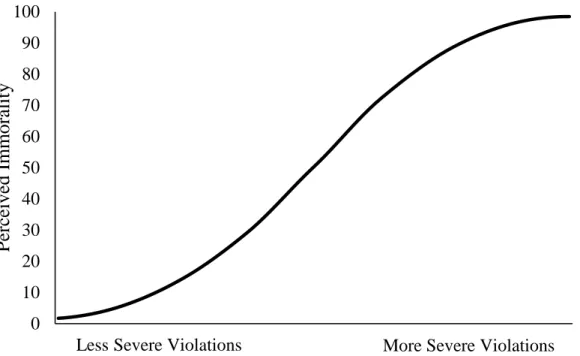
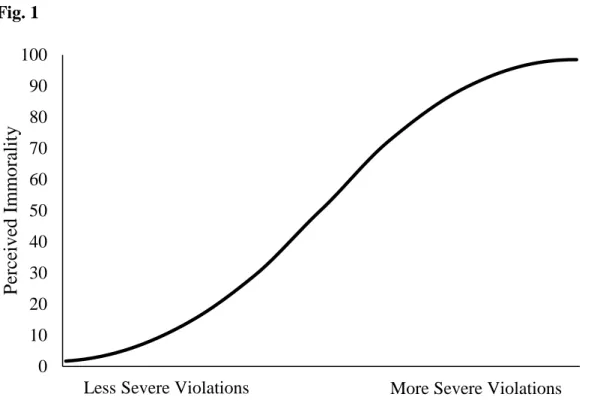
Figure 1: The moral cliff. Recent research has identified a non-linear curve in people’s moral
judgments. People will see less severe transgressions as similarly low in immorality, and more
severe transgressions as similarly high in immorality, with a steep gradient of change in
between. The religion and deontology hypothesis predicts that this non-linearity should be
largest for religious individuals.
As such, our specific hypotheses for this study are as follows:
1) Religious individuals will view immoral actions as being more immoral than non-religious people.
2) Religious individuals will have a steeper “moral cliff” than non-religious people—they will justify more extreme minor infractions and will condemn less extreme major infractions.
0 10 20 30 40 50 60 70 80 90 100
Perceived
Im
m
oralit
y
In our study, we attempted to identify a significant difference between how religious and non-religious people view the morality of 100 actions ranging in severity from walking to class to detonating an atomic bomb in a densely populated city.
Method
Participants
We received 283 responses from a recruited 256 participants (Mage = 36.33, SDage =
10.93; 55% male, and 45% female) from Amazon’s Mechanical Turk—an online survey distribution platform; exclusion criteria were that participants had to be at least 18 years of age and live within the United States. In our sample, 54.5% of participants identified as Christian, 41.4% of participants identified as non-religious, and 4.1% of participants identified themselves into other religious categories like Muslim, Jewish, etc.
Measures
Immoral Actions
We came up with 100 different actions that varied in severity from “Shaving your beard” to “Firing a rifle into a crowd of people.” Participants would then use a sliding scale to rank how immoral a randomly selected 20 of these 100 actions were from 0-100, with 0 being “Not
immoral at all” and 100 being “Very immoral.” We wanted to have a fairly equal distribution of actions’ severities between these two extremes as well, so we were sure to include items like “Not saying ‘bless you’ when someone sneezes,” “Flicking someone’s ear for your own
amusement,” “Spitting in someone’s food,” and “Body shaming a slightly overweight woman.” In addition to having a fairly equal distribution across immorality severities, we were also aware of specificity in actions that may leave too much interpreted by participants as to create
had to get rid of the question of whether or not someone might have killed the person they then consumed (which would alter how one person views the morality of that action)—so we put “Cannibalism of a person’s body you found in the woods.” If you look at Appendix A, you can see all of the items as well as their ratings of severity (out of 100) across all participants.
Religious Morality Scale
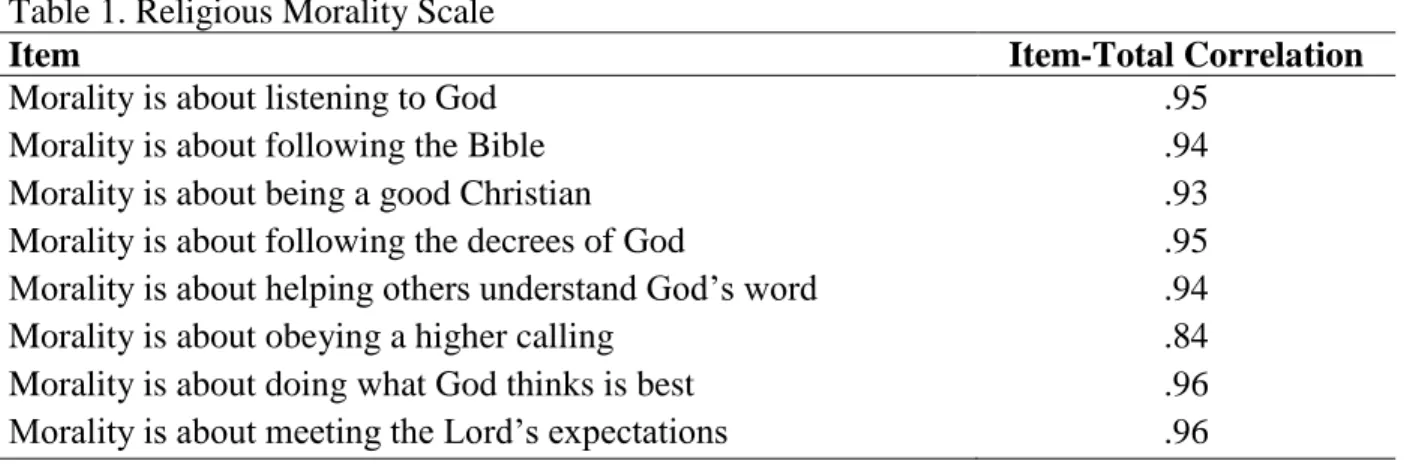
Next, participants were asked to use a seven-point Likert scale—(“Strongly Disagree” to “Strongly Agree”)—to rate their agreement with eight statements about the nature of morality and whether it originates from sources pertaining to religion; items included “Morality is about doing what God thinks is best” and “Morality is about following the Bible.” This measure was created by the graduate and faculty adviser of this project for the purposes of this study, and it showed high reliability (a = .98). Table 1 shows all items in this measure as well as the item-total correlations found through scale reliability calculations. Appendix B shows the exact layout of the measure as seen in the survey.
Table 1. Religious Morality Scale
Item Item-Total Correlation
Morality is about listening to God .95
Morality is about following the Bible .94
Morality is about being a good Christian .93
Morality is about following the decrees of God .95
Morality is about helping others understand God’s word .94
Morality is about obeying a higher calling .84
Morality is about doing what God thinks is best .96
Morality is about meeting the Lord’s expectations .96
Supernatural Belief Scale
all-powerful, all-knowing spiritual being, whom we might call God,” and “There is some kind of life after death” (Jong & Halberstadt, 2016). There is a slightly longer version of this measure (the SBS-10), but the additional items were geared more for Abrahamic religions and we wanted to track religious belief globally as opposed to particular religions (despite our sample being largely Christian). Also, we wanted to keep the survey short enough to where the participants did not suffer from survey fatigue. Appendix C shows all of the items in this measure as well as the measure layout within the survey.
Demographics
Lastly, participants were asked to fill in a standard demographics questionnaire involving race, gender, religious affiliation, income and beliefs of social stature, relationship status, and education level.
Procedure
After consenting to participate in our study, respondents were given 20 randomly selected moral violations (from a pool of 100) and were told to rank these from a scale of 0 (Not at all Immoral) to 100 (Very Immoral). We selected 20 of the 100 transgressions to avoid participants becoming fatigued. Participants then completed our measures of religiosity, and demographic information. This study design involved no experimental manipulations. All participants were run using the same experimental protocol.
Data Analysis Plan
be accounted for by modeling participant effects. Each of our models also controlled for variance in participants’ income, education, gender, and age using multiple regression, in order to isolate the unique variance associated with morality and religious belief (as opposed to other likely environmental factors associated with religious and moral beliefs).
We fit three models to test our research question. First, we tested whether religious belief predicted higher ratings of severity across violations, which would be evidence that religion encourages higher moral standards. Then, we tested for whether religious and non-religious people showed different discrimination between low- and high-severity acts.
For our third analysis, we centered severity ratings within participants in order to test level-1 differences (differences in severity ratings within participants) without confounding level-2 effects (differences in severity ratings between participants). We also estimated the steepness of a non-linear logarithmic curve rather than a linear function, to compare the steepness of the “moral cliff” across religious and non-religious participants.
Results
Does Religious Belief Encourage Higher Moral Standards than Non-Belief?
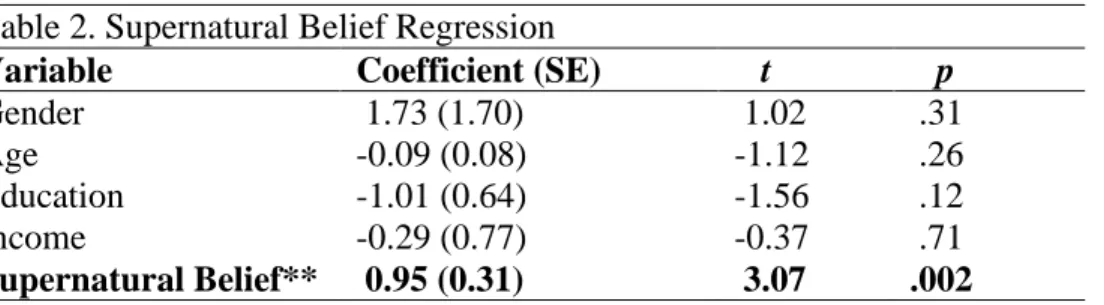
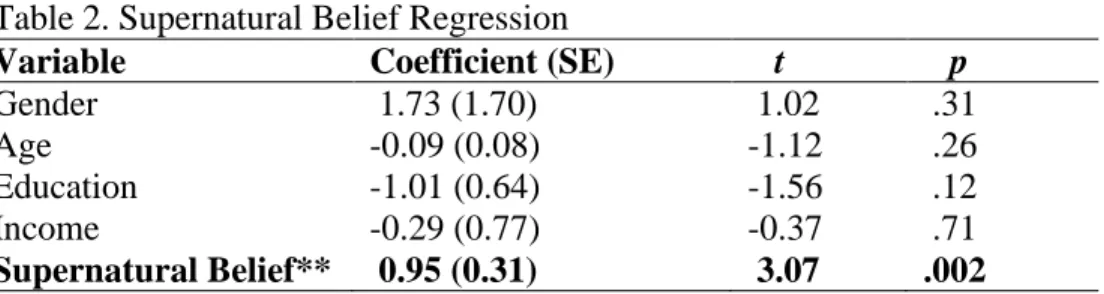
Religious belief encouraged higher moral standards. In our multiple regression, belief linearly predicted ratings of moral severity, even after controlling for gender, age, education, and income. See Table 2 for this multiple regression.
Table 2. Supernatural Belief Regression
Variable Coefficient (SE) t p
Gender 1.73 (1.70) 1.02 .31
Age -0.09 (0.08) -1.12 .26
Education -1.01 (0.64) -1.56 .12
Income -0.29 (0.77) -0.37 .71
Supernatural Belief** 0.95 (0.31) 3.07 .002
What we see from this analysis is that supernatural belief is a statistically significant unique, positive predictor of severity rankings, such that participants with greater supernatural beliefs tend to give higher ratings of immorality of similar actions when compared to participants with lesser supernatural beliefs, [t(239) = 3.07, p = .002].
This analysis replicated, and was slightly more robust, when we used ratings of religious morality rather than religious belief. See Table 3 for this multiple regression.
Table 3. Religious Morality Regression
Variable Coefficient (SE) t p
Gender 1.66 (1.66) 1.00 .32
Age -0.08 (0.08) -1.01 .31
Education -1.13 (0.64) -1.79 .08
Income -0.64 (0.76) -0.85 .40
Religious Morality*** 1.52 (0.42) 3.61 < .001
(* = significant at a = .05, ** = significant at a = .01, *** = significant at a = .001) What we see from this analysis is that one’s belief that morality originates from
religion/God is a statistically significant unique, positive predictor of severity rankings, such that participants who give greater endorsement of a tethering of religion and morality tend to give higher ratings of immorality of similar actions when compared to participants who endorsed these opinions less, [t(238) = 3.61, p < .001].
Is Religious Morality Driven by Deontological Thinking?
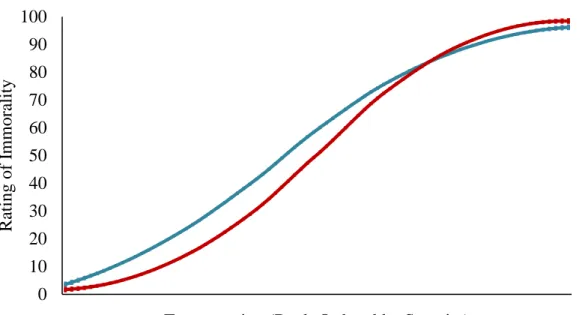
high-religious morality, and Figure 6 is a graph that compares the plots of both of these groups together.
Figures 2-3: These two plots are for low-religious morality participants.
Figure 6: Here is a graph comparing the slopes of high- and low-religious morality participants.
It shows that High-Religious Morality participants (generally more religious people as well),
rate low-severity actions as being more immoral than high-religious morality participants (less
religious people).
Looking at the combined graph isolating the best fit lines for high- and low-religious morality participants, we see that the high-religious morality participants rated the less severe moral transgressions as being more immoral than low-religious morality participants—and that low-religious morality participants have higher sensitivity to the severity of actions such that they discern more explicitly between high- and low-severity transgressions.
Discussion
We have found preliminary evidence confirming that religious people tend to be harsher moral judges than non-religious people do. This effect was amplified when looking at whether people believed religion was a prerequisite for morality. These findings are in accordance with previous research, even after controlling for other personal factors such as income, education,
0 10 20 30 40 50 60 70 80 90 100 R ati ng of I mm ora li ty
gender, and age. The reason for adding in this additional control is largely because of the socialization which tends to direct religious belief (i.e. how one is raised or how one interacts with their surroundings influences their religious beliefs, so controlling for things which might indicate similarities in socialization helps control across similar backgrounds but different religious beliefs) (see Cornwall, 1987; Ozorak, 1989 for further related background).
As for the Deontological Hypothesis, our results did not show support for the idea that religious people are more deontological in their moral reasoning. However, it is possible that we incorrectly constructed the idea of how deontological reasoning would graph onto moral severity ratings such that our results do not contradict this hypothesis (or might actually support it). For example, deontological reasoning for religious people could simply apply a categorical standard to the rules in which they consider morality-relevant. In such a scenario, religious people would have all of the social moral rules that non-religious people have, but on top of that have rules dictated to them by their religious beliefs—all of which they simply treat in a black and white way. Meaning that religious people would have an expanded set of morally relevant beliefs and any violations to those rules result in judgements of immorality, thereby leading to higher
rankings earlier on in the graph, (perhaps things like “getting an abortion at 4 weeks”), as well as a flatter moral severity ratings line due to the heightened ratings altogether. Despite the
One limitation to this study is that we were not able to include supernatural punishment in our analysis as none of the measures directly looked at these sorts of religious belief.
However, a good future direction would be to include such a measure in a follow-up or
replication study. That would allow us to look at empirical support (or lack thereof) for the two hypotheses that attempt to explain why religious people are harsher moral judges. Furthermore, being able to find a measure that looks at how deontological a person is to then match up to moral severity ratings would be an additional way to test the deontological hypothesis (so as to ensure our construction of what “more deontological” results might look like is, in fact, correct.
Additionally, being able to run future studies that could experimentally manipulate different aspects of religious belief would allow us to track causal relationships between religious cognitions and moral cognitions.
An additional limitation is that we were not able to include political beliefs in our regression analyses to control for any unique influence that they had on moral severity ratings. As part of a potential replication/follow-up study, adding in political orientation to the survey would help in isolating religious cognitions in predictive models.
References
Aveyard, M. E. (2014). A Call to Honesty: Extending Religious Priming of Moral Behavior to Middle Eastern Muslims. PLoS ONE, 9(7). https://doi.org/10.1371/journal.pone.0099447 Baumeister, R. F., Masicampo, E. J., & DeWall, C. N. (2009). Prosocial Benefits of Feeling
Free: Disbelief in Free Will Increases Aggression and Reduces. Pers Soc Psychol Bull,
35(260), 260–268. https://doi.org/10.1177/0146167208327217
Brewer, M. B. (1999). The Psychology of Prejudice: Ingroup Love or Outgroup Hate? Journal of Social Issues, 55(3), 429–444. Retrieved from
https://pdfs.semanticscholar.org/6a77/3d4e73794ebfe7e0a82dd24ba51727a4fbd0.pdf Cornwall, M. (1987). The Social Bases of Religion: A Study of Factors Influencing Religious
Belief and Commitment. Review of Religious Research, 29(1), 44–56. Retrieved from http://www.jstor.org/stable/pdf/3511951.pdf?refreqid=excelsior:5e5bc65b7959d5411f8a3eb 2c597cd45
Gervais, W. M., Shariff, A. F., & Norenzayan, A. (2011). Do You Believe in Atheists? Distrust Is Central to Anti-Atheist Prejudice. Per and Soc Psych, 101(6), 1189–1206.
https://doi.org/10.1037/a0025882
Graham, J., & Haidt, J. (2010). Beyond Beliefs: Religions Bind Individuals Into Moral Communities. Pers Soc Psychol Rev, 14(1), 140–150.
https://doi.org/10.1177/1088868309353415
Jong, J., & Halberstadt, J. (2016). Death Anxiety and Religious Belief : An Existential Psychology of Religion. London, UK: Bloomsbury Academic.
https://doi.org/10.5040/9781474297813
Pierro, A. (2015). The Rocky Road From Attitudes to Behaviors: Charting the Goal Systemic Course of Actions. Psychological Review. https://doi.org/10.1037/a0039541 Laurin, K., Shariff, A. F., Henrich, J., & Kay, A. C. (2012). Outsourcing punishment to God:
beliefs in divine control reduce earthly punishment. Proc. R. Soc. B, 279, 3272–3281. https://doi.org/10.1098/rspb.2012.0615
Norenzayan, A., Shariff, A. F., Gervais, W. M., Willard, A. K., McNamara, R. A., Slingerland, E., & Henrich, J. (2016). The cultural evolution of prosocial religions. Behavioral and Brain Sciences, 39. https://doi.org/10.1017/S0140525X14001356
Ozorak, E. W. (1989). Social and Cognitive Influences on the Development of Religious Beliefs and Commitment in Adolescence. Journal for the Scientific Study of Religion, 28(4), 448– 463. Retrieved from
http://www.jstor.org/stable/pdf/1386576.pdf?refreqid=excelsior:d8273956832f2e329c5192 b32d6c829f
Paul, G. S. (2010). Religiosity Tied to Socioeconomic Status. Science, 327(5966), 642–642. https://doi.org/10.1126/science.327.5966.642-b
Piazza, J., Bering, J. M., & Ingram, G. (2011). Princess Alice is watching you’’: Children’s belief in an invisible person inhibits cheating. Journal of Experimental Child Psychology,
109, 311–320. https://doi.org/10.1016/j.jecp.2011.02.003
Piazza, J., & Sousa, P. (2014). Religiosity, Political Orientation, and Consequentialist Moral Thinking. Social Psychology and Personality Science, 5(3), 334–342.
https://doi.org/10.1177/1948550613492826
https://doi.org/10.1002/ejsp.416
Randolph-Seng, B., & Nielsen, M. E. (2007). Honesty: One Effect of Primed Religious Presentations. International Journal for the Psychology of Religion, 17(4), 303–315. Retrieved from
https://www.researchgate.net/profile/Michael_Nielsen5/publication/233090394_Honesty_O ne_Effect_of_Primed_Religious_Representations/links/00b49522b45f84d466000000.pdf Rounding, K., Lee, A., Jacobson, J. A., & Ji, L.-J. (2012). Religion Replenishes Self-Control.
Psychological Science, 23(6), 635–642. https://doi.org/10.1177/0956797611431987 Saroglou, V., Corneille, O., & Cappellen, P. Van. (2009). “Speak, Lord, your servant is
listening”: Religious priming activates submissive thoughts and behaviors. The International Journal for the Psychology of Religion, 19(3), 143–154. Retrieved from http://citeseerx.ist.psu.edu/viewdoc/download?doi=10.1.1.544.8959&rep=rep1&type=pdf Shariff, A. F., & Norenzayan, A. (2007). God Is Watching You: Priming God Concepts
Increases Prosocial Behavior in an Anonymous Economic Game. Psychological Science,
18(9), 803–809. Retrieved from
http://www.jstor.org/stable/pdf/40064818.pdf?refreqid=excelsior%3A07c7465b0e65610e7d d26f90124afeb6
Shariff, A. F., & Norenzayan, A. (2011). Mean Gods Make Good People: Different Views of God Predict Cheating Behavior. The International Journal for the Psychology of Religion,
21(2), 85–96. https://doi.org/10.1080/10508619.2011.556990
Shariff, A. F., Piazza, J., & Kramer, S. R. (2014). Morality and the religious mind: why theists and nontheists differ. Trends in Cognitive Sciences, 18(9), 439–441.
Shariff, A. F., & Rhemtulla, M. (2012). Divergent Effects of Beliefs in Heaven and Hell on National Crime Rates. PLoS ONE, 7(6). https://doi.org/10.1371/
Shariff, A. F., Willard, A. K., Andersen, T., & Norenzayan, A. (2016). Religious Priming: A Meta-Analysis With a Focus on Prosociality. Personality and Social Psychology Review,
20(1), 27–48. https://doi.org/10.1177/1088868314568811
Vohs, K. D., & Schooler, J. W. (2008). The Value of Believing in Free Will. Psychological Science, 19(1), 49–54. Retrieved from
http://www.jstor.org/stable/pdf/40064799.pdf?refreqid=excelsior:209f3f916425895b03c836 41a82171d5
Tables Table 1
Table 1. Religious Morality Scale
Item Item-Total Correlation
Morality is about listening to God .95
Morality is about following the Bible .94
Morality is about being a good Christian .93
Morality is about following the decrees of God .95
Morality is about helping others understand God’s word .94
Morality is about obeying a higher calling .84
Morality is about doing what God thinks is best .96
Morality is about meeting the Lord’s expectations .96
Table 2
Table 2. Supernatural Belief Regression
Variable Coefficient (SE) t p
Gender 1.73 (1.70) 1.02 .31
Age -0.09 (0.08) -1.12 .26
Education -1.01 (0.64) -1.56 .12
Income -0.29 (0.77) -0.37 .71
Supernatural Belief** 0.95 (0.31) 3.07 .002
Table 3
Table 3. Religious Morality Regression
Variable Coefficient (SE) t p
Gender 1.66 (1.66) 1.00 .32
Age -0.08 (0.08) -1.01 .31
Education -1.13 (0.64) -1.79 .08
Income -0.64 (0.76) -0.85 .40
Figures Fig. 1
Figure 1 Caption:
The moral cliff. Recent research has identified a non-linear curve in people’s moral judgments.
People will see less severe transgressions as similarly low in immorality, and more severe
transgressions as similarly high in immorality, with a steep gradient of change in between. The
religion and deontology hypothesis predicts that this non-linearity should be largest for religious
individuals.
(Next figures on next page.) 0
10 20 30 40 50 60 70 80 90 100
Perceived
Im
m
oralit
y
Figs. 2-3
Figures 2-3 Caption:
These two plots are for low-religious morality participants.
Figs. 4-5
Figures 4-5 Caption:
These two plots are for high-religious morality participants.
Fig. 6
Figure 6 Caption:
Here is a graph comparing the slopes of high- and low-religious morality participants. It shows
that High-Religious Morality participants (generally more religious people as well), rate
low-severity actions as being more immoral than high-religious morality participants (less religious
people).
0 10 20 30 40 50 60 70 80 90 100
R
ati
ng
of I
mm
ora
li
ty
Appendices Appendix A
Immoral Actions
Rank Violation Rating
1 Shaving your beard to look better 3.690476
2 Making a sandwich to eat 4.660714
3 Taking the bus to work 4.836735
4 Going to the dentist for a clean-up 5
5 Go-karting in your free time 5.285714
6 Playing video games in your free time 5.756757
7 Going to the park during your day off work 6.326531
8 Drinking a glass of wine with dinner 6.98
9 Walking to class during class change 7.555556
10 Not saying "bless you" when someone sneezes 9.955556
11 Watching a movie in your free time 9.979167
12 Getting a piercing in your ear 11.70492
13 Failing a course at college 13.39623
14 Stating the opinion that a band isn't good 13.65116
15 Handing out flyers to people in a public space 15.31915
16 Rear-ending another driver accidentally 15.58929
17 Getting a tattoo of a bird 16.52381
18 Hitting someone with a bad frisbee throw 17.29412
19 Handing out raisins on Halloween 17.77778
20 Running a red light while taking your wife who's in labor to the hospital 17.94828
21 Mailing a letter without enough postage 18.4
22 Wearing a short dress to walk around town 21.80851
23 Texting during a movie 22.23256
24 Marrying someone of the same sex 22.63889
25 Forgetting a romantic relationship's anniversary 22.75
26 Sleeping during a lecture 22.86047
27 Gambling with disposable income 29.30952
28 Spanking your child after they curse/swear 29.61111
29 Scaring someone as a prank 29.66667
30 Not wiping down the fitness machine when you're done using it 30.36364
31 Taking the Lord's name in vain 31.34884
32 Kneeling during the National Anthem 34.39535
33 Watching pornography for sexual pleasure 35.3
34 Passing gas in a crowded elevator 35.89796
35 Sneaking into a movie you're not old enough to see 36.63462 36 Playing loud music in a dormitory during finals week 37.73913
37 Downloading pirated music 38.49091
38 Stealing post-it notes from work 39.77551
39 Cheating in a game of Monopoly 40.59091
41 Having an abortion 4 weeks into pregnancy 40.78689 42 Purposefully eavesdropping on a private conversation 42.28302
43 Not tipping your server after good service 44.98077
44 Flicking someone's ear for your own amusement 45.73333
45 Burning the American Flag in protest 46.25
46 Tricking someone into listen to a 3-hour timeshare presentation 46.84211
47 Coughing on someone while sick 51.5
48 Burning the American Flag for no reason 51.5
49 Texting an unimportant message while driving 51.74
50 Cat-calling a lady walking down the street 54.8125
51 Running a red light because you didn't want to wait 57
52 Take a hit of meth 58.23729
53 Deforesting for land development 58.59524
54 Selling fake nuclear weapons to terrorists 59.74138
55 Unknowingly give someone HIV through unprotected sex 59.75472
56 Bribing an officer to get out of a ticket 63.96667
57 Refusing to vaccinate your child 64.71429
58 Peeing in holy water 64.83333
59 Starting a cult you don't believe in 65.94118
60 Having sex with a 15 year-old when you're 18 years old 66.70833
61 Borrowing someone's car without asking 67.02778
62 Rioting after a sports-team win 68.93182
63 Having an abortion 7 months into pregnancy 69
64 Using legislative power to further your own interests 70.92
65 Cheating on your partner 72.8913
66 Using a racial slur towards a minority 72.94231
67 Burning down a building with nobody in it 73.65385
68 Yelling "fire" in a crowded theater 73.80851
69 Body shaming a slightly overweight woman 75.9
70 Punching someone in the face when they upset you 76.83333
71 Spitting in someone's food 78.22222
72 Hunting an endangered species (not to extinction) 78.58974 73 Picking someone's pocket and taking their wallet 79.33333
74 Incest with your sibling 80.34091
75 Drinking and driving when you can afford an Uber 80.49091
76 Burning a cross in a black family's yard 81.34
77 Falsifying medical research to push forward an ineffectual drug 82.32653 78 Convincing someone their mother died when she didn't 82.38
79 Smoking a pack a day while pregnant 83.10909
80 Sexually grabbing a stranger on the street 85.76364
81 Stealing from the church collection plate 85.81395
82 Cannibalism of a person's body you found in the woods 86.53704
83 Stealing a car from a parking lot 87.39474
84 Buying a slave in modern day to do all your housework 87.78723
Appendix B
Religious Morality Scale “Please rate the degree to which you agree with these statements.”
Strongly Somewhat Neither Agree Somewhat Strongly Disagree Disagree Disagree Nor Disagree Agree Agree Agree
(1) (2) (3) (4) (5) (6) (7)
Statement Score
Morality is about listening to God Morality is about following the Bible Morality is about being a good Christian Morality is about following the decrees of God
Morality is about helping others understanding God’s word Morality is about answering a higher calling
Morality is about doing what God thinks is best Morality is about meeting the Lord’s expectations
(Last Appendix on next page.)
86 Poking a hole in someone else's condom 87.96154
87 Robbing a bank at gunpoint 88.2439
88 Stabbing someone who angered you 88.2449
89 Having sex with your partner with knowledge that you are HIV positive 89.28846 90 Ordering all members of a racial group to live in an internment camp 90.625
91 Releasing smallpox in Times Square 90.66071
92 Encouraging someone to kill themselves (they don't do it) 90.75676 93 Flaying someone (removing someone's skin) for amusement 91.48718 94 Watching child pornography someone else gave you 91.8
95 Starving a population on purpose 93.33333
96 Forcing a 14 year-old girl to become a prostitute 93.39024
97 Selling nuclear weapons to terrorists 93.64706
98 Detonating an atomic bomb in a large city 94.73333
99 Selling your daughter into prostitution 96.32
Appendix C
Supernatural Belief Scale
“Please indicate your agreement with the following statements, using the scale below:” Strongly Somewhat Neither Agree Somewhat Strongly Disagree Disagree Disagree Nor Disagree Agree Agree Agree
(-4) (-3) (-2) (-1) (0) (1) (2) (3) (4)
Statement Score
There exists an all-powerful, all-knowing spiritual being, whom we might call God.
There exist spiritual beings, who might be good or evil, such as angels or demons.
Every human being has a spirit or soul that is separate from the physical body. There is some kind of life after death.
There is a spiritual realm besides the physical one.