Body-specific Co-rumination: Relationship with Anxiety, Self-esteem, and Body Dissatisfaction in College Women
Kaitlin Doyle
The University of North Carolina at Chapel Hill Spring 2013
A thesis presented to the faculty of The University of North Carolina at Chapel Hill in partial fulfillment of the requirements for the Bachelor of Arts degree with Honors in
Psychology
Committee Chair: Anna Bardone-Cone, Ph.D. Committee Member: Sara Algoe, Ph.D.
Acknowledgments
Abstract
Body-specific Co-rumination: Relationship with Anxiety, Self-esteem, and Body Dissatisfaction in College Women
Co-rumination, or excessively discussing problems, is a fairly new and complex construct in psychological research. Several aspects of co-rumination include mutual dyadic
encouragement of problem talk, rehashing problems, speculating about problems, and focusing on negative affect (Rose, 2002). Co-rumination is associated with adaptive and maladaptive social, emotional, and physical outcomes, particularly in girls and women. For example, co-rumination is associated with the positive outcome of greater friendship quality, but also the negative outcomes of depression, anxiety, and increased stress hormones (Byrd-Craven, Geary, Rose, & Ponzi, 2008; Rose, 2002; Rose, Carlson, & Waller, 2007). Previous research indicates that females co-ruminate more than males and only females experience increased anxiety and general internalizing symptoms associated with this behavior (Rose, Carlson, & Waller, 2007; Schwartz-Mette & Rose, 2012; Tompkins, Hockett, Abraibesh, & Witt, 2011)
Previous research on co-rumination has only focused on general problem talk. To our knowledge, no studies exist that examine co-ruminating about specific problems, especially those that may be salient to women, such as body and appearance concerns. Female
to capture the types of co-rumination females engage in related to body concerns. In this study we will examine the relationship between body-specific co-rumination and anxiety, self-esteem, and body dissatisfaction. Furthermore, we will investigate whether these relationships are moderated by appearance-contingent self-worth and social comparison.
While body-specific co-rumination is a new and unstudied construct, it synthesizes aspects of several related constructs – co-rumination, fat talk, and self-objectification. As noted, general rumination, as has been examined so far, lacks the specificity of body-specific co-rumination. Fat talk, or “highly ritualized conversation… involving explicit negative self-statements, physical appearance complaints, and weight management tips” (Martz, Petroff, Curtin, & Bazzini, 2009, p.34) captures aspects of negatively-valenced body talk. However, fat talk is much more public and social (e.g., often engaged in with multiple friends at a time) than co-rumination which is done with a close friend in a dyadic format. On the other hand, self-objectification, which refers to viewing one’s body as an object, taking on the others’ (an outsider’s) perspective of one’s body, and focusing on the body’s appearance rather than functions (Breines, Crocker, & Garcia, 2008), reflects a focus on appearance, but on an
intrapersonal, non-interactive level. Given the novelty of body-specific co-rumination, we will review literature on the related constructs of general co-rumination, fat talk, and
self-objectification in relation to our outcomes of interest: anxiety, self-esteem, and body dissatisfaction.
Co-rumination, Fat Talk, and Self-objectification in Relation to Anxiety, Self-esteem, and Body Dissatisfaction
their male counterparts only experience greater friendship quality as a result of this behavior (Rose et al., 2007; Tompkins et al., 2011). Rose suggests that the relationship between co-rumination and anxiety is particularly detrimental because it can create a snowball effect whereby increases in anxiety foster increased co-rumination which in turn contributes to more anxiety (Rose et al., 2007). To our knowledge, no research has examined relations between co-rumination and either self-esteem or body dissatisfaction.
Empirical work supports negative effects of fat talk and, due to the similarities between fat talk and body-specific co-rumination, such work provides some theoretical insight about the effects of negatively focused body conversations. First, fat talk is associated with increased body dissatisfaction and sociocultural pressure to be thin (Arroyo & Harwood, 2012; Tucker, Martz, Curtin, & Bazzini, 2007). Second, Arroyo and Harwood (2012) also found that although fat talk did not specifically predict decreased self-esteem over time, it did mediate the relationships between body dissatisfaction and esteem as well as between pressure to be thin and self-esteem, suggesting that fat talk may be a mechanism linking body image issues with broader self-concept concerns. Research also shows that body dissatisfaction predicts increased fat talk, suggesting a cyclical “snowball effect” similar to that of co-rumination and anxiety (Arroyo & Harwood, 2012). To date, no research has examined fat talk in relation to anxiety.
be thought of as repeatedly engaging in self-objectification with a close psychological other, or best friend. Self-objectification and body surveillance (the behavioral manifestation of self-objectification) are related to appearance anxiety, body shame, and disordered eating
(Tiggemann & Williams, 2012). Increased self-objectification is also associated with decreased self-esteem and decreased well-being in general, suggesting that when women view their bodies and appearance from an outsider’s perspective, they feel worse (Breines et al., 2008). Given the theoretical link between self-objectification and body-specific rumination, body-specific co-rumination will likely also have damaging effects in the realms of anxiety, self-esteem, and body dissatisfaction.
Interactive Models: Appearance-contingent Self-worth and Social Comparison as Moderators
Some women may be especially vulnerable to the anxiety, low self-esteem, and body dissatisfaction that body-specific co-rumination is thought to produce, while other women may be less affected and even view these conversations as casual chatting with a friend. Appearance-contingent self-worth and social comparison may be moderators that explain women’s different experiences and consequences of body-specific co-rumination.
A contingency of self-worth is a domain in which a person stakes his or her sense of value, with self-esteem depending on successes or failures in that domain (Crocker & Wolfe, 2001). Appearance-contingent self-worth is a contingency in which one evaluates oneself based on physical appearance (Crocker, Luhtanen, Cooper, & Bouvrette, 2003). External contingencies of self-worth, like appearance-contingent self-worth, are related to low self-esteem, body
worse as a result of self-objectification than those with low appearance-contingent self-worth and those with high appearance-contingent self-worth and high self-esteem. Thus, it is important to note that appearance-contingent self-worth can affect women’s state self-esteem differently, depending on the extent to which women stake their self-worth in their appearance (Breines et al., 2008). Theoretically, if women have high appearance-contingent self-worth then co-ruminating on body flaws will affect overall self-esteem and body dissatisfaction more than women with low appearance-contingent self-worth.
Social comparison is another potential moderator of the relationship between body-specific co-rumination and anxiety, self-esteem, and body dissatisfaction. According to
The Current Study
The current study tests three hypotheses: 1) Higher levels of body-specific co-rumination with a close friend will be associated with higher levels of anxiety, lower levels of self-esteem, and higher levels of body dissatisfaction; 2) Appearance-contingent self-worth will moderate these relationships such that the combination of high levels of body-specific co-rumination and high appearance-contingent self-worth will identify the most negative outcomes in terms of anxiety, self-esteem, and body dissatisfaction; and 3) Social comparison will moderate these relationships such that the combination of high levels of body-specific co-rumination and high levels of social comparison will identify the most negative outcomes in terms of anxiety, self-esteem, and body dissatisfaction.
Method Participants
Participants were 441 female undergraduate college students from a large, public Southeastern university who were recruited from an introductory psychology course. The mean age was 18.71 years (SD = 1.01). Based on self-report, the sample was 73.2% Caucasian/White, 9.1% African American/Black, 5% Asian, 8% Hispanic/Latina, and 4.7% other/ multiple
races/ethnicities. The average body mass index (BMI) for participants was 22.39 kg/m2 (SD = 3.73). The mean highest level of parental education attained (a proxy for socioeconomic status) was 17.01 years (SD = 2.67), which is the equivalent of about one year of post-baccalaureate schooling.
Procedure
co-rumination habits, anxiety, esteem, body dissatisfaction, appearance-contingent self-worth, social comparison, and other measures related to peers and body image using the Qualtrics survey program. The survey took approximately 45 minutes to an hour to complete. Upon completion participants received an electronic debriefing and research credit for their psychology course for participation in the study. The study was approved by the university’s Institutional Review Board.
Measures
Body-specific co-rumination. The measure of body-specific co-rumination was adapted from Rose’s (2002) measure of co-rumination by adding phrasing related to weight and eating. The modified measure asks about co-rumination behaviors on the topics of weight, eating, and feelings about one’s body with the subject’s best or closest female friend. The original phrasing of Rose’s (2002) measure was kept as intact as possible. For example, the original item “When one of us has a problem, we talk to each other about it for a long time” was changed to “When one of us initiates discussion about her weight problems or issues, we talk to each other about it for a long time.” Our 9-item measure was rated on a 5-point Likert scale (1 = Not at all true to 5
= Really true), with higher scores reflecting greater body-specific co-rumination with one’s
closest female friend. Previous research using Rose’s co-rumination measure has shown good internal consistency (e.g., α = .97; Rose et al., 2007) in a sample of male and female children and adolescents. In the present study α = .90.
of anxiety. In previous research the STAI has shown high internal consistency (e.g. mean α = .91; Barnes, Harp, & Jung, 2002). Previous research also demonstrates the STAI’s construct validity. For example, responses to the state anxiety scale vary given different stressors, but responses to the trait anxiety scale remain stable (Hedberg, 1972). The trait anxiety scale also distinguishes individuals with anxiety disorders from those without anxiety disorders (Watson & Clark, 1984) and correlates highly with other negative affectivity measures (Taylor, Koch, & McNally, 1992). In the present study α = .94.
Self-esteem. Trait self-esteem was assessed using the Rosenberg Self-Esteem Scale (RSES; Rosenberg, 1965). This 10-item measure is scored on a 4-point Likert scale (1 = strongly
agree to 4 = strongly disagree), and recoded so that higher scores indicate higher self-esteem. A
sample item is, “On the whole, I am satisfied with myself.” Previous research with college women has shown high internal consistency (α = .93) and good convergent validity with another measure of self-esteem (Tylka & Sabik, 2010). In the present study α = .92.
Body Dissatisfaction. Body dissatisfaction was measured using the Weight Concern and Shape Concern subscales of the Eating Disorder Examination-Questionnaire (EDE-Q; Fairburn & Beglin, 2008). The 12 items that make up these two subscales assess weight and shape dissatisfaction over the past 28 days; items are scored from 0 to 6 (0 = no days to 6 = every day or 0 = not at all to 6 = markedly, depending on the question), with higher scores indicating greater weight and shape concerns. A sample item is “On how many of the past 28 days have you felt fat?” Previous research with the Weight Concern and Shape Concern subscales in
weight and shape concern correlating significantly with the questionnaire version (Grilo, Masheb, &Wilson, 2001). In the current sample α = .95.
Appearance-contingent self-worth. Appearance contingent self-worth was assessed with the appearance subscale of Crocker’s contingencies of self-worth questionnaire (Crocker et al., 2003). This 5-item subscale is scored on a 7-point Likert scale (1 = strongly disagree to 7 =
strongly agree), with higher scores reflecting greater appearance contingent self-worth. A sample
item is “When I think I look attractive, I feel good about myself.” Crocker et al. (2003) reported good construct and discriminant validity in a sample of college students for all contingencies of self-worth subscales (including appearance) and specifically noted that it is distinct from other measures of self-esteem. Previous research with the appearance subscale in a female college student sample yielded a coefficient alpha of .72 (Thøgersen-Ntoumani, Ntoumanis, Cumming, & Chatzisarantis, 2011). In the present study α= .76.
Social comparison. Social comparison was measured using the Body, Eating, and Exercise Comparison Orientation Measure (BEECOM; Fitzsimmons-Craft, Bardone-Cone, & Harney, 2012). This 18-item measure is scored on a 7-point Likert scale (1 = never to 7 =
always), with higher scores indicating more social comparison. A sample item is “I pay attention
to whether or not I am as thin as, or thinner than, my peers.” Fitzsimmons-Craft et al. reported good internal consistency and construct validity in college women, including high correlations with other measures of social comparison. In the present study α = .97.
Data Analysis Plan
significant correlations. To test the hypotheses of the moderator models, hierarchical multiple regression analyses were conducted following the guidelines in Cohen, Cohen, West, and Aiken (2003) and centering the continuous variables entering in interactions (Frazier, Tix, & Barron, 2004). In Step 1, the independent variables of body-specific co-rumination and the moderator (e.g., appearance-contingent self-worth) were entered simultaneously, and in Step 2, the two-way interaction of body-specific co-rumination and the moderator (e.g., body-specific co-rumination x appearance-contingent self-worth) were entered. These same steps were used in a separate analysis with social comparison as the moderator. Separate regression analyses were run for the dependent variables of anxiety, self-esteem, and body dissatisfaction. Significant interactions were graphed to identify the nature of the interaction. For dependent variables significantly correlated with BMI, the regression analyses included BMI as a covariate.
Results
The means, standard deviations, and correlations for the study variables are presented in Table 1. The mean level of body-specific co-rumination observed in this sample of
undergraduate women was close to 2, indicating low levels of body-specific co-rumination on average, although the full range from 1 to 5 was represented in the sample. Body-specific co-rumination was significantly, positively related to both moderators: appearance contingent self-worth (r = .28, p < .001) and social comparison (r = .50, p < .001). Furthermore, both
Relations Between Body-specific Co-rumination and Anxiety, Self-esteem, and Body Dissatisfaction
As predicted, body-specific co-rumination was significantly positively correlated with anxiety (r = .30, p < .001), significantly negatively correlated with self-esteem (r = -.29, p < .001), and significantly positively correlated with body dissatisfaction (r = .47, p < .001), as seen in Table 1.
Interactive Models Involving Body-specific Co-rumination and Appearance-contingent Self-worth
None of the interactions between body-specific co-rumination and appearance-contingent self-worth yielded significant results, as seen in Table 2. Specifically, the interaction of body-specific co-rumination and appearance-contingent self-worth was not significant in identifying levels of anxiety (t(417) =.25, ΔR2 =.00, p = .802), self-esteem (t(424) = -.42, ΔR2 =.00, p = .673) or body dissatisfaction (t(431) = -.26, ΔR2 =.00, p = .794).
Interactive Models Involving Body-specific Co-rumination and Social Comparison
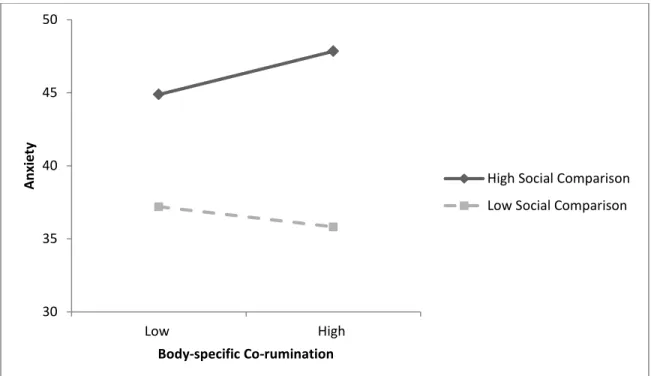
The interaction of body-specific co-rumination and social comparison was significant in identifying levels of anxiety (t(378) = 2.13 , ΔR2 = .01, p = .034) (see Table 3). Figure 1 depicts the nature of this interaction, with high and low levels of the independent variables determined by using one standard deviation above and one standard deviation below the mean, respectively, for all figures. Women who reported high levels of body-specific co-rumination and high levels of social comparison exhibited the greatest amount of anxiety.
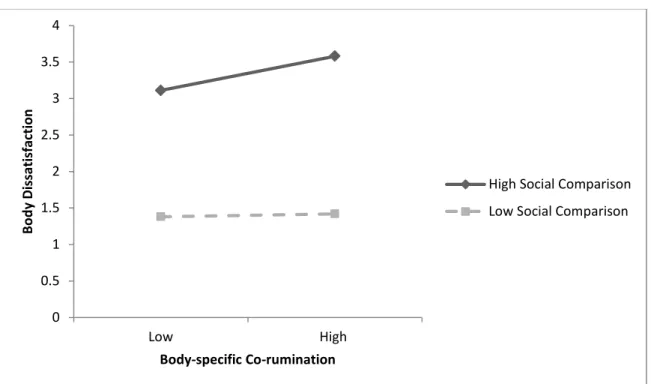
The interaction of body-specific co-rumination and social comparison was significant in identifying levels of body dissatisfaction (t(388) = 1.98, ΔR2 = .004, p = .048) (see Table 3). The nature of this interaction is shown in Figure 2, demonstrating that women who reported high levels of body-specific co-rumination and high levels of social comparison exhibited the greatest amount of body dissatisfaction.
Discussion
The current study examined a new construct, body-specific co-rumination, or repeatedly engaging in appearance-focused problem talk with a best friend, and its relationship with three key variables: anxiety, self-esteem, and body dissatisfaction. We also examined the interactions between body-specific co-rumination and the hypothesized moderators of appearance-contingent self-worth and social comparison. Findings indicated that that body-specific co-rumination is associated with the three dependent variables as predicted, and that the combination of high body-specific co-rumination and high social comparison is particularly detrimental for young women in terms of anxiety and body dissatisfaction.
to test the directionality between body-specific co-rumination, and co-rumination in general, and anxiety, self-esteem, body dissatisfaction, and other areas of self-concept.
The interaction of body-specific co-rumination and appearance-contingent self-worth did not yield any significant findings in identifying levels of anxiety, self-esteem, or body
dissatisfaction. One possible explanation for the lack of a significant interaction has to do with the phrasing used in the body-specific co-rumination measure. For instance, many questions use the pronoun “we,” as in “When we talk about weight, eating, or the way we feel about our bodies, we’ll talk about it over and over.” This phrasing does not allow us to tease out whether one friend is doing more talking or listening. While appearance-contingent self-worth and body-specific co-rumination are positively correlated, perhaps women who are high in appearance-contingent self-worth do more listening than talking in co-ruminating conversations as a way to protect a domain that their self-worth is staked on (their appearance) and thus are also protected some from co-rumination’s negative. Perhaps a group with high appearance-contingent self-worth who does talk negatively about their bodies in a co-ruminating way would exhibit the highest levels of anxiety and body dissatisfaction and the lowest levels of self-esteem. Additional research with a modified questionnaire that explicitly assesses the degree of talking and listening in body-specific co-rumination or follow-up questions is essential, however, to test this theory.
and body dissatisfaction. This significant interactive model holds promise for clinical
implications in treating women struggling with body image concerns or anxiety. For example, should the relationship between the variables be causal, altering either behavior (body-specific co-rumination or social comparison) should alleviate symptoms of anxiety and body
dissatisfaction. These findings also open the door for researching links between social comparison and both general co-rumination and other content-specific co-rumination, which could examine many problems women face and perhaps compare and co-ruminate about in their daily lives (e.g., relationships, work, family, etc.). As for the non-significant interaction of body-specific co-rumination and social comparison in identifying levels of self-esteem, we note that the relationship between general co-rumination and self-esteem has never been examined and further research is needed to see if these results can be replicated.
One major strength of this study is its novelty in relation to previous research on co-rumination. First off, body-specific co-rumination is a completely new construct that has never been examined before, even though excessively discussing body-related problems with a close friend is a familiar phenomenon to most women and, indeed, is partially characterized by fat talk (Arroyo & Harwood, 2012). Another novel aspect of the current study is the sample of college-aged women, as most co-rumination research has focused on children and adolescents.
One limitation of this study is its cross-sectional design. Although associations emerged between body-specific co-rumination and anxiety, self-esteem, and body dissatisfaction, the nature of the relationships is correlational and causation cannot be established. Another
limitation is generalizability; using a sample of college women aged 18-25 means that the results may not generalize to other age groups or to non-college, same-aged peers. A final limitation comes from using a modified measure for body-specific co-rumination. Although the measure of body-specific co-rumination does not have well-established psychometrics, the measure was modified from a measure with strong psychometric support and the alpha in our sample was excellent (α = .90).
Future research should implement an experimental design to test whether body-specific co-rumination has any causal effects on anxiety, self-esteem, and body dissatisfaction. Particular attention should be paid to scenarios involving social comparison as this moderator yielded significant results in the current study. Also, future research may want to test the efficacy of interventions warning women against the potential negative outcomes associated with body-specific co-rumination and social comparison on their own and in combination. Future studies should also test whether depression and greater friendship quality are related to body-specific co-rumination given that more general co-co-rumination is related to these outcomes (Rose, 2007).
References
Arroyo, A., & Harwood, J. (2012). Exploring the causes and consequences of engaging in fat talk. Journal of Applied Communication Research, 40, 167-187.
doi:10.1080/00909882.2012.654500
Bailey, S. D., & Ricciardelli, L. A. (2010). Social comparisons, appearance related comments, contingent self-esteem and their relationships with body dissatisfaction and eating disturbance among women. Eating Behaviors, 11, 107-112.
doi:10.1016/j.eatbeh.2009.12.001
Barnes, L. B., Harp, D., & Jung, W. (2002). Reliability generalization of scores on the
Spielberger State-Trait Anxiety Inventory. Educational and Psychological Measurement, 62, 603-618. doi:10.1177/0013164402062004005
Breines, J. G., Crocker, J., & Garcia, J. A. (2008). Self-objectification and well-being in women's daily lives. Personality and Social Psychology Bulletin, 34, 583-598.
doi:10.1177/0146167207313727
Byrd-Craven, J., Geary, D. C., Rose, A. J., & Ponzi, D. (2008). Co-ruminating increases stress hormone levels in women. Hormones and Behavior, 53(3), 489-492.
doi:10.1016/j.yhbeh.2007.12.002
Cohen, J., Cohen, P., West, S. G., & Aiken, L. S. (2003). Applied multiple regression/correlation
analysis for the behavioral sciences (3rd ed.). Mahwah, NJ US: Lawrence Erlbaum
Associates Publishers.
Corning, A. F., Krumm, A. J., & Smitham, L. A. (2006). Differential social comparison
processes in women with and without eating disorder symptoms. Journal of Counseling
Crocker, J., Luhtanen, R. K., Cooper, M. L., & Bouvrette, A. (2003).Contingencies of self-worth in college students: Theory and measurement. Journal of Personality and Social
Psychology, 85, 894-908.
Crocker, J., & Wolfe, C. T. (2001). Contingencies of self-worth. Psychological Review, 108, 593-623. doi:10.1037/0033-295X.108.3.593
Dittmar, H., & Howard, S. (2004). Thin-Ideal Internalization and Social Comparison Tendency as Moderators of Media Models' Impact on Women's Body-Focused Anxiety. Journal of
Social And Clinical Psychology, 23(6), 768-791. doi:10.1521/jscp.23.6.768.54799
Fairburn, C. G., & Beglin, S. J. (2008). Eating Disorder Examination Questionnaire (EDE-Q 6.0). In Fairburn, C. G. (Ed.) Cognitive behavior therapy and eating disorders. New York, NY: Guilford Press.
Festinger, L. (1954). A theory of social comparison processes. Human Relations, 7, 117-140. doi:10.1177/001872675400700202
Fitzsimmons-Craft, E. E., Bardone-Cone, A. M., & Harney, M. B. (2012). Development and validation of the Body, Eating, and Exercise Comparison Orientation Measure (BEECOM) among college women. Body Image, 9, 476-487.
doi:10.1016/j.bodyim.2012.07.007
Franzoi, S. L., Vasquez, K., Sparapani, E., Frost, K., Martin, J., & Aebly, M. (2012). Exploring body comparison tendencies: Women are self-critical whereas men are self-hopeful.
Psychology of Women Quarterly, 36(1), 99-109. doi:10.1177/0361684311427028
Grilo, C. M., Masheb, R. M., & Wilson, G. (2001). A comparison of different methods for assessing the features of eating disorders in patients with binge eating disorder. Journal
Of Consulting And Clinical Psychology, 69, 317-322. doi:10.1037/0022-006X.69.2.317
Hedberg, A. G. (1972). Review of 'State-Trait Anxiety Inventory'. Professional Psychology, 3, 389-390. doi:10.1037/h0020743
Lin, L. F., & Kulik, J. A. (2002). Social comparison and women's body satisfaction. Basic and
Applied Social Psychology, 24, 115-123. doi:10.1207/153248302753674622
Luce, K.H., & Crowther, J.H. (1999). The reliability of the Eating Disorder Examination – Self-report questionnaire version (EDE-Q). International Journal of Eating Disorders, 25, 349-351. doi:10.1002/(SICI)1098-108X(199904)25:3<349::AID-EAT15>3.0.CO;2-M Martz, D. M., Petroff, A. B., Curtin, L., & Bazzini, D. G. (2009). Gender differences in fat talk among American adults: Results from the psychology of size survey. Sex Roles, 61(1-2), 34-41. doi:10.1007/s11199-009-9587-7
Myers, T. A., Ridolfi, D. R., Crowther, J. H., & Ciesla, J. A. (2012). The impact of appearance-focused social comparisons on body image disturbance in the naturalistic environment: The roles of thin-ideal internalization and feminist beliefs. Body Image, 9, 342-351. doi:10.1016/j.bodyim.2012.03.005
Nichter, M. (2000). Fat talk: What girls and their parents say about dieting (pp. 45-67). Cambridge, MA: Harvard University Press.
Rose, A. J. (2002). Co-rumination in the friendships of girls and boys. Child Development, 73, 1830-1843. doi:10.1111/1467-8624.00509
co-rumination. Developmental Psychology, 43, 1019-1031. doi:10.1037/0012-1649.43.4.1019
Rosenberg, M. (1965). Society and the adolescent self-image. Princeton, NJ: Princeton University Press.
Sanchez, D. T., & Crocker, J. (2005). How investment in gender ideals affects well-being: The role of external contingencies of self worth. Psychology of Women Quarterly, 29, 63-77. Schwartz-Mette, R. A., & Rose, A. J. (2012). Co-rumination mediates contagion of internalizing
symptoms within youths' friendships. Developmental Psychology, 48, 1355-1365. doi:10.1037/a0027484
Spielberger, C.D., Gorsuch, R.L., & Lushene, R.E. (1970). The State-Trait Anxiety Inventory:
Test manual. Palo Alto, CA: Consulting Psychologist Press.
Stice, E. (2002). Risk and maintenance factors for eating pathology: A meta-analytic review.
Psychological Bulletin, 128(5), 825-848. doi:10.1037/0033-2909.128.5.825
Stice, E., & Bearman, S. (2001). Body-image and eating disturbances prospectively predict increases in depressive symptoms in adolescent girls: A growth curve analysis.
Developmental Psychology, 37(5), 597-607. doi:10.1037/0012-1649.37.5.597
Stice, E., Maxfield, J., & Wells, T. (2003). Adverse effects of social pressure to be thin on young women: An experimental investigation of the effects of 'fat talk'. International Journal of
Eating Disorders, 34, 108-117. doi:10.1002/eat.10171
Thøgersen-Ntoumani, C., Ntoumanis, N., Cumming, J., & Chatzisarantis, N. D. (2011). When feeling attractive matters too much to women: A process underpinning the relation between psychological need satisfaction and unhealthy weight control behaviors.
Motivation and Emotion, 35, 413-422. doi:10.1007/s11031-011-9226-9
Tiggemann, M., & Williams, E. (2012). The role of self-objectification in disordered eating, depressed mood, and sexual functioning among women: A comprehensive test of objectification theory. Psychology of Women Quarterly, 36, 66-75.
doi:10.1177/0361684311420250
Tompkins, T. L., Hockett, A. R., Abraibesh, N., & Witt, J. L. (2011). A closer look at co-rumination: Gender, coping, peer functioning and internalizing/externalizing problems.
Journal of Adolescence, 34, 801-811. doi:10.1016/j.adolescence.2011.02.005
Tucker, K. L., Martz, D. M., Curtin, L. A., & Bazzini, D. G. (2007). Examining 'fat talk' experimentally in a female dyad: How are women influenced by another woman's body presentation style?. Body Image, 4, 157-164. doi:10.1016/j.bodyim.2006.12.005
Tylka, T. L., & Sabik, N. J. (2010). Integrating social comparison theory and self-esteem within objectification theory to predict women’s disordered eating. Sex Roles, 63(1-2), 18-31. doi:10.1007/s11199-010-9785-3
Watson, D., & Clark, L. A. (1984). Negative affectivity: The disposition to experience aversive emotional states. Psychological Bulletin, 96(3), 465-490.
Table 1
Correlations, Means, and Standard Deviations of Study Variables (N = 441)
1 2 3 4 5 6 7 M/SDs
1.Body-specific co-rumination — M = 1.82
SD = .78
2. Appearance-contingent SW .28*** — M = 5.12
SD = .94
3.Social comparison (BEECOM) .50*** .47*** — M = 66.99
SD = 23.15
4.Anxiety (STAI) .30*** .52*** .48*** — M = 41.74
SD = 11.05
5.Self-esteem (RSES) -.29*** -.46*** -.43*** -.82*** — M = 31.00
SD = 5.61 6. Body Dissatisfaction (EDE-Q) .47*** .49*** .70*** .55*** -.51*** — M = 2.33
SD = 1.59
7.BMI .16** .07 .20*** .11* -.09 .38*** — M = 23.39
SD = 3.72
Note. SW=self-worth. BEECOM= Body, Eating, and Exercise Comparison Orientation Measure. STAI=Spielberger Trait Anxiety
Table 2
Hierarchical Multiple Regression Analyses Testing Interactive Models Involving Body-specific Co-rumination and Appearance-contingent Self-worth with Dependent Variables of Anxiety, Self-esteem, and Body Dissatisfaction
Note. DV = dependent variable. BMI = body mass index. SW=self-worth. Regression analyses
with the dependent variables of anxiety and body dissatisfaction controlled for BMI given the significant bivariate relations between BMI and each of these two dependent variables. * p < .05. *** p < .001.
Step and predictors B SE B β t (dfs) ΔR2
Step 1 DV= Anxiety .01*
BMI .39 .15 .11* 2.33 (1, 420)
Step 2 .28***
Body-specific co-rumination 2.38 .61 .17*** 3.94 (2, 418) Appearance-contingent SW 5.51 .50 .47*** 10.95 (2, 418)
Step 3 .00
Body-specific co-rumination x appearance-contingent SW
.147 .59 .01 .25 (1,417)
Step 1 DV=Self-esteem .24***
Body-specific co-rumination -1.30 .32 -.18*** -4.06 (2, 425) Appearance-contingent SW -2.48 .26 -.41*** -.938 (2, 425)
Step 2 .00
Body-specific co-rumination x appearance-contingent SW
-.13 .314 -.02 -.42 (1, 424)
Step 1 DV= Body Dissatisfaction .14***
BMI .16 .02 .38*** 8.52 (1,434)
Step 2 .30***
Body-specific co-rumination .64 .08 .31*** 8.26 (2, 432) Appearance-contingent SW .64 .06 .38*** 10.11 (2, 432)
Step 3 .00
Body-specific co-rumination x appearance-contingent SW
Table 3
Hierarchical Multiple Regression Analyses Testing Interactive Models Involving Body-Specific Co-rumination and Social Comparison with Dependent Variables of Anxiety, Self-esteem, and Body Dissatisfaction
Note. DV = dependent variable. BMI = body mass index. Regression analyses with the
dependent variables of anxiety and body dissatisfaction controlled for BMI given the significant bivariate relations between BMI and each of these two dependent variables. * p < .05. ** p < .01. *** p < .001.
Step and predictors B SE B β t (dfs) ΔR2
Step 1 DV= Anxiety .01*
BMI .33 .15 .11* 2.17 (1, 381)
Step 2 .23***
Body-specific co-rumination 1.33 .73 .09 1.81 (2, 379)
Social comparison .21 .03 .43*** 8.22 (2, 379)
Step 3 .01*
Body-specific co-rumination x social comparison
.06 .03 .11* 2.13 (1, 378)
Step 1 DV=Self-esteem .19***
Body-specific co-rumination -.78 .39 -.11* -2.00 (2, 385)
Social comparison -.09 .01 -.37*** -6.97 (2, 385)
Step 2 .002
Body-specific co-rumination x social comparison
-.02 .02 -.05 -1.02 (1,384)
Step 1 DV= Body Dissatisfaction .14***
BMI .16 .02 .37*** 7.98 (1, 391)
Step 2 .42***
Body-specific co-rumination .25 .08 .12** 3.14 (2, 389)
Social comparison .04 .003 .59*** 15.19 (2, 389)
Step 3 .004*
Body-specific co-rumination x social comparison
Figure 1. Interactive findings demonstrating how social comparison moderates the relationship between body-specific co-rumination and anxiety after controlling for body mass index.
30 35 40 45 50
Low High
A
n
xi
e
ty
Body-specific Co-rumination
High Social Comparison
Figure 2. Interactive findings demonstrating how social comparison moderates the relationship between body-specific co-rumination and body dissatisfaction after controlling for body mass index.
0 0.5 1 1.5 2 2.5 3 3.5 4
Low High
B
o
d
y
D
issati
sf
ac
tion
Body-specific Co-rumination
High Social Comparison