PROCESS TECHNOLOGY, CHEMICAL
COMPOSITION AND QUALITY OF "AADUN"
A MAIZE- BASED NIGERIAN SNACK
M.A. IDOWU1* AND S.O. ADEDOKUN21Department of Food Science and Technology, Federal University of Agriculture,
Abeokuta, Nigeria
2Department of Food Technology, The Polytechnic Ibadan, Saki Campus,
Oyo State, Nigeria
*Corresponding author:[email protected]
manufactured from maize include "guguru", " k o k o r o " , " l a n p a t a " , " a b a r i " a n d "aadun" (Oke, 1967; Akinjogbin, 1984; Akin-yele, 1998).
"Aadun" has been described as one of the energy giving snacks commonly consumed by Nigerians and it is predominantly pro-duced in Yoruba speaking areas of South-western Nigeria (Akinyele, 1998). "Aadun" is known for its reddish colour, ease of disinte-gration in the mouth, fine texture and sweet-ness. It is traditionally used for marriages, naming ceremonies and had been eaten in
ABSTRACT
Process technology, chemical composition and sensory quality of "aadun"- a maize based Nigerian snack were investigated. Process technology was established through oral interview and visitation to processors at Abeokuta and Ibadan, while "aadun" samples were evaluated for their chemical compo-sition and sensory quality using laboratory samples as control. Although ingredient compocompo-sition varied widely among processors, roasted maize flour and palm oil constitute about 71 and 27 % of the ingre-dients respectively. Pepper, salt and other spices added up to only 1- 2%. The major unit operations identified in "aadun" processing were: cleaning, roasting, milling, sieving, mixing, molding and packag-ing. "Aadun" was found to be very rich in calorie (495.34- 618.84kcal/ 100g), low in protein (4.95- 6.08%) and a good source of phosphorus (538.45- 600mg/100g) and magnesium (245.05- 255.12mg/100g). Sensory quality of "aadun" is processor dependent as samples differ significantly (p> 0.05) in their colour, aroma, texture and overall acceptability but not in taste. "Aadun" samples generally had low microbial loads with total plate count ranging between 1.2 x10³ and 3.3x10³cfu/g.
Key words: "Aadun", maize snack, process technology, chemical composition, sensory quality
INTRODUCTION
In Nigeria, maize (Zea mays L) is grown an-nually as a single crop or sometimes inter-cropped with legume plants (Okoruwa, 1995). It is the second most important ce-real crop, ranking behind sorghum in the number of people it feeds with an estimated annual production of about 7 million ton-nes (CBN, 2003). Maize is commonly con-sumed as a staple food in form of the meal, flour or starch and as snacks by ordinary cooking or roasting of fresh corn, or modi-fied by fermentation to obtain a product such as "mosa". Other snacks traditionally
Journal of Natural Sciences, Engineering
and Technology
ISSN:
Print - 2277 - 0593 Online - 2315 - 7461
the past by warriors, children, women and people of all ages (Akinjogbin, 1984; Ade-dokun, 2006). However, despite the wide consumption of "aadun", like many other Nigerian traditional snacks, its process tech-nology, chemical composition, sensory quality, storage stability and safety remain largely uninvestigated. Furthermore, its product quality and packaging need to be standardized in order to upgrade the snack to an internationally acceptable product. This paper therefore reports the process technology, chemical composition and sen-sory quality of "aadun", a widely consumed maize-based Nigerian snack. It also pro-vides information on the microbial load of the snack.
MATERIALS AND METHODS
Maize (Zea mays L) grains (white variety), red palm oil, pepper and common salt were purchased from Kuto market, Abeokuta. Commercial "aadun" samples were obtained fresh from processors at Abeokuta and Ibadan.
Investigation of traditional processing technology of "aadun"
To establish traditional method of process-ing "aadun", 3 different processors per loca-tion (Abeokuta and Ibadan) were identified and visited 3 times. Rapid Rural Appraisal technique of oral interview and observation was used since most of the processors were illiterate (Metrick, 1993). Questions were asked to determine the ingredient composi-tion, and unit operations involved in the preparation of "aadun". During each visit, "aadun "samples were produced and sam-ples obtained from the different processors at each location were bulked together as Abeokuta and Ibadan samples. The samples were kept at -18oC inside a REFCO freezer
until use.
Preparation of laboratory "aadun
"samples
Laboratory "aadun" samples were prepared by using the recipe and method of Adedo-kun (2006). The ingredient composition con-sists of roasted maize flour (71.0%), palm oil (27%), pepper (1.57%) and salt (0.34%). Maize grains were cleaned, roasted using an electric hot plate (NAKAI model) at 260- 270oC for 10 minutes, milled (Attrition disc
mill) with dry pepper, sieved (<0.4mm), mixed with red palm oil and salt, molded and packaged in polyethylene and kept at -18oC
inside a REFCO freezer until use.
Chemical analyses
Moisture, crude protein, crude fat, crude fi-bre and total ash were determined using the AOAC (2000) methods; carbohydrate was determined by difference, while energy val-ues were calculated using the Atwater factor (FAO/WHO, 1998). Calcium and magne-sium were determined after wet ashing using the Buck Scientific Atomic Absorption Spec-trophotometer (Model 210). Phosphorus was determined using the vanado- molybdate colorimetric method (Kirk and Sawyer, 1991). Free fatty acid and peroxide values were determined by volumetric method as described by Kirk and Sawyer (1991).
Sensory evaluation
A taste panel evaluation of "aadun" was con-ducted using a panel of 50judges made up of staff and students of the University of Agri-culture, Abeokuta, who are regular consum-ers of the product. The attributes evaluated were colour, aroma, taste, texture and overall acceptability. "Aadun" samples were placed in white ceramic plates at ambient tempera-ture before each tasting session. Ranking method was used where judges were asked
to rank samples according to their prefer-ence, the most preferred was ranked first, while the least preferred sample was ranked last (Iwe, 2002). Responses of the panelist were collated and subjected to statistical analysis of variance using the Microsoft Ex-cel statistical package for data analysis. Means were separated using Duncan's Mul-tiple Range Test (DMRT) to establish if there were significant differences between the samples (Larmond, 1977; Iwe, 2002).
Microbial analyses
Total plate and fungi counts were deter-mined using the method of Harrigan and MacCance (1982) as described by Atanda and Akano (1997). Coliform counts were determined using the method of most prob-able number (MPN). Each of 3 tubes of Lauryl Sulphate tryptose (LST) broth con-taining inverted Durham tube was inocu-lated with 1.0ml from the serial dilution. The LSTs tubes were incubated at 37oC for
48 hours. The tubes showing acid and gas production was recorded while the MPN values were calculated (FAO, 1979).
RESULTS AND DISCUSSION
Process technology of "aadun"
Roasted maize flour (71%) and palm oil (27%) were the main ingredients of "aadun" as revealed by traditional processors of "aadun" from Abeokuta and Ibadan. Dry pepper, common salt and other spices con-sist of about 1-2% of the total weight of the ingredients depending on location or pref-erence of the processor. For samples of "aadun" obtained from Abeokuta, the palm oil was first heated to a high temperature (>100oC) briefly, while pepper and other
spices were fried inside hot oil. This ac-counts for the slightly brown/dark colour of "aadun" from Abeokuta compared with
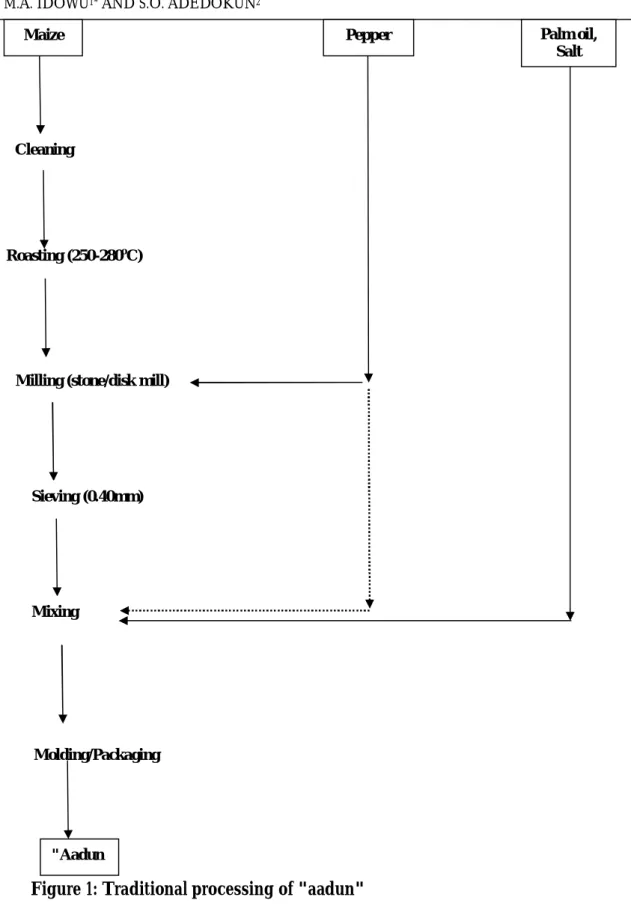
the bright red colour characteristic of Ibadan samples. Although ingredient composition of "aadun" may be location/processor specific, the major unit operations involved in the processing of "aadun" is generally the same, irrespective of location or processor. Hence, the unit operations identified in the tradi-tional processing method of "aadun" were roasting, milling, sieving, mixing, molding and packaging (Fig 1). Roasting of maize grain was achieved inside a frying pan using firewood as source of heat, temperature of roasting therefore varies between 250oC and
280oC since it can not be properly
con-trolled. Roasting to a golden brown colour is often used as index of a well roasted corn. This type of roasting method has also been reported in the preparation of maize- soy mix for production of "ampla"- a Nigerian traditional breakfast meal where maize grains were also roasted to a tan- brown colour (Keku, 2006). Milling of the roasted maize grains could either be done along with dry pepper as ingredient or separately. Where the dry pepper is milled separately, it is added to the roasted maize flour at the mixing stage (Fig 1). Milling is usually done by using attri-tion disc mills without any preset gap be-tween the milling surfaces. Sieving is usually to a particle size of <0.4mm and is achieved manually to obtain a uniform product which is necessary for an acceptable fine texture in "aadun". Mixing of roasted maize flour, dry pepper, palm oil and spices is usually achieved manually by hand. The proper mix-ing of all the mix-ingredients is very essential to the final quality and stability of "aadun". At this stage, palm oil is allowed to percolate all the fine particles of the roasted maize flour, while spices are evenly distributed to achieve a fine texture and uniform product. Molding is done manually inside the packag-ing material which is usually a leaf of
Figure 1: Traditional processing of "aadun" Roasting (250-280oC)
Molding/Packaging
"Aadun
Pepper Palm oil,
Salt Maize
Cleaning
Milling (stone/disk mill)
Sieving (0.40mm)
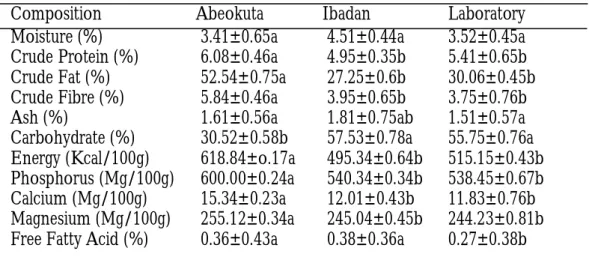
Range of values obtained for crude protein, crude fat, crude fibre, carbohydrate and en-ergy were 4.95±0.35 - 6.08±0.46%, 27.25±0.68 - 52.54±0.75%, 3.75±0.76 - 5.84±0.46%, 30.52±0.58 - 57.53±0.78% and 495.34±0.64 - 618.84±0.17kcal/100g respec-tively. Also range of values for phosphorus, calcium and magnesium were 538.45±0.67 - 600.00±0.24mg/100g, 11.83±0.76 - 15.34±0.23mg/100g and 244.23±0.81 - 255.12±0.34mg/100g respectively. It is ap-parent from the result that "aadun" is low in protein, but high in calories. It also contains appreciable amount of phosphorus and mag-nesium but low in calcium. The free fatty acid and peroxide values of "aadun" samples were also low. The low protein content of "aadun" suggests the need for enrichment with a protein source if consumed in large quantity. In some parts of the country such as Kogi state, cooked beans are often added as an attempt to enrich "aadun" with a pro-tein source. The high calorie content on the other hand is desirable for a snack and could be due to high inclusion of palm oil (27.1%) as ingredient. This high percentage of fat (palm oil) may however predispose "aadun" to oxidation and rancidity during storage (Berk, 1991).
Laboratory "aadun" samples were ranked as the most preferred samples in terms of col-our (1.42±0.05), aroma (1.58±0.73), taste (1.36±0.56), texture (1.62±0.70) and overall acceptability (1.50±0.46) (Table 2). "Aadun samples obtained from Ibadan were ranked next to the Laboratory samples in terms of colour (1.68±0.65), texture (1.70±0.71) and overall acceptability (1.84±0.54), while sam-ples obtained from Abeokuta were the least preferred in terms of colour (2.74±0.60), texture (2.50±0.72) and overall acceptability (2.23±0.57), they were however better rated in their aroma and taste than samples ob-Tomatococcus danielli. Similar use of leaf had
earlier been reported for packaging of "agidi"- a stiff gel of fermented maize (Adeyemi and Oluwamukomi, 1989). Al-though local vendors may present "aadun" to consumers in unpackaged and exposed form, or bulk packaged them in wooden boxes with transparent glass sides exposed to air and sunlight; most of the retail sales of "aadun" are often in leaves. Leaf as a packaging material had earlier been reported to be highly porous and may not offer ade-quate protection for food against microbial and chemical deterioration (UNIFEM, 1996). Information from processors re-vealed that variations in product quality of "aadun" could be due to differences in in-gredient composition, method of process-ing or handlprocess-ing after production. It is there-fore necessary to standardize the ingredient composition and optimize the process tech-nology particularly the roasting, mixing, molding and packaging which were largely achieved manually in the traditional method of processing. A temperature range of 260-270oC was used to roast maize grains in the
preparation of the laboratory "aadun" sam-ples because an electric hot plate was used, thus reducing the wide variation (250- 280oC) in the temperature of roasting used
in the traditional processing method.
Chemical composition, sensory quality and microbial load of "aadun"
"Aadun "samples varied widely and are sig-nificantly different (p>0.05) in their chemi-cal composition except in moisture and ash contents (Table 1). However, "aadun" sam-ples obtained from Ibadan were not signifi-cantly different (p<0.05) from the labora-tory samples in their chemical composition except in percentage free fatty acid and per-oxide value probably due to different sources of palm oil used as ingredients.
accompanied differences in the sensory qual-ity of "aadun" therefore, underscore the need to optimize the particle size, colour and aroma of "aadun" for consistency and inter-national product acceptability. Oyewole (2002) had earlier reported the need for up-grading African foods through optimization of process and packaging to meet interna-tional standards.
"Aadun" samples generally had low total aerobic plate (1.2x 10³ - 3.3x10³ cfu/g) and
fungi (< 10 sfu/g) counts (Table 3). These values are well within the permitted limits of Codex Alimentarius for cereals and derived products (105cfu/g) (Codex, 1990). The
de-tection of coliform in "aadun" samples ob-tained from Ibadan is however not desirable and suggests possible faecal contamination of the samples.
tained from Ibadan. Although "aadun" sam-ples obtained from Ibadan were not signifi-cantly different from the laboratory samples except in aroma; Samples obtained from Abeokuta were significantly different (p>0.05) from Ibadan and laboratory sam-ples in colour, texture and overall accept-ability. All "aadun" samples were however not significantly different (p<0.05) in taste. The observed difference in colour of "aadun" obtained from Abeokuta from the other samples may be due to the pre- frying of the pepper and spices before mixing with the roasted maize flour. The preference of the panelists for colour and texture of the laboratory and Ibadan samples may be a reflection of the attractive carotene (red) colour of palm oil and fine particle size of roasted maize flour used as ingredients. The variation in ingredient composition and the
Composition Abeokuta Ibadan Laboratory
Moisture (%) Crude Protein (%) Crude Fat (%) Crude Fibre (%) Ash (%)
Carbohydrate (%) Energy (Kcal/100g) Phosphorus (Mg/100g) Calcium (Mg/100g) Magnesium (Mg/100g) Free Fatty Acid (%)
3.41±0.65a 6.08±0.46a 52.54±0.75a 5.84±0.46a 1.61±0.56a 30.52±0.58b 618.84±o.17a 600.00±0.24a 15.34±0.23a 255.12±0.34a 0.36±0.43a
4.51±0.44a 4.95±0.35b 27.25±0.6b 3.95±0.65b 1.81±0.75ab 57.53±0.78a 495.34±0.64b 540.34±0.34b 12.01±0.43b 245.04±0.45b 0.38±0.36a
3.52±0.45a 5.41±0.65b 30.06±0.45b 3.75±0.76b 1.51±0.57a 55.75±0.76a 515.15±0.43b 538.45±0.67b 11.83±0.76b 244.23±0.81b 0.27±0.38b
Table 1: Chemical Composition of Commercial and Laboratory "Aadun" Samples
Data represent mean± standard deviation of 3 replicates
Table 2: Sensory quality of commercial and laboratory "Aadun" samples "Aadun"
samples
Colour Aroma Taste Texture Overall
Ac-ceptability Ibadan
Abeokuta Laboratory
1.68±0.65a 2.74±0.60b 1.42±0.50a
2.16±0.68b 2.06±0.87b 1.58±0.73a
1.70±0.71a 2.50±0.72b 1.62±0.70a
1.80±0.67a 1.62±0.68a 1.36±0.56a
1.84±0.54a 2.23±0.57b 1.50±0.46a
Data represent means ± standard deviation of 3 replicates
Mean scores with same letters in a column are not significantly different (p<0.05) Preference based on ranking: 1= Most preferred; 3= Least preferred.
Parameter Abeokuta Ibadan Laboratory
Total aerobic plate count (cfu/g)
Fungi (mould & yeast) count (sfu/g)
Coliform count (mpn)
1.4x10³
<10 0
3.3x10³
<10 18
1.2x10³
<10 0
Table 3: Microbiological quality of commercial and laboratory "Aadun" samples
CONCLUSION
Ingredient composition and sensory quality of "aadun" may vary, the major unit opera-tions involved in its processing are essen-tially the same. Although "aadun" contains low microbial load and it is rich in calorie, phosphorus and magnesium; there is a need to standardize its ingredient composition and optimize its process technology and packaging in order to upgrade the snack to an internationally acceptable product.
REFERENCES
Adeyemi, I.A., Oluwamukomi, M.O. 1989. An investigation into the storage sta-bility of Agidi, a Nigerian fermented maize gel. J. Cereal Sci., 10: 239- 246.
Adedokun, S.O. 2006. Effect of packaging material and storage condition on quality
attributes of "aadun" -a maize based Nige-rian snack. M. Sc. Thesis, Department of Food Science and Technology, University of Agriculture, Abeokuta, Nigeria. 90pp.
Akinjogbin, I.A. 1984. Some discarded food items of Nigeria. Historian perspec-tives. Paper presented at the 8th Annual
Conference of the Nigerian Institute of Food Science and Technology, held at the University of Ife (OAU), Ile- Ife, Osun State, Nigeria.
Akinyele, I.O. 1998. Street foods and their contribution to food security and nutritional status of Nigerians. West Afr. J. Fd. and Nutr., 1(1): 8- 20.
AOAC, 2000. Official methods of analysis 17th ed.: Association of Official Analytical Chem-ists, Arlington, Virginia.
Atanda, O.O., Akano, D.A. 1997. The incidence of different types of microorgan-isms and aflatoxin content of dry "tatase" pepper (Capsicum annum L.) stored for sale in dry season. Nig. J. Micro., 11: 36-38. Berk, Z. 1991. Braverman's introduction to the Biochemistry of foods. 5th ed. Elsevier Scientific
Publishing Co. Amsterdam. Oxford, New York.
CBN, 2003. Annual report and statement of account. Central Bank of Nigeria. Lagos. Codex, 1990. Codex standard for cereals, pulses, legumes and derived products. Codex Alimen-tarius 1st ed. 6: 115-120.
FAO, 1979. Manuals of Food Quality Control: Microbiological analysis. Food and Agricultural Organization of United Nations, Rome Italy.
FAO/WHO, 1998. Preparation and use of food based dietary guidelines. Report of a joint FAO/WHO consultation Technical repot series 880. World Health Organization, Geneva.
Harrigan, W.F., McCance, M. 1982.
Laboratory methods in food and dairy microbiology; Academic Press Inc. Ltd. London. Pp. 482.
Iwe, M.O. 2002. Handbook of Sensory Evaluation Methods and Analysis. Publ. Rojoint communication services Ltd. Uwani -Enugu, Nigeria.
Keku, K.O. 2006. Production, chemical composition and storage stability of "ampla"- A breakfast meal from a mixture
of roasted corn and soyabean. M.Sc. Thesis, Department of Food Science and Technology, University of Agriculture, Abeokuta.
Kirk, S.R., Sawyer, R. 1991. Pearson’s Com position and Analysis of Foods. 19th ed. Longman
Group Limited U.K. Pp 621-644.
Larmond, E. 1977. Methods for sensory evaluation of food. Food Research Central Exptal. Farm. Canada Dept. of Agric. Ottawa. Pp72.
Mettrick, H. 1993. Development oriented research in Agriculture. Publ. The international centre for development oriented Research in Agriculture (SCRA) Wageningen, Netherlands. Pp 1-90.
Oke, O.L. 1967. Chemical studies on the Nigerian foodstuff Ogi. Food Tech., 21: 202-204.
Okoruwa, E.A. 1995. Utilization and processing of maize. International Institute of Tropical Agriculture (IITA) Ibadan. Nigeria. Research guide 35: 1-29.
Oyewole, O.B. 2002. The powers at the roots: Food and its Microbial allies. University of Agriculture, Abeokuta. Inaugural lecture series 15: 56.
UNIFEM, 1996. Packaging. Food cycle technology source books. Intermediate Technology publication in association with The United Nations Development Fund for Women, Ed. M. Whtton. Pp. 1-32.