Effect of Trenched Zirconia Bar on Flexural Strength of
IPS-Empress 2 Ceramic
H. Kermanshah 1, S. Soroor Homayoon 2, SH. Ghabraei 3 , N. Berijani 4.
1Member of Dental Research Center and Laser Research AND Assistant Professor, Department of Operative Dentistry, School of Dentistry, Tehran University of Medical Sciences, Tehran, Iran
2Resident of Department of, Pediatric Dentistry, School of Dentistry, Babol University of Medical Sciences, Babol, Iran 3Assistant Professor, Department of Endodontics, School of Dentistry, Tehran University of Medical Sciences, Tehran, Iran 4Resident of Prosthodontic, Department of, School of Dentistry, Shahid Beheshti University of Medical Sciences, Shahid Beheshti, Iran
Corresponding author: SH. Ghabraei, Assistant Professor, Department of Endodontics, School of Denti-stry, Tehran University of Medical Sciences, Tehran, Iran
Received: 3 Jan 2012 Accepted: 30 Sep 2012
Abstract
Background and Aim: In the recent years, inlay-retained fixed partial dentures (FPDs) have gained attention due to the preservation of tooth structure and their conservative tooth preparation. The wet ability of IPS2 ceramic surfaces can be increased by acid etching enhancing their bond to resin cement. High-strength ceramics cannot be etched due to the high resistance of alumina and zirconia. Inadequate bond between the zirconia and resin cement in zirconia-based FPDs leads to unequal stress distribution on the surface and consequent debonding and failure of the inlay-retainer. This study aimed to evaluate the effect of a trenched zirconia bar on the flexural strength of IPS-Empress 2 ceramic core.
Materials and Methods: In this experimental study, 21 ceramic specimens measuring 3x4x25 mm were divided into three groups:
Group 1 was the control group and fabricated from In-Ceram alumina ceramic Group 2 specimens were fabricated from IPS-Empress 2 ceramic
Group 3 specimens were fabricated from IPS-Empress 2 and had an embedded trenched zirconia bar at the bottom
Specimens were subjected to three point flexural test with 15 mm support span at a cross head speed of 0.5 mm/min. The fracture forces were recorded and data were statistically analyzed using ANOVA and Tukey’s test. The fracture surfaces were evaluated with an electron microscope.
Results: The flexural strength of specimens was 302.66 in group 1, 187.25 in group 2 and 247.89 MPa in group 3. Flexural strength of In-Ceram specimens was significantly higher than that of IPS2 (p<0.019) but no difference existed between In-Ceram and IPS2 with an embedded trenched zirconia bar. Therefore, use of trenched zirconia bar at the bottom of specimens had limited effects on increasing their flexural strength.
Conclusion: Flexural strength of IPS-Empress 2 specimens with an embedded trenched zirconia bar was equal to that of the other two groups. Although the flexural strength value of the mentioned group was higher than that of IPS-Empress 2 specimens without the bar and lower than that of In-Ceram alumina specimens, these differences were not statistically significant.
Key Words: Three point flexural test, Dental ceramic, Lithium disilicate glass ceramic, Core material, Electron microscopy
Journal of Islamic Dental Association of IRAN (JIDAI) Summer 2013 ;25, (3)
Introduction
In the recent years, inlay-retained FPDs (IRFPD) have become increasingly popular due to the pre-servation of tooth structure and their conservative tooth preparation [1]. Due to the unaesthetic ap-pearance of metal and lack of natural translucency, tooth-colored restorations gained the spotlight. At present, full ceramic restorations are considered as a suitable option for esthetic clinical cases and use of these restorations is increasingly growing. Full ceramic restorations provide optimal esthetics and have better biocompatibility compared to metals (particularly base metals) [2-5]. IPS-Empress 2 is a popular full ceramic system for inlay and onlay restorations. Its surface area and wettability can be increased by acid etching, improving its bond to resin cement. However, IPS2 IRFPDs have a siderably high fracture rate especially at the con-nector region. High-strength ceramics cannot be etched because alumina and zirconia are acid resis-tant. Lack of an adequate bond between zirconia and resin cement in zirconia-based FPDs results in unequal stress distribution on the surface leading to consequent debonding and fracture of the inlay-retainer [6]. Kermanshah et al, in their study eva-luated IPS2 IRFPD reinforced with a zirconia bar embedded in the pontic component [7]. They aimed to reduce the stress at the connector area and other parts of the restoration and found that zirco-nia post could not reinforce the ceramic core. Since the majority of failures in their study occurred at the interface and no gap was observed with SEM between the porcelain veneer and zirconia (which was indicative of the good compatibility of these two ceramics due to the similarity of their CTEs) the authors conducted another study and performed a finite element analysis on the effect of increased interface on increasing the fracture strength [8]. In the second study, they demonstrated that the bar design can affect the amount of stress. In their analysis, trenched post caused the greatest reduc-tion in stress. Since it is not feasible to trench the pre-fabricated posts by laser, in the present study we used zirconia bars that were sectioned by the Mecatome cutting machine and trenched by di-amond discs.
The present study aimed to assess the effect of trenched zirconia bar on flexural strength of IPS-Empress 2 ceramic core.
Materials and Methods
Sample preparation
In this experimental study 21 cubic ceramic cores measuring 3x4x25 mm were fabricated in 3 groups of 7. In group 1 (control group), In-Ceram alumina (VITA Zahnfabrik, Bad Säckingen, Germany) spe-cimens were fabricated with slip casting method. Die was prepared and the duplicate model was poured with In-Ceram die stones (Die-Keen, Mod-ern Dental Materials Inc., St. Louis). Fine grain alumina powder (Lot 6264) was mixed with water and the prepared suspension called slip was ap-plied to the die using a specific brush and alumina core was fabricated. Alumina core was placed in In-Ceram III furnace (Vita Zahnfabrik, Germany) and sintered.
Contraction was only 0.2% and thus, a porous net-work was formed (Figure 1).
Figure 1. Fabrication steps for group 1 specimens
Melted lanthanum aluminosilicate glass (La A12O3 SiO2)(Lot 6440 L) was used to fill up the alumina pores. External core material was placed on the glass and the core was then heated in the furnaceto 1100°C for 4 hours (Figure 2).
(1)
(2)
(3)
Figure 2. Schematic view of the cross section of speci-mens in group 3
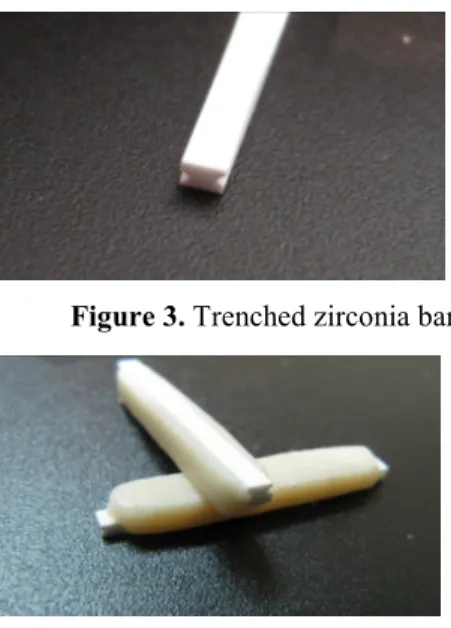
Excess glass on the specimens was removed by sandblasting with 50 microns alumina particles at 2 bar pressure (Figure 3).
Figure 3. Trenched zirconia bar
Figure 4. Final specimens in group 3
In group 2, wax patterns measuring 3x4x25 mm were first fabricated in the mold and then sprued and placed in specific molds; 100 g of the invest-ment material (Ivoclar Vivadent, Schaan, Liech-tenstein) was mixed with 13 ml of the special liq-uid (Schaan, Ivoclar Vivadent, Liechtenstein) and 9 ml of distilled water and then vibrated in the cy-linders containing wax patterns. After drying of the investment, Ring liner removed and investment ring along with the alumina plunger was trans-ferred to the preheated furnace (to burn out the wax). Wax burnout furnace was heated from room temperature to 250°C at a heating rate of 5°C/min and maintained at 250°C for 30 minutes. The tem-perature was then further increased from 250°C to 850°C at a heating rate of 5°C/min and maintained at 850°C for 60 minutes. After completion of
thermal cycles, cold Ingot was placed in the in-vestment ring. The inin-vestment ring along with the ingot and the alumina plunger were transferred to the EP600 furnace (Ivoclar Vivadent, Press Fur-nace Empress, AG, Liechtenstein). The initial tem-perature of the furnace was set at 700°C. This fur-nace was automated. For IPS-Empress 2 specimens the temperature of the furnace increased from 700°C to 920°C at a heating rate of 69°C/min and then remained at this temperature for 20 minutes. According to the manufacturer’s instructions, the plunger pressure was set at 5 bar. Under these cir-cumstances, viscous glass ceramic flowed into the mold. Ring was removed from the furnace and al-lowed to cool down at room temperature. Speci-mens were then sandblasted to remove residual investment stone.
In group 3, the fabrication of specimens was simi-lar to the abovementioned process with one differ-ence. A trenched zirconia bar was embedded at the bottom of the IPS-Empress 2 core.
After sintering of the zirconia block (color-based 47Cercon 0124, Degu Dent, Germany), it was sec-tioned into the desired dimensions using Mecatome cutting machine (T201A, Presi, France) and zirco-nia bars were trenched with diamond discs (D&Z, Darmstadt, Germany). The next steps were similar to group 2.
Flexural strength test
Three-point flexural test was carried out based on ISO 6872 standards. This test was performed at dry conditions and room temperature by universal test-ing machine (Zwick, Germany). The span length was 15 mm and load was applied at a crosshead speed of 0.5 mm/min.The fracture force for each specimen was measured in N and its flexural strength was calculated using the equation below: Flexural strength (3 point)=3FL/2bd2
Where F is the fracture force (N), L is the span length (mm), b is the specimen width (mm) and d is the specimen thickness (mm).
SEM observation of fracture surface
Fractured specimens were immersed in ultrasonic bath containing 95% ethanol for 15 minutes. Spe-cimens were then rinsed with water,air dried and fixed on a metal plate with glue. Specimen margins were coated with silver adhesive (for electrical conductivity), samples were gold coated and eva-luated using a scanning electron microscope
lips XL30, Eindhoven, Netherlands). Data regard-ing the 3 point flexural strength of specimens in different groups were analyzed using one-way ANOVA and Tukey’s test and P<0.05 was consi-dered statistically significant.
Results
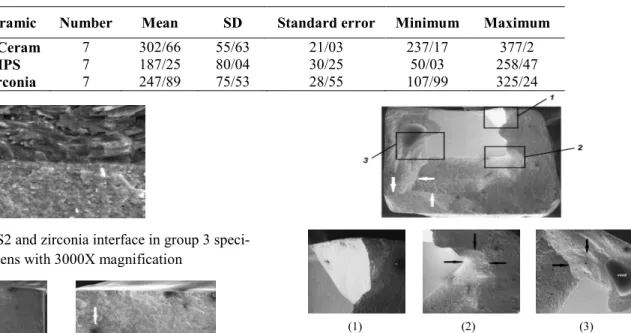
Based on the obtained results, the mean and SD of flexural strength was 302.66 and 55.63 MPa for In-Ceram specimens, 187.25 and 80.04 MPa for IPS and 247.89 and 75.53 MPa for trenched zirconia specimens (Table 1). One-way ANOVA showed significant differences between groups in terms of flexural strength (p<0.024). Additionally, consider-ing the similarity of analysis of variances, pairwise comparison of groups was done using Tukey’s test;which revealed that flexural strength of In-Ceram specimens was significantly higher than that of IPS samples (p<0.019). However, no signif-icant differences were found between In-Ceram
Figure 5. IPS2 and zirconia interface in group 3 speci-mens with 3000X magnification
and trenched zirconia (P>0.34) or IPS ceramics and trenched zirconia groups in terms of flexural strength (P>0.27).
SEM analysis showed no gap at the IPS2-zirconia interface (Figure 5); which is indicative of the suit-able bond between the two. Optimal porcelain-zirconia bond indicates that the residual stresses were not strong enough to form a gap at the inter-face of the two materials. Figures 6 and 7 show the fracture surface of groups 2 and 3 specimens along with the fracture lines and internal defects (pores). Figure 7 shows the fracture surface of a group 3 specimen. It appears that the fracture started at the external surface of the specimen, propagated to-wards the interface and spread from there (white arrows) 1: Fractured zirconia piece due to stress, 2: Stress accumulation points and Wallner lines are seen (black arrows), 3: Presence of void has prob-ably weakened the material structure (100X magni-fication).
Ceramic Number Mean SD Standard error Minimum Maximum
In-Ceram 7 302/66 55/63 21/03 237/17 377/2
IPS 7 187/25 80/04 30/25 50/03 258/47
Zirconia 7 247/89 75/53 28/55 107/99 325/24
Table 1. The results of 3-point flexural strength test
Figure 6.Fracture surface of group 2 specimens. Fracture line (black arrows) and pores (white arrows) can be
seen (50X magnification)
(1) (2) (3)
Figure 7.Shows the fracture surface of a group 3 specimen. It appears that the fracture started at the external surface of the specimen, propagated towards the interface and spread from
there (white arrows)
1: Fractured zirconia piece dueto stress,
2: Stress accumulation points and Wallner lines are seen (black arrows),
3: Presence ofvoid has probably weakened the material struc-ture (100X magnification).
Discussion
Various factors can affect the mechanical proper-ties and clinical application of ceramics. However, fracture strength and resistance are the first para-meters to consider for evaluation of ceramics. Strength is the necessary final stress for fracture or plastic deformation of material and is significantly influenced by the presence of cracks or defects in the specimen [9].
Three-point flexural strength test was used in this study because of the convenient design of the ma-chine and armsand simple shape of specimens [11]. Width and thickness of fabricated specimens in the present study were 3x4 mm. These dimensions were selected to simulate the contour cross section in all ceramic resin-bonded bridges in the clinical setting.
The flexural strength of In-Ceram, IPS and trenched zirconia specimens was 302.66, 187.25 and 247.89 MPa, respectively. Flexural strength of In-Ceram specimens was significantly higher than that of IPS samples (P<0.019) but no significant differences were detected between In-Ceram and trenched zirconia or IPS and trenched zirconia spe-cimens in this regard. However, 33% increase in flexural strength was noted.
Based on the results of Edelhoff et al, in 2002, when a glass ceramic is placed over a Cosmopost (zirconia post), given the coefficient of thermal expansion (CTE) of the ceramic is higher than that of Cosmopost, tensile stressesare created during cooling in the ceramic that expedite the propaga-tion of micro-cracks in the glass ceramic [12]. Al-so, it has been mentioned that if the CTE of the metal inside the ceramic is less that the CTE of ceramic, radial cracks form during the process of cooling in the ceramic. This is also true in ceramic-ceramic systems [13].
The 3-point flexural strength of IPS-Empress 2according to a report by the manufacturer (Ivoc-lar) is 350±50 MPa [14]; which is higher than the obtained value (187.25 MPa) in this study. Differ-ent shape of specimens, tests, surface preparation techniques and test conditions may be responsible for this difference in strength. In a study by Ker-manshah and Ebrahimi in 2006, the flexural strength of IPS-Empress 2 was less than the value reported by the manufacturer [7].
Based on the present study results, 3-point flexural strength of In-Ceram ceramic was 302.66 MPa; which is slightly less than the values reported by Chong et al, in 2002. They reported the mean flex-ural strength of 362 MPa for this ceramic [10]. Al-so, in Kermanshah and Ebrahimi study the mean flexural strength of In-Ceram ceramic was 378 MPa that is higher than the obtained rate in the current study. The reported flexural strength for In-Ceram alumina core has also been variable from 236-530 MPa [10].
According to the results of the current study, flex-ural strength of In-Ceram ceramics was significant-ly higher than that of IPS-Empress 2. In Fisher et al, study in 2001, the flexural strength of In-Ceram alumina was significantly higher than IPS-Empress 2 specimens (450 MPa versus 273 MPa) [15]. Ce-ramics are fragile and their fracture force greatly depends on the size, number and distribution of cracks in the material and on the surface. In anoth-er study conducted by Guazzato et al, in 2002, bi-axial flexural strength of In-Ceram alumina ceram-ic was reported as 600 MPa [9]. Considering the fact that the highest tensile stresses in biaxial test specimens occurred at the center of disc-shaped specimens and marginal fractures were eliminated, the obtained strength value from the biaxial testing will be higher than the strength value obtained by 3-point flexural strength testing. Flexural strength of trenched zirconia specimens along with IPS-Empress 2 was equal to that of other two groups and although the obtained flexural strength value for this group was higher than that of IPS-Empress 2 and lower than that of In-Ceram Alumina speci-mens, these differences were not statistically sig-nificant. In the mentioned group, a trenched zirco-nia bar was embedded at the bottom of specimens and the results revealed that by doing so the flex-ural strength increased (but not significantly). In another study by Kermanshah et al, using finite element analysis, strength increased following trenching the zirconia bar [8].
Kermanshah and Ebrahimi in 2006 demonstrated no statistically significant differences between IPS-Empress 2 specimens with and without zirconia bar. In their study, specimens with zirconia bars embedded at the bottom showed higher strength. However, this difference was not statistically sig
nificant. They used a zirconia bar in the form of a prefabricated cylindrical zirconia post and its size was not in accord with the ISO standard. Addi-tionally, the zirconia post was placed at the center and in the bottom of the IPS-Empress ceramic core [7]. However, in the present study, size of IPS-Empress 2 specimens was according to the ISO standard (3x4x25 mm) and the zirconia bar was sintered in the form of zirconia block and sectioned by the Mecatome cutting machine to yield 1.5x2x27 mm bars. Furthermore, since Kerman-shah and Ebrahimi in their study in 2006 demon-strated the higher strength of specimens with zir-conia bar embedded at the bottom, in the current study we only placed the bars at the bottom of spe-cimens. In the mentioned study the majority of fractures occurred at the interface and no gap was observed with SEM between the porcelain veneer and zirconia (indicating the optimal compatibility of these two ceramics due to their similar CTEs). Therefore, Kermanshah et al. performed a finite element analysis on the effect of increasing the interface area on the fracture strength and demon-strated that the bar design can influence the amount of stress. In the mentioned analysis, trenched post showed the highest level of stress reduction. Considering the above mentioned study, since it was not feasible to trench the prefabricated post by laser, in the current study zirconia bars were used that were sectioned by Mecatome cutting machine and trenched with diamond discs.
It seems that different materials incorporated into zirconia frameworks have different structural cha-racteristics and differences in size, shape, composi-tion, concentration and hardness of grains indicate the significant role of different surface preparation techniques in development of some differences in final structure of the zirconia material.
The present study was an in-vitro study and thus, the obtained results cannot be generalized with confidence to clinical setting. It has been revealed that under in-vitro conditions, confounding va-riables can be easily controlled while under in-vivo conditions, several confounding factors such as host-related variables exist that affect the service and performance of ceramic materials in the oral cavity. Thus, generalization of in-vitro findings to clinical setting is associated with some limitations.
Conclusion
Results of the present study on the flexural strength of IPS-Empress 2 ceramic specimens following the placement of a trenched zirconia bar at their bot-tom revealed that:
-The flexural strength of In-Ceram, IPS and trenched zirconia specimens was 302.66, 187.25 and 247.89 MPa, respectively. Flexural strength of In-Ceram specimens was significantly higher than that of IPS specimens without the zirconia bar but no differences were detected between group 1 (In-Ceram) and group 3 (IPS plus trenched zirconia bar) or Group 2 (IPS without zirconia bar) and group 3 (IPS plus trenched zirconia bar) in this respect.
-Trenched zirconia bar embedded at the bottom of IPS-Empress 2 ceramic specimens had limited ef-fects on increasing the flexural strength.
Acknowledgement
This research project was approved by Tehran University of Medical Sciences (project # 8553-69-04-88, dated January 19, 2009). The authors would like to express their gratitude to Tehran University of Medical Sciences for funding this project and also thank Dr. KharazyFard for statistical consult-ing and Mr. MehdiAbaddar for his sincere coop-eration in the conduction of this study.
References
1-Puschmann D, Wolfart S, Ludwig K& Kern M. Load-bearing capacity of all ceramic posterior inlay-retained fixed dental prostheses. Eur J Oral Sci. 2009 Jul; 117(3):312-318
.
2-Ohlmann B, Rammelsberg P, Schmitter M, Schwarz S & Gabbert O. All-ceramic inlay-retained fixed partial dentures: preliminary results from a clinical study. J Dent. 2008 Sep; 36(9):692-696
.
3-Kilicarslan MA, Kedici PS, Kucukesmen HC & Ulu-dag BC. Invitro fracture resistance of posterior metal-ceramic and all-metal-ceramic inlay-retained resin-bonded fixed partial dentures. J Prosthet Dent. 2004Oct; 92 (4):365-370
.
4-Mehl C, Ludwig K, Steiner M &Kern M. Fracture strength of prefabricated all-ceramic posterior inlay-retained fixed dental prostheses. Dent Mater. 2010 Jan;26(1):67-75
.
5- Wolfart S, Ludwig K, Uphaus A &Kern M. Fracture strength of all-ceramic posterior inlay-retained fixed dental prostheses. Dent Mater .2007 Dec;23(12)1513-1520
.
6-Valandro LF, Ozcan M, Amaral R, Vanderlei A & Bottino MA. Effect of testing methods on the bond strength of resin to zirconia-alumina ceramic: microten-sile versus shear test. Dent Mater J. 2008 Nov; 27(6):849-855
.
7-Kermanshah H, Farzin ebrahimi SH. The effect of zirconia on flexural strength of IPS-Empress2 ceramic. TUMS J Dent Med. 2007 Sum; 20(2):100-107
.
8-Kermanshah H, Gherami A, Ghorbani T .Finite ele-ment analysis of effect zirconium post on stress distribu-tion core IPS-Empress2. [Theses]. Tehran: Tehran Uni-versity of Medical Scienes Shool of Dentistry; 1378,88
.
9-Guazzato M, Al-Bakry M, Swain MV, Ironside J. Mechanical properties of in-ceram alumina and In-ceram zirconia. Int J Prosthod. 2002 Jul-Aug;15 (4):339-346.
10- Chong KH, John C, Takahashi Y, Wozniak W. Flexural strength of In-ceram alumina and In-ceram zirkonia core materials. Int J Prosthod. 2002 Mar-Apr;15(2):183-188
.
11-Zeng K, Oden A, Rowcliffe D. Flexure tests on dental ceramics. Int J Prosthod. 1996 Sep-Oct;9(5):434-443
.
12-Edolhoff D, Sorensen JA. Retention of selected core materials to zirconia posts. Oper Dent. 2002 Sep-Oct; 27(5):455-461
.
13-Steiner P, Kelly JR, Giuseppetti AA. Compatibility of ceramic-ceramic systems for fixed prosthodontics. Int J Prosthod. 1997. Jul-Aug;10(4):375-380
.
14-Holand W, Beal G. Glass ceramic technology. The American Ceramic Society 2000;287-300
.
15-Fisher H, Dautzenberg G, Marx R. Nondestructive estimation of the strength of dental ceramic materials. Dent Mater. 2001. Jul;17(4):289-295