Available Online atwww.ijcsmc.com
International Journal of Computer Science and Mobile Computing
A Monthly Journal of Computer Science and Information Technology
ISSN 2320–088X
IJCSMC, Vol. 4, Issue. 8, August 2015, pg.295 – 300
RESEARCH ARTICLE
Cost Based Efficient Routing for
Wireless Body Area Networks
Harsharan Pal Kaur
1, Kirtika Goyal
2¹C.S.E Yadavindra College of Engineering, India ²C.S.E Yadavindra College of Engineering, India 1
[email protected]; 2 [email protected]
Abstract- WBAN is an emerging technology and is a sub-field of the existing WSN technology. It provides real-time health monitoring of patients with the ability to provide feedback to the central controlling head or the administrator. In this paper we discuss how the wireless body area networks are used in health care relevance by using multiple sensor nodes. The paper discusses the calculation of energy and cost function. Our proposed cost function computes the reliability of path on basis on factor critical. Simulation result demonstrates that over proposed protocol highest energy stability period and cost effective.
Keywords- WBAN, Multi-hop protocol, Residual Energy, Cost Function, Delay
I. INTRODUCTION
WBAN technology is a sub-emerging field of the existing WSN technology. WSN is a collection of nodes or sensors that are placed on human body at various parts. WBAN can be used in many applications to facilitate the lifestyle of the people such as entertainment, transport system, health monitoring, emergency reliefs and many more. It is an emerging technology that enables wireless sensor nodes to provide real-time health monitoring of patients. In WBAN, wireless sensors are placed on the human body or implanted in the body to monitor vital signs like blood pressure, body temperature, heart rate, glucose level etc. This proves economical and is widely used in hospitals for patients’ health monitoring. Patients get better facilities and longer time to be treated, get medicated and taken care of since sensors continuously sense data and forward it to the central controlling head or the administrator. But, various energy constraints are present on these sensor nodes and hence we need to focus on their minimum level of energy and power consumption. The main problem that arises in WBAN is of battery consumption as it is difficult and not feasible to discharge batteries from body parts for charging them from time to time. Since the nodes have to travel along distance to forward their signal to the central device which is done at the cost of their energy level consumption. These factors have made energy the most critical resource in WBAN.
these sensors always transmit their data directly to sink. Other sensors follow their parent node and transmit their data to sink through forwarder node. It saves energy of nodes and network works for longer period.
II. LITERATURE SURVEY
Jocelyne Elias et al. had proposed Energy-Aware Topology Design for Wireless Body Area Network [1]. The author addressed the topology design problem for WBANs, proposing a novel and effective model based on mathematical programming that determines the optimal number and placement of relay nodes; the optimal assignment of sensors to relays and the optimal traffic routing , taking accurate account of both the total network cost and energy consumption.
Gill R. Tsouri et al. had worked on Increasing Network Lifetime in Body Area Networks Using Global Routing with Energy Consumption Balancing [2]. The author proposed global routing approach which allows WBANs to operate efficiently for longer period of time before recharging of batteries is required. NL is increased as well, decreasing the maintenance requirements even further.
Arash Maskooki et al. have proposed Opportunistic Routing for Body Area Network [3]. Author attempt to increase the battery life of the node in WBAN which can lead to more comfort of the user or even a necessity in some cases e.g. implantable sensors where changing the energy resource is invasive. In this work we exploited the motion of the body parts to increase the lifetime of the network. To evaluate the performance of the
proposed scheme, the energy consumption of the network per bit for the single hop, multi-hop using relay node and the opportunistic scheme are compared. The results shows that the proposed scheme can increase the life time of the network by decreasing the energy consumption in both the sensor and relay nodes while maintaining the same BER as the other two schemes. By appropriately placing the relay and sink nodes we showed that the energy consumption in the relay node can be significantly decreased by using the proposed opportunistic routing scheme. Decreasing the energy usage of the relay node decreases the overhead energy consumption in the network as the relay node is the major overhead energy consumer in the network.
Q. Nadeemet et al. had proposed a stable increased-throughput Multi-hop Protocol used Wireless Body Area Networks [4]. In this paper author propose a cost function based on residual energy of node and its distance from sink. Nodes with less value of cost function choose as parent, and other nodes become child nodes. Two critical nodes placed near to sink, so that their energy not deplete early.
III. PROPOSED ROUTING
In paper [3] author presented an opportunistic protocol. In this paper the author deploy sink node at wrist. Whenever sink node is far from node, it uses a hop node to collect data from sensor. In paper [4] the author proposed Multi-hop protocol using cost function for efficient routing. The cost function is based on distance and residual energy, which is not capable of addressing the request when load is higher than residual energy. In our proposed work a cost function is used which computes the reliability of path on basis of factor critical. This also results in enhancing network lifetime and successful delivery of packets. The working of network is as follow:
Initially sink broadcast hello packet to all nodes which contain the position information of the sink. The nodes in form of acknowledgment send ACK packet to sink contain information of node id, energy and distance. These factors help in computing the energy and cost factor.
Energy factor (E factor) = Residual energy / Initial power
Cost factor = Distance/ Energy factor
To avoid data collision in case two nodes send data at same time to sink, the sink issue TDMA to all nodes. The TDMA also saves energy as nodes status turns to sleep while TDMA has higher value. Using proposed scheme the performance of routing in all terms has been improved.
IV. RESULTS AND DISCUSSIONS
Number of dead nodes- Figure 1. represents the dead nodes WRT rounds for Old Multi-hop and Proposed
where, as in old Multi-hop 3 nodes are dead at 3000 rounds where as proposed multi-hop there will be no loss at 3000 rounds. There is only one node dead at 4500 round and 6 nodes are dead at 6000 rounds. It shows that each node consumes almost equal energy in each round and all the nodes die almost at the same time.
Fig.1 No. of dead nodes
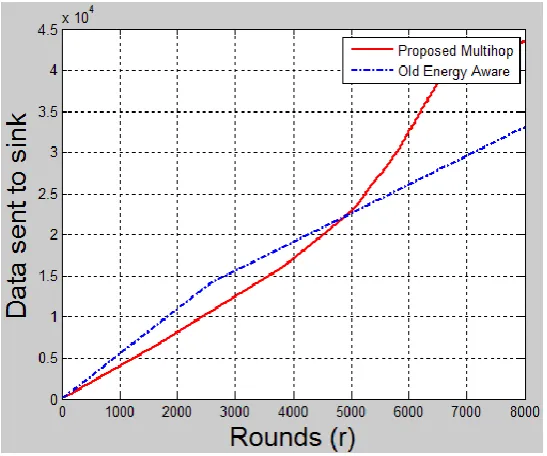
Data sent to Sink: In fig. 2, the data sent to sink has shown for both old energy aware and proposed multihop. It
also signify throughput. The proposed Multihop sent lesser data to sink initially as it use energy in uniform manner. Afterward proposed multihop shows great increase than old energy aware because in proposed multihop all the nodes are alive but not in energy aware. Proposed multihop achieve high throughput then old energy aware.
Data received at Sink: The data sent to sink in proposed multihop is much higher than old energy aware. The proposed protocol perform better in term of sending data to sink than old energy aware.
Fig 3: Data received at sink
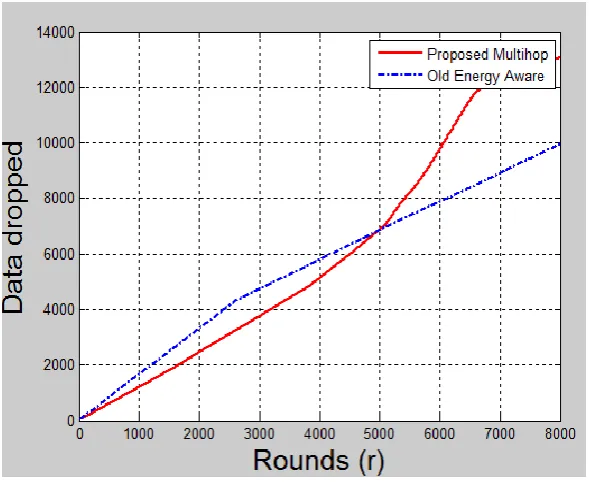
Data Dropped: The data dropped by proposed multihop is much higher than old energy aware as the
compression ratio taken is higher as well as duplicate packets discard is higher.
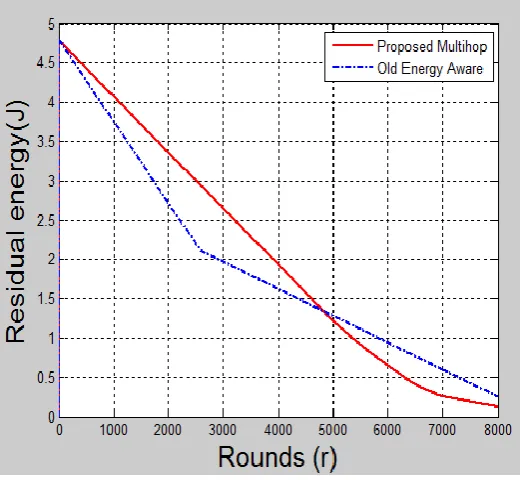
Residual energy: The proposed scheme use energy in fair way, results in residual energy left in nodes is same at all points. It enhance network lifetime, whwere as usage of energy is not optimal in old energy aware.
Fig. 5 Residual energy
Delay- The delay for both proposed and old energy aware shown in fig.6. the average delay shown by proposed
multihop is much lesser than old multihop. It also signify that throughput of proposed mutihop is better,. The lesser delay justify the efficiency of proposed multihop protocol routing in WBAN.
Fig. 6: Delay
Conclusion
References
[1] W. Joseph, B. Braem, E. Reusens, B. Latre, L. Martens, I. Moerman, and C. Blondia, “Design of Energy Efficient Topologies for Wireless On-Body Channel,” Wirel. Conf. 2011-Sustainable Wirel. Technol. (European Wireless), 11th Eur., vol. 5, no. 4, pp. 1–7, 2011.
[2] J. Elias and A. Mehaoua, “Energy-aware topology design for wireless body area networks,” in 2012 IEEE International Conference on Communications (ICC), 2012, pp. 3409–3410.
[3] Arash Maskooki, Cheong Boon Soh, Erry Gunawan and Kay Soon Low, " Opportunistic Routing for Body Area Network", 1st IEEE International Workshop on Consumer eHealth Platforms, Services and Applications 2011.
[4] Q. Nadeem, N. Javaid, S. N. Mohammad, M. Y. Khan1, S. Sarfraz and M. Gull, “SIMPLE: Stable Increased-throughput Multi-hop Protocol for Link Efficiency in Wireless Body Area Networks.,” Arxiv california university., vol. 19, no. 7, 2013.
[5] G. R. Tsouri, A. Prieto, and N. Argade, “On Increasing Network Lifetime in Body Area Networks Using Global Routing with Energy Consumption Balancing,” Sensors, vol. 12, no. 9, pp. 13088–13108, 2012.
[6] G. Lo, S. Member, S. Gonz, and V. C. M. Leung, “Wireless Body Area Network Node Localization using Small- Scale Spatial Information,” IEEE J. Biomed., vol. 01, no. 00, 2012.
[7] D. Zhang, G. Li, K. Zheng, X. Ming, and Z. H. Pan, “An energy-balanced routing method based on forward-aware factor for wireless sensor networks,” IEEE Trans. Ind. Informatics, vol. 10, no. 1, pp. 766–773, 2014.
[8] G. Subramanian, “Efficient and Secure Routing Protocol for Wireless Sensor Networks using Mine detection,” IEEE Trans. Netw., vol. 10, no. 7, pp. 141–145, 2014.
[9] J. Choi, “Secure Multipath Routing in Wireless Multihop Networks based on Erasure Channel Modeling,” in IEEE Wireless Advanced, 2012, pp. 6–10.
[10] C. S. Raghavendra, S. Lindsey, and S. Lindsey, “PEGASIS : Power-Efficient Gathering in Sensor Information Systems Stephanie Lindsey,” in Aerospace Conferance Proceedings, 2002, p. 7.