A Systematic Review of Antiretroviral Therapy Program Outcomes in Sub-Saharan Africa and Haiti
By
J. Wayne Burris, Jr.
A Master's Paper submitted to the faculty of The University of North Carolina at Chapel Hill
In partial fulfillment of the requirements for The degree of Master of Public Health in
The Public Health Leadership Program.
Chapel Hill
2004
~
'f---~
i'--Research Questions:
1. Do antiretroviral treatment programs for the treatment ofHIV -infection
reduce AIDS-related mortality and improve immunovirologic markers in
HIV-infected adults in Haiti and the countries of sub-Saharan Africa?
2. What factors contribute to the improvement of health outcomes in
antiretroviral treatment programs for HIV-infected individuals in
sub-Saharan Africa and Haiti?
"Don't believe it when they tell me there ain't no cure The rich stay healthy and the sick stay poor"
--U2
Background
Burden of suffering
Human immunodeficiency virus (HIV), the infectious agent of acquired
immune deficiency syndrome (AIDS), currently infects forty million people
throughout the world, and in 2000, surpassed TB to kill more people each year
than does any other infectious agent.1' 2 Three million individuals died of
HIV/AIDS in 2003, and ninety percent of those deaths occurred among people
living in the world's poorest countries where few if any resources exist to combat
the disease3 Furthermore, in 2003, an estimated five million individuals were
Though the pandemic spans the globe, it disproportionately infects,
affects, and entrenches itself in the populations of the poorest regions on the
planet. Seventy percent of the world's infected individuals live in sub-Saharan
Africa alone, where HIV infects an estimated twenty-seven million adults and
children-more infected individuals than in all the other countries of the world
combined.3 Sub-Saharan Africa has the highest adult HN -prevalence of any
region in the world at eight percent, with HN infecting over thirty percent of the
adult populations of Botswana, Lesotho, Swaziland, and Zimbabwe.5 In the
Caribbean, the world's second hardest hit region, HN infects 2.2 percent of the
adult population, and in Haiti, the poorest cmmtry in the Caribbean and the
Western hemisphere, adult HN prevalence estimates range from 5.5 to 6.1 %4•5
Not only does HIV/AIDS inflict a significant amount of morbidity and
mortality, the disease exerts a tremendous economic, social, and political burden
upon resource-poor countries. The HIV I AIDS pandemic threatens to destroy the
societies, economies, infrastructures, and national and regional security of many
nations.6 Acquired immune deficiency syndrome-related deaths disrupt family
structures and seriously reduce entire work forces including those of agricultural
workers, health professionals, and teachers7-10 Of the fourteen million children
orphaned by the AIDS-related death of their parents, eleven million live in
sub-Saharan Africa5 Human immunodeficiency virus infection acts synergistically
with other diseases to overwhelm the already inadequate and overburdened
medical facilities in developing countries.8' 11' 12 The stigma associated with
individuals and their families. Many HIV-infected individuals report abuse by
family and neighbors.
Disparities in access to antiretroviral medications between wealthy and poor
countries
In the U.S. and Europe, HN infects and kills only a fraction of the munber
it does in poorer nations.4 The U.S. and other industrialized Western countries
thus might be said to be "resistant" to HIV I AIDS and better equipped to defend
themselves against the virus once infected. The effectiveness of antiretroviral
therapy (ART) for the treatment ofHN/AIDS in the industrialized world is
well-established.13-15 The introduction of highly active antiretroviral therapy
(HAART) in 1997 sharply decreased AIDS-related mortality, morbidity, and
hospitalizations in wealthier industrialized countries. While HAART has become
the standard of care for HIV -infected patients in wealthier nations, international
health experts have traditionally considered ART to be unfeasible in developing
countries.16• 17 Haiti and the countries of sub-Saharan Africa represent, by almost
any standard, the poorest areas of the world.18
According to the World Health Organization (WHO), six million people
living in the world's poorest countries are in desperate need of antiretroviral
(ARV) medications, though only 300,000 of those in need currently receive
them.19 Despite widespread use in wealthy nations, ART in developing countries
remains a novel concept, first entertained seriously only in 1998 at the 12'h World
AIDS conference in Geneva. As a result, we know little about the use of
Africa and Haiti. The inequitable distribution of antiretroviral medications
persists and perpetuates the disparate dichotomy that exists between wealthy and
poor nations.
Prevention efforts not sufficient
Current international HIV I AIDS strategies in developing countries focus
primarily on preventing HIV infection rather than preventing the progression of
HIV disease in those already infected. The annually increasing numbers of
newly infected individuals suggests this approach is inadequate.
A whole consists not of the sum of its parts.20• 21 Many infectious disease
experts argue that health workers and officials need to link prevention efforts with
care, including the provision of antiretroviral therapy to those already infected
with HIV.1• 6• 8• 22 Preventive and curative medicine likely act synergistically to
produce better health outcomes.
The medical anthropologist George Foster in 1952 found that people in
resource-poor countries are interested in prevention only after their first priority,
treatment of illness, is satisfied23 Some HIV/AIDS activists in many sub-Saharan
African countries are becoming increasingly hostile toward international health
agencies that provide only prevention without treatment for those already infected
with HIV.1 They want HIV medications for those who have AIDS, not just
condoms and prevention messages for those not yet infected.
Treatment may also decrease transmission by reducing viral load, as a
HN disease with treatment may therefore constitute a means of secondary
prevention that is not well emphasized in developing countries.
Obstacles to providing antiretrovirals in resource-poor settings
Objection to providing ART in developing countries centers around the
following obstacles: the high cost of medications relative to national health
budgets in resource-poor settings, lack of health infrastructure to provide
treatment and follow-up, concerns about possible lack of adherence to treatment,
the risk of perpetuating inequalities between the rich and poor, and the emergence
of viral resistance27
Recent sharp drops in the price of ART medications, however, now render
ART increasingly practical, at least on financial grounds. Generic manufacturers
in India, China, and other countries now produce and sell antiretroviral
medications at substantially lower prices. The availability of inexpensive
medications, however, will likely affect only the few in resource-poor settings
who have regular access to medical services. 6
If faced with the extremely high HN prevalence of poorer countries,
many wealthier nations might also experience the disintegrations of their public
health services, as well. Some estimate that for every one dollar spent for
antiretroviral medications, three dollars are necessary for health infrastmcture.
Inexpensive antiretroviral regimens to decrease vertical transmission of HIV are
still not available to many in Africa, despite their cheap price, because of the lack
Managing HIV infection requires not only access to ART medications, but
adherence to potentially complicated dosing regimens, as well. Farmer, et. a/.8
point to tuberculosis (TB) as an example of a chronic infection well-managed in
resource-poor settings. Like HIV/AIDS, multi-drug resistant TB (MDR-TB) is
managed with multiple medications on a long-term basis. The success of
managing TB with the provision of directly observed treatment (DOT) by health
workers or trained community members may serve as a model for HIV treatment
with ART in sub-Saharan Africa and other parts of Haiti.
Can ART interventions work in Haiti and sub-Saharan Africa?
A number of unanswered questions exist regarding the establishment and
expansion of ART programs in resource-poor countries such as sub-Saharan
Africa and Haiti:
• Do these countries have the capacity to establish and maintain programs to
treat large numbers ofHIV-infected patients?
• In successful ART programs, what factors contribute to improved health
outcomes for HIV -positive individuals in these countries?
• As interest in providing ARV therapy increases in developing countries,
what should new programs look like to effectively provide ARV therapy?
This paper is a systematic review of existing programs that provide ART
in sub-Saharan Africa and Haiti. It proposes to report the health outcomes of
ART provision in those areas and to identify factors that contribute to the failures
program effectiveness include AIDS-related mortality and the surrogate
immunovirologic markers of CD4+ cell count and viral load. Findings from this
study will be useful to ascertain the effectiveness of ART programs in developing
countries, and to determine if programs are successful enough to warrant a shift in
international health policy focus from HIV prevention-only strategies to
prevention plus treatment.
Methods
Criteria for selecting studies for this review:
The principle investigator performs a systematic search of the literature to
select studies, with the inclusion considerations being study design, geographic
location, study participant characteristics, type of intervention, and health
outcomes.
Study Designs: Study designs must be randomized controlled trials
(RCT), prospective cohort studies, retrospective cohort studies, or case series
published between January 1996 and April2004. The study must enroll at a
minimum twenty participants. Although randomized controlled interventions are
ideal to determine effectiveness, few published studies likely exist that use an
experimental RCT study design, owing to ethical considerations.
Geographic Location: Studies must be conducted in Haiti or a country of
sub-Saharan Africa (Botswana, Namibia, Mozambique, Zimbabwe, Zambia,
Uganda, Nigeria, Benin, Togo, Ghana, Cote d'Ivoire, Liberia, Sierra Leone,
Senegal, Mali, or South Africa).
Study Participants: Participants must be adults (defined as 13 years or
older, as used in the CDC classification, which includes adolescents28) who are
infected with HIV, and may or may not have an AIDS diagnosis or AIDS-related
symptomatology. Studies with both male and female participants will be
considered, though studies that include pregnant female participants treated with
ART only to prevent transmission ofHN from mother to infant will be excluded.
Criteria for HN infection and AIDS include those specified by the CDC
(1993-revisedi8or by WHO classification (Clinical Stage 4)29
Intervention: Studies must provide an intervention of ART, either a single
dmg or multi-dmg regimen, to HN-positive, non-pregnant adults for the
treatment ofHIV/AIDS. The intervention can be either directly observed therapy
(DOT) or non-DOT.
Health Outcomes: Principal health outcomes include probability of
survival; the proportion of patients achieving an undetectable HN -ribonucleic
acid (RNA) level (viral load), e.g. viral load less than 50 viral copies/ml; mean
change in CD4+ cell count relative to baseline; and change in HIV-RNA levels
relative to baseline. Secondary health-related outcomes include clinical outcomes
such as adverse dmg events, adherence, and any quality oflife indicators the
studies report. The review will report adverse advents as either minor or major.
Major events will be those severe enough to require change or discontinuation of
Search strategy for identification of studies
To identifY relevant articles, the principal investigator searched the
MEDLINE database via PUBMED, restricting the search to published articles
from January 1996 through April2004. The MEDLINE search used the Medical
Subject Headings (MeSH) '"HIV' AND 'DEVELOPING COUNTRIES'" Limits
were set for "adult" and "human." This yielded very few ART programs, and the
investigator consulted a reference librarian at the Health Sciences Library at The
University of North Carolina at Chapel Hill.
The revised search utilized the following search terms:
"ANTIRETROVIRAL AND (AFRICA OR BOTSWANA OR NAMIBIA OR
MOZAMBIQUE OR ZIMBABWE OR ZAMBIA OR ANGOLA OR MALA WI
OR TANZANIA OR CONGO OR ZAIRE OR KENYA OR GABON OR
GUINEA OR CAMEROON OR UGANDA OR NIGERIA OR BENIN OR
TOGO OR GHANA OR COTE D'IVOIRE OR LIBERIA OR SIERRA LEONE
OR SENEGAL OR MALI OR HAITI)" The investigator set the following limits:
"All Adult, Publication Date from 1996 to 2004, Human." The revised search
yielded 127 articles on April 8, 2004. The investigator conducted the same search
again on April19, 2004, which yielded an additional two articles.
In addition to the PUBMED search above, the principal investigator
performed a search of Cochrane Data Base of Systematic Reviews via OVID
using the search term "antiretroviral," and a search using CINAHL (via
searches yielded no additional articles. A search of the NIH, CDC, and UN AIDS
websites yielded no additional studies for consideration.
Lastly, the investigator's consultation of infectious disease experts at the
University of North Carolina at Chapel Hill identified an unpublished manuscript
in Malawi, Africa for consideration.
Results
Data abstraction
The principal investigator examined titles and abstracts of the 127 articles
identified by the PUBMED search and the additional one unpublished manuscript
from Malawi and assessed them for the selection criteria specified above. Of the
127 articles identified from the search, only 27 articles initially appeared to meet
the inclusion criteria, for which the investigator reviewed the full texts. Ten of
these articles met the selection criteria and were included in the analysis. Two of
these articles addressed the same antiretroviral program, so a total of nine ART
programs in Africa and Haiti were identified-eight in Africa and one in Haiti.
The most common reasons for exclusion of articles included the following: the
article addressed only antiretroviral use for the prevention of maternal-fetal
transmission; the article evaluated only non-retroviral care ofHIV/AIDS patients;
or the article represented the authors' expert opinion with no evidence-based
findings.
Once the principal investigator selected articles for inclusion in the
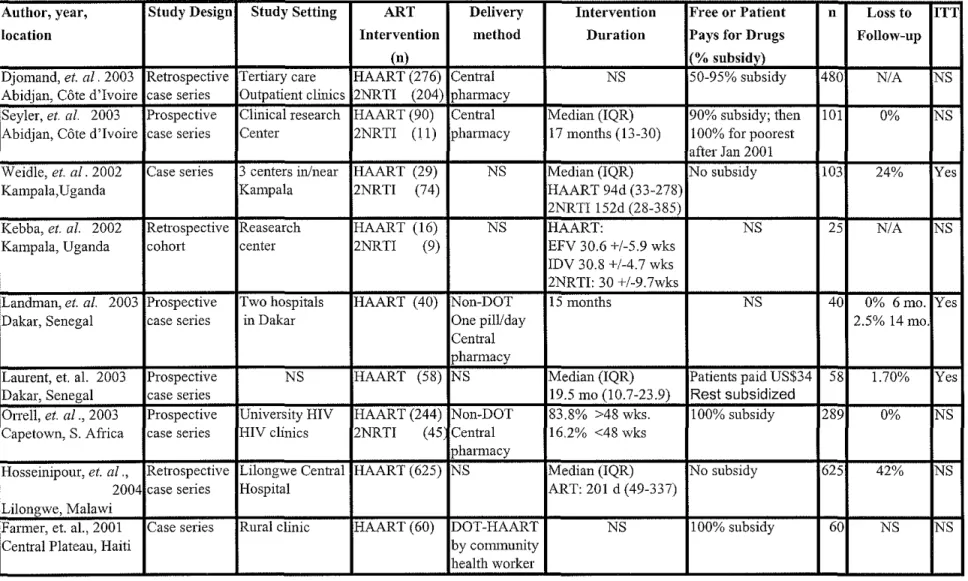
review, he abstracted relevant information from each article and placed it into
Table l, with the variables being author, year, study location, study dates, study
design, study setting, type of ART intervention, delivery method of ART,
intervention duration, whether or not patients have to pay for study drugs, number
in sample, percent lost to follow-up, and whether or not intention to treat analysis
was carried out. Table 2 presents baseline characteristics and outcomes that were
abstracted from the selected studies. Baseline data extracted include whether or
not participants had taken antiretroviral medications at some time prior to the
study, CD4 count, and viral load. Outcomes that were measured post-intervention
included percent of patients with undetectable viral load, CD4 cell count change,
viral load change, probability of survival, adherence data, and any adverse drug
events.
The primary investigator combined outcome data wherever possible to
calculate a weighted mean value, with the denominator consisting only of those
participants for whom studies reported values.
Methodological description of selected studies
All ten of the selected studies employed non-randomized, and in most
cases uncontrolled, drug trials to determine effectiveness of ART in Africa and
Haiti. Kebba, et al. conducted a retrospective cohort study in Uganda comparing
the effectiveness of three different ART regimens. This Uganda study did not
randomize patients into treatment groups and did not include a placebo control
group for comparison. The remaining studies consisted of prospective and
retrospective case series designs in which the investigators or programs
occurred without the use of control groups. With no comparison groups in these
descriptive studies, no basis exists to conclude that outcomes represent an
improvement over the natural course of the disease or that outcomes result from
the ART intervention itself. These studies describe the frequency of occurrence
of health outcomes associated with the ART intervention, but their study design
precludes them from providing definitive evidence for the effectiveness or
ineffectiveness of ART in Africa and Haiti. They describe initial attempts to treat
HIV positive individuals in these resource-poor regions and may generate
hypotheses to be later tested in randomized trials and ideas to be incorporated in
the planning and execution of future programs.
The studies evaluated programs in the Central Plateau of Haiti (Farmer, et.
aT/·
8 and in five large sub-Saharan African cities: two studies in Abidjan, Coted'Ivoire (Djomand, et. al and Seyler, et al.);30' 31 two in Kampala, Uganda
(Weidle, et. al. and Kebba, et al.);32• 33 two in Dakar, Senegal (Landman, et al. and
Laurent, et al.);34• 35 one study in Capetown, South Africa (Orrell, et al.i6; and
one in Lilongwe, Malawi (Hosseinipour, et al.).37 Each of the sub-Saharan
African studies took place in tertiary care centers, outpatient clinics, and military
hospitals, all within or near large cities. These medical centers represent the best
medical care available in their respective countries, which contrasts greatly with
the level of care available in more mral areas where health care infrastmcture is
likely much more limited or non-existent. This confines the generalizability of
these study results to ART programs in larger cities with relatively
Haiti, however, differs from the African studies, as it operates from a small clinic
in a poor, mral setting, so that its results might be more widely generalizeable to
poorer areas with fewer resources.
The amount of money patients paid for ART differed greatly among
studies. The South African and Haitian studies and the study by Seyler, et al. in
Cote d'Ivoire completely subsidized ART medications, and the programs
evaluated by Djomand, et al. in Cote d'Ivoire and by Laurent, et al., in Senegal
heavily subsidized ART. The remaining studies either provided no ART subsidy
or did not specify the amount patients paid. Those studies that did not provide
subsidies likely selected wealthier patients for inclusion, which may bias results
toward better outcomes if higher socioeconomic status acts as a confounder to
contribute to improved outcomes. The results of the programs that provided ART
free of charge are more widely generalizeable, as most HN-infected patients in
Africa and Haiti are poor and unable to afford antiretroviral medications without
financial assistance.
Description of study participants
Both Ugandan studies and Landman, et al. in Senegal enrolled only
patients infected with HIV-1, which limits the generalizeability of their results, as
HN -2 infection is not uncommon in Africa. Laurent, et al. in Senegal enrolled
fifty patients with HN-1 and only three patients co-infected with HN-1 and
HN-2. The other studies did not specify HN type. Djomand, et al. in Cote d'Ivoire;
Kebba, et al. in Uganda; and both the Senegalese studies included only patients
to only ART-naive patients. Weidle, et al. in Uganda and Hosseinipour, et al. in
Malawi included both ART-naYve and experienced patients, but did not
breakdown outcomes by ART status. The Haitian and other Cote d'Ivoire study
do not specify participant ART status.
Baseline clinical and immunovirological data show that the majority of the
participants in these studies had advanced HIV -disease. CD4+ cell counts were
below 200 in a majority of patients in all studies, though the Haitian study did not
specify baseline CD4+ count. Mean baseline viral load exceeded 200,000
copies/ml in all studies that report values. Seyler, et al. in Cote d'Ivoire; the
Senegalese studies; and Hosseinipour, et al. in Malawi emolled a majority of
patients with WHO stage 3 or 4 disease or CDC stage B or C disease, late clinical
stages ofHIV infection. The severity ofHIV disease contributes to the
generalizeability of these studies to other populations in Haiti and sub-Saharan
Africa where HIV testing and counseling programs are sparse, and HIV infection
is therefore commonly diagnosed at a relatively later stage than in more
developed countries.
Description of stndy interventions
Study interventions included provision of a variety of antiretroviral agents,
alone or in combination, to include the following drug classes: nucleoside reverse
transcriptase inhibitors (NRTI), non-nucleotide reverse transcriptase inhibitors
(NNRTI), and protease inhibitors (PI). One category of drug combination
employs the use of two NRTis (2NRTI). Highly active antiretroviral therapy,
PI, or abacavir. All nine programs provided HAART as an intervention. The
Cote d'Ivoire and Uganda studies also provided 2NRTI to participants. The
Haitian program delivered DOT-HAART via community health workers. The
Senegalese program evaluated by Landman, eta!. delivered a non-DOT one pill
per day HAART regimen. The other studies did not specify whether or not ART
was directly observed. A central pharmacy dispensed antiretroviral medications
in the Cote d'Ivoire studies; in Landman, eta!. in Senegal; and in Orrell, eta!. in
South Africa. This allowed for tighter control over medication dispensation.
Duration of ART varied from a median of ninety-four and 152 days (HAART and
2NRTI, respectively) in Weidle, eta!. in Uganda to 546 days (19.5 months) in the
Laurent, eta!. Senegalese study.
Orrell, et. a!. in South Africa reported eighty-seven percent adherence
without DOT, and Landman reported ninety-five percent adherence in Senegal
with once a day dosing without DOT. The study by Farmer, et. a!., the only study
using DOT, does not report adherence, so no comparison can be made between
DOT and non-DOT ART programs. Randomized control trials should be
conducted, using HAART as the standard of care, to compare DOT programs
versus non-DOT programs.
Changes in health outcomes
Despite initially high drug costs, a small pilot HN/AIDS project in a poor
rural community in Haiti provides directly observed therapy (DOT) with HAART
to sixty patients with advanced HN disease.1' 8 The project serves patients in the
existing TB-control infrastructure. The project initially began providing
zidovudine to HN infected pregnant women, which led to dramatic decline of
vertical transmission ofHN to infants. It expanded in 1997 to provide
post-exposure prophylaxis with three-drug regimen to victims of rape or professional
injury. In 1998 it began to provide HAART to patients with long-standing HN
infection. 1' 8
The Haitian pilot DOT-HAART program, modeled on successful TB
control efforts, provides each HN patient with a community health worker who
observes ingestion of medications, responds to patient/family concerns, and offers
moral support. Support includes help with children's school fees; free,
uninterrupted access to medications; continuity of care; and monthly meetings.
The initial cohort of sixty patients experienced dramatic responses to HAART.
HAART-treated patients were far less likely to enter the hospital than were
non-treated patients, and the HN viral load dropped to undetectable levels in most
patients. Many of these patients returned to work and to caring for their
families. 1' 8
All studies that report values show an adherence, reduction in plasma viral
load, and increases in plasma CD4+ cell count comparable to those of studies
conducted in developed countries using similar ART regimens. Overall,
participants in ART programs in Africa and Haiti took eighty-two percent of
medications and experienced a weighted mean loglO viral load reduction of 1.83
after approximately one year of treatment. Sixty-five percent of all participants
L
the sensitivity of the laboratory test from less than fifty RNA copies/ml to less
than 400 copies/mi. Plasma CD4+ cell count increased by a weighted mean of
123 x 106 cells/L. Adherence and viral load suppression in these sub-Saharan
African and Haitian studies compare favorably to adherence and virologic
outcomes in developed countries where studies report an adherence of seventy
percent and viral load suppression to undetectable levels in fifty percent of
patients on similar ART regimens.34• 36• 38-45 Overall survival in the Haitian and
African studies was eighty-percent.
Adherence was generally higher among programs that provided ART free
of charge, though this trend may or may not be statistically significant. Further
studies should be conducted to determine those factors that contribute to
adherence in non-DOT sub-Saharan African programs. Loss to follow-up also
reflects this trend. Among programs that provided ART subsidies, loss to
follow-up ranged from zero percent to 1.7 %. Loss to follow-follow-up ranged from twenty-four
to forty-two percent in programs that provided no subsidy. Most studies reported
unscheduled treatment interruption, most often owing to pharmacy stock
shortages and lack of personal resources.
The average incidence of medication-related adverse events was ten
percent, and most of these events were minor, such as gastric discomfort, not
necessitating a discontinuation of therapy. No study reported any dmg-related
deaths.
Results from these studies show clinical, virological, and immunological
responses to antiretroviral therapy in sub-Saharan Africa and Haiti that compare
favorably with those same responses in industrialized countries, despite
differences in the HIV -1 subtype distribution in Africa and the fact that many of
the sub-Sahara African studies enrolled a majority of patients with advanced
disease. These studies suggest that ART interventions can be implemented in
sub-Saharan Africa and Haiti, and can demonstrate improvements in surrogate
markers for health outcomes, such as viral load, CD4 counts, and adherence.
Financial constraint emerged as the leading cause for non-adherence. 30
Most sh1dies reported unscheduled treatment interruption, most often owing to
dismption in the provider's dmg supply (pharmacy stock shortages) or to lack of
personal resources. Programs that provided medications, monitoring, and other
care free of charge to patients achieved much greater rates of adherence.
Adherence likely contributes to decreased viral resistance and has been shown to
correlate with better virologic suppression and immune recovery and with
decreased HIV -related morbidity and mortality. 36 41 -47 . In those studies in which
antiretroviral supply was assured, viral resistance rarely emerged. HAART was
well-tolerated, at least in the short-term, in these studies.
Many individuals in sub-Saharan Africa who can afford ART medications
already use them, sometimes sporadically, as individual resources allow. As dmg
prices continue to fall, more and more Africans are likely to use antiretrovirals,
whether or not organized programs exist to ensure their proper prescription and
result in indiscriminate antiretroviral use that contributes to dmg toxicity,
sub-optimal clinical results, and the emergence of antiretroviral-resistant viral strains.
Secondary benefits from ART
Improvement of health care infrastructure in Africa and Haiti to facilitate
the provision of ART will likely contribute to better health outcomes in other
diseases, as well. The lack of infrastructure argument, however, should not be a
deterrent to developing and implementing ART interventions. Instead, further
research should be undertaken to evaluate these interventions for their
effectiveness in settings oflimited health infrastruch1re, and the optimal way of
doing so would be through randomized controlled trials.
Perhaps most importantly, providing HN treatment--a biomedical attempt
to ameliorate a social as well as biological problem-may have even more
profound positive secondary and tertiary psychological and societal effects.
Providing treatment to the millions most in need not only fills an immediate need;
it evens the playing field, reduces inequality, and brings into the fold those on the
fringes of society, lifting them from the lowest rungs of the societal ladder to give
them hope and a future.
HN/AIDS decreases resistance to tuberculosis (TB), and the global spread
ofHN threatens TB control efforts worldwide. HN/AIDS dramatically
increased the incidence ofTB in sub-Saharan Africa, where up to sixty percent of
TB patients are co-infected with HIV, and each year 200,000 TB deaths are
attributable to HN co-infection. HN now threatens control ofTB in Asia,
secondarily aid TB control in developing countries. In addition, TB programs
provide an important entry point for the treatment ofHIV/AIDS, as was the case
in the program evaluated in Haiti.
Factors contributing to program success
Several factors contribute to the success of the ART programs evaluated
by the studies in this review. Perhaps most important are the free provision of an
uninterrupted supply of ART medications and the availability of regular medical
care. If ART is available, but not made affordable for the impoverished
individuals who need it, or ifHIV-infected individuals have no access to regular
medical care, patients will not use the available medications, or may use them
improperly or sporadically, possibly leading to resistant viral strains. Falling drug
prices make the free provision of ART much more feasible. Because the presence
of HIV infection is readily and well defined through HIV testing, patients are
unlikely to ovemse free HIV treatment services.
Strong public control and support are also required for successful ART
expansion.17 Strict control of ART medications and close follow-up of patients
will prevent illegal and inappropriate trade in the informal market that may lead to
resistance.17• 27 Guidelines should be in place before administering ART to
prevent dmg resistance, and a program must train health care workers how to
administer antiretroviral medications effectively. Using existing TB programs as
delivery mechanisms for ART, as in the ART program in Haiti, may facilitate the
Follow-up and social support by pharmacists, physicians, other medical
personnel, support groups, and social or community workers may also contribute
to program effectiveness. In Haiti, Haitian patients value the moral support
provided to their families, and may perceive those who use this tactful approach
as better health care workers. The fact that caring community members
administered the intervention, as opposed to culturally insensitive physicians or
nurses, might partly explain the success of the program. It is possible that Haitian
communities value their autonomy and might resist taking orders from an outside
doctor, so that this community-led approach is more likely to be accepted and to
produce better health outcomes than would be a rigid clinic-based system such as
we have in the U.S. This is one example of an AIDS treatment program
providing ART in an extremely impoverished area despite the lack of a developed
health infrastructure.
A once a day regimen, such as that in Senegal,48 allows patient
confidentiality to be more easily maintained, as the patient can take the
medication at bedtime without the knowledge of other family members. Ease of
administration and maintenance of confidentiality will likely increase adherence
to ART. Adherence in the Senegalese one pill per day program was enhanced by
the regimen's simplicity, tolerability, and uninterrupted supply.
A thorough knowledge of the culture and health care system of the region,
country, or community in which the program will operate will also greatly
contribute a program's success. Programs in different regions may look different,
national or local healthcare system and other attributes of the region to include
local culture and leadership. A detailed, theoretically well-conceived program
designed to deliver efficacious medications may prove clinically irrelevant and
ineffective on the ground owing to simple yet grave oversights, even when great
effort is made to incorporate all available information into the planning process.
Therefore a program plan must be flexible and amenable to change once the
program is put into practice.
The presence of the four Cs-- concern, commitment, competence, and
continuity-- is essential for program success.49 These may come from
govermnent, national health officials, local leaders, or program leaders. A
successful program conducted in a country such as Uganda where the four Cs are
present will unlikely be as successful if carried out in Botswana or South Africa
where the four Cs may be absent and relatively little or no attention been given to
HIV as a national health care priority. The Haiti study is important in that it
shows an HN program operating in a country where the four Cs are absent. A
program designer should first find out to what degree the four Cs are present in a
country or region before designing and implementing an HN program or any
program. If concern, commitment, competence, or continuity is lacking, an ART
program leader may be able to provide the missing component or components, but
he or she will almost certainly meet resistance to create a new environment in
which a program will flourish. Program leaders in Haiti appear to have stepped in
necessary in a country devoid of leadership, and program designers should be
aware of this before establishing any program.
For the establishment and maintenance of a program designed to treat
large numbers of people, a strong national government that recognizes a problem
and commits itself to solving it is indispensable. A few countries in sub-Saharan
Africa, such as Uganda, may provide this favorable environment, while many
may not. A small, isolated program, such as that in Haiti, will experience
problems with its prevention efforts, as it cannot influence what goes on in larger
cities where many rural inhabitants go to work. 8• 50 Local prevention efforts do
little to prevent people from going to the city and bringing HIV back home.
Barriers to overcome
Even with recent price decreases, the price of antiretroviral medications is
still a major issue for Haiti and the countries of sub-Saharan Africa with limited
health care budgets. Countries must create supply and distribution networks for
antiretroviral and other medications and laboratory materials to facilitate
adherence. The diagnosis and treatment of opportunistic infections is deficient in
many parts of Africa and Haiti. Many patients in these studies came for treatment
late in the course of their disease. Frequent use ofless effective lower cost
2NRTI regimens for patients with advanced stages of disease may compromise
clinical response to ART. The marginal cost of a third drug required for HAART
was unaffordable for many, even for the relatively wealthy patients in these
The high costs of laboratory monitoring also presents a potential barrier to
ART programs. As with ART, the price oflaboratory testing is dropping. Former
President Bill Clinton recently announced a deal he negotiated with five
companies that manufacture laboratory tests. One of the companies, Becton,
Dickinson & Co., reduced the cost of its CD4+ cell count from $10 to $3.19
Woefully inadequate healthcare infrastructure in Haiti and sub-Saharan
Africa is a reality. Most of the studies reviewed in this paper were conducted in
the best medical centers of the respective participating countries. The existing
infrastructure in the surrounding areas may not support the expansion of the ART
programs. The Haiti program operates in one of the poorest regions of Haiti. It
builds, however, on an already successful non-government organization (NGO)
TB treatment program in place for years before it began providing ART to HIV
patients. Haiti and the countries in sub-Saharan Africa likely need to expand and
improve their healthcare infrastructure to facilitate the provision ART or any
other therapy, though the existing infrastructure supports TB therapy to some
extent.
Perhaps the most formidable barriers to the provision of ART in Haiti and
sub-Saharan Africa are the absence of"the four C's:" concern, commitment,
competence, and continuity. Until recently, many sub-Saharan African leaders
denied or ignored HIV as a major problem in their respective countries. Until
leaders acknowledge HIV/AIDS as a problem, they cannot begin to develop
Current discourse at international forums and the formation of
organizations and initiatives such as UNAIDS, the Global Fund, and the 3X5
Initiative reflect an increasing concern for the millions of HN I AIDS patients in
the poorest areas of the world and a commitment to reduce the inequalities of
ART availability. Remaining to be seen, however, is if the global community is
competent to treat HN I AIDS in poor areas ofthe world and if it can provide the
continuity to ensure the success of providing ART to those most in need.
Antiretroviral therapy only a partial fix
Uncontrolled spread of infection marks societies with woefully deficient
resources and minimal exposure to disease prevention education, though a
cotmtry' s HN epidemic could start anywhere for reasons that have nothing to do
with poverty. The disease was initially spread among homosexual men in the
U.S., and through the jet-set in Brazil, but no matter how HN enters a country,
HIV infection travels downhill along a common pathway of least resistance to
settle among the most marginalized51 HNIAIDS tracks along social fault-lines
to find the poor. Poverty and inequality are the risk factors most strongly
associated with HIV infection and AIDS-related mortality. 8• 52-54
HIV I AIDS is a dye that stains the world for the presence of poverty and
inequality. Where there is HN, there is poverty and inequality. The
entrenchment and uncontrolled spread ofHN I AIDS in impoverished areas is a
symptom, a surrogate marker for deeper societal and global problems that existed
allows us to epidemiologically map the location of these more fundamental
problems.
Successful HN treatment, or even the development of an effective
vaccine, solves only the surface problem. Malaria, TB, and other diseases still
stain the impoverished and the marginalized. Other diseases are likely to emerge,
as well. Further technological advances will have minimal impact if national and
international leaders fail to address the deeper societal issues affecting disease
management.
Future Research
Most studies examine only ART-nai:ve patients infected with HN-1.
Future research should concentrate on HN-2 infected individuals and on
ART-experienced patients, as well, as these patients represent a significant portion of
the populations of sub-Saharan Africa. A small, limited study by Adje-Toure, et
al. in Cote d'Ivoire (not included in this review) ofHN-2 patients receiving ART
showed nelfinavir-containing ART regimens may have little or no
immunovirologic effect on patients infected with HN-2.55 Further studies should
identify those ART regimens effective against HN -2.
The short duration of these studies may fail to demonstrate possible
antiretroviral drug intolerance and the development of antiretroviral resistant HN
strains. Future longer-term studies may reveal dmg intolerance to be an
adherence issue, as it already is in industrialized nations30 Therapeutic cohort
studies should also study long-term survival, morbidity, immunovirological
Farmer, et. al. advocate the use of DOT for the provision of antiretroviral
drugs in resource-poor settings8, though evidence for the superiority of DOT
versus non-DOT treatment is limited. 56 For example, Orrell, et. al. in South
Africa reported eighty-seven percent adherence without DOT. One might argue
that DOT might have resulted in even greater adherence. Randomized control
trials should be conducted, using HAART as the standard of care, to compare
DOT programs versus non-DOT programs. Randomized trials should also
compare programs that provide different mixtures of social and financial support
to determine which supplementary interventions prove most effective and
feasible. Differences in the way a program is designed and administered may
make larger differences in treatment outcomes than do choices of specific
antiretroviral combinations, though research should continue to sort out which
drug combinations provide the greatest benefit, given the prevalence ofHIV-2
and many HIV -1 subtypes in sub-Saharan Africa not found in other areas of the
world.
Limitations of this systematic review
Ideally two other readers would independently review the titles and
abstracts of the 128 articles identified by the literature search. Those articles the
independent reviewers agreed did not meet eligibility criteria would be excluded.
If the initial reviewers disagreed, the investigators would carry the full text
articles to the next review stage in which the investigators would review the full
The primary investigator alone selected articles for inclusion in the review
and abstracted relevant information from each article and placed it into evidence
tables. Ideally, two independent investigators would perform this information
abstraction. One reviewer would have abstracted the relevant information and
placed it into the evidence tables, and a second investigator would then check
these tables and note any discrepancies, which would then be resolved by
consensus. Owing to the limited resources available for the production of this
systematic review, the primary investigator carried out the above review process.
Limitations of this review also include the investigator's limited
experience in Africa and Haiti and relative unfamiliarity with the history, politics,
economics, health care systems, and culture of Haiti and sub-Saharan African
countries.
Conclusion
Antiretroviral therapy programs in sub-Saharan Africa and Haiti achieved
similar health outcomes as did treatment programs in wealthier Western countries.
These studies suggest that ART works in African patients. The major issue is
how to expand existing programs and establish new ones to get the medications to
those in need. Free access to uninterrupted antiretroviral medications and regular
access to a primary care provider are essential to success of any ART program in
these resource-poor areas. International and national concern, commitment,
competence, and continuity on the behalf of political, health, and community
leaders will greatly increase the likelihood of success ofthe difficult undertaking
"In war it is the things which are thought impossible which most often succeed, when they are well conducted. "20
--Eighteenth century general
Acknowledgment
Personal funds of the investigator funded this evidence report. Faculty
members of the schools of Medicine and Public Health of the University of North
Carolina at Chapel Hill reviewed draft and final manuscripts and made editing
References
1. Farmer P, Leandre F, Mukherjee JS, eta!. Community-based approaches
to HN treatment in resource-poor settings. Lancet. Aug 4 2001 ;358(9279) :404-409.
2. Garrett L. Of epidemic proportions!UN report: AIDS deaths to surpass
plague, Spanish flu. Newday. November 29 2000.
3. UNAIDS. AIDS epidemic update: December 2003. Available at:
http://www.unaids.org/Unaids/EN/Resources/Epidemiologv/epidemicupda teslides.asp. Accessed April21, 2004.
4. UNAIDS, WHO. AIDS Epidemic Update. December 2003. Available at:
http://www.unaids.org/en/other/functionalities/ViewDocument.asp?href=h
ttp://gva-doc-owl/WEBcontent/Documents/pub/Publications/IRC-pub06/JC943-EpiUpdate2003 en. pdf. Accessed May 11,2004.
5. UNAIDS. Report on the HN/AIDS epidemic 2002, table of
country-specific HIV/AIDS estimates and data end 2001. Available at:
http://www.unaids.org/EN/other/functionalities/doctmlent.asp?href=http% 3A%2F%2Fwvvw%2Eunaids%2Eorg%2Fhtml%2Fpub%2FGlobal%2DRe ports%2FBarcelona%2FBRTableCountryEstimatesEnd2001 %5Fen%5Fpd
t%2Ehtm&PDFHref=http%3A%2F%2Fww~%2Etmaids%2Eorg%2Fhtml
%2Fpub%2FGlobal%2DReports%2FBarcelona%2FBRTableCountrvEsti matesEnd2001 %5Fen%5FpdfU/o2Epdf&FileSize=4857904. Accessed May 21, 2004.
6. Kallings LO, Vella S. Access to HIV I AIDS care and treatment in the south
of the world. Aids. May 4 2001 ;15(7):IAS1-3.
7. Sibanda A. A nation in pain: why the HIV/AIDS epidemic is out of
control in Zimbabwe. Int J Health Serv. 2000;30( 4):717-738.
8. Farmer P, Leandre F, Mukherjee J, Gupta R, Tarter L, Kim JY.
Community-based treatment of advanced HN disease: introducing
DOT-HAART (directly observed fuerapy with highly active antiretroviral therapy). Bull World Health Organ. 2001;79(12):1145-1151.
9. Floyd K, Reid RA, Wilkinson D, Gilks CF. Admission trends in a rural
South African hospital during the early years of the HIV epidemic. Jam a.
Sep 151999;282(11):1087-1091.
10. Low-Beer D, Stoneburner RL, Mukulu A. Empirical evidence for the
severe but localized impact of AIDS on population structure. Nat Med. May 1997;3(5):553-557.
11. El Sony AI, Baraka 0, Enarson DA, Bjune G. Tuberculosis control in
Sudan against seemingly insurmountable odds. Int J Tuberc Lung Dis. Jul
2000;4(7):657-664.
12. Madhi SA, Petersen K, Madhi A, Khoosal M, Klugman KP. Increased
immunodeficiency virus type !-infected children. Clin Infect Dis. Jul
2000;31 (1 ): 170-176.
13. Moore RD, Chaisson RE. Natural history ofHIV infection in the era of
combination antiretroviral therapy. Aids. Oct 1 1999;13(14):1933-1942.
14. Mocroft A, Vella S, Benfield TL, et al. Changing patterns of mortality
across Europe in patients infected with HIV -1. EuroSIDA Study Group.
Lancet. Nov 28 1998;352(9142):1725-1730.
15. Pal ella FJ, Jr., Delaney KM, Moorman AC, eta!. Declining morbidity and
mortality among patients with advanced human immunodeficiency virus infection. HIV Outpatient Study Investigators. N Eng! J Med. Mar 26
1998;338(13):853-860.
16. Hogg RS, Weber AE, Craib KJ, et al. One world, one hope: the cost of
providing antiretroviral therapy to all nations. Aids. Nov 12
1998; 12(16):2203-2209.
17. Katzenstein D, Laga M, Moatti JP. The evaluation of the HIV/AIDS drug
access initiatives in Cote d'Ivoire, Senegal and Uganda: how access to antiretroviral treatment can become feasible in Africa. Aids. Jul2003;17
Suppl3:Sl-4.
18. United Nations Development Programme. Human Development Report
2000. New York: Oxford University Press for UNDP; 2000.
19. McNeil D. Funding, dmg feud hurting AIDS war. New York Times. March
28, 2004 2004.
20. Jervis R. System effects: complexity in political and social life. Princeton:
Princeton University Press; 1999.
21. Feinstein A. Clinical Judgment. Baltimore, MD: The Williams and
Wilkins Company; 1967.
22. Farmer P. Barcelona 2002: law, ethics, and human rights. Introducing
ARV s in resource-poor settings: challenges and consequences. Can HIV
AIDS Policy Law Rev. Dec 2002;7(2-3):95-98.
23. Foster G. Relationships between theoretical and applied anthropology: a
public health program analysis. Human Organization.
Fall1952;11(3):5-16.
24. Baeten JM, Overbaugh J. Measuring the infectiousness of persons with
HIV -1: opportunities for preventing sexual HIV -1 transmission. Curr HIV Res. Jan 2003;1(1):69-86.
25. Hu DJ, Subbarao S, V anichseni S, et al. Higher viral loads and other risk factors associated with HIV -1 seroconversion during a period of high
incidence among injection drug users in Bangkok. J Acquir Immune Defic
Syndr. Jun 1 2002;30(2):240-247.
26. V emazza PL, Gilliam BL, Flepp M, et al. Effect of antiviral treatment on
the shedding ofHIV-1 in semen. Aids. Aug 1997;11(10):1249-1254.
27. Desclaux A, Ciss M, Taveme B, et al. Access to antiretroviral drugs and
AIDS management in Senegal. Aids. Jul2003; 17 Supp13:S95-101.
28. Castro KG WI, Slutsker L, Buehler JW, Jaffe HW, Berkelman RL. 1993
definition for AIDS among adolescents and adults. The Morbidity and Mortality Weekly Report. December 18 1992;4l(RR-17).
29. Grimwood A MG, Hussey G, Fransman D, Bamford L. HIVAIDS and the family. First ed. Cape Town: Hansa ReproPrint; 1998.
30. Djomand G, Roels T, Ellerbrock T, et a!. Virologic and immunologic outcomes and programmatic challenges of an antiretroviral treatment pilot project in Abidjan, Cote d'Ivoire. Aids. Ju!2003;!7 Suppl3:S5-15.
31. Seyler C, Anglaret X, Dakoury-Dogbo N, eta!. Medium-term survival, morbidity and immunovirological evolution in HIV -infected adults receiving antiretroviral therapy, Abidjan, Cote d'Ivoire. Antivir Ther. Oct 2003 ;8( 5):3 85-393.
32. Weidle PJ, Malamba S, Mwebaze R, et a!. Assessment of a pilot antiretroviral drug therapy programme in Uganda: patients' response, survival, and drug resistance. Lancet. Ju! 6 2002;360(9326):34-40. 33. Kebba A, Alwine D, Mwebaze R, Kityo C, Nakityo R, Peter M.
Therapeutic responses to AZT + 3TC + EFV in advanced antiretroviral naive HIV type !-infected Ugandan patients. AIDS Res Hum Retroviruses.
Nov I 2002;18(16):1181-1187. ·
34. Laniece I, Ciss M, Desclaux A, et a!. Adherence to HAART and its principal determinants in a cohort of Senegalese adults. Aids. Jul2003;17 Suppl3:SI03-108.
35. Laurent C, Diakhate N, Gueye NF, eta!. The Senegalese government's highly active antiretroviral therapy initiative: an 18-month follow-up study. Aids. Ju!5 2002;16(10):1363-1370.
36. Orrell C, Bangsberg DR, Badri M, Wood R. Adherence is not a barrier to successful antiretroviral therapy in South Africa. Aids. Jun 13
2003;17(9):1369-1375.
37. Hosseinipour M, Neuhan F, Kanyama C, Namarika D, Luftl S, Phiri S. Antiretroviral therapy in Lilongwe, Malawi: the first year experience: a original paper (draft). 2004.
38. Walsh JC, Mandalia S, Gazzard BG. Responses to a 1 month self-report on adherence to antiretroviral therapy are consistent with electronic data and virological treatment outcome. Aids. Jan 25 2002;16(2):269-277.
39. Fellay J, Boubaker K, Ledergerber B, eta!. Prevalence of adverse events associated with potent antiretroviral treatment: Swiss HN Cohort Study. Lancet. Oct 20 2001;358(9290):1322-1327.
40. Lucas GM, Chaisson RE, Moore RD. Highly active antiretroviral therapy in a large urban clinic: risk factors for virologic failure and adverse drug reactions. Ann Intern Med. Jul20 1999;131(2):81-87.
41. Lin H, Go lin CE, Miller LG, eta!. A comparison study of multiple measures of adherence to HN protease inhibitors. Ann Intern Med. May 15 2001;134(10):968-977.
42. Arusten JH, Demas P A, Farzadegan H, et a!. Antiretroviral therapy adherence and viral suppression in HIV-infected drug users: comparison of self-report and electronic monitoring. Clin Infect Dis. Oct 15
43. Bangsberg DR, Hecht FM, Charlebois ED, et al. Adherence to protease inhibitors, HN -1 viral load, and development of drug resistance in an indigent population. Aids. Mar 10 2000;14(4):357-366.
44. Paterson DL, Swindells S, Mohr J, et al. Adherence to protease inhibitor therapy and outcomes in patients with HN infection. Ann Intern Med. Jul 4 2000;133(1):21-30.
45. McNabb J, Ross JW, Abriola K, Turley C, Nightingale CH, Nicolau DP. Adherence to highly active antiretroviral therapy predicts virologic
outcome at an inner-city human immunodeficiency virus clinic. Clin Infect Dis. Sep 1 2001;33(5):700-705.
46. Bangsberg DR, Perry S, Charlebois ED, et al. Non-adherence to highly active antiretroviral therapy predicts progression to AIDS. Aids. Jun 15 2001 ;15(9): 1181-1183.
47. Hogg RS, Heath K, Bangs berg D, et al. Intermittent use of
triple-combination therapy is predictive of mortality at baseline and after 1 year of follow-up. Aids. May 3 2002;16(7):1051-1058.
48. Landman R, Schiemann R, Thiam S, et al. Once-a-day highly active antiretroviral therapy in treatment-naive HIV -!-infected adults in Senegal. Aids. May2 2003;17(7):1017-1022.
49. Jain S. UNC School of Public Health course: HPAA 110--Comparative healthcare systems. In: Burris J, ed. Chapel Hill, NC; 2003.
50. Farmer P, Walton D. Condoms, coups, and the ideology of prevention: facing failure in mral Haiti. Catholic Ethicists in HIVIAIDS prevention. Maryknoll, NY: Orbis Books; 2000.
51. Mann J. Chapter 15. Human rights and AIDS: the future of the pandemic. In: Mann J, Gmskin S, Grodin MA, Annas GJ, ed. Health and human rights: a reader. New York: Routledge; 1999:216-226.
52. Accorsi S, Fabiani M, Lukwiya M, et al. Impact of insecurity, the AIDS epidemic, and poverty on population health: disease patterns and trends in Northern Uganda. Am J Trap Med Hyg. Mar-Apr 2001;64(3-4):214-221.
53. Butler C. HIV and AIDS, poverty, and causation. Lancet. Oct 21 2000;356(9239): 1445-1446.
54. Basu S, Mate K, Farmer PE. Debt and poverty tum a disease into an epidemic. Nature. Sep 7 2000;407(6800):13.
55. Adje-Toure CA, Cheingsong R, Garcia-Lerma JG, et al. Antiretroviral therapy in HN -2-infected patients: changes in plasma viral load, CD4+ cell counts, and dmg resistance profiles of patients treated in Abidjan, Cote d'Ivoire. Aids. Jul2003;17 Supp13:S49-54.
Table 1. Study Description
Author, year,
location
Djomand, et. a/. 2003 Abidjan, Cote d'Ivoire Seyler, et. a/. 2003 Abidjan, Cote d'lvoire
Weidle, et. a/. 2002 Kampala, Uganda
Kebba, et. a/. 2002 Kampala, Uganda
Landman, et. a/. 2003 Dakar, Senegal
Laurent, et. al. 2003 Dakar, Senegal Oneil, et. a/., 2003 Capetown, S. Africa
Hosseinipour, et. al., 2004 Lilongwe, Malawi Farmer, et. al., 2001 Central Plateau, Haiti
Study Design Retrospective case series Prospective case senes Case series Retrospective cohort Prospective case series Prospective case senes Prospective case series Retrospective case series Case series Study Setting Tertiary care Outpatient clinics Clinical research Center
3 centers in/near Kampala Rease arch center Two hospitals in Dakar NS University HIV HIV clinics Lilongwe Central Hospital Rural clinic
ART Delivery
Intervention method
(n)
HAART(276) Central 2NRTI (204) pharmacy HAART(90) Central 2NRTI ()I) pharmacy
HAART (29) NS 2NRTI (74)
HAART (16) NS 2NRTI (9)
HAART (40) Non-DOT One pill/ day Central pharmacy HAART (58) NS
HAART(244) Non-DOT 2NRTI (45 Central
phannacy HAART(625) NS
HAART(60) DOT-HAART by conununity health worker
Intervention Free or Patient n Loss to ITT
Duration Pays for Drugs Follow-up
%subsidy)
NS 50-95% subsidy 480 N/A NS
Median (IQR) 90% subsidy; then 101 0% NS 17 months (13-30) 100% for poorest
after Jan 2001
Median (IQR) No subsidy 103 24% Yes
HAART 94d (33-278) 2NRTI152d (28-385)
HAART: NS 25 N/A NS
EFV 30.6 +/-5.9 wks IDV 30.8 +/-4.7 wks 2NRTI: 30 +/-9.7wks
15 months NS 40 0% 6mo. Yes
2.5% 14mo.
Median (IQR) Patients paid US$34 58 1.70% Yes 19.5 mo (10.7-23.9) Rest subsidized
83.8% >48 wks. 100% subsidy 289 0% NS 16.2% <48 wks
Median (IQR) No subsidy 625 42% NS
ART: 201 d (49-337)
Table 2. Baseline Characteristics and Outcomes
Author, year, n
location
Djomand, 480 et. al., 2003
Cote d'Ivoire
Seyler, 101 et. a!., 2003 Cote d'Ivoire
Weidle, 103 et. al., 2002
Uganda
Kebba, 25
et. al., 2002 Uganda
Landman,. 40
et. al. , 2003 Senegal
Laurent, et al. 58
2003, Senegal
Orrell, 289 et. al., 2003
S. Africa
Hosseinipour, 625 2004, Malawi Farmer, et. a!. 60 2001, Haiti
Total (n) 1781
Baseline ART status ART-naYve 100% NS HAART: 57% naive 2NRTI: 65% naive ART-naYve 100% ART-naYve 100% ART-naYve 100% ART-naYve 100% 47% naive NS 37% naive
Base CD4 Baseline Viral (xlO"IL) Load (copies/mL)
<200 n 331 <10,000 (33) >200 n~J27 10-99,000 (64) missing=22 >100,000 (324)
<50 n~21 Median log10 (IQR >50 n~73 5.3 (4.8-5.8) missing=?
Median HAART 233,523 HAART78 2NRTI 187,469 2NRTI 55
HAART: HAART: EFV med 19 EFV 565 IDV med 16 IDV 219 2NRTI: 200 2NRTI: 320
Mean 164 Mean log!O 5.4 (+/- 0.4)
Median 109 Median (IQR)
108 (28-217)
Mean 256 Mean logiO 5.53
Median 70 NS
NS NS
0/o with undetect.
Mean loglO CD4 chg Probability of Adherence Adverse Viral Load (VL) change VL (xlO"/L) Survival Drug Events 50% at I yr P.9at I yr. t>IOO I yr 0.84 lyr NS 69 events
( <200copies/ml) severity NS
51% at I yr NS tJI5lyr By base CD4 NS Severe: 10 >50: 0.96 lyr
<50: 0.80 lyr >50: 0.94 18mo <50: 0.76 18mo
HAART: 39% lyr At I year: HAART: 0.74 I yr 6 mo. 0.77 NS 2NRTI: 24% 1yr HAART: tJ.5 t75 1 yr I yr. 0.67
( <400 copies/ml ) 2NRTI: tQ.3 2NRTI: t42 !yr.
HAART: NS NS NS NS Minor: 2
EFV 71% at 31wk IDV 80% at 31 wk 2NRTI: 12% 31wk
( <400 copies/ml)
70% at 1 year P.4 at 15 mo tJ99 NS 95% Minor 2 77% at 15 months
(<50 copies/ml)
NS
t2.3
at 12 mo tJ47 !yr. 85% 12 mo >80% adh. Severe: 8!2.8 at 18 mo tJ 79 1.5yr 82.3% 18 mo in88% Minor: 39
I-IAART: 71% NS NS NS Med 94% Major: 5
Dual tx: 41% Mean 87%
( <400 copies/ml)
NS NS tJI5 6mo. NS NS Major: 25
[89, 141]
86% (time NS) NS NS NS NS NS