Sharif University of Technology
Scientia IranicaTransactions A: Civil Engineering http://scientiairanica.sharif.edu
Invited/Review Article
Three decades of the Shued Complex Evolution
(SCE-UA) optimization algorithm: Review and
applications
M. Rahnamay Naeini
a;, B. Analui
a, H.V. Gupta
b, Q. Duan
c, and S. Sorooshian
a,d a. Center for Hydrometeorology and Remote Sensing (CHRS) & Department of Civil and Environmental Engineering, University ofCalifornia, Irvine, CA, USA.
b. Department of Hydrology & Atmospheric Sciences, The University of Arizona, Tucson, AZ, USA. c. Faculty of Geographical Sciences, Beijing Normal University, Beijing, China.
d. Department of Earth System Science, University of California, Irvine, CA, USA. Received 11 April 2019; received in revised form 27 May 2019; accepted 28 May 2019
KEYWORDS Optimization; Hydrology; Shued Complex Evolution, SCE-UA; Water resources; Evolutionary algorithm; Multi-objective; Uncertainty assessment.
Abstract. The Shued Complex Evolution (SCE-UA) method developed at the University of Arizona is a global optimization algorithm, initially developed by Duan et al. [Duan, Q., Sorooshian, S., and Gupta, V. \Eective and ecient global optimization for conceptual rainfall-runo models", Water Resources Research, 28(4), pp. 1015-1031 (1992)]. for the calibration of Conceptual Rainfall-Runo (CRR) models. SCE-UA searches for the global optimum of a function by evolving clusters of samples drawn from the parameter space, via a systematic competitive evolutionary process. Being a general-purpose global optimization algorithm, it has found widespread applications across a diverse range of science and engineering elds. Here, we recount the history of the development of the SCE-UA algorithm and its later advancements. We also present a survey of illustrative applications of the SCE-UA algorithm and discuss its extensions to multi-objective problems and to uncertainty assessment. Finally, we suggest potential directions for future investigation.
© 2019 Sharif University of Technology. All rights reserved.
1. Introduction
The performance of Conceptual Rainfall-Runo (CRR) models when representing the physical ow of water through the land phase of the earth system depends on the adequacy of the parameter estimation (calibration) of these models [1]. A conceptual rainfall-runo model f can be \parametrically" expressed as:
Y = f(X; ) + ; (1)
*. Corresponding author. Tel.: +1 949 824 8821
E-mail address: [email protected] (M. Rahnamay Naeini) doi: 10.24200/sci.2019.21500
where Y is the model output, represents the modeling error, X represents the system inputs, and represents the tunable parameters of the model. In general, model calibration is carried out by searching for a set of pa-rameters that optimize the value(s) of some metric(s) that quantify the performance of the model [2]. Due to the diculties of performing such calibration manually, in the 1960s and 1970s, researchers began investigating the possibility of developing automated approaches [2]. Before the 1990s, a number of \local-type" direct search methods were tested [3], due mainly to the fact that such methods do not require explicit information about the gradient of the response surface [4], but instead rely upon function information systematically collected
from the parameter space during the search proce-dure [5]. However, such local-type methods were found to be unsuitable for tuning the parameters of highly complex and nonlinear models due, in part, to the multimodal nature of their function response surface, which are theoretically hard or nearly impossible to analyze their equations [5,6].
One of the more successful (in a relative sense) local-type methods was the Downhill Simplex Method (DSM) [3] and a natural suggestion for dealing with multimodality was to implement a multi-start version (multi-start simplex or MSX), which ran several trials of the DSM method staring at multiple independent randomly selected starting points [6]. However, the independence of such DSM runs is inecient and a large number of restarts is required for high dimen-sional problems [6]. This ineciency stems from the lack of communication among the independent DSM searches. As explained by Duan et al. [6], this is similar to asking multiple people to solve the same dicult problem without sharing information and the ineciency can be resolved by allowing them to alter-nate between working independently for some period of time and working together to share their ndings. The Shued Complex Evolution (SCE-UA) method developed at the University of Arizona [1,6] is based on this idea.
The SCE-UA method integrates the strengths of several eective global optimization concepts. It em-ploys both deterministic search strategies and random elements to enable the algorithm to simultaneously benet from topological response surface information collected during the search. Further, it employs a clus-tering strategy to focus the search towards regions that tend to be more favorable, while using a version of the DSM search strategy to evolve the population towards the global solution [1]. Since its development, the SCE-UA algorithm has attracted a great deal of attention from scientists and practitioners in various elds of study, especially in water resources management and hydrology [7].
In this paper, we recount the history of develop-ment and application of the SCE-UA algorithm over
the past three decades. The rest of this paper is orga-nized as follows. In Section 2 we detail the SCE-UA algorithm and summarize some of its extensions and developments. Section 2 also reviews multi-objective and parameter uncertainty assessment tools that were further developed based on SCE-UA concept. Sec-tion 3 summarizes the applicaSec-tion of the SCE-UA and its extensions to various optimization and calibration problems. Section 4 outlines the potential directions for further investigations. Section 5 concludes the paper.
2. Development
2.1. Single-objective optimization
The SCE-UA method is a general-purpose [2] direct search population-based global optimization algorithm that combines the concepts of complex shuing [6] with the strengths of DSM [8], controlled random search [9], and competitive evolution [10] to solve a broad class of optimization problems [1]. The algorithm has a simple structure and only few parameters that need to be tuned by the user. Optimization begins by sampling a population of points i= [1i; :::; ni] uniformly from
the feasible parameter region Rn. These points are
clustered into complexes each having m members. An iterative evolution procedure is carried out by sampling q points from each complex to form a sub-complex that is then evolved times using the DSM strategy. This evolutionary process is repeated times for each complex, after which the complexes are shued to share the information obtained by each during the evolution process. The pseudo code of these steps is outlined in Algorithm 1. As mentioned above, the performance of SCE-UA depends on a small number of algorithm parameters that need to be specied by the user, for which [11] recommended using the default values: = 1, = 2n + 1, m = 2n + 1, and q = n + 1 with n being the dimension of the problem.
The SCE-UA algorithm employs a process called Competitive Complex Evolution (CCE) as its search engine. CCE evolves each complex Cj, j = 1; :::; ,
through steps, with its reection and contraction steps being based on the DSM method [8]. If these
Algorithm 2. Competitive Complex Evolution (CCE).
steps fail to improve the worst point in the sub-complex, the algorithm randomly generates a new location within the smallest hypercube H Rn that
contains all the individuals within the complex Cj.
The pseudo code of the CCE process is presented in Algorithm 2.
The SCE-UA algorithm has been successfully applied to a broad range of optimization problems. Its success has spawned a number of extensions to further enhance its performance and extend its applicability. Examples include the Shued Frog Leaping (SFL) algorithm, introduced to solve discrete optimization problems [12], that employs a local search method similar to Particle Swarm Optimization (PSO) [13] as the search core. Other studies have replaced or adapted the DSM search strategy with other search methods such as Dierential Evolution (DE) [14].
Extensions of SCE-UA have not been limited only to the hybrid algorithms mentioned above. Several investigations have shed light on the potential for further developments to the performance and structure of SCE-UA. The shued complex with principal com-ponents analysis (SP-UCI) method, developed at the University of California, Irvine, was proposed to over-come the problem of population degeneration in high-dimensional problems, which occurs when the search population spans only a subspace of the search do-main and cannot eectively search the whole problem
space [15]. To address this issue, the SP-UCI algorithm monitors the dimensions of the population using prin-cipal component analysis and restores the missing ones [15]. Further, it uses a Modied Competitive Complex Evolution (MCCE) module that follows all the steps of the DSM method except the shrink [15], and replaces the mutation step with multi-normal sampling within the sub-complex. SP-UCI also performs multi-normal resampling after the complexes are shued to overcome local roughness.
Recently, Naeini et al. [7] proposed a new version of SCE-UA, titled Shued Complex Self Adaptive Hybrid Evolution (SC-SAHEL), which extended the competitive evolution concept to incorporate several search strategies. This approach includes a number of dierent evolutionary algorithms as search cores and follows an award and punishment concept to allocate the complexes to dierent search methods, thereby adaptively updating itself during the course of the search to nd the search method most suitable for the problem at hand [7]. The SC-SAHEL algorithm increases methodological exibility by using dierent evolutionary algorithms as search cores and provides an arsenal of tools for initial sampling and boundary handling. Developments and extensions of the SCE-UA algorithm are not limited to the single-objective methods. In the next two subsections, we review the tools which were developed on the basis of
SCE-UA architecture in order to tackle multi-objective optimization problems and to address parameter un-certainty.
2.2. Multi-objective optimization
The original SCE-UA algorithm was developed to address single-objective optimization problems. Later, Yapo et al. [16] extended the method to address multi-objective optimization problems by developing the Multi-Objective Complex Evolution (UA) algorithm at the University of Arizona. MOCOM-UA was introduced to solve the so-called a posteriori optimization problems, in which prior information about the decision making process in the form of weighting preferences among a set of the problem-specic performance metrics, was not available [17]. In such problems, the solution is not unique and improving any one of the performance metrics can be achieved only at the expense of the deterioration of one or more metrics [16]. The goal of multi-objective opti-mization is, therefore, to converge to the set of solutions known as the Pareto optimal set [16], in which none of the solutions can be deemed superior to any other without bringing additional information to bear [18]. The Pareto optimal set is found based on the Pareto dominance concept [17]. The search for the Pareto op-timal set for a multi-objective minimization problem
(minF(X; ) = ff1(X; ), :::; fM(X; )g) depends on
the concept of Pareto dominance [16,17]:
= f2 j @ 2 ; F(X; ) F(X; )g; (2)
where dominance () is dened as: F(X; ) F(X; ) ! 8 i = 1; : : : ; M
fi(X; ) fi(X; ) & 9 j fj(X; )<fj(X; ): (3)
Subsequently, Pareto front, F, can be expressed as:
F= fF(X; ) j 2 g: (4)
The MOCOM method modies the SCE-UA algorithm to employ a Pareto ranking concept [19], which starts
by identifying all the non-dominated individuals within a population and ranks these individuals as one. These points are then removed from the population and the process is repeated to nd the second group of non-dominated points, which are ranked as two. The process is repeated until all the points in the population have been ranked. Hence, the points with the smallest rank are those (within the population) that are closest to the Pareto optimal set [16]. Competitive evolution is then carried out based on the rank of the individuals; in other words, MOCOM eectively converts the multi-objective problem to a single-multi-objective one by replacing the set of multi-objective performance criteria by a rank ordering criterion to determine the improvement direction(s).
The MOCOM-UA algorithm employs a concept called the Multi-Objective Simplex (MOSIM) as its search engine to evolve the complexes towards the Pareto optimal set, terminating when all of the individ-uals in the population become non-dominated, i.e., all are of rank one [16]. The goal of the evolution process is to generate successors that are, on average, better than their corresponding predecessors. Let us denote R = frigsi=1as the set of Pareto ranked individuals and
dene Rmax = arg max1isri. MOCOM-UA forms
the subcomplexes according to the rank of individuals. Algorithm 3 presents the evolutionary strategy of MOCOM-UA.
Weakness of the original MOCOM-UA algorithm, mainly in the MOSIM search engine, have led to the development of several other multi-objective optimiza-tion frameworks that use the SCE-UA framework. For example, Yang et al. [20] proposed a multi-objective complex evolution method with PCA and crowding distance operator (MOSPD) to overcome the clustering tendency of non-dominated solutions and premature convergence phenomenon. Also, Guo et al. [21] pro-posed the Multi-Objective Shued Complex Dieren-tial Evolution (MOSCDE) method, which employed dierential evolution as the search engine. Meanwhile, the SFL algorithm has also been extended to handle multi-objective problems in several other studies [22].
2.3. Parameters uncertainty assessment tools While SCE-UA was developed mainly to nd (near) op-timal solution to global optimization problems, factors such as data errors and model inaccuracies result in pa-rameter estimation errors that necessitate uncertainty assessments associated with the resulting parameter estimates. Because problem complexity in hydro-logical models cannot be captured using rst-order approximations and Gaussian distributions, statistical simulation algorithms such as Markov Chain Monte Carlo (MCMC) have gained popularity as a class of general-purpose methods for problems involving com-plex inference, search, and optimization [23]. For many applications (including hydrology), the challenge is to employ MCMC samplers that exhibit fast convergence to the global optimum while maintaining adequate representation of the lower posterior probability regions in the parameter space.
Towards this end, Vrugt et al. [24] developed a modied version of the SCE-UA, entitled Shued Complex Evolution Metropolis (SCEM-UA), which combined MCMC sampling with shued complex evo-lution to infer the posterior distribution of the param-eters. The SCEM-UA algorithm merges the strengths of the Metropolis algorithm, controlled random search, competitive evolution, and complex shuing to contin-uously update the proposal distribution and evolve the sampler towards the posterior target distribution [24]. To avoid ignoring parameter regions with lower poste-rior density, and thereby collapsing into a small region close to the best parameter set, SCEM-UA applies a Bayesian approach in which probabilistic description regarding the unknown parameters is inferred from
prior knowledge of and observed information about model output Y. From Eq. (1), and using a Gaussian assumption for the residuals , the likelihood that the observed data Y could have been generated by the model conditioned on the parameter set iis computed
as:
L ijY= exp
" 1 2
N
X
=1
(i)
!2#
: (5)
Vrugt et al. [24] assumed a non-informative prior p() / 1 which followed by the posterior density:
p ijY/
XN
=1 i
2 1 2N
: (6)
In order to draw the link between Algorithm 1 and Algorithm 4, given prior density p(), s sample points f1; : : : ; sg are generated and their corresponding
pos-terior probabilities fp 1jY; : : : ; p sjYg are
com-puted according to Eq. (6). The next step is to sort the points in decreasing order of posterior probability and form the set D (recall step 5 of Algorithm 1). Construction of the complexes follows a procedure similar to Algorithm 1. Referring to steps 7-13 of Algorithm 1, SCEM-UA replaces the evolution step 9 with a Sequence Evolution Metropolis (SEM) strategy as explained in Algorithm 4.
Vrugt et al. [25] subsequently developed a multi-objective extension of the SCEM-UA entitled Multi-Objective Shued Complex Evolution Metropolis (MOSCEM) based on the same evolution strategy used
in SCEM-UA. The main dierence is the replacement of the single-objective posterior probability with a multi-objective tness assignment concept [26]. Major reasons for development of this extension were that (i) the MOCOM-UA method failed to represent the tails of Pareto front, as its non-uniform approximation of the Pareto front resulted in a concentrated solution in the compromise region between the objectives, and (ii) the MOCOM-UA evolution strategy failed to converge to the true Pareto optimal set for problems with highly correlated performance criteria and large number of parameters [25]. In a later development, Vrugt et al. [27] developed the Dierential Evolution Adaptive Metropolis (DREAM) algorithm to maintain ergodicity and detailed balance, thereby providing better estima-tion of the posterior distribuestima-tion [28].
3. Applications of SCE-UA and its descendants
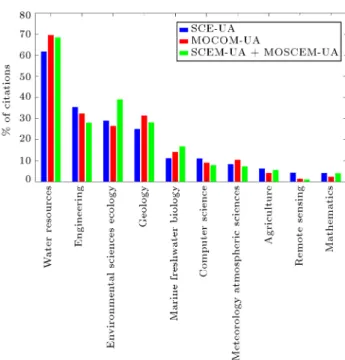
In this section, we look into the diverse applications of the SCE-UA family in dierent elds. According to the Web of Science (a.k.a web of knowledge), at the time of submitting this manuscript, the original SCE-UA papers [1,6] have been cited by over 2400 documents excluding the self-citations, and MOCOM-UA [16], SCEM-UA [24], and MOSCEM-UA [25] have over 500, 600, and 300 independent citations, respectively. To relatively compare application domains of SCE-UA and its extensions, a sample statistic is calculated and shown in Figure 1. The gure shows the top 10 research elds with the highest contributions to the total number of independent citations for the SCE-UA papers [1,6] by dividing the total number of citing references in that eld by the total number of indepen-dent citations for each algorithm. As these elds may overlap, the sum of these percentages is larger than 100 percent. Figure 1 reveals that the original SCE-UA papers and its decedents are mostly cited in water resources domain, while engineering and environmental sciences are next in the ranking. Other elds, such as computer science and mathematics, have smaller but still signicant contribution to the independent citations of the SCE-UA family. In this section, some of these applications are briey presented.
3.1. Applications of SCE-UA
The SCE-UA algorithm was initially developed for the automated calibration of CRR models and has since been mostly applied to hydrologic and terrestrial models [29]. Initially, the algorithm was tested on the six-parameter SIXPAR model [6,30], which is a simplied version of the Sacramento Soil Moisture Accounting (SAC-SMA) model [31]. SIXPAR was developed mainly for theoretical and analytical stud-ies of SAC-SMA and was not intended for practical
Figure 1. The current top 10 research elds with the highest contribution to the total number of SCE-UA independent citations, and the portion of citation for MOCOM-UA and combined citations for SCEM-UA and MOSCEM-UA for these categories according to the web of science.
application [32]. The model has been used to test the SCE-UA and its extensions in a number of studies [33]. Following its demonstrated success with the SIXPAR model, the SCE-UA algorithm has been widely used for parameter estimation of several other conceptual models, including the lumped SAC-SMA model [34].
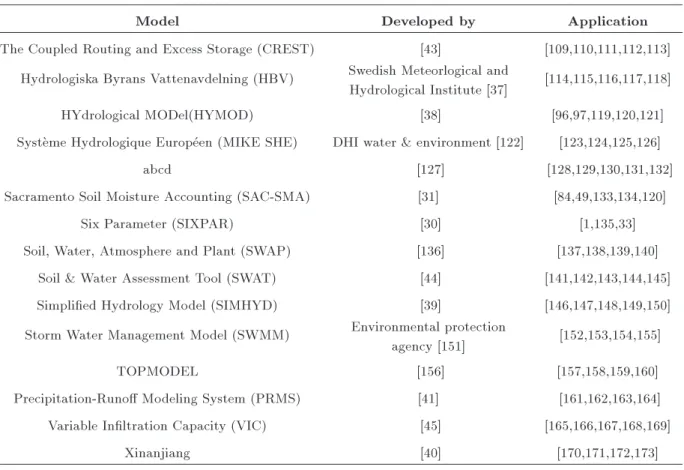
Over the past several decades, the SCE-UA has also served as a performance benchmark against which other algorithms such as the Genetic Algorithms (GA) and Simulated Annealing (SA) [35] have been com-pared. These studies have revealed the robustness and eciency of the SCE-UA for calibrating a wide class of models [6,36], including lumped models such as Hydrologiska Byrans Vattenavdelning (HBV) [37], HY-MOD [38], SIMHYD [39], Xinanjiang [40], and PRMS [41] as well as distributed models such as coupled routing and excess storage Hydrology Laboratory Re-search Distributed Hydrologic Model (HL-RDHM) [42], coupled routing and excess storage (CREST) [43], Soil & Water Assessment Tool (SWAT) [44], and Variable Inltration Capacity (VIC) [45] model. Some of these models and their application with the SCE-UA algorithm are listed in Table 1.
Due to its success, the SCE-UA method has been implemented within several optimization tools developed for the calibration of a variety of models. For instance, ParaSoll [46] employs SCE-UA as the core search method used for calibration of the SWAT model [47] and has been coupled with the SWAT
Cal-Table 1. Example of hydrologic models calibrated by SCE-UA.
Model Developed by Application
The Coupled Routing and Excess Storage (CREST) [43] [109,110,111,112,113] Hydrologiska Byrans Vattenavdelning (HBV) Swedish Meteorlogical and
Hydrological Institute [37] [114,115,116,117,118]
HYdrological MODel(HYMOD) [38] [96,97,119,120,121]
Systeme Hydrologique Europeen (MIKE SHE) DHI water & environment [122] [123,124,125,126]
abcd [127] [128,129,130,131,132]
Sacramento Soil Moisture Accounting (SAC-SMA) [31] [84,49,133,134,120]
Six Parameter (SIXPAR) [30] [1,135,33]
Soil, Water, Atmosphere and Plant (SWAP) [136] [137,138,139,140]
Soil & Water Assessment Tool (SWAT) [44] [141,142,143,144,145]
Simplied Hydrology Model (SIMHYD) [39] [146,147,148,149,150]
Storm Water Management Model (SWMM) Environmental protection
agency [151] [152,153,154,155]
TOPMODEL [156] [157,158,159,160]
Precipitation-Runo Modeling System (PRMS) [41] [161,162,163,164]
Variable Inltration Capacity (VIC) [45] [165,166,167,168,169]
Xinanjiang [40] [170,171,172,173]
ibration and Uncertainty Program (SWAT-CUP) [48]. In addition, the Multi-step Automatic Calibration Scheme (MACS) uses the SCE-UA algorithm as its optimization engine [49].
Beyond its application to hydrologic and land surface models, the SCE-UA method has been applied in other domains such as ground water [50], water quality [51], water demand [52], rating curve [53], radar rainfall [54], and stochastic rainfall models [55].
Further, it has been used to solve other kinds of optimization problems. Ketabchi and Ataie-Ashtiani [56] applied the SCE-UA to groundwater management problems and showed that it provided better solutions than those obtained using other meta-heuristic algorithms such as GA and DE. Moreover, Liong and Atiquzzaman [57] applied the SCE-UA to aid in optimal design of water distribution network and optimization of reservoir operation [58].
Beyond hydrology and water resources manage-ment, the SCE-UA framework has found numerous applications in other elds of science and engineering. In the elds of data analysis and machine learn-ing, it has been used to calibrate the parameters of statistical distributions such as the Beta probability distribution [59], copulas [60], Generalized Extreme Value (GEV) [61], and Gamma function [62]. It has also been used in conjunction with several
ma-chine learning algorithms including Support Vector Regression (SVR) [63], Support Vector Machine (SVM) [64], Random Forest (RF) [65], and fuzzy neural network [66]. The related SP-UCI algorithm has been used for calibrating the parameters of the Articial Neural Networks (ANNs) [67].
Applications of SCE-UA in other elds include pavement and road design [68], optimal air trac ow [69], earthquake and structural engineering [70], crop yield analysis [71], uid mechanics [72], oil spill modelling [73], wireless sensor networks load opti-mization [74], modeling sorption in polymers [75], dielectric spectra analysis [76], astronomy [77], and many other elds [78]. These studies illustrate the wide utility of the SCE-UA algorithm and its tremendous potential for helping to solve a wide variety of classes of optimization problems.
Finally, the SCE-UA method has been adapted for use with computationally expensive models by incorporating the use of surrogate models [79] to provide lower-cost information about the nature of the objective function response surface. For instance, Wu et al. [80] employed SCE-UA with SVMs for the optimization of groundwater use, Ketabchi and Ataie-Ashtiani [81], used it with ANNs for coastal manage-ment, Gan et al. [82] coupled it with Multivariate Adaptive Regression Splines (MARS) for use with
hydrologic models, and Wang et al. [83] used it with a general adaptive Gaussian Process (GP) surrogate model for optimization.
3.2. Applications of MOCOM-UA
The MOCOM-UA method has also been widely used for calibrating hydrologic and land surface models including, SAC-SMA [84,85], HYMOD [38], Biosphere-Atmosphere Transfer Scheme (BATS) [86], VIC [87], Alpine Hydrochemical Model (AHM) [88], Ecomag [89], and many other models [90]. Its appli-cability to multi-objective problems has enabled the investigation of uncertainty bounds of parameters for dierent CRR models by providing a Pareto optimal set for the parameters [91]. The MOCOM-UA and its extensions have been also used for calibrating other types of models, such as those related to the carbon cycle [92], ecohydrology [93], and the optimization of reservoir discharges [20]. Notably, MOCOM-UA has been used as the core optimization tool within the U.S. Geological Survey Modular Modelling System (MMS) for parameter estimation [94].
3.3. Applications of SCEM-UA and MOSCEM-UA
The SCEM-UA and MOSCEM-UA methods have been widely used for parameter uncertainty assessment. The SCEM-UA method has been extensively applied to hy-drologic models including the SAC-SMA [95], HYMOD [96,97], MOD-HMS [98], LISFLOOD [99], HBV [100], Xinanjiang [101], TopNet [102], and Flex [103] model. Further, Blasone et al. [104] used SCEM-UA to sample the prior distribution of the parameters for Gen-eralized Likelihood Uncertainty Estimation method (GLUE) [105] and demonstrated its superior perfor-mance in comparison with other sampling methods. The SCEM-UA enabled GLUE method has also been used for uncertainty assessment of the MIKE-SHE model [106]. In other applications, Haddeland et al. [107] used SCEM-UA to nd optimal reservoir releases, while the MOSCEM-UA algorithm has been used for uncertainty assessment of several hydrologic models [25,100].
4. Future directions
As reported above, the SCE-UA algorithm has been extensively studied and applied to a wide variety of optimization problems, and has also spawned a number of descendant methodologies. However, since the time it was rst introduced, there has been a rapid increase in problem complexity across all of the scientic domains, and this motivates the need for further improvements. Here, we briey mention some potential research directions:
The application of optimization algorithms can be
severely limited by computational burden, which is closely linked to the number of model or function evaluations required. Hence, complexity of the models, and the associated function can hinder application of SCE-UA type algorithms to high dimensional problems. The use of surrogate models has been proposed by Wang et al. [83] to address this issue. Further investigations can extend the application of SCE-UA to more complex systems;
Initial sampling and boundary handling methods can play a signicant role in the performance of optimization algorithms. To-date, there have been very few studies on the eects of initial sampling and boundary handling on the performance of the SCE-UA;
Self-adaptive search mechanisms can extend the ap-plication of the SCE-UA to a wider class of optimiza-tion problems [7]. The investigaoptimiza-tion of other adap-tive procedures for implementation within SCE-UA is likely to be a productive direction for future research;
While the SCE-UA algorithm was initially devel-oped for continuous problems, many engineering problems deal with discrete, mixed-integer, and binary problems. Although the SFL algorithm [12] was introduced to tackle this class of problems, there is room to explore mixed-integer and binary optimization problems. The recent development of new hybrid algorithms [7] illustrates the exibility of the SCE-UA family of methods for employing discrete, mixed-integer, and binary evolutionary methods;
While MOCOM-UA and its extensions were devel-oped to tackle multi-objective problems, extending the application of SCE-UA to many-objective prob-lems (with 4 or more objective functions) needs further investigation;
The architecture of SCE-UA makes it suitable for parallel computing. Since the complexes within SCE-UA evolve independently during each evolution loop, each complex can be assigned to a dierent processing unit [7]. To-date, the prospect of acceler-ating SCE-UA through parallel computing method has been little studied [108].
5. Conclusion
Since its introduction in 1992, the SCE-UA algo-rithm has been successfully applied to scientic and engineering problems ranging from water resources management to machine learning and statistics. In this paper, we reviewed the history of its development and application, and its extensions to multi-objective problems and uncertainty assessment. We showed that
the methodology had found a wide range of applica-tions to dierent elds of science and engineering, and explored future directions for further development. It seems clear that the SCE-UA methodology shows great potential to become more prominent in the eld of optimization. In summary, its popularity is due to:
The algorithm is simple to understand and easy to implement. This argument is supported by the widespread implementation of SCE-UA on dierent platforms and its application to a wide range of problems as referenced above;
The algorithm has proven to provide more robust and ecient performance than many traditional op-timization methods such as GA, DE, and SA [35,57];
The algorithm has only a few control parameters (e.g., ; m; ; q) that need to be tune by the user. Duan et al. [11] made suggestions for typical values of ; q; and m and these recommendations have stood the test of time.
Acknowledgement
The senior author of this invited paper, \Prof. Sorooshian," wishes to reect on the immense contri-butions of Professor Abolhassan Vafai to whom this special issue of the journal is dedicated:
\I had the honor of getting to know Professor Vafai in the early 1990's during his stop at the University of Arizona, Tucson (UAZ). He had one mission and that was to promote educational and scientic interactions between international academic institutions including those in the US. Since that rst visit, Dr. Vafai tirelessly continued his mission of promoting these exchanges resulting in a number of bilateral workshops and exchanges on topics of mutual interest between the Iranian and American academics through the US and Iranian National Academies of Sciences. Looking back at this almost 30 years, many of the students in my research group, whether at UAZ or at the University of California, Irvine (UCI) whose dissertation research was related to the topic of our paper, were from Iran. I am certain that their ability to come to the US and contribute to our research in this eld would not have come to reality without the seless eorts of Dr. Vafai, through the National Academies, promoting the idea that students should be granted visas to pursue their educational goals in the US. Lastly, Scientia Iranica Journal, which I have had the honor of serving on its editorial board, owes its prestige to the vision of Professor Vafai as its founding editor in 1991, who saw the need for a high quality, international science and technology journal."
The senior author also wishes to acknowledge the more than three decades of support and involvement of colleagues from the University of Arizona during the
period from early 1983 to the present and the Uni-versity of California, Irvine (UCI), and the Center for Hydrometeorology and Remote Sensing (CHRS) from 2003 to the present, for their sustained and continued support of the research work related to the SCE-UA algorithm. It is also tting to acknowledge Beijing Normal University, which is the current institution of Professor Duan, who was the original developer of the SCE-UA algorithm.
References
1. Duan, Q., Gupta, V.K., and Sorooshian, S. \Shued complex evolution approach for eective and ecient global minimization", Journal of Optimization The-ory and Applications, 76(3), pp. 501-521 (1993).
2. Gupta, H.V., Sorooshian, S., and Yapo, P.O. \Status of automatic calibration for hydrologic models: Com-parison with multilevel expert calibration", Journal of Hydrologic Engineering, 4(2), pp. 135-143 (1999).
3. Johnston, P. and Pilgrim, D. \Parameter optimiza-tion for watershed models", Water Resources Re-search, 12(3), pp. 477-486 (1976).
4. Kolda, T.G., Lewis, R.M., and Torczon, V. \Opti-mization by direct search: New perspectives on some classical and modern methods", SIAM Review, 45(3), pp. 385-482 (2003).
5. Hendrickson, J., Sorooshian, S., and Brazil, L.E. \Comparison of Newton-type and direct search al-gorithms for calibration of conceptual rainfall-runo models", Water Resources Research, 24(5), pp. 691-700 (1988).
6. Duan, Q., Sorooshian, S., and Gupta, V. \Eec-tive and ecient global optimization for conceptual rainfall-runo models", Water Resources Research, 28(4), pp. 1015-1031 (1992).
7. Naeini, M.R., Yang, T., Sadegh, M., et al. \Shued complex-self adaptive hybrid evolution (SC-SAHEL) optimization framework", Environmental Modelling & Software, 104, pp. 215-235 (2018).
8. Nelder, J.A. and Mead, R. \A simplex method for function minimization", The Computer Journal, 7(4), pp. 308-313 (1965).
9. Price, W. \Global optimization algorithms for a CAD workstation", Journal of Optimization Theory and Applications, 55(1), pp. 133-146 (1987).
10. Holland, J.H., Adaptation in Natural and Articial Systems: An Introductory Analysis with Applications to Biology, Control, and Articial Intelligence, MIT press (1992).
11. Duan, Q., Sorooshian, S., and Gupta, V.K. \Optimal use of the SCE-UA global optimization method for calibrating watershed models", Journal of Hydrology, 158(3-4), pp. 265-284 (1994).
12. Eusu, M., Lansey, K., and Pasha, F. \Shued frog-leaping algorithm: a memetic metaheuristic
for discrete optimization", Engineering Optimization, 38(2), pp. 129-154 (2006).
13. Eberhart, R. and Kennedy, J. \A new optimizer using particle swarm theory. In MHS'95", Proceedings of the Sixth International Symposium on Micro Machine and Human Science, IEEE, pp. 39-43 (1995).
14. Mariani, V.C. Luvizotto, L.G.J., Guerra, F.A., et al. \A hybrid shued complex evolution approach based on dierential evolution for unconstrained op-timization", Applied Mathematics and Computation, 217(12), pp. 5822-5829 (2011).
15. Chu, W., Gao, X., and Sorooshian, S. \A new evolutionary search strategy for global optimization of high-dimensional problems", Information Sciences, 181(22), pp. 4909-4927 (2011).
16. Yapo, P.O., Gupta, H.V., and Sorooshian, S. \Multi-objective global optimization for hydrologic models", Journal of Hydrology, 204(1-4), pp. 83-97 (1998).
17. Hadka, D. and Reed, P. \Borg: An auto-adaptive many-objective evolutionary computing framework", Evolutionary Computation, 21(2), pp. 231-259 (2013).
18. Deb, K., Pratap, A., Agarwal, S., et al. \A fast and elitist multiobjective genetic algorithm: NSGA-II", IEEE Transactions on Evolutionary Computation, 6(2), pp. 182-197 (2002).
19. Goldberg. D.E., Genetic Algorithms in Addison Wes-ley Search, Optimization, and Machine Learning, Addison Wesley (1989).
20. Yang, T., Gao, X., Sellars, S.L., et al. \Improving the multi-objective evolutionary optimization algorithm for hydropower reservoir operations in the California Oroville-Thermalito complex", Environmental Mod-elling & Software, 69, pp. 262-279 (2015).
21. Guo, J., Zhou, J., Zou, Q., et al. \A novel multi-objective shued complex dierential evolution algo-rithm with application to hydrological model param-eter optimization", Water Resources Management, 27(8), pp. 2923-2946 (2013).
22. Rahimi-Vahed, A. and Mirzaei, A.H. \A hybrid multi-objective shued frog-leaping algorithm for a mixed-model assembly line sequencing problem", Computers & Industrial Engineering, 53(4), pp. 642-666 (2007).
23. Gilks, W., Richardson, S., and Spiegelhalter, D., Practical Markov Chain Monte Carlo, New York., Chapman-Hall (1996).
24. Vrugt, J.A., Gupta, H.V., Bouten, W., et al. \A shued complex evolution metropolis algorithm for optimization and uncertainty assessment of hydro-logic model parameters",Water Resources Research, 39(8), 1201 (2003).
25. Vrugt, J.A., Gupta, H.V., Bastidas, L.A., et al. \Eective and ecient algorithm for multiobjective optimization of hydrologic models", Water Resources Research, 39(8), 1214 (2003).
26. Zitzler, E. and Thiele, L. \Multiobjective evolution-ary algorithms: a comparative case study and the strength Pareto approach", IEEE Transactions on Evolutionary Computation, 3(4), pp. 257-271 (1999).
27. Vrugt, J.A., Ter Braak, C., Diks, C., et al. \Ac-celerating Markov chain Monte Carlo simulation by dierential evolution with self-adaptive randomized subspace sampling", International Journal of Non-linear Sciences and Numerical Simulation, 10(3), pp. 273-290 (2009).
28. Hinnell, A.C., Ferre, T.P.A., Vrugt, J.A., Huisman, J.A., Moysey, S., Rings, J., and Kowalsky, M.B. \Improved extraction of hydrologic information from geophysical data through coupled hydrogeophysical inversion", Water Resour. Res., 46, W00D40 (2010).
29. Moradkhani, H. and Sorooshian, S. \General review of rainfall-runo modeling: model calibration, data assimilation, and uncertainty analysis", In Hydrologi-cal Modelling and the Water Cycle, Springer, pp. 1-24 (2009).
30. Gupta, V.K. and Sorooshian, S. \The relationship be-tween data and the precision of parameter estimates of hydrologic models", Journal of Hydrology, 81(1-2), pp. 57-77 (1985).
31. Burnash, R.J., Ferral, R.L., and McGuire, R.A., A Generalized Streamow Simulation System Concep-tual Modeling for Digital Computers, U.S. Dept. of Commerce, National Weather Service, and State of California, Dept. of Water Resources (1973).
32. Gupta, V.K. and Sorooshian, S. \The automatic calibration of conceptual catchment models using derivative-based optimization algorithms", Water Re-sources Research, 21(4), pp. 473-485 (1985).
33. Ozelkan, E.C. and Duckstein, L. \Fuzzy conceptual rainfall-runo models", Journal of Hydrology, 253(1-4), pp. 41-68 (2001).
34. Hsu, K.L., Gupta, H.V., and Sorooshian, S. \Arti-cial neural network modeling of the rainfall-runo process", Water Resources Research, 31(10), pp. 2517-2530 (1995).
35. Cooper, V., Nguyen, V., and Nicell, J. \Evaluation of global optimization methods for conceptual rainfall-runo model calibration", Water Science and Tech-nology, 36(5), pp. 53-60 (1997).
36. Duan, Q. \Global optimization for watershed model calibration", Calibration of Watershed Models, 6, pp. 89-104 (2003).
37. Bergstrom, S., Development and Application of a Conceptual Runo Model for Scandinavian Catch-ments, 52, Department of Water Resources Engineer-ing, Lund Institute of Technology, University of Lund (1976).
38. Boyle, D.P., Gupta, H.V., and Sorooshian, S. \Mul-ticriteria calibration of hydrologic models", Calibra-tion of Watershed Models, Duan, Q., Gupta, H., Sorooshian, S., Rousseau, A., Turcotte, and R., AGU, Eds., pp. 185-196, Wiley Online Library 2003.
39. Chiew, F.H., Peel, M.C., Western, A.W., et al. \Application and testing of the simple rainfall-runo model SIMHYD", Mathematical Models of Small Watershed Hydrology and Applications, pp. 335-367 (2002).
40. Zhao, R.-J. \The Xinanjiang model", In Proceedings of the Oxford Symposium (1980).
41. Leavesley, G., Lichty, R., Troutman, B., et al. \Precipitation-runo modeling system: User's man-ual", Water-Resources Investigations Report, 83, p. 4238 (1983).
42. Thorstensen, A., Nguyen, P., Hsu, K., et al. \Us-ing densely distributed soil moisture observations for calibration of a hydrologic model", Journal of Hydrometeorology, 17(2), pp. 571-590 (2016).
43. Wang, J., Hong, Y., Li, L., et al. \The coupled routing and excess storage (CREST) distributed hydrological model", Hydrological Sciences Journal, 56(1), pp. 84-98 (2011).
44. Arnold, J.G., Srinivasan, R., Muttiah, R.S., et al. \Large area hydrologic modeling and assessment part I: Model development", JAWRA Journal of the American Water Resources Association, 34(1), pp. 73-89 (1998).
45. Wood, E.F., Lettenmaier, D.P., and Zartarian, V.G. \A land-surface hydrology parameterization with subgrid variability for general circulation mod-els", Journal of Geophysical Research: Atmospheres, 97(D3), pp. 2717-2728 (1992).
46. Van Griensven, A. and Meixner, T. \A global and ecient multi-objective autocalibration and uncer-tainty estimation method for water quality catchment models", Journal of Hydroinformatics, 9(4), pp. 277-291 (2007).
47. Yang, J., Reichert, P., Abbaspour, K.C., et al. \Comparing uncertainty analysis techniques for a SWAT application to the Chaohe basin in China", Journal of Hydrology, 358(1-2), pp. 1-23 (2008).
48. Abbaspour, K.C., SWAT-CUP 2012. SWAT Cali-bration and Uncertainty Program - A User Manual (2013).
49. Hogue, T.S., Gupta, H.V., Sorooshian, S., et al. \A multi-step automatic calibration scheme for water-shed models", Calibration of Waterwater-shed Models, 6, pp. 165-174 (2003).
50. Rozos, E. and Koutsoyiannis, D. \A multicell karstic aquifer model with alternative ow equations", Jour-nal of Hydrology, 325(1-4), pp. 340-355 (2006).
51. Van Griensven, A. and Bauwens, W. \Multiobjec-tive autocalibration for semidistributed water quality models", Water Resources Research, 39(12), 1348 (2003).
52. Alvisi, S., Franchini, M., and Marinelli, A. \A stochastic model for representing drinking water de-mand at residential level" Water Resources Manage-ment, 17(3), pp. 197-222 (2003).
53. Franchini, M., Lamberti, P., and Di Giammarco, P. \Rating curve estimation using local stages, upstream discharge data and a simplied hydraulic model", Hydrology and Earth System Sciences Discussions, 3(4), pp. 541-548 (1999).
54. Winchell, M., Gupta, H.V., and Sorooshian, S. \On the simulation of inltration- and saturation-excess runo using radar-based rainfall estimates: Eects of algorithm uncertainty and pixel aggregation", Water Resources Research, 34(10), pp. 2655-2670 (1998).
55. Burton, A., Kilsby, C.G., Fowler, H., et al. \Rainsim: A spatial-temporal stochastic rainfall modelling sys-tem", Environmental Modelling & Software, 23(12), pp. 1356-1369 (2008).
56. Ketabchi, H. and Ataie-Ashtiani, B. \Evolutionary algorithms for the optimal management of coastal groundwater: a comparative study toward future challenges", Journal of Hydrology, 520, pp. 193-213 (2015).
57. Liong, S.-Y. and Atiquzzaman, M. \Optimal design of water distribution network using shued complex evolution", Journal of The Institution of Engineers, Singapore, 44(1), pp. 93-107 (2004).
58. Le Ngo, L., Madsen, H., and Rosbjerg, D. \Simula-tion and optimisa\Simula-tion modelling approach for opera-tion of the Hoa Binh reservoir, Vietnam", Journal of Hydrology, 336(3-4), pp. 269-281 (2007).
59. Sheeld, J. and Wood, E.F. \Characteristics of global and regional drought, 1950-2000: Analysis of soil moisture data from o-line simulation of the terrestrial hydrologic cycle", Journal of Geophysical Research: Atmospheres, 112, D17115 (2007).
60. Sadegh, M., Ragno, E., and AghaKouchak, A. \Mul-tivariate Copula Analysis Toolbox (MvCAT): De-scribing dependence and underlying uncertainty using a Bayesian framework", Water Resources Research, 53(6), pp. 5166-5183 (2017).
61. Menendez, M., Mendez, F.J., Izaguirre, C., et al. \The inuence of seasonality on estimating return val-ues of signicant wave height", Coastal Engineering, 56(3), pp. 211-219 (2009).
62. Menberu, M.W., Haghighi, A.T., Ronkanen, A.-K. et al. \Eects of drainage and subsequent restoration on peatland hydrological processes at catchment scale", Water Resources Research, 54(7), pp. 4479-4497 (2018).
63. Fang, W., Huang, S., Ren, K., et al. \Examining the applicability of dierent sampling techniques in the development of decomposition-based streamow forecasting models", Journal of Hydrology, 568, pp. 534-550 (2019).
64. Wang, W.-C. Chau, K.-W., Cheng, C.-T., et al. \A comparison of performance of several articial intelli-gence methods for forecasting monthly discharge time series", Journal of hydrology, 374(3-4), pp. 294-306 (2009).
65. Fang, W., Huang, S., Huang, Q., et al. \Reference evapotranspiration forecasting based on local meteo-rological and global climate information screened by partial mutual information", Journal of Hydrology, 561, pp. 764-779 (2018).
66. Alvisi, S. and Franchini, M. \Fuzzy neural networks for water level and discharge forecasting with uncer-tainty", Environmental Modelling & Software, 26(4), pp. 523-537 (2011).
67. Yang, T., Asanjan, A.A., Faridzad, M., et al. \An enhanced articial neural network with a shued complex evolutionary global optimization with princi-pal component analysis", Information Sciences, 418, pp. 302-316 (2017).
68. Gopalakrishnan, K. and Kim, S. \Global optimiza-tion of pavement structural parameters during back-calculation using hybrid shued complex evolution algorithm", Journal of Computing in Civil Engineer-ing, 24(5), pp. 441-451 (2010).
69. Jiang, Y., Zhang, H., and Hongshan, X. \Opti-mization strategy for air trac ow in multi-airport network", Scientic Research and Essays, 6(31), pp. 6499-6508 (2011).
70. Barakat, S.A. and Altoubat, S. \Application of evolu-tionary global optimization techniques in the design of RC water tanks", Engineering Structures, 31(2), pp. 332-344 (2009).
71. Ma, G., Huang, J., Wu, W., et al. \Assimilation of MODIS-LAI into the WOFOST model for forecast-ing regional winter wheat yield", Mathematical and Computer Modelling, 58(3-4), pp. 634-643 (2013).
72. Bertaglia, G., Ioriatti, M., Valiani, A., et al. \Numer-ical methods for hydraulic transients in visco-elastic pipes", Journal of Fluids and Structures, 81, pp. 230-254 (2018).
73. Abascal, A.J., Castanedo, S., Mendez, F.J., et al. \Calibration of a Lagrangian transport model using drifting buoys deployed during the prestige oil spill", Journal of Coastal Research, 25(1), pp. 80-90 (2009).
74. Edla, D.R., Lipare, A., and Cheruku, R. \Shued complex evolution approach for load balancing of gateways in wireless sensor networks", Wireless Per-sonal Communications, 98(4), pp. 3455-3476 (2018).
75. Sharma, H.N., Kroonblawd, M.P., Sun, Y., et al. \Role of ller and its heterostructure on moisture sorption mechanisms in polyimide lms", Scientic Reports, 8(1), p. 16889 (2018).
76. Schmidt, F., Wagner, N., Mai, J., et al. \Dielectric spectra reconstruction of layered multiphase soil", In 2018 12th International Conference on Electro-magnetic Wave Interaction with Water and Moist Substances (ISEMA), IEEE, pp. 1-9 (2018).
77. Lazare, B., Berger, J.P., Kluska, J., et al. \Structure of herbig aebe disks at the milliarcsecond scale-a statistical survey in the h band using pionier-vlti", Astronomy & Astrophysics, 599, p. A85 (2017).
78. Shahriari R. and Dehghani, M.R. \New electrolyte SAFT-VR Morse EOS for prediction of solid-liquid equilibrium in aqueous electrolyte solutions", Fluid Phase Equilibria, 463, pp. 128-141 (2018).
79. Yang, T., Hsu, K., Duan, Q., et al. \Method to estimate optimal parameters", Handbook of Hydrom-eteorological Ensemble Forecasting, pp. 1-39, Springer Berlin Heidelberg (2018).
80. Wu, B., Zheng, Y., Wu, X., et al. \Optimizing water resources management in large river basins with integrated surface water-groundwater modeling: A surrogate-based approach", Water Resources Re-search, 51(4), pp. 2153-2173 (2015).
81. Ketabchi, H. and Ataie-Ashtiani, B. \Coastal ground-water optimization-advances, challenges, and prac-tical", Hydrogeology Journal, 23(6), pp. 1129-1154 (2015).
82. Gan, Y., Liang, X.-Z., Duan, Q., et al. \A systematic assessment and reduction of parametric uncertainties for a distributed hydrological model", Journal of Hydrology, 564, pp. 697-711 (2018).
83. Wang, C., Duan, Q., Gong, W., et al. \An evaluation of adaptive surrogate modeling based optimization with two benchmark problems", Environmental Mod-elling & Software, 60, pp. 167-179 (2014).
84. Gupta, H.V., Sorooshian, S., and Yapo, P.O. \Toward improved calibration of hydrologic models: Multiple and noncommensurable measures of information", Water Resources Research, 34(4), pp. 751-763 (1998).
85. Boyle, D.P., Gupta, H.V., and Sorooshian, S. \To-ward improved calibration of hydrologic models: Combining the strengths of manual and automatic methods", Water Resources Research, 36(12), pp. 3663-3674 (2000).
86. Gupta, H.V., Bastidas, L., Sorooshian, S., et al. \Parameter estimation of a land surface scheme us-ing multicriteria methods", Journal of Geophysical Research: Atmospheres, 104(D16), pp. 19491-19503 (1999).
87. Anghileri, D., Voisin, N., Castelletti, A., et al. \Value of long-term streamow forecasts to reservoir operations for water supply in snow-dominated river catchments", Water Resources Research, 52(6), pp. 4209-4225 (2016).
88. Meixner, T., Bastidas, L., Gupta, H.V., et al. \Mul-ticriteria parameter estimation for models of stream chemical composition", Water Resources Research, 38(3), pp. 9-1 (2002).
89. Engeland, K., Braud, I., Gottschalk, L., et al. \Multi-objective regional modelling", Journal of Hydrology, 327(3-4), pp. 339-351 (2006).
90. Collischonn, W., Haas, R., Andreolli, I., et al. \Fore-casting river Uruguay ow using rainfall forecasts from a regional weather-prediction model", Journal of Hydrology, 305(1-4), pp. 87-98 (2005).
91. Beldring, S. \Multi-criteria validation of a precipitation-runo model", Journal of Hydrology, 257(1-4), pp. 189-211 (2002).
92. Magnani, F., Mencuccini, M., Borghetti, M., et al. \The human footprint in the carbon cycle of temperate and boreal forests", Nature, 447(7146), p. 849 (2007).
93. Naseem, B., Ajami, H., Liu, Y., et al. \Multi-objective assessment of three remote sensing vegeta-tion products for streamow predicvegeta-tion in a concep-tual ecohydrological model", Journal of Hydrology, 543, pp. 686-705 (2016).
94. Leavesley, G., Markstrom, S., Restrepo, P.J., et al. \A modular approach to addressing model design, scale, and parameter estimation issues in distributed hydro-logical modelling", Hydrohydro-logical Processes, 16(2), pp. 173-187 (2002).
95. Ajami, N.K., Duan, Q., and Sorooshian, S. \An inte-grated hydrologic Bayesian multimodel combination framework: Confronting input, parameter, and model structural uncertainty in hydrologic prediction", Wa-ter Resources Research, 43(1), W01403 (2007).
96. Moradkhani, H., Sorooshian, S., Gupta, H.V., et al. \Dual state-parameter estimation of hydrological models using ensemble Kalman lter", Advances in Water Resources, 28(2), pp. 135-147 (2005).
97. Vrugt, J.A., Diks, C.G., Gupta, H.V., et al. \Im-proved treatment of uncertainty in hydrologic model-ing: Combining the strengths of global optimization and data assimilation", Water Resources Research, 41(1), W01017 (2005).
98. Schoups, G., Hopmans, J.W., Young, C., et al. \Multi-criteria optimization of a regional spatially-distributed subsurface water ow model", Journal of Hydrology, 311(1-4), pp. 20-48 (2005).
99. Feyen, L., Vrugt, J.A., O. Nuallain, B., et al. \Parameter optimisation and uncertainty assessment for large-scale streamow simulation with the lisood model", Journal of Hydrology, 332(3-4), pp. 276-289 (2007).
100. Parajka, J., Merz, R., and Bloschl, G. \Uncertainty and multiple objective calibration in regional water balance modelling: case study in 320 Austrian catch-ments", Hydrological Processes: An International Journal, 21(4), pp. 435-446 (2007).
101. Jiang, S., Ren, L., Hong, Y., et al. \Comprehensive evaluation of multi-satellite precipitation products with a dense rain gauge network and optimally merging their simulated hydrological ows using the Bayesian model averaging method", Journal of Hy-drology, 452, pp. 213-225 (2012).
102. McMillan, H., Freer, J., Pappenberger, F., et al. \Impacts of uncertain river ow data on rainfall-runo model calibration and discharge predictions", Hydrological Processes: An International Journal, 24(10), pp. 1270-1284 (2010).
103. Fenicia, F., Savenije, H.H., Matgen, P., et al. \Under-standing catchment behavior through stepwise model concept improvement", Water Resources Research, 44(1), W01402 (2008).
104. Blasone, R.-S., Vrugt, J.A., Madsen, H., et al. \Generalized likelihood uncertainty estimation (glue) using adaptive Markov chain Monte Carlo sampling", Advances in Water Resources, 31(4), pp. 630-648 (2008).
105. Beven, K. and Binley, A. \The future of distributed models: model calibration and uncertainty pre-diction", Hydrological Processes, 6(3), pp. 279-298 (1992).
106. Blasone, R.-S., Madsen, H., and Rosbjerg, D. \Un-certainty assessment of integrated distributed hydro-logical models using glue with Markov chain Monte Carlo sampling", Journal of Hydrology, 353(1-2), pp. 18-32 (2008).
107. Haddeland, I., Skaugen, T., and Lettenmaier, D.P. \Anthropogenic impacts on continental surface water uxes", Geophysical Research Letters, 33(8), L08406 (2006).
108. Kan, G., He, X., Li, J., et al. \Computer aided nu-merical methods for hydrological model calibration: An overview and recent development", Archives of Computational Methods in Engineering, 26(1), pp. 35-59 (2019).
109. Xue, X., Hong, Y., Limaye, A.S., et al. \Statistical and hydrological evaluation of TRMM based multi-satellite precipitation analysis over the Wangchu basin of Bhutan: Are the latest satellite precipitation products 3B42V7 ready for use in ungauged basins", Journal of Hydrology, 499, pp. 91-99 (2013).
110. Shen X. and Anagnostou, E.N. \A framework to improve hyper-resolution hydrological simulation in snow-aected regions", Journal of Hydrology, 552, pp. 1-12 (2017).
111. Gao, Z., Long, D., Tang, G., et al. \Assessing the potential of satellite-based precipitation estimates for ood frequency analysis in ungauged or poorly gauged tributaries of China's Yangtze river basin", Journal of Hydrology, 550, pp. 478-496 (2017).
112. Ma, Q., Xiong, L., Liu, D., et al. \Evaluating the temporal dynamics of uncertainty contribution from satellite precipitation input in rainfall-runo modeling using the variance decomposition method", Remote Sensing, 10(12), p. 1876 (2018).
113. Sun, W., Ma, J., Yang, G., et al. \Statistical and hy-drological evaluations of multi-satellite precipitation products over Fujiang river basin in humid southeast China", Remote Sensing, 10(12), p. 1898 (2018).
114. Yu, P.-S., Yang, T.-C., and Wu, C.-K. \Impact of climate change on water resources in southern Taiwan", Journal of Hydrology, 260(1-4), pp. 161-175 (2002).
115. Parajka, J., Merz, R., and Bloschl, G. \A compari-son of regionalisation methods for catchment model parameters", Hydrology and Earth System Sciences Discussions, 9(3), pp. 157-171 (2005).
116. Parajka, J. and Bloschl, G. \The value of MODIS snow cover data in validating and calibrating con-ceptual hydrologic models", Journal of Hydrology, 358(3-4), pp. 240-258 (2008).
117. Merz, R., Parajka, J., and Bloschl, G. \Time stability of catchment model parameters: Implications for climate impact analyses", Water Resources Research, 47(2), W02531 (2011).
118. Dakhlaoui, H., Bargaoui, Z., and Bardossy, A. \To-ward a more ecient calibration schema for HBV rainfall-runo model", Journal of Hydrology, 444, pp. 161-179 (2012).
119. Duan, Q., Ajami, N.K., Gao, X., et al. \Multi-model ensemble hydrologic prediction using Bayesian model averaging", Advances in Water Resources, 30(5), pp. 1371-1386 (2007).
120. Naja, M., Moradkhani, H., and Jung, I. \Assessing the uncertainties of hydrologic model selection in cli-mate change impact studies", Hydrological Processes, 25(18), pp. 2814-2826 (2011).
121. Naseem, B., Ajami, H., Cordery, I., et al. \A multi-objective assessment of alternate conceptual ecohy-drological models", Journal of Hydrology, 529, pp. 1221-1234 (2015).
122. Abbott, M., Bathurst, J., Cunge, J., et al. \An introduction to the European hydrological system { systeme hydrologique Europeen,\SHE", 2: Structure of a physically-based, distributed modelling system", Journal of hydrology, 87(1-2), pp. 61-77 (1986).
123. Mertens, J., Madsen, H., Feyen, L., et al. \Including prior information in the estimation of eective soil parameters in unsaturated zone modelling", Journal of Hydrology, 294(4), pp. 251-269 (2004).
124. Stisen, S. and Sandholt, I. \Evaluation of remote-sensing-based rainfall products through predictive capability in hydrological runo modelling", Hydro-logical Processes: An International Journal, 24(7), pp. 879-891 (2010).
125. Liu, J., Liu, T., Bao, A., et al. \Response of hydrological processes to input data in high alpine catchment: An assessment of the Yarkant river basin in China", Water, 8(5), p. 181 (2016).
126. Li, D., Liang, Z., Li, B., et al. \Multi-objective calibration of MIKE SHE with SMAP soil moisture datasets", Hydrology Research, 50(2), pp. 644-654 (2018).
127. Thomas. H. \Improved methods for national water as-sessment", Report WR15249270, US Water Resource Council, Washington, DC (1981).
128. Sankarasubramanian, A., Vogel, R.M., and Limbrun-ner, J.F. \Climate elasticity of streamow in the united states", Water Resources Research, 37(6), pp. 1771-1781 (2001).
129. Sankarasubramanian, A. and Vogel, R.M. \Annual hydroclimatology of the united states", Water Re-sources Research, 38(6), pp. 19-1-19-12 (2002).
130. Vogel, R.M. and Sankarasubramanian, A. \Validation of a watershed model without calibration", Water Resources Research, 39(10), 1292 (2003).
131. Martinez, G.F. and Gupta, H.V. \Toward improved identication of hydrological models: A diagnostic evaluation of the \abcd" monthly water balance model for the conterminous united states", Water Resources Research, 46(8), W08507 (2010).
132. Deng, C., Liu, P., Wang, D., et al. \Temporal variation and scaling of parameters for a monthly hydrologic model", Journal of Hydrology, 558, pp. 290-300 (2018).
133. Ajami, N.K., Gupta, H., Wagener, T., et al. \Cal-ibration of a semi-distributed hydrologic model for streamow estimation along a river system", Journal of Hydrology, 298(1-4), pp. 112-135 (2004).
134. Behrangi, A., Khakbaz, B., Jaw, T.C., et al. \Hy-drologic evaluation of satellite precipitation products over a mid-size basin", Journal of Hydrology, 397(3-4), pp. 225-237 (2011).
135. Gan, T.Y. and Biftu, G.F. \Automatic calibration of conceptual rainfall-runo models: Optimization algorithms, catchment conditions, and model struc-ture", Water Resources Research, 32(12), pp. 3513-3524 (1996).
136. Gusev Y.M. and Nasonova, O. \The land surface pa-rameterization scheme swap: Description and partial validation", Global and Planetary Change, 19(1-4), pp. 63-86 (1998).
137. Nasonova, O.N., Gusev, Y.M., and Kovalev, Y.E. \Investigating the ability of a land surface model to simulate streamow with the accuracy of hydrological models: A case study using MOPEX materials", Journal of Hydrometeorology, 10(5), pp. 1128-1150 (2009).
138. Gusev, E., Nasonova, O.N., and Dzhogan, L.Y. \Physically based modeling of many-year dynamics of daily streamow and snow water equivalent in the lena R. basin", Water Resources, 43(1), pp. 21-32 (2016).
139. Nasonova, O.N., Gusev, Y.M., Volodin, E.M., et al. \Application of the land surface model SWAP and global climate model INMCM4.0 for projecting runo of northern Russian rivers. 1. Historical simulations", Water Resources, 45(2), pp. 73-84 (2018).
140. Gusev, E., Nasonova, O.N., Kovalev, E., et al. \Modelling water balance components of river basins located in dierent regions of the globe", Water Resources, 45(2), pp. 53-64 (2018).
141. Eckhardt, K. and Arnold, J. \Automatic calibration of a distributed catchment model", Journal of Hy-drology, 251(1-2), pp. 103-109 (2001).
142. Van Liew, M.W., Veith, T.L., Bosch, D.D., et al. \Suitability of SWAT for the conservation eects as-sessment project: Comparison on USDA agricultural research service watersheds", Journal of Hydrologic Engineering, 12(2), pp. 173-189 (2007).
143. Green, C. and Van Griensven, A. \Autocalibration in hydrologic modeling: Using SWAT2005 in small-scale watersheds", Environmental Modelling & Software, 23(4), pp. 422-434 (2008).
144. Yu, D., Xie, P., Dong, X., et al. \Improvement of the SWAT model for event-based ood simulation on a sub-daily timescale", Hydrology and Earth System Sciences, 22(9), pp. 5001-5019 (2018).
145. Rouhani, H. and Leconte, R. \A methodologi-cal framework to assess PMP and PMF in snow-dominated watersheds under changing climate con-ditions - A case study of three watersheds in Quebec (Canada)", Journal of Hydrology, 561, pp. 796-809 (2018).
146. Chiew, F., Kirono, D., Kent, D., et al. \Comparison of runo modelled using rainfall from dierent down-scaling methods for historical and future climates", Journal of Hydrology, 387(1-2), pp. 10-23 (2010).
147. Vaze, J., Post, D., Chiew, F., et al. \Conceptual rainfall-runo model performance with dierent spa-tial rainfall inputs", Journal of Hydrometeorology, 12(5), pp. 1100-1112 (2011).
148. Duan, D. and Mei, Y. \Comparison of meteorological, hydrological and agricultural drought responses to climate change and uncertainty assessment", Wa-ter Resources Management, 28(14), pp. 5039-5054 (2014).
149. Khan, U., Ajami, H., Tuteja, N.K., et al. \Catchment scale simulations of soil moisture dynamics using an equivalent cross-section based hydrological modelling approach", Journal of Hydrology, 564, pp. 944-966 (2018).
150. Potter, N., Ekstrom, M., Chiew, F., et al. \Change-signal impacts in downscaled data and its inuence on hydroclimate projections", Journal of Hydrology, 564, pp. 12-25 (2018).
151. Rossman, L.A. \Storm water management model user's manual", version 5.0. Cincinnati: National Risk Management Research Laboratory, Oce of Research and Development, US Environmental Pro-tection Agency (2010).
152. Lee, S. and Kang, T. \Analysis of constrained opti-mization problems by the SCE-UA with an adaptive penalty function", Journal of Computing in Civil Engineering, 30(3), p. 04015035 (2015).
153. Russwurm, I.L., Johannessen, B.G., Gragne, A.S., et al. \Modelling green roof detention performance in cold climates", EPiC Series in Engineering, Easy-Chair, 3, pp. 1804-1813 (2018).
154. Hamouz, V. and Muthanna, T.M. \Modelling of green and grey roofs in cold climates using EPA's storm water management model", In International Conference on Urban Drainage Modelling, pp. 385-391, Springer (2018).
155. Johannessen, B.G., Hamouz, V., Gragne, A.S., et al. \The transferability of SWMM model parameters between green roofs with similar build-up", Journal of Hydrology, 569, pp. 816-828 (2019).
156. Beven, K.J. and Kirkby, M.J. \A physically based, variable contributing area model of basin hydrol-ogy/un modele a base physique de zone d'appel vari-able de l'hydrologie du bassin versant", Hydrological Sciences Journal, 24(1), pp. 43-69 (1979).
157. Kavetski, D., Franks, S.W., and Kuczera, G. \Con-fronting input uncertainty in environmental mod-elling", Calibration of Watershed Models, 6, pp. 49-68 (2003).
158. Hossain, F., Anagnostou, E.N., and Bagtzoglou, A.C. \On latin hypercube sampling for ecient uncer-tainty estimation of satellite rainfall observations in ood prediction", Computers & Geosciences, 32(6), pp. 776-792 (2006).
159. Qi, W., Zhang, C., Fu, G., et al. \Quantifying dynamic sensitivity of optimization algorithm pa-rameters to improve hydrological model calibration", Journal of Hydrology, 533, pp. 213-223 (2016).
160. Rogelis, M.C. and Werner, M. \Streamow forecasts from WRF precipitation for ood early warning in mountain tropical areas", Hydrology and Earth System Sciences, 22(1), pp. 853-870 (2018).
161. Hay, L., Clark, M., Pagowski, M., et al. \One-way coupling of an atmospheric and a hydrologic model in Colorado", Journal of Hydrometeorology, 7(4), pp. 569-589 (2006).
162. Viger, R.J., Hay, L.E., Markstrom, S.L., et al. \Hy-drologic eects of urbanization and climate change on the int river basin, Georgia", Earth Interactions, 15(20), pp. 1-25 (2011).
163. Ott, I., Duethmann, D., Liebert, J., et al. \High-resolution climate change impact analysis on medium-sized river catchments in Germany: an ensemble assessment", Journal of Hydrometeorology, 14(4), pp. 1175-1193 (2013).
164. Mendoza, P.A., Clark, M.P., Mizukami, N., et al. \Eects of hydrologic model choice and calibration on the portrayal of climate change impacts", Journal of Hydrometeorology, 16(2), pp. 762-780 (2015).
165. Abdulla, F.A., Lettenmaier, D.P., Wood, E.F., et al. \Application of a macroscale hydrologic model to estimate the water balance of the Arkansas-Red river basin", Journal of Geophysical Research: Atmo-spheres, 101(D3), pp. 7449-7459 (1996).
166. Wooldridge, S., Kalma, J.D., and Walker, J.P. \Im-portance of soil moisture measurements for infer-ring parameters in hydrologic models of low-yielding ephemeral catchments", Environmental Modelling & Software, 18(1), pp. 35-48 (2003).
167. Troy, T.J., Wood, E.F., and Sheeld, J. \An ecient calibration method for continental-scale land surface modeling", Water Resources Research, 44(9) (2008).
168. Sheeld, J., Wood, E.F., Chaney, N., et al. \A drought monitoring and forecasting system for Sub-Sahara African water resources and food security", Bulletin of the American Meteorological Society, 95(6), pp. 861-882 (2014).
169. Mizukami, N., Clark, M.P., Newman, A.J., et al. \To-wards seamless large-domain parameter estimation for hydrologic models", Water Resources Research, 53(9), pp. 8020-8040 (2017).
170. Gan, T.Y., Dlamini, E.M., and Biftu, G.F. \Eects of model complexity and structure, data quality, and objective functions on hydrologic modeling", Journal of Hydrology, 192(1-4), pp. 81-103 (1997).
171. Guo, W., Wang, C., Zeng, X., et al. \Subgrid parameterization of the soil moisture storage capacity for a distributed rainfall-runo model", Water, 7(6), pp. 2691-2706 (2015).
172. Yuan, F., Zhang, L., Win, K., et al. \Assessment of GPM and TRMM multi-satellite precipitation products in streamow simulations in a data-sparse mountainous watershed in Myanmar", Remote Sens-ing, 9(3), p. 302 (2017).
173. Zeng, Q., Chen, H., Xu, C.-Y., et al. \The eect of rain gauge density and distribution on runo simulation using a lumped hydrological modelling approach", Journal of Hydrology, 563, pp. 106-122 (2018).
Biographies
Matin Rahnamay Naeini received his BS in Civil and Environmental Engineering from the Iran Univer-sity of Science and Technology (IUST) in 2014 and his MS in Civil Engineering from the University of California, Irvine, in 2016. In 2019, Dr. Rahnamay Naeini earned his PhD in Civil Engineering with emphasis on hydrology and water resources from the University of California, Irvine. His research focus is on optimization theory, reservoir decision making, data mining, hydropower, water resources management, and hydrology. He is currently a postdoctoral scholar in the Center for Hydrometeorology & Remote Sensing (CHRS) at the University of California, Irvine. Bita Analui received her PhD in Statistics and Operations Research from the University of Vienna, Austria, in 2014. She was a postdoctoral scholar in Electrical, Computer and Energy Engineering School with Arizona State University. Her expertise includes mathematical and statistical modeling with focus on dynamic decision making under uncertainty and theory of stochastic optimization. More recently, in her role as research scientist at University of California, Irvine, Dr. Analui has been engaged in research projects for improving sustainable hydropower design and opera-tion through the US Department of Energy Clean En-ergy Research Center for Water-EnEn-ergy Technologies (CERC-WET) program.
Hoshin V. Gupta received his PhD in Systems Engineering from the Case Western Reserve University.
Dr. Gupta is a regents professor at the University of Arizona. He is a hydrologist and systems theorist and philosopher with an extensive background in earth system modeling. His research interests include ood-forecasting, land-atmosphere interaction, hydrology, hydrologic modeling, remote sensing, machine learning, decision support systems, and policy analysis. He is a fellow of the American Geophysical Union (AGU), vice-chair of the IFAC Technical Committee on Modeling and Control of Environmental Systems, the chair of the \Model Diagnostics" working group of IAHS, and a member of the IAHS/PUB Steering Committee. He also served as a member of the NAS/NRC Commission to review the Modernization Program of the US Na-tional Weather Service, the AGU Hydrology Section \Fellows Committee", the Water Resources Research Editor-In-Chief Search Committee, and the European Geosciences Union (EGU) John Dalton Medal Com-mittee.
Qingyun Duan received his PhD in Hydrology from the University of Arizona in 1991. He is currently a Professor and Chief Scientist of hydrology and water resources in the Faculty of Geographical Science at Bei-jing Normal University in China. His research interests include hydrology and water resources, hydrological model development and calibration, hydrometeorolog-ical ensemble forecasting, and uncertainty quantica-tion for large complex system models. He has authored or co-authored more than 160 peer reviewed articles and edited 3 books. Dr. Duan has been active in many international scientic activities, including serving as the co-leader of the Model Parameter Estimation Ex-periment (MOPEX) and a member of the scientic steering committees of the Global Energy and Water Exchanges (GEWEX) Project and the Hydrological Ensemble Prediction Experiment (HEPEX). He has been serving as an editor or editorial board member for numerous scientic journals, including Reviews of Geophysics, Bulleting of American Meteorological Society, and Water Resources Research. Dr. Duan is a recipient of Chinese Government \One-Thousand Talents Program" Award and a Fellow of American Geophysical Union and American Meteorological So-ciety.
Soroosh Sorooshian received his BS in Mechanical Engineering from California State Polytechnic Univer-sity. Also, he received an MS, an Engineer Degree, and a PhD from the University of California, Los Angeles, focusing on operations research, systems en-gineering, and engineering. Dr. Sorooshian's expertise and the research focuses include articial intelligence, optimization, hydrometeorology, remote sensing, water resources systems, hydropower, climate studies, and application of articial intelligence techniques to earth
science problems with special focus on the hydrologic cycle and water resources. Dr. Sorooshian is an internationally recognized Distinguished Professor at the University of California, Irvine, and the Director of the Center for Hydrometeorology & Remote Sensing (CHRS). He a fellow of International Union of Geodesy and Geophysics (IUGG), American Association for the Advancement of Science, American Meteorological
So-ciety (AMS), American Geophysical Union (AGU), and International Water Resources Association (IWRA). He is a member of the US National Academy of Engineering (NAE) and International Academy of As-tronautics (IAA). He also served as the editor and editorial board member of many scientic journals including Water Resources Research, IEEE Systems Journal, and Scientia Iranica.