Goals and Reality in the Compacting of the
Cherokee Indian Hospital:
Evaluating the Process of Change
By
C. Blythe Sanders
A Master's Paper submitted to the faculty of the University of North Carolina at Chapel Hill
in partial fulfillment of the requirements for the degree of Master of Public Health in
the Public Health Leadership Program.
Abstract
Objective: (1) To describe and analyze the process of "compacting," or
moving control of health systems from the Indian Health Service to American
Indian and Alaska Native (AlAN) tribes, and the stimuli that drove it; (2) To
evaluate the obstacles and advantages to compacting; (3) To determine
whether compacting has the capacity to contribute to improved quality of care
and better health outcomes of AlAN people; (4) To illustrate these processes
via a preliminary case study of the compacting of the Cherokee Indian Hospital
of the Eastern Band of the Cherokee Indians, in Cherokee, North Carolina.
Design: Primary analysis of legislation and other primary source documents
and in·depth interviews with key informants.
Source of Study Data: Public documents in the form of legislation,
regulation, and administrative policies; key informant interviews of health
policymakers in the Cherokee Indian Hospital conducted by the author
Findings: Successful compacting requires an intricate, multistage process of
preparation and high levels of assistance and cooperation. The goal of
compacting is not accompanied by the level of resources necessary to make
compacting a straightforward matter of transfer of federal funds to tribes.
Successful compacting, at present, is probably only possible for wealthier
tribes with independent revenue streams that can be diverted to tribal health
system support, such as gaming revenues.
Conclusions: Tribal health care likely cannot escape the challenges of
existing in a public·private hybrid that dominate the larger U.S. health care
system, despite the clear federal treaty obligation to provide for AlAN health.
Compacting, as an important part of the larger trend to tribal self-governance,
is the best strategy for improving the quality of care and health outcomes for
AIANs, since tribes know their members' needs best. Compacting in the
absence of adequate resources, including money and administrative capacity, is
likely doomed to failure. With such resources, however, compacting will
Table of Contents
Page
Abstract . . . ii
Table of Contents ... iii
List of Figures ... iv
Overview: historical and political paths to compacting... 1
The Eastern Band of the Cherokee Indians . . . 3
Health status of the EBCI... 5
History of the Indian Health Service... 8
Indian Health Service today... 9
The development of Native American self-governance ... 11
Compacting: giving substance to self-governance ... 15
Methods ... 1 7
Searching the literature and locating primary documents ... 17
Conducting research with a sensitive population ... 19
Scientific rigor in qualitative research ... 20
The decision to compact ...•...•...•. 24
Determining feasibility ... 25
Community support ... 28
Planning phase ... 32
Negotiation ... 33
Implementing the compact ... 35
Current challenges for compacting ... 36
Data collection and reporting requirements ... 38
Public-private hybrid ... 43
The current state of insurance coverage ... 44
Third party payments and the need for services ... 45
Medicaid ... 46
Future changes in health insurance policy ... 49
Gaming revenues ... 50
Conclusion ... 53
List of References ... 58
List of Figures
Overview: historical and political paths to compacting
I, a sickly child, had no difficulty obtaining the care I needed from the Cherokee Indian Hospital in Cherokee, North Carolina; contract health services, for example, referred me to a cardiologist when my EKG showed an abnormal heart rhythm. During most of my childhood, the hospital was owned and operated by the Indian Health Service (IHS). IHS offers health care to 1.4 million American Indians and Alaskan Natives (AIANs) from 500 federally recognized tribes in 35 states.' The Indian Health Service is an agency within the Department of Health and Human Services whose goal is to "assure that comprehensive, culturally acceptable, personal and pubic health services are available and accessible to American Indians and Alaskan Natives". 2 Although I received good care from the IHS facility in Cherokee, IHS health services have usually suffered from inadequate funding, limited facilities, and workforce shortages. In addition, IHS's top·down provision of services to AIANs perpetuates a state of affairs that, many argue, does not support tribal autonomy or facilitate tribes' capacity to govern their own affairs; nor may it be the best way to promote quality of care and good health outcomes for AIANs.
Act also gave tribes the power to overhaul health programs to combine services or contract with other providers. Many IHS facilities function as managed care components of a larger IHS system that includes more than 59,000 hospital admissions and 8 million ambulatory care visits each year. 2 At present, as a result of the Self-Determination Act, over half of IHS facilities and programs are now administered by tribes. 3
Tribes and the federal government use the term "compacting" when a tribe assumes administrative responsibility for a facility previously managed by the IHS. Compacting enables a tribe to use IHS appropriations according to the needs of that individual community. Tribes can also use revenue from other sources (e.g. casinos) under compacting, something that had not been possible under the old style of IHS administration. One of this paper's major findings is that a significant force pushing the IHS and the tribes toward compacting is chronic inadequate funding of IHS by Congress.'
Other forces driving more tribes to compact include a desire for increased self-governance; decreased administrative costs for area headquarters' offices and IHS, and therefore more budgeting allocations
directly to tribes for various programs; and increased quality of care for tribes. Compacting also presents potential problems for data collection; the creation of a new public-private hybrid health system; and transparent reporting of performance measures. This paper examines the compacting of the Cherokee Indian Hospital by the Eastern Band of Cherokee Indians, which took place in 2003, within the broader context of how compacts will affect the future of the Indian Health Service.
l
'
The Eastern Band of Cherokee Indians
A brief history of the Removal, citizenship status, and land ownership of the Eastern Band of Cherokee Indians (EBCI) will provide evidence of the
difficulties this tribe has endured in its relationship to the state and federal governments. This history makes clear the EBCI developed distrust of government and desired to become self-governing.
The EBCI is a tribe located on approximately 56,000 acres, known as the Qualla Boundary, in Western North Carolina. 5 Approximately 13,400 people are members of the EBCI, and 60 percent of them reside on the reservation." The members have descended from the few who defied what is known as the "Removal" in 1838 and stayed in the Appalachian mountains that had always been their home.
The Removal is often referred to as the "Trail of Tears" because it forced several thousand tribal members to march to Oklahoma. The Removal was the result of a treaty that exchanged lands in the West for those in the East. The EBCI never agreed to this treaty, and even had support from whites who believed the treaty was ridiculous, but the government overruled the wishes of tribal members and leadership. Soldiers then forced the tribe at gunpoint to leave. Approximately one-quarter of the tribe died during the journey, mostly from disease. Those who walked the Trail of Tears established the Cherokee Nation in Tahlequah, Oklahoma. Those who remained behind, defying the treaty, became the Eastern Band of Cherokee Indians. The EBCI tribal government, inaugurated in 1870, consists of a Chief and Vice Chief, who each serve four·year terms, and twelve council members who serve two· year terms. The council members represent the reservation communities of
Birdtown, Painttown, Wolftown, Yellow Hill, Big Cove, and Snowbird. Elections
r
are by popular vote. I am an enrolled member of this tribe, and grew up on the Qualla Boundary.
The citizenship status of the EBCI created many disputes about what relationship the federal government and states had with the tribe, and whether tribe members were citizens of the United States. The case of US v. D.L. Boyd in 1897 designated EBCI as being under "direct jurisdiction of the federal government"5 but the case did not resolve citizenship questions; nor did the federal government adequately define the citizenship status of tribal members. EBCI members were encouraged to serve in World War I in order to
obtain
citizenship, despite many Native Americans' lack of interest in such foreign affairs. 5
The May 18, 1917 draft should not have applied to AIANs, since state and federal governments could not agree that they were citizens. This did not prevent many officials from telling tribal members that the draft applied to them. A large number of EBCI members served after seeing the many posters and flyers encouraging them to demonstrate their patriotism. EBCis were relatively complacent about military service compared to other tribes, who rioted over the draft. EBCI men may have felt that they had to enroll in the draft because Cherokee citizenship in the U.S. was again under consideration at this time. After the conclusion of World War I, and after several more elections in which EBCI members were targeted by county politicians to exploit their voting power, Congress passed the Indian Citizenship Act on June 2, 1920.5
several tribal members wanted allotment, meaning the division of tribal land
into parcels intended to individualize land ownership for AIANs, even though it
had proven to be tragic for other tribes. The tribe also tried to complete a
new roll of members, as a stipulation of an allotment bill of 1924 - a bill that
caused total confusion. The allotment bill caused EBCI to be removed from
county property tax lists; the fact that EBCI did not pay property taxes
infuriated many officials of the county containing the Qualla Boundary, who
attempted to tax members anyway. At the same time, officials in surrounding
counties continued to obstruct EBCI's voting rights, despite the Indian
Citizenship Act. 5 The unceasing dispute between the federal, state, and local
governments over Native Americans' rights can be considered evidence of
governments' paternalistic approach to the tribes. The citizenship and land
ownership struggles make clear that the EBCI faced considerable challenges
merely to be treated as citizens, much less as individuals capable of, and
entitled to, self-governance, and the struggles form a backdrop for any analysis
of the provision of health services to AIANs.
Health status of the EBCI
Historically, government physicians who have worked at the Cherokee
Indian Hospital or who have visited periodically have documented the health
status of the EBCI. This section presents a summary of the health status of the
EBCI and the history of alternative healing therapies used by the tribe and ends
with a brief discussion of the reservation's first tribal hospital.
In 1914, untreated waste water from the Cherokee Boarding School ran
straight into the Oconoluftee River. This situation may seem unsanitary, but
lacked even outhouses. The absence of a sewage treatment infrastructure in
the reservation's early years is illustrative of the sources of many tribal health
problems. 5
The EBCI, as do many tribes, has a strong history of alternative forms of
medicine. Several taboos associated with "white" medicine still existed in the
1920's, after the 1918 influenza pandemic had killed 21 million worldwide,
including many EBCI members. One belief was that physicians purposely gave
diseases to AIANs. Traditional medicine flourished amidst beliefs that magic
and conjuring were better to use for any illness. Most physicians commenting
on EBCI health in the early part of the twentieth century said that they didn't
see those AIANs who used traditional medicine unless it was unsuccessful,
suggesting that some EBCI were willing to try "white medicine", at least when
traditional methods failed or when death was the only other option. This
health care discord was built on the enduring conflict between AIANs and
whites, especially white professionals, who wanted "progress." The AIANs, in
contrast, wanted to preserve their traditions and be left alone by outsiders who
wanted to change traditional ways. Many of those outsiders wanted to
eliminate any practice by conjurers. 5
Beyond the borders of the Qualla Boundary, American medicine as a
whole was undergoing a dramatic consolidation, with physicians achieving
unprecedented levels of autonomy and control over admission to their ranks.
In the latter decades of the nineteenth century, the American Medical
Association (AMA) and other entities began virtually recreating medical
education, establishing something like uniform standards for the first time.
consistent, leading to a more homogeneous group of physicians. Around 1900,
the medical profession went to war with patent medicine makers to prevent
them from being able to market their products. In 1905, the AMA created the
Council on Pharmacy and Chemistry to have the authority to assess the
effectiveness and safety of drugs. Physicians also felt very confident about
their profession, after several advances in medicine had been made. The
bacteria responsible for several deadly diseases had been isolated, vaccines for
diphtheria and tetanus existed, and new diagnostic tools like the stethoscope
enabled physicians to increase their ability to accurately diagnose disease.
7American allopathic medicine used this combination of strong new
confidence in what it could accomplish and new authority to control admission
to its ranks, to pressure other practitioners, or the "sectarian groups" who
practiced what we would now call alternative forms of medicine that set them
apart from the medical establishment.
7Conjurers and healers of the EBCI
would have been considered "sectarians," and it is not therefore surprising
that visiting physicians wanted to put an end to their practices, particularly
given the health problems these white physicians saw on the reservation.
The EBCI 's most common health problems in the first decade of the
twentieth century included measles, tuberculosis, malnutrition, and "female
problems. "
5By 1923, health improvements had already begun to come about.
Walter 5. Stevens, after conducting a medical inspection, found high
prevalence only of hookworm, pellagra, and goiter, illnesses that are more
treatable and have less severe sequelae than do the aforementioned diseases.
A 24·bed government hospital staffed by one physician, one nurse, and an
Russell D. Holt, had gained the trust of the EBCI after working there for 26 years. The hospital admitted 251 patients in 1922-1923 and discharged 250. This remarkable apparent hospital mortality rate is somewhat was deceptive, since most EBCI members feeling close to death preferred to live out their final days at home rather than even go to the hospital, but this first hospital served some important EBCI needs. 5
The federal government decided to close the Cherokee Hospital on June 30, 1954. The Chief at the time, Osley Bird Saunooke, persuaded officials to give him a one-year extension to try to find a "private sponsor-preferably a religious denomination," but when the year was up the U.S. Public Health Service (PHS) assumed control of the hospital in what the PHS and the EBCI thought would be a temporary arrangement. 5From this time, the Indian Health Service became the most important factor affecting Native American health care for many years.
History of the Indian Health Service: the road to compacting
The Indian Health Service (IHS) offers health care to 1.4 million AIANs from 500 federally recognized tribes in 35 states.1 In order to understand how compacting developed, we must understand how the IHS has been the locus of interaction between the tribes and the US government for health care delivery. As more and more Europeans settlers claimed lands without regard for prior tribal territorial claims, and forced movements of Native Americans from their ancestral homes, the U.S. Government attempted some amelioration through the creation of treaties with the tribes, the enforcement of which the
government delegated to the U.S. Army. The Army sometimes ignored the treaties and often changed tribal borders; nonetheless, the treaties
L
represented the first effort by the federal government to protect Native
Americans. The treaties retained their legal validity even though they were
not being upheld. The provision of health care was a part of the treaty
agreements and the Army was also charged with delivering this care, an
assignment it often neglected to complete. 8
The Bureau of Indian Affairs (BIA) was created as a government response
to the Army's inability or unwillingness to execute treaties but the BIA, like the
Army, also failed to deliver adequate health services, and its health care
responsibilities were transferred to the Public Health Service in 1954, which
responded by creating the Indian Health Service in 1955. The Snyder Act of
1920 had legislated that Congress would provide a budget and occasional
monetary support for AIANs, giving the new IHS a legislative foundation for
appropriation of revenues to implement its responsibilities. 9 Initially, IHS
funding was almost nonexistent; despite this, the US Public Health Service was
nonetheless able to provide what was considered quality health care during the
1920's. 8 This good quality health care meant improving the health status of
AIANs to the point that they achieved average lifespan and health status equal
to that of white populations.
Indian Health Service today
Many people assume that the IHS is an entitlement program, similar to
Medicare and Medicaid. This is not the case; health care delivered by the IHS is
the fulfillment of a federal treaty obligation, and the budget for IHS is
appropriated as a form of block grant, with Fiscal Year 2005 appropriations of
three billion dollars. 2
This sum is not enough to meet obligations. The IHS
mission. Its current per capita expenditure is $2,100, compared to an average
per capita expenditure on health care of $5,298 for the U.S. population as a
whole. 10
The IHS is currently funded to meet only 60 percent of estimated need
for services.11
Although IHS does not charge its users for services, it is
considered a "residual" payer; that is, a user must exhaust all other sources of
payment, including insurance, before IHS begins to cover health care costs.12
Approximately one in five AIANs is covered by Medicaid (17 percent}, compared
to 5 percent of whites who are Medicaid clients. 13 Approximately half of AIANs
have employee· based or private insurance, a number much lower than the 83
percent of whites who have such coverage. Unfortunately, one·third of AIANs
have no insurance, leaving them virtually entirely dependent on meager IHS
resources to cover most of the services they receive.13 Many IHS facilities
function as managed care components of a larger IHS system that includes
more than 59,000 hospital admissions and 8 million ambulatory care visits each
year.2
IHS coverage is capitated and, as a result, in the IHS system care is
often postponed or overlooked. The IHS capitation for contracted services
must cover everything from simple x·rays or diagnostic tests to specialist visits
that are not available at the local clinic or hospital. 14 Contract health services
(CHS) are often difficult to acquire via IHS not just because of insufficient
funding or geographic remoteness, but because patients must complete a long
and wearisome process before becoming eligible for CHS. They are required to
go through every other avenue of available assistance, including Medicaid and
Despite inadequate resources, the IHS has accomplished a great deal in decreasing incidence of preventable diseases. AIANs have benefited from exceptional declines in infectious disease, infant mortality, homicide, and alcohol-related deaths. 8 This progress has not eliminated disparities between AIANs and whites and other populations. In the EBCI, complications from diabetes are three to six times higher than for the white population of the United States.15 Stroke and heart disease death rates are 25 percent higher for North Carolina American Indians than for non-Hispanic whites.15 All of the IHS attempts to raise the health status of AIANs have not yet brought them to a par with the larger American population.
Tribes are making improvements since they have begun to compact, or administer their own health care programs, as a part of the larger drive known as "self-determination". Health care administrators in specific tribes are using their knowledge of the culture to re-design programs and improve facilities. This micromanagement may produce better health outcomes than did one large organization administering programs for alliHS facilities. On the other hand, others believe that self-determination may cause tribes to plunge into a private health care market for which they do not have the resources to thrive, and because this move toward the private sector will inevitably result in the decline of Indian Health Service capacity on many reservations, a failure to thrive in the private market may leave tribes with no recourse. 16
Development of Native American self-governance
government. Passage of the legislation, however, has by no means ended the
debate over whether tribes are truly prepared to handle the responsibility.
During the development of the self·governance legislation, even tribal
members were unsure of the strength of their appetite for self·governance.
Self·governance (also known as self-determination) for AIANs is a
concept that has struggled to exist since federal responsibility for tribal
services began. Before any settlers arrived in the United States, Native
American tribes were self-governed; that is, all operated as autonomous
political systems and were completely self-sufficient. These tribes had been
sovereign; the introduction of new ways of life forced them to forfeit their
traditions and customs, and were anathema to tribal self-governance.
17For
example, the Dawes Act of 1887 insisted on assimilation, preventing AIANs from
using their language, dress, or customs, and divided tribal land into pieces for
each family. This approach to assimilation harmed the unity and connectivity
of tribes, and health status plummeted and mortality rates rose, as a
consequence.
18Given the strength of the ideology of assimilation, the idea of
self-governance did not re-emerge until the 1950's, but by the 1970's, it was
encouraged to the point of being forced on tribes, particularly in the
administration of their health programs.
17Regaining power and feeling more
united as a community and tribe is desirable in many ways. However, many
tribal members and policy-makers question what benefits this new
government-to-government relationship will actually produce.
The IHS has had its own self-governance struggles. It survives only
directors, and with the aid of important allies in some presidential
administrations. Joseph Jorgensen concludes from comments made by several congressional members that IHS was created by members of Congress who wanted to dismantle the Bureau of Indian Affairs (BIA) and demolish Indian Programs, ultimately denying AIANs any federal provisions. 19 The biggest struggle for the IHS occurred during the 1950's, the era of assimilation, when · the Eisenhower Administration endorsed the idea of "termination," or
terminating federal responsibility for AIANs and acculturating them to become typical American citizens. 17
Eisenhower and many members of Congress believed that termination was desirable for AIANs, and that the exchange of lands for the loss of federally recognized status was a worthy exchange - an improvement, and the route to becoming more "American." At the same time, no one in government wanted responsibility for AlAN health- including the Department of Health, Education, and Welfare and the Public Health Service. After all, AIANs were the poorest, least educated, and most unhealthy population in the United States. 17
Native Americans were influenced by their experiences in World War II and after, and by the Civil Rights Movement, and began to press for more control over tribal matters. Many were tired of government decisions being made with no tribal input. 5•16 At the same time, the IHS and the perpetuation
was to place the power of administering health programs in the hands of the tribes. His first step in doing this was training and recruiting Community Health Representatives (CHR) on the reservations, who were chosen and supervised by the tribes themselves. 17
Tribes were confused by the alternating status of their independence. Some had even supported termination during the Eisenhower Administration, because they believed anything was better than having the BIA make decisions for them, since the BIA had a long-standing record of inadequate health care administration. 8 Others were vehemently opposed to termination, because it violated the promise of federal obligation in treaties that should never be forgotten. Whichever side they took on termination, most Native Americans had an intense distrust of the government and the IHS. The distrust is not surprising, given the most recent experiences under assimilationist policies. Now, people in the government wanted to give them power· an idea that was perplexing and seemed too good to be true. Many AIANs distrusted their own tribal governments to handle this kind of responsibility, believing politics and health care never mix well. Others assumed this new power was embedded in a plan designed for tribal failure.19
Dr. Johnson truly supported the self-governance of tribes, and with the help of his ties to key members of Congress, he was a driver of the passage of the Indian Health Care Improvement Act (PL 94-437) in 1976. The Act required tribes to determine their specific health care needs and design a
maximum participation of Indians in the planning and management of those
services".
17This was a small victory, as it only allowed Native Americans to
take part in construction of facilities for safe water, waste disposal, and
limited facility management.
17A year before the Indian Health Care Improvement Act became law, the
Indian Self-Determination and Education Assistance Act (Public Law 93·638) of
1975 established tribes' ability to manage health programs of their choosing.
The act mandated IHS provision of assets to tribes to support this transition.
The Act also gave tribes the power to overhaul health programs to combine
services or contract with other providers. Over half of I HS facilities and
programs are now administered by tribes as a result of these Acts.
3These two
pieces of legislation, supporting health care improvement and endorsing self·
determination, formed the present policy foundation for compacting.
Compacting: giving substance to self-governance
Compacts, or the assumption by tribes of the administration of their
own health
service~,are the ultimate goal of self-governance. They allow
tribes to be completely in control of their health systems and the funding
associated with them. However, compacting also has potential problems,
including the use of gambling revenues to supplement the cost of health care
for a tribe, inadequate data collection and reporting, and the possible inability
of tribes who are not wealthy to compact.
Compacts are similar to contracts, but allow more flexible use of IHS
funds. The direct relationship between the federal government and tribal
area offices. Compacting also allows tribes to tailor federal money to suit the
specific needs of their tribes. Unlike IHS administration, which does not permit
the use of outside revenues, compacts authorize tribes to take advantage of
any monetary resources available.
4However, compacts have many extant and potential problems. One
problem confronts those tribes who do not have other sources of monetary
support to help them run programs. While many are excited about compacting
and its preliminary results showing improving health care on reservations,
others are sure this new relationship will cause the downfall of many tribes
who do not have gambling revenues to enhance their programs.
4Everett
Rhoades, the Director of the IHS from 1981 to 1993, believes "a great
redistribution or rearrangement is happening, with a shift of resources to the
compacted (wealthier) tribes", and " ... a possible ultimate outcome of
self-determination and now self-governance will be termination"
17 -to the
detriment of tribes without their own unique revenue sources.
Self-governance and compacting are means to functional independence.
Compacted tribes can decide for themselves the pressing issues for their tribes
and apply the proper resources to resolve these issues. The separation of the
tribes into many entities, however, also causes a loss of consistent, comparable
data gathered from similarly administered health programs, and, as with other
features of compacting, the effects of this loss of health status information will
cause the poorest tribes to suffer the most. Self-governance may also help the
federal government move closer to transferring IHS responsibilities to the
states, via block grants, with the increased risk of termination in many states.
determine whether tribes can survive their own "market-based health economy" now thriving in other parts of the US health care system.
Compacting has fragmented the system of care for AIANs. If the government had provided the Indian Health Service with adequate funds from the beginning of its existence, the system of AlAN health care delivery context would be better and stronger, able to enjoy the benefits of centralization - and compacting of health care may not ever have gained momentum; the targets of self-governance may have been elsewhere. The federal government, however, has never made budgets adequate to meet AlAN health care needs. This has forced tribes to abandon some ties to IHS in an attempt to salvage health care for their communities. Though IHS provides support for tribes throughout their transition into compacts, the ultimate success of these new arrangements will depend on the business mentality of tribal leaders.
Methods
This research uses a variety of policy analysis techniques, often denoted "qualitative," to explore the likely consequences of compacting. In particular, I have searched the published literature, analyzed primary public and quasi-public source documents, including legislation, IHS documents, and tribal documents, and have conducted in-depth interviews of tribal policymakers. This section concludes with a summary of the legislation that surrounds self-governance and compacting.
'
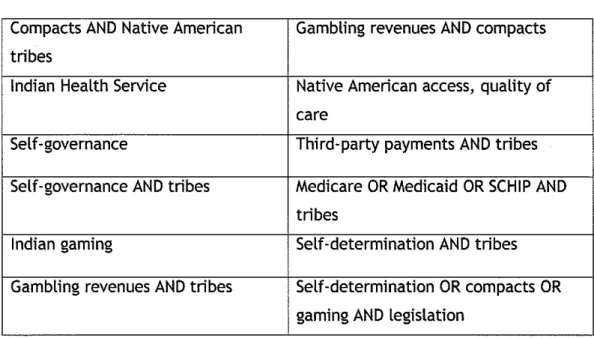
I searched several databases including Cochrane, PubMed (MEDLINE), and Ebsco in addition to using the "Google" search engine to identify documents relevant to my topic. I used the search terms and combinations presented in Figure 1 below.
I eliminated most documents concentrating on specific tribes other than the Eastern Band of Cherokee Indians. These excluded articles covered a variety of the topics discussed here, but since my focus is on compacting with particular reference to my tribe, I did not feel that using several documents from different tribes in other geographical locations would provide
generalizability to the EBCI, although such a comparative analysis of compacting in other tribes would certainly be a valuable future area for research. Such an analysis is beyond the scope of the present work but, in a few cases, I have included documents associated with other tribes' compacting when the documents provided insight into the development of self-governance, compacting, gaming, insurance coverage, or access to care. I also excluded documents that did not have legislative or regulatory authority, and documents that were created before 1995 in order to include only the most recent
evidence on compacting and the state of the IHS. I attempted to gather information on as many perspectives as possible, and was also interested in obtaining an indication of the degree of public discussion surrounding
compacting. To this end, I have included some editorials. Dr. Anne Bullock, Medical Director at Cherokee Indian Hospital, provided the remainder of
Figure 1. Search terms for locating primary documents
Compacts AND Native American Gambling revenues AND compacts tribes
Indian Health Service Native American access, quality of care
Self-governance Third-party payments AND tribes Self-governance AND tribes Medicare OR Medicaid OR SCHIP AND
tribes
Indian gaming Self-determination AND tribes
Gambling revenues AND tribes Self-determination OR compacts OR gaming AND legislation
Conducting research with members of a sensitive population
often failed to give the tribe information about research results after having collected data from the tribe. This failure, helped in part to spur the creation of the tribaliRB. The whole approval process may take up to three months, as tribaliRB and council meetings permit. The present research has passed through this process.
After I received IRB approval from UNC-Chapel Hill, I submitted my IRB application to the tribaliRB through Dr. Bullock. I received council approval upon my assurance that I would provide the council with a copy of my final document. I then conducted three open-ended in-depth interviews. I selected the three respondents based on their role in the compacting. I wanted to talk with employees who focused on different areas: community, clinical services, and overall administration. The three respondents representing those domains, respectively, were Jody Adams, Public Relations Officer of the Cherokee Indian Hospital Authority; Dr. Ann Bullock, Medical Director, Eastern Band of Cherokee Indians Health and Medical Division; and Casey Cooper, CEO of the Cherokee Indian Hospital Authority.
Scientific rigor in qualitative research
Throughout my data collection I adhered to the principles of qualitative research collection as described by King, Keohane, and Verba in "Designing Social Inquiry: Scientific inference in Qualitative Research". One of the principles is to keep and recount the full data collection process. I have described my search terms and how I have gathered all forms of data in an attempt to fulfill this principle. Another principle is to use many different ways to gather data from several sources, or to gather "observable
This gathering data from several sources is, in essence, the concept
behind the theory of triangulating research. If data from several different
sources converge, they validate one another and strengthen the synthesized
findings to which they contribute. One should also take care to use valid and
reliable data collection techniques. Figure 1 shows the breadth of the search
terms I used to uncover primary documents. I used the same interview script
for each depth interview respondent, following established principles of
in-depth interviewing.
21The interview script is presented as an Appendix at the
end of this paper.
Even with the most careful use of both methods - analysis of primary
documents and in-depth interviewing -- we cannot always be certain that we
have avoided "omitted variable bias".
20It is possible that my interview
questions, selection of respondents, or literature search omitted a key "control
variable" that would affect any cause and effect association I attempted to
make.
20By searching broadly rather than narrowly, however, I am less likely to
have missed a key variable in the causal pathway.
The data collection process should also be replicable. I believe that this
presentation of my research methods would enable another researcher to
replicate my processes and collect the same data, from which he or she could
draw the same, if not very similar, conclusions. Replicability, however,
remains the most difficult of the qualitative research principles to assure, as
many different and unexpected obstacles may prevent someone else from
having access to the same materials I have used.
20Also, any other researcher
would need to be able to interview the same people, which assumes that those
questions in ways substantially similar to their responses to the questions I
asked. This is a stringent assumption. Nonetheless, if my conclusions are valid,
and if I have presented my methods clearly enough, a replication of the
research should produce findings similar to those I have drawn. In fact, I
welcome additional research on this topic.
On the following page, Figure 2 presents a summary of critical
legislative and regulatory developments that set the path on which tribes and
the IHS walked toward compacting. In the sections to follow, I present an
Figure 2. Chronology of legislation and development of self-governance 1824 Bureau of Indian Affairs created and located in War Dept. 1887 Dawes Act forced assimilation of AlANs
1920 Indian Citizenship Act declares AlANs to be citizens of the United States
1920 Snyder Act appropriates a budget for AlAN health care.
1949 BlA transferred to Dept of the Interior and charged with responsibility for Native health
1954 Public Health Service assumes responsibility for AlAN health care from the BIA
1955 Indian Health Service created
1975 Indian Self-Determination and Education Assistance Act (lSDEAA), Public Law (PL) 93-638 allows tribes to manage their own health programs
1976 Indian Health Care Improvement Act , PL 94-437 mandates that tribes should determine their own needs and encourages maximum participation in the management of health care 1994 Permanent Self-Governance Legislation, PL 1 03-413
established permanence of self-governance in tribes
2000 Tribal Self-Governance Amendments of 2000, PL : laid out the specific tasks and responsibilities of IHS and tribes in carrying out self-governance
·-The decision to compact
The following four sections describe and analyze the process of compacting specifically for the EBCI. This first section describes why
compacting was seen by the tribe to be the best option to improve the health care system and outlines the steps the tribe took to make this decision.
The EBCI experienced budgetary shortfalls that had left the tribe on the point of making drastic cuts in health services; in the circumstances, they had been searching for any alternatives that would change or delay that outcome. Compacting was an option that, at a glance, seemed to be favorable. The tribe had a casino and other gaming revenue that could provide additional funding, and the ability to use tribal shares and provide care specific to EBCI needs were very appealing aspects of compacting. Also, as mentioned by Casey Cooper, the tribe had been exercising their 638 rights (638 referring to the ISDEAA legislation) in the form of a Title I contract and already managed many services such as housekeeping and the Community Health Representatives program. He estimates they were managing approximately $3 million of the services, and had done so for years. Therefore, self·determination was not a completely new concept to the tribe.
Determining feasibility
The tribe then had to determine whether compacting would be feasible
in terms of finances, staff, resources, and community and council support.
They also had to examine what the relevant legislation permits and requires for
a tribe to compact.
The governing legislation mandates permits a tribe to compact if it
meets three criteria:
• The tribe must demonstrate financial stability over three consecutive
years.
25That is, they cannot have a history of any uncorrected
significant and material audit exceptions in the required annual audit of
contracts or funding agreements.
• A tribe must also have completed the planning phase as stated in §137.
20, which requires budgetary and legal research, as well as internal
tribal government planning and organizational preparation relating to
administration of programs.
•
Finally, the tribe must have passed a resolution to compact, and the
council and Chief must agree to the resolution.
25The EBCI first created a core committee charged with determining the
feasibility of a compact. They had to examine the current system and decide if
adequate systems were in place to make the transition to a tribally run facility.
The tribe would be responsible for payroll and would acquire a mountain of
One of the most difficult tasks was to create five-year forecasts with
and without compacting as a measure of whether compacting was economically
desirable. The committee determined that compacting would postpone the
drastic financial shortfall from 2003 to 2007. One of the ways this financial
boost would take place is through using tribal shares. Indian Health Service has
an extensive book that describes the programs, services, functions, and
activities (PSFAs) the organization provides and oversees for tribes. Each of
these PSFAs has a dollar amount or "share" attached to it. Though some of the
PSFAs are inherently Federal and cannot have their shares used for other
programs, several of the PSFA shares can be controlled by tribes for programs
of their own choosing. 26 Many of these shares had resided at the headquarters
level and, upon compacting, would be transferred to the tribe for local
services.
Doing research on the available shares as well as the legislation and
rights under compacting was an extensive process, Casey Cooper explained in
his interview. The legislation on self-governance is fairly specific on the
question of what information about IHS and PSFAs is available for tribes to use
in this research. 25
Even more beneficial than the general mandate in the legislation is its
requirement that the IHS as an agency must support self-governance and all
tribes who wish to participate in it. 22 Ironically, the agency must support a
concept and actions the effect of which will be to take money away from the
agency at the national headquarters level. The law requires the I HS to
encourage self-governance and assist the tribes in gaining self-governing skills
respondents noted the awkwardness of this situation. Jody Adams remarked
about the suspicions present among Cherokee representatives who met with
IHS employees. She said "sometimes we left thinking that it was just, 'that's
what they are supposed to say to us'." However, she also said that they (IHS
employees) were helpful and offered to assist as much as possible.
Casey Cooper also mentioned that, in particular, the Nashville area
office is extremely helpful: "The agency lead negotiator is one of the best
advocates in the nation," he said. This is extremely important, as "there are
other areas in the nation where there is still a lot of agency resistance to self·
governance and it makes it very difficult for those tribes, and very
contentious." Mr. Cooper emphasized how crucial it is to have someone who
really comprehends self-governance and supports its implementation.
Certainly, bureaucratic obstructionism has slowed or halted the
implementation of other policies, and such would be the case with compacting
if alliHS employees resisted the policy change.
Apart from the question of IHS resistance to implementation of self·
governance is the question of the funds available to help tribes prepare to
compact. Each year a specific amount is available to as many as 50 tribes who
decide to compact.
25When large tribes choose to compact, their budgets
consume a considerable share of the funds, limiting the number of smaller
tribes who can begin the process. The EBCI is a large tribe, but it is smaller
than are some others, meaning that it might come out quite well or quite
poorly in the compacting budget exercise. As Dr. Bullock noted, the Navajo
tribe was considering a compact at the same time that the EBCI had begun to
with 173,987 of those members living on the reservation.27 1f the Navajos, with a population about 20 times that of the EBCI, had compacted at the same time as did the EBCI, the money available to assist the EBCI would have been
proportionately much smaller than what they did in fact receive. Section
1000.52 of the Federal code regulations for self-governance states that tribes are awarded advanced planning grants based on need, completeness of the grant application, and the percentage of tribal resources comprising the total resources covered by the last audit. Section 1000.47 states that these grants are not competitive but, if there are insufficient funds, then priority is first given to those tribes that have been selected from an applicant pool to negotiate a Funding Agreement. 25 So, an element of chance and timing also affects a tribe's successful initiation of the compacting process.
Community support
The EBCI conducted all of the budgetary and legal research required to compact. After determining that compacting the hospital would be the best option to improve quality of care and deal with the budgetary shortfall, they also wanted to make sure they had community support. Those involved with researching the compact addressed both the community and hospital employee concerns. All three of my interview respondents named community and
employee resistance as one of the most important challenges in the compacting process.
what the predictions were for the future of the hospital with and without
compacting. Casey Cooper said that they also held a " ... series of town hall
meetings, if you will, where we had televised meetings in the council chambers
and hired a completely independent moderator to put forth questions that
were coming from the community and then answer them the best that we
could."
Why was the community concerned? A perceived majority felt that
there was not anything in particular wrong with the existing system of health
care delivery and therefore wondered why the tribe wanted control of the
hospital. The biggest concern emerging from the meetings was that a political
body would be responsible for the functionality of the hospital. Many
community members did not know what a compact was, and explaining these
concepts in the appropriate manner was very delicate. Casey Cooper said that
if compacting is " ... oversimplified it stimulates a lot of unnecessary fears
and concerns in people." Community members also feared that compacting
would diminish the responsibility of the federal government for their health
care. Casey Cooper also stressed that "it was really difficult to get the
community to understand that self-governance doesn't relieve the government
and it doesn't eliminate their accountability to those treaty obligations, it just
provides it in a different method. Rather than providing that accountability or
paying those treaty debts through service, they're paying it monetarily through
financial resources, and then the management is up to the local tribe." He
called the meetings a very open forum of information flow: "there was nothing
held back, there was nothing hidden, it was really important to just roll it out
Employee unease had a different source. They felt their jobs were on
the line, and felt that they had much more of a vested interest in what
happened to the hospital and to their positions. The tribe hired an
independent facilitator to conduct focus groups with the employees. Their
anonymity was protected in these meetings, and all responses were recorded
and collected into a large document distributed to all who were responsible for
planning the compact. As Casey Cooper noted, this document helped " ... so
that we could just address [employee concerns] and so they could be assured
that their concerns were affirmed, that leadership heard them, and then there
were a lot of conditions applied to the self-governance process to help resolve
some of their fears." He gives as an example "the federal employees said they
feared an unfair personnel system, one that wouldn't provide the same level of
rights they had, rights to due process, rights to appeals. They feared that they
would lose credit for their services or that their retirement would be in
jeopardy." The compacting committee then prepared a "whole list of
recommendations that were endorsed by tribal council to help address each of
those fears."
The employee focus groups transcript shows that, indeed, the main
concerns were political influence and job security.
28Dr. Bullock understood this
concern completely. She was recruited in 2000 to be the medical director of
the Health and Medical Division of the Eastern Band of Cherokee Indians. She
had many years of Federal service under her belt. She wanted to remain a
"Fed", as she puts it, throughout the compact. Casey Cooper granted her wish
and created an Intergovernmental Personnel Agreement (IPA) for her. The IPA
retain all of his/her benefits, as the government pays the hospital for that
employee's salary/benefits.
29She describes her desire to stay a Federal
employee as " ... you get enough years toward a pension, and a lot of sick hours
built up, and you want to keep them." The breadth of federal employees'
concerns about their federal employment credit and their concern about
becoming tribal employees led the compacting committee to structure a
choice: employees could stay in federal employ, enter into a hybrid
arrangement via devices like the IPA, or become a tribal employee. For those
with years of Federal service, there is clearly a benefit to staying Federal, as
described by Dr. Bullock. For others, the excellent benefits package offered to
tribal employees may be more attractive. The goal of the compacting is to
increase the number of tribal employees over the years, and that is occurring.
This goal exists because a compacted tribe is trying to cut ties to the Federal
government; having more tribal employees supports this transition.
The EBCI had resources at hand; the histories of compacts in other
tribes enabled the EBCI to see how these personnel questions had been
resolved elsewhere. The EBCI obtained statistics from these tribes on
percentages of employees who decided to stay Federal or switch, and the
attrition they experienced up to five years after compacting. This information
also helped the EBCI to reassure employees that indeed this system had been
accomplished in other places.
By the time the issue of compacting went before council, everyone was
well-informed. Council members had been invited to serve on the compacting
exploration committees, and were well aware of or had participated in
conducted research on all areas of the compact including PSFA shares, core
competency of hospital employees, financial forecasts, and employee and
community concerns (as well as how to address them). 30 When resolution 739
passed, the process of compacting could begin.
Planning phase
The planning phase of the compact consisted of demonstrating
eligibility, showing the tribal resolution, and completing the planning
requirements. The planning report, according to section 1000.20 of the Code
of Federal Regulations for self-governance, must describe each of the
following:
• The programs the tribe wants to negotiate to include in the compact;
• Planning activities for the programs;
• Benefits derived from planning activities;
• Processes the tribe will use to resolve complaints by service recipients;
• Organizational planning the tribe has completed in anticipation of
implementing tribal self-governance;
• Indications of whether the tribe's planning efforts have revealed that its
current organization is adequate to assume programs under tribal
self-governance25
Several hospital committees from various departments met on a regular
basis to plan how the compact would take place. 31 Casey Cooper became the
lead negotiator for the EBCI in negotiating what shares the tribe would control.
The ultimate goal in everyone's planning was to design a system of
implementation that would cause no break in clinical services. Essentially, if
health care delivery on the first day of compacting. Each department determined its short· and long·term needs to help determine financial estimates for compacting. 32"34 More definitive policies and procedures were formed to govern performance and evaluation measures as well as job
descriptions. Jody Adams and others continued to educate both the community and hospital employees about the compacting process.
Negotiation
The negotiation phase consisted of developing the proposed compact, itemizing the shares the tribe would control, and negotiating with the IHS (and
BIA) to finalize a Compact and Funding Agreement.
The annual funding agreement (AFA) as defined by§ 100.81 of the governing CFR is a "legally binding and mutually enforceable written
agreement negotiated and entered into annually between a self-governance tribe/consortium and BIA".25 The AFA specifies the funding that will be retained by BIA for Federal programs, those shares that could not be used by tribes; the funding that will be transferred to tribes; and the funding to be retained by the BIA because the tribe is leaving such funding to BIA
administration. Residual funds are those necessary to carry out functions only BIA employees could do given that all tribes assumed responsibilities for all BIA programs the Act opens to tribal assumption. 25
The two phases of AFA negotiation are the information phase and the negotiation phase. The tribe is not required to go through the information phase; should it do so, the tribe would have to submit a letter of interest that demonstrates interest in negotiating a program to be included in the AFA. The letter must also describe several other aspects of the program including a
L
F
description of the program's cultural or geographical significance to the tribe,
requests for available program funds, and the technical assistance to be
provided by the Bureau. The actual negotiation process involves a discussion of
tribal legal or program concerns and the options for program amounts.
25The most difficult part of negotiation for Casey Cooper was determining
contract support costs. These are the "administrative or the indirect costs
associated with management." Each tribe must try to estimate how much
money it will need to cover those contract support costs. If the tribe
negotiates an amount that turns out to be below what it needs, the tribe will
not have enough administrative support, or it will have to cut direct care
services to make up the administrative shortfall. Each year Mr. Cooper
participates in the revision of the AFA, and reviews the "services we will
provide, the services that we will buy back from them, and the cost associated
with each of those." Negotiators also discuss the funding associated with
different services no matter whether the tribe provides them or they remain a
government provision.
One of the main services the EBCI decided to buy back was use of the
Resource Patient Management System (RPMS), an extensive data collection
system that integrates clinical and administrative data. Several parts of the
system are based on the Department of Veteran Affairs (VA) VistA software.
35The RPMS contains over 50 integrated software applications, and allows the
Cherokee Indian Hospital data to be accessed on a national level by IHS. It is
an expensive data system, and is often not affordable to the smaller tribes that
compact. As Casey Cooper noted, having the RPMS would not be a high priority
family practice doc two days a week and you're trying to get all your enrolled
members who need visits seen in the two days that he's available, the last
thing on your mind is all that intensive data collection."
Implementing the compact
Implementation refers to the actual transition from IHS administration
to tribal control of the hospital. The implementation of the compact went
smoothly for the EBCI in September of 2003. Respondents attribute this
smooth transition to the excellent preparation and organization of all parties
involved. Casey Cooper said "as far as the clinical side and the patient care, I
think it went very smooth." The difficulties in implementation were in the
functionality of the accounting and finance divisions, departments that had
been virtually non-existent before, and had to be built almost from the ground
up. Administrative and support services "had to be developed and had to
evolve, and as they were evolving there were obvious limitations on the
system." The clinical services transition was flawless, Cooper said, because
"there were good systems in place and it was not vulnerable really to the
attrition or to the change in management because the systems were so
formalized."
All three respondents feel that compacting has greatly benefited the
EBCI. Compacting postponed a drastic budgetary shortfall and freed shares to
be used to administer programs the tribe needs. The employees can now feel
more of a sense of ownership of the hospital. Jody Adams noted that before
compacting the IHS " ... just gave you that pocket of money and they ... dictated
could remodel...the money came from them, it was really that paternalistic type of management ... ". She emphasized that now " ... we ask the community what they want and then we try to implement that." Dr. Bullock supported the self-governance: " ... 1 believe Indian people can and should, when the
infrastructure ... is there, when the local expertise is there, when the pieces are in place to do it, tribes should do it."
Respondents also noted the financial benefits of compacting. Tribes can use supplemental revenue sources under a compact, and can therefore get additional funding from gaming revenue, foundations, and donations. Dr. Bullock noted the hospital's ability to acquire aCT scanner and the flexibility in how to allocate funding. Because she is deeply involved in diabetes
programs at a national level, she advocates for the cutting-edge diabetes program in Cherokee, including a complete complementary medicine program with acupuncture, massage, and yoga. A meditation garden is under
construction now.
Though large financial issues loom in the future, the funding that comes from smaller grants, donations, and other sources of revenue is being used for several changes to the hospital. Jody Adams emphasized the need to assure that the hospital has as many culturally appropriate features as possible. She said "I want people to know when they walk in the door, when they drive up the driveway, that it's a Cherokee Indian Hospital, not just another hospital."
Current challenges for compacting
Extensive data collection by compacting tribes can demonstrate the
degree to which the health system has or has not improved under tribal
administration, and data collection can provide continuing information useful
to those seeking ways to close gaps in health care and access between AIANs
and other groups in society. One question, however, is whether thorough data
collection requirements interfere with tribal sovereignty. Reporting these data
is obviously helpful, but to what system of reporting should tribes adhere?
Compacting tribes are responsible for administering their contract care services
and negotiating with outside providers, an entry into the private health
services sector tribes have not taken before. Will tribes unfamiliar with the
private sector have the resources and skills to negotiate with outside parties?
Because of the overall structure of the Indian Health Service, tribes are
increasingly relying on third-party sources of funding. Also, compacting tribes
must be able to negotiate and contract for services with outside providers.
The structure of these health systems is now that of a public-private hybrid,
and whether this structure will be more beneficial than was the old system is
uncertain.
Tribes can use gaming revenues to support the cost of their compacted
health care systems. The EBCI has both a casino and a bingo hall that provide
revenue for everything from the police department and language retention
programs to individual tribal members' income. From the time the casino
doors opened, people have debated whether gaming is a stable or ethically
appropriate use of funding for a hospital. Employees of the Cherokee Hospital
were concerned that should the casino close, their hospital would also have to
gambling addictions and loss of income from others are not without ethical
questions as a funding source for a hospital system.
The next sections explore these challenges in more detail.
Data collection and reporting requirements
Sovereignty questions surrounding data collection emerge from the
Indian Self-Determination and Education Assistance Act (ISDEAA) of 1975 (PL
93-638) and its provision allowing tribes to compact with the Government3 at
the same time that it prevents the Indian Health Service from forcing tribes to
conduct outcomes or performance measurement. 36 Any reporting, then, is
required only as a result of what is negotiated in the compacting process after
the tribe has proven economic feasibility and assumed administration of a
program.
According to §137.200 of the Amendments of 2000 to the ISDEAA, each
compact must have a stipulation that obligates a tribe to report
some
measureof health status and services delivered. 23 However, it is stated clearly that
these bare data requirements are intended to impose a light burden on tribes,
and are in no way intended to be used for quality assessment or monitoring.
Tribes can include their own standards and requirements for data reporting as
they see fit. This section also states that tribes are never required to report
any confidential information regarding employee salary or identifying patient
information. Examples of data reported may include sets of existing
information such as demographics or workload. Tribes and IHS must agree
upon reporting requirements no less than 60 days prior to the initiation of