EFFECTIVENESS OF HR MANAGEMENT SYSTEM AND ITS IMPACT
ON VARIOUS SECTORS
Santosh Mookanagoudar
1, Dr. Arvind Saraswat
2Department of Management
1,2
OPJS University, Churu (Rajasthan) – India
Abstract
Its commitment concerns two components examined in the writing. To begin with, we apply a multidimensional performance point of view, and we will in this manner consider three result dimensions: financial, organizational and HR. This is inventive because albeit numerous healthcare considers have examined care - an organizational result - and HR outcomes, financial pointers have gotten considerably less consideration. Also, we are uninformed of healthcare sector considers that have inspected the relationship among HRM and these three result dimensions all the while. The second commitment concerns the 'discovery' issue. Numerous examinations utilize employee demeanours. Nonetheless, an important translation of the 'black box' infers that employee mentalities will intervene the link among HRM and performance. Utilizing work fulfilment as marker of employee demeanours, we will test whether this holds for every one of the three result estimates considered in this paper.
1. INTRODUCTION
Employee satisfaction or job satisfaction is, quite simply, how content or satisfied employees are with their jobs. Employee satisfaction is
typically measured using an employee
satisfaction survey. Factors it impacts the employee satisfaction addressed in these surveys may be include compensation, workload,
perceptions of management, flexibility,
teamwork, resources, etc. There are many things important to companies who want to keep their employees happy and reduce turnover, but employee satisfaction is only a part of the entire solution. In fact, for some organizations and the
satisfied employees are individual the
organization might be better off without. Satisfaction doesn't mean high performance or engagement. HR ideas and strategies focused on
oftentimes have results it demoralize high performers. Employee satisfaction and employee engagement are similar concepts on the surface,
and many people use these terms
interchangeably.
The essential knowing of the difference between satisfaction and engagement is critical for an organization to make strategic decisions to create a culture of engagement. Employee satisfaction covers the basic concerns and needs of employees. It is a good starting point, but it usually stops short of what really matters. Employee engagement is a workplace approach
designed to ensure that employees are
well-components - attitudes, behaviors and outcomes are a part of the engagement story. There is a virtual ground, when the pre-conditions of engagement are met. These three aspects of engagement trigger and reinforce one another.
Involved organizations have strong and
authentic values, with clear evidence of trust and fairness based on mutual understanding, where two way promises and commitments between employers and staff – are understood and are achieved.
One of the main goals of Human Resource
Management (HRM) is to expand the
performance of organizations. The utilization of a coordinated and rational 'package' of commonly strengthening HR practices over discrete ones. Despite the generous volume of research on the link among HRM and performance, the correct idea of this relationship inside the health care sector remains unclear. This can be viewed as hazardous, as considering HRM in the health care sector and its impact on
performance has both down to earth and academic importance. Nonetheless, performance isn't an idea that can be effectively characterized and conceptualized.
2. HRM MANAGEMENT SYSTEM
Successful human resources can enable
organization with structure and to satisfy business needs through dealing with company's employees. Human resource management is an assortment of information and set of training that characterizes the idea of work and directs job relationship. Human resource management is crucial piece of the organization that is related with the "general population" dimension. It is a
staff, or support, intersection in the
organizations. Its role is to offer help in HRM issues to line employees, or those specifically
engaged with creating the organization's
products and enterprises.
Each organization is contained individuals; securing their administrations, developing their aptitudes, rousing them to abnormal amounts of performance. Human Resource Management always adds to organization by improving the
efficiency and development of personal
occupation. The main target of human resource management is to guarantee the availability of skilful and willing workforce to an organization.
The particular goals incorporate the
accompanying:
1. Human capital: Assisting the
organization in obtaining the right number and types of employees to fulfil its strategic and operational goals.
2. Developing organizational climate:
Helping to create a climate in which employees are encouraged to develop and utilize their skills to the fullest and to employ the skills and abilities of the workforce efficiently.
3. Helping to maintain performance
standards and increase productivity through effective job design; providing
adequate orientation, training and
development; providing performance-related feedback; and ensuring effective two-way communication.
4. Helping to establish and maintain a
harmonious employer/employee
relationship.
5. Helping to create and maintain a safe
and healthy work environment.
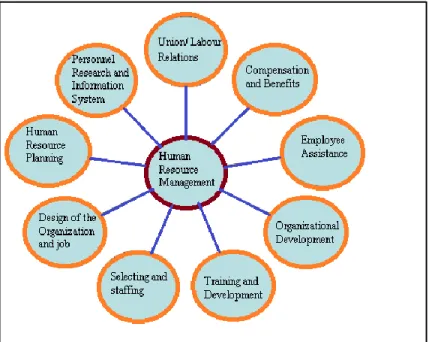
The major HRM activities include HR planning, job analysis, job design, employee hiring, employee and executive remuneration, employee motivation, employee maintenance, industrial relations and prospects of HRM.
3. EFFECTIVENESS OF HUMAN
AND ITS IMPACT ON EMPLOYEES’ SATISFACTION IN BANKING SECTOR
The banking sector in India assumes an important role in the nation's development toward free-market exchange because of nation's large economic advancement. Accordingly, this sector is considered as one of the centre mainstays of Indian economy. The banking sector demonstrates astonishing prospects for development and broadening. It represented 44.6% of total securities exchange capitalization and contributed 18.7% to GDP in 2004. In this way, the Indian government has been giving extraordinary consideration on the development of banking organizations. This exertion is mainly intended to enhance the quality of bank administrations, increment upper hands of this sector and energize interest in the nation.
Toward the finish of 1999, twenty-two national and five global business banks were operating in the nation with a basic system of 466 branches that assume a critical role in the restoration of the Indian economy and nation's future.
Every one of these gatherings is additionally isolated into business banks and Islamic banks. These days, the greater part of the organizations are looking for the ideal approach to enhance
their business performance and
accomplishments by developing and receiving new work environment practices that improve managed level of superior and job satisfaction. Human Resource Management (HRM) is a broadly known management rationality that has turned into a key factor for upgrading organizations' upper hand. Moreover, it is perceived as an important apparatus to improve
consumer loyalty, unwaveringness, and
maintenance that positively influence
Then again, HRM is the vital and rational way to deal with the management of organization's most esteemed resources and matches them to the key prerequisites of business. It is being perceived that the upper hand can be gotten with a
qualified workforce that empowers
organizations to contend and prevail in business. The declining remote financial guide and help, especially from Arab inlet nations, have irritated economic and financial hardships over the most recent couple of years. This has made nearby financing of little and medium size development ventures fundamental for India development. In this way, the banking sector of a nation is progressively turning into an important player in
the nation's development. In any case,
distributed studies exploring the effect of HRM practices on employees' satisfaction in Indian
organizations are rare and extremely
constrained. Along these lines, the discoveries of this study are relied upon to advance the information and fill in the hole of writing.
Thirdly on the down to earth side, the foreseen outcomes would help leaders in the Indian banking sector to perceive the capability of HRM adequacy and help them in developing employee satisfaction to increase superior performance. Human resource management has turned out to be more important to general management on account of its role in improving performance, anchoring and developing the
abilities of employees and upgrading
cooperation between them to help organizational
development. Employee satisfaction has
dependably been an important issue and best need for all kind of organizations.
4. IMPACT OF HUMAN RESOURCE
MANAGEMENT PRACTICES ON
EMPLOYEES’ SATISFACTION IN
TELECOMMUNICATION COMPANIES
In today's world of business, the worldwide rivalry is the fundamental component that concerns the brains of CEOs and researchers and accordingly to this, the mechanical economy has been experienced to go toward to learning economy. Over the most recent two decades All researchers and specialists endeavours have for the most part centred around human resource management (HRM) practices, considering the employee perceived feeling, the condition of prosperity and job satisfaction is a high need for best managers and HR managers, realizing that human capital is the most basic piece of any
firm, and organizational goals can be
accomplished through them.
The field of human resource management (HRM) has voyage far from its straightforward personnel management where the job of the personnel chief was just concerned with job opportunities, enrolment, following employee payrolls, advancements, and other commonplace personnel issues. Human resources management (HRM) is a term used to speak to that piece of an organization's exercises concerned with the enrolment, development, and management of its employees.
The cutting-edge field of today's human resource management (HRM) is drawing in a lot of consideration due to its potential effect on an organization's survival and prosperity. There is presently an advancing conviction that, if organizations wish to survive and contend in today's talent-based worldwide economy, they need to gain, develop, and in like manner
oversee world-class human resource
advantages of any organization requires the human application to produce their esteem.
Monitoring this acknowledgment, higher
management, industrialists, and researchers have been in a condition of consistent inquiry of strategies to upgrade the level of employee exertion and exercises identified with his/her work, which at last enhance organizational performance. HRM alludes to the arrangements and practices associated with completing the human resource parts of a management position
including human resource planning, job
examination, enlistment, choice, introduction, remuneration, performance evaluation, training and development, and work relations. These Innovative HRM practices are required to be actualized in today's information organizations to pull in, hold and include esteem, where esteem is situated in the abilities and aptitudes of the work compelling, best HRM practices just can guarantee proceeded with the achievement of business organizations. Human resource
management is concerned with giving
administrations and projects to develop and
encourage employee satisfaction and
development and to get the most extreme satisfaction from work and give their earnest attempts to the organization. In this way, the way to maintaining a beneficial company or a healthy economy is the profitability of the workforce which can be accomplished through enhanced HRM practices. The researcher has taken after a mix of Human Resource Management Practices in the study: Whatever remains of this study is organized as pursues: First, the study introduces a broad writing survey, concentrating on HRM and employees' satisfaction, and after that, it proposes a conceptual model and inferred theories.
5. IMPACT OF MANAGEMENT
PRACTICES ON JOB SATISFACTION
Human resource management practices (HRMP) allude to the approaches and activities associated
with the indispensable management of
employees, including job examination,
enrolment, selection, introduction,
compensation, performance assessment,
training, development and mechanical relations. HRMP comprise the noticeable side of the organizational culture, at the end of the day, activities that give personality to the companies. Up until this point, there is no univocal and consensual meaning of HRMP, albeit a large portion of the proposition share a concept like that best in class by Schuler, as in they are "particular activities utilized by companies to
draw in, persuade, hold, and develop
employees". Various experts have called attention to that the selection of fitting HRMP benefits companies, since they add to amplifying the abilities of their human resources. In any case, of late it has been accounted for that it isn't the accepted procedures that issue, yet the blend of those that fit the strategic vision of the company.
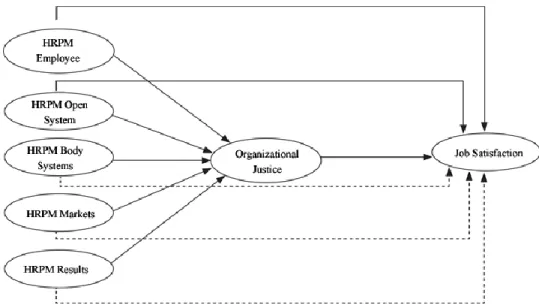
Delicate practices advance the employee's trust, responsibility, and full of feeling ties with the organization. The present study surveys the impact of five HRMP, three hard (situated to results, to unbending systems, and to permanent enlistment of new markets), and two delicate (arranged to employees, and to open systems),
on job satisfaction of the employees.
were estimated as they are perceived by the employee, given that the current pattern demonstrates that perceptions of the practices
could really compare to the composed arrangements themselves.
Figure 2: Theoretical Model Postulated For Relations between HRMP, Justice, and Satisfaction
6. CONCLUSION
In this research, we examined the impact of HRM practices on workers' general job satisfaction and their satisfaction with pay. In the wake of controlling for countless, job and firm-related characteristics, we find that HRM practices have a measurably huge, and sometimes generous, impact on workers' general job satisfaction and their satisfaction with pay. In particular, we find that workers appreciate on-going learning and job self-governance. Close supervision of work is detested, yet workers appreciate some visual appraisal of their performance, suggesting that some observing is alluring. Besides, giving workers a "voice" through employee association plans positively affects job satisfaction. Managers who hold ordinary gatherings with employees to empower them to express their perspectives about work
have the most generous impact in raising job satisfaction.
REFERENCES
[1].Paauwe J, Guest DE, Wright P. HRM
and Performance: Achievements and Challenges. UK: Wiley Press; 2013.
[2].Harris C, Cortvriend P, Hyde P. Human
resource management and performance in healthcare organisations. J Health
Organ Manag. 2007;21(4/5):448–459.
doi: 10.1108/14777260710778961
[3].Kabene SM, Orchard C, Howard JM,
Soriano MA, Leduc R. The importance of human resources management in health care: a global context. Hum Resour Health. 2006;4(20):1–17.
[4].Guest DE. Human resource management
and performance: a review and research
agenda. Int J Hum
ResourManag. 1997;8(3):263–276.
[5].Boselie P, Dietz G, Boon C.
HRM and performance research. Hum ResourMAnag J. 2005;15(3):67–94.
[6].Nishii LH, Wright PM. In: The people
make the place. Dynamic linkages
between individuals and
organizations. Smith DB, editor. New York, Sussex: Taylor & Francis Group; 2007. Variability Within Organizations:
Implications for Strategic Human
Resource Management; pp. 225–248.
[7].Bowen DE, Ostroff C. Understanding
HRM-firm performance linkages: The role of the ‘strength’ of the HRM
system. Acad Manage
Rev. 2004;29(2):203–221.
[8]. Paauwe J. HRM and performance:
achievements, methodological issues
and prospects. J Management