R E S E A R C H
Open Access
The value of high-resolution computed
tomography (HRCT) to determine exercise
ventilatory inefficiency and dynamic
hyperinflation in adult patients with cystic
fibrosis
Ernesto Crisafulli
1*, Elisabetta Teopompi
1, Silvia Luceri
2, Francesco Longo
1,3, Panagiota Tzani
1, Paolo Pagano
2,
Antonella Ielpo
1, Chiara Longo
1, Marcello Di Paolo
4, Nicola Sverzellati
2, Paolo Palange
4, Alfredo Chetta
1and
Giovanna Pisi
3Abstract
Introduction:In Cystic Fibrosis (CF), exercise ventilatory inefficiency and dynamic hyperinflation (DH) cause exercise limitation and induce poor exercise tolerance. High-resolution computed tomography (HRCT) of the lung can detect pulmonary abnormalities in CF patients. We aimed to identify the determinants of exercise ventilatory inefficiency and DH using HRCT-derived metrics.
Methods:Fifty-two adult CF patients were prospectively enrolled; all participants underwent cardio-pulmonary exercise test (CPET) and HRCT. Radiological impairment was evaluated by the Brody II scoring system. Slope and intercept of the minute ventilation/CO2production (V’E/V’CO2) regression line and the ratio of inspiratory capacity/ total lung capacity (IC/TLC) at rest and at peak of exercise were measured.
Results:Four groups of patients were identified based on the combination of ventilatory efficiency (Vef) or inefficiency (Vin) and the presence/absence of DH. Compared to other groups, CF adults withVinand DH had worse functional status and higher total (T), bronchiectasis (B) and air trapping (AT) scores at HRCT. Significant correlations were found between V’E/V’CO2 interceptand V’E/V’CO2 slope(ρ−0.455,p= 0.001) and between V’E/V’CO2
interceptandΔinspiratory capacity (IC) (ρ−0.334,p= 0.015).Regression analysis identified AT score (cut-off 7.9, odds ratio-OR 3.50) as the only independent predictor of Vinand T (cut-off 53.6, OR 4.98), B (cut-off 16.1, OR 4.88), airways wall thickening (AWT) (cut-off 13, OR 3.41), and mucous plugging (MP) scores (cut-off 11.7, OR 4.18) as significant predictors of DH.
Conclusion:In adult CF cohort, values of HRCT metrics are determinants ofVin(AT) and DH (T, B, AWT, MP).
Keywords:Cystic fibrosis, Ventilatory inefficiency, Dynamic hyperinflation, Brody II score
© The Author(s). 2019Open AccessThis article is distributed under the terms of the Creative Commons Attribution 4.0 International License (http://creativecommons.org/licenses/by/4.0/), which permits unrestricted use, distribution, and reproduction in any medium, provided you give appropriate credit to the original author(s) and the source, provide a link to the Creative Commons license, and indicate if changes were made. The Creative Commons Public Domain Dedication waiver (http://creativecommons.org/publicdomain/zero/1.0/) applies to the data made available in this article, unless otherwise stated.
* Correspondence:[email protected]
1Department of Medicine and Surgery, Respiratory Disease and Lung
Introduction
In Cystic Fibrosis (CF) patients, pulmonary infections lead to a progressive decline in lung function [1]. Al-though spirometry and, particularly, the forced expira-tory volume at 1st second (FEV1) is considered a
valuable measure for lung function monitoring [2], vari-ables derived from exercise testing, such as the cardio-pulmonary exercise test (CPET), are more sensi-tive than spirometry in detecting early structural pul-monary changes in CF patients [3].
In adolescents with CF, an exaggerated ventilatory re-sponse to exercise but adequate to V’CO2 (normal V’E/
V’CO2 slope) was documented [4] and, interestingly, in
adult CF patients the V’E/V’CO2at peak of exercise was
an independent determinant of exercise limitation, espe-cially in those with a worse lung function [5]. Moreover, in adults with CF, a high prevalence of exercise dynamic hyperinflation (DH) was found, secondary to the devel-opment of air trapping during exercise; DH was also shown to be associated to poor resting lung function, re-duced exercise tolerance and increased exertional dys-pnea [6].
High-resolution computed tomography (HRCT) of the lung is able to demonstrate a broad range of pulmonary abnormalities in CF patients with mild-to-moderate lung disease [7], identifying lower airway inflammation and early lung impairments [8]. The Brody score [7] is a composite HRCT score including different radiological features of lung disease (Bronchiectasis-B, Airways Wall Thickening-AWT, Mucous plugging-MP, Parenchyma-P and Air Trapping-AT) and demonstrating a high inter-observer reproducibility [9]. In CF patients, higher Brody scores indicate more severe disease [7]; they are also strongly associated with lung disease progression [10], predicting the rate of pulmonary exacerbations up to 10-year follow-up [11].
Interestingly, with regards to the relationship between HRCT-derived variables and the ventilatory response to exercise, the emphysema HRCT metrics were independ-ent predictors of exercise-induced DH and V’E/V’CO2 slope in COPD patients [12]. In CF adults, however, no
studies assessed the value of the variables derived from HRCT to determine both the exercise ventilatory re-sponse to CO2and DH. Therefore, we aimed to identify
in a large cohort of adult patients with CF the determi-nants of exercise ventilatory response to CO2 and DH
using HRCT-derived metrics, as expressed by the Brody II score.
Methods Patients
We conducted this prospective study at the University Hospital of Parma (Italy) between June 2013 and July 2017. The main inclusion criteria were a confirmed
diagnosis of CF as recommended by international guide-lines [13], age > 18 years and a stable respiratory condi-tion (i.e. patients free from exacerbacondi-tions) for at least 4 weeks before enrolment Patients with lung transplant, pregnancy and concomitant malignancies or comorbidi-ties (i.e. heart failure, previous rib fracture) which could preclude their safety were excluded.
The study was conducted according to the Declaration of Helsinki; all the procedures and their risks were ex-plained to the patients, who gave their written informed consent for the participation to the study. The ethical committee of the University Hospital of Parma approved the protocol (approval number: 200084; 07 June 2013). All participants’ data were anonymously analyzed and reported. No extramural funding was used to support the study.
Measurements
For all patients, anthropometric characteristics (age, gen-der, body mass index-BMI and fat-free mass index-FFMI), presence of diabetes, CFTR mutations (F508del/F508del, F508del/Other, or Other/Other), Pseudomonas aeruginosacolonization, long-term oxygen therapy and domiciliary non-invasive mechanical venti-lation were recorded at the enrolment. BMI was calcu-lated in kilograms per square meter. Body composition was also assessed by a foot-to-foot bioelectrical imped-ance analysis (BIA) method by a body composition analyzer (model SC-331S, Tanita, Tokyo, Japan). The fat-free mass (FFM) was standardized for height to cal-culate the FFM index (FFMI = FFM/height squared, in kilograms per square meter).
All lung function tests were performed according to the international recommendations [14]. A flow-sensing spirometer and a body plethysmograph connected to a computer for data analysis (Vmax 22 and 6200, Sensor Medics, Yorba Linda, USA) were used for the measure-ments. FEV1 and forced vital capacity (FVC) were
re-corded; the FEV1/FVC ratio was considered as the index
of airflow obstruction. Thoracic gas volume (TGV) was measured by body plethysmography with the patients painting against a closed shutter at a frequency slightly < 1 Hz and supporting their cheeks with their hands. Total lung capacity (TLC) was obtained as the sum of TGV and related inspiratory capacity (IC). To ensure re-producibility for each spirometry and lung volume vari-ables at least three measurements were taken; the highest value was considered. The flow-sensor was cali-brated before each test using a three-liter syringe. FEV1,
FVC, and IC were expressed as a percentage of the pre-dicted values [15].
could take their current therapies. After calibrating the oxygen and carbon dioxide analysers and flow mass sen-sor, patients were invited to sit on an electromagnetically braked cycle ergometer (Corival PB, Lobe Bv, Gro-ningen, The Netherlands) and the saddle was adjusted properly to avoid the maximal extension of the knee. The exercise protocol involved an initial rest of 3 min, followed by unloaded cycling for another 3 min with an increment of 5 to 15 watts every minute, according to the patient’s anthropometry and degree of functional im-pairment, in order to achieve an exercise time between 8 and 12 min. Patients were invited to maintain a pedalling frequency of 60 rates per minute.
Breath-by-breath oxygen uptake (V’O2 in L/min),
carbon dioxide production (V’CO2 in L/min), tidal
vol-ume (VT in L) and minute ventilation (V’E in L/min)
were recorded during the test (CPX/D; Med Graphics, St Paul, MN, USA). Patients were continuously moni-tored with a 12-lead electrocardiogram (Welch Allyn CardioPerfect, Delft, the Netherlands) and a pulse ox-imeter (Pulse Oxox-imeter 8600, Nonin Medical Inc., MPLS, Mn U.S.A.). Blood pressure was measured every two minutes. Stopping criteria consisted of symptoms, such as unsustainable dyspnea, leg fatigue or chest pain, a significant ST-segment depression at ECG, or a drop in systolic blood pressure or oxygen saturation≤84% [17].
Workload and V’O2 at peakwere recorded as the mean
value of watts and V’O2 during the last 20 s of the test.
V’O2 at peak was expressed as mL/kg/min. The
ventila-tory response during exercise was expressed as a linear regression function by plotting V’E against V’CO2
ob-tained every 10 s, excluding data above the ventilatory compensation point [17]. Then, the slope and Y inter-cept values were obtained from the V’E/V’CO2regression
line. V’E/V’CO2at rest,V’E/V’CO2 slopeand V’E/V’CO2 inter-cept (L∙min−1) were recorded. Values of V’E/V’CO2 slope≥
30 and < 30, derived from the median value in our co-hort, were used to define patients with an exercise venti-latory inefficiency (Vin) and patients with ventilatory efficiency (Vef), respectively [18].
The end-tidal pressure of CO2 (PETCO2, in mm Hg)
was measured as the mean of PETCO2 during the 3-min
rest period and during the last 20 s of the test; moreover, the difference between PETCO2 at peak and PETCO2 at
rest (ΔPETCO2) was recorded.
Changes in operational lung volumes were assessed every two minutes during exercise and at peak exercise, taking the IC measured at rest, as the baseline. After a full explanation of the procedure, satisfactory technique and reproducibility of IC maneuvers were established during an initial practice session at rest. Assuming that TLC remains constant during exercise [19], a change in IC (Δ IC, L)≤ −0.100 L at peak of exercise was
considered to define patients with DH, as reported from the literature [20].
The cardiovascular response to exercise was expressed by the following parameters: oxygen pulse (O2 pulse),
HR recovery and double product (DP) reserve. O2 pulse
(in mL/beats/min) was calculated by dividing instantan-eous VO2by the HR and was recorded at rest and as the
change between the peak of exercise and the resting phase (Δ O2 pulse) [17]. HR recovery (in beats) was
de-fined as the reduction of the HR at the peak exercise level compared to the HR after one minute of the exer-cise cessation [17]. DP (mmHg*bpm) at rest and at max-imal exercise was calculated by the product of systolic blood pressure and HR [21]; DP reserve was calculated as DP at maximal exercise minus DP at rest and was also expressed as a ratio to workload in watts.
Oxygen saturation (SpO2) was reported at rest and as
the difference between values at peak of exercise and at rest (ΔSpO2). Peak dyspnea and fatigue were described
as visual analogic scale (VAS) with 0–100 score and then divided by peak workload (watts) for analysis.
Patients were scanned with a 128-slice Somatom Def-inition Flash scanner (Siemens Medical Solutions, For-chheim, Germany). Technical parameters were as follows: volumetric acquisition, collimation 128 × 2 × 0.6 mm; 1 mm slice thickness, rotation time 0.28 msec; tube voltage 80–100 kVp; tube current modulation (Care-Dose) on. Images were visually scored using a window setting (−1550 W, −600 L). Each HRCT scan was evalu-ated independently by two radiologists (S.L. and P.P.), both with a 3-year imaging experience. Readers scored HRCTs using the Brody II scoring system [7]. The total score (T) is the sum of the following sub-scores: Bronchiectasis-B, Airways Wall Thickening-AWT, Mu-cous Plugging-MP, Parenchyma-P (e.g. bullae, ground glass and consolidation) and Air Trapping-AT with de-creased attenuation areas. Each of the five sub-scores is rated according to presence and severity, in each of the six lobes, lingula being considered as a separate lobe. All scores and sub-scores are expressed as a percentage of the maximum possible score, ranging from 0 (no patho-logical findings) to 100 (maximum severity).
Statistical analysis
test for continuous variables. For multiple comparisons, the Bonferroni post-hoc analysis, the ANOVA, and the nonparametric Kruskal-Wallis test were used.
The interrater reliability was evaluated by a two-way random-effects model with mean ofkraters and definition of consistency [22]. The intraclass correlation coefficients (ICC) were interpreted by the following scale: ICC values < 0.50 are indicative of “poor reliability”, values between 0.50 and 0.75 indicate “moderate reliability”, values be-tween 0.75 and 0.90 indicate“good reliability”, and values greater than 0.90 indicate“excellent reliability”[23].
For correlation analysis, the Pearson or Spearman cor-relation coefficients were used for linear or normally dis-tributed variables and for not linear or not normally distributed variables, respectively.
Receiver operating characteristic (ROC) curves were generated to calculate the area under the curve (AUC)
with 95% confidence interval (CI) and to find the best cut-off with the related sensibility and specificity. Uni-variate and multiUni-variate regression logistic models (method: Stepwise) were performed to predict the prob-ability to have Vin and DH (set as dependent variables). Odds ratios (OR) and 95% CI were calculated. Apvalue at two tails < 0.05 was considered significant.
Results
Our study sample consisted of 52 adult patients with CF, normal-weight, with a wide range of lung function from normal to severe airflow obstruction and a normal-to-mildly reduced maximal exercise capacity. Variables related to spirometry and CPET demonstrated that, in comparison to patients with Vefand without DH and patients with Vinand without DH, patients with Vin and with DH had statistically significant lower values of
Table 1General characteristics according to the ventilatory efficiency and dynamic hyperinflation
Variables Study samplen = 52
Patients with Vefand without DHn = 10 (19%)
Patients with Vinand without DHn = 13 (25%)
Patients with Vefand with DHn = 14 (27%)
Patients with Vinand with DHn = 15 (29%)
p value
a
Age, years 29.1 ± 8.1 30.9 ± 10.1 29.8 ± 8 26.3 ± 6 30 ± 8.7 0.494
Male, % 58 80 46 50 60 0.373
BMI, kg/m2 21.4 [19.5; 22.5]
22.3 [21.7; 24.3] 20.8 [19; 22.8] 20.9 [19.8; 21.9] 20.9 [18.8; 23.3] 0.230
FFMI, kg/m2 17.1 [15.4;
18]
17.6 [15.7; 18.3] 16.4 [14.5; 17.4] 17 [15.6; 18.2] 17.4 [15.3; 18] 0.402
Diabetes, % 31 50 23 29 27 0.523
CFTR mutations, % 0.972
F508del/F508del 42 40 39 36 54
F508del/Other 41 40 46 43 33
Other/Other 17 20 15 21 13
Pseudomonas aeruginosa colonization, %
94 80 92 100 100 0.133
LTOT, % 8 0 0 14 13 0.328
Domiciliary NIMV, % 4 0 0 7 7 0.647
FEV1, % pred. 69.2 ± 22.3 85.2 ± 22.3 82.1 ± 20 61.7 ± 17.4b c 54.3 ± 15.6b c <
0.001
FVC, % pred. 89.6 ± 18.3 98.6 ± 17.1 100.4 ± 20 86 ± 12.8 77.5 ± 14.1b c 0.001
FEV1/FVC, % 64.8 ± 12.2 72.8 ± 9.1 70.1 ± 11.8 59.9 ± 11.1b 59.6 ± 11.3b 0.005
IC at rest, % pred. 77.5 [61.5; 91.7]
76.5 [69.2; 104.5] 76 [57.5; 103] 78 [63.7; 89.5] 81 [57; 87] 0.977
VTat rest, L 0.64 [0.48;
0.84]
0.61 [0.37; 0.71] 0.86 [0.67; 0.95]b 0.50 [0.44; 0.81]c 0.61 [0.54; 0.71]c 0.015
RR at rest, breath/min 17.5 [13; 21.5]
18 [16.6; 20.7] 13 [11.8; 18] 17 [11.7; 24] 20 [15.9; 26] 0.510
Ventilatory efficiency (Vef) and inefficiency (Vin) were defined according to the V’E/V’CO2 slope< 30 and V’E/V’CO2 slope≥30, respectively. Patients without and with
dynamic hyperinflation (DH) were defined according to the peak-to-rest change of IC (ΔIC, L) >−0.100 L and≤ −0.100 L. Data are shown as number of patients (%), means ± SD or medians [1st quartile; 3rd quartile], unless otherwise stated
Abbreviations: BMIbody mass index,FFMIfat-free mass index,LTOTlong-term oxygen therapy,NIMVnon-invasive mechanical ventilation,FEV1forced expiratory volume at 1st second,FVCforced vital capacity,ICinspiratory capacity,VTtidal volume,RRrespiratory rate
a
p-value calculated between all groups;b
p-value < 0.05 versus patients with Vefand without DH;c
FEV1% pred., FVC % pred., FEV1/FVC %, and lower
values in V’O2 at peak ml/kg/min and workload in watts
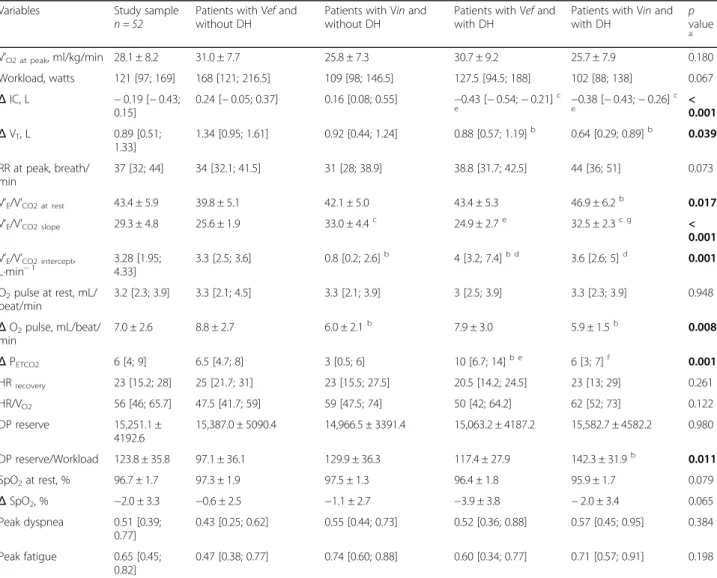
at peak without reaching statistical significance. Table1
summarises the results about anthropometric and lung function characteristics and Table 2 CPET-related variables.
The interrater reliability between the two radiologists was“excellent” for T (ICC 0.95; 95% CI 0.91 to 0.97), B (ICC 0.93; 95% CI 0.88 to 0.96), MP (ICC 0.93; 95% CI 0.88 to 0.96), and P (ICC 0.91; 95% CI 0.84 to 0.95),
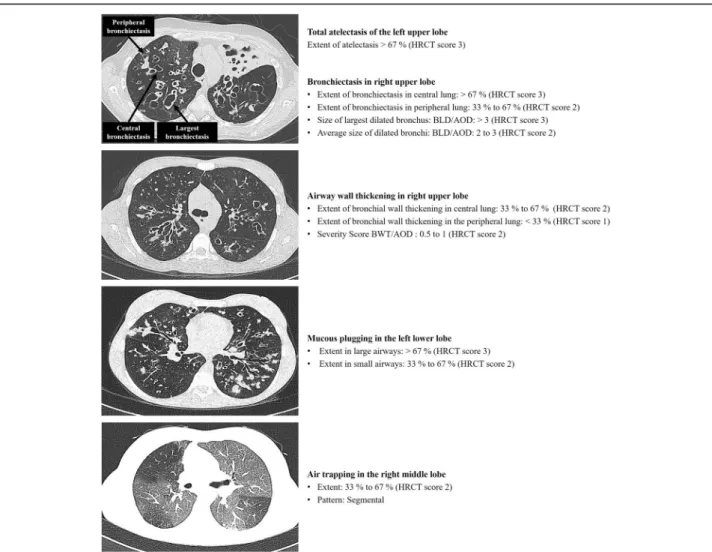
while was “good” for AWT (ICC 0.86; 95% CI 0.75 to 0.92) and AT (ICC 0.81; 95% CI 0.66 to 0.88). Then, the average value of each Brody II score was considered for all analyses. Examples of HRCT metrics according to the Brody II score are provided in Fig. 1, while in Fig.2 are illustrated for all patients the HRCT variables related to the Brody II scores. Among Vinpatients (Fig. 3, bottom left), only AT differed significantly compared to those with Vef. Patients with DH, in comparison to those with-out DH (Fig. 3,bottom right), had higher values of T, B,
Table 2CPET-related variables
Variables Study sample n = 52
Patients with Vefand without DH
Patients with Vinand without DH
Patients with Vefand with DH
Patients with Vinand with DH
p value
a
V’O2 at peak, ml/kg/min 28.1 ± 8.2 31.0 ± 7.7 25.8 ± 7.3 30.7 ± 9.2 25.7 ± 7.9 0.180
Workload, watts 121 [97; 169] 168 [121; 216.5] 109 [98; 146.5] 127.5 [94.5; 188] 102 [88; 138] 0.067 ΔIC, L −0.19 [−0.43;
0.15]
0.24 [−0.05; 0.37] 0.16 [0.08; 0.55] −0.43 [−0.54;−0.21]c
e −0.38 [−0.43;−0.26] c
e <0.001
ΔVT, L 0.89 [0.51;
1.33]
1.34 [0.95; 1.61] 0.92 [0.44; 1.24] 0.88 [0.57; 1.19]b 0.64 [0.29; 0.89]b 0.039
RR at peak, breath/ min
37 [32; 44] 34 [32.1; 41.5] 31 [28; 38.9] 38.8 [31.7; 42.5] 44 [36; 51] 0.073
V’E/V’CO2 at rest 43.4 ± 5.9 39.8 ± 5.1 42.1 ± 5.0 43.4 ± 5.3 46.9 ± 6.2b 0.017
V’E/V’CO2 slope 29.3 ± 4.8 25.6 ± 1.9 33.0 ± 4.4c 24.9 ± 2.7e 32.5 ± 2.3c g <
0.001
V’E/V’CO2 intercept,
L∙min−1 3.28 [1.95;4.33] 3.3 [2.5; 3.6] 0.8 [0.2; 2.6] b
4 [3.2; 7.4]b d 3.6 [2.6; 5]d 0.001
O2pulse at rest, mL/
beat/min
3.2 [2.3; 3.9] 3.3 [2.1; 4.5] 3.3 [2.1; 3.9] 3 [2.5; 3.9] 3.3 [2.3; 3.9] 0.948
ΔO2pulse, mL/beat/
min
7.0 ± 2.6 8.8 ± 2.7 6.0 ± 2.1b 7.9 ± 3.0 5.9 ± 1.5b 0.008
ΔPETCO2 6 [4; 9] 6.5 [4.7; 8] 3 [0.5; 6] 10 [6.7; 14]b e 6 [3; 7]f 0.001
HRrecovery 23 [15.2; 28] 25 [21.7; 31] 23 [15.5; 27.5] 20.5 [14.2; 24.5] 23 [13; 29] 0.261
HR/VO2 56 [46; 65.7] 47.5 [41.7; 59] 59 [47.5; 74] 50 [42; 64.2] 62 [52; 73] 0.122
DP reserve 15,251.1 ± 4192.6
15,387.0 ± 5090.4 14,966.5 ± 3391.4 15,063.2 ± 4187.2 15,582.7 ± 4582.2 0.980
DP reserve/Workload 123.8 ± 35.8 97.1 ± 36.1 129.9 ± 36.3 117.4 ± 27.9 142.3 ± 31.9b 0.011
SpO2at rest, % 96.7 ± 1.7 97.3 ± 1.9 97.5 ± 1.3 96.4 ± 1.8 95.9 ± 1.7 0.079
ΔSpO2, % −2.0 ± 3.3 −0.6 ± 2.5 −1.1 ± 2.7 −3.9 ± 3.8 −2.0 ± 3.4 0.065
Peak dyspnea 0.51 [0.39; 0.77]
0.43 [0.25; 0.62] 0.55 [0.44; 0.73] 0.52 [0.36; 0.88] 0.57 [0.45; 0.95] 0.384
Peak fatigue 0.65 [0.45; 0.82]
0.47 [0.38; 0.77] 0.74 [0.60; 0.88] 0.60 [0.34; 0.77] 0.71 [0.57; 0.91] 0.198
Data are shown as number of patients (%), means ± SD or medians [1st quartile; 3rd quartile], unless otherwise stated Variables withΔwere calculated as peak-to-rest changes
Abbreviations: V’O2oxygen uptake,ICinspiratory capacity,VTtidal volume,RRrespiratory rate,V’Eminute ventilation,V’CO2carbon dioxide output,PETCO2end-tidal pressure of CO2,HRheart rate,DPdouble product,SpO2oxygen saturation
Peak dyspnea and peak fatigue were described as visual analogic scale (VAS) with 0–100 score and peak workload ratio
a
p-value calculated between all groups
bp
-value < 0.05 versus patients with Vefand without DH
cp
-value < 0.001 versus patients with Vefand without DH
d
p-value < 0.05 versus patients with Vinand without DH
e
p-value < 0.001 versus patients with Vinand without DH
f
p-value < 0.05 versus patients with Vefand with DH
gp
AWT, and MP, respectively. Patients with Vin and with DH had higher values of T, B and AT compared to other groups (Fig.3,top).
Significant correlations were found between V’E/V’CO2 interceptand V’E/V’CO2 slopeand between V’E/V’CO2 intercept
and Δ IC. No correlation, however, was found between V’E/V’CO2 slope and Δ IC (Fig. 4). Multiple comparisons
between patient subgroups (Fig. 5) showed that V’E/
V’CO2 intercept was significantly higher among patients
with Vef and with DH compared to those with Vef and without DH and those with Vinand without DH. More-over, V’E/V’CO2 interceptwas significantly lower in patients
with Vinand without DH than those with Vefand with-out DH and those with Vinand with DH.
Regression analysis (Table3) showed that AT was the only independent predictor of Vin, whilst T, B, AWT and MP were significant predictors of the development of DH.
Discussion
Our study in adult patients with CF allows us to high-light two main findings: 1) there is no correlation be-tween Vin and DH and variables derived from spirometry and CPET seem to be complementary and specific to one condition rather another and2)Brody II scores at HRCT are able to discriminate and predict Vin (AT) and DH (T, B, AWT and MP).
Ventilatory response to exercise in CF patients
There are very few data about the ventilatory response to exercise in adult CF patients. In a retrospective study on 102 CF patients with mild-to-moderate lung disease, the authors reported that VE/VCO2 at peakwas not related
to airflow obstruction but to the VO2 at peak [5]. High
values of VE/VCO2 slopeidentify greater dead space (VD)
due to more extensive emphysema and/or high pulmon-ary vascular pressures, poorer cardiac performance,
Fig. 1Example of HRCT metrics according to the Brody II scoring system.Abbreviations:BLD indicates bronchial lumen diameter; AOD, adjacent
Fig. 2Boxplots of HRCT variables in study sample.Abbreviations:T indicates total score; B, bronchiectasis score; AWT, airways wall thickening score; MP, mucous plugging score; P, parenchyma score; AT, air trapping score
Fig. 3Boxplots of HRCT variables according to the presence of associated ventilatory efficiency/inefficiency and/or presence or absence of
dynamic hyperinflation ((top),ventilatory efficiency/inefficiency only(bottom left), and presence/absence of dynamic hyperinflation only(bottom
right).Abbreviations:Vefand Vinindicates ventilator efficiency and inefficiency, respectively; DH, dynamic hyperinflation; T, total score; B,
bronchiectasis score; AWT, airways wall thickening score; MP, mucous plugging score; P, parenchyma score; AT, air trapping score.apvalue
calculated between groups;bp< 0.05 versus patients with Vefand without DH;cp< 0.05 versus patients with Vinand without DH;dpvalue <
Fig. 4Scatterplots between V’E/V’CO2 slope,ΔIC and V’E/V’CO2 intercept. Continuous and dash lines represent fit line and 95% CI, respectively. Vertical
lines in the above scatterplots represent the defined cut-off of V’E/V’CO2 slopeandΔIC (30 and−100 L, respectively)
Fig. 5Boxplots of V’E/V’CO2 interceptaccording to the presence of associated ventilatory efficiency/inefficiency and/or presence or absence of
dynamic hyperinflation.Abbreviations:Vefand Vinindicates ventilator efficiency and inefficiency, respectively; DH, dynamic hyperinflation.
higher sympathetic drive, worse exertional hypoxemia and greater ergoreceptor stimulation [18]. Indeed, in a sample of CF children undergoing sub-maximal constant work rate exercise testing, the arterial partial pressure of carbon dioxide (PaCO2) levels were significantly related
to alveolar ventilation rather than VE; this denotes the
leading role of physiologic VD in the quantitative
deter-mination of ventilatory response to exercise [24]. In our cohort, data about the relationship between DH and lung function impairment at rest are in line with Stevens et al. [6]. Surprisingly, we did not observe differ-ences in term of exercise tolerance [6]; however, patients with DH and Vinhad a tendency to show a poorer exer-cise tolerance (Table2). It is of note that in COPD pa-tients, VE/VCO2 measurements may explain exercise
intolerance, particularly in milder and in symptomatic patients with preserved FEV1[25], since an increased VD
may occur [25].
The value of HRCT metrics in Vinand DH
HRCT scores and CPET-variables have been often used separately to predict future outcomes in CF patients, such as early structural alterations [3] or disease pro-gression [10,11]. However, in adult CF patients no stud-ies looked for determinants of two exercise-induced functional scenario (presence of Vin and DH) using HRCT scores.
Air trapping at HCRT is an important marker of distal airways disease in children with CF [26] and in COPD patients [27]. Using a modified Bhalla scoring system, a retrospective study [28] demonstrated that HRCT abnor-malities were more sensible than lung function (evalu-ated only by FEV1) to detect disease decline of adult CF
patients; notably, patients with air trapping and moderate-to-severely impaired lung function had more rapid rate of deterioration [28]. Moreover, in children with CF, air trapping demonstrated a significant relation-ship with non-invasive measures of ventilation inhomo-geneity, such as the lung clearance index (LCI) [29].
These aspects are in line with our regression analysis, in which AT score independently increases the probability to have Vin which, at least for COPD patients, may de-fine a series of worse disease-related features [18]. Simi-larly, HRCT metrics on emphysema measured by low attenuation areas (LAA%) - that conceptually may be seen as a surrogate of AT - were shown to significantly explain VE/VCO2 slopein COPD patients in a multivariate
adjusted linear regression model [12].
MP, secondary to the basic ion-transport defect of the disease, represents a recognized HRCT hallmark of dis-ease [30] and, together with perfusion abnormalities seems to play a relevant role in exacerbation [31]. Based on our results, it may also have a potentially reversible role on DH.
The V’E/V’CO2 interceptin CF patients
The relationship between V’Eand V’CO2- when V’CO2is
equal to zero - represents the V’E/V’CO2 intercept [18]. In
normal subjects, V’E/V’CO2 intercept is a small positive
value (< 3 L∙min−1) [32]. In COPD patients, V’E/V’CO2 intercept is related to greater DH [18] and it is associated
with exertional dyspnea [18].
In our CF patients, V’E/V’CO2 interceptvalues lead us to
some considerations. Among the whole study group, the median value was high (3.28) and, in particular, it was higher in patients with Vef(V’E/V’CO2 slope< 30) and with
DH. As shown for COPD patients [18], a high V’E/V’CO2
intercept is a necessary compromise for the progressive
mechanical respiratory constraints, increased VDand
re-duced V’E/V’CO2 slope. Notably, it is proved that V’E/
V’CO2 intercept reflects some aspects about the VD [33].
The increased VDand ventilation inhomogeneity [29] in
our CF patients may explain the increased value of V’E/
V’CO2 intercept in DH patients. Then, in this context it is
plausible that V’E/V’CO2 interceptcorrelates with both V’E/
V’CO2 slope and Δ IC. Because each condition (Vin and
DH) influences, in different ways, the V’E/V’CO2 intercept Table 3Receiver operating characteristic (ROC) variables and univariate regression predicting the probability to have exercise ventilatory inefficiency or dynamic hyperinflation
Variables ROC variables Univariate regression
Cut-off AUC 95% CI Sensitivity Specificity OR 95% CI pvalue
Dependent variable: Ventilatory inefficiency
AT (score) 7.9 0.682 0.535 to 0.829 0.714 0.583 3.50 1.10 to 11.09 0.033
Dependent variable: Dynamic hyperinflation
T (score) 53.6 0.707 0.564 to 0.849 0.793 0.565 4.98 1.47 to 16.86 0.010
B (score) 16.1 0.699 0.550 to 0.848 0.759 0.608 4.88 1.48 to 16.12 0.009
AWT (score) 13.0 0.663 0.514 to 0.811 0.724 0.565 3.41 1.07 to 10.87 0.038
MP (score) 11.7 0.711 0.570 to 0.851 0.793 0.521 4.18 1.24 to 14.09 0.021
(Table2), the level of this parameter does not increase if the two conditions coexist (Fig.5).
Strength and limitations of the study
Although our study has some important points of strength (originality because for the first time the exercise-induced ventilatory response was considered and the wide cohort of adult CF, in which all participant performed both HRCT and CPET) we need to report some limitations. First, our study concerns data collected in a single center in Italy, in adult CF with a wide range of lung function from normal to severe airflow obstruc-tion and a relatively well-conserved maximal exercise capacity. The considerations derived from our analyses cannot be translated into patients with different func-tional and physical characteristics. Secondly, data about ATs have been collected only during the inspiration phase. Although in CF a pilot study demonstrated a very good agreement between HRCT scores from end-expiratory and end-inspiratory scans [34], we can-not be sure that the execution of the end-expiratory phase scans could have changed our findings.
Conclusion
In summary, our prospective study performed in a co-hort of adult patients with CF showed the values of HRCT metrics as determinants of Vin (AT) and DH (T, B, AWT and MP). Moreover, we highlighted in CF pa-tients the functional and clinical potential role of Vin and DH. We believe that in the future these aspects should be considered when exercise tolerance is assessed, such as for COPD patients. The comprehensive scenario for CF patients could be more interesting.
Abbreviations
AOD:adjacent pulmonary artery outer diameter; AUC: area under the curve;
BLD: bronchial lumen diameter; BMI: body mass index; BWT: bronchial wall thickening; CF: cystic fibrosis; CI: confidence interval; CPET: cardio-pulmonary
exercise test; DH: dynamic hyperinflation; DP: double product; FEV1: forced
expiratory volume at 1st second; FVC: forced vital capacity; HRCT: high-resolution computed tomography; IC: inspiratory capacity; ICC: intraclass
correlation coefficients; O2pulse: oxygen pulse; PETCO2: end-tidal pressure of
CO2; ROC: receiver operating characteristic; RR: respiratory rate; SpO2: oxygen
saturation; TLC: total lung capacity; VAS: visual analogic scale; VCO2: carbon
dioxide production; VE: minute ventilation; Vef: ventilatory efficiency;
Vin: ventilatory inefficiency; VT: tidal volume
Acknowledgements
None.
Funding
This work was not supported by any financial source.
Availability of data and materials
The datasets used and/or analysed during the current study are available from the corresponding author on reasonable request.
Authors’contributions
EC, MDP, NS, PP, AC, GP contributed to conception and design of the work. ET, SL, FL, PT, PP, AI, CL contributed to acquisition, analysis or interpretation of data for the work. EC, MDP, NS, PP, AC, GP contributed to drafting the
article or revising it critically for important intellectual content. EC, AC: Final approval of the version.
Ethics approval and consent to participate
The ethical committee of the University Hospital of Parma approved the protocol (approval number: 200084; 07 June 2013).
Consent for publication
Not applicable.
Competing interests
The authors declare that they have no competing interests
Publisher’s Note
Springer Nature remains neutral with regard to jurisdictional claims in published maps and institutional affiliations.
Author details
1Department of Medicine and Surgery, Respiratory Disease and Lung
Function Unit, University of Parma, Via Rasori 10, 43126 Parma, Italy.2Section of Radiology, Unit of Surgical Sciences, Department of Medicine and Surgery, University of Parma, Parma, Italy.3Cystic Fibrosis Unit, University Hospital of
Parma, Parma, Italy.4Department of Public Health and Infectious Diseases,
Sapienza University of Rome, Rome, Italy.
Received: 5 December 2018 Accepted: 7 April 2019
References
1. Gibson RL, Burns JL, Ramsey BW. Pathophysiology and management of
pulmonary infections in cystic fibrosis. Am J Respir Crit Care Med. 2003;
168(8):918–51.
2. Tiddens HA. Detecting early structural lung damage in cystic fibrosis. Pediatr
Pulmonol. 2002;34(3):228–31.
3. Hatziagorou E, Kampouras A, Avramidou V, et al. Exercise responses are
related to structural lung damage in CF pulmonary disease. Pediatr
Pulmonol. 2016;51(9):914–20.
4. Bongers BC, Werkman MS, Takken T, Hulzebos EH. Ventilatory response to
exercise in adolescents with cystic fibrosis and mild-to-moderate airway obstruction. Springerplus. 2014;3:696.
5. Pastré J, Prévotat A, Tardif C, Langlois C, Duhamel A, Wallaert B.
Determinants of exercise capacity in cystic fibrosis patients with mild-to-moderate lung disease. BMC Pulm Med. 2014;14:74.
6. Stevens D, Stephenson A, Faughnan ME, Leek E, Tullis E. Prognostic
relevance of dynamic hyperinflation during cardiopulmonary exercise
testing in adult patients with cystic fibrosis. J Cyst Fibros. 2013;12(6):655–61.
7. Brody AS, Klein JS, Molina PL, Quan J, Bean JA, Wilmott RW. High-resolution
computed tomography in young patients with cystic fibrosis: distribution of abnormalities and correlation with pulmonary function tests. J Pediatr. 2004;
145(1):32–8.
8. Davis SD, Fordham LA, Brody AS, et al. Computed tomography reflects
lower airway inflammation and tracks changes in early cystic fibrosis. Am J
Respir Crit Care Med. 2007;175(9):943–50.
9. Weber K, Paolini M, Schmitz M, et al. Cystic fibrosis in adults: short-term and
long-term reproducibility of the Brody score for lung morphology in
low-dose MDCT scans. Rofo. 2014;186(1):54–60.
10. Sanders DB, Li Z, Brody AS, Farrell PM. Chest computed tomography scores
of severity are associated with future lung disease progression in children
with cystic fibrosis. Am J Respir Crit Care Med. 2011;184(7):816–21.
11. Sanders DB, Li Z, Brody AS. Chest computed tomography predicts the
frequency of pulmonary exacerbations in children with cystic fibrosis. Ann
Am Thorac Soc. 2015;12(1):64–9.
12. Crisafulli E, Alfieri V, Silva M, et al. Relationships between emphysema and
airways metrics at high-resolution computed tomography (HRCT) and ventilatory response to exercise in mild to moderate COPD patients. Respir
Med. 2016;117:207–14.https://doi.org/10.1016/j.rmed.2016.06.016.
13. Farrell PM, White TB, Ren CL, et al. Diagnosis of Cystic Fibrosis: Consensus
Guidelines from the Cystic Fibrosis Foundation. J Pediatr. 2017;181S:S4–S15.
e1.https://doi.org/10.1016/j.jpeds.2016.09.064.
14. Miller MR, Hankinson J, Brusasco V, et al. ATS/ERS task force. Standardisation
15. Wanger J, Clausen JL, Coates A, et al. Standardisation of the measurement
of lung volumes. Eur Respir J. 2005;26(3):511–22.
16. American Thoracic Society; American College of Chest Physicians. ATS/ACCP
statement on cardiopulmonary exercise testing. Am J Respir Crit Care Med.
2003;167(2):211–77.
17. Puente-Maestu L, Palange P, Casaburi R, et al. Use of exercise testing in the
evaluation of interventional efficacy: an official ERS statement. Eur Respir J.
2016;47(2):429–60.https://doi.org/10.1183/13993003.00745-2015.
18. Neder JA, Berton DC, Arbex FF, et al. Physiological and clinical relevance of
exercise ventilatory efficiency in COPD. Eur Respir J. 2017;49(3).https://doi.
org/10.1183/13993003.02036-2016.
19. Stubbing DG, Pengelly LD, Morse JL, Jones NL. Pulmonary mechanics
during exercise in subjects with chronic airflow obstruction. J Appl Physiol.
1980;49:511–5.
20. Regnis JA, Alison JA, Henke KG, Donnelly PM, Bye PT. Changes in
end-expiratory lung volume during exercise in cystic fibrosis relate to severity of
lung disease. Am Rev Respir Dis. 1991;144:507–12.
21. Gobel FL, Norstrom LA, Nelson RR, Jorgensen CR, Wang Y. The rate-pressure
product as an index of myocardial oxygen consumption during exercise in
patients with angina pectoris. Circulation. 1978;57(3):549–56.
22. McGraw KO, Wong SP. Forming inferences about some intraclass correlation
coefficients. Psychol Methods. 1996;1:30–46.
23. Koo TK, Li MY. A guideline of selecting and reporting Intraclass correlation
coefficients for reliability research. J Chiropr Med. 2016;15(2):155–63.https://
doi.org/10.1016/j.jcm.2016.02.012.
24. Pianosi P, Wolstein R. Carbon dioxide chemosensitivity and exercise
ventilation in healthy children and in children with cystic fibrosis. Pediatr
Res. 1996;40(3):508–13.
25. Elbehairy AF, Ciavaglia CE, Webb KA, et al. Canadian respiratory research
network. Pulmonary gas exchange abnormalities in mild chronic obstructive pulmonary disease. Implications for dyspnea and exercise intolerance. Am J
Respir Crit Care Med. 2015;191(12):1384–94.
26. Bonnel AS, Song SM, Kesavarju K, et al. Quantitative air-trapping analysis in
children with mild cystic fibrosis lung disease. Pediatr Pulmonol. 2004;38(5):
396–405.
27. Lee SM, Seo JB, Lee SM, Kim N, Oh SY, Oh YM. Optimal threshold of
subtraction method for quantification of air-trapping on coregistered CT in
COPD patients. Eur Radiol. 2016;26(7):2184–92.
28. Judge EP, Dodd JD, Masterson JB, Gallagher CG. Pulmonary abnormalities
on high-resolution CT demonstrate more rapid decline than FEV1 in adults
with cystic fibrosis. Chest. 2006;130(5):1424–32.
29. Owens CM, Aurora P, Stanojevic S, et al. London cystic fibrosis collaboration.
Lung clearance index and HRCT are complementary markers of lung
abnormalities in young children with CF. Thorax. 2011;66(6):481–8.
30. Wielpütz MO, Eichinger M, Biederer J, et al. Imaging of cystic fibrosis lung
disease and clinical interpretation. Rofo. 2016 Sep;188(9):834–45.
31. Wielpütz MO, Puderbach M, Kopp-Schneider A, et al. Magnetic resonance
imaging detects changes in structure and perfusion, and response to therapy in early cystic fibrosis lung disease. Am J Respir Crit Care Med. 2014;
189:956–65.
32. Sun XG, Hansen JE, Garatachea N, Storer TW, Wasserman K. Ventilatory
efficiency during exercise in healthy subjects. Am J Respir Crit Care Med.
2002;166(11):1443–8.
33. Gargiulo P, Apostolo A, Perrone-Filardi P, Sciomer S, Palange P, Agostoni P.
A non invasive estimate of dead space ventilation from exercise measurements. PLoS One. 2014;9(1):e87395.
34. Loeve M, Lequin MH, de Bruijne M, et al. Cystic fibrosis: are volumetric
ultra-low-dose expiratory CT scans sufficient for monitoring related lung disease?