RESEARCH PAPER
Can Population Modelling Principles be Used to Identify Key
PBPK Parameters for Paediatric Clearance Predictions?
An Innovative Application of Optimal Design Theory
Elisa A. M. Calvier1&Thu Thuy Nguyen2&Trevor N. Johnson3&Amin Rostami-Hodjegan3,4&Dick Tibboel5&Elke H. J. Krekels1& Catherijne A. J. Knibbe1,6
Received: 30 March 2018 / Accepted: 27 August 2018 / Published online: 14 September 2018
#The Author(s) 2018
ABSTRACT
Purpose Physiologically-based pharmacokinetic (PBPK) models are essential in drug development, but require param-eters that are not always obtainable. We developed a meth-odology to investigate the feasibility and requirements for pre-cise and accurate estimation of PBPK parameters using pop-ulation modelling of clinical data and illustrate this for two key PBPK parameters for hepatic metabolic clearance, namely whole liver unbound intrinsic clearance (CLint,u,WL) and
he-patic blood flow (Qh) in children.
Methods First, structural identifiability was enabled through re-parametrization and the definition of essential trial design components. Subsequently, requirements for the trial compo-nents to yield precise estimation of the PBPK parameters and their inter-individual variability were established using a novel application of population optimal design theory. Finally, the
performance of the proposed trial design was assessed using stochastic simulation and estimation.
Results Precise estimation of CLint,u,WLand Qh and their
inter-individual variability was found to require a trial with two drugs, of which one has an extraction ratio (ER)≤0.27 and the other has an ER≥0.93. The proposed clinical trial design was found to lead to precise and accu-rate parameter estimates and was robust to parameter uncertainty.
Conclusion The proposed framework can be applied to other PBPK parameters and facilitate the development of PBPK models.
KEY WORDS
paediatrics . physiologically-based pharmacokinetic . population modelling . population optimal designABBREVIATIONS
Θ Fixed effect
CLint,u,WL Whole liver unbound intrinsic clearance
CLp Total (bound and unbound) plasma clearance
mre Mean relative estimation error
PBPK Physiologically-based pharmacokinetics
Qh Hepatic blood flow
re Relative estimation error
rrmse Relative root mean square error
ω2
Inter-individual variance
INTRODUCTION
Physiologically-based pharmacokinetic (PBPK) models are an essential tool to predict the pharmacokinetics (PK) of new compounds in various human populations. PBPK models quantify how drug molecules, characterized by drug-specific parameters reflecting their properties, interact with organisms
Electronic supplementary material The online version of this article (https://doi.org/10.1007/s11095-018-2487-1) contains supplementary material, which is available to authorized users.
* Catherijne A. J. Knibbe [email protected]
1
Division of Systems Biomedicine and Pharmacology, Leiden Academic Centre for Drug Research (LACDR), Gorlaeus Laboratories, Leiden University, Einstein weg 55, 2333 CC Leiden, The Netherlands 2
IAME, UMR 1137, INSERM, University Paris Diderot, Sorbonne Paris Cité, Paris, France
3 Simcyp Limited, Sheffield, UK
4
Manchester Pharmacy School, University of Manchester, Manchester, UK 5
Intensive Care and Department of Pediatric Surgery, Erasmus University Medical Center - Sophia Children’s Hospital,
Rotterdam, The Netherlands
which are defined by system-specific parameters reflecting an-atomical and physiological measures. Predictions are made by feeding drug-specific parameters into a PBPK model with the system-specific parameter values of the population of interest. This has been proven useful for instance to define first-in-child doses (1) (2) (3) or support paediatric clinical trial design. (2) (4). System-specific parameter values for PBPK models can be either obtained experimentally by direct measurements or they can be derived from clinical PK data through model parameter estimation (5–7). The latter not only allows for coping with a lack of experimental data, which may be par-ticularly relevant in special patient populations, but is also the most robust approach which has been well described by Tsamandouraet al. (8). For instance, it has been found that ontogeny functions estimated from clinical PK data per-formed markedly better than those developed from in vitro measurements (7). However, estimating parameter values is not always trivial due to structural identifiability issues. Structural identifiability refers to the possibility to uniquely estimate model parameters given a model and ideal, error-free data (9,10). Without a guarantee of structural identifiability, parameter estimates will be either non obtain-able or random and unreliobtain-able (11). In such cases global struc-tural identifiability, meaning that only one unique solution exists for each parameter, can be obtained by fixing or using priors for some model parameters, while estimating the others. Once global structural identifiability of model parameters is achieved, population modelling of longitudinal data can be used for estimation of the PBPK parameters and their inter-individual variability. However, structural identifiability of a model does not guarantee precise and unbiased parameter estimates, as this depends on the information content of the data. Therefore, model parameters should also be numerically identifiable, meaning that accurate and precise estimates can be obtained given real, observed data. Numerical identifiability can in general terms be achieved by designing studies that yield sufficiently rich data (12). Evaluation and optimization of trial designs for population PK analyses can be achieved without time-consuming clinical trial simulations using optimal design software (13). Optimal design software packages approximate the Fisher information matrix (FIM) of population models and rely on the Rao and Cramer bound that states that the inverse of the FIM is the lower bound of the variance-covariance matrix of any unbiased estimator of the parameters. While to date population optimal design is routinely used in optimizing trials for the precise es-timation of population PK parameters (14), it has never been applied to the estimation of population PBPK parameters.
For drugs undergoing hepatic metabolism, the part of a paediatric PBPK model describing this clearance contains two key parameters that cannot be directly measured and that cannot be simultaneously estimated from the PK data of one
drug, due to identifiability issues, namely whole liver unbound intrinsic clearance (CLint,u,WL) and hepatic blood flow (Qh).
As illustrated in Fig.1, both contribute to the overall hepatic metabolic clearance. The extraction ratio (ER) of a drug re-flects the relative contribution of these two parameters to he-patic metabolic clearance. On one hand, clearance of high ER drugs reflects Qh, while clearance of low ER drugs reflects CLint,u,WL. To achieve global structural identifiability, Qh is
often fixed while CLint,u,WLis estimated based on PK data
(5,15). As Qh cannot be directly measured in very young chil-dren, its value is often fixed to an assumed percentage of cardiac output (5,15). When this assumed percentage is how-ever not correct, the estimation of CLint,u,WLvalues and
en-zyme ontogeny functions may be biased. Therefore, there is a need for other methodologies that allow us to cope with the lack of experimental data on system-specific parameters. Even though paediatric PBPK models have been proven to predict clearance of many drugs with reasonable accuracy (15–17), such methods would ultimately improve and accelerate the development and validation of these models in various paedi-atric populations.
The aim of this paper was to develop an analysis frame-work to investigate whether population modelling approach can be used to estimate PBPK model parameters from clinical PK data and establish the required criteria for such estima-tions. The developed analysis framework depends on firstly establishing the data requirements for structural identifiability of PBPK model parameters. Then on a subsequent applica-tion of innovative populaapplica-tion optimal design theory to define a clinical trial design that yields precise estimates of the relevant model parameters. And lastly on the evaluation of the perfor-mance of the proposed trial design in terms of bias and im-precision of parameter estimates using stochastic simulation and estimation. The approach is illustrated using the simulta-neous estimation of Qh and CLint,u,WLin the paediatric
pop-ulation as an example.
MATERIALS AND METHODS
Step 1: Structural Identifiability
The dispersion model (equations1–6) was used to describe hepatic plasma clearance based on PBPK-principles. This model was selected as it has been reported to better predict clearance than the well-stirred model for high clearance drugs, while both models lead to equivalent clearance predictions for other drugs (22,23).
CLp¼CLbB:P ð1Þ
CLb¼QhER ð2Þ
ER¼1−FH ð3Þ
FH¼
4a 1þa
ð Þ2
exp afð −1Þ=2DNg−ð1−aÞ2expf−ðaþ1Þ=2DNg
ð4Þ
a¼ð1þ4RNDNÞ1=2 ð5Þ
RN¼ðfu=B:PÞ CLintu;WL=Qh ð6Þ
In these equations CLp is the total (bound and unbound) plasma clearance, B:P is the blood to plasma ratio, CLb is the whole blood clearance, Qh is the hepatic blood flow, ER is the hepatic extraction ratio, FH is the hepatic
availability, fu is the unbound drug fraction in plasma, CLint,u,WLis the whole liver unbound intrinsic clearance, RN
is the efficiency number and DN is the dispersion number,
which was taken to be 0.17 (23).
In the dispersion model, CLp values can be directly derived from PK data of intravenously administered drugs. In the paediatric population, the unbound drug fraction in plasma (fu) and the blood to plasma ratio (B:P) of a drug can be obtained experimentally and, assuming these values were ob-tained precisely and accurately, they were fixed in the model (equation1–6). Qh and CLint,u,WLare thereafter the only two
parameters that remain to be estimated. As in this case the dispersion model can be written as a single equation with two unknowns, clinical data on the PK of one drug will not yield
structural identifiability. Therefore clinical trial scenarios were explored based on obtaining PK profiles of two different drugs, in which case there would be two equations for clear-ance, each with two unknowns. Global structural identifiability can then be obtained if the unknowns are the same in both equations.
Using this approach, Qh is a system-specific parameter that will be the same for two drugs administered to individuals from the same population, assuming the drugs do not alter Qh. CLint,u,WLis however a parameter that combines
system-specific properties (i.e. isoenzyme abundance) and drug-specific properties (i.e. isoenzyme activity measured inin vitro systems as intrinsic clearance (μl / min) per functional unit of system). This means that even when two drugs are metabo-lized by the same isoenzyme, their CLint,u,WLvalue is likely to
be different. Therefore a re-parameterization of CLint,u,WL
was performed to separate system-specific parameters from drug-specific parameters.
The ratio in CLintu,WL(CLintratio) of drug A and drug B
that are metabolized by the same isoenzyme is equivalent to the ratio in the activity for the metabolizing isoenzyme of the two drugs according to equation7. Therefore, this parameter is a drug-specific parameter.
CLintratio¼
CLintu;WL B
CLintu;WL A
¼isoenzyme activity Bisoenzyme abundance
isoenzyme activity Aisoenzyme abundance
¼isoenzyme activity B
isoenzyme activity A
ð7Þ
This ratio does not vary with age, as the isoenzyme activity towards a drug is believed to be unaffected by maturational processes. When fixing CLintratioobtained for the two drugs,
one unique CLintu,WL value can be estimated in a patient Fig. 1 The relationships between
population for the two drugs according to the re-parametrization in equations8and9:
CLintu;WL¼CLintu;WL A ð8Þ CLintu;WL B¼CLintu;WLCLintratio ð9Þ
Step 2: Optimal Design for Precise Population Parameter Estimates
Because population PK modelling disentangles inter-individual variability in PK parameters from residual unex-plained variability, this method allows for the estimation of population PK parameter values Θ and their inter-individual variabilityω2which is characterized as described in equation10. In order to obtain precise estimates ofΘand
ω2
for CLint,u,WLand Qh,a global sensitivity analysis of the
uncertainty of these parameters with respect to the drugs ERs was undertaken using PFIM 4.0 (see under uncertainty section in methods). Defining the relationship between parameter un-certainty and the drugs ERs enables optimization of the trial design, by selecting drugs based on their ER. ER was chosen as the trial design parameter to optimize because it reflects the relative information content of drug clearance values regard-ing CLintu,WLand Qh (See Fig.1).
Clinical Trial Design
The clinical trial design is illustrated in Fig.2. To allow for structural identifiability, the clinical trial design was composed of two arms. The patients in each arm belonged to the same paediatric population, for which 1-year-olds were chosen, and the drugs administered in each arm were eliminated by the same isoenzyme and had different extraction ratios. In order to ensure that the sampling design was informative enough, while only focusing on the optimization of drug’s ER, the number of patients and blood samples were chosen to be high, with 45 patients included in each arm and 7 blood samples drawn in each patient. This choice allowed us to assess the impact of the drug’s ER on the performance of the trial design without a confounding impact of patient or sample number. Finally, in order to assess the impact of the drug’s ER on the performance of the design without any confounding impact of sampling times, drug dosing, and number of patients and sampling times, these parameters were adapted to the drugs’ properties. To do so, drugs were administered as a constant rate infusion with infusion rate and sampling times adapted to the drugs clearance and half-life respectively, and each arm of the study included the same number of patients and sampling times. The infusion rate was set to reach the same arbitrary steady state concentration of 70 mg/L. Sampling times were drawn every half-life, from the first half life after the start of the infusion up to seven half-lives.
Hypothetical Drug Combinations
A total of 99 hypothetical drugs were generated and each unique combination was tested in the design. In order to re-duce computational costs and increase interpretability of the results, fu and B:P were taken to be 1. Using the dispersion model, population values of CLintu,WL(ΘCLintu;WL ) were
cal-culated to be such that ER values ranged from 0.01 to 0.99. This required population values of Qh (ΘQh) which was
ob-tained by simulating 500 male and 500 female individuals of 1 year in Simcyp and estimating the population parameter value using theBfitdist^function from the fitdistrplus R pack-age (24) in R.
Studied Models and Parameters
For illustration, the proposed workflow is applied to identify-ing Qh and CLint,u,WLin the paediatric population. As none
of the parameters in the dispersion model are impacted by absorption or distribution processes, it is possible to study this PBPK sub-model in full while simplifying the remaining as-pects of the PK model for the purpose of this work. Therefore, for each drug in the design (drug A and B), the structural model was a one compartment PK model with a volume of distribution VA and VB respectively and with constant intra-venous infusion (see PFIM model code in supplementary material 2 and corresponding model equations in supplementary material 1). Clearance was parameterized as defined by the dispersion model (equation 1–6). CLintu,WL for drug A and B was parameterized
accord-ing to equations8and9 respectively. The differential equa-tions of the models, as implemented in PFIM can be found in supplementary material2.
Inter-individual variability was implemented on all fixed effects except on fu, B:P, DNand CLintratio. Inter-individual
variability on fu and B:P can be measured and are therefore attainable parameters. DNis a model specific parameter with
a fixed value taken from literature. And as a drug-specific parameter, CLintratiois not subject to inter-individual
variabil-ity. For the other parameters, inter-individual variability was assumed to follow a log normal distribution and implemented using equation10, in whichηis normally distributed with a mean of 0 and a variance ofω2(see eq.10)
Pi¼θeη ð10Þ
A proportional residual error model for each arm in the design with a standard deviationσof 0.1 was assumed, to yield the same impact of the model error on the parameter uncer-tainty between study arms and study designs.
Design Evaluation with PFIM 4.0
The models, parameters and designs described above were implemented in PFIM 4.0 (19). Concentration-time profiles obtained for both drug A and B were simultaneously analysed to enable for the estimation ofΘandω2for CLint,u,WLand
Qh. The clinical design parameter to optimize for precise estimation of these parameters was the ER of each of the two drugs in the design. To do so, the population Fisher in-formation matrix (FIM) was evaluated for each drug combi-nation in PFIM 4.0. The expected standard errors for each population parameter were calculated as the square root of the diagonal of the inverse of the FIM and reported in PFIM outputs with corresponding relative standard errors (rse). Parameter uncertainties were assessed using their rse with precise estimates being defined as having an rse≤30%.
Uncertainty
ER, which is the design variable that was optimized, is depen-dent on the relative contribution of CLint,u,WLand Qh to
overall hepatic metabolic clearance, but not on their absolute values since there is an infinity of combinations of CLint,u,WL
and Qh values leading to a specific value of ER. Hence, com-binations ofΘCLintu;WL andΘQhthat lead to similar ER values
are estimated with the same rse%. Therefore no uncertainty on the ΘCLintu;WL andΘQh was implemented in the design
evaluation procedure to avoid unnecessary computations, meaning that only one value forΘCLintu;WL and one value for
ΘQhas displayed in TableIwas used in the PFIM runs.
For each combination of hypothetical drugs, the analysis was repeated for different values ofω2
CLintu;WLandω 2
Qhin order
to account for uncertainty in these parameters. The range in
ω2
CLintu;WLwas set from 0.1 to 0.8, while the range inω 2 Qhwas
set from 0.1 to 0.6, both reflecting realistic ranges (see supplementary material1). Then, design evaluations were
repeated using each combination of the upper and lower un-certainty value of the defined range for ω2CLintu;WL and ω2Qh, running 4 possible inter-individual variance scenarios in total yielding a global sensitivity analysis of the uncertainty of CLint,u,WLand Qh. Only the lowest and highest values for ω2
CLintu;WL andω 2
Qh were retained in the uncertainty analysis
since this yields the extreme values for the rse values. Rse results of all variance scenarios were collapsed for each hypo-thetical drug combination into one single precision category reflecting the worst case scenario of all variance scenarios. The PFIM model file, input file, and the R command to launch the PFIM evaluation runs for all combinations of hypothetical drugs for one uncertainty scenario are provided in supplemen-tary material2to4. The table containing the drug properties used for the PFIM runs are provided in supplementary table1.
Step 3: Investigation of Performance of the Proposed Design
In step 2, the requirements for ER of the two drugs yielding numerical identifiability of fixed effectΘand inter individual variabilityω2of CLint,u,WLand Qh were identified. In the last
step of the developed approach, the performance of the pro-posed design was investigated in terms of bias and imprecision using stochastic simulation and estimation (sse).
First, two drugs meeting the ER requirements defined in step 2 were selected and their ER was converted to expected plasma clearance (CLp) values in a one year old using the expected age-appropriate ΘQh value derived from Simcyp
in step 2. The volume of distribution of each drug was used together with their expected CLp to derive their expected life. Since the clinical trial design depends on the half-life and CLp of the two drugs for establishing sampling times and infusion rate respectively these parameters were used for its implementation.
Because the true value ofΘQhmight differ from the value
derived from Simcyp in step 2, the selected drugs might have an ER differing from their expected ER. Therefore, uncer-tainty in bothΘandω2values of CLint,u,WLand Qh, were
accounted for in the sse. This was performed by sampling each of these parameters 1000 times from a uniform distribution. For the population parameters the range of the distribution entailed the typical values from step 2 ± 50%. For the vari-ance parameters the range of the distribution entailed the range defined for the parameter uncertainty in step 2. Sampling of population parameter valuesΘQhandΘCLintu;WL
was restricted, such that their corresponding CLp values yielded a variation of ± 30% of the drugs’CLps value derived from the ERs of the selected drug A and drug B. This mimics the accepted 30% uncertainty of the reported CLp value in literature. The performance of the design settings were assessed using relative estimation error re (equation11), mean relative estimation error mre (equation12), and and relative root mean square error rrmse (equation13) for Θ andω2 CLint,u,WLand Qh, using only the runs for which
minimiza-tion was successful.
Relative estimation errorið Þ ¼% estitrue−truei
i 100 ð11Þ Mean relative estimation errorð Þ ¼% 1
N∑Ni¼1
esti−truei
truei 100 ð12Þ
Relative root mean square errorð Þ ¼%
ffiffiffiffiffiffiffiffiffiffiffiffiffiffiffiffiffiffiffiffiffiffiffiffiffiffiffiffiffiffiffiffiffiffiffiffiffiffiffiffiffiffiffiffiffiffiffiffiffiffiffi 1
N∑Ni¼1
esti−truei
ð Þ2
truei2 100
s
ð13Þ
In these equations,trueis the true parameter value used in the simulation step,estis the estimated parameter value from the estimation step, andiis the run index, ranging from 1 to N, the total number of runs for which minimization was successful.
RESULTS
Step 1: Structural Identifiability
Qh and CLint were found to be structurally identifiable when the concentration-time profiles from a clinical trial with 2 arms were simultaneously analysed. Each arm of the trial re-quired patients from the same population and administration of different drugs metabolized by the same isoenzyme for which the ratio in intrinsic clearance (CLintratio) is known.
Step 2: Optimal Design for Precise Population Parameter and Variance Estimates
Precision of fixed effects and variance values for CLint,u,WL
and Qh obtained with combinations of two drugs in the de-scribed clinical trial design are summarized in Fig.3. Except for drug combinations with similar extraction ratio ER (i.e. drug combinations near the line of unity), most drug combi-nations will lead to a preciseΘCLintu;WLestimate. However, for
the estimate ofω2CLintu;WLto be precise, at least one of the drugs should have a low extraction ratio. ForΘQh, most drug
com-binations leading to precise estimation include one drug with a high ER, while for precise estimation of ω2Qh, at least one drug with an ER≥0.93 is required. Finally, precise estimation of all parameter estimates (rse ≤30%) requires one drug with an ER≥0.93 and one drug with an ER≤0.27. Parameter estimation with rse≤50% (corresponding to the blue and green areas in Fig.3) for all parameters, requires one drug with an ER≥0.85 and one drug with an ER≤0.41.
Supplemental fig.1shows the results presented in Fig.3, but separated for the four variance scenarios. As shown by both Fig.3 and supplementary figure1,ω2CLintu;WL andω2Qh drive the threshold for the highest and lowest ER value re-quired in the drug combination for precise estimation of all parameters respectively. Supplementary figure1 also shows that the value of each of these thresholds are driven by both
ω2
CLintu;WL andω 2
Qh. For precise parameter estimates, an
in-crease inω2Qhfrom 0.1 to 0.6 leads on one hand to a decrease in the threshold for the highest ER value required in the drug combination from 0.79 to 0.56 whenω2
CLintu;WL is equal to 0.1
and from 0.93 to 0.80 whenω2CLintu;WLis equal to 0.8. On the other hand, such an increase inω2
Qhalso leads to a decrease in
the threshold for the lowest ER value required in the drug combination from 0.48 to 0.27 when ω2CLintu;WL is equal to
Table I Estimated and Fixed Model Parameters
Parameters Values Estimated and fixed parameters
Fixed effects
ΘCLintu;WL [0.10–156] L/h Estimated
ΘQh 20.3 L/h Estimated
Θfu 1 Fixed
ΘB:P 1 Fixed
ΘVA 4 L Estimated ΘVB 4 L Estimated ΘDN 0.17 Fixed
ΘCLintratio. [0.00065– 0.97000]
Fixed
Inter-individual variability ω2
CLintu;WL [0.1–0.8] Estimated ω2
Qh [0.1–0.6] Estimated ω2
VA 0.25 Estimated ω2
VB 0.25 Estimated Residual error
σA 0.1 Estimated
σB 0.1 Estimated
0.1 and from 0.76 to 0.55 whenω2
CLintu;WLis equal to 0.8. The
reverse is observed regardingω2
CLintu;WL, with an increase in
ω2
CLintu;WL leading to an increasing threshold for the highest
ER value required in the drug combination for precise esti-mates ofω2
Qh andΘQh, and an increasing threshold for the
lowest ER value required in the drug combination for precise
ω2
CLintu;WLestimates.
The results on ER requirements for drug A and B are independent of the age of children as the ER does not depend on absolute values ofΘQhandΘCLintu;WL. However, the ERs
of drugs are often unknown, especially in special patient pop-ulations, because as presented in Fig.1, ER in children chang-es due to maturation of both CLint,u,WLand Qh and the
impact of these changes are isoenzyme-dependent due to dif-ferent maturation patterns.
To facilitate the identification of model drugs for which clinical data could be obtained to precisely estimate popula-tion values and variance of CLint,u,WLand Qh at different
ages, maturation patterns of different isoenzymes were used to identify isoenzymes and ages for which drugs with the low-est and highlow-est ER required for such low-estimation are likely to exist. To do so, the dispersion model in combination with maturation patterns for CLint,u,WL of various isoenzymes as
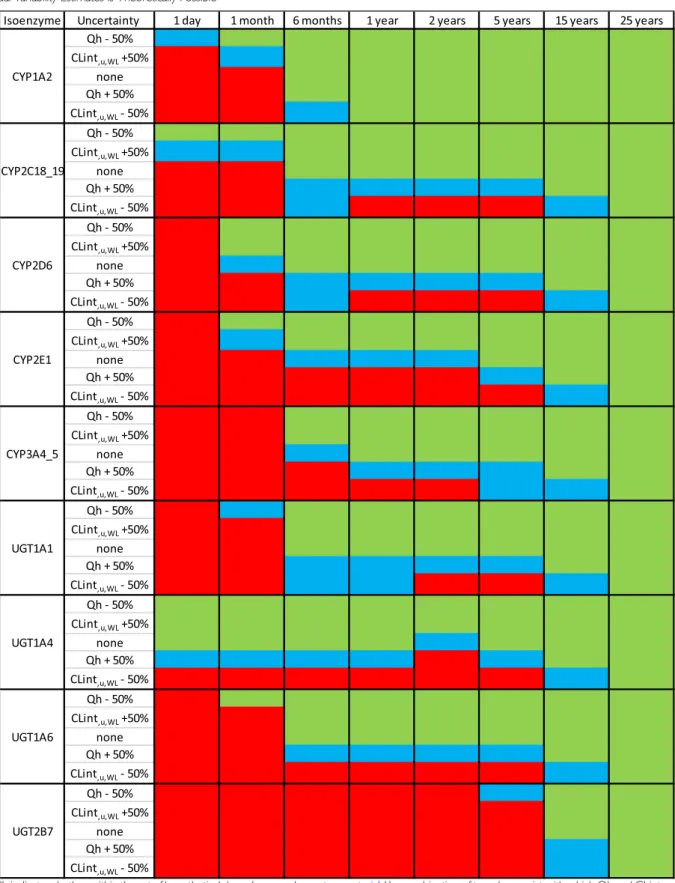
implemented in Simcyp V15 (see supplementary material1) were used to calculate expected ER values for the hypothetical drugs that are substrates of these isoenzymes in children of various ages. We found that drugs with an ER≤0.27 are likely to exist for all investigated isoenzymes at all ages (results not shown). However, drugs with an ER≥0.93 are likely to exist only for specific isoenzyme pathways and ages, as shown in TableII by the increased blue and red boxes with younger ages for most isoenzyme pathways. This is, because low en-zyme maturation will reduce the overall ER of drugs. As a result, drugs metabolized by slowly maturing isoenzymes such as CYP2E1 and UGT2B7, are unlikely to have a high ER at young ages. On the other hand, drugs metabolized by fast maturing isoenzymes, such as CYP1A2 or UGT1A4, with a very high ER over a wide range of paediatric ages are likely to exist and could be used as model drugs.
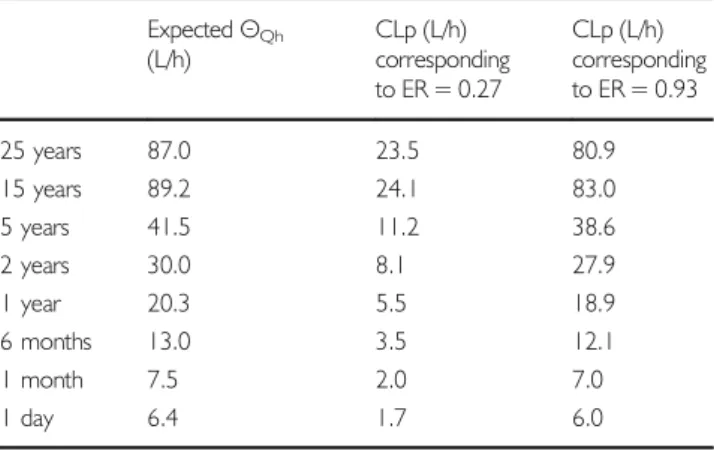
For convenience, to identify drugs with desired ER values, the ER values have also been translated into the required total plasma clearance values (CLp) for various paediatric ages. This is presented in TableIII, which shows for instance that in a one year old child, ER≤0.27 and ER≥0.93 translate into a CLp≤5.5 L/h and a CLp≥18.9, respectively.
Step 3: Investigation of Bias
The performance of a clinical trial design resulting from step 1 was evaluated using sse with one drug with an ER of 0.94 and one drug with an ER of 0.2 in one year old children. The uncertainty onΘCLintu;WL and ΘQhincluded in the sse, lead
to the simulation of 1000 combinations ofΘCLintu;WL and
ΘQhwith a range of ER from 0.09 to 0.38 and from 0.76 to
0.99 for the drug with the lowest and the highest ER respec-tively. Minimization was successful in 78.3% of the sse runs. The mre was≤7.5% for all parameters (TableIV), and the rrmse was below 31%. The confidence interval (5th and 95th percentile) of the re was below or around 20% forΘCLintu;WL
and ΘQh. Higher values were found for ω2CLintu;WL and ω2Qh,
with values below or around 47%.
DISCUSSION
The aim of this paper was to develop an analysis framework to investigate the feasibility and clinical trial requirements for the estimation on clinical data of PBPK parameters with a popu-lation PK approach. This work represents, to our knowledge, the first application of population optimal design principles for the estimation of PBPK parameters. Being able to a priori define trial requirements that yield sufficiently informative da-ta (i.e. numerical identifiability), is essential for a decision mak-ing process when costs and benefits of performmak-ing a study need to be weighed. The complex design requirements derived in our example for instance, would not be easy to define and would likely not have been met using conventional study de-sign approaches. The execution of clinical trials that yield uninformative data that do yield numerical identifiability is both unethical, especially in vulnerable populations, and cost-inefficient.
While we focused on CLint,u,WLand Qh in a paediatric
population, the analysis workflow herein developed can be applied to other PBPK parameters, a different number of parameters, and for other populations. In these cases, the workflow would contain the same steps as outlined here: struc-tural identifiability, optimal design and evaluation of the op-timized design performance.
In our example, in the first step of the workflow, structural identifiability for the estimation of both CLint,u,WLand Qh
was found possible when PK data of a minimum of two drugs were simultaneously analysed. In addition, both drugs must be administered in patients groups from the same population, metabolized by the same isoenzyme, and their CLintratio
should be known. CLintratiois the ratio of thein vitromeasured
intrinsic clearance of the drugs and is a drug-specific param-eter (equation7).
ER≥0.93 and an ER≤0.27, in order to precisely (rse≤30%) estimateΘandω2for CLint,u,WL and Qh. These
require-ments might not be easy to meet since drugs with ER≥0.93 are rare, especially in very young children whose isoenzyme maturation can lead to a decrease in ER with decreasing age (26). This is shown in TableII, displaying isoenzymes and ages for which drugs with ER values that meet these criteria exist within the set of hypothetical drugs tested. These results show that characterization of isoenzyme specific ontogeny is chal-lenging in very young children not only due to the sparsity and lack of available data in this population, but also due to intrin-sic characteristics of the system which leads to a decrease in ER with decreasing age. Drugs metabolized by fast maturing isoenzymes were found to be the best model drugs to estimate Qh and CLint,u,WL simultaneously. For instance, CYP1A2
substrates are likely to have the required ERs in children as young as 6 month even in situations whereΘCLintu;WLandΘQh
deviate up to ± 50% of their expected values. UGT1A4
substrates are likely to have the required ERs in children as young as term neonates of one day, but only in situations whereΘCLintu;WLandΘQhvalues correspond to their expected
value or are up to +50% and−50% of their expected value respectively. To support the selection of such model drugs from existing drugs, the requirements in ER were translated into CLp values in the conversion table (see TableIII) using reported hepatic blood flow values. Overall, these results do highlight the importance of investigating the clinical trial re-quirements a priori, as otherwise the chances of successfully estimating PBPK model parameters from clinical PK data using population approach will be very low.
In the last step of our analysis workflow, stochastic simula-tions and estimasimula-tions were used to assess the performance of the optimized study design, since optimal design only ad-dresses parameter precision. While step 2 defined the ER of the two drugs required in the clinical trial, in practice the selected drugs might have an ER deviating from their
Fig. 3 Parameter precision as a function of the extraction ratios (ER) of the two drugs studied in the clinical trial.Θrepresents the fixed effect,ω2the inter-individual variance in the parameter. CLint,u,WLis the whole liver unbound intrinsic clearance as defined in equations8and9, Qh is the hepatic blood flow. For each tested drug combination, the precision of the parameter estimates are summarized, with each pixel representing the results for all four variance scenarios (i.e.:ω2
CLintu;WLandω 2
Table II Identification of Isoenzyme Pathways and Ages for which Combinations of Two Drugs Leading to Precise Qh and CLint,u,WLFixed Effects and Inter-Individual Variability Estimates is Theoretically Possible
Isoenzyme Uncertainty 1 day 1 month 6 months 1 year 2 years 5 years 15 years 25 years Qh - 50%
CLint,u,WL +50% none Qh + 50% CLint,u,WL - 50%
Qh - 50% CLint,u,WL +50%
none Qh + 50% CLint,u,WL - 50%
Qh - 50% CLint,u,WL +50%
none Qh + 50% CLint,u,WL - 50%
Qh - 50% CLint,u,WL +50%
none Qh + 50% CLint,u,WL - 50%
Qh - 50% CLint,u,WL +50%
none Qh + 50% CLint,u,WL - 50%
Qh - 50% CLint,u,WL +50%
none Qh + 50% CLint,u,WL - 50%
Qh - 50% CLint,u,WL +50%
none Qh + 50% CLint,u,WL - 50%
Qh - 50% CLint,u,WL +50%
none Qh + 50% CLint,u,WL - 50%
Qh - 50% CLint,u,WL +50%
none Qh + 50% CLint,u,WL - 50% UGT1A4
UGT1A6
UGT2B7 CYP1A2
CYP2C18_19
CYP2D6
CYP2E1
CYP3A4_5
UGT1A1
expected values, which was accounted for in the sse. Uncertainty in fixed effects and inter-individual variability for CLint,u,WL and Qh was also accounted for in the sse.
This step allowed for the assessment of whether further inves-tigation to optimize the clinical trial design would be needed to ensure unbiased parameter estimates. Absolute mean ree was below 7.5% for all parameters and the rrmsee was below 31%, meaning that on aver-age the estimates both are accurate and precise. The confidence interval (5th and 95th percentile) of the relative estimation error was below or around 20% forΘCLintu;WL
andΘQh. Higher values were found for ω2CLintu;WL and ω 2 Qh
which was expected due to parameter uncertainty and the general difficulty in estimating inter-individual variability. Overall, the sse showed that the proposed clinical trial design is robust to parameter uncertainty.
Once existing model drugs with the required ER are iden-tified, clinical data to estimateΘandω2for CLint,u,WLand
Qh can be sought. The source of these data could either be new clinical trials or historical data from studies meeting the defined design requirements.
An advantage of PBPK models is that quantification of system-specific model parameters, like Qh and the maturation profile of CLint,u,WLfor each isoenzyme, needs to be
per-formed only once. Once Qh has been quantified for instance using substrates for the CYP1A2 or UGT1A4 isoenzymes, this can be implemented in the PBPK model either as fixed value or as prior in order to estimateΘandω2for CLint,u,WLfor
any other drug or other isoenzyme pathway in the same pop-ulation. This is important because both CLint,u,WLand Qh
cannot be directly measured and because identifiability is im-portant for the estimation of PBPK model parameters (27).
While in this work we focus on popPBPK parameter esti-mation for a specific age, the scalability of the rse results with regard to ER allows for the applicability of design require-ments across the entire age range. Since most paediatric PK studies include patients of a range of ages, estimation of a maturation function would be preferable over the estimation of parameter values for each specific paediatric age. In the future this work could be extended to the design of studies for the estimation of such maturation functions. This will re-quire thea prioridefinition of the most suitable covariate for maturation function and optimization of study designs for the estimation of parameters in continuous covariate functions, the latter of which is not yet available in the PFIM software.
In the developed analytical workflow, optimal design prin-ciples were applied in an innovative manner. The clinical design parameter optimized was the ER of the drugs included in the clinical trial. In a classical optimal design setting, opti-mized clinical design parameters include the number of pa-tients and samples, sampling times, and drug dose. In this work, in order to assess the impact of the drug’s ER on the performance of the design without any confounding impact these design parameters, these parameters were set such as to have the same impact for each hypothetical drug in the study. To do so, drugs were administered as a constant rate infusion with infusion rate and sampling times adapted to the drugs clearance and half-life respectively, and each arm of the study included the same number of patients and number of blood samples. Practically, such design adaptation on half-life and clearance means that when normalizing sampling times over
Table III Conversion Table to Convert the Extraction ratio (ER) Values of 0.27 and 0.93 to Total Plasma Clearance (CLp, equation1) in Various Postnatal Ages Using Expected Hepatic Blood Flow (Qh) Values and fu and B:PValues Taken to be 1
ExpectedΘQh (L/h)
CLp (L/h) corresponding to ER = 0.27
CLp (L/h) corresponding to ER = 0.93
25 years 87.0 23.5 80.9 15 years 89.2 24.1 83.0 5 years 41.5 11.2 38.6 2 years 30.0 8.1 27.9 1 year 20.3 5.5 18.9 6 months 13.0 3.5 12.1 1 month 7.5 2.0 7.0
1 day 6.4 1.7 6.0
ExpectedΘQhis the fixed effect for the hepatic blood flow derived from Simcyp simulations
Table IV Assessment of the Clinical trial Performance Based on the Precision and Accuracy of the Parameter Estimates of the sse with Uncertainty
ΘCLintu;WL
ΘQh
ω2
CLintu;WL ω
2 Qh
re 5th percentile −16.2935 −18.356 −44.4268 −47.0063 re 50th percentile 0.715404 −1.6823 −9.7909 −10.7792 re 95th percentile 23.68881 16.63842 41.03665 46.80308
mre 1.548568 −1.19669 −7.38877 −7.24315
rrmse 12.21483 10.9555 26.24813 30.54991
the drug’s half-life, sampling times and measured concentra-tions are identical between different drugs (between each arm of the design and between different drug combinations tested), which in turn allows for the same impact of sampling times and dosing regimen on the design performance. Another in-novative feature of the workflow is that the optimal design is not given as a unique solution as classically performed, but as a range of solutions. This was done by investigating the param-eter space of the design variable to optimize (ER) and catego-rization of the results by level of precision.
The number of patients and samples in the assessed trial designs in step 2 of the workflow were selected to be relatively high, so that these variables would not be limiting to the op-timization of trial requirements regarding the definition of ER values. Once the important design features relevant for the research question of interest have been defined in the pro-posed workflow, traditional optimal design procedures could be applied to further optimize the trial design regarding these variables.
In the developed workflow, computational cost was tre-mendously reduced through the optimization of a scalable variable and the use of extreme variance scenarios to account for parameter uncertainty. The ER of a drug is a scalable variable, as it can be converted to clearance values in any paediatric age by using the expected hepatic blood flow in the corresponding age which represents the scaling factor. Indeed, ER reflects the relative contributions of Qh and CLint,u,WLto the hepatic metabolic clearance, but is
indepen-dent of the absolute value of these two parameters. Therefore, the results of the optimal design analysis obtained for one age, one year-olds in our example, can be extended to any other ages, allowing to reduce the computational cost and to facili-tate results interpretation. Moreover, the ER summarizes the influence of all drug-specific parameters (e.g.: drug binding to plasma proteins, drug distribution in red blood cells, etc.), and therefore, accounting for uncertainty inΘCLintu;WL and ΘQh
becomes unnecessary in the optimal design phase and the result obtained in our example for drugs with an unbound drug fraction in plasma or fu of 1 and blood to plasma ratio or B:P of 1 can be translated to drugs for which these param-eters take different values. Testing all combinations of extreme
ω2
Qhandω2CLintu;WLvalues lead to results reflecting the best and
worst case scenarios in terms of parameter precision. Because we defined precise parameter estimates as rse < 30% in all tested variance scenarios, the final results reflect the worst case scenarios and account for all untested intermediate variance scenarios.
In conclusion, this work presents an analysis framework that allows for thea prioriidentification of clinical trial require-ments that would allow for the estimation of PBPK model parameters from clinical data using population modelling. The example on CLint,u,WL and Qh shows that it may be
unlikely to design an adequate clinical trial, without the
knowledge obtained by the application of this analysis frame-work. Being able to identify PBPK parameters that cannot be obtained by direct experimental measurements in a time and cost efficient manner would greatly improve the development of PBPK models and their predictive performance.
ACKNOWLEDGMENTS AND DISCLOSURES
We would like to thank Sinziana Cristea for reviewing all model codes used in this study. Trevor Johnson is a paid employee of Simcyp Limited. Professor Amin Rostami-Hodjegan holds shares in Certara, a company focusing on Model-Informed Drug Development. This author has completed the Unified Competing Interest form at http://www.icmje.org/coi_ disclosure.pdf (available on request from amin.rostami@ manchester.ac.uk) and declares no support from any organisation for the submitted work. This study was supported by the Innovational Research Incentives Scheme (Vidi grant, June 2013) of the Netherlands Organization for Scientific Research (NWO) to Catherijne A. J. Knibbe (2013).
Open AccessThis article is distributed under the terms of the Creative Commons Attribution 4.0 International License (http://creativecommons.org/licenses/by/4.0/), which per-mits unrestricted use, distribution, and reproduction in any medium, provided you give appropriate credit to the original author(s) and the source, provide a link to the Creative Commons license, and indicate if changes were made.
REFERENCES
1. Maharaj AR, Edginton AN. Physiologically based pharmacokinetic modeling and simulation in pediatric drug development. CPT pharmacometrics Syst Pharmacol Wiley-Blackwell; 2014 Oct 22;3(11):e150.
2. Thai H-T, Mazuir F, Cartot-Cotton S, Veyrat-Follet C. Optimizing pharmacokinetic bridging studies in paediatric oncol-ogy using physiologically-based pharmacokinetic modelling: appli-cation to docetaxel. Br J Clin Pharmacol Wiley-Blackwell. 2015 Sep;80(3):534–47.
3. Johnson TN, Zhou D, Bui KH. Development of physiologically based pharmacokinetic model to evaluate the relative systemic ex-posure to quetiapine after administration of IR and XR formula-tions to adults, children and adolescents. Biopharm Drug Dispos. 2014 Sep;35(6):341–52.
4. Dumont C, Mentré F, Gaynor C, Brendel K, Gesson C, Chenel M. Optimal sampling times for a drug and its metabolite using S I M C Y P ( ® ) s i m u l a t i o n s a s p r i o r i n f o r m a t i o n . C l i n Pharmacokinet. 2013 Jan;52(1):43–57.
6. Zhao W, Leroux S, Biran V, Jacqz-Aigrain E. Developmental pharmacogenetics of CYP2C19 in neonates and young infants: omeprazole as a probe drug. Br J Clin Pharmacol. 2018 Jan;28 7. Upreti VV, Wahlstrom JL. Meta-analysis of hepatic cytochrome
P450 ontogeny to underwrite the prediction of pediatric pharma-cokinetics using physiologically based pharmacokinetic modeling. J Clin Pharmacol. 2016 Mar 1;56(3):266–83.
8. Tsamandouras N, Rostami-Hodjegan A, Aarons L. Combining the
Bbottom-up^and Btop-down^ approaches in pharmacokinetic modelling: fitting PBPK models to observed clinical data. Br J Clin Pharmacol 2013 Sep 3;
9. Bellman R, Åström KJ. On structural identifiability. Math Biosci. 1970 Apr;7(3–4):329–39.
10. Bonate PL. Pharmacokinetic-Pharmacodynamic Modeling and Simulation. Boston, MA: Springer US; 2011.
11. Bellu G, Saccomani MP, Audoly S, D’Angiò L. DAISY: a new software tool to test global identifiability of biological and physio-logical systems. Comput Methods Prog Biomed. 2007 Oct;88(1): 52–61.
12. Chis O-T, Banga JR, Balsa-Canto E. Structural identifiability of systems biology models: a critical comparison of methods. Jaeger J, editor PLoS One. 2011 Nov 22;6(11):e27755.
13. Nyberg J, Bazzoli C, Ogungbenro K, Aliev A, Leonov S, Duffull S, et al. Methods and software tools for design evaluation in popula-tion pharmacokinetics-pharmacodynamics studies. Br J Clin Pharmacol. 2015 Jan;79(1):6–17.
14. France Mentré, Marylore Chenel, Emmanuelle Comets, Joachim Grevel, Andrew Hookeret al. Current Use and Developments Needed for Optimal Design in Pharmacometrics: A Study Performed Among DDMoRe’s European Federation of Pharmaceutical Industries and Associations Members. CPT Pharmacometrics Syst Pharmacol, 2013, 2, pp.e46 <101038/ psp201319> <hal-01122163>.
15. Johnson TN, Rostami-Hodjegan A, Tucker GT. Prediction of the clearance of eleven drugs and associated variability in neonates, infants and children. Clin Pharmacokinet. 2006 Jan;45(9):931–56. 16. Björkman S. Prediction of drug disposition in infants and children by means of physiologically based pharmacokinetic (PBPK)
modelling: theophylline and midazolam as model drugs. Br J Clin Pharmacol. 2005 Jun;59(6):691–704.
17. Maharaj AR, Barrett JS, Edginton AN. A workflow example of PBPK modeling to support pediatric research and development: case study with lorazepam. AAPS J. 2013 Apr;15(2):455–64. 18. R Development Core Team. R: a language and environment for
statistical computing. ISBN: 3–900051–07-0, 2008.
19. Dumont C, Lestini G, Le Nagard H, Mentré F, Comets E, Nguyen TT, et al. PFIM 4.0, an extended R program for design evaluation and optimization in nonlinear mixed-effect models. Comput Methods Prog Biomed. 2018 Mar;156:217–29.
20. Beal SL, Sheiner LB, Boeckmann AJ eds. NONMEM Users Guides. Ellicott City, USA: Icon Development Solutions. Ellicott City, USA: Icon Development Solutions;
21. Lindbom L, Pihlgren P, Jonsson EN, Jonsson N. PsN-toolkit–a collection of computer intensive statistical methods for non-linear mixed effect modeling using NONMEM. Comput Methods Prog Biomed. 2005 Sep;79(3):241–57.
22. Ridgway D, Tuszynski JA, Tam YK. Reassessing models of hepatic extraction. J Biol Phys. 2003 Mar;29(1):1–21.
23. Roberts MS, Rowland M. Correlation between in-vitro microsom-al enzyme activity and whole organ hepatic elimination kinetics: analysis with a dispersion model. J Pharm Pharmacol. Wiley/ Blackwell (10.1111); 1986 Mar;38(3):177–181.
24. Delignette-Muller ML, Dutang C. Fitdistrplus : an R package for fitting distributions. J Stat Softw. 2015 Mar 20;64(4):1–34. 25. Shivva V, Korell J, Tucker IG, Duffull SB. An approach for
identifiability of population pharmacokinetic-pharmacodynamic models. CPT pharmacometrics Syst Pharmacol. 2013 Jan;2:e49. 26. Salem F, Abduljalil K, Kamiyama Y, Rostami-Hodjegan A.
Considering age variation when coining drugs as high versus low hepatic extraction ratio. Drug Metab Dispos. 2016 Jun 14;44(7): 1099–102.