O R I G I N A L R E S E A R C H
Open Access
A tailored e-learning program to improve
handover in the chain of emergency care: a
pre-test post-test study
Remco HA Ebben
1*, Pierre M van Grunsven
2, Marie Louise Moors
3, Peter Aldenhoven
2, Jordan de Vaan
3,
Roger van Hout
2, Theo van Achterberg
4,5and Lilian CM Vloet
1,6Abstract
Objective:To standardize patient handover in the chain of emergency care a handover guideline was developed. The main guideline recommendation is to use the DeMIST model (Demographics, Mechanism of Injury/illness, Injury/Illness, Signs, Treatment given) to structure pre-hospital notification and handover. To benefit from the new guideline, guideline adherence is necessary. As adherence to guidelines in emergency care settings is variable, there is a need to systematically implement the new guideline. For implementation of the guideline we developed a e-learning program tailored to influencing factors. The aim of the study was to evaluate the effectiveness of this e-learning program to improve emergency care professionals’adherence to the handover guideline during pre-hospital notification and handover in the chain of emergency medical service (EMS), emergency medical dispatch (EMD), and emergency department (ED).
Methods:A prospective pre-test post-test study was conducted. The intervention was a tailored e-learning program that was offered to ambulance crew and emergency medical dispatchers (n=88). Data on adherence included pre-hospital notifications and handovers and were collected through observations and audiotapes before and after the e-learning program. Data were analyzed using X2-tests and t-tests.
Results:In total, 78/88 (88.6%) professionals followed the e-learning program. During pre- and post-test, 146 and 169 handovers were observed respectively. After the e-learning program, no significant difference in the number of handovers with the DeMIST model (77.9% vs. 73.1%, p=.319) and the number of handovers with the correct sequence of the DeMIST model (69.9% vs. 70.5%, p=.159) existed. During the handover, the number of questions by ED staff and interruptions significantly increased from 49.0% to 68.9% and from 15.2% to 52.7% respectively (both p=.000). Most handovers were performed after patient transfer, this did not change after the intervention (p=.167). The number of handovers where information was documented during handover slightly increased from 26.9% to 29.3% (p=.632).
Conclusions:The tailored e-learning program did not improve adherence to a handover guideline in the chain of emergency care. Results show a relatively high baseline adherence rate to usage and correct sequence of the DeMIST model. Improvements in the handover process can be made on the documentation of information during handover, the number of interruptions and questions, and the handover moment.
Keywords:Guideline adherence [MeSH], Patient handoff [MeSH], Emergency Medical services [MeSH]
* Correspondence:[email protected] 1
Research department acute care, HAN University of Applied Sciences, Nijmegen, the Netherlands
Full list of author information is available at the end of the article
Introduction
Patient handover from one health care setting to another includes possible threats to quality and continuity of care [1]. A handover is characterized by the involvement of two or more professionals, the exchange of verbal and/or written information about the patient’s diagnosis, treatment and care, and the transition of patient respon-sibility [1-5]. The handover from ambulance to emer-gency department (ED) involves 2-way communication between the ambulance crew and ED-staff [6]. Especially the handover from ambulance to ED seems error prone as there is a high patient turnover, patients present themselves with a wide diversity of clinical conditions, there are acute time constraints, and the ambulance crew has only one opportunity to transfer patient infor-mation [7]. Previous studies report a loss of inforinfor-mation during handover from ambulance to ED [5,8,9]. Factors which might influence the quality of the handover from ambulance to ED are a lack of active listening skills or in-attention of ED-staff, unnecessary repetitions or provision of unnecessary information by ambulance crew, interrup-tions, workload, working relationships between ambulance crew and ED-staff, uncertainty about the transfer of re-sponsibility, and failure to reach shared understanding [5,6,10-12].
To overcome these problems and barriers, standardization of the handover from ambulance to ED is recom-mended [5,13]. To facilitate standardization, structured models for ambulance to ED handover have been devel-oped: (De)MIST (Demographics, Mechanism of Injury/ illness, Injury or Illness found or suspected, Signs, Treat-ment given), AMPLE (Allergies, Medications, Past ill-nesses, Last meal, Events), ASHICE (Age, Sex, History, Injuries, Condition, Expected time of arrival), IMIST-AMBO (Identification of the patient, Mechanism/
medical complaint, Injuries, Signs, Treatment and treat-ment respons/trend, Allergies, Medications, Back-ground and Other), SOAP (Subjective information, Objective information, Assessment, Plan) and BAUM (‘Bestand’(inventory),‘Anamnese’(medical history),‘ Kli-nische Untersuchungsergebnisse’ (clinical findings), ‘Massnahmen’(actions)) [5,13-15].
To standardize handover practice from ambulance to ED in the Netherlands, an evidence-based guideline has been developed. The key-recommendation of the guide-line is to use the DeMIST-model to structure prehospital notification and handover in the chain of ambulance, emergency medical dispatch (EMD) and ED. Due to a lack of evidence about effectiveness and applicability of hand-overs models, the choice for the DeMIST model was based on the fact that the MIST model was already in use. Other recommendations of the handover guideline are (a) that the pre-hospital professional who is responsible for the patient, provides a handover to the ED-professional who will be responsible for the patient, (b) that a handover takes place before patient transfer, and (c) that the ambu-lance crew verifies if the handover was clear.
To assist implementation of the newly developed guideline, a tailored e-learning program was developed to serve as educational intervention. The e-learning pro-gram was tailored to influencing factors that were identi-fied beforehand in the local chain of emergency care. Previous studies show that e-learning can be effective to teach emergency physicians and nurses to recognize child abuse, to administer metoclopramide and to im-prove triage skills [16-18]. The effect of e-leaning on handover has not been studied.
Therefore, the aim of the study was to evaluate the effectiveness of an e-learning program to improve adher-ence to the handover guideline, hereby structuring
pre-Table 1 Outcomes
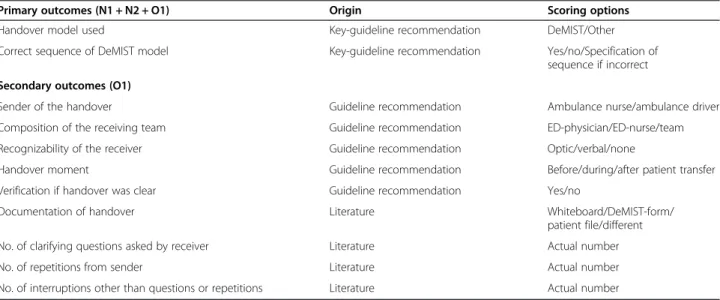
Primary outcomes (N1 + N2 + O1) Origin Scoring options
Handover model used Key-guideline recommendation DeMIST/Other
Correct sequence of DeMIST model Key-guideline recommendation Yes/no/Specification of
sequence if incorrect
Secondary outcomes (O1)
Sender of the handover Guideline recommendation Ambulance nurse/ambulance driver
Composition of the receiving team Guideline recommendation ED-physician/ED-nurse/team
Recognizability of the receiver Guideline recommendation Optic/verbal/none
Handover moment Guideline recommendation Before/during/after patient transfer
Verification if handover was clear Guideline recommendation Yes/no
Documentation of handover Literature Whiteboard/DeMIST-form/
patient file/different
No. of clarifying questions asked by receiver Literature Actual number
No. of repetitions from sender Literature Actual number
hospital notification and handover in the chain of ambulance-EMD-ED. We hypothesized that the e-learning was effective to improve handover on the two key-guideline recommendations (Table 1), being 1) to use the DeMIST model and 2) to use the DeMIST model in the correct sequence.
Methods
Design
The study had a prospective pre-test post-test design.
Setting
The study setting was located in the chain of emergency care of Nijmegen, the Netherlands. The chain of emer-gency care consists of the regional ambulance service (EMS), the emergency medical dispatch centre (EMD), and the emergency department (ED) of the Radboud university medical centre. In 2013, the EMD in this re-gion managed 66.316 ambulance calls. Ambulances are staffed with one driver and one registered ambulance nurse, specialized EMD-nurses staff the EMD. Regis-tered nurses become qualified as an ambulance nurse or
EMD-nurse after following a specific national training course. Ambulance nurses work autonomously and are allowed to administer medical treatment based on their national protocol, without direct consultation of an EMS physician. The ED of the Radboudumc is a level 1 trau-macenter, meaning the ED is delivering 24/7 trauma care for all types of patients. The ED had 21.672 admissions in 2012 and is staffed with emergency nurses and emer-gency physicians. Additional medical teams (trauma sur-geon, intensivist) can be activated.
Handover process
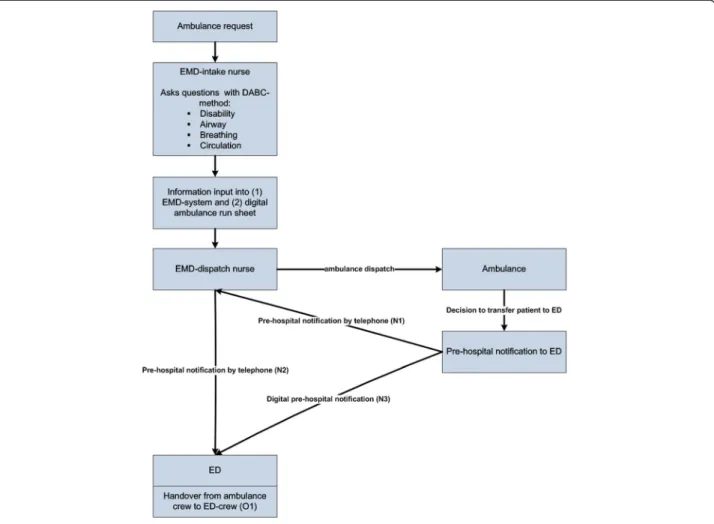
The transfer process of the patient and patient infor-mation in the chain of emergency care is displayed in Figure 1. A request for an ambulance can be made by a lay person calling the national emergency number, or by another healthcare professional (e.g. general practitioner). The request is handled by the EMD-intake nurse, who interrogates the caller and triages the problem. During the intake, information is stored into (1) the EMD-system and (2) the digital ambulance run sheet. On the basis of this information and guided
by dispatch-protocols, the EMD-dispatch nurse de-cides about dispatching an ambulance. The ambulance can be dispatched with urgency level A1 (arrival <15 minutes), A2 (arrival <30 minutes) or B (planned). After on-scene diagnosis and treatment, the ambu-lance nurse may decide to transfer the patient to the ED. The ambulance crew provides a notification (N1) to the EMD-dispatch nurse by telephone, then the EMD-dispatch nurse calls the ED and notifies the ED (N2). Both calls are logged into the EMD-system. At the same time, the ambulance sends a digital notifica-tion (N3) to the ED. The digital notificanotifica-tion is a short version of the ambulance run sheet with DeMIST data. When the ambulance arrives at the ED, the handover of the patient, the patient information, and the pa-tients’ personal belongings from ambulance to ED takes place (O1).
Outcomes
The degree of adherence to the key-recommendation to use the DeMIST-model in the correct sequence to structure pre-hospital notification and handover from ambulance to ED was the primary outcome of this study for N1, N2 and O1 (Table 1). For handover (O1), sec-ondary outcomes based on guideline recommendations were the professional providing a handover (sender), the composition of the receiving team, recognizability of the receiver, handover moment, and verification if the handover was clear. The choice for ‘composition of the receiving team’ was also based on the idea that if the receiving team is complete at the start of a handover, this reduces the risk of loss of information
due to multiple handovers (‘Chinese whisper’) [5]. Additional secondary outcomes based on literature were documentation of information from the hand-over, the number of repetitions, number of questions, and the number of interruptions other than repetitions and questions.
Pre-test
The pre-test phase consisted of two periods of 4 weeks between April 22nd and August 9th 2013. Handovers from ambulance to ED for all types of ambulance runs and all types of patients were included. Handovers of pa-tients with a possible or confirmed MRSA-contamination were excluded, as these handovers took place in separ-ate rooms with infection precautions. Data were col-lected in two steps. First, all handovers from ambulance to ED were observed using a structured data collection form based on primary and secondary outcomes and scoring options (Table 1). Secondly, to collect data for the prehospital notification (N1 + N2) from ambulance to ED we used audiotapes. Corresponding audiotapes for a handover were identified at the EMD using an unique ambulance run identifier. All data were col-lected by trained 4thyear students from the bachelor of nursing or bachelor of health studies.
Intervention
We used Grol's model for effective implementation as study framework (Figure 1) [19,20]. The model provides a stepwise approach for improving clinical practice and starts with the identification of research findings or guidelines that have to be implemented (step 1). Steps 2
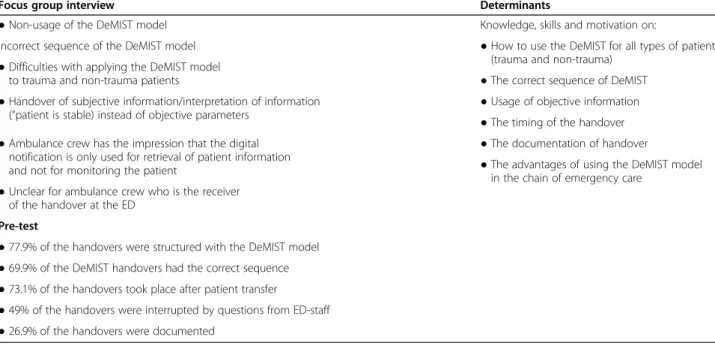
Table 2 Handover problems identified in the chain of emergency care
Focus group interview Determinants
●Non-usage of the DeMIST model Knowledge, skills and motivation on:
Incorrect sequence of the DeMIST model ●How to use the DeMIST for all types of patients
(trauma and non-trauma) ●Difficulties with applying the DeMIST model
to trauma and non-trauma patients ●The correct sequence of DeMIST
●Handover of subjective information/interpretation of information (“patient is stable) instead of objective parameters
●Usage of objective information ●The timing of the handover ●Ambulance crew has the impression that the digital
notification is only used for retrieval of patient information and not for monitoring the patient
●The documentation of handover
●The advantages of using the DeMIST model in the chain of emergency care
●Unclear for ambulance crew who is the receiver of the handover at the ED
Pre-test
●77.9% of the handovers were structured with the DeMIST model ●69.9% of the DeMIST handovers had the correct sequence ●73.1% of the handovers took place after patient transfer
and 3 include a description of (change) targets and an analysis of the target group, current practice and setting. On the basis of this analysis, implementation strategies can be selected or developed (step 4), followed by the execution and evaluation of an implementation plan (steps 5 and 6). For step 1 in this study, the aim was to implement the handover guideline. The analysis of the target group (step 2 and 3) was undertaken composing a multi-disciplinary steering group and conducting a focus group interview. The multi-disciplinary steering group
included opinion leaders from the chain of emergency-care: 1 EMD nurse, 1 ambulance nurse, 1 ambulance care medical manager, 1 emergency physician and 1 emergency nurse. The role of the steering group was to provide input in the study design and to create support for the study in the local chain of emergency care. The aim of the focus group interview was to identify hand-over problems in the local chain of emergency care. The focus group was organized in April 2013, participants were 2 emergency physicians, 2 emergency nurses, 2 Table 3 Components and content of the e-learning program
Component Aim Content
Introduction Explanation on the usage of the e-learning program and the learning goals to the participant
Learning goals
●The professional knows the elements of a proper DeMIST handover ●The professionals knows why it is important to use the DeMIST
model for handover
●The professional knows the role of the emergency medical dispatcher, ambulance driver, ambulance nurse, emergency nurse and emergency physician during handover
●The professional performs a DeMIST handover for trauma and non-trauma patients
Theory Provision of theory on DeMIST and its usage to the participant
Theory on DeMIST
●De: full name, date of birth/age and sex of the patient ●M: trauma or non-trauma
●I: injuries found or suspected/complaints
●S: Airway, Breathing (frequency, SpO2), Circulation (heart rate, blood pressure), and Disability (EMV-score, pupil reaction, pain, blood glucose)
●T: working diagnosis, treatment given, effect of the treatment When to use DeMIST
How to use DeMIST
Supply of objective information
When to provide a handover
Verification if handover was clear
Who provides a handover to whom (professionals’role)
Advantages of using the DeMIST in the total chain of emergency care
Knowledge test Summative test whether the participant has sufficient knowledge, insight and basic skills about a DeMIST handover
8 random questions out of 22 on knowledge, insight and application of theory
Simulation test Summative test whether the participant can integrate knowledge and skills to provide a DeMIST handover
2 high fidelity simulation scenarios, randomly picked from 7 possible scenarios:
1. Female (75 yrs), low energetic trauma (pedestrian-car)
2. Male (45 yrs), high energetic trauma (tree-car)
3. Female (28 yrs), hypovolemic shock (fluxus post partum)
4. Male (30 yrs), fever, hypotension altered consciousness (septicaemia)
5. Female (55 yrs), resuscitation
6. Male (68 yrs), resuscitation
7. Female (70 yrs), stroke
Evaluation Feedback on knowledge and simulation test to the participant
ambulance nurses and 1 EMD-nurse. The focus group interview was audiotaped, and transcribed verbatim. Two researchers identified the problems on the basis of the transcription, and for each problem a key-determinant was added (Table 2). To enhance trustworthiness a mem-ber check was performed [21], therefore identified prob-lems and determinants were sent to the participants of the focus group interview. Furthermore, problems which arose from the pre-test were also addressed.
On the basis of identified problems and determinants the steering group chose to use a tailored online e-learning program as intervention. Literature suggests tai-loring interventions to identified problems to increase effectiveness, although the effectiveness of tailoring has not been proven irrefutable yet [22]. Reasons to choose e-learning were (a) the fact that all determinants could be addressed, (b) the flexibility, availability and accessi-bility of using e-learning which suits the emergency care context [23], and (c) the fact the target group was famil-iar with e-learning in their training programs. The e-learning program was specifically designed for EMD-nurses, ambulance nurses and drivers, emergency nurses and physicians, on the basis of (1) the handover guide-line, (2) literature, (3) expert opinion, and (4) identified problems. The e-learning program yielded five compo-nents aimed at (1) knowledge about the DeMIST model and handover process, (2) skills how to use the DeMIST model to provide a proper handover, and (3) motivation to use the DeMIST model in the total chain of emer-gency care (Table 3).
During the knowledge test, 8 random questions were presented. The caesura for the knowledge test was 87.5% (1 wrong answer). The e-learning program included 7 simulation scenarios on trauma (2x), resuscitation (2x), septicaemia (1x), fluxus post-partum (1x), and stroke (1x). All scenarios were designed with regard to the 3 diagnoses with the highest national incidence in emer-gency care: cardiology, trauma and internal medicine. The scenarios could be simulated from EMD, EMS or ED perspective that the professional could choose. This choice was added to the e-learning program to emphasize the chain of emergency care. Professionals could exercise simulations before entering the simula-tion test. During the simulasimula-tion test the professionals had to simulate two scenarios (caesura 90%). The con-struction of the simulation test included that the result of the first scenario cumulated to the result of the sec-ond scenario, so if the professional failed the first simu-lation, zero faults were allowed during the second simulation. The rationale was that professionals provided a good handover the first time, as in real practice the ambulance crew has only one opportunity to provide a handover. Both the knowledge and simulation tests pro-vided feedback to the professionals. The draft version of
the e-learning program was tested on content and us-ability by representatives (n = 6) from the targetgroup. There was no maximum time restriction for completion of the entire e-learning program.
Intervention phase
All possible professionals from the EMD (n = 15) and EMS (n = 73) who could be involved in a handover dur-ing the study period were invited to follow the e-learning program on October 3rd 2013. The e-e-learning program was accompanied by an email in which the pur-pose was explained, and in which the professionals were motivated by their managers and educational coordina-tors. Also, information on the EMD and EMS intranet was published and professionals were motivated to fol-low the e-learning program by members of the steering group. The professionals could start the e-learning pro-gram any time on any computer they wanted, until No-vember 16th 2013. During this period, each professional received 2 digital reminders. To stimulate the profes-sionals to follow the e-learning program, the program was accredited with official registration points for EMD and ambulance nurses, and ambulance drivers.
Post-test
The post-test phase lasted from November 11th until December 8th 2013. To collect data, the same methods were used as in the pre-test.
Data analysis
As this study is the first intervention study on handover, the number of observed handovers was based on feasi-bility and we did not perform a formal power analysis. To have an estimation, the minimum number of Table 4 Characteristics of the e-learning program
Variable
All professionals (n = 88) n (%)
Started the e-learning program 78 (88.6)
Certification status of starters (n = 78)
n (%)
Knowledge test alone 29 (37.2)
Knowledge test + simulation test 41 (52.6)
Started but no certification 8 (10.3)
Average time spent of starters (n = 78)
25th percentile
Median 75th percentile
Time spent on theory (in minutes)
5 11 18
Time spent on knowledge test (in minutes)
15 30 46
Time spent on simulation test (in minutes)
14 34 115
handovers required was determined by a power analysis using G*Power 3 [24]. Hereby, we set the α-level at .05 and the power level at .8. Based on these settings, we needed 143 handovers. Data were entered in SPSS and analysed using descriptive techniques. To compare the pre-test data with the post-test data, X2-tests and t-tests were performed. For all tests, statistical significance was set at P-value less than 0.05. To enhance validity and re-liability, all handovers and audiotapes were observed/lis-tened by two independent observers who discussed differences until consensus was reached. Inter-rater reli-ability was computed for a random sample of 10% (n = 17) of the observations in the post-test and was 91.9%.
Ethical considerations
On the basis of the study protocol, the Committee on Research Involving Human Subjects region Arnhem/ Nijmegen waived the need for ethical approval (registra-tion number 2013/046).
Results
Intervention
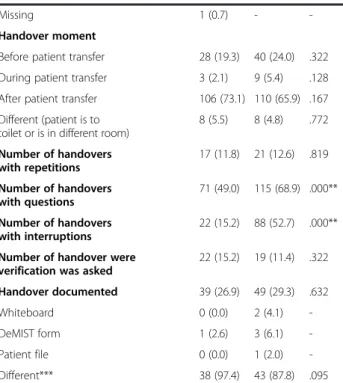
In total, 78/88 (88.6%) professionals followed the e-learning program, of which 70/78 (89.7%) certified for the knowledge test, and 41/70 (52.6%) certified for the simula-tion test also. The professionals spent an average median time on the e-learning program of 75 minutes (Table 4). Table 5 Handover from ambulance to ED (O1)
Variable Pre-test
(n = 145)
Post-test (n = 167)
p-value X2-test
n (%) n (%)
Characteristics
Patient gender .797
Male 75 (51.7) 83 (49.7)
Female 70 (48.3) 73 (43.7)
Missing* 10 (6.0)
Medical specialty .106
Trauma 32 (22.1) 25 (15.0)
Non-trauma 113 (77.9) 142 (85.0)
Urgency
A1 (within 15 minutes) 49 (33.8) 44 (26.3) .152
A2 (within 30 minutes) 81 (55.9) 93 (55.7) .975
B (low urgency/planned) 15 (10.3) 30 (18.0) .056
Primary outcomes
Handover model used
DeMIST 113 (77.9) 122 (73.1) .319
ABCD 0 (0.0) 2 (1.2)
-AMPLE 0 (0.0) 1 (0.6)
-No method/not recognizable 32 (22.1) 42 (25.1) .523
Correct sequence of the DeMIST
Yes 79 (69.9) 86 (70.5) .159
No 34 (30.1) 24 (19.7)
No sequence recognizable within DeMIST
- 12 (9.8)
Secondary outcomes
Receiving team composition at start handover
Physician and nurse 62 (42.8) 68 (40.7) .715
Physician later than start 64 (44.1) 90 (53.9) .035**
Nurse later than start 18 (12.4) 9 (5.4) .055
Physician and nurse too late 1 (0.7) -
-Receivers recognizability
Optic 33 (22.8) 39 (23.4) .901
Verbal 29 (20.0) 49 (29.3) .057
Not recognizable 83 (57,2) 79 (47.3) .080
Handover given by
Ambulance nurse 143 (98.6) 157 (94.0) .035**
Ambulance nurse + ambulance driver
2 (1.4) 10 (6.0)
Receiver handover
ED physician 19 (13.1) 26 (15.6) .553
ED nurse 64 (44.1) 89 (53.3) .120
ED team(minimum: ED nurse + ED physician)
61 (42.1) 52 (31.1) .040**
Table 5 Handover from ambulance to ED (O1)(Continued)
Missing 1 (0.7) -
-Handover moment
Before patient transfer 28 (19.3) 40 (24.0) .322
During patient transfer 3 (2.1) 9 (5.4) .128
After patient transfer 106 (73.1) 110 (65.9) .167
Different (patient is to toilet or is in different room)
8 (5.5) 8 (4.8) .772
Number of handovers with repetitions
17 (11.8) 21 (12.6) .819
Number of handovers with questions
71 (49.0) 115 (68.9) .000**
Number of handovers with interruptions
22 (15.2) 88 (52.7) .000**
Number of handover were verification was asked
22 (15.2) 19 (11.4) .322
Handover documented 39 (26.9) 49 (29.3) .632
Whiteboard 0 (0.0) 2 (4.1)
-DeMIST form 1 (2.6) 3 (6.1)
-Patient file 0 (0.0) 1 (2.0)
-Different*** 38 (97.4) 43 (87.8) .095
*The gender was not registered for 10 patients, this could not be retrieved. **Significant difference.
Handover from ambulance to ED
All observed handovers during the pre-test (n = 145) were included. From the observed post-test handovers (n = 169), two handovers were excluded as these were provided by EMS-students who did not work at the EMS during the intervention period, leaving a total of 167 handovers. There were no significant differences be-tween both study periods regarding patient gender, med-ical specialty or urgency.
Regarding the primary outcome, no significant differ-ence in the number of handovers that were structured with the DeMIST model between the pre-test (77.9%) and the post-test (73.1%) existed (Table 5). In the pre-test, 69.9% of the DeMIST handovers used a correct sequence, in the post-test this was 70.5%. When profes-sionals deviated from the correct sequence during both the pre- and post-test, the most common deviation was to mix or switch the‘S’and‘T’. There was no association between medical specialty (trauma/non-trauma) and the correct sequence (X2= .36, p = .872).
The composition of the receiving team differed after the intervention as less handovers started with presence of an emergency physician. There was no difference in how the receivers made themselves recognizable. During
the post-test, significantly more handovers in which the ambulance driver was involved took place. Between pre-and post-test, there were no significant differences between the moment of the handovers, although the highest number of handovers take place after patient transfer. After the intervention, the number of handover with questions (p = .000) and interruptions (p = .000) sig-nificantly increased, the number of handovers with repe-titions did not differ. The percentage of handover with a verification did not significantly decrease.
Pre-hospital notification
During the pre-hospital notification from ambulance to EMD (N1), no significant difference in the number of handovers that were structured with the DeMIST model between the pre-test (72.9%) and post-test (80.7%) existed (Table 6). In the pre-test, 66.7% of the DeMIST handovers used a correct sequence, in the post-test this was 56.5%. During the pre-hospital notification from EMD to ED (N2), no significant difference in how many handovers were structured with the DeMIST model be-tween the pre-test (83.3%) and post-test (86.5%) existed. In the pre-test, 84.0% of the DeMIST handovers used a correct sequence, in the post-test this was 73.3%.
Discussion
This study evaluated the effectiveness of a tailored e-learning program to improve adherence to a handover guideline in the chain of emergency care. A total of 314 handovers from ambulance to ED were observed and re-sults show no significant differences regarding the usage and correct sequence of the DeMIST model between the pre-test and post-test.
Results from both the pre-test and post-test phase show adherence rates to the DeMIST model ranging from 77.9%-73.1%, and adherence rates for correct se-quence ranging from 69.9%-70.5%. To our knowledge, no studies investigated adherence to an ambulance to ED handover model in real practice, only one study assessed adherence the ISBAR handover model in a sim-ulated setting, reporting an improvement in correct se-quence from 0%-46% after a high-fidelity simulation intervention [25]. Compared to other guideline adher-ence rates in the prehospital and ED setting, adheradher-ence in our study is relatively high [26]. Nevertheless, the re-sults also indicate room for improvement as in 22.1%-25.1% of the handovers no model was recognizable. This might incorporate the risk for loss or deformation of es-sential information. Possibly, this result indicates that professionals might perceive that the DeMIST model does not fit entirely for all patients handed over from ambulance to ED. For instance, one often heard counter argument for the (De)MIST is that it might be less ap-plicable to non-trauma or non-critical patients [13], Table 6 Prehospital notification (N1 + N2)
Pre-test (n = 145)
Post-test (n = 167)
p-value X2-test
n (%) n (%)
EMS to EMD by telephone (N1)
Notification given 70 (48.3) 57 (34.1)
Handover model used
DeMIST 51 (72.9) 46 (80.7) .147
ABCD 1 (1.4) -
-AMPLE 1 (1.4) -
-No method/not recognizable 17 (24.3) 11 (19.3) .500
Correct sequence of the DeMIST
Yes 34 (66.7) 26 (56.5) .304
No 17 (33.3) 20 (43.5)
EMS to ED by telephone (N2)
Notification given 60 (41.4) 52 (31.1)
Handover model used
DeMIST 50 (83.3) 45 (86.5) .149
ABCD 1 (1.7) -
-AMPLE - -
-No method/not recognizable 9 (15.0) 7 (13.5) .817
Correct sequence of the DeMIST
Yes 42 (84.0) 33 (73.3) .203
however our results show no association between trauma or non-trauma and the correct sequence of the DeMIST. On the other hand, one might argue that there are no valid reasons to deviate from a handover guide-line, in contrast to diagnostic or therapeutic guidelines and protocols where deviations on the basis of patient conditions or preferences can be justified.
The e-learning program was not effective in improving and thereby implementing the new guideline, this can be explained by several reasons. The first reason might be the relatively high baseline adherence rates. These high rates can be caused by the (De)MIST integration in basic emergency care education in the Netherlands. Another reason might be the sole use of the e-learning program as the sole use of an educational intervention might not be effective [20]. However, emergency care research shows moderate to good effects of the sole use of e-learning [16-18]. Furthermore, our results might also urge the use of blended-learning were e-learning is com-bined with face-to-face educational meetings [23]. Des-pite these results, the effectiveness of e-learning should be further investigated as it is widely used to educate and train emergency care professionals [23].
A third reason might be that only the handover senders (EMD and ambulance professionals) were trained. During the study period it was not possible to train the ED-staff because they already were in training for the implementation of a digital patient file. A previ-ous study showed that information retention by ED-staff decreased from 56.6% to 49.2% if the handover model is implemented in the ambulance setting only [7]. This stresses the need to implement a handover model in the chain of emergency care.
A fourth reason is the fact that 88.6% of the profes-sionals started the e-learning program and that 52.6% of the starters certified for the whole program. This means that the intervention did not fully reach all intended professionals. The variation around the median time spent on the simulation test reflects the struggle profes-sionals had with certifying for the simulation test, which was due to the accumulation of the result of scenario 1 with scenario 2. This accumulation resulted in a signifi-cant amount of the professionals who had to try several times before certifying for the simulation test which caused the high variation, and in 37.2% of the profes-sionals who only certified for the knowledge test.
Despite relatively high adherence rates for the key-guideline recommendation, our results indicate several areas of improvement for handover from ambulance to ED. Firstly, in 26.9%-29.2% of the handovers transferred information was documented by ED-staff during hand-over. Most information was written down on gloves, napkins, pieces of paper or sheets, which carries the risk that this information is not integrated in medical
records. In our study medical records were not checked for documented information after handover, but previ-ous studies indicate suboptimal documentation of trans-ferred information [9,27].
Secondly, the number of handovers in which verifica-tion was asked by ambulance staff, dropped from 15.2% to 11.4%. A previous simulation study also showed low rates of verification, although these rates increased after simulation exercises [25]. Verification of a handover dicates the end of the handover and might prevent in-terruptions of the handover due to questions asked by ED-staff.
Thirdly, most handovers took place after patient trans-fer in the ED. Handing over a patient during or after transfer, incorporates the risk that ED-staff already starts diagnostic or therapeutic actions that might distract ED-staff from the handover.
Fourthly, in 44.1%-53.9% the complete team was not present at the start of the handover. A previous study re-ported physician absence at 88% of the handovers [28]. Our results might be caused by lower-acuity patients for whom it is less urgent to be seen by a physician. An-other explanation might be that there is no pre-hospital notification given by the ambulance crew to ED, as with 41.4% of the handovers in the pre-test and 31.1% of the handovers in the post-test a verbal notification was given. Another reason can be that the digital pre-hospital notification (N3) arrives too late at the ED sometimes, and the handover already took place.
Strengths and weaknesses
Obviously, the absence of a control group might be a threat to the external validity. Another threat to the val-idity of this study is the Hawthorne effect: the ambu-lance crew and ED personnel could see the observers when they were present at the ED. Furthermore, not all staff participated in the full intervention, which could explain limited effects. Also, it is possible there are other determinants that influence handover which were not integrated in the learning program, making the e-learning program less powerful. Inter-rater reliability between 2 observers was calculated for 10% of the obser-vations, showing a satisfying 91.9% agreement. To in-crease reliability between pre- and post-test, observers of the post-test were trained by observers from the pre-test, but despite this effort slight differences in observa-tions between pre- and post-test might have occurred. Finally, statistical significance may have occurred due to multiple X2-testing, although in the light of the low number of significant tests this did not seem a major issue.
Future research
Future research should focus on the applicability of dif-ferent handover models to structure the handover in the chain of emergency care. Which models are applicable for which settings and patients groups? Also, the add-itional effect of training the receivers of the handover (ED-staff ) should be investigated. Furthermore, the use of multiple strategies or blended learning should be ex-amined for their effectiveness to improve handover prac-tice. Finally, the user satisfaction of e-learning to implement a (handover) guideline can be evaluated.
Conclusion
This pre-test post-test study found no effect of a tailored e-learning program on adherence to a handover guide-line. The results suggest that e-learning alone does not improve adherence. Despite the relatively high baseline adherence, our results indicate room for improvement in the handover process, with regard to documentation of information during the handover, the handover mo-ment, and the completeness of the receiving team at the start of the handover.
Competing interests
Declaration of interest: The authors report no conflicts of interest. The authors alone are responsible for the content and writing of the paper. The developer of the e-learning program had no involvement in study design and interpretation of the data.
Authors’contributions
Study design (RE, PvG, MLM, PA, JdV, RvH, TvA, LV). Data collection and analysis (RE, PvG, MLM, PA, JdV, RvH, TvA, LV). Manuscript preparation (RE, PvG, TvA, LV). All authors read and approved the final manuscript.
Acknowledgements
The authors would like to thank Wim Huijzendveld and Paul Sanders for their role in motivating the professionals to follow the e-learning program. Furthermore, the authors would like to thank all the students from the bachelor nursing and bachelor of health for their support during data collection.
Author details
1Research department acute care, HAN University of Applied Sciences,
Nijmegen, the Netherlands.2Ambulance Service Gelderland Zuid, Veiligheidsregio Gelderland Zuid, Nijmegen, the Netherlands.3Emergency Department, Radboud university medical center, Nijmegen, the Netherlands. 4Centre for Health Services and Nursing Research, KU Leuven, Leuven,
Belgium.5Scientific Institute for Quality of Healthcare, Radboud university medical center, Nijmegen, the Netherlands.6Canisius Wilhelmina Hospital, Nijmegen, the Netherlands.
Received: 27 August 2014 Accepted: 9 April 2015
References
1. Benham-Hutchins MM, Effken JA. Multi-professional patterns and methods of communication during patient handoffs. Int J Med Inf. 2010;79:252–67. 2. Bruce K, Suserud BO. The handover process and triage of ambulance-borne
patients: the experiences of emergency nurses. Nurs Crit Care. 2005;10:201–9. 3. Cheung DS, Kelly JJ, Beach C, Berkeley RP, Bitterman RA, Broida RI, et al.
Improving handoffs in the emergency department. Ann Emerg Med. 2010;55:171–80.
4. Lawrence RH, Tomolo AM, Garlisi AP, Aron DC. Conceptualizing handover strategies at change of shift in the emergency department: A grounded theory study. BMC Health Serv Res. 2008;8:256. doi:10.1186/1472-6963-8-256 5. Jensen SM, Lippert A, Ostergaard D. Handover of patients: a topical review
of ambulance crew to emergency department handover. Acta Anaesthesiol Scand. 2013;57:964–970 10.1111/aas.12125 [doi].
6. Jenkin A, Belson-Mitchell N, Cooper S. Patient handover: time for a change? Accid Emerg Nurs. 2007;15:141–7.
7. Talbot R, Bleetman A. Retention of information by emergency department staff at ambulance handover: do standardised approaches work? Emerg Med J. 2007;24:539–42.
8. Carter AJE, Davis KA, Evans LV, Cone DC. Information loss in emergency medical services handover of trauma patients. Prehosp Emerg Care. 2009;13:280–5.
9. Evans SM, Murray A, Patrick I, Fitzgerald M, Smith S, Andrianopoulos N, et al. Assessing clinical handover between paramedics and the trauma team. Injury. 2010;41:460–4.
10. Bost N, Crilly J, Patterson E, Chaboyer W. Clinical handover of patients arriving by ambulance to a hospital emergency department: a qualitative study. Int Emerg Nurs. 2012;20:133–141 10.1016/j.ienj.2011.10.002; 10.1016/ j.ienj.2011.10.002.
11. Owen C, Hemmings L, Brown T. Lost in translation: maximizing handover effectiveness between paramedics and receiving staff in the emergency department. Emerg Med Australas. 2009;21:102–107 10.1111/j.1742-6723.2009.01168.x; 10.1111/j.1742-6723.2009.01168.x. 12. Thakore S, Morrison W. A survey of the perceived quality of patient
handover by ambulance staff in the resuscitation room. Emerg Med J. 2001;18:293–6.
13. Bost N, Crilly J, Wallis M, Patterson E, Chaboyer W. Clinical handover of patients arriving by ambulance to the emergency department - a literature review. Int Emerg Nurs. 2010;18:210–220 10.1016/j.ienj.2009.11.006; 10.1016/ j.ienj.2009.11.006.
14. Riesenberg LA, Leitzsch J, Little BW. Systematic review of handoff mnemonics literature. Am J Med Qual. 2009;24:196–204 10.1177/ 1062860609332512.
15. Iedema R, Ball C, Daly B, Young J, Green T, Middleton PM, et al. Design and trial of a new ambulance-to-emergency department handover protocol: 'IMIST-AMBO'. BMJ Qual Saf. 2012;21:627–633 10.1136/bmjqs-2011-000766; 10.1136/bmjqs-2011-000766.
17. Smeekens AE, Broekhuijsen-van Henten DM, Sittig JS, Russel IM, ten Cate OT, Turner NM, et al. Successful e-learning programme on the detection of child abuse in emergency departments: a randomised controlled trial. Arch Dis Child. 2011;96:330–334 10.1136/adc.2010.190801.
18. Yeoh BS, Taylor DM, Taylor SE. Education initiative improves the evidence-based use of metoclopramide following morphine administration in the emergency department. Emerg Med Australas. 2009;21:178–183 10.1111/ j.1742-6723.2009.01179.x.
19. Van Achterberg T, Schoonhoven L, Grol R. Nursing implementation science: how evidence-based nursing requires evidence-based implementation. J Nurs Scholarsh. 2008;40:302–10.
20. Grol R, Wensing M, Eccles M. Improving Patient Care. The Implementation of Change in Clinical Practice. Toronto: Elsevier Science; 2005.
21. Holloway I, Wheeler S. Qualitative reseach in nursing. Oxford UK: Blackwell Science ltd; 2004.
22. Grol R, Wensing M. What drives change? Barriers to and incentives for achieving evidence-based practice. Med J Aust. 2004;180:S57–60. 23. Roe D, Carley S, Sherratt C. Potential and limitations of e-learning in
emergency medicine. Emerg Med J. 2010;27:100–104 10.1136/ emj.2008.064915.
24. Faul F, Erdfelder E, Lang AG, Buchner A. G*Power 3: a flexible statistical power analysis program for the social, behavioral, and biomedical sciences. Behav Res Methods. 2007;39:175–91.
25. Dojmi Di Delupis F, Pisanelli P, Di Luccio G, Kennedy M, Tellini S, Nenci N, et al. Communication during handover in the pre-hospital/hospital interface in Italy: from evaluation to implementation of multidisciplinary training through high-fidelity simulation. Intern Emerg Med. 2014 10.1007/s11739-013-1040-9.
26. Ebben RH, Vloet LC, Verhofstad MH, Meijer S, Mintjes-de Groot JA, van Achterberg T. Adherence to guidelines and protocols in the prehospital and emergency care setting: a systematic review. Scand J Trauma Resusc Emerg Med. 2013;21:9-7241-21-9 7241-21-9; 10.1186/1757-7241-21-9.
27. Murray SL, Crouch R, Ainsworth-Smith M. Quality of the handover of patient care: a comparison of pre-Hospital and Emergency Department notes. Int Emerg Nurs. 2012;20:24–27 10.1016/j.ienj.2010.09.004; 10.1016/j. ienj.2010.09.004.
28. Yong G, Dent AW, Weiland TJ. Handover from paramedics: observations and emergency department clinician perceptions. Emerg Med Australas. 2008;20:149–155 10.1111/j.1742-6723.2007.01035.x.
Submit your next manuscript to BioMed Central and take full advantage of:
• Convenient online submission
• Thorough peer review
• No space constraints or color figure charges
• Immediate publication on acceptance
• Inclusion in PubMed, CAS, Scopus and Google Scholar
• Research which is freely available for redistribution