International Journal of Communication Networks and Information Security (IJCNIS) Vol. 5, No. 2, August 2013
Lateral Pre-crash Sensing and Avoidance in
Emotion Enabled Cognitive Agent based
Vehicle-2-Vehicle Communication System
Faisal Riaz
1, Syed Ismail Shah
2, Muhammad Raees
3, Imran Shafi
2, Arslan Iqbal
31
Department of Computing, Iqra University, Islamabad Campus, Islamabad, Pakistan 2Department of Computing and Technology Abasyn University Islamabad Campus, Pakistan 3
Department of Software Engineering, Mirpur University of Science and Technology, AJK, Pakistan
[email protected], [email protected],[email protected],[email protected],[email protected]
Abstract: A novel inter-vehicle communication system based on emotion enabled cognitive (EEC) agent has been anticipated as an intelligent solution to evade the road catastrophe due to hasty decisions by drivers. An input stimulus is processed in human brain using a short route and a long route during any emergency situation. The proposed EEC agent, mounted inside a vehicle, acts like a human brain and is stirred by short route information processing mechanism of human brain in fear condition. The results are acquired for the decisions made by the proposed approach through the EEC agent using short route and human drivers using long route during urgent situations. A pre crash sensing and avoidance algorithm has been proposed as well to mitigate the lateral or side by side collision using EEC agent. Experimental findings reveal that by commencing emotions with cognition, and using formulated L-PCSA algorithm, lateral collisions chances can be sensed and avoided to secure the valued lives of passengers. It has been pragmatic that the new approach is very effectual and useful in shunning the lateral road collisions.
Keywords: Cognitive, collision avoidance, inter- vehicle
communication, Amygdala, Emotions, Fear model
1.
Introduction
To evade a road catastrophe, drivers have very short time to make a quick and precise decision. The intelligent transportation system (ITS) is a vigorous research field aimed to improve driver’s safety and comfort by evading the human confines in decision making [1]. The inter-vehicle communication systems (IVC) is a kind of ITS in which vehicles correspond with each other to exchange information about their locations, road conditions, and traffic jams [2]. Current IVC systems are using audio-video displays in vehicles to help out the drivers in dangerous/emergency situations. These doodads can create a dangerous situation as drivers have to consistently watch them before taking any decision to avoid a road accident and it takes longer time. In this research paper, a smart IVC system using emotion enabled cognitive (EEC) agent has been anticipated which can assist in making nippy decisions by a vehicle itself and does not involve humans during an emergency situation and thus assists in accident avoidance. Muse of this research work is the human brain which is a very complex and a state of the art machine from the perspective of its quick decisions, management and memory capabilities [3]. The term ‘emotion’ has been used to refer mental and physical processes that include aspects of subjective experience, evaluation & appraisal, motivation and body responses such as arousal and facial expression [4]. Aristotle, defined
emotion as “that which leads one’s condition to become so transformed that his judgment is affected and, which is accompanied by pleasure or pain”.
In [5] it has been reported that reasoning; memorizing, learning and decision making are being affected by emotions. An essential role of emotions in working of the mind was analyzed by Perlovsky [6]. Human brain can process information using two routes, primary route and secondary route [7], [8]. Primary route (also known as short route) activates once fear or danger is felt and reacts in short span of time to input stimuli. Whereas secondary route involves consciousness and consult episodic memory, so takes longer time to process information. In this research work using 2*2*2 choice reaction experiment [9] human reaction time and EEC agent reaction time in case of emergency situations has been computed. The total time computed via long route needed by human driver from perception to final action is 5.678 seconds, whereas short route followed by EEC agent from sensors information to autopilot action (safety maneuver) is taking 0.308 seconds. It can be seen obviously that human driver will take 5.37 seconds more as compared to the EEC agent to evade accident. Hence human driver have more chances of collisions.
section 7. Pre-crash Sensing and Avoidance for lateral collision using EEC Agenthas been devised in the section 8. Test results of L-PCSA are using c-sharp simulator are shown in section 9.The paper is concluded in section 10.
2.
Different types of cognitive agents &
importance of emotions
In [11], there are four conventional agent architectures have been elucidated. First one is logic based agents in which decision making is made after processing the facts mathematically. Second agent architecture is reactive agents and they need sufficient information related to their local surroundings to perform an appropriate action. The third one agent architecture is known as layered architecture performs their critical functions using layered framework. The fourth one agent is the trendiest one known as BDI architecture which employs the human’s realistic reasoning process [12]. The main problems with this architecture are how to efficiently implement the various functions and how to accomplish the balance between being committed to and over-committed to one’s intention. Currently BDI architecture ignores the influence of emotions in decision making [11].
Incorporating emotions into agents has been reported in [13], a functional role played by emotions has been observed in the behaviors of humans and animals. In the development of complex social system of animal and humans, a key role of emotions has been observed [13].
The effects of emotions in the behavior of agents have been tested in woggles of oz-world, where happiness improves the efficiency of agent and sadness decreases the performance of agent [14]. It has been reported in [15] that long term goals of agents are affected by emotions. In [16], it has been evaluated that agents act like human beings by using emotions to perform complete tasks by giving punishment to their enemy agents and rewarding their companion agents. From the above description, it can be deduced that to build more human like agents incorporating emotions with cognitive structure of agents is necessary. Importance of emotions has been revealed in a research report [17], that human being having relatively minor emotional impairments have less good capability to do beneficial decisions, as compared to the healthy minded person with full of emotions.
Dyer develops a comprehensive lexicon of emotional states based on goal success and failure, since the goal success or failure can affect emotional states. Frijda and Swage man postulates emotions as processes that safeguard long term persistent goals or concerns of the agents, such as survival, a desire for stimulation or a wish to avoid cold and damp[11].Thus, if we have desire to build agents that behave like humans, we must incorporate emotions into our design. Emotions can serve as an efficient way to prioritize an agent’s multiple goals. In this way they can reduce the computational load of rational agent.
3.
Existing IVC Systems and their limitations
The Technologies used so far for IVC are GSM/GPRS, CDMA, Wi-Max, LTE, and Wi-Fi [18] There is a CDMA based IVC system called multi carrier multi-code spread aloha (MMSA) [19]. Broadband wireless access for users onthe road and IVC based on Wi-Fi is also under consideration [20]. In all existing IVC systems, drivers depend on audio and (or) video displays installed in their vehicles which graphically inform them about possible dangers.
The drivers have many things to manage, like speed, other vehicles position awareness and obstacles. There is a need of quick response from driver in case of possibility of any road accident. It has been noticed that in video based IVCs, drivers have to pay attention towards video displays which can create a dangerous situation itself, whereas audio based IVCs are little better in comfort, by using special 3D sound effects [21]. However, a driver has to first take input from these audio/video based systems and then take decision in both types of systems. To find out the problems facing by drivers with current audio/video displays mounted inside the vehicles, a practical road experiments has been performed. For this purpose a Wi-Fi based IVC system was deployed on a main Kotli road of Mirpur city. A peer to peer paradigm was developed using C# .Net platform. The whole topology as shown in Fig.1 consist of two laptops installed with IVC software, IEEE 802.11g wireless access point and currently available in market highest resolution 16 megapixel camera. In Fig.2 and Fig.3 it can be seen clearly that in daylight even a highest resolution cameras are failed to give the clear view of traffic flow or any road hazard.
Drivers have to serve more time on video displays to understand the possibility of any dangerous situation. These on road experiments of audio/video based IVC system proved that, there is a need of some sort of new solution which relaxes the drivers from paying their attention on these gadgets and help them to achieve secure and comfortable driving.
4.
Human
being
accident
encounter
&
avoidance cycle
International Journal of Communication Networks and Information Security (IJCNIS) Vol. 5, No. 2, August 2013
5.
Proposed Solution
In this paper, an efficient and intelligent IVC system using an emotion enabled cognitive (EEC) agent has been proposed as a solution to avoid road accidents which may result due to hasty decisions by drivers. The proposed EEC agent possesses human like ability to react in sudden danger and is proposed to be installed inside vehicle in assistance with autopilot. According to the best categorized emotion model Orton, Collins (OCC), human beings have 22 emotions [22]. Among these twenty two emotions, “fear” is the main concern.
The proposed EEC based IVC model is based on this natural gifted capability of human brain’s sudden reaction against sudden threat. The literature on neuro-imaging indicates that some or more parts of human brain are responsible for emotions processing. One of these is an almond- shaped structure known as Amygdala [23]-[26]. Information can be processed by human brain in two branches after receiving input stimuli, primary route and secondary route. In primary route information is directly passed by sensory thalamus to Amygdala from where action against stimuli is taken. Whereas in long route of information processing, information is passed from sensory thalamus to primary sensory cortex, uni-modal association cortex, poly-modal association cortex, hippocampus and finally to Amygdala from where final action is passed to motor area of brain [8]. Primary route is faster than secondary route [8]. We have used this primary route approach to make a smarter emotions enabled cognitive agent. The details of EEC agents are discussed in next section.
6.
Emotion enabled cognitive agent
The proposed EEC agent has six major modules as indicated in its architecture highlighted in Fig.5. The proposed architecture is designed after detailed study of human brain, its cognition abilities and relation of emotions with cognition [6]. First the Input Stimuli (sensors data (distance between cars)) are received by the Sensory Module. Function of Sensory unit is to initiate coding process. In the field of physiology term coding refers to the conversion of Stimulus energy into a signal that conveys the relevant Sensory information into the central nervous system [5]. After receiving signal from Sensory unit, afferent neurons of hypothalamus act accordingly, here important characteristic of Stimulus is the intensity of signal. Two levels of threshold have been defined to control functionality of EEC agent. Pre- threshold ThP (50 Hz) and final-threshold ThF (75 Hz). Human brain consists of millions of neurons responsible for information relay but from simplicity point of view only two neurons named thalamus neuron NH and Amygdala neuron NA have been supposed for the EEC agent. The type of NA is Intercalated (ITC) Amygdala neuron. ITC regulates fear expression by controlling impulse traffic between the input (Basolateral Amygdala; BLA) and output (central nucleus; Ce) stations of the Amygdala for conditional fear responses [27]. Depending on the sensor’s information of distance between vehicles, frequency of signal varies. Initial frequency has been set to 10 Hz. On receiving sensor’s information, Sensory Module of EEC agent performs coding process, and converts sensors information into signal. The graded potential of NH varies according to the intensity of
signal from Sensory unit. Intensity of signal is directly proportional to the value of graded potential which in turn is directly proportional to the action potential. Higher the graded potential of NH in results higher the graded potential of NA.
The frequency of signal is passed to the thalamus neuron NH, which takes it as its initial value for graded potential. As the intensity of received signal increases (depending on the decreasing distance between vehicles), the value of graded potential increases. On encountering pre threshold value (50 Hz) graded potential activates action potential of NH, which in turn initiates the graded potential of NA. NA set its graded potential 50 Hz and activates the Auto-Pilot Module. On receiving the ThP (50 Hz) Amygdala initiates Motor Module, which uses its GPS module to gather the statistics of road. At the back end, the Thalamus Module continuously accumulates the input from Sensory Module. As the graded potential of NH reaches 75 Hz, the action potential of NH initiates and sets the value of graded potential of NA 75 Hz, which is the final threshold value for fear generation. The Auto-Pilot takes sudden action on the basis of pre-gathered statistics of road. We have included GPS module for the assistance of Auto-Pilot Module in our EEC agent architecture. Short term memory (STM) of Auto-Pilot Module contains most current GPS information about road. For most suitable and fast action, concept of a stack has been employed.
According to the geography of road, and communication between other EEC_Agents of intact vehicles, actions like sudden break, sudden turn on left side, or sudden turn on right hand side are stored in stack. The top (pointer) of stack indicates the most suitable action and Auto-Pilot simply executes the top of stack. In the end the fear memory of current event is stored in Emotion Memory for future decisions.
7.
Simulation results and discussion
To test the validity of the proposed approach and the idea of long and short route, the simulation environment has been designed using C# on .NET framework. Following factors are taken into account for the simulation of long route.
7.1 Communication time between sensors
This factor is tested for the bad communication channel as well as for the normal communication channel. The values assigned are 10ms and 7ms for the specified channels. After a survey about “how much time does a driver need to read a video display with different attention levels” we have observed the amount of time needed for this purpose is average 5 seconds. The total response time (RT) of an average human is then computed from the experiment known as 2*2*2 choice reaction experiment [9]. These experiments are based on different sub factors which are used in simulation. These sub factors are described in Table-1.
seconds. This indicates that the EEC agent can act much faster as compared to the human driver by using short route method.
Various tests have been conducted and their results using different factors and sub factors involved in long route and short route have been shown in Table-2. Fig.6 shows that there is a time difference of 5.37 seconds between the
decision made by human driver and the proposed approach using EEC agent during dangerous situation. In the comparison graph we have used different colors to show time taken by different factors and sub factors in long and short route decision to avoid accidents. A constant value of 5 sec is added as an additional overhead with NA as discussed earlier in text.
Table 1. Sub Factors Description
8.
Pre-crash Sensing and Avoidance for
lateral collision using EEC Agent
According to [28] by pre-crash sensing we have an additional time that is available to perform suitable safety manoeuvres. Many research papers related to the pre-crash sensing systems has been published so far.In [29] researchers have proposed crash avoidance system using embedded system. The system consist of ultrasonic distance measuring sensor , which measures the distance between vehicles and feed the results to the microcontroller, which in turn reacts according to the different situations, i.e. decelerating the speed or applying the brake. These researchers have tested their proposed system for rare and front end collision, but the lateral or side by side collision cases have been ignored.
The name of this system is Honda's Collision Mitigation Brake System (CMS). CMS is fully automated and can apply the brakes without waiting any reaction from driver and can apply brakes automatically on sensing any about to crash situation. The drawback of system is it can counter only rear end collisions. The pre crash sensing and avoidance systems discussed so far are considering 2 to 2.5 seconds as human reaction time and also not considering the lateral collision cases. We have proposed our lateral collision sensing and avoidance algorithm, which is considering short route as a reaction time to perform a suitable accident avoidance maneuver.
Table 2. Response time: Long route VS. short route
T
es
t
Steps R
es p o n se T im e ( S -m s) C o m T im e b et w ee n s en so rs NA (ms) SQ (ms) R ep et it io n T im e ( m s) A m y g d a la P ro je ct io n T im e ( m s) D ec is io n T im e ( m s) A ct io n T im e (m s) SR LR SR LR SR LR SR LR SR LR 10 10 10 10 7 7 7 7 7 7 0 2 0 8 0 8 0 8 0 8 0 300 0 300 0 300 0 425 0 425 0 1 0 1 0 1 0 2 0 2 100 100 100 100 100 100 100 100 100 100 100 100 100 100 100 100 100 100 100 100 100 100 100 100 100 100 100 100 100 100 00.310 05.611 00.310 05.625 00.307 05.638 00.307 05.734 00.307 05.784
LONG ROOT Mean 05.678
SHORT ROOT Mean 00.308
NA No of Numerals to understand in Video display, here we check this sub factor on 2 and 8
values
SQ Quality of Stimulus, Here we test quality of video display on >=95 % and >=75 %.
REPEATING TIME Repeating time is different for familiar stimuli and unfamiliar stimuli. For familiar stimuli, we fix the value to be 1*RT where as for unfamiliar we set value to be 2*RT.
International Journal of Communication Networks and Information Security (IJCNIS) Vol. 5, No. 2, August 2013 We have supposed that there are two vehicles bullet
vehicle BV and target vehicle TV, which are traveling side
by side with different speeds. The proposed pre-crash sensing and avoidance (PCSA) algorithm consist of following steps.
1. Measure the current position (latitude and longitude) of target and bullet vehicle.
2. Compute the tire side slip angle of bullet vehicle. 3. Measure the velocities vt (target vehicle) and vb (bullet
vehicle)
4. Using above steps compute the time to collision (TTC). 5. Using less reaction time of EEC adopt the road
accident evading strategy (Automatic brake or/and sudden turn on left side or/and turn on right/side or/and speed declaration).
The working of PCSA algorithm in case of EEC agent during lateral collision scenario has been illustrated in Fig.7, two vehicles: target vehicle (TV) and Bullet vehicle
(BV) are considered. It can be seen that BV (long truck)
has changed its straight path of motion and change its lateral position towards a small four wheel vehicle. To compute the current (latitude, longitude) of target and bullet vehicle on-board unit(OBU) has been considered to be deployed in both BV and TV.OBU consist of Garmin
legend eTrex single antenna GPS unit and computer. As seen in Fig.7, the sideslip (β) of the BV is the
difference between the velocity heading and the true heading of the vehicle. The yaw rate is the angular velocity of the BV about the center of gravity.
The equations (1.1) to (1.4) are the computations of sideslip angle of bullet vehicle and has been described in [33] for all four tires of BV.
tan
(1.1)
tan
(1.2)
tan !
(1.3)
tan
(1.4)
Where
V is velocity of vehicle
r is the angular velocity about the center of gravity
β is the direct estimate of the sideslip
t is width of track and δ steer angle at the wheel
δ can be calculated with the help of following equation (2.0) and it is taken from [34]
δ"#$ %&'.)*)+.# (2.0)
Where L is Length of Vehicle and R is cornering radius Kus is called under steer co-efficient using equation (2.1).
%&' ./-,-./0,0 (2.1)
12 3 * 4 *5 ! (2.1.1)
1 3 * 4 *5 (2.1.2)
The velocities Vt and Vb can be computed using single
antenna GPS. In Fig.7on board unit (OBU) helps EEC agents to compute the time to avoidance (TTA) and time to collision (TTC). TTA is the time in which after pre-crash sensing a vehicle can perform any saving maneuver to avoid accident. Whereas TTC is the total time which gives information that after how much time bullet vehicle and target vehicle will get collision. OBU installed on BV
and TV exchange their current (long, lat) and velocities
randomly. The EEC agent of BV calculates its front tire
sideslip angle . OBU of BV calculates the TTC by
predicting that when the incoming (long, lat) of BV will be
near or equal to the incoming (long, lat) of TV as shown in
Fig.7. There is a threshold point also known as TTA. Using fast reaction time of EEC agent BV can perform any
safety maneuver.
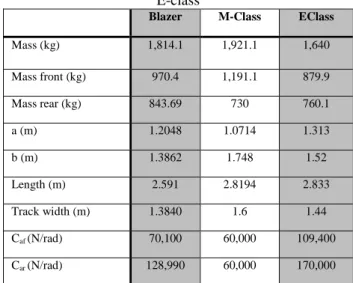
Table 3. Vehicle parameters for the blazer, M-class and
E-class
Blazer M-Class EClass
Mass (kg) 1,814.1 1,921.1 1,640
Mass front (kg) 970.4 1,191.1 879.9
Mass rear (kg) 843.69 730 760.1
a (m) 1.2048 1.0714 1.313
b (m) 1.3862 1.748 1.52
Length (m) 2.591 2.8194 2.833
Track width (m) 1.3840 1.6 1.44
Caf (N/rad) 70,100 60,000 109,400
Car (N/rad) 128,990 60,000 170,000
We calculate vehicle initial positions; distance is calculated using distance formula using equation (2.2)
6 781 82;$ <1 <2; (2.2)
Vehicle path can be calculated using slope line equation y = mx + c; and slope as, m = tan (α)
Point of intersection shown in Fig.8 can be found by equations 2.3 and 2.4. In Fig.8 we have predicited vehicles future positions using the straight line equation, in this way we can conclude a possible future path on every calculation that is one of the scenarios to obtain future position of vehicles. Our tests are formally based on straight equation y=mx + c.
=> @@;?;? (2.3) =A 3=> $ B1 (2.4)
either brake or turn out of the way before an impact occurs.
The first avoidance alternative considered is vehicle turning. The simplified test algorithm neglects vehicle stability by assuming a turn angle of 90°. While other turn angles may be more efficient, this assumption provides a simple standard for the purposes of crash prediction. Therefore, the worst case scenario is when the target is coming straight down the y-axis. In this case the vehicle can maximize the x-intercept distance by turning 90°. Using the speed and turning radius of the vehicle, the time it takes to complete a 90° turn is calculated as by equation (2.5)
CD&E FGH*IJKL
M (2.5)
The total lateral displacement possible in TTC seconds in this case using equation (2.5.1) is
81 ND&E $ CCO CD&E * P (2.5.1) If Tturn is greater than TTC, the algorithm calculates how
much of the turn is possible before the target reaches the x-axis. The distance that the vehicle can travel in this time is calculated by eq. (2.6)
Q CCO * P (2.6)
Collision Chances: “YES” a collision will occur if current trajectories continue. “No” otherwise.
Time to Collision (TTC): Predicted time to impact in seconds.
Time to Avoidance (TTA): Time in which a bullet vehicle can perform an action to avoid accident.
Collision Level: “RED” if the vehicle and the target are on a collision course and it is determined that it is not possible to avoid the collision by turning or braking, “YELLOW” if there if the vehicle and the target are on a collision course and it is determined that it is possible to avoid the collision by turning or braking, “GREEN” is safe for near future.
9.
Simulation Results for L-PCSA using
EEC Agent and human driver reaction
time
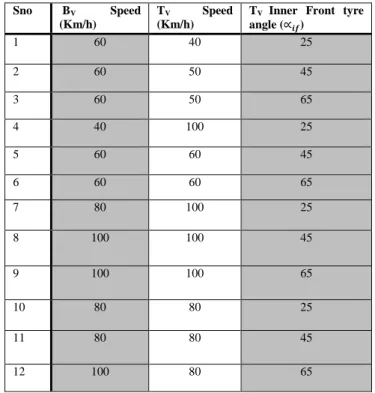
Several test cases of real life lateral collisions have been designed and tested in a specially developed simulator. Total 12 lateral collision scenarios with real life data have been simulated. The main parameters of the simulation are given in table-4 and table-5. The test case 1 (no collision scenario) is shown in Fig.9 in which BV is
traveling with the speed of 60 km/h and TV is moving
with the speed of 40 km/h. BV With RST 25is predicting
a safe scenario.The whole simulation for test case 1 works as. BV is moving on lane1 and TV is moving on lane2. In
this test case it has been supposed that driver of BV
suddenly changes its lane due to any of the following reason like lane changing, or drowsiness or due to tire blast. The simulator calculates the distance between both vehicles and then using equations 1.0 to 2.5 calculates the time to collision (TTC) and time to avoidance (TTA). From multi tests with RST 25 collision chances are very
less as compare to the other angle RST 45andRST 65. The test case 2 (possible collision scenario) is shown in Fig.10 in which BV is traveling with the speed of 60 km/h
and TV is moving with the speed of 50 km/h .BV With
RST X5 is predicting a possible lateral collision scenario.The whole simulation for test case 2 works as. BV is moving on lane1 and TV is moving on lane2. In this
test case it has been supposed that driver of BV suddenly
changes its lane due to any of the following reason like lane changing, or drowsiness or due to tire blast. The collision level presented with yellow color is showing possible collision. The simulator calculates the distance between both vehicles and then using equations 1.0 to 2.5 calculates the time to collision (TTC) and time to avoidance (TTA). TTC in this case is 1.99 seconds and TTA is 1.04 seconds. Human driver needs 5. 678 seconds to avoid this accident using audio/video based emergency alerts, which is not possible in this case. Using short reaction time of our EEC agent which is 0.308 seconds, the possible collision can be avoided.
Table 4. 12 test cases of BV and TV with different speeds
and
R
YZSno BV Speed
(Km/h)
TV Speed
(Km/h)
TV Inner Front tyre
angle (RST)
1 60 40 25
2 60 50 45
3 60 50 65
4 40 100 25
5 60 60 45
6 60 60 65
7 80 100 25
8 100 100 45
9 100 100 65
10 80 80 25
11 80 80 45
12 100 80 65
The test case 12 (possible collision scenario) is shown in Fig.11in which BV is traveling with the speed of 100
km/h and TV is moving with the speed of 80 km/h .BV
With RST [5is predicting a possible lateral collision scenario.The whole simulation for test case 12 works as. BV is moving on lane1 and TV is moving on lane2. In this
test case it has been supposed that driver of BV suddenly
International Journal of Communication Networks and Information Security (IJCNIS) Vol. 5, No. 2, August 2013 TTA is 0.310 seconds. Human driver needs 5. 678
seconds to avoid this accident using audio/video based emergency alerts, which is not possible in this case. Using short reaction time of our EEC agent which is 0.308 seconds, the possible collision can be avoided. Here it can
be seen that performing a safety maneuver by BV is a
tough task because TTA and reaction time of EEC gent are very close. The results of remaining tests along with different BV , TV speeds along with different RSTand
corresponding TTA and TTC are given in table-5.
Table 5. Test results for vehicle moving at different speeds and angle of turn
Test no
Distance Between Vehicles
(m)
Vehicle Speed (km/h)
Target Speed (km/h)
Bullet Vehicle Angle of Turn
(RST)
TTA (sec)
TTC (sec)
Human Reaction (sec)
EEC Agent (sec)
1 56.03 60 40 25 - - 5.678 0.308
2 33.13 60 50 45 1.045 1.988 5.678 0.308
3 13.92 60 50 65 0.678 1.621 5.678 0.308
4 26.62 40 100 25 - - 5.678 0.308
5 27.45 60 60 45 0.705 1.647 5.678 0.308
6 23.53 60 60 65 0.469 1.412 5.678 0.308
7 35.22 80 100 25 0.878 1.58 5.678 0.308
8 30.41 100 100 45 0.529 1.094 5.678 0.308
9 29.42 100 100 65 0.493 1.059 5.678 0.308
10 65.30 80 80 25 - - 5.678 0.308
11 33.37 80 80 45 0.795 1.50 5.678 0.308
12 24.33 100 80 65 0.310 0.875 5.678 0.308
A comparison bar chart shown in Fig.12 has been generated on table 5. TTC parameter values are represented with blue color, TTA parameter values with red, EEC agent reaction time with green and human reaction time with purple one. From the bar chart it can be seen obviously that most of the values of TTA parameter are less than 1 and using EEC agent reaction time, vehicle can perform accident avoidance maneuver successfully as compare to the human reaction time, which takes longer time for accident avoidance decision.
10.
Conclusion
A novel intelligent solution for enhancing road safety in form of an IVC system based on EEC is proposed in this work. The simulation results indicate that availability of an EEC agent ensures quick actions as compared to the human drivers without such facility. In this way, the capabilities of current IVC systems are enhanced which may result in reduction of road accidents.
References
[1] ZuzanaItavancová, Martin Hájek. “Intelligent transport systems: thematic research summary”. Internet, www.transportresearch, April. 2, 2009 [3rd march, 2011]
[2] Jung, Jaeyoung, Chen, Rex, “An Empirical Study Of Inter Vehicle Communication Performance Using
Ns-2,” [On-line]. Available:
http://ideas.repec.org/p/cdl/uctcwp/1602020.html [Feb 26, 2011], August 2010
[3] Murray Shanahan, “Consciousness, Emotion, and Imagination A Brain-Inspired Architecture for Cognitive Robotics” in Proc. AISB 2005 Workshop: “Next Generation Approaches to Machine Consciousness”, pp. 26–35.
[4] Edwards E. Smith and Stepehen M. k, “Emotion and Cognition” in Cognitive Psychology, 1st ed. Asoke K. Ghosh, New Delhi: PHI Learning, 2009, pp.325-363
[5] Eric P.Widmaier and Hershel Raff. , “Sensory Physiology” in Textbook of Physiology, 10th ed. Yan Jianqun, McGrawHill, 2006, pp.279-282.
[6] Leonid I. Perlovsky (2005, November), “Toward physics of the mind Concepts, emotions, consciousness, and symbols” ELSEVIER [On- line] Physics of Life Reviews 3 23-55. Available: www.sciencedirect.com [July.10, 2011]
[7] Faghihi, U., Nkambou, R, Poirier, P., & Fournier-Viger, “Emotional Learning and a Combined Centralist-Peripheralist Based Architecture for a More Efficient Cognitive Agent”, in Proc. 7th IEEE International Conference on Industrial Technology, 2009, pp. 45-51
[8] “The Amygdala and its Allies” Internet: http://thebrain.mcgill.ca/flash/i/i_04/i_04_cr/i_04_cr_ peu/i_04_cr_peu.html#2 [Aug. 23, 2011].
[9] Saul Sternberg, “Reaction-Time Experimentation”, available: http://www.psych.upenn.edu/~saul/ [Aug.20, 2011].
[10]Ron Pack, Jonathan Koopmann,HailingYu,Wassim G.
Najm “PRE-CRASH SENSING
COUNTERMEASURES AND BENEFITS ”, Volpe National Transportation Systems Centre United States Paper Number 05-0202
[11] Hong Jiang, Jose M. Vidal and Michael N.” EBDI: an architecture for emotional agents,” in proc. AAMAS '07 Proceedings of the 6th international joint conference on Autonomous agents and multiagent systems,2007.
[12] M. E. Bratman. Intention, Plans, and Practical Reason. Harvard UniversityPress, Cambridge, MA, 1987.
[13]M. Toda, editor. Man, Robot and Society. Martinus Nijh off Publishing, Boston, MA, 1982.
[14]J. Bates. The role of emotion in believable agents. Communications of theACM, 37(7):122–125, 1997. [15]N. Frijda and J. Swagerman. Can computers feel?
theory and design of anemotional system. Cognition and Emotion, 1(3):235–257, 1987.
[16]C. F. Camerer, G. Loewenstein, and M. Rabin, editors. Advances in Behavioural Economics. Princeton University Press, Princeton, NJ, 2003. [17]A. R. Damasio. Descartes’ Error : Emotion, Reason,
and the Human Brain. Avon Books, New York, 1994. [18]Y. Khaleda, M. Tsukadaa, J. Santab, J. Choia, and T.
Ernst, "A Usage Oriented Analysis of Vehicular Networks: From Technologies to Applications," Journal of Communications, Academy Publisher, vol. 4, no. 5, pp. 357-368, June 2009.
[19]O. Shagdar, T. Ohyama, M. N. Shirazi, S. Tang, R. Suzuki, R. Miura (2009, October). “Message Dissemination in Inter-Vehicle CDMA Networks for Safety Driving Support”,[Online] Available: http://202.194.20.8/proc/VTC09Spring/DATA/08-03- 01.PDF [Jan.3, 2011]
[20]Y F Ko, M L Sim and M Nekovee (2006, April). “Wi-Fi based broadband wireless access for users on the road”. BT Technology Journal [On-line] Volume
24 Issue 2 Available:
http://portal.acm.org/citation.cfm?id=1145493 [March.21, 2011].
[21]Francesco Bellotti, Riccardo Berta, Alessandro De Gloria and MassimilianoMargarone, (2011, March). “Using 3D Sound to Improve the Effectiveness of the Advanced Driver Assistance Systems”, SpringerLink [On-Line].Vol 6, number 3, pp.155-163. Available: www.springerlink.com/content/g7yyeweu665wvgth [Sep.6, 2011]
[22]Carole Adam, Andreas Herzig, Dominique Longin, “A Logical Formalization of The OCC Theory of Emotions”. In Synthese: Vol. 168, pp. 201-248, 2009.
[23]Bechara A, Damasio H, Damasio AR, “Role of the Amygdala in decision making. Ann. N Y Acadscie, pp.985-356, Apr. 2003.
[24]J. E. LeDoux, "Emotion circuits in the brain," Annu. Rev. Neurosci. Vol 23, pp. 155–184, 2000.
[25]Elizabeth A Phelps. “Human Emotion and Memory Interaction of the Amygdala and Hypocampal Complex”. ELSEVIER Current Opinion in Neurobiology vol. 23, pp. 198-202, 2004.
[26]Sah P, Faber ES, Lopez De Armentia M, power J “The amygdaloid complex: anatomy and physiology”. Psysiol Rev 803-834, July.2003.
[27]Guoshi Li, Taiju Amano, Denis Pare. (2011, March) “Impact of infralimbic inputs on intercalated Amygdala neurons: A biophysical modeling study”. Learn. Mem. [On-line]. Vol 18, pp. 226-240. Available: www.ncbi.nlm.nih.gov/pubmed/21436395 [Sept. 2, 2011]
[28]Knoll, P., B.J. Schaefer, H. Guettler, M. Bunse, R. Kallenbach (2004). “Predictive safety systems – steps towards collision mitigation.” SAE World Congress, Detroit, USA.
[29]Rajarajan.R1 , Abdul Rahuman.S2, Harish Bharath.M.A,” A Design & Implementation of Collision Avoidance System (CAS) for Automobiles using Embedded System” in the proceedings of 2011 International Conference on Circuits, System and Simulation IPCSIT vol.7 2011 Singapore, pp. 295-298.
[30] S. Tokoro, K. Kuroda, T. Nagao, T. Kawasaki and T. Yamamoto, “Pre-crash sensor for precrash safety”. The 18th International Technical Conference on the Enhanced Safety of Vehicles (ESV) Proceedings, Paper Number 545, Nagoya, Japan, May 19-22, 2003. [31]K. Fujita, H. Fujinami, K. Moriizumi, T. Enomoto, R.
Kachu, and H. Kato, “Development of pre-crash safety system”. The 18th ESV International Technical Conference Proceedings, Paper Number 544, Nagoya, Japan, May 19-22, 2003.
[32]Http://world.honda.com/news/2004/4040513.ht ml,
May 13, 2004.
Http://www.honda.com.au/discover+honda/press+off ice/press+releases/honda+develops+new+collision+a voidance+safety+system.htm, May 23, 2003. [33]R. A. Anderson. “Using GPS for Model Based
Estimation of Critical Vehicles States and Parameters”, M.S. thesis Auburn University Alabana USA. 2004.
International Journal of Communication Networks and Information Security (IJCNIS) Vol. 5, No. 2, August 2013
Fig.1. Wi-Fi Based IVC Arrangement.
Fig.4.
Fig.3. None- cleared client side video display.
International Journal of Communication Networks and Information Security (IJCNIS) Vol. 5, No. 2, August 2013
Fig.5. Emotions Enabled Cognitive Agent Architecture
Fig.6.Long Route vs. Short Route time difference during dangerous situation
0 100 200 300 400 500 600 700 800
Short Route
Long Route
Communication Time
NA
SQ
Repeatition Time
Amygdala Projection
Decision Time
Fig.7. Bv and Tv moving towards same point
International Journal of Communication Networks and Information Security (IJCNIS) Vol. 5, No. 2, August 2013
Fig.9. Safe Scenario
Fig.11. Possible Collision and Avoidance Scenario 12 using EEC agent reaction time
Fig.12. Comparison of Human Reaction Time with EEC agent Reaction time to encounter TTA Parameter
0 1 2 3 4 5 6
1 2 3 4 5 6 7 8 9 10 11 12