Perspectives
Anecdotal, Historical and Critical Commentaries on Genetics
Edited by James F. Crow and William F. Dove
But See K
ITANI
(1978)
Franklin W. Stahl
1and Henriette M. Foss
Institute of Molecular Biology, University of Oregon, Eugene, Oregon 97403-1229
I
N 1974, two articles regarding meiotic recombination in fungi were submitted for publication: one to the proceedings of a meeting held in Gatlinburg, Tennessee (Mortimer and Fogel 1974), and the other, whichremained unpublished for 4 years, to Genetics(Kitani
1978). The two articles dealt with relationships among gene conversion, crossing over, and crossover interfer-ence, and they appeared to flatly contradict each other. Mortimer and Fogel claimed that crossovers accompa-nied by conversion interfered with additional, nearby crossing over; Kitani claimed that such crossovers did not interfere.
Mortimerand Fogel’s (1974) article was based on
data from theARG4andHIS1loci of yeast (Saccharomyces cerevisiae); Kitani’s was based on data from theglocus of
Sordaria fimicola. Was one of them wrong, or is recombi-nation in Sordaria truly so different from that in yeast? And why did it take 4 years to move Kitani’s article through the Geneticseditorial process?
SOME BACKGROUND
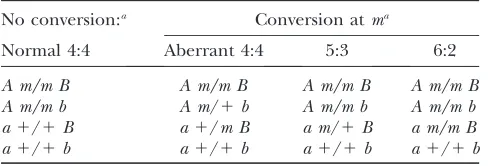
The 1960s and 1970s featured efforts to understand recombination at the Watson–Crick level. The fungi, with their meiotic tetrads, played a central role in these efforts. They provided the key observation that ‘‘gene conversion’’—defined in this review to mean 5:3, 6:2, or aberrant 4:4 segregation of markers (Table 1)—was often (about half the time) accompanied by crossing over of closely linked markers bracketing the converted site. Moreover, crossovers for closely linked markers frequently manifested conversion for a marker lying between them. This strong association between
conver-sion and crossing over inspired models that described these processes as consequences of a single event that could, but need not, lead to crossing over and could, but need not, lead to conversion. Some simple arithmetic based on data from yeast (Fogelet al. 1971) encouraged
the assumption that all crossing over would be accom-panied by conversion, if there were markers present to reveal it. Thus, since crossing over scored without regard to conversion is characterized by interference in Sorda-ria (Perkinset al. 1963) as well as in yeast (e.g., Fogeland
Mortimer1971), crossing over that accompanies
con-version was expected to similarly interfere with neigh-boring crossovers. In fact, Stadler(1959) had earlier
presented evidence from Neurospora supporting that position, as had Fogeland Mortimer(1971) for yeast.
Clearly, Kitani(1978) was swimming against a heavy
tide when, first, he presented data showing that, in Sordaria at least, conversion and interference were mutually exclusive and then explained his observation with the hypothesis that interfering crossovers occur only where there are no markers,i.e., in spaces between genes. Developments reported in this issue of Genetics
by Getz et al. (2008) make that interpretation
un-tenable, but they reveal that Kitani was right when he proposed (1) that meiotic recombination probably occurs at two different stages (or phases, in the language of Getzet al.2008), (2) that crossovers in the two stages
of recombination have different relationships to gene conversion, (3) that crossovers in one stage do not positively interfere with those in the other, and (4) that the wide variation among organisms in their reported interference indices probably represents varying pro-portions of the two stages of crossing over.
WHY DID IT TAKE 4 YEARS?
Documents relating to the publication of Kitani
(1978), kindly supplied by Kitani, provide support for each of several possibilities for the delay in publication.
This article is dedicated to the memory of David Perkins and Dorothy Newmeyer Perkins, whose own perspectives were broad, intelligent, and generous.
1Corresponding author:Institute of Molecular Biology, Onyx Room 287,
University of Oregon, Eugene, OR 97403-1229. E-mail: [email protected]
More experiments were needed:The first version of the manuscript reported convincing evidence that con-version crossovers (in Sordaria) lacked interference. How-ever, the editor (a Neurospora geneticist) agreed with the referees that Kitani needed better evidence that ‘‘ordinary’’ crossovers in Sordaria did have interference. Kitani promptly collected control data and found that crossovers selected for being nonconversions showed robust interference.
The manuscript was unclear:Two editors (the second being a yeast geneticist) and several referees declared the writing to be poor and the arguments unclear. The author and editors did a lot of rewriting for clarification.
One editor was slow: A turnaround interval of 6 months was too long, even by the standards of Genetics.
The editor put the blame, in part, on the ‘‘complexities of the manuscript.’’ The issues dealt with by Kitaniare
complex, and the field was (and still is) burdened with inconsistent, model-dependent, and otherwise poorly defined vocabulary. However, part of the delay may well be attributable to the editor’s move from her home lab in the United States to a sabbatical in France.
There were disagreements regarding content and style:The largest single reason for the 4-year delay seems to have been Kitani’s inability to accept the editors’
advice regarding thediscussionand conclusions. The discussion, as published, has.500 words devoted to
cytological observations supporting the view that chro-mosomes appear to have many opportunities for re-combination. The editors repeatedly tried, but failed, to convince Kitani that he would be better served by a simple statement that recombination may occur at more than one stage in meiotic prophase. (On this point, Kitani suspected a conspiracy to suppress his ideas. As a result of our own experiences, we deeply sympathize with Kitani, while acknowledging the validity of the editors’ position.)
The concluding statement in the article, as published, makes no mention of the contradictory yeast and
Neurospora data despite the editors’ insistence that it do so. The history of this outcome is, we suspect, a key to understanding the protracted exchanges between au-thor and editors. In exchanges with the second editor, Kitani agreed to mention in the conclusion that the data from Neurospora and yeast contradicted his Sordaria data, saying he would do so ‘‘in a gentle manner.’’ He offered the following sentence, which appears to have been editorially deleted from the published article: ‘‘This conclusion does not conflict with the observations in Neurospora and Saccharomyces as far as the struc-tures of gene loci are reconsidered.’’ We surmise that Kitani meant this puzzling sentence to imply that, with respect tootherconsiderations, his data were, in fact, in direct conflict with those of Stadler and of Fogel. Could a cultural imperative to avoid direct confrontation ac-count for this and other apparent miscommunications?
THE POST-PUBLICATION RECEPTION
Did the article fare better once it was published? Examination of the post-1978 literature reveals few cita-tions to Kitani (1978), indicating that the genetics
community was, in fact, reluctant to take his data and/or proposals seriously. The several citations to Kitani
(1978), other than by Kitani himself, are of three sorts: (1) those that do not relate to the main conclusion of the article (e.g., Holmand Rasmussen1980); (2) those
that somewhat dismissively say ‘‘. . . but see Kitani
(1978)’’ (e.g., Carpenter1979; Foss et al. 1993); and
(3) one (Roman1985, p. 927) that seriously
misrepre-sents the article when it states that ‘‘Kitani. . .found two classes of convertants in Sordaria, one that interfered with an adjacent crossover and one that did not.’’
Why did Kitani (1978) receive so little attention?
Although, like most tetrad analysis articles, Kitani
(1978) is difficult to read, it does contain remarkable data and conclusions. We suspect that part of its neglect was a result of ‘‘Saccharomycelial imperialism.’’ The relevant history is related below.
Symmetry and asymmetry:The influential models for recombination, from the 1960s through today, feature hybrid DNA, segments of duplex in which the two strands come from different parents. The models differ, however, in the degree to which this swapping of strands is recip-rocal (Figure 1). The Sordaria data (Kitaniet al. 1962),
which were rich in aberrant 4:4 conversions (Table 1), argued that strand swapping was, for the most part, re-ciprocal, creating ‘‘symmetric heteroduplex.’’ Holliday
(1964) embodied this reciprocality in a simple model in which a bimolecular intermediate ( joint molecule) featured such a symmetric heteroduplex (Figure 1A) (see Stahl1994). Some Ascobolus data (Leblonand
Rossignol1973) supported the symmetric
heterodu-plex view. On the other hand, Ascobolus data reported by Stadlerand Towe(1971) and yeast data acquired
soon thereafter by Sy Fogel and Bob Mortimer implied
TABLE 1
Crossover tetrad types from the crossA m B3a1b
No conversion:a Conversion atma
Normal 4:4 Aberrant 4:4 5:3 6:2
A m/m B A m/m B A m/m B A m/m B
A m/m b A m/1b A m/m b A m/m b
a1/1B a1/m B a m/1B a m/m B a1/1b a1/1b a1/1b a1/1b
Tetrads are monitored for crossing over between markers
AandB, closely bracketing sitem.
aThe Watson–Crick duplex nature of the haploid products
that such reciprocality was not general and was probably rare in yeast. In an effort to achieve a general model, Meselsonand Radding(1975) proposed that there be
two steps in heteroduplex formation. The first step would feature an asymmetric heteroduplex arising from nonreciprocal strand exchange near the point of initi-ation of the recombininiti-ation event. The second step would create a symmetric heteroduplex, arising from ‘‘branch migration,’’ located at a distance from the initiation point (see Figure 1B). This model was attractive for its ability to deal with both the Sordaria and the yeast data simply by varying the relative lengths of the two steps. When experiments at theb2locus in Ascobolus yielded data supporting asymmetric heteroduplex near a putative initiation point changing to symmetric heteroduplex farther away (Paquetteand Rossignol1978), the
Mesel-son–Radding model became the dominating paradigm. At Cold Spring Harbor that year (1978), Sy Fogel, a formidable figure in the yeast field, declared allegiance to the Meselson–Radding model in amagnum opus en-titled ‘‘Meiotic gene conversion: a signal of the basic recombination event in yeast’’ (Fogelet al. 1979). These
developments, combined with a wave of budding-yeast chauvinism, created a bandwagon for simple models, such as that of Meselson and Radding, with the result that deviant data from ‘‘weird’’ organisms tended to be ignored. Consequently, Kitani’s (1978) demonstration
that, in Sordaria, conversion crossovers lack interfer-ence while interfering crossovers lack conversion did not trigger investigations by others. No one appears to have asked whether features characteristic of Sordaria, but not of yeast, might underlie Kitani’s observations. Instead, his discovery was allowed to die and could not be reborn until yeast caught up with Sordaria.
Rediscovering KITANI (1978): Kitani’s proposal for
Sordaria—that meiosis generates both interfering and noninterfering crossovers, which probably occur at dif-ferent stages—was newly suggested to apply to yeast by Zalevsky et al. (1999). However, Zalevsky did not
challenge the popular assumption that all crossing over is associated with conversion. Stahl et al.(2004)
em-braced Zalevsky’s (1999) proposal and made some
predictions regarding crossing over in the noninterfer-ence and the interfernoninterfer-ence recombinational stage in yeast. Our co-workers (Getz et al. 2008, this issue) set
out to test those predictions. Working overtime, under pressure imposed by the impending closure of our laboratory, they dissected and analyzed the thousands of tetrads required. As the deadline drew near, they presented their data and conclusions: (1) like those of Kitani in Sordaria, the crossovers among our 5:3’s failed to manifest crossover interference!, and (2)unlikethose of Kitani, but like those of Malkovaet al.(2004) and
presumably like those of Mortimerand Fogel(1974;
see below), our 6:2 crossovers, as a class, did manifest interference. These results were not what we had expected.
Figure1.—Hypothetical bimolecular recombination
inter-mediates ( joint molecules). Material contributions from the two interacting chromatids are in red and blue. Newly synthe-sized DNA is in broken lines, with the color indicating the chromatid on which it was templated. The arrowheads indi-cate the 39-ends of strands. (A) The intermediate proposed by Holliday(1964) features a reciprocal exchange of single
strands of DNA, resulting in symmetric heteroduplex. (B) The intermediate proposed by Meselson and Radding
(1975) features a stretch of asymmetric heteroduplex, near the point of initiation of recombination, followed by a stretch of symmetric heteroduplex. (C) The meiotic double-strand-break-repair intermediate as envisioned for yeast (Sunet al.
Reconciliation: When we recovered, we recognized convergence among Kitani (1978), Mortimer and
Fogel (1974), and ourselves. Full reconciliation
de-pended upon clarification of three issues.
First, why did Mortimerand Fogel (1974) not see
any noninterfering 5:3 crossovers? The answer lies in the fact that the mismatches made by most yeast markers are always rectified by meiotic mismatch repair (MMR). Thus, Mortimer and Fogel’s conversions, like those of Malkova et al. (2004), probably did not include any
5:3’s, the only class in which noninterfering crossovers would be detectable. By contrast, in the work of Getz
et al. (2008) the incorporation of ‘‘poorly repairable mismatches,’’ arising from the intentional use of small palindromes (Nag and Petes 1991), enabled the
authors to recover and analyze 5:3 tetrads.
Second, did the discovery that, in yeast, noninterfer-ing crossovers were identified through the use of palindromic markers imply that Kitani must have used special markers? An overdue rereading of Kitani(1978)
reminded us that MMR is less efficient in Sordaria than in yeast. In fact, it appears that all mismatches in Sordaria are poorly repairable.
Third, the work by Getzet al.(2008, this issue) offers
a clue to the remaining question: Why would Kitani’s
(1978) 6:2 crossover data lack interference while our 6:2 yeast crossovers, as a class, do manifest interference? As elaborated below, the analysis by Getzet al.(2008)
explains how two sets of rules for MMR—one for products of the noninterference stage and the other for products of the interference stage—would apply to the relations observed among crossing over, interfer-ence, and conversion in Sordaria as well as in yeast.
The rules were developed within the framework of the currently favored double-strand-break-repair model for meiotic recombination (Figure 1, C and D), building on the notion that MMR is guided by strand interruptions, as it is when operating at replication forks to diminish mutation rates. In this model there are two occasions when strand interruptions can guide MMR: (1) during the strand invasion that leads to the pictured inter-mediates (Figure 1, C and D), resulting in 6:2 conver-sion (Szostak et al. 1983; Haber et al.1993), and (2)
following or during resolution of the bimolecular in-termediate (Foss et al. 1999), allowing the possibility
of restoration of normal 4:4 segregation. Accordingly, Getzet al.(2008), working with yeast, proposed that a
poorly repairable mismatch arising in the noninterfer-ence stage enjoys some MMR, but only at invasion. Such MMR would generate noninterfering 6:2 crossovers, as reported by Kitani (1978) for Sordaria. In contrast,
MMR of poorly repairable mismatches in the interfer-ence stage was proposed by Getzet al. (2008) to occur
invariably, but only at junction resolution. In an asym-metric heteroduplex, typical of yeast (Figure 1C), resolution-directed repair will yield interfering cross-overs with either 6:2 or normal 4:4 segregation,
depend-ing on which of the two resolved junctions directs the MMR. In yeast, the interference in such 6:2 tetrads would mask the lack of interference of 6:2 tetrads derived from the noninterference pathway. By contrast, in the symmetric heteroduplex characteristic of Sorda-ria (Figure 1D), MMR directed by either of the two resolved junctions would restore normal segregation. Consequently, in Kitani’s (1978) experiments, there
would be no 6:2 interfering crossovers to mask the lack of interference in the 6:2 crossovers of the noninterfer-ence stage. At the same time, Kitani’s normal 4:4
interfering crossovers would give no hint of their origin from intermediates that were heteroduplex for intra-genic DNA. Thus, there seems to be no need to suppose, as Kitani(1978) did, that interfering crossovers occur
only in spaces between genes.
Conclusion: The apparently conflicting data of Kitani(1978), Mortimerand Fogel(1974), and Getz
et al. (2008, this issue) are reconciled as follows: (1) Mortimer and Fogel’s (1974) use of well-repairable
mismatches prevented them from seeing the noninter-fering 5:3 crossovers identified by Kitani (1978) in
Sordaria and by Getz et al. (2008) in yeast, and (2)
junction-directed MMR in symmetric heteroduplexes (Figure 1D), as manifested in Sordaria by abundant aberrant 4:4 tetrads, would fail to generate the in-terfering 6:2 crossovers seen in yeast (Getzet al.2008).
Kitani’s remarkable 1974/1978 contribution appears to have been a casualty of poor timing. It could be reconciled with Mortimerand Fogel(1974) and with
Fogel et al.(1979) only with the realization that both
yeast and Sordaria have two meiotic recombination stages, which differ from each other with respect toboth
crossover interference and MMR.
Readers can consult Kitani(1978) as well as Kitani’s
(1989) review article for a full treatment of his views as held at that time. The 1978 article is available in the online Genetics archives. The 1989 article, available
through PubMed, appears to be the last published word by Kitani on Sordaria genetics. Since losing his labora-tory and cultures upon closure of the Kihara Institute for Biological Research at Matsukawa, Yokohama, Japan, Kitani has been exercising his interests in Chinese and English poetry and in gardening (Y. Kitani, personal
communication).
In his last days, David Perkins put us in touch with Y. Kitani and encouraged us to record this episode in the history of fungal genetics. We are deeply grateful to Kitani, who made this effort possible by giving us carefully assembled copies of 76 documents related to the publication of Kitani(1978). Jim Haber and John Cairns improved
the accuracy and clarity of our text.
LITERATURE CITED
Carpenter, A. T. C, 1979 Recombination nodules and
synaptone-mal complex in recombination-defective fesynaptone-males of Drosophila melanogaster.Chromosoma75:259–292.
Fogel, S., and R. K. Mortimer, 1971 Recombination in yeast. Annu.
Fogel, S., D. D. Hurstand R. K. Mortimer, 1971 Gene conversion
in unselected tetrads from multipoint crosses. Stadler Symp.1/2: 89–110.
Fogel, S., R. Mortimer, K. Lusnakand F. Tavares, 1979 Meiotic
gene conversion: a signal of the basic recombination event in yeast. Cold Spring Harbor Symp. Quant. Biol.43:1325–1341. Foss, E., R. Lande, F. W. Stahland C. M. Steinberg, 1993 Chiasma
interference as a function of genetic distance. Genetics133:681– 691.
Foss, H. M., K. J. Hillersand F. W. Stahl, 1999 A role for mismatch
repair directed by biased resolution of the recombinational inter-mediate. Genetics153:573–583.
Getz, T. J., S. A. Banse, L. S. Young, A. V. Banse, J. Swansonet al.,
2008 Reduced mismatch repair of heteroduplexes reveals ‘‘non’’-interfering crossing over in wild-typeSaccharomyces cerevi-siae.Genetics178:1251–1269.
Haber, J. E., B. L. Ray, J. M. Kolband C. I. White, 1993 Rapid
ki-netics of mismatch repair of heteroduplex DNA that is formed during recombination in yeast. Proc. Natl. Acad. Sci. USA90: 3363–3367.
Holliday, R., 1964 A mechanism for gene conversion in fungi.
Genet. Res.5:282–304.
Holm, P. B., and S. W. Rasmussen, 1980 Chromosome pairing,
re-combination nodules and chiasma formation in diploid Bombyx males. Carlsberg Res. Commun.45:483–548.
Kitani, Y., 1978 Absence of interference in association with gene
conversion inSordaria fimicola, and presence of interference in association with ordinary recombination. Genetics89:467–497. Kitani, Y., 1989 Composition of eukaryotic loci regarding gene
con-version units and the presence or the absence of intralocus recip-rocal recombination. Jpn. J. Genet.64:295–313.
Kitani, Y., L. S. Oliveand A. S. El-Ani, 1962 Genetics ofSordaria
fimicola.V. Aberrant segregation at theglocus. Am. J. Bot.49: 697–706.
Leblon, G., and J.-L. Rossignol, 1973 Mechanism of gene
conver-sion inAscobolus immersusIII. The interaction of heteroalleles in the conversion process. Mol. Gen. Genet.122:165–182. Malkova, A., J. Swanson, M. German, J. H. McCusker, E. A.
Housworthet al., 2004 Gene conversion and crossing over
along the 405-kb left arm of Saccharomyces cerevisiae chromo-some VII. Genetics168:49–63.
Meselson, M. S., and C. M. Radding, 1975 A general model for
ge-netic recombination. Proc. Natl. Acad. Sci. USA72:358–361. Mortimer, R. K., and S. Fogel, 1974 Genetical interference and
gene conversion, pp. 263–275 inMechanisms in Recombination, edi-ted by R. F. Grell. Plenum, New York/London.
Nag, D. K., and T. D. Petes, 1991 Seven-base-pair inverted repeats in
DNA form stable hairpinsin vivoinSaccharomyces cerevisiae. Genet-ics129:669–673.
Paquette, N., and J.-L. Rossignol, 1978 Gene conversion spectrum
of 15 mutants giving post-meiotic segregation in theb2locus of
Ascololus immersus.Mol. Gen. Genet.163:313–326.
Perkins, D. D., A. S. El-Ani, L. S. Oliveand Y. Kitani, 1963
In-terference between exchanges in tetrads of Sordaria fimicola.
Am. Nat.97:249–252.
Roman, H., 1985 Gene conversion and crossing over. Environ.
Mu-tagen.7:923–932.
Stadler, D. R., 1959 The relationship of gene conversion to crossing
over in Neurospora. Proc. Natl. Acad. Sci. USA45:1625–1629. Stadler, D. R., and A. M. Towe, 1971 Evidence for meiotic
recom-bination in Ascobolus involving only one member of a tetrad. Genetics68:401–413.
Stahl, F. W., 1994 The Holliday junction on its thirtieth
anniver-sary. Genetics138:241–246.
Stahl, F. W., H. M. Foss, L. S. Young, R. H. Borts, M. F. F. Abdullah
et al., 2004 Does crossover interference count inSaccharomyces cerevisiae? Genetics168:35–48.
Sun, H., D. Trecoand J. W. Szostak, 1991 Extensive 39-overhanging,
single-stranded DNA associated with the meiosis-specific double-strand breaks at ARG4 recombination initiation site. Cell 64: 1155–1161.
Szostak, J., T. L. Orr-Weaver, R. J. Rothsteinand F. W. Stahl,
1983 The double-strand-break repair model for recombination. Cell33:25–35.
Zalevsky, J., A. J. MacQueen, J. B. Duffy, K. J. Kemphuesand A. M.
Villeneuve, 1999 Crossing over duringCaenorhabditis elegans