Former Faculty Member, Department of Statistics, Utkal University, Bhubaneswar, Odisha, India
1.
I
NTRODUCTIONSometimes a survey sampler selects a large sample of units to collect information on certain variables and then select a relatively smaller sample to collect information on main character under study. This is the problem of two phase sampling. Further phases may be added, if required and the resulting sampling is termed as multiphase sampling, when the sample for the main survey is selected in more than two phases. For example, let us consider the problem of estimating the total consumer expenditure in a particular city through a sample survey, when the available information is only a list of all households in the city. If it is decided to select a sample of households, this might involve a very large sample to get a reasonably precise estimate and hence the cost involved may be considerable and prohibitive. An alternative procedure may be thought of as selecting a preliminary moderately large sample in the first phase to collect information on characteristics such as household size, occupational status etc. and these information may be used either for stratification, or for selection or in estimation procedures. In the second phase, a sub-sample from the first phase sample or an independent sample from the population is selected to observe the main character under study.
Although two-phase sampling can theoretically be extended to three or more phases, not much theoretical work is available concerning such extensions. In this paper we treat a three-phase sampling where the first phase is used for stratification, the second phase sample to observe auxiliary variables to estimate the auxiliary population characteristics to be used in estimation and the third phase sample to observe the main character under study.
2.
N
OTATIONSAssume that the population
U
of sizeN
is divided intoL
strata. Further for theh
thstratum
(
h
=
1 , 2 ,
…
,
L
)
denote hN
the number of units for theh
th stratum' h
n
the number of units falling intoh
th stratums
1h after stratifying the first phasesample
s n
1( )
' with the help of stratifying variableZ
,=
=
∑
' ' 1 Lh h
n
n
.'' h
n
the number of units in a subsamples
2h froms
1h( )
n
'h for each h in the se-cond phase to observe an auxiliary variablex
.''' h
n
the number of units in a subsamples
3hdrawn froms
2h( )
n
h'' for each h in the third phase to observe the main charactery
.=
h hN
W
N
,=
'
' h h
n
w
n
=
h''' hh
n
g
n
, a constant proportion of units sampled from the thh
stratum at the second phase,0
<
g
h ≤1.=
'''h'' hh
n
t
n
, a constant proportion of unit sampled from the thh
stratum at the third phase,0
<
t
h ≤1.=
=
∑
1
1
Nhh hi
i h
Y
y
N
, the mean based onN
h units ofy
.=
=
∑
1
1
Nhh hi
i h
X
x
N
, the mean based onN
hunits ofx
.' h
y
the sample mean based on first phase sample of size in theh
th stratum ofy
.'' h
y
the sample mean based on second phase sample of sizen
h'' in the thh
stratum ofy
.''' h
y
the sample mean based on third phase sample of sizen
h'''in the thh
stratum ofy
.' h
x
the sample mean based on first phase sample of sizen
h' in the thh
stratum ofx
.'' h
''' h
x
the sample mean based on third phase sample of sizen
h'''in the thh
stratum ofx
.=
'=
' ''=
''' ''
,
,
h h h
h h h
h h h
Y
y
y
R
R
R
X
x
x
(
)
=
=
−
−
∑
2 2
1
1
1
h
N
yh hi h
i h
S
y
Y
N
, the mean squared error based onN
h units ofy
.(
)
=
=
−
−
∑
2 2
1
1
1
h
N
xh hi h
i h
S
x
X
N
, the mean squared error based onN
h units ofx
. yxhS
population covariance betweeny
and
x
in theh
th stratum=
+
−
2 2 2 2
2
rh yh h xh h yxh
S
S
R S
R S
' 2 yh
s
the sample mean squared error based on first phase sample ofy
in theh
thstratum
' 2 xh
s
the sample mean squared error based on first phase sample ofx
in theh
thstratum
' 2 yxh
s
the sample covariance based on first phase sample ofy
and
x
in theh
th stra-tum=
+
−
' 2 ' 2 '2 '2 ' '
2
rh yh h xh h yxh
s
s
R s
R s
'' 2 yh
s
the sample mean squared error based on second phase sample ofy
in theh
thstratum
'' 2 xh
s
the sample mean squared error based on second phase sample ofx
in theh
thstratum
''2 yxh
s
the sample covariance ofy
and
x
based on second phase sample in theh
thstratum
ρ
h the population correlation coefficient betweenx
andy
for the thh
stratum.3.
D
OUBLE SAMPLING FOR STRATIFICATIONConsidering double sampling for stratification
=
=
∑
1 L
st h h
h
y
w y
(3.1)where preliminary simple random sample without replacement (SRSWOR) sample
s
1which is a subsample of first where
n
h'' units are selected according to simple randomsample without replacement (SRSWOR) out of
n
h' units belonging to stratumh
in the initial sample, under the assumption that an unbiased estimate ofW
h isw
h=
n
h'n
',st
y
is an unbiased estimator ofY
and the large sample variance ofy
stis given by( )
=
=
−
+
−
∑
2 2
' '
1
1
1
1
1
Lh yh
st y
h h
W S
V y
S
N
g
n
n
(3.2)Minimizing the
V
( )
y
st subject to the cost function=
=
'+
∑
'' 11
,
Lh h h
C
c n
c n
(3.3)where
c
1 is the cost of observing a unit in the first phase andc
h is the cost of observing a second phase unit, the optimum value of variance is obtained as( )
(
(
)
)
(
)
−
+
=
∑
∑
−
2
2 2
2 1
*
Mukhopadhya
,
y, 1998
y h yh h yh h
y st opt
S
W S
c
W S
c
S
V y
N
C
(3.4)where the expected cost is
( )
=
*=
'+
'∑
1 h h h
,
E C
C
c n
n
c g W
(3.5)and ( )
(
)
=
−
∑
1 2
1
2 2 yh
h opt
y h yh h
c
g
S
S
W S
c
; and hence( )
''=
'( )
.
h h h opt
E n
n W g
(3.6)Pradhan (2000) considered a ratio estimator under two phase stratified sampling scheme given by
=
=
∑
" ' " 1 Lh
Rst h h
h h
y
y
w
x
Here, a preliminary simple random sample without replacement (SRSWOR) sample
s
1of fixed size
n
' is selected and then classified into different strata withn
h' units falling in theh
th stratums
1h(
h
=
1, 2, ,
…
L
)
with=
=
∑
' 1'
Lh h
n
n
. In the second phase a SRSWOR samples
2h of size'' h
n
is drawn froms
1h of size ' hn
independently of each h to observe the main variabley
.y
Rst is approximately unbiased estimator ofY
and the large sample variance ofy
Rst is given by( )
=
=
−
+
−
∑
2 2
' '
1
1
1
1
1
Lh rh
Rst y
h h
W S
V y
S
N
g
n
n
(3.8)Using the cost function
=
=
'+
∑
'' 11 L
h h
h
C
c n
c n
(3.9)the optimum value of the variance of
y
Rst is obtained as( )
= =
−
+
=
−
∑
∑
2
2 2
1 2
1 1
*
L L
y h rh h rh h
h h y
Rst opt
S
W S
c
W S
c
S
V
y
N
C
(3.10)
where the expected cost is
( )
=
=
*=
'+
'∑
* 11
,
Lh h h
h
E C
C
c n
n
c g W
(3.11)( )
(
)
=
−
∑
1 2
* 1
2 2
h opt rh
y h rh h
c
g
S
S
W S
c
, and hence( )
"=
' *( ).
h opt
h h
4.
T
HE SAMPLING DESIGNSuppose a large sample
s
1 of fixed size 'n
is drawn from a population of sizeN
and is stratified on the basis of the stratifying variableZ
. Letn
'h denote the number of units ins n
1( )
' falling intoh
th stratum=
=
=
∑
' '
1
1 , 2 , ,
,
L
h h
h
…
L
n
n
. A sub-sample( )
''2h h
s
n
is drawn froms
1h( )
n
'h independently for each h and an auxiliary variablex
is observed whose frequency distribution is unknown. Further, in the third phase a sub-sample
s
3h( )
n
h''' is drawn from( )
'' 2h h
s
n
independently for each h and the character of interesty
, that is, the study variable, is observed. In the present study, simple random without replacement samples are selected in all the three phases.5.
P
ROPOSED RATIO ESTIMATOR IN THREE PHASE SAMPLING WITH STRATIFICATIONDefine an estimator of population mean
Y
ofy
under three phase sampling set up given by=
=
∑
''' '' ''' 1 Lh
Rst h h
h h
y
y
w
x
x
(5.1)THEOREM 5.1.
y
Rst given by (5.1) is approximately an unbiased estimator ofY
.PROOF.
( )
=
=
∑
''' ''
1 2 3 '''
1 L
h
Rst h h
h h
y
E y
E E E
w
x
x
, whereE E
1,
2, andE
3denoteexpectation operators taken with respect to the first phase, second phase and third phase samples respectively.
=
=
∑
''' ''
1 2 3 '''
1 L
h
h h
h h
y
E E
w x E
x
=
≅
∑
'' 1 2
1
,
Lh h
h
E E
w y
since
≅
''' ''
3 ''' ''
h h
h h
y
y
E
x
x
neglecting bias of( )
''
1/
o
n
forlarge value of
n
h'''=
=
∑
'=
1 1 L
h h
h
Thus,
y
Rst is approximately unbiased estimator ofY
.THEOREM 5.2. If a first sample is a random sub-sample of fixed size
n
', the second sample is a random stratified sample from the first with fixedg
h(
o
<
g
h≤
1
)
and the third sampleis a random sample from the second with fixed
t
h(
o
< ≤
t
h1
)
, then( )
= =
≅
−
+
−
+
−
∑
∑
2 2
2
' ' '
1 1
1
1
1
1
1
1
1
L L
h yh h rh
Rst y
h h h h h
W S
W S
V y
S
N
g
g
t
n
n
n
(5.2)PROOF. Now,
V y
( )
Rst=
E E V
1 2 3( )
y
Rst+
E V E
1 2 3( )
y
Rst+
V E E
1 2 3( )
y
Rst(i)
( )
=
=
≅
−
=
⋅
−
−
≅
−
=
∑
∑
∑
∑
''' ''
1 2 3 1 2 3 '''
2 '' 2
1 2 ''' ''
2 '' 2
1 2 '
' 2
1 '
1
2
1
1
1
1
1
1
1
1
1
1
1
1
h
Rst h h
h
h rh
h h
h rh
h h
h
h rh L
h h
h
h rh
h h
y
E E V
y
E E V
w
x
x
E E
w
s
n
n
E E
w
s
g
t
n w
w s
g
t
E
n
W S
g
t
=
∑
'1 L
h
n
(5.3)
(ii)
( )
= = = = =
=
≅
=
−
−
−
≅
=
∑
∑
∑
∑
∑
''' ''1 2 3 1 2 3 '''
1
'' 2 ' 2
1 2 1 '' '
1 1
' 2 2
1 ' '
1 1
1
1
1
1
1
1
L hRst h h
h h
L L
h h h yh
h h h h
L L
h h
h yh h yh
h h
y
E V E
y
E V E
w
x
x
E V
w y
E
w
s
n
n
g
g
E
w s
W S
n
n
(5.4)
(iii)
( )
=
=
≅
=
=
−
∑
∑
∑
''' ''1 2 3 1 2 3 '''
'' ' 2
1 2 1 '
1
1
1
h
Rst h h
h
L
h h h h y
h
y
V E E
y
V E E
w
x
x
V E
w y
V
w y
S
N
n
(5.5) Hence,( )
= =
≅
−
+
−
+
−
∑
∑
2 2 2 ' ' ' 1 11
1
1
1
1
1
1
L L
h yh h rh
Rst y
h h h h h
W S
W S
V y
S
N
g
g
t
n
n
n
(5.6)THEOREM 5.3. An unbiased estimator of
V y
( )
Rst is given by( )
= = = =
−
−
=
−
+
−
−
−
−
+
−
−
∑
∑
∑
∑
'''' ' 2
' ' '
1 1
'
2 ' 2
'
1 1
1
1
1
1
1
1
ˆ
1
1
1
1
1
1
h
L L
Rst h h rh
h h h h h
n L
hj Rst
h h h j
N
N
V y
n
n s
g
g
t
Nn
n
n
N
n
y
n y
g t
n
(5.7)
PROOF. Using
Est
. .
{}
as an estimator operator, we have the estimator ofV y
( )
Rst( ) ( )
= =
=
=
−
+
−
+
−
∑
∑
2 2 ' ' 1 2 ' 11
1
1
ˆ
.
.
.
1
1
1
.
1
L
h yh
Rst Rst y
h h
L
h rh
h h h
W S
Est V y
V y
Est
S
Est
N
g
n
n
W S
Est
g
t
n
(5.8)
Now,
(
)
= =
−
2=
∑∑
2−
2 1 11
h N L y hj h jN
S
y
NY
(
)
( )
= = = =∴
−
=
−
=
−
−
∑∑
∑∑
2 2 2
1 1
2 2
1 1
.
1
.
.
ˆ
.
h h N L y hj h j N Lhj Rst Rst
h j
Est
N
S
Est
y
N Est Y
Est
y
N
y
V y
(5.9) = = = = = = = = =
=
=
=
⋅
=
∑ ∑
∑
∑
∑
∑
∑
∑
∑∑
'''2 2 2
'''
1 1 1 1 1
2 2
1 1 1 1
1
1
h h h
h h
n N N
L L
h h h
hj hj hj
h h j h j h h j
N N
L L
h
hj hj
h h j h j
w
w
W
E
y
y
y
N
N
n
N
y
y
N
N
N
(5.10) Hence
(
)
{
( )
}
= =
−
==
−
−
∑ ∑
'''2 2 2
''' 1 1
ˆ
.
1
h n L hy hj Rst Rst
h h j
w
Est
N
S
N
y
y
V y
n
(5.11) = =
−
=
−
∑
'2∑
'21 1
1
1
.
1
1
L L
h yh h yh
h h h h
W S
w s
Est
g
n
g
n
(5.12)= =
−
=
−
∑
' 2∑
'21 1
1
1
1
1
.
1
1
L L
h rh h rh
h h h h h h
W S
w s
Est
g
t
n
g
t
n
(5.13)6.
O
PTIMUM ALLOCATIONConsider the cost function
= =
=
' '+
∑
'' ''+
∑
''' '''1 1
L L
h h h h
h h
C
c n
c n
c n
(6.1)where,
'
c
= cost of observing a unit in the first phase'' h
c
= cost of observingx
-variate on a unit in theh
th stratum in the second phase''' h
c
= cost of observingy
-variate on a unit in theh
th stratum in the third phase. Heren
''h and''' h
n
are random variables, hence we have( ) ( )
''=
'=
( )
'=
'h h h h h h h
E n
E g n
g E n
n W g
(6.2)( ) ( )
'''=
''=
( )
''=
'h h h h h h h h
E n
E t n
t E n
n W g t
(6.3)So the expected cost is given by
( )
=
*( )
=
' '+
'∑
''+
'∑
'''h h h h h h h
h h
E C
C
say
c n
n
c g W
n
c g t W
(6.4)It is required to find
n
',
g
hand
t
h so as to minimizeV y
( )
Rst for a given expectedcost.
This is same as to minimize the product
(
)
= =
= =
= =
= =
+
=
+
+
×
+
−
+
−
=
+
+
−
×
−
+
+
∑
∑
∑
∑
∑
∑
∑
∑
2
* ' '' '''
1 1
2 2 2
1 1
' '' '''
1 1
2 2
2 2
1 1
1
1
1
1
1
L L
y
h h h h h h h
h h
L L
y h yh h rh
h h h h h
L L
h h h h h h h
h h
L L
h yh rh
y h yh
h h h
S
C
V
c
c g W
c g t W
N
S
W S
W S
g
g
t
c
c g W
c g t W
W S
S
W
S
W S
g
=
∑
21 L
h rh
h h h
with respect to
g
hand
g t
h h.By applying Cauchy – Schwartz inequality, the minimum value of
+
2
*
S
yC
V
N
oc-curs if and only if
(
)
=
=
=
−
−
∑
'' '''
'
2
2 2
2 2
1
h h h h h h h
L
h rh
h yh rh
y h yh
h h h
h
c g W
c g t W
c
W S
W S
S
S
W S
g t
g
This gives the optimum value of
g
hand
t
h as( )
(
)
( )(
)
=
−
=
=
−
−
∑
1 2
' 2 2 ''
2 2 '''
'' 2 2
1
and
yh rh rh h
h opt L h opt
yh rh h
h y h yh
h
c S
S
S
c
g
t
S
S
c
c
S
W S
(6.5)
Substituting the value of
n
',
g
h opt( )and
t
h opt( ) in the variance expression, the optimumvariance is obtained as
( )
(
)
−= = =
=
=
−
+
−
+
−
∑
∑
∑
1*
2
' 2 2 2 2 '' ''' *
1 1 1
2 Rst
opt
L L L
y h yh h yh rh h h rh h
h h h
y
V
V y
c
S
W S
W
S
S
c
W S
c
C
S
N
(6.6)
7.
N
UMERICAL ILLUSTRATIONExample - 7.1
Consider a hypothetical population given in Table 1, where population
N
=
250
units are distributed inL
=
2
strata.Now,
(
)
= =
=
∑
2+
∑
2−
2=
2 2
1 1
52.4176
y h yh h h
h h
S
W S
W Y
Y
.Hence,
( )
=
−
=
2
1
1
1.1008
ran y
V y
S
n
N
.TABLE 1 Strata
h
N
2yh
S
S
xh2Y
hX
hR
hρ
h1 160 25 36 30 40 0.75 0.90 2 90 9 16 18 25 0.72 0.85 As
S
rh2=
S
2yh+
R S
h2 xh2−
2
R
hρ
hS S
yh xh, we have=
2 1
4.75
rS
andS
r22=
2.6064
.For
c
h= =
c
1.5
the optimum variance ofy
st in two phase stratified sampling with cost function=
=
'+
∑
2 '' 11 h h h
C
c n
c n
is given by (1.3) i.e.,( )
=
(
+
)
−
2
1
5.76
5.2419
0.2097.
60
st opt
c
V y
Now
V
( )
y
st opt<
V
( )
y
ran , ifc
1<
0.3962
.For
c
h= =
c
1.5
, the optimum variance ofy
stin two phase stratified sampling withratio method of estimation with the cost function
=
=
'+
∑
2 '' 11 h h h
c
c n
c n
is given by (1.7) i.e.( )
=
(
+
)
−
2
1
6.9598
2.4202
0.2097.
60
Rst opt
c
V y
Now,
( )
Rst<
( )
st optopt
V
y
V
y
ifc
1<
0.8581
.Setting
c
1=
0.25
andc
h=
1.5
, we findV
( )
y
st opt=
0.8897
and( )
Rst=
0.3705
optV
y
.For
c
''h= =
c
10.25,
c
h'''= =
c
h1.5
, the optimum variance ofy
Rst in three phasestrati-fied sampling with ratio method of estimation is given by (5.6) i.e.,
( )
=
(
+
)
−
2 '
5.76
4.31535
0.2097
60
Rst opt
c
V y
( )
Rst<
( )
st opt optV
y
V
y
ifc
'<
0.4367
( )
st<
( )
Rst opt optFinally, setting
c
'=
0.05,
c
h''=
0.25,
c
h'''=
1.5
, we find( )
Rst=
0.3136
optV
y
.Hence, the relative precision of the various methods can be summarized as follows: TABLE 2
Sampling Method Method of Estimation Relative Precision 1. Simple Random Mean per unit 100 2. Stratified random Two phase 123.7271 3. Stratified random Two phase ratio 297.1120 4. Stratified random Three phase ratio 351.0204 The optimum value of the sampling fractions for two phase stratified random sampling are given by
g
1( )opt=
0.35438
andg
2( )opt=
0.21263.
From the expected cost we find
n
'=
85,
E n
( )
1''=
19,
E n
( )
''2=
12
.The optimum value of the sampling fractions for two phase stratified random sampling with ratio method of estimation are given by
g
1( )opt=
0.12784
andg
2( )opt=
0.09470 .
From the expected cost we find
n
'=
142,
E n
( )
1''=
12,
E n
( )
''2=
5
.The optimum value of the sampling fractions for three phase stratified random sam-pling with ratio method of estimation are given by
g
1( )opt=
0.34939
,( )
=
2opt
0.19632,
g
t
1( )opt=
0.19772,
t
2( )opt=
0.26066
.From the expected cost we find
( )
( )
( )
( )
=
=
=
=
=
' '' '' ''' '''
1 2 1 2
276,
62,
20,
12,
5
n
E n
E n
E n
E n
.Note:
n
'is determined by the expected cost,c c
',
h'',
c W
h''',
h,( ) ( ) ( ) ( )
1opt
,
2opt,
1opt,
2optg
g
t
t
and may be more thanN
in a given situation. As=
'
276
n
is more than the finite population sizeN
=
250
, the first phase sample size is restricted to 250, resulting in a two phase sampling design.Example - 7.2
The following data come from a particular census in a given year, of all farms in Jefferson County, Iowa. In this example,
y
hj represents area in acres under corn andhj
x
as total area in acres in the farm. The population is divided into two strata, the first stratum containing farms of area upto 160 acres and the second stratum containing farms of more than 160 acres.If the cost per unit of observation is
c
=
0.5
, then for SRSWOR a sample sizen
=
100
is permissible.
TABLE 3 Strata Size (Acres)
h
N
2yh
S
S
xh2Y
hX
hR
hρ
h1 0 – 160 1580 312 2055 19.404 82.56 0.2350 0.61694 2 more than 160 430 922 7357 51.626 244.85 0.2109 0.32945 Hence,
V y
( )
ran=
5.86474
.As
S
rh2=
S
2yh+
R S
h2 xh2−
2
R
hρ
hS S
yh xh, we have=
=
2 2
1
193.3078,
2887.3112
r r
S
S
.For
c
h= =
c
0.05
, the optimum variance ofy
st in two phase stratified sampling with the cost function=
=
'+
∑
2 '' 11 h h h
C
c n
c n
is given by (1.3) i.e.,( )
=
(
+
)
−
2
1
13.2167
20.3806
0.30705.
50
h st opt
c
c
V
y
Now,
V
( )
y
st opt<
V
( )
y
ran ifc
1<
0.057.
For
c
h= =
c
0.05
, the optimum variance ofy
st in two phase stratified sampling with ratio method of estimation with the cost function=
=
'+
∑
2 '' 11 h h h
C
c n
c n
is given by (1.7) i.e.( )
=
(
+
)
−
2
1
16.5953
17.30164
0.30705.
50
h
Rst opt
c
c
V y
Now,
( )
Rst<
( )
ranopt
V
y
V
y
ifc
1<
0.103.
Setting
c
1=
0.015,
c
h=
0.5,
we findV
( )
y
st opt=
4.8322
andV
( )
y
Rst opt=
3.7637.
For
c
''h= =
c
10.015
and= =
'''0.5
h h
c
c
, the optimum variance ofy
st in three phase stratified sampling with ratio method of estimation is given by (5.6) i.e.,( )
=
(
+
)
−
2 '
13.2167
13.4373
0.30705.
50
Rst opt
c
V y
Now,
( )
Rst<
( )
stopt opt
V
y
V
y
ifc
'<
0.03848
and( )
Rst<
( )
Rst opt optV
y
V
y
if<
'
0.0039.
c
Finally, setting
c
'=
0.003,
c
h''=
0.015,
c
'''h=
0.5
, we find( )
Rst=
3.7037
optV
y
.The optimum value of the sampling fractions for two phase stratified random sampling are given by
g
1( )opt=
0.23148,
g
2( )opt=
0.39793
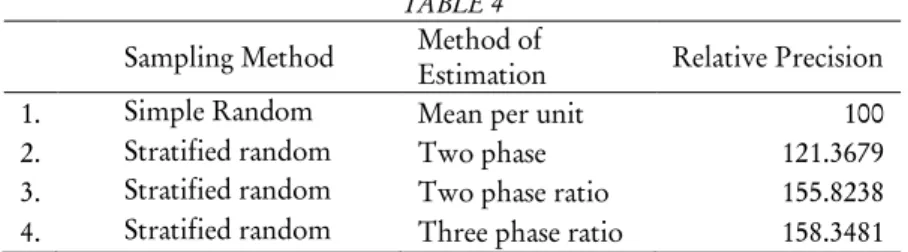
TABLE 4 Sampling Method Method of
Estimation Relative Precision 1. Simple Random Mean per unit 100 2. Stratified random Two phase 121.3679 3. Stratified random Two phase ratio 155.8238 4. Stratified random Three phase ratio 158.3481 From the expected cost we find
n
'=
337,
E n
( )
1''=
61,
E n
( )
''2=
29
.The optimum value of the sampling fractions for two phase stratified random sampling with ratio method of estimation are given by
g
1( )opt=
0.14511,
g
2( )opt=
0.31090.
From the expected cost we find
n
'=
475,
E n
( )
1''=
54,
E n
( )
''2=
32
.The optimum value of the sampling fractions for three phase stratified random sam-pling with ratio method of estimation are given by
g
1( )opt=
0.36864,
g
2( )opt=
0.19929
and
t
1( )opt=
0.22104,
t
2( )opt=
0.87600
.From the expected cost we find
n
'=
852,
E n
( )
1''=
246,
E n
( )
''2=
36,
( )
'''=
( )
'''=
1
55,
232.
E n
E n
8.
C
ONCLUSIONSACKNOWLEDGEMENTS
Author is thankful to Prof. A.K.P.C. Swain for his kind suggestions. The author also wishes to express sincere gratitude to the referee for his valuable suggestions in improving the manuscript.
REFERENCES
W.G. COCHRAN (1977), Sampling Technique (Third Edition), John Wiley and Sons, New York.
A.L. FINKNER (1950), Methods of Sampling for estimating commercial peach production in North Carolina, North Carolina Agr. Exp. Stat. Tech. Bull. 91
P. MUKHOPADHYAY (1998), Theory and Methods of Survey Sampling, Prentice Hall of India, New Delhi.
J.N. PASCUAL (1961), Unbiased Ratio Estimators in Stratified Sampling, Jour. Amer. Stat. Assoc., 56, 80 – 87.
B.K. PRADHAN (2000), Some problems of Estimation in Multi-phase Sampling, Thesis submitted for the degree of Ph.D degree in Statistics of the Utkal University, Bhuba-neswar.
B.K. PRADHAN, A.K.P.C. SWAIN (2000), Two Phase Stratified Sampling with Ratio and Regression Methods of Estimations, Journal of Science and Technology, Vol. XII, Section B, 52 – 57.
J.N.K. RAO (1973), On Double Sampling for stratification and analytical surveys, Biamet-rica, 60,125 – 133.
D.S. ROBSON (1952), Multiple Sampling of Attributes, Jour. Amer. Stat. Assoc., 47, 203 – 215.
D.S. ROBSON, A.J. KING (1953), Double Sampling and the Curtis impact Surveys, Cornell Univ. Expt. Stat. Mem., 231.
SUMMARY
Three phase stratified sampling with ratio method of estimation