CHANGING SOMEONE ELSE’S STORY: HOW SOCIAL STUDIES TEACHERS TRANSFORM THE DISCIPLINE
Tommy Ender
A dissertation submitted to the faculty of the University of North Carolina at Chapel Hill in partial fulfillment for the degree of Doctor of Philosophy in the School of Education (Cultural
Studies and Literacies).
Chapel Hill 2017
ABSTRACT
Tommy Ender: Changing Someone Else’s Story: How Social Studies Teachers Transform The Discipline
(Under the direction of Juan F. Carrillo)
This dissertation examines the influence of critical pedagogy in social studies. Research indicates critical pedagogy’s lack of influence on social studies teachers (Ross, 2016; Maloy & LaRoche, 2015; Evans, 2008). However, recent political events in North Carolina and the United States, as well as the long-term effects of neoliberal policies in education, have
encouraged teachers to engage in pedagogical resistance. This three-article dissertation studies the pedagogical practices of current K-12 social studies teachers in North Carolina who identify themselves as critical teachers.
The first article illustrates common themes found within the teachers’ pedagogies. Using narrative inquiry, I interviewed teachers at different times of the study. The findings indicate the recognition of students as knowledge holders, evoking social justice as part of the curriculum, engaging in self-reflection, the assertion of local communities into social studies, and
demonstrating critical care pedagogies as contributors to the existence of critical pedagogy in social studies classrooms. Implications suggest that scholars need to reconsider the existence of critical pedagogy in social studies.
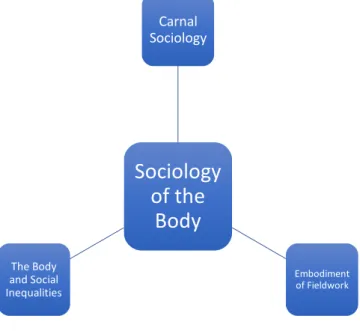
The second article investigates the effects of the body and voice on critical thought in the social studies classroom. Using the sociology of the body as a theory, I discovered three
manifestations supported the development of critical conversations in social studies classrooms. The introduction of a sociological theory indicates the need for critical, interdisciplinary work in social studies research.
The third article provides space for the voices of two teachers of color in the form of counter-narratives. Grounded in Critical Race Theory (CRT) and Latino Critical Theory
(LatCrit), the teachers and I created counter-narratives as resistance to dominant narratives found in social studies. The counter-narratives challenge racism and other forms of prejudice. The counter-narratives also establish community and social justice as integral pedagogical
components. The implication of counter-narratives suggests the need to establish new historical and contemporary chronicles within social studies. Furthermore, it suggests the need to engage with the increasing diversities of K-12 student populations in North America. While each article represents a divergent view, all three articles reconceptualize critical pedagogy as organic
ACKNOWLEDGEMENTS
This dissertation is personal. The work did not start the fall of 2016. It started on a cold day in February in Jersey City, New Jersey, USA. The following individuals and settings have influenced this body of work. Thank you! ¡Siempre en la lucha!
PREFACE
“Why do I need to learn about this stuff? There’s never nothing about Latinos1 in social
studies.”
The class worked on a small group assignment on World War II. I taught seventh grade social studies as a second-year Latino educator in Raleigh, North Carolina. I circulated around the classroom, and I noticed the student visibly upset. When I asked what was wrong, he said the above statement. I stopped walking around. More importantly, I could not respond to him. At that point of my teaching career, I focused on teaching the social studies curriculum, as it was, to my students. After what appeared to be a long time, I responded with the following statement:
“I honestly do not know.”
I could tell from the negative reaction of that student (putting his head down) that I had lost him for the lesson. I then spent the rest of the day pondering his question. Days became weeks. Weeks become months. By the time May rolled around, I started including narratives on Latino role models and details about historical settlements in the Southwest and West that were not included in the curriculum. However, every time I looked at that student’s face, I knew it was too little, too late. He had stopped contributing to class discussions.
I began to critically examine the curriculum. I dreaded the start of the year curriculum meetings with colleagues. I scanned the sheets for notable persons of color and empowering
experiences beyond tokenized narratives, and I often found the same individuals and stories depicted: Harriet Tubman, Frederick Douglas, Cesar Chavez, and Martin Luther King. The same narratives played out in different states. Whether it was New Jersey, North Carolina, or New Hampshire, the curriculum portrayed them and other well-known individuals of color as uplifting contributors to American society. Yet, the curriculum never went deeper. Why were they uplifting? Anytime I asked questions to curriculum writers and fellow social studies teachers on the lack of emphasis on people of color in the curriculum, I typically received the following two comments:
“We devote a whole unit on the Civil Rights. That should be enough.”
“Why study a group of people who can work hard if they wanted to succeed?”
These comments always hurt me. After expressing my dissatisfaction with the
curriculum and a willingness to go “off on my own,” those in leadership roles typically said to me:
“Do your own thing, but if you get into trouble, then don’t say we supported you.”
have a community of critical teachers to rely on for guidance and support. I received comments like
“Your students really like your class” Or
“I could never do that amount of work.”
Towards the tail of my K-12 career, I started receiving this comment:
“How will your students achieve passing scores on the end of grade test?”
After reflecting and writing this vignette, I ran into three former students working at a major department store. All three commented on how our conversations and activities prepared them for high school. When I asked them how, they all said similar statements that I combined into two statements:
“You let us talk in class. The high school social studies teachers have us copy
definitions from textbooks and answer questions on worksheets.”
TABLE OF CONTENTS
LIST OF TABLES ... xiv
LIST OF FIGURES ... xv
LIST OF ILLUSTRATIONS ... xvi
CHAPTER 1: AN INTRODUCTION ...1
Introduction ...1
Dissertation Format ...3
Theoretical Foundation ...4
Critical pedagogy ...5
Critical pedagogy in the social studies ...8
Critical practices in the K-12 setting ...10
Research Agenda ...13
General Research Methodology ...14
Methodology ...15
Field Work ...17
Data Analysis ...19
Summaries ...20
Article 1 ...20
Article 2 ...21
NARRATIVE INQUIRIES INTO THE SOCIAL STUDIES TEACHER ...24
Introduction ...24
Framework: Critical Pedagogy ...25
Critiques of Critical Pedagogy ...26
Researcher Positionalities ...29
Data Collection and Analysis ...30
Participants ...30
Process ...32
Analysis ...33
Discussions ...33
Recognizing Students as Intellectuals ...35
Caring ...38
Evoking Social Justice ...42
Engaging in Self-Reflection ...45
Community as Part of Teaching ...47
Conclusion ...51
Implications ...52
Summary ...53
References ...55
CHAPTER 3: THE BODY: CLARIFYING THEORY FROM THE EXPERIENCES OF SOCIAL STUDIES TEACHERS ...61
Introduction ...61
The Body and Social Inequalities ...66
The Embodiment of Fieldwork ...67
Methodology ...70
The Different Manifestations of the Body in Social Studies Learning ...75
The Mobility of the Body ...75
The Variations of the Voice ...85
The Body As Commodity ...91
Conclusion ...95
References ...98
CHAPTER 4: COUNTER-NARRATIVES FROM CURRENT SOCIAL STUDIES TEACHERS ...102
Introduction ...102
Framework ...103
Critical Race Theory ...103
Latino Critical Theory ...105
Critical Race Theory in Social Studies ...106
Latino Critical Theory in Social Studies ...108
Summary ...108
Methodology ...109
Charlie ...109
Rosita ...110
Data Collection ...110
Nearly Empty Pizzeria, College Town, NC ...113
Crowded Sports Bar, Rural Town, NC ...122
Concluding Thoughts ...130
Epilogue ...132
References ...134
CHAPTER 5: A CONCLUSION ...139
Introduction ...139
Future Research ...141
Teacher Education Programs – Social Studies ...141
Arts as Critical Literacy in Social Studies ...142
Détournement in Social Studies ...143
APPENDIX 1: INITIAL INTERVIEW ...145
APPENDIX 2: FINAL INTERVIEW ...146
LIST OF TABLES
LIST OF FIGURES
LIST OF ILLUSTRATIONS
Illustration 1. Hallway Behaviors ...78
Illustration 2. Timeline ...114
Illustration 3. Zinn ...115
AN INTRODUCTION
Teach about what matters. Our job is to excite students about the world, to help them see the role that they can play in making society more equal and more just, to express their ideas powerfully, to see that social studies is about real people's lives and about their relationship to each other and to nature. Enter the profession as a scholar, an historian, an activist, a curricular artist -- not as a subordinate to some "official" curriculum established far away from our classrooms by self-interested parties. (Bigelow, 2012)
Social studies needs to be relevant. Teaching social studies in critical ways often proved to be an isolating and difficult process, as the preface illustrated. However, my students
provided me with a much-needed in-school community. Whenever I run into former students, they often bring up how much they loved my teaching style and the class itself. We connected current events to the past. We discussed race and culture. My students relearned social studies in critical and empowering ways.
At the same time, I learned from them. Students taught me about their own worlds, communities, and interests. They pushed me to expand my teaching pedagogy. We created unique educational experiences, such as practicing our First Amendment rights in the school setting (It was worth getting in trouble!). By the end of my K-12 career, I interrogated social studies, instead of just “teaching it.” Transitioning to graduate school, I expected to find more research on similar experiences. I discovered limited research on teachers disrupting traditional norms and practices in social studies.
2007). Recent scholarship (Busey & Waters, 2016; Harshman, 2016; Meuwissen & Berger, 2016; Bermudez, 2015; Chandler, 2015; Chandler & Branscombe, 2015; King & Finley, 2015; Shear et al, 2015; Helmsing, 2014; Jorgensen, 2014; Ross, Mathison, & Vinson, 2014; Mayo, 2013; Ramirez, 2012; Daniels, 2011) supports the argument that students find social studies uninspiring and/or boring. To better understand how significant change is necessary for recalibrating the discipline, I studied social studies teachers who view themselves as critical teachers. Through qualitative research, I learned about practices, experiences, and ideas from these teachers. The results from this dissertation offer different presentations of current social studies engaging in critical practices.
The results address a number of gaps in social studies literature. First, the results illustrate the teachers’ different examples of critical engagement as their settings become more corporatized. Second, the manuscripts demonstrate the need to situate new ideas into social studies research. Third, the manuscripts provide teachers and educators with suggestions in continuing the cultivation of future critical social studies teachers. Lastly, the overall results narrow the gap between theory and practice.
This introduction will discuss the dissertation format, theoretical framework connecting the three manuscripts, the research agenda, general statements regarding the research
DISSERTATION FORMAT
There is too much here that I cannot ignore. I recall a class with George Noblit, where he said that the data that ends up on the “cutting room floor” have stories to tell. It is up the
researcher to do something with this. I perceive a number of gaps in the social studies literature. The data collected supported my perception. However, I could not leave behind some data, that with rigorous analysis and additional collection would yield substantial support in covering those gaps. Ultimately, I know I will leave some details on that floor. But I will use a
non-traditional route to show three different viewpoints of the data. And for those details on the floor, don’t worry, I’ll come back and get you in the future.
The foundation for this dissertation originates from the central tenets of my doctoral training. The dissertation critiques the lack of critical perspectives in social studies. The results illustrate practices that address systemic inequalities. The results also critically engage with social studies itself. My dissertation produces new theories and practices. The results will encourage two future objectives: supporting critical research and developing future critical social studies teachers.
The academy views journal publications as a central aspect of a faculty member’s career. Manuscripts developed for publication typically contain the following characteristics: (1) page lengths between 25 and 30 pages, (2) a format illustrating structure and functions, and (3) a rationale that encourages further scholarly discussions (Bowen, 2010). As preparation for entry into the academy, my dissertation is presented using the three articles format. I seek a wider audience to demonstrate my work. I constructed this three-article dissertation from guidelines developed by the Graduate School at the University of North Carolina at Charlotte, The
University of Texas-Austin School of Social Work, and Loyola University Chicago and vetted by my dissertation committee. This non-traditional dissertation reflects the type of writing that will be expected throughout my career as an activist scholar (Bowen, 2010).
THEORETICAL FOUNDATION “Scholarship, like culture, is fluid…” Gloria Ladson-Billings
“It doesn’t hurt to repeat here the statement, still rejected by many people in spite of its obviousness, that education is a political act.”
Paulo Freire
Second, I view my roles in social studies and academia as political acts. I rejected the authoritarian approaches associated with social studies after some difficult experiences as a teacher (Freire, 1998). I inspired my students to reject the status quo and find value in the world. I encouraged my students to not only prepare for life beyond the K-12 setting, but also for
change in the world (DeLeon & Ross, 2010). I still encourage change in the world with my undergraduate students today. I know that students enrolling in my courses will leave with a sense of empowerment, since they learn how to create their own critical qualitative research projects. The projects allowed them to understand worldly experiences while breaking down constructs affecting them (Evans-Winter, 2009).
Critical pedagogy serves as the theoretical influence on my research. However, I argue critical pedagogy is a complex idea, existing in a state of flux. Even though scholars tend to portray critical pedagogy as a liberating concept (Giroux, 2009; McLaren, 1989), the theory garners significant criticism. Whether the concept is rooted in patriarchy (Lather, 1998; hooks, 1994; Luke & Gore, 1992; Weiler, 1991; Ellsworth, 1989), or the concept lacks influence from scholars of color (Evans-Winters & Piert, 2015; Gist, 2015; Troutman, 2015; Anzaldua, 2012; Darder, 2012; Duncan-Andrade & Morrell, 2008; Mayer, 2007; Lynn, 2004), critical pedagogy has difficulty settling into the K-12 setting. As Gibson (1999) pointed out, “Consciousness alone will never lead to democracy” (p. 147). I now discuss critical pedagogy, critical pedagogy within social studies, and critical practices in the K-12 setting from the literature.
Critical Pedagogy
military government interference as an adult in Brazil. Freire’s work with illiterate Brazilian adults in marginalized communities motivated him to publish his experiences (Freire,
1970/2000). North American scholars learned from Freire, and subsequently developed a label for this work: critical pedagogy.
Critical pedagogy draws attention to the influences of neoliberalism in education in North America (Giroux, 2009; McLaren, 1989). Neoliberalism encourages a sense of individualism within the context of capitalism. Neoliberalism allows a student graduating from education to make economic choices that benefit them while obstructing others (Hursh, 2007). Neoliberalism practices contribute to a widening gap of inequality in society and in schools (Darder, Baltodano, & Torres, 2009). Curriculum development, classroom management strategies, and high stakes testing culture all reflect neoliberalism in schools (Sleeter, 2012). In social studies, the
standardization of social studies forces students to “master” information instead of questioning the information (Leahey, 2014, p. 56). Neoliberalism essentially suppresses critical discourse. Critical pedagogy works to expose the dominant overt and hidden narratives found in schools (Darder, 2012). Critical pedagogy also encourages political, economic, cultural, and social agency for disenfranchised students and individuals (Darder, 2012; Giroux, 2009; McLaren, 1989).
into account the additional layers of oppression accumulating when individuals became more human (Weiler, 1991). The consistent referencing of these theorists (Paulo Freire, Henry Giroux, Peter McLaren, Michael Apple, and Joe Kincheloe) as the “founding fathers” enable them as the leading thinkers in the field of critical pedagogy while ignoring feminist viewpoints (Breuing, 2011, p. 16).
Critical pedagogy draws from European philosophical thought, also made up of males. Critical pedagogy “owes a profound debt to its European progenitors” (McLaren, 1989, p. 159). Giroux (2009) cites The Frankfurt School, a collection of pre-World War II Marxist thinkers, as a major influence on his interpretation of critical pedagogy. Theorists also cite Pierre Bourdieu and Michel Foucault as influential thinkers (McLaren, 1989; Apple, 1979). References to these thinkers invoke exclusivity since only a small number of individuals can engage with one another at such an abstract level of knowledge (Knight and Pearl, 2000; Ellsworth, 1989).
Along with the elitism of white, male dominance in the field, critical pedagogy
encourages a similar form of oppression by the once oppressed when liberated (Orelus, 2015). Scholars condemning the hypocritical nature of critical pedagogy provoke strong reactions from the first generation of critical thinkers (Breuing, 2011; Lather, 1998). Mainstream journals, as a result, seldom published works critical of critical pedagogy (Martin, 2001).
While debates over the interpretations and underpinnings of critical pedagogy now extend into a fourth decade, the theory remains stuck in abstract form (Brock, 2015). Scholars and teachers continue to perceive critical pedagogy to be elitist in nature (Orelus, 2015). The perceived gatekeepers of critical pedagogy continue to disregard new arguments and
However, criticisms of critical pedagogy do introduce new perspectives into the discussion. Rhetoric and theory positioned within an African-American, feminist framework creates new spaces for scholars (Evans-Winter & Piert, 2015; hooks, 1994). Borderland identity gives voices to Chicanxs and Latinxs sharing deeply personal connections with ancestral and current homelands while directly attacking the Anglo-American, patriarchal, heterosexual hegemony (Anzaldua, 2012). Queer theory provides researchers with opportunities to
interrogate and transform “rigid normalizing categories…beyond the binaries of man/woman, masculine/feminine, student/teacher, and gay/straight” (Mayer, 2007, p.15). The promise of these perspectives supports the notion of critical pedagogy existing social studies, and providing voices to teachers and students engaging in resistance (Bermudez, 2015).
Critical pedagogy in the social studies
Being a child of immigrants, I grew up hearing how the United States provided my parents with opportunities to improve their lives. It begins with my first name: Thomas. My parents wanted me to have an American sounding name. Given the fact that Ender was already my surname, it made it easier for them to give me an American identity.
Beginning in elementary school, I quickly gravitated towards social studies. I ate up facts, dates, and famous people. My parents and teachers conditioned me to love the American flag unconditionally. I often re-read the textbook and materials at home for fun. I did extra projects. I really liked social studies.
we. I even collected trading cards of politicians and military leaders engaged in conflict in 1991.
Looking back, I realized my formative years of soaking up social studies subconsciously and consciously encouraged me to turn my back on my other histories. While I have returned to speaking Spanish and engaging in Latino cultural practices as an adult, I still deal with the residual effects of that initial education.
Critical pedagogy’s perceived elitism and the oppressive actions create a significant implication with the setting most needed for change: K-12 schools. Knight and Pearl (2000) argue that critical pedagogy’s major fallacy was the clear disconnect from the realities of the K-12 classroom. Evans (2008) goes further in stating that critical pedagogy was too dogmatic for implementation in social studies. Yet, curriculum standards and textbooks continue to provide superficial accounts of people of color (Maloy & LaRoche, 2015). Social studies teachers continue to face accountability, stagnant pay, corporate influences, business-based teaching standards, and an intense standardized testing culture (Darder, Baltodano, & Torres, 2009).
The existence of critical pedagogy would allow students and teachers to cooperatively reshape social studies. Enter any K-12 classroom today, and you will find a multiplicity of cultures, languages, and ethnicities (Ladson-Billings, 2009). According to Daniels (2011):
We need to be deeply aware that who we are and what we teach are interconnected. Our social identities and understanding (or misunderstanding) of historically marginalized people has to be taken into account in order to be remedied. (p. 218)
relations” (Au, 2009, p. 34). Critical pedagogy in social studies also encourages teachers to be active citizens. Teachers advocate systematic change, both inside and outside, the school setting (Gist, 2015; Evans-Winters, 2009). The objectives for constructive action in social studies is twofold: providing spaces in the literature for teachers currently using critical practices to transform the discipline, and emphasize the voices of those teachers.
Critical practices within the K-12 setting
I cannot even tell you how many social studies teachers I had who just stood in front of the class and lectured to us. I found it boring. Often times, I acted up in class just to get out of
those lectures. 7th grade, 8th grade, 9th grade…the social studies educators I had told long stories about people who did not look like me, sounded like me, or even walked like me. Anytime I had a chance to show a different side to the narrative on a test or in class conversations, these teachers told me that I had my facts wrong or I did not know the correct information.
So, entering my 10th grade US History class, I expected another boring year. I saw the seats lined up in rows, facing the chalkboard. Newspaper and magazine covers from decades earlier laminated and stapled to the back. Windows slightly opened, but the blinds were closed. I just went to a seat and sat down.
10th grade US History changed my life. For the first time, an educator asked for my thoughts on issues. We read parts of critical works in the classroom. We developed projects that we could actually implement in our neighborhoods. We listened to (now) classic hip-hop and punk rock in class. And here’s the kicker: he was a white teacher who got it. My neighborhood was 99% Latino. Yet, he always allowed us to bring our cultural and historical strengths into this class.
I cried when I learned that Mr. A was not going to be my 11th grade history teacher. And guess what…
That 11th grade teacher was just like the 7th, 8th, and 9th grade social studies teachers: boring. And guess what else….
I got into trouble, and instead of going to the assistant principal’s office, I was always sent to Mr. A’s classroom.
The vignette above illustrated the traditional approaches I experienced in social studies
Social studies educators continue to rely on traditional methods to disseminate
information to adolescents and young adults. Enter a social studies classroom today, and one will most likely see an educator lecturing to adolescents sitting in rows (Saye & SSRIC, 2013). This common approach relies heavily on the notion that the information learned in a social studies class as fact, details that go unchecked or questioned (Segall, 1999). The social studies teacher is complacent in depicting social studies as a presumed set of events (Stanley, 2015; Ross, Mathison, & Vinson, 2014). Teachers continue to view students as lacking knowledge, due to outside pressures or political points of view (Saye & SSRIC, 2013). This, in turn, allows them to maintain a banking system approach when they teach (Freire, 1970/2000).
A possible reason is the lack of awareness of critical pedagogy. Critical pedagogy is largely anonymous with teachers. Most students training to become social studies teachers never encounter controversial subjects at both the undergraduate and graduate levels of education (Loewen, 2007). Ignoring these issues further enhances the disconnect between the teachers and the students. Students, as a result, continue to remain apathetic towards social studies (Maloy & LaRoche, 2015).
investigated collaboration between a university professor and two elementary teachers in a social studies methods course. The researchers learned how “powerful social studies” practices
allowed educators to position the students as the knowledge makers (p. 139). The literature demonstrates that reconceptualizing the concept of critical pedagogy in social studies is possible and productive.
RESEARCH AGENDA
I view my research as part of a growing field of critical social studies scholars. Social studies research, similar to the K-12 praxis, tends to suppress critical scholarship (Howard, 2003; Ladson-Billings, 2003). As a response, social studies scholars (Shear, 2016; Crowe & Cuenca, 2015; Woodson, 2015) have attempted to incorporate critical theories and methodologies in attempts to change this perception. I aim to add new tactics to the on-going conversations. First, I use critical qualitative methodologies uncommon to social studies research. Second, I look to bridge the open space between theory and practice and practice and theory. While it is important for a theory to inform practice (Stanley, 2015), I also argue that practice needs to inform theory (Ritter, 2012). A two-way street type of methodology encourages critical perspectives in social studies research while disarming the banking view of academia towards the K-12 setting (Freire, 1970/2000).
synthesize the experiences of Latino families in North Carolina (Ender & Rodriguez, 2016, In press). The methodological process of engaging and reengaging with the data led to the discovery of critical themes. In addition, employing letter-writing techniques provided a different example of counter-narratives. With two other Latino fathers established in academia, we wrote letters to our children. Each letter addressed past experiences and future situations with candor and wisdom (Carrillo, Ender, & Perez, 2016). Our letters, thus, disengaged deficit perspectives. Engaging in non-traditional methodologies would position social studies research as a discipline more aware with the realities and experiences of the students learning it.
I also situate my own experiences as a K-12 social studies educator. I incorporated new pedagogical methods and concepts. I, however, never had an opportunity to demonstrate the strengths of my critical pedagogies. This dissertation seeks add the voice and experiences of Mr. Ender into the research. I position the teachers as advocates. For example, the second
manuscript explains how teachers, in establishing critical spaces within social studies,
understand how their bodies and voices influence learning. In addition, I wrote a book chapter on involving the keyword “Ethnic” in social studies education (Ender, 2016). In the original call for book chapters, the keyword “ethnic” was not even listed as an option. I reflected on my K-12 experiences in constructing the chapter. I used the keyword to challenge aspects of the social studies curriculum. The chapter also challenged any deficit perspectives in regards to the term “Ethnic.” The chapter positions practice as the driving force in developing a new concept. From past scholarship, I seek to be a different voice in social studies research.
GENERAL RESEARCH METHODOLOGY
(Mathison, 2017). I will list the research methodology in the listing style of a recipe. I then offer the reader an understanding on how I conducted the research. Lastly, I will describe each part.
Critical Practices in Social Studies
personal and professional experiences, pedagogical rituals, artifacts
field work: sustained engagement, formal and informal interviewing, observations, document collection
field notes, photographs, drawings inductive analysis, thick description Methodology
To learn how these social studies teachers developed critical practices in their classrooms, I used informed grounded theory in conjunction with ethnography. Informed grounded theory encouraged reflections on the existing literature (Thornberg, 2012). I took those reflections and applied them to the collected data. This process then constructed new concepts.
I also took into account my positionalities. I arrived at the research from two points of view: a former insider (K-12 social studies teacher) and an outsider scholar (engaging in critical research on social studies). The experiences of being a social studies teacher informed my scholarship. I understood the discipline from different points of view, i.e. urban social studies middle school teacher, suburban middle school social studies teacher, rural high school history teacher. Being an outsider, I view the majority of the research created within the discipline as opportunities for criticism. I look for opportunities to take the literature to parts unknown
I then synthesized new theories from the data for implementation in social studies education research. I construct these new ideas “from the ground up” (Saldaña & Omasta, 2018). Since I am arguing for critical social studies approaches, I present these new ideas in ways that show that my research did not simply repackage critical pedagogy. This was a difficult process before, during, and after conducting the research. As a result, I created two general research questions:
1. How do social studies teachers navigate the discipline for their students?
2. How do social studies teachers utilize practices that differ from traditional approaches? The research questions allowed flexibility in conducting the research. By using a variety of methods, the overall study articulated new knowledges from numerous settings and
experiences (Saldaña & Omasta, 2018). The dissertation reflected my own personal growth and understanding. I discovered certain themes within the data that pushed me to develop
manuscript-specific research questions (Saldaña & Omasta, 2018). Each manuscript lists the related questions.
I found ethnography helpful in addressing the research questions. Even though I reflected on my own experiences in the K-12 classroom as a critical social studies teacher, I pursued other manifestations of critical social studies teaching. I developed a field work approach that would provide numerous opportunities to collect data (Reeves, Kuper, & Hodges, 2008). I also planned to use a variety of data collection techniques to learn about each teacher (Patton, 2002). Lastly, I sought to understand why these teachers were willing to disrupt the discipline (Steinberg, 2012).
who held licensure in social studies, worked in an educational setting, and taught at least one class on American history. The participants received no compensation of any sort in exchange for their participation. They also selected pseudonyms. Purposeful sampling encouraged a triangulation of data collection and in-depth data analysis (Patton, 2002).
I set out to examine three components of critical teaching in social studies. First, I characterized the teachers’ experiences into two categories: personal and professional. For personal experiences, I sought to learn how their own involvements as K-12 students and/or students in teacher education programs influenced their pedagogical development. For professional experiences, I encouraged them to discuss their working relationships with
colleagues and administrators regarding their critical approaches. Second, I studied pedagogical rituals in the classroom. I focused on how the teachers communicated with the students. I also examined how they understood their bodies, body language, and voices. Third, I surveyed each teacher’s classrooms for visual representations of critical learning. This included non-traditional textbooks, posters, and timelines. I used these components in my field work.
Field Work
I planned a six-month study timeline. I started collecting data in October 2016, when I received IRB approval from the university. I relied on formal and informal interviews, observations, and document collection as the data collection methods. I also used research journals to help deconstruct my thoughts and experiences out in the field. I concluded my research in March 2017.
with the teachers formally and informally. Formally, I conducted interviews in a book-end format: one interview at the start of my research and one interview at the end of my research. I also engaged in informal conversations before and after the formal interview. We shared
personal stories, discussed mutual interests, and life in general. This approach authenticated the relationships between myself and the teachers, as well as provided validity checks to my analysis (Mears, 2009). I then started interpreting the meanings and intentions behind their words
(Crotty, 1998). Establishing trust also helped the teachers address issues with social studies, the curriculum, and research (Charmaz, 2016).
Observations represented opportunities to see connections between the words of teachers, and their actions in the classroom (Saldaña & Omasta, 2018). I observed teachers in their respective educational settings over a nine-week period from November 2016 to January 2017. The amount of time observing differed with each school (due to school bell schedule differences between elementary and secondary school settings). However, the average time for each
observation was about 45 minutes. I observed multiple classes during a visit. Similarly to the interview protocol, I briefly spoke with the teacher after each observation. This method allowed me to verify any inconsistencies in my observation data, while engaging in a form of member-checking with the teachers (Saldaña & Omasta, 2018).
credibility of the research (Bowen, 2010). The documents produced an additional set of rich and valuable details, which helped situate the teachers within their settings (Marshall & Rossman, 2011).
Data Analysis
I implemented an induction process for the data analysis portion of the research. Inductive analysis supported the theoretical framework of this research through the discovery of certain patterns from the data (Patton, 2002). I understood the data would offer a rich amount of details that would answer the overall research questions and manuscript-specific research questions. The experiences of these teachers are unique, yet complex. The induction process signaled a two-step approach: unifying the data, under the guise of the general research questions, and splitting them into new categories to make sense of their worlds (Saldaña & Omasta, 2018, Patton, 2002).
I also simultaneously engaged in data analysis as I collected the data. The articles reflect “description” (Bowen, 2010, p.867). Thick description involves a balance of analysis and interpretation from the data as it will “inform writing and further data collection” (Bowen, 2010; Coffey & Atkinson, 1996, p. 6). I implemented two methods. First, I developed substantive and theoretical categories (Maxwell, 2009). I searched for connections between the statements of the teachers and the actions taking place in the classroom as examples of critical pedagogy (Delgado & Stefancic, 2012; Maxwell, 2009; Freire, 1970/2000). Second, I engaged in continuous
reflection. In the margins of the word document or in my notebook, I addressed the data through comments, questions, or drawings in pushing the research forward (Charmaz, 2016). The
growth I experienced as a critical researcher (Denzin & Giardina, 2016). Each manuscript will discuss more specific inductive practices related to their research questions.
SUMMARIES
My sitting area is completely littered: books, clean papers, dirty papers, papers with marks, notebooks, notepads, pens, pencils, and a digital recorder. The laptop sits in the middle, surrounded by the organized chaos. I am engaged in a continuous search for answers. I
alternate from file to file, composing paragraphs and editing them. The illustration of my sitting area is a metaphor for the type of radicalized research I’m engaged in. The research is personal. But anything with change, the process takes time, patience, and evokes a flurry of thoughts and feelings. At the end, the sitting area will be cleared. While the research technically ends with the presentation of these manuscripts, the journey continues. The results from this research will change social studies.
This non-traditional dissertation highlighted critical ideas and practices from three different angles. The first manuscript generated narratives from the stories articulated by teachers through interviews. The second manuscript positioned the sociology of the body as a relevant theory in interpreting the critical practices of social studies teachers. The third manuscript amplified the power of counter-narratives for teachers of color working in a
politically volatile setting such as North Carolina. The summaries also reveal the inspirations for each manuscript.
Article 1
“Nothing Clean or Sanitary in My Classroom”: Narrative Inquiries into the Social Studies Teacher
The inspiration for this manuscript came from another idea I first proposed to my
that the teachers retained unique voices and experiences. I wanted to “extract meaning from experience rather than depict experience exactly as it was lived” from these teachers (Denzin, 2014, p. 36). However, I realized that multiplicity of relationships in the research would take a significant amount of time in creating autoethnographies (Hughes, Pennington, & Makris, 2012). The depth of this type of work required far more time than the research timeline allowed.
Following conversations with my committee members, I changed the focus to narrative inquiry. I then realized how two facets of narrative inquiry that would critical engage the data: narrative inquiry required particular attention to the teachers telling their stories and my own
positionalities and standing in the research (Clandinin, 2016).
The narratives revealed current social studies teachers critically engaging with their students. First, even though each teacher came from different parts of the United States, taught in different regions of North Carolina, and at different levels of instruction, they integrated common ideas in developing critical conversations. They viewed their students as intellectuals. They saw social justice as a significant component of their teaching. They engaged in constant self-reflection. They asserted the community as part of their learning sphere. And, they all demonstrated caring towards students. As a result, they constructed their own versions of critical pedagogy without much input from higher education. Overall, the narratives showed
interpretations of critical pedagogy already in practice in social studies. Article 2
The Body: Clarifying Theories from the Experiences of Social Studies Teachers
started expanding from social movements into other concepts. The idea of involving a
sociological concept when I presented my original findings of this manuscript to my advisor, Dr. Juan Carrillo.
Similarly to the first manuscript, I changed my original focus for the second manuscript. I settled on critical pedagogy of the flesh as a theoretical focus. However, when I spoke with Juan about my initial findings, he informed me that my analysis sounded more like sociology of the body. I researched the concept and realized that I briefly studied sociology of the body in my social movements course. I then switched concepts.
The manuscript uncovered teachers’ understandings of their own bodies and voices in relation to critical learning. The body, as a material object grounded in reality, situates the person in two ways: finding comfort in familiar settings and resisting other, more chaotic settings (Engman & Crawford, 2016; McGuire, 1990). Because social studies is rooted in the mindset of American exceptionalism, the body finds comfort in learning about the United States in uncritical terms. Different experiences outside the classroom, i.e. racism, gender, inequality, impact the body as well. Social studies teachers who engaged in critical practices start clearing up those confusions and encourage a reconceptualization of social studies. Their own
understandings of the body and voice does not fit neatly into the scope of American
exceptionalism. Their willingness to “change up how social studies is taught,” as one teacher stated, stresses the understanding of overt and implicit ideas in the classroom. As a result, they start to define critical social studies from a non-educational theory.
Article 3
Counter-Narratives From Current Social Studies Teachers
Latino, mestizo, and Latin American. I currently use Latino. But during my doctoral training, I learned that my mother was a Quechua woman from Colombia and that my great-great
grandfather from Spain colluded with the U.S. government in building the Panama Canal. He also helped the country of Panama declare independence from Colombia. These stories add to the complication of understanding my own identity. I also felt the sting of microaggressions in education, due to my complex identity. I found power in the counter-narratives facet of Critical Race Theory (CRT) and Latino Critical Theory (LatCrit).
The manuscript presented the counter-narratives of two teachers in the study. The teachers, one who identified as a Latina and one who identified as an African-American,
recognized the power of constructing their own narratives in challenging the majoritarian stories (Solórzano & Yosso, 2002). I also wrote a short counter-narrative as the epilogue. We
“Nothing Clean or Sanitary in My Classroom”: Narrative Inquiries into the Social Studies Teacher
With every lesson, there is a framing as to why the lesson is important or relevant to present-day. With our slavery unit, students were shocked to learn about how the conditions of enslaved Africans then is resembled in the current injustice happening in the black communities. For tomorrow's lesson, we will compare maps of free/slave states, mass incarceration per state, and the Election 2016 results. (Rosita)
I had just finished an interview with Rosita. She articulated a range of experiences that left me dazed, excited, angry, and ready to change the world. I opened up the car door, and upon sitting down, I pulled out my journal from my book bag. I started scribbling in it. I realized how much time I was taking in writing in my journal when two cars honked at me. The initial
takeaway, one that I still understand as the significant understanding for this manuscript, was the connection I had with the teacher. The teacher opened up her book of experiences, and shared many with me. The trust she had in me allowed her to stress certain sounds and words in her thoughts; she went beyond answering the questions I originally asked her by offering detailed descriptions. By the end of the interview, I was exhausted. I realized I was not exhausted by the interview process itself, but at the complexity and perspectives of the teacher herself (Coffey & Atkinson, 1996). I also understood how her own experiences contributed to her teaching pedagogy.
Narrative inquiries into the experiences of social studies teachers remains a concept under-utilized in social studies research. While some researchers (Salinas, Franquiz, &
teacher education programs. The opening vignette, conducted in an interview with Rosita, a Latina social studies teacher in North Carolina, detailed a wide variety of reflections that
extended beyond the classroom setting. The narratives illustrated complex representations of her life experiences (Riessman, 1993). These complex representations revealed the potential for critical pedagogical development in her classroom (Freire, 1998). As a result, I saw her narratives as phenomena that called for further understanding (Riessman, 1993).
This study illustrates experiences that have contributed to the development of critical pedagogies in the social studies classroom. The stories came from interviews with three current teachers of social studies in North Carolina. The results indicated the pedagogical
transformation of social studies occurring in the K-12 setting, since one teacher taught 5th grade, one teacher taught 8th grade, and the third teacher taught grades 9-12. The teachers resisted fact recall and lecturing, and focused more on conversations on race, prejudice, and inequalities (Maloy & LaRoche, 2015). They also accepted student and community (de los Rios, Lopez, & Morrell, 2014).
Following the introduction, I review critical pedagogy and critiques of the theory. I then analyze the narratives appearing from the teachers’ understandings of critical pedagogy. I conclude by clarifying the influence of grassroots critical pedagogy on the field, along with recommendations on enhancing the visibility of critical perspectives in social studies.
FRAMEWORK: CRITICAL PEDAGOGY
narratives, and encourages individuals to confront them (Darder, 2012). Individuals confront them through the use of community-based knowledge, which encourage problem posing practices and dialogue (Nygreen, 2010). In theory, critical pedagogy advocates for all individuals.
CRITIQUES OF CRITICAL PEDAGOGY
Even though the theory of critical pedagogy has existed for decades in North America, widespread attempts at implementing it in K-12 settings have failed. US schools require students to take numerous standardized tests at various stages of their K-12 educational path (Ross, Mathieson, & Vinson, 2014). Teachers now prioritize academic calendar days for testing preparation, thus losing opportunities to engage critically with their students (Sondel, 2015; Villaverde & Carter, 2015). School districts, “racing to the top” to earn federal government money, force teachers and staff members to engage in pedagogical practices that undermine critical thought and put forward performance as the main reason for academic learning (Villaverde & Carter, 2015). Standardized testing only concentrates on facts and concepts; it does account for thinking critically about topics and issues. For school districts facing socio-economic inequalities, teacher shortages, and/or administrative mismanagement, they receive fewer funding opportunities and resources, thus continuing the vicious cycle of
underperformance (Winstead, 2011).
invokes an aura of exclusivity and prestige, concepts teachers find unrealistic when their
classrooms welcome diverse groups of students (Ladson-Billings, 2009; Knight and Pearl, 2000; Ellsworth, 1989).
The patriarchal system associated with critical pedagogy results in condemnations from feminist scholars (Breuing, 2011; Cook-Sather, 2007; Lather, 1998; Ladson-Billings, 1995; hooks, 1994; Weiler, 1991; Ellsworth, 1989). Critical pedagogy subjugates individuals who are not “European, White, male, middle class, Christian, able-bodied, thin, and heterosexual
(Ellsworth, 1989, p. 304). The theory also does not take into consideration the concealed levels of oppression when individuals became more human (Weiler, 1991). The constant referencing of Giroux, McLaren, Kincheloe, Freire, and Apple in critical pedagogy literature characterizes them as “founding fathers,” a narrative that authenticates a paternalistic reflection while discounting or ignoring other viewpoints (Breuing, 2011, p. 16). It is important to note that white, feminist scholars articulated the first set of critiques of critical pedagogy. As a result, other scholars and scholars of color have attempted to question critical pedagogy.
A growing literature on black feminist critical pedagogy, deconstruction of heterosexual narratives, voices from the borderlands/testimonios and the development of queer and
homelands while directly attacking the patriarchal, heterosexual, Anglo-American supremacy (Anzaldua, 2012).
Thus, the pedagogical, philosophical, and theoretical foundation of critical pedagogy, based on European models, remains a theory stuck in the abstract (Brock, 2015). Scholars, as a result, perceive critique pedagogy to be elitist (Orelus, 2015; Nygreen, 2010). Even when new scholars express theoretical arguments and didactic actions reflecting forms of critical pedagogy, they go unnoticed by the mainstream thinkers (Lynn & Jennings, 2009). Because of this
perceived ignorance, a gap exists between critical scholars and K-12 educators. This has significant implications for social studies K-12 educators.
Very few social studies teachers are familiar with critical pedagogy. Many do not know how to implement it in the classroom (Evans, 2008). Evans (2008) noted that existing literature on critical pedagogy, mired in abstract language and concepts, prove to be too difficult for social studies teachers to understand. Teachers rarely learn about critical pedagogy, either during teacher education training or in the field (Sondel, 2015). Maximizing the view, critical pedagogy has experienced intense debates over the lack of diverse perspectives, the gendering of the
theory, and elitism (Orelus, 2015; Ladson-Billings, 2009; Lather, 1998; Ellsworth, 1989). While these conversations have gone back and forth for decades now, it remains a theory residing among educational elites (Gibson, 1999). The future of critical pedagogy depends on teachers willing to continuously learn from themselves, and the worlds around them (Ross, 2016).
for critical education: past educational experiences have already marginalized them, present curricula fail to take into account different viewpoints, and future experiences could revert them to bystander status in an environment dominated by a small population of affluent power holders (de los Rios et al., 2015). It is up to the critical social studies teacher to establish a pedagogical environment where learning involves constant questioning of discipline and the inequities surrounding it (Segall, 1999).
RESEARCHER POSITIONALITIES
I brought some unusual perspectives to the research. My own K-12 experiences disrupted the conventional applications of a passive observer in the field (Saldaña & Omasta, 2018). I taught social studies/history for nine years. I taught elementary and secondary school social studies in rural, suburban, and urban settings. As an active researcher, I participated in the research through conversations about my own experiences as a social studies teacher. Yet, as a complete researcher, I lived “the same experiences as those observed” in the classroom (Saldaña & Omasta, 2018). I focused on developing positive relationships with all of the students. The level of trust I developed with them allowed for critical conversations on race, ethnicity, and gender to occur in my classroom. I also realized the continued lack of teachers of color. I often worked as the only Latino in the school, along with a small number of African-American and multi-racial teachers. Incorporating graduate training as a Latino critical theorist and critical social studies educator perspectives, I bring a variety of positionalities that influence the development of this study.
I, therefore, used a number of tools to continually deconstruct my dual research
on the data. The reflections not only established credibility with the data, but also encouraged me to maintain a constant receptivity to research surprises (Saldaña & Omasta, 2018; Clandinin & Connelly, 2000).
DATA COLLECTION AND ANALYSIS
The purpose of this research was to explore how current social studies teachers have interpreted their own transformative pedagogies. I relied on the following questions to guide the research:
(1) How do teachers perceive social studies?
(2) What do teachers take into account in developing their pedagogies?
I collected data from a six-month study of current social studies teachers in North Carolina. I conducted research in rural, suburban, and rural settings. I relied on a combination of informed grounded theory and ethnographical methodology. Using this tactic provided an understanding of existing literature on the topic of narrative inquiry while being situated in the data collection and learning from it (Thornberg, 2012; Charmaz, 2006). Each teacher described critical components that contributed to their pedagogies (Riessman, 1993). The teachers’ stories encouraged awareness of new concepts of critical pedagogy from the data (Thornberg, 2012). The teachers’ narratives embodied both the story-telling aspect of the interviews and the phenomena of the research (Clandinin & Connelly, 2000). The variety of stories supported the notion that current social studies work to resist dominant ideals and labels in order to engage their students critically (Clandinin, 2006).
Participants
helped develop a comprehensive network of colleagues. I relied on that network to gather a sample of teachers (Patton, 2002). Once I received IRB approval, I then engaged in
conversations with several possible participants via email and the telephone. I chose individuals teaching in the field to inform the research. The selected teachers would provide an abundant amount of data to answer the research questions (Patton, 2002).
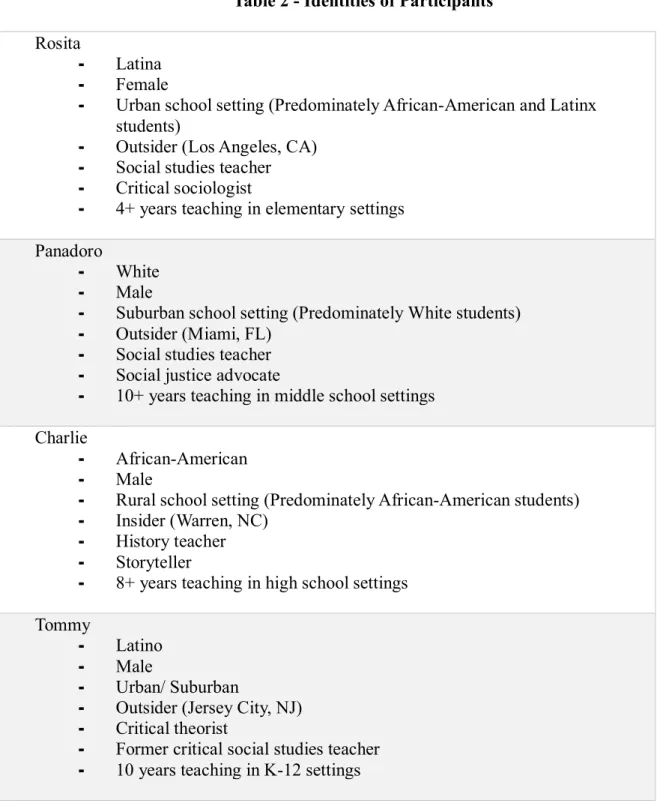
Three teachers participated in this study. Rosita, identifying as Latina, is in her fourth year teaching social studies. She taught the first two years of her career in an urban public school district, and has been teaching in an urban charter elementary school since 2014. She is originally from Los Angeles, California. Charlie, identifying as an African-American male, is in his eleventh year of teaching social studies. He has taught his entire career at the same public high school in a rural district close to the North Carolina-Virginia border. Charlie returned “home” to teach in the county; he attended K-12 schools in the same district. Panadoro, identifying as a White male, is in his fourteenth year of teaching social studies. He has been teaching in a suburban charter school for the past four years. Prior to that, he taught in middle schools in North Carolina and Florida. He is originally from Miami, Florida.
Participation in the study required the following criteria: (1) holding a state-recognized teaching license in social studies/history, (2) employment by a school or school district, (3) teaching a course on American history as part of their employment, and (4) and demonstrating a commitment to using a critical teaching approach. I emailed consent forms to all three
individuals. They were given opportunities to ask questions, both in person and via email prior to engaging in the research. After all questions were answered, they signed the consent forms.
participate due to the lack of administrative support. Despite these limitations, the remaining participants responded to questions about their experiences of teaching social studies through a combination of formal interviews, numerous informal interviews, and observations. The findings from this study will further support the growing sphere of critical social studies research. The narratives also reveal the potential for future qualitative research on the topic of critical pedagogy in social studies.
Process
I utilized in-depth interviews and follow-up questioning as the primary methods of data collection. The interviews reflected a semi-structured, informal approach. I created a set of questions to evoke responses from the teachers (Saldaña & Omasta, 2018). The questions were to invoke two viewpoints. The first perspective engaged teachers in reflection. Teachers recalled and detailed their experiences as both a student and as a teacher. The second perspective
addressed the pedagogies used by teachers in connecting with students. The informal setup allowed follow-up questions to be developed during the interview. The new questions expanded the scope of the conversations: I encouraged the teachers to explain further certain concepts or statements. The follow-up questions also illustrated my heightened attention to their narratives (Saldaña & Omasta, 2018). All interviews lasted between 30 and 90 minutes.
Participant observations provided a secondary data collection method. I wrote field notes. The statements made on my field notes not only bolstered the words of the teachers, but also illustrated the representations of their experiences (Baker, 2006; Riessman, 1993). Even though I taught social studies for a number of years, I maintained a form of peripheral
observer (as a researcher) allowed me to understand the teachers’ practices in the classroom as both an insider and an outsider (Baker, 2006).
I recorded all interviews with a digital audio recorder, with written permission obtained from each teacher. I then transcribed the interviews. I shortened the transcripts through the process of interview condensation. I eliminated “extraneous and tangential comments” that did not directly address the research questions (Saldaña & Omasta, 2018, p.118). I provided condensed the transcripts to the teachers for verification and accuracy (Saldaña & Omasta, 2018).
Analysis
I engaged in continuous data analysis and reflection. I took notes and wrote memos on the margins of the sheet during the interviews. I used these reflections to inform the formal process of data analysis. I developed codes, both analytical and in-vivo, via the computer program MaxQDA. I reassessed the codes two additional times. As I engaged in the coding process, I kept replaying the conversations I had with the teachers. I did not want to rely on the computer program as the primary analytical approach. The words on paper, or in this case, in digital written form, only provided one point of view. In listening to their conversations numerous times, I picked up instances of accenting certain words, spaces between words, and other verbalizations not found in a transcript. Their stories provided illustrations of space and time in their lives (Saldaña & Omasta, 2018). This process developed the themes that I will discuss in the following section.
DISCUSSIONS
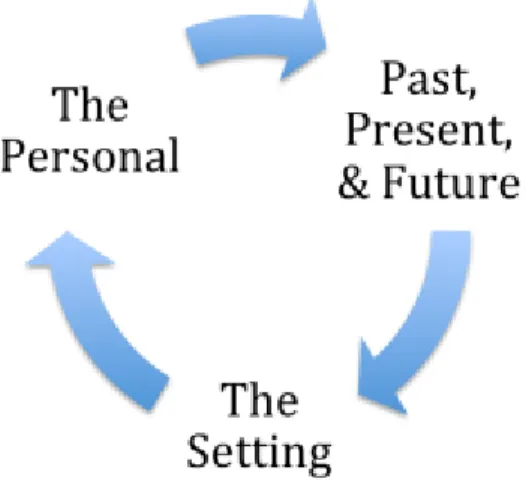
social studies, (2) their understandings of the students’ past and present experiences in social studies and the future for them, and (3) perceptions of the classroom, school, and outside
communities. I created a design, Figure 1, to illustrate the spaces studied within this research. Figure 1 – Cycle of Knowledge
Based on Clandinin (2006) & Riessman (1993)
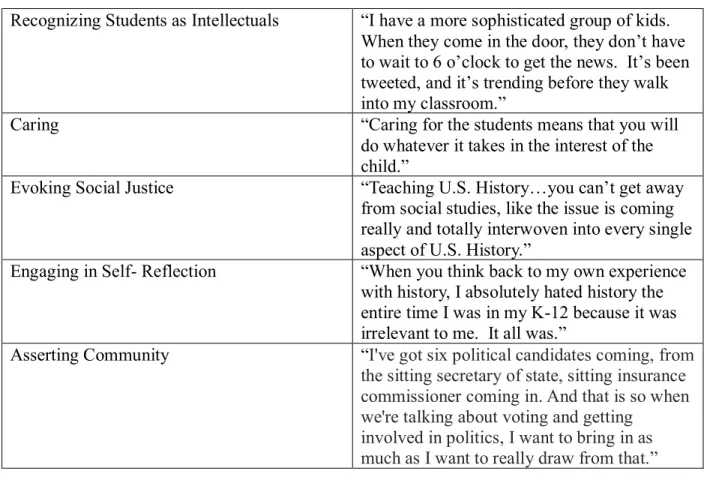
Table 1 – Common Themes
Recognizing Students as Intellectuals “I have a more sophisticated group of kids. When they come in the door, they don’t have to wait to 6 o’clock to get the news. It’s been tweeted, and it’s trending before they walk into my classroom.”
Caring “Caring for the students means that you will
do whatever it takes in the interest of the child.”
Evoking Social Justice “Teaching U.S. History…you can’t get away from social studies, like the issue is coming really and totally interwoven into every single aspect of U.S. History.”
Engaging in Self- Reflection “When you think back to my own experience with history, I absolutely hated history the entire time I was in my K-12 because it was irrelevant to me. It all was.”
Asserting Community “I've got six political candidates coming, from the sitting secretary of state, sitting insurance commissioner coming in. And that is so when we're talking about voting and getting
involved in politics, I want to bring in as much as I want to really draw from that.”
The first theme emphasized the importance of recognizing the intellectual strengths of students. The second theme showed the level of caring the teachers had for their students. The third theme illustrated the interconnectivity between social justice and teaching social studies. The fourth theme situated self-reflection as a significant part of their practice. The final theme incorporated the worlds outside their classrooms as relevant and valuable settings. All teachers viewed their work as life lessons. They all expected their students to leave their classroom with certain academic and social tools to address inequalities in society.
Recognizing Students as Intellectuals
studies. Panadoro said, “They are making the connections between their personal lives to the lessons they have learned in the classroom.” Charlie said, “I have a more sophisticated group of kids. When they are coming in the door, they don’t wait to 6 o’clock to get the news. It’s been tweeted and it’s trending before they walk into my classroom, and they already have questions” Rosita said, “So where I am, our students, most of them watch the news either as they are walking by the TV set or maybe their grandparents watched that afternoon. So, they are very much aware of what's going on. They just don't have the time to talk about it, you know.”
Yet, each teacher used different techniques to draw out student knowledge into forms of critical thinking and conversations. Panadoro attempted to help students articulate those
thoughts into more cohesive arguments. He discussed an interaction with a student who openly supported Trump in his class:
I didn’t personally agree with him [the student] but I got him to think about it. There, he's a critical thinker. And if you're critically thinking, if you're looking at your world around you, and you're bringing in facts, you're bringing in facts that leads you to the conclusion that the country needs a wall. At least I can respect your decision because you can explain it to me.
For Panadoro, putting aside personal beliefs belied the importance of articulating a position
thoroughly. He explained, “I’d rather train a kid to make their own decisions than to just force
them into agreeing with me.” Panadoro was quite aware that he was engaging with his students in forms of critical consciousness. He was equally aware of the fact that his students needed to
develop their own forms of critical questioning from their knowledge bases. Instead of viewing
the student Trump supporter as a deficit thinker and dismissing him, Panadoro chose to engage
with him in the hopes of establishing more democratic participation in his social studies
For Charlie, he prepared himself for students to ask critical questions at any point of
instruction:
You know, if you talk about ideas of revolution and you have no basic understanding of the Haitian, French Revolution, American Revolution, you know all these things, then you can’t fully develop ideas in your classroom that really builds your confidence. Particularly if you got this savvy kid who was online last night and he learned about Toussaint L’overture and he hits you with that on the second day…
He talked about connecting history to other history-makers who were not typically mentioned in
textbook books or the curriculum:
I say history is a puzzle, borderless puzzle. And there are pieces that you have been able to put in place throughout your entire experience. Martin Luther King, y’all know a lot about him. I’m not really going to talk a lot about him in this class. Why? Because you’ve heard a lot about him before. You’ll hear me talking about Famie Lou Hamer and Stokley Carmichael.
For Charlie, extending their knowledge by discussing other notable figures brought new
profound perspectives for his students. He explained, “It’s relevant teaching. It takes very little
effort when you connect the material to their personal, academic, and social experiences.”
Rosita sought to establish more critical understanding through questioning and
conversations. She mentioned teaching about two well-known figures in social studies: “They
Charlie, Panadoro, and Rosita articulated views of their students as intellectuals entering their classrooms ready to engage with their teachers. They encouraged their students to use that knowledge. Students, as a result, feel more connected with one another, their teachers, and their communities. Maloy and LaRoche (2015) supported this theme. They called on current teachers to establish and engage in genuine conversations in social studies classrooms. Genuine
conversations, combining respect for the students and inclusivity of different thoughts, help students “feel their ideas matter and adults are willing to listen, even when adults disagree with what is being said” (Maloy & LaRoche, 2015, p. 98).
The findings for this theme went beyond honest conversations. All three teachers framed their conversations with critical ideas. Because the teachers all accepted student-based
knowledge, they helped establish empowering relationships with their students. The findings for this theme support the call made by Villaverde and Carter (2015) for educators to develop their own interpretations of critical pedagogy for the benefit of their students. Teachers understood the positive power behind constructive discussions. As a result, they all started fundamentally changing their students’ understandings of social studies (Maloy & LaRoche, 2015; Freire, 1998). Students would leave these classrooms more empowered at the end of the year than they had when they entered at the start.
Caring
The teachers’ narratives indicated forms of caring towards their students. Exhibiting a caring pedagogy allowed them to establish positive relationships that allowed the teachers to engage in critical practices.