IOS Press
KnowMore - Knowledge Base Augmentation
with Structured Web Markup
Editor(s):Claudia d’Amato, University of Bari, Italy; Agnieszka Lawrynowicz, Poznan University of Technology, Poland; Jens Lehmann, University of Bonn and Fraunhofer IAIS, Germany
Solicited review(s):Aleksander Smywinski-Pohl, AGH University of Science and Technology, Poland; two anonymous reviewers
Ran Yu
a,∗, Ujwal Gadiraju
a, Besnik Fetahu
a, Oliver Lehmberg
b, Dominique Ritze
band Stefan Dietze
a aL3S Research Center, Appelstr. 4, 30167 Hannover, GermanyE-mail: {yu, gadiraju, fetahu, dietze}@l3s.de
bData and Web Science Group, University of Mannheim, B6, 26 68159 Mannheim, Germany
E-mail: {oli,dominique}@informatik.uni-mannheim.de
Abstract.Knowledge bases are in widespread use for aiding tasks such as information extraction and information retrieval, for example in Web search. However, knowledge bases are known to be inherently incomplete, where in particular tail entities and properties are under-represented. As a complimentary data source, embedded entity markup based on Microdata, RDFa, and Microformats have become prevalent on the Web and constitute an unprecedented source of data with significant potential to aid the task of knowledge base augmentation (KBA). RDF statements extracted from markup are fundamentally different from traditional knowledge graphs: entity descriptions are flat, facts are highly redundant and of varied quality, and, explicit links are missing despite a vast amount of coreferences. Therefore, data fusion is required in order to facilitate the use of markup data for KBA. We present a novel data fusion approach which addresses these issues through a combination of entity matching and fusion techniques geared towards the specific challenges associated with Web markup. To ensure precise and non-redundant results, we follow a supervised learning approach based on a set of features considering aspects such as quality and relevance of entities, facts and their sources. We perform a thorough evaluation on a subset of the Web Data Commons dataset and show significant potential for augmenting existing knowledge bases. A comparison with existing data fusion baselines demonstrates superior performance of our approach when applied to Web markup data.
Keywords: Knowledge base augmentation, Web markup, microdata, data fusion, entity resolution, structured data
1. Introduction
Knowledge bases (KBs) such as Freebase [3] or YAGO [36] are in widespread use to aid a variety of applications and tasks such as Web search and Named Entity Disambiguation (NED). While KBs capture large amounts of factual knowledge, their coverage and completeness vary heavily across different types or domains. In particular, there is a large percentage of less popular (long-tail) entities and properties that are under-represented. For instance, Freebase is
miss-*Corresponding author. E-mail: [email protected].
ing statements for 63.8% (Wikidata for 60.9% and DB-pedia for 49.8%) of all entities considering a selected set of properties used to describe books, such as lan-guage, publisher or number of pages (see Section 3). Here, gaps are in particular observable for less popu-lar books or attributes, such astranslatorornumber of pages.
Recent efforts in knowledge base augmentation (KBA) aim at exploiting data extracted from the Web to fill in missing statements. These approaches ex-tract triples from Web documents [10], or exploit semi-structured data from Web tables [30,31]. After extract-ing values, data fusion techniques are used to identify the most suitable value (or fact) from a given set of
observed values, for example, the correct director of a movie from a set of candidate facts extracted from the Web [11]. To this end, data fusion techniques are fun-damental when attempting to solve the KBA problem from observed Web data.
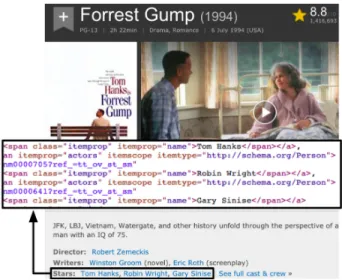
Fig. 1. Example of embedded entity annotation unsing structured markup of Web pages.
Although the extraction of structured data from Web documents is costly and error-prone, the recent emer-gence of embedded and structured Web markup has provided an unprecedented source of explicit entity-centric data, describing factual knowledge about en-tities contained in Web documents. Figure 1 shows an example of a web page containing entity markup, where explicit entity information about the actor Tom Hanks is embedded in a machine readable format. Building on standards such as RDFa1, Microdata2
and Microformats3, and driven by initiatives such as schema.org, a joint effort led by Google, Yahoo!, Bing and Yandex, markup data has become prevalent on the Web. An analysis from 2014 shows that 30% of all pages in a crawl of 2.01 billion HTML documents con-tain some form of embedded markup [22], while this proportion has grown to 38% in 2016, considering a crawl of 3.2 billion documents4. This demonstrates a general upward trend of adoption, where the
propor-1RDFa W3C recommendation:
http://www.w3.org/TR/xhtml-rdfa-primer/
2http://www.w3.org/TR/microdata 3http://microformats.org
4
http://webdatacommons.org/structureddata/2016-10/stats/stats.html
tion of pages containing markup increased from 5.76% to 38% between 2010 and 2016.
Through its wide availability, markup lends itself as a diverse source of input data for KBA. In particu-lar when attempting to complement information about long-tail attributes and entities, the diversity and scale of markup provide opportunities for enriching existing knowledge bases [23].
However, the specific characteristics of facts ex-tracted from embedded markup pose particular chal-lenges [40]. In contrast to traditional, highly connected RDF graphs, markup statements mostly consist of iso-lated nodes and small subgraphs, where entity de-scriptions often describe the same or highly related entities, yet are not linked through common identi-fiers or explicit links. For instance, in the WDC2013 corpus, 18,000 disconnected entity descriptions are retrieved when querying the label of instances of typeschema:Product for ‘Iphone 6’. Also, extracted markup statements are highly redundant and often lim-ited to a small set of highly popular predicates, such as schema:name. Another challenge is data quality, as data extracted from markup contains a wide vari-ety of errors, ranging from typos to the frequent mis-use of vocabulary terms [21]. In this work, we intro-duce KnowMore, an approach based on data fusion techniques which exploits markup crawled from the Web as diverse source of data to aid KBA. Our ap-proach consists of a two-fold process, where first, can-didate facts for augmentation of a particular KB en-tity are retrieved through a combination of blocking and entity matching techniques. In a second step, cor-rect and novel facts are selected through a supervised classification approach and an original set of features. We apply our approach to the WDC2015 dataset and demonstrate superior performance compared to state-of-the-art data fusion baselines. We also demonstrate the capability for augmenting three large-scale knowl-edge bases, namely Wikidata5, Freebase and
DBpe-dia6through markup data based on our data fusion
ap-proach. The main contributions of our work are three-fold:
– Pipeline for data fusion on Web markup. We propose a pipeline for data fusion (Section 3.3) that is tailored to the specific challenges arising from the characeristics of Web markup (Section 3.1). In particular, given the dynamics and scale
of markup data, our approach performs the task of query-centric data fusion, which provides an effi-cient means to fuse only specific parts of a given markup corpus, obtained through a preliminary blocking step. Relevance, diversity, and correct-ness of facts is addressed through a combination of entity matching, and data fusion techniques. To the best of our knowledge, this is the first ap-proach addressing the task of data fusion on Web markup data.
– Model & feature set.We propose a novel data fu-sion approach consisting of a supervised classifi-cation model (Section 5), utilising an original set of features geared towards validating correctness and relevance of markup facts. Experimental re-sults demonstrate high precison (avg. 91.7%) and recall (avg. 88.2%) of our model, outperforming the state-of-art baselines.
– Knowledge base augementation from markup data. As part of our experimental evalua-tion (Secevalua-tion 7), we demonstrate the use of fused markup data for augmenting three well-established knowledge bases. Our results under-line the suitability of markup data for support-ing KBA tasks, where KnowMore is able to reach 100% coverage gain (Section 6.2.2) for se-lected properties and types, for instance, book descriptions in Freebase and Wikidata. On aver-age, KnowMore has a coverage gain of 36.49% in Wikidata, 39.42% in Freebase and 34.75% in DBpedia. We also investigate the particular po-tential for augmenting tail entities and properties in Section 9.1.
The paper is structured as follows: Section 2 dis-cusses related work on knowledge base augmentation and data fusion, while Section 3 introduces the moti-vation, problem statement and an overview of our ap-proach. Section 4 and 5 describe the detailed steps for entity matching, data fusion and deduplication, while Section 6 describes the experimental setup, followed by the presentation of the results in Section 7. We assess the potential to generalise our supervised ap-proach across distinct types in Section 8 and provide a thorough discussion of the potential of markup data for KBA as well as limitations of our work in Section 9 and conclude by proposing future work (Section 10).
2. Related Work
In this section we review related literature. We fo-cus on two main lines of work, namelyknowledge base augmentationanddata fusionas the most closely re-lated fields to our work.
2.1. Knowledge Base Augmentation (KBA)
The main goal of KBA is to discover facts pertaining to entities and augmenting Knowledge Bases (KBs) with these facts [38,15].
Some previous works have proposed to augment KBs through inference on existing knowledge, i.e. KB statements. Such works typically focus on predicting the type [19] of an entity or finding new relations based on existing data [5,6,34]. Other prior works are more closely relevant to our problem setup; in that they fo-cus on predicting relations with external data. Notable works propose the use of Wikipedia as a text cor-pus annotated with entities, search for patterns based on existing KB relations, and further apply the pat-terns to find additional relations for DBpedia [1] or Freebase [25]. News corpora have also been used for augmenting DBpedia through similar approaches [14]. Paulheim et al. [26] proposed to identify common pat-terns of instances in Wikipedia list pages and apply the patterns to add relations to the remaining entities in the list. Dong et al. proposed ‘Knowledge Vault’ [10], a framework for extracting triples from web pages, aimed at constructing a KB from Web data. Dutta et al. [13] focus on the mapping of relational phrases such as facts extracted by ‘Nell’ and ‘Reverb’ to KB prop-erties. Furthermore, they group the same semantic re-lationships represented by different surface forms to-gether through Markov clustering. Recent works by Ritze et al. use relational HTML tables available on the Web to fill missing values in DBpedia [30,31]. The au-thors propose to first match the tables to the DBpedia entities, and then compare several data fusion strate-gies such as voting and the Knowledge-Based Trust (KBT) score to identify valid facts.
not sufficient. However, we have revised and adopted some of the features in our proposed approach.
Other works suggest using the whole Web as a po-tential data corpus through search engines [16,39]. QA-based approaches are often designed to facilitate the filling of values of a specific set of properties, and rely on manually created templates. This limits their application to a constrained sets of properties.
Existing works typically assume that, there is only one true value for a property when resolving con-flicts. In contrast, we aim for higher recall by allowing multiple (non-redundant) correct values, catering for the fact that multiple-cardinality properties are wide-spread. Another limitation of existing KBA works is that the novelty of the discovered facts is ignored; there is an overlap between the result and the facts existing in a KB. On the contrary, our approach aims at pro-viding correct and novel results that are of immediate value to the KB.
2.2. Data Fusion
Data fusion is defined as “the process of fusing mul-tiple records representing the same real-world object into a single, consistent, and clean representation” [2]. In the context of the Semantic Web, previous works on data fusion can be categorized into two classes – heuristic-basedandprobability-based.
Heuristic-based Methods.Schultz et al. introduced ‘LDIF’, that uses user provided heuristics to find du-plicate real-world entities [33]. Mendes et al. proposed ‘Sieve’, which resolves conflicts in Linked Data from different sources by selecting one value for each prop-erty based on quality measures such as recency and frequency [20,4]. ‘ODCleanStore’ provides heuristic-based mechanisms such as max frequency for resolv-ing conflicts durresolv-ing the fusion of Linked Data [17,24]. One of the limitations of such heuristics-based ap-proaches is that they rely on the observation of a spe-cific dataset, which is often not generalizable for other datasets. Furthermore, the used heuristics usually fo-cus on a single aspect of the quality, e.g. recency or frequency, while the quality of a resource is typically influenced by multiple factors to varying degrees.
Probability-based Methods.Zhao et al. [43] pro-posed an unsupervised probabilistic graphical model to infer true records and source quality based on the false-positives and false-negatives of the data source. Dong et al. [11] introduced data fusion techniques which identify true subject-predicate-object triples, that are extracted by multiple extractors and originate
from multiple sources [10]. Pochampally et al. pro-posed to use joint precision and joint recall to indi-cate correlation between sources in order to penalize the copying between sources [28]. In later work, the authors proposed a probabilistic model to compute the Knowledge-Based Trust (KBT), i.e., a score for mea-suring the trustworthiness of the resources [12]. KBT focuses on the general quality of a resource, and is computed based on the overlap of the extracted data and the knowledge base.
Whereas previous works focus only on the correct-ness of the source and assign equal weights to all the facts from the same source, in contrast, we not only consider the source quality but also features of the predicates, facts and entities. Hence, distinct facts from the same source are classified differently, depending on multiple feature dimensions. Thus, through a more fine-grained classification, our data fusion approach is able to improve both precision and recall. Another dif-ference is that our query-centric data fusion approach does not require the fusion of of the entire dataset after partial changes to the corpus, but can be applied itera-tively over specific subsets.
Our recently published work presents an entity sum-marization approach that retrieves entities from WDC and selects distinct facts to build entity descriptions based on clustering [42]. Additional recent work [41] proposes a data fusion approach focused on ensuring correctness of facts obtained from noisy entity descrip-tions in Web markup. While the focus of the former work was on deduplication, the main focus of the lat-ter was correctness. In contrast, this paper proposes a complete two-step pipeline aiming at obtaining correct and non-redundant facts which augment existing KBs.
3. Motivation & Approach
3.1. Motivation
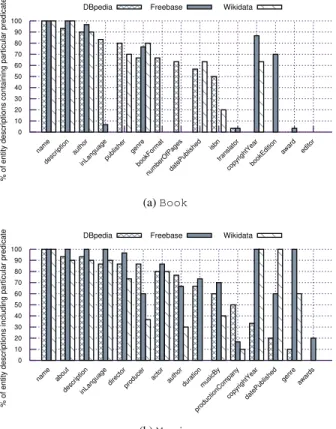
For a preliminary analysis of DBpedia, Freebase andWikidata, we randomly select 30 Wikipedia en-tities of type Movie andBook and retriev the corre-sponding entity descriptions from all three KBs. We select the 15 most frequently populated properties for each type and provide equivalence mappings across all KB schemas as well as theschema.orgvocabulary manually7. Since all vocabulary terms and types in the following refer to schema.org, prefixes are omitted. Figure 2 shows the proportion of instances for which the respective properties are populated. We observe a large amount of empty slots across all KBs for most of the properties, with an average proportion of miss-ing statements for books (movies) of 49.8% (37.1%) for DBpedia, 63.8% (23.3%) for Freebase and 60.9 % (40%) for Wikidata.
0 10 20 30 40 50 60 70 80 90 100
name description
author inLanguagepublisher
genre bookFormat
numberOfPagesdatePublished isbn
translator copyrightYearbookEdition
award editor
% of entity descriptions containing particular predicate
DBpedia Freebase Wikidata
(a)Book
0 10 20 30 40 50 60 70 80 90 100
name about
descriptioninLanguagedirectorproducer
actor authorduration musicBy
productionCompany copyrightYeardatePublished
genre awards
% of entity descriptions including particular predicate
DBpedia Freebase Wikidata
(b)Movie
Fig. 2. Proportion of book and movie instances per KB that include selected popular predicates.
In addition, coverage varies heavily across different properties, with properties such aseditorortranslator being hardly present in any of the KBs.
7The mappings are online at: http://l3s.de/ yu/knowmore/
Tail entities/types as well as time-dependent proper-ties which require frequent updates, such as theaward of a book, are prevalent in markup data [23], yet tend to be underrepresented in structured KBs. Hence, markup data lends itself as data source for the KBA task. However, given the specific characteristics of markup data [40], namely the large amount of coreferences and near-duplicates, the lack of links and the variety of er-rors, data fusion techniques are required which are tai-lored to the specific task of KBA from Web markup.
3.2. Problem Definition
For the purpose of this work, anentity descriptionis considered a semi-structured representation of an ac-tualentity, where the latter is either a physical (e.g. a person) or an abstract notion (e.g. a category or the-ory). Entity descriptions which represent the same en-tity are considered to becoreferences.
In particular, our work is concerned with entity de-scriptions extracted from structured Web markup of Web documents. We refer to such a dataset as M, where the WDC dataset is an example. Data in M consists of entity descriptionsei, each consisting of a set of RDF quads, i.e. a set ofhs,p,o,ui quadruples which are referring to entities. The elementshs,p,o,ui of the quadruple represent subject, predicate, object and the URL of the document from which the triple hs,p,oihas been extracted, respectively. An example of an entity description consisting of 3 quadruples is shown in Table 1. Here, for instance,_:node1 corre-sponds to subjects,<http://schema.org/author> cor-responds to predicatep,“Evelyn Waugh”corresponds to objecto and<http://example.url>8 corresponds to u, i.e. the document where the observed triples were extracted from. In later sections, for the sake of clar-ity and readabilclar-ity, we simplify the representation of quads by omitting the namespace and certain format-tings such as double quotes.
There existn≥0subjectss1,s2, ...,sn , and con-sequently,n entity descriptionsei = hsi,pi,oii ∈ E which represent a particular query entityqinM. Here, E is the set of all entity descriptions which (co)refer to entityq. We define a property-value pairhp,oi de-scribing the entityqas a fact ofq. Note that we explic-itly consider multi-valued properties, i.e. a particular
8For simplicity, we use http://example.url to represent the
Table 1
Example of an entity description of entity “Brideshead Re-visited” (of typeBook) extracted from Web markup.
Quadruples
_:node1 <http://schema.org/author> “Evelyn Waugh” <http://example.url> _:node1 <http://schema.org/bookFormat> “Paperback” <http://example.url> _:node1 <http://schema.org/publisher> “Back Bay Books” <http://example.url>
predicatepmight be involved in more than one fact for a particular entityq.
We define the task of augmenting a particular entity descriptioneq, representing a query entityqwithin a particular KB from data in a markup corpusMas fol-lows:
Definition 1 KBA task:
For a query entity q that is represented through an entity description eqin a KB, we aim at selecting a sub-set Fnovfrom M, where each fact fi ∈Fnovrepresents a valid fact which augments the entity description eq for q.
Note that Fnov represents the final output of the KnowMore pipeline. We consider a fact valid for aug-mentation, if it meets the following criteria:
– A fact iscorrectwith respect to query entityq, i.e. consistent with the real world regarding query entity qaccording to some ground truth (Section 6).
– A fact represents novel, i.e. not duplicate or near-duplicate, information with regard to the entity de-scriptioneqofqin a given KB.
– The predicate pi of facthpi,oiishould already be reflected in a KBs given schema.
As an illustrative example, let q be the book Brideshead Revisited. In a given KB, such as DB-pedia, there is an entity description9 eq which rep-resents q. From the Web markup corpus (M), we can extract a set of coreferring entity descriptions E representing the query entity q, that is, the book Brideshead Revisited. An example entity description ei ∈ E consists of 3 triples
<_:node1, author, Evelyn Waugh>, <_:node1, datePublished, 1940>, <_:node1, isbn, 9781904605577> . From all the facts (e.g.isbn, 9781904605577) inE, we aim at selecting the ones that are valid, according to the previous defi-nition, for augmenting the KB at hand.
9http://dbpedia.org/resource/Brideshead_Revisited
3.3. Approach Overview
Our approach (KnowMore) for addressing the KBA problem defined above consists of two steps, namely (i) entity matching, and (ii) data fusion. We introduce the intuition behind each step below and describe the actual method in the following sections.
Fig. 3. Overview of pipeline.
Entity matching. The first step, KnowMorematch, aims at obtaining candidate facts by collecting the set E of coreferring entity descriptions ei ∈ E from M which describeqand corefer to the entity description eqin a given KB. We use a three step approach in order to efficiently achieve high accuracy results.
– Data cleansing to improve general data quality.
– Blocking with standard BM25 entity retrieval on the value of propertynameof all indexed entity descrip-tions to reduce the search space. This step results in a set of candidate entity descriptionsE0that poten-tially describe the same entity aseq.
– Validation of each entity descriptione0
i ∈ E0in the result of the blocking step using supervised classifi-cation on the similarity vector betweene0
i andeq. Hence, we retrieve the setEcontaining candidate en-tity descriptions represented through facts f ∈F that potentially describeq.
Data fusion. During the data fusion step, KnowMoreclass, we aim at selecting a subsetFnov⊂F that fulfills the criteria as listed in Section 3.2. More specifically, we introduce data fusion techniques based on supervised classification to ensure the correctness (Section 5.1) and two deduplication steps to ensure novelty (Section 5.2), namely deduplication with respect toM (KnowMoreded) and deduplication with respect to the KB (KnowMorenov). The latter is a prerequisite for the KBA task.
Table 2
Summary of involved steps.
Step Notation Input Output
Entity matching KnowMorematch q,M F
Data fusion - correctness KnowMoreclass F Fclass
Deduplication with respect toM KnowMoreded Fclass Fded
Deduplication with respect to KB KnowMorenov Fded Fnov
We describe each step of the approach in the follow-ing two sections in detail.
4. Entity Matching
The entity matching step (KnowMorematch) aims at detecting a set of candidate entity descriptionsei ∈ E withE ⊂ M which are likely to be coreferences of a given KB entity description eq. We apply three steps inKnowMorematch, namely cleansing, blocking and matching. These steps are applied over all entities which are to be augmented.
4.1. Data Cleansing
This initial data cleansing step aims at (i) resolving object references and (b) fixing common errors [21] to improve overall usability of the data.
Whileschema.orgproperty range definitions are not bound in a strict way but constitute mere recommen-dations, previous studies [9] observe a strong tendency towards statements which refer to literals rather than objects, i.e. URIs. For instance, within a markup cor-pus of 44 million quads, 97% of transversal properties referred to literals rather than URIs/objects, despite the fact that only 64% of quads involved properties where schema.orgrecommends literals as property range [9]. Given this prevalence of literals in Web markup and the need to homogenise entity descriptions for further processing, we resolve object references into literals by replacing object URIs with the labels of the corre-sponding entity.
In addition, based on earlier work [21] which stud-ied common errors in Web markup, we implement heuristics and apply these to E as a cleansing step thereby improving the quality of the data. In particular, we implemented the heuristics as proposed in [21] to:
– Fix wrong namespaces.Most namespace issues seem due to typing errors, e.g. lacking a slash or using https:// instead ofhttp://. Another reason is the misuse of the upper/lower-cases in a
case-sensitive context, e.g. use ofSchema.orginstead of the valid termschema.org.
– Handle undefined types and properties. The use of undefined types and properties is frequent in Web markup data. Some of the undefined types exist due to typos and the misuse of the upper/lower-cases, e.g. the use of creativework for the intended typeCreativeWork, where simple heuristics can be applied to resolve these issues.
Applying these heuristics improves the performance of the subsequent step by providing a wider and higher quality pool of candidates.
4.2. Blocking
Blocking is typically used as a pre-processing step for entity resolution to reduce the number of required comparisons by placing potentially relevant entity de-scriptions, i.e. potential coreferences, into the same block so that the entity resolution algorithm is applied to entity descriptions within the same block only [7].
Related work [37] shows that string comparison be-tween labels of markup entities is an efficient way for obtaining potential coreferences, whereas the Lucene BM25 retrieval approach has been used successfully by previous works on entity resolution as summarized by [7].
Therefore, we implement the blocking step through entity retrieval using the BM25 retrieval model, i.e. a probabilistic ranking function used to rank match-ing documents accordmatch-ing to their relevance to a given search query, to reduce the search space. We created an index for each type-specific subset using Lucene, and then use the labelof eq to query the field name within a type-specific index. Hence, queries for a spe-cific type/label-combination which representsqresult in a set of candidate entity descriptionse0i ∈ E0 that potentially describe the same entity aseq.
Given that thename10 property is one of the most frequently populated properties for the considered en-tity types, i.e. 90.2% of enen-tity descriptions of type Bookand 86.8% of entity descriptions ofMovieare an-notated with a name, entity retrieval on the name/la-bel ensures comparably high recall during the blocking step.
For instance, considering the query “Brideshead Re-visited” (of type Book), as part of the blocking step we query the Lucene index and obtain 1,657 entity
scriptions consisting of 15,940 quads. An excerpt of the result set is shown in Table 3.
Table 3
Excerpt from the result set (1,657 entity descriptions in total) for the query “Brideshead Revisited” (of typeBook) after blocking.
Subject Predicate Object
_:node1 author Evelyn Waugh
_:node1 datePublished 1940
_:node1 isbn 9781904605577
_:node2 author Waugh, Evelyn
_:node2 publisher Back Bay Books.
_:node3 author Roger Parsley
_:node3 publisher Samuel French Ltd
4.3. Entity Matching
When attempting to match entities, one can build on the observation that particular property-value pairs can be considered near-unique identifiers for a spe-cific entity, so-called pseudo-key properties. For in-stance,taxIDcan be considered one of the pseudo-key property for instances of typePerson, andisbnfor in-stances of typeBook. However, as studied by Meusel et al. [23], resolving coreferences simply through pseudo-key properties does not produce sufficient re-sults when applied on sparsely described and heteroge-neous entity descriptions obtained from Web markup.
Thus, we adapt the entity matching approach de-scribed in [29] to filter out noise inE0, for instance, en-tity descriptions which are not relevant toqbut fetched through the initial blocking step due to ambiguous la-bels. Our matching approach builds on the assumption that the importance of distinct properties differs when computing entity similarity, with pseudo-key proper-ties being the most decisive ones. For example, in-stances of typeBookwhich share the sameauthorhave a higher probability to be equivalent than books which share the samebookFormat.
In order to compute the similarity for each prop-erty, we consider all properties as attributes of the fea-ture space−→A = {a1,a2, ...,an}, so that each entity descriptionecan be represented as a vector of values −
→v ={o
a1,oa2, ...,oan}which represent the objects of the consideredhp,oi tuples. We construct a similar-ity vector−→sim(−→vK B,−→v)betweeneqand each entity de-scriptione0i ∈E0as in Equation 1.
−→
sim(−→vK B,−→v) ={λa1, λa2, ..., λan} (1)
λai =sim(o
K B
ai ,oai) (2)
In order to compute sim(oK B
ai ,oai), we employ datatype-specific similarity metrics, i.e., we imple-mented one similarity measure for each schema.org datatype11, and automatically select the appropriate
metric. Specifically, for 1) Text, we employ cosine similarity, for 2)Number or Booleanattributes, sim
-(oK B
ai ,oai) equals to 1 if o
K B
ai is the same as oai, and 0 otherwise, for 3)Time or DateTime, we first unify different formatting styles with thejava DateTimeFor-matter12 class, and then split values into separate date parts (i.e. year, month, date), wheresim(oaK Bi ,oai)is 0 if there is a conflict any of the observed parts. For ex-ample, 1990 April and May 10th would constitute a conflict as the month unit is present in both strings, but the values are different. This indicates that these two strings cannot possibly represent the same date. Other-wise, i.e., in cases where no direct conflict is observed, we compute the Jaccard similarity between both triples consisting of the value ofhyear,month,dateias a met-ric of the overlapping semantics. For instance, the dates “2017 Oct 1st” and “2017 Oct” have a similarity of 0.667 as they have 2 common units out of 3. The java implementation of this step can be found online13. We then train a supervised classification model, to make the decision whether or not e0i is a match for eq. We experimented with several state-of-the-art clas-sifiers (SVM, Logistic Regression and Naive Bayes). Since Naive Bayes achieves a F1 score that is 0.08 higher than the best SVM (linear kernel), and 0.123 higher than the Logistic Regression (LR), throughout the remaining paper we rely on a trained Naive Bayes classifier unless otherwise stated. More details about classifier performance are provided in Section 7.1. The classification and clustering implementation in our ap-proach is built on top of the Java-ML toolkit14. The
training data is described in Section 6.2.
The final result of the entity matching step is the set of coreferring entity descriptionsei∈Ewhich consti-tute candidate facts fi∈Ffor the following steps.
Returning to our running example “Brideshead Re-visited”, after removing the unmatched entity de-scriptions from the blocking result through the entity matching step, there are 44 matched entity descriptions remaining in the result set. Some examples are shown in Table 4, where, for instance,_:node3had been re-moved since it refers to the stage play rather than the book and does not match entityq.
Table 4
Excerpt from result set (44 entity descriptions in total) for the query, “Brideshead Revisited” (of typeBook) after entity matching.
Subject Predicate Object
_:node1 author Evelyn Waugh
_:node1 datePublished 1940
_:node1 isbn 9781904605577
_:node2 author Waugh, Evelyn
_:node2 publisher Back Bay Books.
5. Data Fusion
This step aims at fusing candidate entity descrip-tions in E by detecting the correct and novel facts
fnov∈FnovwithFnov⊂Fto augmenteq.
5.1. Correctness - Supervised Classification
The first step (KnowMoreclass) aims at detecting correct facts by learning a supervised model that pro-duces a binary classification for a given fact f ∈ F into one of the labels {‘correct’,‘incorrect’}. For the classification model, we have experimented with sev-eral different approaches, namely Naive Bayes classi-fication, SVM with different kernel functions, Logistic regression, kNN with varying k’s and Random Forest. We rely on a Naive Bayes classification since our ex-periments have shown superior performance over the second best performing approach Logistic Regression with an increase inF1score of 0.016, and over SVM (linear kernel) with an increase inF1score of 0.044. Details about the performance of the three best per-forming approaches (Naive Bayes, SVM and Logistic regression) are provided in Section 7.2. We introduce the features used for our supervised learning approach in Table 5 and describe them in detail below. Through an initial data analysis step, all features have been iden-tified as potential indicators of fact correctness.
While we aim to detect the correctness of a fact, we consider characteristics of thesource, that is the Pay-Level-Domain (PLD, i.e. the sub-domain of a public top-level domain, which Website providers usually pay for), from which a fact originates, theentity descrip-tion, thepredicateterm as well as thefact itself. The four different categories are described below.
Source level. As has been widely studied in pre-vious works, source quality is an important indicator for data fusion [43,28,12]. Featurestr
1, ...,tr3are gener-ated from the PageRank score as an authority indica-tor of the PLD from which a fact is extracted, assum-ing a higher PageRank indicates higher authority and hence quality. Based on the intuition that more errors across the markup from of respective PLD indicate a higher potential of this PLD to provide incorrect facts, we consider the rate of common errors detected based on previously identified heuristics [21] to compute fea-turestr4, ...,tr6. Finally, we use precision of a PLD com-puted based on our ground truth (Section 6.2) as qual-ity indicators in featurestr7, ...,tr9.
Entity level.Based on the data analysis, entity de-scriptions containing a large number of facts are usu-ally of higher quality. Thus, we use the size of entity descriptions, reflected through featureste
1, ...,te3, as ad-ditional indicator of quality.
Property level.The quality of facts strongly varies across predicates, as identified in previous studies [40, 23], with some properties being more likely to be part of a correct fact than others. One example of a predi-cate often included in incorrect statements is datePub-lishedof a movie, that is often mistakenly used to de-scribe the publishing time of the Web document. Fol-lowing this observation, we extract features t1p, ...,t
p
5 to consider characteristics of the involved predicate terms, such as their frequency.
sur-Table 5
Features for supervised data fusion from markup data.
Category Notation Feature description
Source level t
r
1,tr2,tr3 Maximum, minimum, average PageRank score of the PLDs
containing fact f
tr4,tr5,tr6 Maximum, minimum, average percentage of common errors
[21] of the PLDs containing fact f
tr7,tr8,tr9 Maximum, minimum, average precision (based on training
data) of the PLDs containing fact f
Entity level te1,te2,te3 Maximum, minimum, average size (number of facts) ofei con-taining f
Property level
t1p Predicate term
t2p Predicate frequency inF
†tp
3 Amount of clusters of predicatep †tp
4 Average cluster size of predicatep †tp
5 Variance of the cluster sizes of predicatep
Fact level t
f
1 Fact frequency inF
†t2f Normalized cluster size thatfbelongs to
†-features extracted based on clustering result
face forms. The performance of the clustering on re-moving near duplicates is discussed in Section 7.3. An-other challenge considered here is the cardinality of predicates. Depending on the predicate, the number of potentially correct statements varies. For example, ac-tor is associated with multiple values, whereas dura-tionnormally has only one valid statement. This is re-flected in the cluster amountn for a given predicate (t3p). The intuition behind featuret4p is that the aver-age size of clusters is an indicator of the frequency of facts inpwhich usually correlates with the quality. Featuret5p is extracted based on the observation that in most cases, wrong facts have lower frequency than average, thus the variance is larger if there are wrong facts among the facts ofp.
Fact level.Fact frequency [20] has been used in pre-vious data fusion works and is shown to provide effi-cient features for determining the correctness of facts. Based on these insights, we extract featurest1f andt2f. We consider the size of a cluster as featuret2f indicat-ing the frequency of a fact, where the normalized size of clusterciis|ci|/Pn
j=1|cj|.
From the computed features we train the classifier for classifying the facts fromF into the binary labels {‘correct’,‘incorrect’}. More details about the train-ing and evaluation through 10-fold cross-validation are
presented in Section 7.2. The‘correct’facts form a set Fclassthat is the input for the next steps.
Again returning to our running example, after re-moving wrong facts from the candidate facts, such as datePublished: 1940 through the classification step, we obtain 37 correct facts in the result set for the query Brideshead Revisited, type:(Book). An excerpt of the resulting facts are shown in Table 6.
Table 6
Excerpt from result set (37 distinct correct facts) for query “Brideshead Revisited” (of typeBook) forKnowMoreclass.
Class Predicate Object
correct s:author Evelyn Waugh
correct s:isbn 9781904605577
correct s:author Waugh, Evelyn
incorrect datePublished 1940
correct s:publisher Back Bay Books.
5.2. Novelty
the KB. Each of these two conditions corresponds to a deduplication step.
Deduplication with respect to M (KnowMoreded). As introduced in Section 5.1, we detect near-duplicates via clustering. For each predicatep, all the facts f =
hp,oiicorresponding to pare clustered intonclusters {c1, c2,· · ·,cn}. Each cluster ci,i = 1, ...,n contains a set of near-duplicates. To fulfill i), we select only one fact from each cluster by choosing the fact that is closer to the cluster’s centroid. This results in the fact setFdedthat is the input for next deduplication step.
Deduplication with respect to KB
(KnowMorenov). We compute the similarity sim(fi,fK B) between a fact fK B in a respective KB for a particular predicate pand a fact fifor the same (mapped) predicate p in Fded with the datatype-specific similarity metrics as introduced in Section 4. Ifsim(fi,fK B)is higher than a thresholdτ, we remove the fact along with its near-duplicates, i.e. the facts in the same cluster from the candidate set Fnov. We explainτand its configuration during the experimental Section 6.3. The facts selected fromFnov in this step are the final result for augmenting the KB.
In our running example, the fact author: Waugh, Evelynis removed during the deduplication with re-gard to M as it is a duplicate of factauthor: Evelyn Waugh, which has been selected as more representa-tive.
With respect to the KBA task, consider the augmen-tation of the example entity “Brideshead Revisited” (of typeBook) as illustrated in Table 7. The example facts #2 and #3 would be valid results of the KBA task for DBpedia since they arenovel, while only fact #2 is a valid augmentation for Freebase and Wikidata as it is the only fact that is novel.
Table 7
Novelty of correct, distinct facts with regard to KBs for the query “Brideshead Revisited” (of typeBook).
ID Fact DBpedia Wikidata Freebase
1 author, Evelyn Waugh 7 7 7
2 isbn, 9781904605577 4 4 4
3 publ., Back Bay Books 4 7 7
Note that our deduplication step considers and sup-ports multi-valued properties. By relying on the clus-tering features, computed during the fusion step, we select facts from multiple clusters (corresponding to multiple predicates) as long as they are classified as correct. As documented by the evaluation results
(Sec-tion 7), this does not negatively affect precision while improving recall for multi-valued properties.
6. Experimental Setup
6.1. Data
Dataset.We use the WDC2015 dataset15, where we extracted 2 type-specific subsets consisting of entity descriptions of theschema.orgtypesMovieandBook. Initial experiments indicated that these types are well reflected in the WDC2015 datasets, and at the same time, their facts are comparably easy to validate man-ually when attempting to label a ground truth. The Moviesubset consists of 116,587,788 quads that corre-spond to 23,334,680 subjects/nodes, and theBook set consist of 174,459,305 quads and 34,655,078 sub-jects.
Entities & KBs to Augment.As input for the KBA task, we randomly select 30 entities from Wikipedia for each typeBookand Movie. We evaluate the per-formance of our approach for augmenting entity de-scriptions of these 60 entities obtained from three different KBs: DBpedia (DB), Freebase (FB) and Wikidata (WD). For DBpedia, we retrieve entity de-scriptions through the SPARQL endpoint16 where re-source URIs were obtained by replacing the Wikipedia namespace of our selected entities with the DBpedia resource path. URIs of corresponding Freebase and Wikidata entity descriptions are obtained through the owl:sameAs links present in DBpedia. Using these URIs, the respective entity descriptions are obtained through the latest available version of Freebase17
(ac-cessed Sep 30, 2016) and the Wikidata SPARQL end-point18.
The full list of entities can be found online13. An
analysis of the completeness of these obtained entity descriptions is shown in Figure 2 in Section 3.1.
Properties to Augment. To simplify the schema mapping problem between WDC data and the re-spective KBs while at the same time taking advan-tage of the large-scale data available in our cor-pus, we limit the task to entities annotated with the http://schema.org ontology for this experiment.
Pre-15http://webdatacommons.org/structureddata/index.html#toc3 16http://dbpedia.org/sparql
17
http://commondatastorage.googleapis.com/freebase-public/rdf/freebase-rdf-latest.gz
vious works have shown thatschema.orgis the only vocabulary which is consistently used at scale [23]. We manually create a set of schema mappings that maps the schema.org vocabularies to the DB, FB, WD vocabularies. For this, we first select all the schema.org predicates appearing in F. We identify the ones that have equivalent properties within all in-volved vocabularies and create equivalence mappings (owl:equivalentProperty). The list of predicates and the mapping statements can be found online13. 6.2. Ground Truth & Metrics
This section describes the ground truth used for training and testing together with the evaluation met-rics used for assessing performance in different tasks.
6.2.1. Ground Truth via Crowdsourcing
Entity Matching.We used crowdsourcing to build a ground truth by acquiring labels for eachei ∈ E. In each case, crowd workers were presented with the entity descriptioneq, i.e. the Wikipedia page, and en-tity descriptionei ∈ E, and were asked to validate ei as either valid, invalid or insufficient information to judgewith respect toeq. We deployed the task on CrowdFlower19, and gathered 5 judgments from
dis-tinct workers on each (q,ei∈ E) pair. To ensure high quality, we restricted the participation to Level 3 work-ers alone20. In addition to this, we used test questions to flag and reject untrustworthy workers. Workers were compensated at the rate of 6 USD cents per judgment. On average, workers performed with an accuracy of 92% on the test questions, indicating high reliability. The inter-rater agreement between workers was 75% using Krippendorff’s Alpha [18], and 89% using pair-wise percent agreement (PPA). By applying this pro-cess onE0, we obtain 89 (180)validand 128 (118)
in-validentity descriptions forMovie(Book) entities re-spectively.
Data Fusion - Correctness. Similarly, we used crowdsourcing to build a ground truth for the correct-ness of factsfi∈F. For the valid entity descriptions in E, we acquire labels for all distinct facts, as either cor-rectorincorrectwith respect toq. We acquired 5 judg-ments from distinct workers for each entity and cor-responding facts through Crowdflower. We used simi-lar quality control mechanisms as in the entity
match-19http:www.crowdflower.com
20Level 3 workers on CrowdFlower have the best reputation and
near perfect accuracy in hundreds of previous tasks.
ing task. Workers were compensated at the rate of 6 USD cents per judgment. Workers performed with an accuracy of 95% on the test questions. The inter-rater agreement between workers was 71.1% using Krip-pendorff’s Alpha, and 86.9% using pairwise percent agreement (PPA). This indicates a high reliability of the ground truth. This process results in 371 (out of 456) and 298 (out of 341)correctfacts forMovieand Bookdataset respectively. Distinct facts were obtained by removing duplicate literals, null values, URLs and the unresolved objects (e.g. node3that could not be resolved in the dataset). The ground truth is publicly available13.
Data Fusion - Novelty. We built corresponding ground truths for validating (i) deduplication perfor-mance withinM, as well as (ii) novelty with respect to the differentKBs. Three authors of this paper acted as experts and designed a coding frame to decide whether or not a fact is novel. After resolving disagreements on the coding frame on a subset of the data, every fact was associated with one expert label through manual delib-eration. We followed the guidelines laid out by Strauss [35] during the coding process, which provide guide-lines for designing reliable coding frames and carrying out manual coding and are frequently used to design coding frames and conduct qualitative analysis. Dis-tinct facts were obtained by removing duplicate liter-als, null values, URLs and unresolved objects.
6.2.2. Metrics
We consider distinct metrics for evaluating each step of our approach.
– KnowMorematch. To evaluate performance of the matching step, we consider precisionP- the percent-age of entity descriptionsei∈Ethat were correctly matched toeq, recallR- the percentage ofei ∈ E0 that were correctly matched to KB, and theF1score.
– KnowMoreclass.We evaluate the performance of the approaches through standard precision P, recall R andF1scores, based on our ground truth.
– KnowMoreded. We evaluate the performance of deduplication with respect to M (KnowMoreded) using Dist% - the percentage of distinct facts within the respective result set. We compare between Dist%(Fded) andDist%(Fclass), that is, before and after the deduplication withinM.
– KnowMorenov. For evaluating the performance of deduplication with respect to a given KB (Know -Morenov), we measure the novelty asNov- the per-centage of novel facts - and compare betweenNov
after this step. We also measure the recall R - the percentage of distinct and accurate facts inFded that have been selected byKnowMorenovintoFnov.
Furthermore, we demonstrate the potential of our approach for augmenting a given KB by measuring the coverage gain, which we introduce as a means to mea-sure the capacity of our approach to populate gaps in existing KBs (Section 3.1). The coverage gain of pred-icatepis computed as the percentage of entity descrip-tions having ppopulated through theKnowMore ap-proach (i.e. after stepKnowMorenov) with at least one fact hp,oi, out of the ones that did not have at least one statement involving propertypwithin the respec-tive KB before augmentation. Note that according to this metric a coverage gain of less than 100% might not necessarily indicate non-optimal recall but might be caused by the non-applicability of attributes to a particular entity. For instance, not all entities of type Moviehave a value for the propertyaward. The result is reported in Section 7.4.
6.3. Configuration & Baselines
Configuration. We deploy our approach as de-scribed in Section 4.3 and 5. For the entity matching step, we use Lucene for indexing and BM25 retrieval with the Lucene default configuration wherek1= 1.2,
b = 0.75. For the deduplication with respect to KBs, we report the evaluation result ofKnowMorenovusing differentτ={0.3,0.5,0.7}in Section 7.3.
Baselines. We compare (KnowMoreclass) with PrecRecCorr that is proposed by Pochampally et al. [28] andCBFS [42]. To the best of our knowledge, theCBFSapproach is the only available method so far directly geared towards the challenges of markup data, whilePrecRecCorrrepresents a recent and highly re-lated data fusion baseline. We also present the results ofKnowMorematchandKnowMoreclassusing different classifiers.
– KnowMoreclass: facts selected based on the KnowMoreclasspipeline fromF, using Naive Bayes as classifier for selecting correct facts.
– KnowMoreclass (SVM): facts selected based on the KnowMoreclasspipeline fromF, using Support Vec-tor Machine (linear kernel) as the classifier for se-lecting correct facts.
– KnowMoreclass (LR): facts selected based on the KnowMoreclasspipeline fromF, using Logistic Re-gression (LR) as classifier for selecting correct facts.
– PrecRecCorr: facts selected based on the approach from candidate set F. We consider each PLD as a
source and implemented the exact solutionas de-scribed in the paper. We use the threshold as pre-sented in the paper, i.e. 0.5, to classify facts.
– CBFS: facts selected based on theCBFS approach from F. The CBFS approach clusters the associ-ated values at the predicate level into n clusters (c1,c2,· · · ,cn) ∈ C. Facts that are closest to the cluster’s centroid of each cluster are select, provided they meet the following criteria:
|cj|> β·max(|ck|),ck∈C (3) where|cj|denotes the size of clustercj, andβis a parameter used to adjust the number of facts. In our experiment,βis empirically set to 0.5, which is the one used by the best-performing setup in the original paper.
7. Evaluation Results
In this section, we present experimental results ob-tained through the setup described in the previous sec-tions.
7.1. Entity Matching
As the entity matching step (KnowMorematch) is a precondition for the subsequent fusion step, we pro-vide evaluation results for this step and compare it to entity descriptions obtained through BM25@kas base-line. The BM25 configuration is the same as used in our approach (Section 6.3). Since we obtain the cor-responding URIs of Freebase and Wikidata entities through thesameAslink in DBpedia, here we present only the result of matching entity descriptions to DB-pedia. Table 8 shows the evaluation results of the stan-dard precisionP, recallRandF1scores.
Table 8
Performance ofKnowMorematchand baselines.
Movie Book
Approach P R F1 P R F1
KnowMorematch 0.943 0.742 0.83 0.88 0.894 0.887
KnowMorematch(SVM) 0.583 0.87 0.698 0.824 0.899 0.86
KnowMorematch(LR) 0.627 0.645 0.636 0.821 0.851 0.836
BM25@10 0.659 0.652 0.655 0.325 0.533 0.404
BM25@20 0.592 0.831 0.692 0.219 0.722 0.336
BM25@50 0.406 1.000 0.578 0.124 1.000 0.220
classi-fier) achieves high F1 scores of 0.83 and 0.887 re-spectively, thereby outperforming the BM25@20 and BM25@50 baselines and providing a sound set of can-didates for the subsequent step. One reason for the poor precision of the baseline BM25@k is the in-troduction of false positives by relying on the value of propertyname, which is inherently ambiguous for the matching task. SinceKnowMorematchuses BM25 retrieval as a blocking step and then applies a clas-sifier that takes all the properties into consideration, precision is significantly improved. Among differ-ent configurations of the KnowMorematch approach, the Naive Bayes classifier achieves the highest preci-sion and F1 score compared to the Logistic Regres-sion (LR) classifier KnowMorematch(LR) and SVM KnowMorematch(SVM) on both types.
7.2. Correctness - Data Fusion
Table 9
Performance ofKnowMoreclassand baselines.
Movie Book
Approach P R F1 P R F1
KnowMoreclass 0.954 0.896 0.924 0.880 0.868 0.874
KnowMoreclass(SVM) 0.845 0.976 0.906 0.810 0.799 0.804
KnowMoreclass(LR) 0.894 0.946 0.919 0.889 0.809 0.847
PrecRecCorr 0.924 0.861 0.891 0.893 0.48 0.624
CBFS 0.802 0.752 0.776 0.733 0.842 0.784
The results forKnowMoreclassas well as the base-lines are shown in Table 9. As shown in the table, our chosen configuration, i.e. using a Naive Bayes classifier (KnowMoreclass) achieves highestF1scores among all the different configurations. Compared to the different configurations of our approach deploy-ing different classification models, the precision is 0.025 (0.089) higher, and theF1score is 0.016 (0.044) higher than using LR (SVM). Potential reasons for the strong performance of the NB classifier could be 1) the assumed independence of features, which is one of the expectations of NB classifiers and 2) that, compared to other models, NB tends less to overfitting when the amount of training data is limited.
The presented F1 score of thePrecRecCorr base-line is the best possible configuration for our given task, where we experimented with different thresh-olds ([0,1], gap 0.1) as discussed in [28] and identi-fied 0.5 experimentally as the best possible configu-ration. We observe that theF1score of our approach is 0.141 higher than PrecRecCorr and 0.119 higher thanCBFS on average across datasets. This indicates
that our approach provides the most efficient balance between precision and recall across the investigated datasets, when applied to the novel task of data fu-sion from Web markup. Although, the precifu-sion of the baseline approach PrecRecCorr is 0.013 higher than the one fromKnowMoreclasson theBookdataset, the baseline fails to recall a large amount of cor-rect facts, where the recall of KnowMoreclass is ap-proximately 0.388 higher. This also is reflected in the average size of entity descriptions obtained through both approaches, where the entity descriptions from PrecRecCorr consist of 4.88 statements on average, and the ones fromKnowMoreclassare 8.83, indicating a larger potential for the KBA task.
The reason that the baseline PrecRecCorr has lower recall compared to KnowMoreclass is that the PrecRecCorr approach relies on the assumption that the facts extracted from high quality sources (i.e. PLDs that provide larger percent of correct facts) are more likely to be true. Although this is a reasonable as-sumption that results in a high precision result, it penalises facts that originate from sources (PLDs) which contributed wrong facts as part of the training set. This leads to a large number of false negatives. KnowMoreclass, however, considers the source quality (source level features), yet uses several other features in the decision making process and is more robust to the source quality and thus results in higher recall.
TheCBFS approach is built based on the intuition that the more frequent a fact is, the higher the chance that it is true. Based on the results, this assumption does not necessarily lead to higher precision compared to the assumption used by thePrecRecCorrapproach. Since KnowMoreclass utilizes multiple features ex-tracted from several different dimensions, including fact frequency, the classifier trained on these multi-dimensional features results in better performance.
A more detailed discussion of the potential impact on the KBA task is provided in Section 9, investigating the KBA potential beyond the narrow definition of the investigated task of this setup, e.g. by augmenting ad-ditional predicates not already foreseen in a given KB schema or to populate KBs with additional entities.
(p<.01). Tables 8 and 9 reflect the average values over 20 runs of the corresponding algorithms.
7.3. Novelty
This section presents the evaluation results for the deduplication steps introduced in Section 5.2.
Diversity.Table 12 presents the evaluation result be-fore (Dist% (Fclass)) and after (Dist% (Fded)) the step KnowMoreded.
Table 10
DiversityDist%before and after deduplication.
Dataset Dist%(Fclass) Dist%(Fded)
Movie 94.8 96.1
Book 82.1 95.6
The Dist% of facts improves by 1.3 percentage points for theMovie dataset and by 13.5 percentage points for theBook dataset (Table 12). The less im-provement gain for the Movie dataset presumably is due to the nature of the randomly selectedMovie enti-ties. As these appear to be mostly tail entities, candi-date facts in our markup corpusM are fewer and less redundant. Hence, the amount of duplicates and near-duplicates is smaller, reducing the effect of the dedu-plication step. Hence, dedudedu-plication is of particular im-portance for popular and well-represented entities.
Novelty with respect to KB.The results before (Nov
(Fded)) and after (Nov (Fnov)) the deduplication for specific KBs using different similarity thresholds (τ) are presented in Table 11.
Since our approach is not aware of the total num-ber of novel facts for a particular entity descrip-tion on the Web a priori, in this evaluadescrip-tion, we con-sider all the novel facts in Fded as the gold stan-dard, and compute the recall of Fnov after applying theKnowMorenovaccordingly. We evaluate the perfor-mance ofKnowMorenovusingτin {0.3, 0.5, 0.7} since (1) 0.5 is widely used as threshold for identifying du-plicate text using cosine similarity, (2) for computing DateTime similarity between facts, the possible simi-larities according to our metric are: {0, 0.33, 0.5, 0.67, 1}. These 3 selected thresholds are most influential on the selection of DateTime facts, thus can produce most conclusive results for showing the trade-off between novelty and recall. As shown in Table 11, even though there is a trade-off betweennoveltyandrecall, differ-ent values ofτdo not have a strong influence on the evaluation metrics. One of the reasons is that, a large
proportion of facts have non-literal (e.g. numeric) val-ues. While our datatype-specific similarity computes a binary (0 or 1) score in these cases, it is not influenced by the selection ofτ.
Considerτ= 0.5as an example. TheKnowMorenov step improves novelty by 0.282 on average across datasets and KBs compared to the result of the KnowMoreded step (Fded), and is able to recall over 90% of the novel facts. Our final resultFnov shows a novelty of over 90% on average, what translates to a minor amount of near-duplicates and a sufficient nov-elty for augmenting the target KBs.
7.4. Coverage Gain
This section discusses the coverage gain, as an in-dicator of theKnowMoreperformance in the particu-lar KBA task described in Section 3.2. Since the ad-dressed task is fairly narrow, i.e. dealing with the aug-mentation of a selected set of attributes and entities existing in all three investigated KBs, we discuss the overall KBA potential of Web markup data beyond our ground truth dataset in Section 9.1.
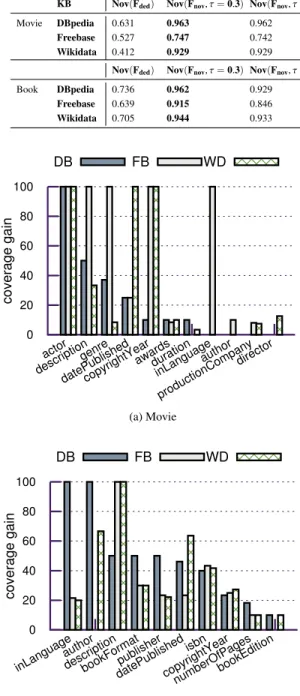
Figure 4 shows the coverage gain on the previously empty slots as shown in Figure 2 per predicate and KB for our selected 30 entities (per type). Based on the evaluation result, the KnowMorepipeline shows a coverage gain of 34.75% on average across dif-ferent properties for DBpedia, 39.42% for Freebase and 36.49% for Wikidata. We observe that the ob-tained gain varies strongly between predicates and en-tity types, with a generally higher gain for book-related facts. For instance, within theMoviecase, for property actorwe were able to gain 100% coverage in both DB-pedia and Freebase, while the propertyawardshows a coverage gain of 10% or less for all three KBs. Rea-sons behind low coverage gain for a particular prop-erty are 2-fold: 1) the lack of data in the Web markup data corpus, and 2) the lack of true facts in the real world for a particular attribute, e.g. only a small pro-portion of movies have won an award. On average, we obtained 2.8 (6.8) facts for each movie (book) entity in our experimental dataset.
Table 11
Novelty ofFdedandFnovwith respect to target KBs.
KB Nov(Fded) Nov(Fnov, τ=0.3) Nov(Fnov, τ=0.5)Nov(Fnov, τ=0.7) R(Fded) R(Fnov, τ=0.3)R(Fnov, τ=0.5)R(Fnov, τ=0.7)
Movie DBpedia 0.631 0.963 0.962 0.962 1 0.927 0.939 0.939
Freebase 0.527 0.747 0.742 0.742 1 0.942 0.957 0.957
Wikidata 0.412 0.929 0.929 0.897 1 0.963 0.963 0.963
Nov(Fded) Nov(Fnov, τ=0.3) Nov(Fnov, τ=0.5)Nov(Fnov, τ=0.7) R(Fded) R(Fnov, τ=0.3)R(Fnov, τ=0.5)R(Fnov, τ=0.7)
Book DBpedia 0.736 0.962 0.929 0.92 1 0.826 0.848 0.870
Freebase 0.639 0.915 0.846 0.825 1 0.833 0.846 0.846
Wikidata 0.705 0.944 0.933 0.923 1 0.791 0.814 0.837
0 20 40 60 80 100
actor description
genre
datePublishedcopyrightYear awardsduration
inLanguage author
productionCompany director
coverage gain
DB FB WD
(a) Movie
0 20 40 60 80 100
inLanguage author
descriptionbookFormatpublisher datePublished
isbn
copyrightYearnumberOfPagesbookEdition
coverage gain
DB FB WD
(b) Book
Fig. 4. Proportion of augmented entity descriptions with
KnowMore. Only predicates which were augmented in at
least one KB are shown.
8. Evaluation of Generalisation Potential
As introduced earlier, our approach has been trained on two specific types (BookandMovie). The intuition
behind this choice is that (i) different properties have varied contribution on different types when comput-ing the similarity between entity descriptions in the entity matching step and (ii) particular features such as predicate termt1p increase the feature space when introducing new types and associated properties. To this end, we have restricted our experiments to partic-ular types to reduce the required training data. How-ever, given the type-agnostic nature of most features, it seems reasonable to anticipate comparable perfor-mance even when applying our approach across types. In this section, we evaluate the generalisation of the KnowMoreapproach with respect to two aspects: 1) the scale of training data required for the supervised fusion step, 2) the performance of our approach when trained with cross-type training data, as opposed to type-specific sets.
8.1. Scale of required Training Data
As described in Section 6.2, our ground truth con-sists of judgments for 217 (298) entity descriptions forMovie(Book) entities for the entity matching step KnowMorematch, and 456 (371) facts ofMovie(Book) entities for the data fusion step KnowMoreclass. The experimental evaluation in Section 7 is based on the averaged P/R/F1 scores from a 10-fold cross validation (90% training and 10% testing). To evaluate how per-formance is affected by the scale of the training data, we have conducted our experiments with subsets of the data which vary in size. In particular, for each type, we run 10 experiments where the subset of the training data usesnpercent of the original training data set and nis in the range of [10, 100]. 10-fold cross-validation is performed for eachn.
0.6 0.65 0.7 0.75 0.8 0.85 0.9 0.95 1
0.1 0.2 0.3 0.4 0.5 0.6 0.7 0.8 0.9 1
P R F1
(a)Movie
0.6 0.65 0.7 0.75 0.8 0.85 0.9 0.95 1
0.1 0.2 0.3 0.4 0.5 0.6 0.7 0.8 0.9 1
P R F1
(b)Book
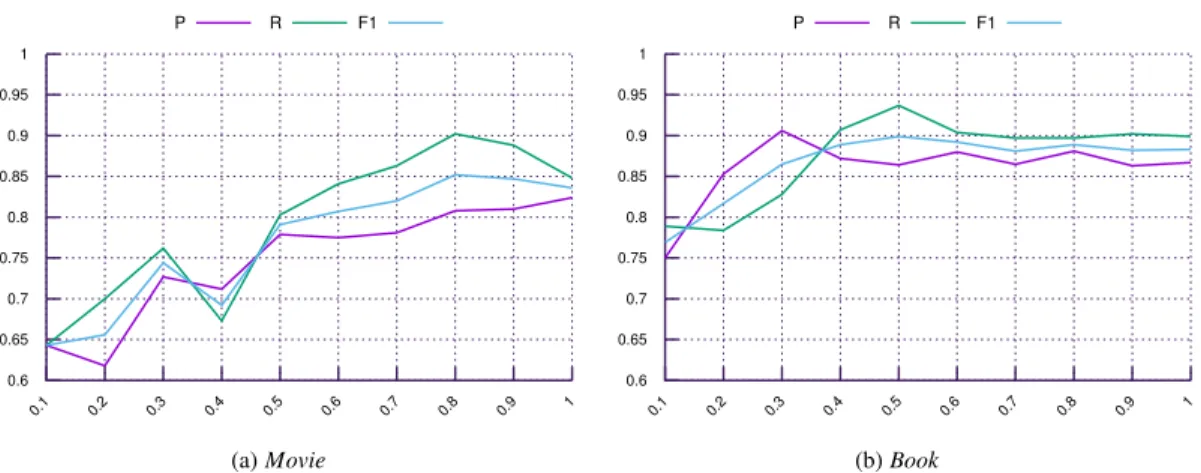
Fig. 5.P, R and F1 score using different size of the training data forKnowMorematch. X-axis shows the percent of training data, Y-axis shows the P/R/F1 value.
0.6 0.65 0.7 0.75 0.8 0.85 0.9 0.95 1
0.1 0.2 0.3 0.4 0.5 0.6 0.7 0.8 0.9 1
P R F1
(a)Movie
0.6 0.65 0.7 0.75 0.8 0.85 0.9 0.95 1
0.1 0.2 0.3 0.4 0.5 0.6 0.7 0.8 0.9 1
P R F1
(b)Book
Fig. 6.P, R and F1 score using different size of training data forKnowMoreclass. X-axis shows the percent of training data, Y-axis shows P/R/F1 value.
training data sets of the size of 80%(50%) for the Movie(Book) type, i.e. training data sets of at least 130 (119) entity descriptions for theMovie(Book) type.
Similar characteristics can be observed for the KnowMoreclass approach in Figure 6, where the F1 score reaches 0.89 (0.87) at 70% (70%) of training data forMovie (Book). Hence, results suggest that even with comparably limited amounts of training data, reason-able performance can be achieved, thereby supporting the application across types and datasets. For instance, the cost for retrieving 80% (70%) of our entity match-ing (data fusion) ground truth from CrowdFlower with the approach as described in Section 6.2, is less than 15 USD and the time required is less than 24 hours for each type.
8.2. Model Performance across Types
from theMoviemodel (0.967). This suggests that our approach can work on models trained on cross-type data. In order to fully validate this finding, further stud-ies are required with more diverse query sets as well as datasets involving larger amounts of types.
9. Discussion & Limitations
9.1. Potential of KBA from Web Markup
Beside the specific KBA task evaluated in this pa-per, where we aim at (i) augmenting existing entities in a given KB by (ii) populating a given set of proper-ties from a given KB schema for these entiproper-ties, markup data shows large potential to augment KBs with prop-erties and entities not yet present in KBs. Investigat-ing the data from our two datasets (Movie, Book) and another set of 30 randomly selected entities of type Product, we observe that a large proportion of state-ments in the WDC dataset involve properties not yet present in any of the KB schemas. For instance, for movies (books), 62.5% (66.8%) of entity descriptions inFcontain facts not yet present in our set of mapped predicates. Comparing product descriptions from F, we detect 20.6% statements containing properties not yet present in the DBpedia ontology at all (verified through manual inspection).
In order to better highlight the potential of Web markup data to support knowledge base augmentation, we applyKnowMoreon all the movie and book enti-ties from DBpedia. Out of all the 106,613 movie en-tities in DBpedia (10 Jan., 2017 version), we found coreferences in our markup corpus for 101,069 dis-tinct entities (94.8%). Out of 35,577 book entities in DBpedia, we found coreferences for 34,964 entities in our markup corpusM (98.3%). In total, this resulted in 4,412,337 (1,783,231) instances, i.e. markup nodes, and 42,624,281 (16,580,862) candidate facts for the selected set of movies (books). On average, we found 5.06 (7.98) facts for each movie (book) instance. Based on the experimental results, our KnowMore approach obtained 511,409 (279,013) new facts for all DBpedia movie (book) entities. Note that this includes only en-tities already present in DBpedia. Whereas there is a wide variety of instances of both types which are not present in DBpedia but in markup, our approach could be used to populate DBpedia, in particular with less popular and long-tail entities. Thus, we observe a con-siderable potential for augmentation of KBs with new entities, as opposed to augmenting existing ones.
To assess performance in such cases, we randomly select 30 names of products under the requirement that each appears in at least 20 different PLDs in WDC, to ensure that there is sufficient consensus on the name being a legitimate product title. Manual inspection confirmed that none of such randomly selected prod-ucts is represented in DBpedia.
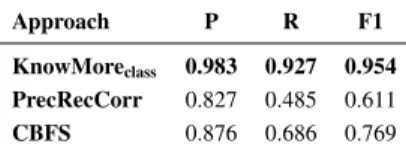
By running theKnowMoreclassapproach on 30 se-lected product entities, we found 136 correct facts in total, resulting in 4.53 facts for each entity on average. Table 12 shows the performance of KnowMoreclass and our baselines on this dataset.
Table 12
Data fusion performance forProductentities.
Approach P R F1
KnowMoreclass 0.983 0.927 0.954
PrecRecCorr 0.827 0.485 0.611
CBFS 0.876 0.686 0.769
Results indicate that the performance gain of our ap-proach is particularly evident on such long-tail entities as represented in ourProductdataset.
9.2. Limitations
Results demonstrate thatKnowMoreis able to ex-ploit Web markup data for KBA tasks. Further im-provement can be gained by applying our approach on a focused crawl, targeted towards a specific KBA task, such as movie enrichment, rather than a cross-domain Web crawl such as the WDC/Common Crawl.
In contrast to related KBA approaches such as [16] or [39], it is worth noting that our approach is trained for particular entity types only, not towards particu-lar properties, as is the case with the aforementioned approaches. Hence, KnowMore can be adapted to a wider range of scenarios with less effort than previous KBA approaches. In addition, we have demonstrated in Section 8.2 that our models can potentially gener-alise across types.