http://www.jscdss.com
Vol.7 No.3 June 2020: 6-12 Article history:
Accepted 22 March 2020 Published online 22 March 2020
Journal of Soft Computing and Decision
Support Systems
Customer Knowledge Management Enhancement in Enterprise Software
Development Firms: Experts Perspective on a Theoretical Framework
Arash Khosravi a,* a
Mahallat Institute of Higher Education, Iran
* Corresponding author email address: [email protected]
Abstract
Application of Customer Knowledge Management (CKM) in different companies, particularly software companies, is growing. Signi ficant beneficial outcomes of CKM encourage companies to implement CKM. This study proposes a theoretical framework based on CKM antecedent factors in enterprise software development companies. The level of significance of CKM antecedent factors was identi fied by experts. A Theoretical CKM Framework was developed by extracting Technological, Organizational and Human factors from the p revious works, then, the “Technique for order of Preference by Similarity to Ideal Solution” (TOPSIS) was used to identify the significant ones. The extracted factors were evaluated by 31 experts in the related domain. The results show that, from an expert viewpoint, the significant factors are classified into high and low level groups. Due to the importance of CKM for organizations, this study provides a significant contribution to CKM by extracting and ranking CKM antecedent factors for enterprise software development. It is proposed that software companies emphasize high priority antecedent factors for successfully implementing CKM.
Keywords:Software Quality, TOPSIS, Customer Knowledge Management
1. Introduction
Software quality in organizations requires a long enhancement process and mature business processes for product production (Yeung, Lo, Yeung, & Cheng, 2008). Research on the organizational conditions such as Customer Knowledge Management (CKM) that improve software quality in software companies’ has not been given much attention. Compared to other types of software, the quality of Enterprise Software (ES) is the most vital, since sales of ES include products and services which are associated with it (Cho, Subramanyam, & Xia, 2013). ES needs related services such as installation, customization, maintenance (repair and updates), training, and routinization (Cho et al., 2013; Sarrab & Rehman, 2014). Adoption in ES requires long-term organizational and financial commitments. Compared to other types of software products, the supported requirements of ES are unique and depend on CKM (Aho & Uden, 2013). These related services require the customer and end user comments, feedback, suggestions, complaints and end user experiences (knowledge from customers). Customization needs more information from customers who suggest new solutions for software enhancement. High quality ES can reduce the cost of service delivery. Investigating how to improve software quality is much demanded in enterprise software development (Cho et al., 2013). According to Knowledge Based View (KBV), CKM is effective
organizational factor that enhance software quality in software companies (Garrido-Moreno, Lockett, & García-Morales, 2014). The outcomes of this study help companies focus on significant CKM factors and reduce organizational resource waste. Understanding the antecedent weights helps software companies improve the success rate for CKM projects and motivate managers to implement CKM. Despite many studies that have examined CKM antecedent factors in multiple contexts, none of them are comprehensive enough to capture all factors into one single framework.
In this study, an empirical study was conducted to investigate possible factors influencing CKM. The questions that were asked in this study are: (a) What are the CKM significant factors in an organization based on Human, Organization and Technology frameworks? (b) What framework is appropriate to weigh and prioritize antecedent factors using TOPSIS for ES development companies?
This paper evaluates the importance level of CKM critical factors. This study proposes a framework to weigh and prioritize CKM antecedent factors based on expert viewpoints using TOPSIS in enterprise software development. To achieve this goal, this report has the following sections. In Section 2 the related works are reviewed. In Section 3 a theoretical framework was developed based on CKM important factors extracted from the literature. In Section 4, the proposed framework was
evaluated by experts. Section 5 discuss the results and compares them with previous studies as well as describing study’s conclusion.
2. Literature Review
2.1 Customer Knowledge Management
Customer data consists of information on customers in organization databases, binders, and the minds of employees. Customer data is organized in organizations’ databases to create customer information. When customer information is translated and disseminated in an organization, it becomes customer knowledge (Gebert, Geib, Kolbe, & Riempp, 2002; Khosravi, 2014). Customer Knowledge Management (CKM) is a combination of Knowledge Management (KM) and Customer Relationship Management (CRM) principles (Aho & Uden, 2013; Khosravi, 2015).
2.2 CKM Challenges
Developing a reliable CKM system must address certain challenges such as a lack of senior management support, a lack of CRM technology infrastructure that facilitates CK absorption, as well as lack of trust between customers and companies (Khosravi & Ab Razak, 2016). Developing trust between project teams and customers is challenging. Customers find it difficult to trust external project teams, and project teams find it difficult to trust customers (Khosravi & Ab Razak, 2016). Another challenge for CKM in organizations is an organizational structure that can support CKM (Aho & Uden, 2013; Smith & McKeen, 2005). CKM also faces cultural challenges. Some organizations are not outward looking toward clients, but inward looking towards products (Attafar, Sadidi, Attafar, & Shahin, 2013; Gibbert, Leibold, & Probst, 2002).
2.3The Generic Framework of CKM
In a study based on Knowledge Based View (KBV) and the Theory of Technology by Orlikowski (1992), the Generic CKM Framework was proposed (see Fig. 1). According to KBV, the success of a CKM plan is measured based on CKM outcomes such as product quality (Khosravi & Nilashi, 2018). The Generic CKM Framework illustrates that product quality is a CKM outcome (Khosravi, Hussin, & Minaei-Bidgoli, 2017).
Fig. 1. Generic CKM Framework
3. Development of the CKM Theoretical Framework
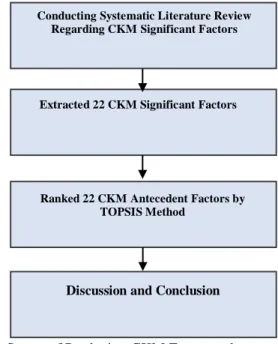
In this study, CKM antecedent factors were extracted from previous studies. Based on the literature review, theoretical background, the Generic CKM Framework described in the previous section, and previous empirical research findings, a theoretical research framework was developed. This framework was then evaluated by experts in the ES development domain using the TOPSIS method. The final CKM theoretical framework for ES development companies was then developed. The researcher systematically reviewed articles regarding CKM that were published between 2002 and 2018, then chose 72 articles concerning CKM enablers to extract 22 antecedent factors. Seven important electronic databases were chosen (Association for Information System (AISeL), Emerald, Google Scholar, IEEE Xplore, Science Direct, Scopus, and Springer) to collect the CKM enablers. These databases were chosen as they were considered the most relevant and covered the most important impact journals and conference proceedings in CKM. After filter were titles, abstracts, and keywords. 687 papers regarding CKM were found, and after checking the abstract and conclusion of the articles, 163 article were selected. Then, using inclusion and exclusion criteria, 72 papers were selected. The papers discuss CKM success factors and provide a clear quantitative or qualitative framework. Review papers were excluded. Fig. 2 illustrates the production of the CKM framework.
Fig. 2. Stages of Producing CKM Framework
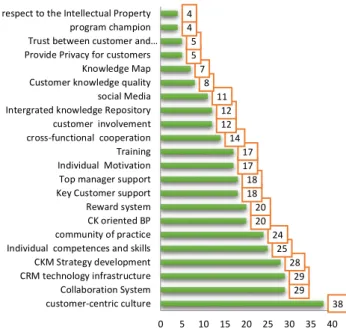
According to Fig. 3, antecedent factors such as “Customer-Centric Organizational Culture”, “Collaboration System”, and “CRM Technology Infrastructure” are the most iterative in the CKM literature. However, “Customer Privacy”, “Program Champion”, “Trust” and “Customer’s Intellectual Property” are less iterative in the literature.
Conducting Systematic Literature Review Regarding CKM Significant Factors
Extracted 22 CKM Significant Factors
Ranked 22 CKM Antecedent Factors by TOPSIS Method
The scope of this study is enterprise software firms. 72 CKM papers were investigated to discover the CKM antecedent factors used by IT companies. Fig. 5 shows the frequency of the factors that were considered by previous IT researches. This was the criteria for selecting important factors in this study.
Fig. 3. CKM antecedent factors frequency in the previous works
According to Fig. 4, CKM was inspected in 13 different contexts. Most selected papers made no mention of the context (32%) and this study considers them to have a general context. The definition of each factor and a list of references is provided in Khosravi and Hussin (2018).
Fig. 4. Frequency of using CKM in different variety of contexts
4. CKM framework for the software companies
In the previous section, 72 articles regarding CKM were reviewed and 22 significant factors were extracted. These factors were used in different fields and countries. This study investigates what of the extracted CKM antecedent
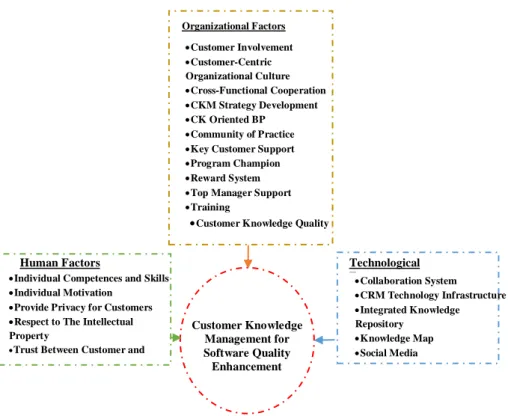
factors are suited for enterprise software development companies. Appropriate techniques were chosen to select suitable CKM antecedent factors for the scope and purpose of this study. The TOPSIS method was used to choose the appropriate factors and develop a framework for CKM for software development companies (see Fig. 6).
Fig. 5. CKM antecedent factors Frequency that was used in the IT companies
4.1 Data collection
After extracting the CKM impact factors, the priority and weight of the factors were used to select appropriate factors for ES development. This study consulted with ES development experts using a survey questionnaire designed to find out what extracted impact factors are most important for ES. The survey questionnaire included a list of CKM enablers and their definitions. This study asked experts to evaluate each factor using a 5-point Likert scale (not important, low important, important, moderate important, and very important). When it comes to MCDM procedures (Ahani et al., 2019; Nilashi, Ahmadi, Ahani, Ravangard, & bin Ibrahim, 2016; Nilashi, Zakaria, Ibrahim, Majid, Zin, Chugtai, et al., 2015; Yadegaridehkordi, Nilashi, Shuib, Asadi, & Ibrahim, 2019), no guidelines exist for deciding the number of respondents. As TOPSIS is not based on statistics (Nilashi & Ibrahim, 2014; Nilashi et al., 2019), a modest sample size was adequate (Duke & Aull-Hyde, 2002; Herath & Prato, 2006; Yang & Tzeng, 2011). In the opinion of Ar and Kurtaran (2013), MCDM such as TOPSIS and AHP are scientifically applicable and do not require a large sample size (Nilashi et al., 2016; Nilashi et al., 2020; Nilashi, Zakaria, Ibrahim, Majid, Zin, & Farahmand, 2015) . In the study conducted by Nilashi, Zakaria, Ibrahim, Majid, Zin, and Farahmand (2015), MCDM procedures were used to rank factors based on the viewpoint of 12 experts. Taking these views into
38 29 29 28 25 24 20 20 18 18 17 17 14 12 12 11 8 7 5 5 4 4
0 5 10 15 20 25 30 35 40
customer-centric culture Collaboration System CRM technology infrastructure CKM Strategy development Individual competences and skills community of practice CK oriented BP Reward system Key Customer support Top manager support Individual Motivation Training cross-functional cooperation customer involvement Intergrated knowledge Repository social Media Customer knowledge quality Knowledge Map Provide Privacy for customers Trust between customer and…
program champion respect to the Intellectual Property
29
14
7 7 6 4 3 3 3 3 3
2 2 2
0 5 10 15 20 25 30 35
4 4
3 3 3
2 2 2 2
1 1 1 1 1 1 1 1 1 1
consideration, this study decided to use 50 specialists for the data gathering stage. After distributing the survey questionnaire to 50 ES experts from 13 different companies, 31 completed questionnaires were returned. Table 1 provides the respondent demographic profiles.
Demographic data illustrates that all the experts have more than 5 years’ work experience and that most experts have more than 10 years work experience in software development in Iran.
Fig. 6. The CKM Theoretical Framework
Table 1
The Respondents’ Demographic Profile
Aspects Category Respondents (n) Respondents (%)
Gender Male 19 61
Female 12 39
Age
24-33 8 26
34-50 18 58
Over 50 5 16
Year of experience in the field of ES development
5-10 11 36
11-15 14 45
Over 15 6 19
Specialization
Chief Executive Officers 6 19
Chief commercial Officers 7 23
Chief Customer Officer 9 29
Chief product officer 5 16
Developer 4 13
Level of education Bachelor’s 19 61
Master’s 9 29
Higher 3 10
4.2 TOPSIS analysis
This study provides factor rankings presented in the TOPSIS Framework. TOPSIS was applied to rank 22 factors in order of importance for CKM in ES development. Five options (index) ranked from 1-5 (1= very low important 2=low important 3=moderately important 4= high important 5= very high important) were used.
The final ranking shows the overall viewpoint of 31 experts on the significance of each factor for improving CKM in the enterprise software domain. The overall viewpoint of the experts showed that “Customer-Centric Culture” and “Customer Involvement” were affected on improving CKM in the software domain significantly. However, “Privacy for customers” and “Intellectual Property” have a less effect on improving CKM in software
Human Factors
Organizational Factors
Customer Involvement
Customer-Centric Organizational Culture
Cross-Functional Cooperation
CKM Strategy Development
CK Oriented BP
Community of Practice
Key Customer Support
Program Champion
Reward System
Top Manager Support
Training
Customer Knowledge Quality
Individual Competences and Skills
Individual Motivation
Provide Privacy for Customers
Respect to The Intellectual Property
Trust Between Customer and Company
Technological FactorsCollaboration System
CRM Technology Infrastructure
Integrated Knowledge Repository
Knowledge Map
Social Media Customer Knowledge
companies. It is clear from Table2 that the distance between the rank of “Key Customer Management” and “Knowledge Map” is considerable. The factor rankings before “Key Customer Management” are very near to each other (0.3<Ranks>0.4). Furthermore, the ranks of the factors after “Knowledge Map” are very near each other as well (0.4<Ranks>0.6). Thus, there is a breakpoint between the rank of these two factors (“Key Customer Management” and “Knowledge Map”) that can categorize the antecedent factors into two groups. The first group refers to high priority CKM antecedent factors (Rank>0.5) and the second group refers to low priority CKM antecedent factors (Rank<0.4). 11 out of 22 factors are in the high priority CKM antecedent group. This high priority group includes Organizational factors and Technological factors. The managers of software companies must give great attention to the successful implementation and deployment of CKM.
5. Conclusion
Based on factor rankings, the antecedent factors are classified into factors of high importance factors and factors of low importance. In the high importance group, the first three are Organizational factors, which mean that Organizational CKM factors have more priority than Human and Technological factors. CKM is based on people and social interaction, where the organization is responsible for establishing the right conditions for CKM, and information and communication technology helps to facilitate this (Van Den Brink, 2001). This finding was supported by the Theory of Technology. Orlikowski (1992) noted that human actions are enabled and constrained by
organizations. However, the rules and the structures of organizations are the result of previous actions. Technology is an instantiation of some of the rules and resources constituting the structure of an organization. Technology is created and changed by human action, yet it is also used by humans to accomplish actions. Thus, it is clear from the results that for successful CKM development, managers of software companies must focus on organizational factors to enable the development of other factors.
The result of this study shows that from the 22 extracted antecedent factors, 11 factors are in the highly important group based on 31 experts’ viewpoint in software development. Implementing and deploying CKM successfully in enterprise software development companies to improve software quality strongly depends on these high priority factors. This finding is supported by the results of the review, which is mentioned in Section 3. In Section 3, we reviewed 72 papers on CKM in a variety of contexts and extracted CKM antecedent factors from them. According to Fig. 3, all of the antecedent factors in the high priority group have high iteration in the literature. Fig. 4 shows that CKM was used in a variety of contexts. Fig. 5 provided evidence and supports our findings, since all high priority factors were already used in IT companies. This study’s findings are similar to past findings, but this study is more comprehensive and considers the entire CKM antecedent factors mentioned in previous studies. Some of the high frequency CKM antecedent factors in the literature were not selected in the high priority group because of the specific conditions of software development in Iran. These factors may be more significant in other countries or other contexts.
Table 2
Distance from positive and negative ideal
Factors ( )
i
D S D S( i)
( i) ( i)
D S D S Ci
Customer involvement 0.08272 0.120818 0.203538 0.59359
Customer-centric culture 0.091899 0.132759 0.224658 0.590937
CKM Strategy development 0.096197 0.138431 0.234628 0.590003
Collaboration System 0.086869 0.123678 0.210548 0.587413
Cross-functional cooperation 0.086056 0.118937 0.204993 0.580199
Individual competences and skills 0.092332 0.123465 0.215798 0.572135
Trust between customer and company 0.084384 0.110967 0.19535 0.568038
Top manager support 0.088304 0.114491 0.202795 0.564566
CRM technology infrastructure 0.093538 0.118261 0.2118 0.558364
Training 0.087253 0.105486 0.192739 0.547299
Knowledge Map 0.094539 0.112504 0.207043 0.543385
Key Customer Management 0.123427 0.079196 0.202623 0.390853
Reward system 0.123696 0.076964 0.20066 0.383553
CK Oriented BP 0.128879 0.080094 0.208973 0.383275
CK Quality 0.13581 0.081571 0.21738 0.375244
Individual Motivation 0.123018 0.071631 0.194649 0.368001
Program champion 0.144845 0.075245 0.22009 0.341885
Integrated knowledge Repository 0.130877 0.06798 0.198857 0.341851
Community of Practice 0.153343 0.077045 0.230388 0.334415
Social Media 0.147994 0.071706 0.2197 0.32638
Provide Privacy for customers 0.137138 0.061561 0.198699 0.309822
References
Ahani, A., Nilashi, M., Yadegaridehkordi, E., Sanzogni, L., Tarik, A. R., Knox, K., . . . Ibrahim, O. (2019). Revealing customers’ satisfaction and preferences through online review analysis: The case of Canary Islands hotels. Journal of Retailing and Consumer Services, 51, 331-343.
Aho, A.-M., & Uden, L. (2013). Customer knowledge in value creation for software engineering process. Paper presented at the 7th International Conference on Knowledge Management in Organizations: Service and Cloud Computing.
Ar, I. M., & Kurtaran, A. (2013). Evaluating the relative efficiency of commercial banks in Turkey: An integrated AHP/DEA approach. International Business Research, 6(4), 129.
Attafar, A., Sadidi, M., Attafar, H., & Shahin, A. (2013). The Role of Customer Knowledge Management (CKM) in Improving Organization-Customer Relationship. Middle-East Journal of Scientific Research, 13(6), 829-835.
Cho, W., Subramanyam, R., & Xia, M. (2013). Vendors' incentives to invest in software quality in enterprise systems. Decision Support Systems, 56, 27-36. Duke, J. M., & Aull-Hyde, R. (2002). Identifying public
preferences for land preservation using the analytic hierarchy process. Ecological Economics, 42(1), 131-145.
Garrido-Moreno, A., Lockett, N., & García-Morales, V. (2014). Paving the way for CRM success: The mediating role of knowledge management and organizational commitment. Information &
Management, 51, 1031-1042.
doi:10.1016/j.im.2014.06.006
Gebert, H., Geib, M., Kolbe, L., & Riempp, G. (2002). Towards customer knowledge management: Integrating customer relationship management and knowledge management concepts. Paper presented at the The Second International Conference on Electronic Business (ICEB 2002).
Gibbert, M., Leibold, M., & Probst, G. (2002). Five styles of customer knowledge management, and how smart companies use them to create value. European Management Journal, 20(5), 459-469.
Herath, G., & Prato, T. (2006). Using multi-criteria decision analysis in natural resource management: Ashgate Publishing, Ltd.
Khosravi, A. (2014). A Review of Customer Knowledge Management Importance. Journal of Soft Computing and Decision Support Systems, 1(1), 45-52.
Khosravi, A. (2015). Using Knowledge Management to Improve Customer Relationship Management: A Systematic Literature Review. Journal of Soft Computing and Decision Support Systems, 3(1), 36-43.
Khosravi, A., & Ab Razak, C. H. (2016). Customer Knowledge Management: Development Stages And
Challenges. Journal of Theoretical and Applied Information Technology, 91(2).
Khosravi, A., & Hussin, A. R. C. (2018). Customer knowledge management antecedent factors: A systematic literature review. Knowledge and Process Management, 25(1), 12-30.
Khosravi, A., Hussin, A. R. C., & Minaei-Bidgoli, B. (2017). Toward a Customer Knowledge Management Model for Enhancing Enterprise Software Quality. Advanced Science Letters, 23(9), 9035-9038. Khosravi, A., & Nilashi, M. (2018). Toward software
quality enhancement by Customer Knowledge Management in software companies. Telematics and Informatics, 35(1), 18-37.
Nilashi, M., Ahmadi, H., Ahani, A., Ravangard, R., & bin Ibrahim, O. (2016). Determining the importance of hospital information system adoption factors using fuzzy analytic network process (ANP). Technological Forecasting and Social Change, 111, 244-264. Nilashi, M., & Ibrahim, O. B. (2014). A model for
detecting customer level intentions to purchase in B2C websites using TOPSIS and fuzzy logic rule-based system. Arabian Journal for Science and Engineering, 39(3), 1907-1922.
Nilashi, M., Mardani, A., Liao, H., Ahmadi, H., Manaf, A. A., & Almukadi, W. (2019). A hybrid method with TOPSIS and machine learning techniques for sustainable development of green hotels considering online reviews. Sustainability, 11(21), 6013.
Nilashi, M., Yadegaridehkordi, E., Samad, S., Mardani, A., Ahani, A., Aljojo, N., . . . Tajuddin, T. (2020). Decision to Adopt Neuromarketing Techniques for Sustainable Product Marketing: A Fuzzy Decision-Making Approach. Symmetry, 12(2), 305.
Nilashi, M., Zakaria, R., Ibrahim, O., Majid, M. Z. A., Zin, R. M., Chugtai, M. W., . . . Yakubu, D. A. (2015). A knowledge-based expert system for assessing the performance level of green buildings. Knowledge-Based Systems, 86, 194-209.
Nilashi, M., Zakaria, R., Ibrahim, O., Majid, M. Z. A., Zin, R. M., & Farahmand, M. (2015). MCPCM: a DEMATEL-ANP-based multi-criteria decision-making approach to evaluate the critical success factors in construction projects. Arabian Journal for Science and Engineering, 40(2), 343-361.
Orlikowski, W. J. (1992). The duality of technology: Rethinking the concept of technology in organizations. Organization science, 3(3), 398-427. Sarrab, M., & Rehman, O. M. H. (2014). Empirical study
of open source software selection for adoption, based on software quality characteristics. Advances in Engineering Software, 69, 1-11.
Smith, H. A., & McKeen, J. D. (2005). Developments in practice XVIII-customer knowledge management: adding value for our customers. Communications of the Association for Information Systems, 16(1), 36. Van Den Brink, P. (2001). Measurement of conditions for
Proceedings 2 nd European Conference on Knowledge Management, Bled.
Yadegaridehkordi, E., Nilashi, M., Shuib, L., Asadi, S., & Ibrahim, O. (2019). Development of a SaaS adoption decision-making model using a new hybrid MCDM approach. International Journal of Information Technology & Decision Making (IJITDM), 18(06), 1845-1874.
Yang, J. L., & Tzeng, G.-H. (2011). An integrated MCDM technique combined with DEMATEL for a novel cluster-weighted with ANP method. Expert Systems with Applications, 38(3), 1417-1424.