Accessible Playground: Balance Structure
Sabrina Dobron, Christian Herrmann, Kaitlyn Pigeon, Jackson Quedenfeld College of Engineering
Hammond Building
The Pennsylvania State University University Park, PA
Prepared for EDSGN 100
1 March 2018
The Pennsylvania State University University Park, PA 16802
ABSTRACT
Our design group started this project by first investigating the existing conditions of playgrounds, including stakeholders and available equipment. This led us to defining a problem; there are not enough accessible playgrounds for children with disabilities. Other groups in the class are working to find a solution to this problem as well. Our design group will be focusing on a balance structure and will collaborate with other groups to create a cohesive playground. All children of varying abilities were considered as the primary stakeholders in the accessible playground equipment. By analyzing the factors of fun, accessibility, challenge of completion, social interaction, ease of use, and level of activity provided by the piece of equipment, we came up with many designs, each having their own strengths and weaknesses which were analyzed in a scoring table. Building concepts for the prototype of the balance equipment included generation, selection, scoring, and testing. We hypothesized that our equipment would fit most of the stakeholder needs, and therefore, would be successful. Our design group concluded that our prototype met less needs than hoped but could be improved by further
CONTENTS
1 EXISTING CONDITIONS………...6
1.1 Introduction………6
1.2 Stakeholder Population………...…...6
1.3 Benefits for Stakeholders………...7
1.4 Stakeholder Needs………..…...8
1.5 Available Equipment………...………...11
1.6 Landscape ………..10
1.7 Summary………..12
2 METHODS………..12
2.1 Introduction ……….12
2.2 Concept Generation………...12
2.3 Concept Scoring……….17
2.4 Concept Selection………..20
2.5 Safety………20
2.6 Testing Effectiveness ………...………….……..21
2.7 Summary………..21
3 DATA ANALYSIS…..……….………22
3.1 Prototype Description………22
3.2 Testing the Prototype……….24
3.3 Summary……….24
4 CONCLUSIONS……….………....24
4.1 Project Summary……….………….24
4.2 Extent of Success……….……24
4.3 Directions for Further Research ……….……..25
List of Figures
No. Title page
1.2.1 Disabilities for U.S. Children 2010 7
1.6.1 Landscape 12
2.2.1 Spinning Tube with Tracks 16
2.2.2 Running Wheel 17
2.2.3 Inclined Tube 17
2.2.4 Double Balance Beam 18
2.2.5 Balance Ropes 18
2.2.6 Steps with Guide Ropes 19
3.1.1 Prototype 24
3.1.2 Landscape with Tube 25
List of Tables
No. Title page
1.3.1 Stakeholder Needs 9-10
2.2.1 Specifications of Functions 14
2.2.2 Specifications of Behaviors 14-15
2.2.3 Specifications of Structure 15
2.2.4 Functions and Behaviors vs. Ideal Equipment 15-16
1 EXISTING CONDITIONS 1.1 Introduction
For this first-year engineering design project, our group of four, Sabrina Dobron, Christian Herrmann, Kaitlyn Pigeon, and Jackson Quedenfeld, will be designing a balance structure for an accessible playground. We are designing this equipment because there is a lack of playgrounds for children with disabilities. Other groups in the class will also be designing equipment for the playground and will be working
collaboratively with each other to fit pieces of equipment together in an efficient and practical manner. In this section, we will discuss the following existing conditions:
● stakeholder population ● benefits for stakeholders ● stakeholder needs ● available equipment ● landscape
1.2 Stakeholder Population
While the introduction of a new piece of playground equipment affects many different people of a community, we have narrowed down the stakeholders to three main groups: children, caretakers, and schools. Due to the fact that the equipment will be used mostly by children, we have defined the children as our primary stakeholder. The caretakers and schools will then be our secondary stakeholders as they are not as involved in the function of the piece of equipment, but they still have few user needs that apply to their roles with the children. When taking into account the stakeholder population, the
population of disabled children must be included and emphasized. According to Figure 1.2.1, about 11% of school-aged children possess some sort of disability. Because we have limited time for this design project, we assume that all children who will be using the playground have nominal upper body strength. Figure 1.2.1 depicts the breakdown of the percentages of disabled children.
Figure 1.2.1
The percent of school children with a disability in 2010 (U.S. Census Bureau, 2010 American Community Survey).
1.3 Benefits for Stakeholders
In her book, Inclusive Play: Practical Strategies for Working with Children Aged 3 to 8, Theresa Casey discusses and analyzes the value of inclusive play. She goes into depth about many benefits of inclusive play for all stakeholders:
● providing children a truer understanding of the world ● developing tolerance and communication skills ● establishing self-esteem
● social friendships established ● increased sense of community
● more participation from citizens in community
Though this playground equipment is made with children with disabilities specifically in mind, an accessible playground would positively affect all those in the surrounding community.
Another major point that Casey makes is that play is a crucial aspect of child
development. Unfortunately, children with disabilities may not have as many avenues to control their lives and person, so it is vital that an accessible playground would allow children with disabilities a certain level of independence for them to be able to grow along with other children. Another integral part of child development is the challenge and risk involved with playing. “Children with disabilities have an equal if not greater need for opportunities to take risks since they may be denied the freedom of choice enjoyed by their… peers” (Casey 21). It is important for the equipment to be accessible and inclusive, but also fun and challenging.
1.3 Stakeholder Needs Children
Fun has most impact on the use of a piece of playground equipment. If the children are not having fun while using a piece of equipment it will soon go desolate. Fun can be described as selectivity, persistence, and the ability to describe the activity. Equipment can be considered fun if children choose to use it over other options, if they continue to use it, and if they are able to describe the experience with adequate detail. If these actions can be achieved, the fun aspect can be as well.
Accessibility for all children is essential in the creation of this playground equipment. To be accessible, it needs to accommodate able bodied children as well as children with physical, visual, and auditory disabilities. In addition, the piece of equipment must not appear as only available for disabled children. This way, the equipment will be inclusive instead of exclusive.
If the difficulty of the equipment is too easy, the children will quickly become bored and not want to participate any further, therefore, the equipment must be challenging. On the other hand, if the difficulty of the equipment is too hard, the children with likely lack persistence and choose to stop trying to complete the desired task, because of their short attention spans.
Studies have shown that children benefit the most from social interaction with a few people as opposed to by themselves or in a large group (Veiga, de Leng, et al.). Therefore, a piece of equipment that allows the children to socially interact with each other and supports multiple users will greatly benefit the social development of the children using it.
As to not discourage children, we need to ensure that it is simple to use. There needs to exist a balance between explicit and implicit instruction. The piece of equipment needs to be able to be understood by the children, but it also needs to create a level of
curiosity which presents the children with a choice in how to operate the equipment. Children consider playgrounds to be an area in which they can run freely and participate in other activities that they cannot normally do in their home setting. Therefore, it is necessary for our piece of playground equipment to promote active movement. As for the children that will be utilizing our equipment who do not enjoy high levels of activity, it is important to incorporate opportunities for use of imaginative play.
Caretakers & Schools
As the secondary users, caretakers and schools share the same needs that children have as the primary users. While the children are under their supervision, caretakers and schools seek a fun, fully accessible experience on their behalf. Just like the children, they require a piece of playground equipment that will maximize social
interaction and create an inclusive environment. They also need a piece of equipment that promotes physical activity as a way to exert built-up energy and promote a healthy lifestyle. While the children, caretakers, and schools exhibit the same needs, some of these needs differ in reasoning.
With regards to the level of challenge, while the main concern for children is the
difficulty of the piece of equipment, caretakers and schools are more concerned with the ability for the piece to enhance the children’s problem-solving skills and encourage independence. This will have a positive influence on their mental development which will be showcased in the classroom and later in life.
As for ease of use, the number caretakers and authoritative personnel is limited in comparison to the number of children; therefore, the operation of the piece of equipment needs to be self-explanatory. Creating a design that is simple to use will allow
caretakers to have the relaxing experience they seek at the playground and will allow recess aids to maintain control of the large number of students for which they are accountable.
Table 1.3.1
Stakeholder Needs: describes the needs for each stakeholder
Fun Accessibility Challenge
Children** Need to choose this piece of equipment over
others and continue to use it to keep it in
circulation
Needs to be accessible for children with visual, auditory,
and physical disabilities, as well as able-bodied children
Perfect balance between too easy and too difficult
will improve problem solving skills
Caretakers* Want to ensure their children are enjoying
themselves
Need a piece of equipment that creates an inclusive environment in which their
children will interact
Instills independence amongst the user, encourages them to branch
off from their caretakers in the future
Schools* Having fun at recess will put students in a desirable mood in the
classroom.
Need to accommodate all types of students
Encourages children to develop new skills for
problem solving
Table 1.3.1 (cont.)
Social Interaction Ease of Use Active
Children** Multi user equipment will aid in the social development of children
Needs to be self-explanatory in regard to operation to prevent discouragement, but also needs to provoke some
curiosity
Needs to promote physical activity for the energetic children, yet also provide an imaginative experience
active Caretakers* Seek that their children
are communicating with others to build a strong foundation in sociability
Desire a piece of equipment that their children can
operate without their assistance to maximize
relaxation time at the playground
Want a piece that encourages movement due to the benefits that physical activity has on the
health and well-being of their children Schools* Want students to interact
with each other and form friendships that will last
the entire school year and beyond
Limited amount of authoritative personnel calls for a piece of equipment that children can operate with little
to no instruction
Need a piece of equipment that allows students to expunge all of their energy that has been accruing throughout the
school day
** primary stakeholder - needs hold most weight
* secondary stakeholder - needs still important, but hold less weight in design decisions
1.5 Available Equipment
Currently there are many different types of playground equipment on the market. Many suit the needs of able-bodied children and other stakeholders, but do not suit the needs of physically disabled children. While there is a select group of marketers that do offer playground equipment for wheelchair bound children, this equipment is often boring and unappealing to able-bodied children. Some companies such as Miracle Recreation (www.miracle-recreation.com) make inclusive equipment, but with few selections it is difficult to create a playground that is both accommodating and fun for all children. 1.6 Landscape
In addition to identifying the current playground equipment and our stakeholder
population’s needs, we also needed to identify the plot of land that our equipment would be built on. Working with the other groups in our class, we selected the plot of land E shown in Figure 1.6.1.
Using the dimensions given (1” ~16’-0”) we would have a scale to dimension our concepts and final prototype later in the design process. We decided that we would place our equipment on the part of land that was +6 above the ground level, because it would minimize the amount of soil we would need to move to another location.
Figure 1.6.1:
Landscape: The above figure gave the dimensions in a 1” ~16’-0” scale of the plot of
land that the park had to be built on. Plot E is highlighted for emphasis.
1.7 Summary
In this section, we discussed the existing conditions of our design project, including the stakeholder population, benefits for stakeholders, stakeholder needs, available
equipment, and landscape. Table 1.3.1 summarized the needs most important to our primary and secondary users. In our research, we discovered that while children with disabilities are a small percentage of the population, an accessible playground would benefit the entire community and create an inclusive environment. Currently, there are not enough accessible playgrounds, therefore, we aim to design a balance structure that will effectively meet and exceed the needs of our stakeholders.
2 METHODS 2.1 Introduction
Due to the lack of accessible playground equipment currently on the market, we decided to create our own design. We generated concepts based on the wants and needs of the stakeholders. Taking into account the factors of fun, accessibility,
challenge of completion, social interaction, ease of use, and level of activity provided by the piece of equipment, we came up with many designs, each having their own
strengths and weaknesses. We created a concept matrix (Table 2.3.1) to display the advantages of each piece that will aid us in choosing which aspects we will pursue in our design. Later, we would adjust the design to meet safety standards.
2.2 Concept Generation
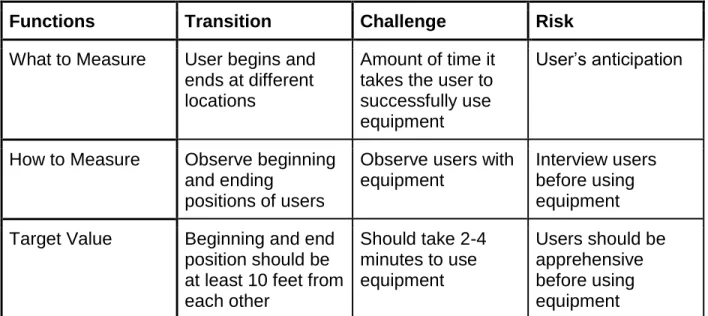
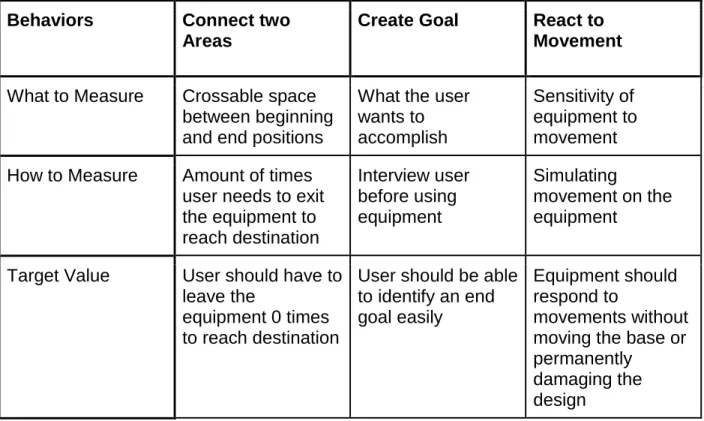
To begin, we followed John Gero’s model for developing design concepts and first laid out the functions, behaviors, and the structures that our equipment should include based off of prior experiences discussed in Available Equipment (Section 1.5). The balance structure should transition the user from one area to another using a platform. The equipment should also challenge the user by creating a goal to reach at the end of the structure. Also, the structure should create risk for the user by reacting to
movements and not being a static object. All target values are arbitrary values influenced by prior experiences of the group.
Table 2.2.1 - Specifications of Functions
Functions Transition Challenge Risk
What to Measure User begins and ends at different locations
Amount of time it takes the user to successfully use equipment
User’s anticipation
How to Measure Observe beginning and ending
positions of users
Observe users with equipment
Interview users before using equipment Target Value Beginning and end
position should be at least 10 feet from each other
Should take 2-4 minutes to use equipment
Users should be apprehensive before using equipment
Table 2.2.2 - Specifications of Behaviors
Behaviors Connect two
Areas
Create Goal React to
Movement
What to Measure Crossable space between beginning and end positions
What the user wants to accomplish
Sensitivity of equipment to movement How to Measure Amount of times
user needs to exit the equipment to reach destination
Interview user before using equipment
Simulating
movement on the equipment Target Value User should have to
leave the
equipment 0 times to reach destination
User should be able to identify an end goal easily
Equipment should respond to
movements without moving the base or permanently
damaging the design
Table 2.2.3 - Specifications of Structure
Structures Horizontal
Platform
Visible Destination
Dynamic
What to Measure Distance between initial and final positions
User’s recognition of the final
destination
Ability of equipment to rotate, move, or change
How to Measure Measuring tape Interview users before play
Change in equipment when applying small force Target Value Should be at least
10 feet apart along the same axis as the level ground
Users should identify what they need to achieve without assistance
Equipment should react to force, but should not break
Using these ideas as a basis for design, we started drawing concepts by finding issues with current playground equipment that did not meet the above specifications. Table 2.2.4 scores the current available equipment against the ideal balance structure. Scores are ranging from 0-3. Scores of 0 shows the equipment meets none of the
Table 2.2.4 - Functions and Behaviors of Available v. Ideal Balance Equipment
Equipment Functions(s) Behavior(s) Structure(s) Total
Available 2.5 2 1.5 4.5
Ideal 3 3 3 9
We also utilized the reference from the Engineering Library at University Park, Architectural Graphic Standards, to find that the average height of a twelve-year-old child is 4.87 feet (1485mm) and the average height of five-year-old child is 3.57 feet (1090mm). These dimensions helped to generate concepts by giving a realistic scaling for our concepts and a range in which to work. All of our concepts were scaled to fit an average sized child at twelve years old, but also stayed within the abilities of smaller children at five years old. The six concepts below are what we came up with while generating ideas. Some of them are variations of each other, while others are similar to equipment in which we had previous experience.
Figure 2.2.1:
Spinning Tube with Tracks: This piece of equipment would allow for the user to go through a tube that rotates on a set of bearings. A user in a wheelchair would be able to go through with ease as there are tracks that run along whole tube.
Figure 2.2.2:
Running Wheel: With this concept the user could enjoy running or grabbing on the side of the frame to rotate in cylindrical motion, very much like a hamster wheel or gyroscope.
Figure 2.2.3
Inclined tube: In this concept the user would climb up an incline using a series of ropes and handles, allowing use by children with certain physical disabilities. This inclined tube could be enclosed or have an open top.
Figure 2.2.4
Double Balance Beam: This concept would be a challenge that the user steps on the top of two walls side trying not to fall while getting to the other side. Someone with a wheelchair would be able to participate in this activity as well
Figure 2.2.5:
Balance Ropes: This idea was for children to either use their hands or their feet to go across the two ropes without falling
Figure 2.2.6:
Steps with guide ropes: This concept was for children to go across while swinging and having to balance their body weight without falling.
2.3 Concept Scoring
List of Concepts for Reference: 0. Balance Beam
1. Spinning Tube with tracks and handles 2. Running wheel
3. Inclined tube with slots and rope feeding through 4. Double balance beam track
5. Double rope balance beam 6. Steps with guide ropes
Table 2.3.1
Concept Scoring: This table shows the values that were chosen for each of the concepts and the final score they received.
S = Score
NW = Need Weight
Our concepts are scored on a scale ranging from -3 to +3 in comparison to the original piece of equipment, the balance beam. Each concept was scored on how well they meet our specifications for the user’s needs. The needs are: fun, accessibility, difficulty, social interaction, ease of use, and physical activity and are weighted as 0.25, 0.25, 0.1, 0.2, 0.1, 0.1, respectively.
Fun will be measured using selectivity. We will be measuring this by observing different playgrounds with equipment similar to ours, so that we can make a reasonable
expectation on our score.
Ease of use will be measured by asking the user if they can explain how to use the equipment to someone else. Our target is for the user to take a short amount of time to understand the equipment and ask little to no questions. We will measure this by showing a user our model.
Accessibility will be measured by conducting an interview with disabled children and hearing their input on their ability to use this piece of equipment. Because this is the main importance of our design, we are targeting near a 100% success rate. We will
measure this by having them use current equipment that is similar and then asking them to try use our equipment.
Level of challenge and physical activity are closely related, so they were measured in a similar manner. Since both needs influence fun, we can extrapolate that if the children have fun on the equipment, it is desirably difficult and requires a moderate amount of physical activity.
Social interaction will be measured by interviewing the children prior to using the equipment and inquiring about whom they met and with whom they played. We are targeting equipment that allows two to four users at once.
Concept one received a rating of 1.9. Although the spinning tube with wheelchair accessible tracks offers a large increase in fun, difficulty, and social interaction, accessibility scored the highest because it allows almost any child, even those with disabilities to use the equipment. One of the drawbacks is that our users with mental disabilities would not have fun on the equipment. This concept also offers moderate physical activity. The only specification that this concept did not see an improvement is in its ease of use.
Concept two received a rating of 0.4. This concept scored high in the fun, challenge, and physical activity aspects since it requires coordination, and offers the chance for intense physical activity. On the other hand, this equipment does not accommodate children with disabilities and scored low in the ease of use category. This concept, however, showed no improvement in the social interaction category.
Concept three has a rating of 1.65. It scored similarly to concept one except its accessibility was lower. Although it is designed to allow wheelchairs to navigate through, the rope in the middle serves as an additional obstacle and may decrease accessibility. Furthermore, the incline of the tube may prove to be too challenging for children with disabilities; however, in terms of physical activity, there is moderate chance for exercise. We also determined that this equipment is not obvious in comparison to the balance beam.
Concept four received a rating of 0.775. It offered a small increase in fun but is more accessible than the balance beam. To continue, it is easier to use and is less physically challenging than the balance beam. There was no change in both ease of use or social interaction. One undesirable outcome is that it is be deemed as equipment that is only for children with disabilities.
Concept five has a score of 0. It has a very high score in the fun, physical activity, and desirable difficulty but very low scores in accessibility and social interaction. This concept is also scored negatively in the ease of use category. Although this concept scored a zero, there are useful mechanisms to it that may be able to be incorporated into our final design.
Concept six was given a total score of 1.15. This concept showed improvement in every category except for ease of use; however, the increases are small in comparison to other concepts. Furthermore, although this concept is more accessible, the change is minimal because the only accommodation is guide ropes. One concern for this concept is that it can be easily misused.
2.4 Concept Selection
When considering our final concept selection, we decided to pull ideas from some of the best scoring concepts, our final concept will be based around concept one. To begin, concept one originally had long handles on the outside that can serve as a hazard for children playing in the area, so we decided to decrease the length of the handles to minimize the risk. In concept three, the equipment was built with an incline which may prove to be too difficult for the children to navigate through. Also, the rope that runs through the middle of the tube could hurt the children using the equipment, so it was omitted. Similar to concept one this concept had slots so that the equipment would be wheelchair accessible; however, we decided that the wheelchair accessibility would decrease the fun for the children and limit the social interaction.
With all factors in mind, we decided that instead of altering the equipment, we will alter the user by making it possible for a user to vacate his or her wheelchair and use the equipment. We will also have rope handles on the sides of the tube for children to pull themselves through the tube. When the ropes are pulled, there will also be bells on both ends in case someone gets disoriented.
2.6 Safety
Throughout the design process, it was imperative that we waited to address safety until later, so that we could optimize the creativity of the equipment. However, safety is a very important need that applies to all of our stakeholders. To make sure our equipment was safe, we made sure that the handles on the tube would not extend too far off of the tube that there would be risk of hitting a user. Also, we made sure that the ball bearings would be far behind the front of the tube and secured enough that a child could not get their fingers stuck. The ropes inside of the tube would need to be taught enough that a
child would not gate stuck inside of the rope. Another aspect of safety would be to add railings to the sides of the platform so that children would not fall off or get pushed onto the ground. All of these safety measures were made in mind that we would reduce the risk of minor injuries, including scrapes, bruises, and fractures.
2.7 Testing Effectiveness
In order to test the concepts that we generated, we would hope for more resources. If we had more time and resources, we would take multiple sample groups of our
stakeholders and record their responses to different concepts. We would also build some of the concepts that did exceptionally well in our scoring so that we could test how much fun and how challenging the equipment was to use for all children, since these aspects are more difficult to predict beforehand.
With the resources given, we discussed the concepts with peers outside of class.
Prompting them with a short introduction to our design project, we asked them how well they thought our concept would work with children of all abilities. Many responses from our peers thought that we should add a theme to the equipment to add a sense of creativity and to gain the children’s interest. The other groups in the engineering design class agreed that the playground would meet more stakeholder needs if the playground had a creative theme. From this information, we decided to format our design in the shape of a submarine or something aquatic to fit the theme of the rest of the
playground. To find if this would be effective for the playground, we would need to create models of two different playgrounds, one made with a theme and one made without. To test this, we would need a test group of stakeholders and would interview them for their reactions to both playgrounds. This creative element, if proven effective, would hopefully increase the children’s creativity, by providing a format in which they could play imaginary games and socialize with other children easily.
2.6 Summary
To summarize, in order to create the best possible piece of playground equipment, it was essential for us to generate different concepts and assess their components. We did this by considering how we could alter current equipment, alter the user, or create a completely new design to attain a more desirable piece of accessible equipment. From this, we were then able to break down each concept and differentiate between the aspects would enhance our piece and the aspects that would not complement our piece. We did this by creating a concept chart in which we assigned weights to each user need and scores for each concept. These scores were based on the weighting of the need discovered in the previous section, and specifications, that measure how well the needs were met, were used in order to compare how our concepts matched up to existing equipment. Our results from the concept scoring presented us with three relatively high scores from the spinning tube with tracks and handles, the inclined tube with slots and rope feeding through, and the steps with guided ropes. Our next step of action will be to analyze these three pieces of equipment and determine which aspects
of them lead to such a high score. We then plan to find a way to best incorporate these features in our final design to maximize our total concept score.
3 DATA ANALYSIS
3.1 Prototype Description
The final prototype is a cylinder that is resting on ball bearings in four locations and revolves about a central axis parallel to the the side of the cylinder. The rings around the cylinder serve as protection against debris getting stuck in the bearings, and help to keep the tube on track. There are windows on the sides of the tube so that the children can see outside and handles on the outside for a parent or other student to spin the tube. Additionally, ropes run along the inside to allow the user to pull himself or herself through the tube as depicted in Figure 3.1.1.
Figure 3.1.1:
Prototype: This prototype was done to a 1”~2’0” scale to demonstrate the practical use
Figure 3.1.2:
Landscape with tube: This figure depicted in a 1”~8’0” scale shows the plot of land that
the cylinder (neon yellow) will be put on. The figure also demonstrates the size of a 4 foot person with the use of thumbtacks.
Figure 3.1.3:
Whole Park: This prototype of the park was made to a 1”~8’0” scale as every group
3.2 Testing the Prototype
To test the effectiveness of our prototype, we first ran some initial tests of ourselves. In our testing we looked at if our equipment works as we planned it to. We also wanted to make sure that people who had no engineering background understood how it works. Once these criteria were met, we would have children play with the model and see if they understand how it works and if they would be interested in playing on real version of it. This feedback would help us to better understand what our users are looking for in playground equipment, and then we would be able to go back to our design process and adjust accordingly.
3.3 Summary
After choosing the appropriate design, we built two different prototypes. One was built to the scale of the landscape, and one was a larger scaled piece of equipment to better understand the functions and behaviors of the prototype. We then laid out further instructions for testing the prototype.
4 CONCLUSIONS 4.1 Project Summary
Our entire design process began with a single idea: to create a piece of fully accessible playground equipment that can be enjoyed by children of all abilities. As we advanced through the process, the idea for our project began to take shape. We first identified the stakeholders as children, caretakers, and schools, and then identified the wide range of benefits they will receive from an accessible piece of playground equipment. Once our stakeholders were clearly identified, we assessed the needs that are most important to them: fun, accessibility, challenge of completion, social interaction, ease of use, and level of activity. Along with the needs, there exists multiple specifications that our design needs to meet in the categories of functions, behaviors, and structures. Tables 2.2.1, 2.2.2, and 2.2.3 summarized these specifications as well as a method in which we can measure them and a target value for which we will aim. After assessing our needs and specifications we were then able to generate various concepts and score them based on these needs. The scoring process showed us which designs were better than others and allowed us to create a combination of ideas into a single, superior piece of
equipment. From this comparison, we were able to generate our final prototype: a revolving cylinder that rests on ball bearings and contains bells, handles, windows, and guide ropes, all of which rest on a spacious platform.
4.2 Extent of Success
Based on our larger scale prototype, our model should be successful in the fact that it accommodates children with physical, visual, and auditory disabilities, but furthermore, it should be enjoyable for able-bodied children as well. The specific features that aided
our success in these aspects are the bells and guide ropes. The working prototype also shows the motion of the attraction which is exactly how we had planned for it to
function. One thing that we did not consider was how wheelchair bound children will regain possession of their wheelchair at the end of their turn on the equipment without the help of a caretaker. We aimed for a piece of equipment that all children could operate completely on their own, so our success was hindered in this category. The success of our prototype could be improved by further research.
4.3 Directions for Future Research
If others were to continue this project, we have many suggestions for success. First, if we had had more time, we would have put more research into the abilities of disabled children. We made many assumptions about the abilities of children to save time, which may have led to inaccurate success. Secondly, we would have gotten a test group of stakeholders to participate in concept generation and the rest of the design process. This way, we would have direct, reliable input from stakeholders instead of
assumptions. Thirdly, we would have secured a location for the playground. The community surrounding the playground was assumed to be similar with our prior experiences, but it could be in a much different environment in which case, our model would have been inappropriate, and therefore, unsuccessful. In the future, we would also put more time into researching the safety of our design. As a design group, we also wish we would have collaborated more with the peers in our class. If we had done this, we believe we would have generated more creative ideas and would have caught mistakes or holes in our designs sooner.
For any future research, assuming more time and resources, it would be helpful to establish roles and a timeline for the project sooner during the design process. Though we came up with a rough timeline with general roles, it was difficult to continue along those expectations, because we were unaware of what problems would occur and when.
5 REFERENCES
Casey, T. (2005). Inclusive play: Practical strategies for working with children aged 3 to 8. Thousand Oaks, Calif;London;: Paul Chapman Pub./Sage.
Gero, John S. “Design Prototypes: A Knowledge Representation Schema for Design .” AI Magazine, 1990, pp. 26–36. AI Magazine, www.aaai.org/ojs/index.php/
aimagazine/article/view/854/772.
Ramsey, C. G., Sleeper, H. R., Hoke, J. R., Bassler, B. L., & American Institute of Architects. (2000). Ramsey/Sleeper architectural graphics standards (Student ed.). New York: John Wiley.
Viega, G., De Leng, W., Cachucho, R., Ketelaar, L., Kok, J. N., Knobbe, A., . . . Rieffe, C. (2016). Social Competence at the Playground: Preschoolers During Recess. Wiley Online Library. doi:10.1002/icd.1957
Brault, M. W. (2011). School-aged children with disabilities in U.S. metropolitan
statistical areas: 2010 (United States of America , United States Census Bureau, Economics and Statistics Administration). Washington, D.C.: U.S. Dept. of
Commerce, Economics and Statistics Administration, U.S. Census Bureau. https://www.census.gov/prod/2011pubs/acsbr10-12.pdf