Proceedings of the
11th International Workshop on Graph Transformation and
Visual Modeling Techniques
(GTVMT 2012)
Algebraic Approach to Timed Petri Nets
Karsten Gabriel, Pascal Lingnau, Claudia Ermel
14 pages
Guest Editors: Andrew Fish, Leen Lambers
Managing Editors: Tiziana Margaria, Julia Padberg, Gabriele Taentzer
Algebraic Approach to Timed Petri Nets
Karsten Gabriel∗, Pascal Lingnau, Claudia Ermel
Technische Universit¨at Berlin, Germany
[email protected],[email protected],[email protected]
Abstract: One aspect often needed when modelling systems of any kind is time-based analysis, especially for real-time or in general time-critical systems. Algebraic place/transition (P/T) nets do not inherently provide a way to model the passing of time or to restrict the firing behaviour with regards to passing time. In this paper, we present an extension of algebraic P/T nets by adding time durations to transitions and timestamps to tokens. We define categories for different timed net classes and functorial relations between them. Our first result is the definition of morphisms preserving firing behaviour for all timed net classes. As second result, we define structuring techniques for timed P/T nets in a way that our category fulfills the prop-erties ofM-adhesive systems, a general categorical framework for structuring and transforming high-level algebraic structures. We demonstrate our approach by ap-plying it to model a real-time communication network.
Keywords:algebraic Petri nets, Petri nets with time, timed P/T nets, Petri net struc-turing technique, P/T net transformation
1
Introduction
Petri nets are a formalism widely used for modelling and analyzing systems and processes. First introduced by Carl Adam Petri in [Pet62], the notion of (classical) Petri nets (and place/transition (P/T) nets in particular) has been refined and extended over the time [Rei85,Rei10], also con-sidering coloured tokens giving rise to the notion of high-level nets, like e. g.Coloured Petri nets [Jen92,JKW07]. Since Petri nets do not inherently provide a way to model the passing of time or to restrict the firing behaviour with regards to passing time, a number of approaches have been established that enhance classical Petri nets by notions of time, such astime Petri nets[BD91], deterministic timed Petri nets[BH07] andtimed coloured Petri nets[JK09].
In the nineties, a main objection against Petri nets as specification technique was that Petri nets lack abstraction, data-type handling, refinement and structuring. Hence, composition and ab-straction mechanisms for Petri nets have been formalized in an algebraic setting [MM90,ER97], viewing an algebraic P/T net as a directed graph whose set of nodes is the free commutative monoidP⊕generated by the setPof places, and transitions are the arcs between them. Note that there is a one-to-one correspondence of classical and algebraic P/T nets. With the definition of morphisms between algebraic Petri nets categories of Petri nets can be defined with and without initial markings. The results provide a formal basis to reason on abstraction and refinement, on
∗ This author is sponsored by the Integrated Graduate Program on Human-Centric Communication at Technische
integration and decomposition of nets, and on semantics given by net processes, at an abstract level using methods from category theory [EM96,EPR94]. Since then, new algebraic Petri net categories, as well as extensions of existing Petri net categories have been developed, includ-ing P/T nets with individual tokens (PTI nets) [MGH11], and Algebraic High-Level (AHL) nets [EHP+02,Ehr04].
Unfortunately, in contrast to classical Petri nets, up to now there exist no extensions of al-gebraic Petri nets by concepts for modelling the passing of time. Adding such a concept to the formalism would allow us e. g. to establish structuring techniques for Petri nets with time in a cat-egorical setting, and to re-use existing results for algebraic Petri nets with respect to rule-based Petri net reconfiguration [EG11,PEHP08].
In this paper, we provide a definition of algebraic, timed P/T nets, which enables us to define categories for different classes of timed nets, allowing the definition of the structuring techniques gluingandrestriction, and morphisms to specify processes for timed P/T nets. Moreover, timed P/T nets can be reconfigured using timed P/T net transformation rules in the well-known alge-braic double pushout (DPO) approach [EEPT06]. In our formalization, tokens carry timestamps, usually denoting the earliest point in time when this token may be consumed by a transition. A global clock models the current time and influences the activation of transitions. Tokens gener-ated in a firing step get a timestamp computed from the current firing time (the global clock) and the time duration of the transition.
The paper is structured as follows: After considering existing approaches that extend Petri nets by time inSection 2, we present our running example, a real-time communication network, inSection 3. InSection 4, we formalize our algebraic notion of timed P/T nets. Categories of timed P/T net classes and their functorial relations are presented inSection 5, while structuring techniques and transformation are introduced in Section 6. We conclude with an outlook to future work inSection 7.
2
Extending Petri Nets by Time Modelling
There are many approaches for extending Petri nets by time. Our approach is based on the approach of timed Coloured Petri nets (timed CPNs) [JK09], where the well-known high-level Petri net variant CPNs [Jen92] has been extended by assigning aduration to a transition and so-called timestampsto each token, indicating the earliest point in time when a token can be used by a transition. A transition that fires adds the duration time of the transition to each created token’s timestamp, so that in general, these tokens cannot be used immediately, but only after the time the transition takes has passed. The timed CPN firing behaviour requires that a transition fires at the earliest point in time at which it is activated. During simulation, the global clock is monotonically increasing, as there is no possibility of a transition being activated at a point in time that has already passed. In our approach, we do not have this limitation of the firing behaviour, so in principle, simulations become possible that explore the past (for more details we refer to [LGM12]). The tool CPN TOOLSprovides means to design and analyse timed CPNs, including state-space analysis and model checking techniques [JKW07].
the maximal time it may be enabled until it has to fire (latest firing time). This firing behaviour is significantly different from that of timed CPNs, allowing for more control over the model behaviour. TPNs can be analysed using a state-space approach [GLMR05].
Deterministic timed Petri nets [BH07] pursue a rather unique approach for firing behaviour by introducing a delay between removal and creation of tokens. In addition, each place has a designated delay, denoting the time before a created token can be consumed from that place.
In time environment-relationship (TER) nets [GMMP91], time is considered as token attribute (chronos) with special behaviour. Token timestamps are set by specific action relations associated to transitions, which also require time monotonicity of firing sequences. This approach has inspired the definition of graph transformation systems with time [GVH04], since considering time as attribute one may re-use the formal framework of attributed graph transformation.
None of the approaches listed above are based on the general algebraic framework that allows for the definition of structuring and reconfiguration techniques for P/T nets with time.
3
Running Example: A Communication Network Infrastructure
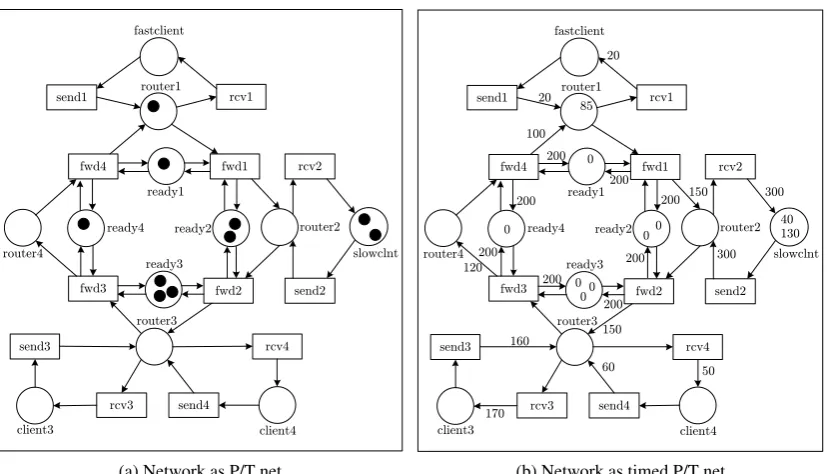
We consider a communication network of four routers connected in a loop of forwarding tran-sitions (see Figure 1a). Each client is connected to a router via send and receivetransitions that model sending and receiving of packets from/to the router. A router allows only a certain number of open connections at a time. This is modelled by the number of tokens on the cor-respondingreadyplaces which represent the maximum number of concurrent connections the router is able to maintain. Hence, a router is ready to forward a packet to the next router only if there are enough tokens on the correspondingreadyplaces. Obviously, in the untimed P/T net in
Figure 1a, thereadytokens are consumed and immediately produced again whenever a forward action occurs. Due to the instant production of the tokens upon firing of aforwardtransition, the number of tokens on thereadyplaces has no effect in an untimed P/T net, even if many forward transactions occur at the same time. Therefore, we need a way to express the duration such a transaction takes, which is possible using timed P/T nets. The assigned firing durations restrict the firing sequences possible in the simulation of the net, which yields a behaviour that is more faithful to that of a real-time communication network.
In the timed P/T net variant, shown inFigure 1b, each token of a marking carries a timestamp (by which it is represented in the illustration), denoting the earliest point in time when this token can be consumed by a transition. A global clock is employed in order to be able to specify “when” transitions are activated and when they fire, with timestamps and clock values being real numbers. The arc inscriptions represent the time duration of the action associated with the connected transition. Note that the arc inscriptions are sums of time values in general, so an output arc creating two tokens would be a sum (⊕) of two time values.1 Analogously to untimed P/T nets, an arc with no inscription means that there is a single token created or consumed with no time delay, i. e. an arc without inscription is equivalent to an arc with a single zero. When firing a transition at a global clock value (not shown inFigure 1b), the newly created tokens get assigned a timestamp that is the sum of that clock value and the respective time duration specified by the output arc. For example, transitionsend2creates a token with a timestamp of 300 time
client3 fastclient slowclnt client4 send1 rcv1 send3 rcv3 send2 rcv2 send4 rcv4 router1 router2 router3 router4 fwd3 fwd1 fwd2 fwd4 ready4 ready2 ready1 ready3
(a) Network as P/T net
client3 fastclient slowclnt client4 send1 rcv1 send3 rcv3 send2 rcv2 send4 rcv4 router1 router2 router3 router4 fwd3 fwd1 fwd2 fwd4 ready4 ready2 ready1 ready3 20 20 100 150 150 120 300 300 50 60 170 160 200 200 200 200 200 200 200 200 85 40 130 0 0 0 0 0 0 0
(b) Network as timed P/T net
Figure 1: Network as P/T net and timed P/T net
units later than the global clock value at the time of firing.
As further example, consider the firing of transitionfwd1at clock value 85, the earliest clock value at which the token onrouter1can be used according to its timestamp. The firing removes that token and creates a token onrouter2with a timestamp of 235 (= 85 + 150). Also, the tokens with timestamp zero onready1andready2are removed and replaced by tokens with timestamp 285. Therefore, transitionfwd2is enabled not earlier than at clock value 285, since this is the timestamp of the token onready2, regardless of the timestamp of 235 of the token onrouter2. In contrast, in the untimed P/T net inFigure 1a, transitionfwd2could fire immediately, as the token onready2simply is recreated whenfwd1is fired.2
4
Algebraic Formalisation of Timed P/T Nets
We define timed P/T nets and systems based on algebraic P/T nets, adding time values to the markings (including pre and post domains). Timed P/T states are an extension of timed P/T systems, incorporating a global clock value.
In the followingX⊕denotes the free commutative monoid over the setX. Note thatS∈X⊕is a formal sumS=∑ni=1λixiwithλi∈Nandxi∈Xmeaning that we haveλicopies ofxiinS, and forS0=∑ni=1λi0xiwe haveS⊕S0=∑ni=1(λi+λi0)xi. Moreover, a sumS0∈X
⊕is a subsum ofS,
writtenS0≤Sif there exists a sumS0∈X⊕ such thatS=S0⊕S0.
Definition 1(Timed P/T Net Classes and Timed Marking)
1. Atimed P/T netor TPT netTN= (P,T,pre,post)consists of a setPof places, a setT of transitions and functionspre,post:T →(P×R)⊕.
2. Atimed P/T systemor TPT system is a tuple(T N,M)with timed P/T netTNand a marking MofTNwhich is an elementM∈(P×R)⊕.
3. Atimed stateor TPT state is a 3-tuple(T N,M,τ)with timed P/T netTN, a markingMof TNand a global clock valueτ∈R.
Remark1 (Relation to Untimed P/T Nets) Note that the definition of timed P/T nets is quite
similar to the definition of untimed algebraic nets [ER97]. The only difference is that in the
timed case the pre and post arcs are equipped with time-values. Accordingly, in a timed marking each token consists of a time-value, called timestamp.
Example1 (Timed P/T System) Figure 1bshows a timed P/T netTN= (P,T,pre,post)with
placesPand transitionsT as described inSection 3. The pre- and post-domains offwd1, for
ex-ample, are: pre(fwd1) = (ready1,0)⊕(ready2,0)⊕(router1,0), post(fwd1) = (ready1,200)⊕
(ready2,200)⊕(router2,150).
The depicted marking isM= (router1,85)⊕(slowclnt,40)⊕(slowclnt,130)⊕(ready1,0)⊕
2·(ready2,0)⊕3·(ready3,0)⊕(ready4,0).
Next, we definetime delaysas relations between markings, to decide whether a transition can be fired with respect to the timestamps of the tokens involved.
Definition 2 (Time-Delay) LetM1,M2∈(P×R)⊕ be two timed markings of TPT netTN=
(P,T,pre,post). We define the following two types of delays:
• M1 is alocation-strict delayofM2, written M1←=M2, ifπP⊕(M1) =πP⊕(M2) and for all
p∈P: M1[p]≥M2[p], withM[p]being the list of timestamps of all tokens on placepin
ascending sorted order, andπP⊕(M)is the projection that “forgets” the time-values, called
locationofM. We call the timestamps inM1laterthan those inM2.
• M1is adelayofM2, writtenM1 ←
≤M2, if there exists a subsumM20 ≤M2, so thatM1 ←
=M20.3
Example2 (Time-Delay) Consider markingM2= (slowclnt,40)⊕(slowclnt,130)of the TPT
net shown inFigure 1b. Then,M1= (slowclnt,50)⊕(slowclnt,150) is a location-strict delay
ofM2, i. e.M1=←M2. For the markingM3= (slowclnt,40)⊕(slowclnt,130)⊕(router1,85)we
have thatM1is a delay ofM3, i. e.M1≤←M3, since there isM2≤M3withM1←=M2.
Now we can define the firing behaviour of timed P/T nets. A transition is enabled under a markingS≤Mof a timed state (whereSis calledselection), if the global clock is late enough in order to satisfy the timestamps of the tokens in the selection. The follower marking is then
3 The symbols chosen for delays are constructed as follows: The bottom comparator indicates which marking is
calculated like for algebraic P/T nets, but now includes the calculation of the newly created tokens’ timestamps by adding the time duration of the transition to the current global clock value.
Definition 3(Firing Behaviour) Given a timed P/T state(T N,M,τ)with timed P/T netT N=
(P,T,pre,post), markingMofTN, global clock valueτ, and a selectionS≤M. Thent∈T is enabled under(S,τ)ifpre(t)+τ is a location-strict delay ofS, i. e.pre(t)+τ←=S, wherepre(t)+τ
means the addition ofτ to every timestamp in the marking pre(t).
Fort∈T enabled under(S,τ), there is afiring step(T N,M,τ)−−→(t,S) (T N,M0,τ), where the
follower markingM0is given byM0=M S⊕post(t)+τ.
Like in algebraic P/T nets, we can link successive firing steps in a firing sequence. Since a firing step does not advance the global clock, so-called timestepsof the form(T N,M,τ)−−→∆τ
(T N,M,τ+∆τ) are inserted between two firing steps where the global clock is changed by ∆τ ∈R. The differentiation between timesteps and firing steps allows us to model actions that overlap in time.
Definition 4(Firing Sequence) Given a timed P/T state(T N,M0,τ0)with timed P/T netT N=
(P,T,pre,post), markingM0 ofTN, global clock valueτ0, andti ∈T enabled under(Si,τi)for i∈ {0, . . . ,n−1}andSi≤Mi. Then,
Seq= (T N,M0,τ0) (t0,S0)
−−−→(T N,M1,τ0)
∆τ0
−−→(T N,M1,τ1)
(t1,S1)
−−−→. . .(T N,Mn−1,τn−2)−−−→∆τn−2 (T N,Mn−1,τn−1)
(tn−1,Sn−1)
−−−−−−→(T N,Mn,τn−1)
is afiring sequencein netT N, if for alli∈ {0, . . . ,n−1}:Mi
(ti,Si,τi)
−−−−→Mi+1is a firing step.
The following is a shorter variant of the same firing sequence, omitting the timesteps, with the clock value at the time of firing included in the firing step notation:
Seq=M0−−−−−→(t0,S0,τ0) M1−−−−−→(t1,S1,τ1) . . .−−−−−−−−−→(tn−1,Sn−1,τn−1) Mn.
Note that in general there is no constraint on the global clock values. We can, however, enforce different restrictions on firing sequences in order to achieve a certain behaviour:
• Seqis calledtime-monotonic, if for 0≤i<n, there isτi≤τi+1.
• Seqemployseager firing, if for all firing stepsMi
(ti,Si,τi)
−−−−→Mi+1 inSeq, there is no firing
stepMi
(ti0,S0i,τi0)
−−−−−→Mi0+1withτi0<τi.4
Example3 (Firing Behaviour) In the timed P/T net depicted inFigure 1b, fwd1is enabled at
τ=85under the selectionS= (ready1,0)⊕(ready2,0)⊕(router1,85), since pre(t)+τ ←=S, i. e.
pre(fwd1)+85= (ready1,0+85)⊕(ready2,0+85)⊕(router1,0+85)←=S.
Therefore,fwd1can fire atτ=85, leading to the follower marking
M0=M S⊕post(t)+τ= (ready1,285)⊕(ready2,0)⊕(ready2,285)
⊕3·(ready3,0)⊕(ready4,0)⊕(slowclnt,40)⊕(slowclnt,130)⊕(router2,235).
5
Categories for Timed P/T Net Classes and Functorial Relations
In this section, we define the category of timed P/T nets. Timed P/T morphisms are defined in a way that they preserve firing behaviour, and thus in general the codomain net of a morphism is more liberal than the domain net. In the following, for a function fP:P1→P2between sets of
placesP1 andP2, we use fP⊕×
Rto denote the extension(fP×idR) ⊕:(P
1×R)⊕→(P2×R)⊕ of
fPto markings overP1andP2.
Definition 5(CategoryTPTNetsof Timed P/T Nets) Given timed P/T-netsT Ni= (Pi,Ti,prei, posti), for i∈ {1,2}, atimed P/T-net-morphism (or short TPT morphism) f :T N1→T N2 is
defined by f = (fP,fT), with functions fP:P1→P2and fT:T1→T2, such that for allt∈T1:
pre2◦fT(t)
←
= fP⊕×
R◦pre1(t) and post2◦fT(t)
→
=fP⊕×
R◦post1(t).
A timed P/T-morphismf is calledtime-strictif for allt∈Twe havepre2◦fT(t) = fP⊕×R◦pre1(t)
andpost2◦fT(t) = fP⊕×R◦post1(t).
The categoryTPTNetsof timed P/T nets consists of timed P/T nets as objects and timed P/T morphisms as morphisms. The composition and identities are defined componentwise for places and transitions inSets.
Theorem 1(Timed P/T Morphisms preserve Firing Behaviour) Given timed nets T Ni= (Pi,Ti, prei,posti) with i=1,2, with marking M of T N1, selection S≤M and a timed P/T morphism
f = (fP,fT),f :T N1→T N2. Let t∈T1 be enabled under S and M (t,S,τ)
−−−→M0 a firing step in T N1with M0=M S⊕post1(t)+τ.
Then, there is a firing step fP⊕×
R(M)
(fT(t),fP⊕×R(S),τ)
−−−−−−−−−−→M00in T N2with fP⊕×R(M
0)=←M00.
Proof Idea. Given a markingM and selectionS≤Msuch thatS is enabled undert∈T1, then
there is pre(t)+τ =←S. We also have a selection f⊕
P×R(S)≤ f ⊕
P×R(M), and since the order ←
= is compatible with operations⊕and as well as with the marking-extension fP⊕×
Rof fP, we have pre2(fT(t))+τ
←
= fP⊕×
R(pre1(t))
+τ = f⊕
P×R(pre1(t)+τ) ←
= fP⊕×
R(S)which means that fT(t) is enabled under(fP⊕×
R(S),τ). Moreover, we obtain for the follower markings that f ⊕
P×R(M 0) =
fP⊕×
R(M S⊕post
+τ
1 (t)) = f ⊕
P×R(M) f ⊕
P×R(S)⊕f ⊕
P×R(post
+τ
1 (t)) ←
= fP⊕×
R(M) f
⊕
P×R(S)⊕
post+τ
2 (fT(t)) =M
00. A detailed proof can be found in [LGM12].
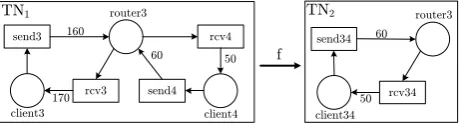
Example4 (Timed P/T morphism and Preservation of Firing Steps) Figure 2shows timed P/T
netsT N1,T N2with morphismf:T N1→T N2, which maps places and transitions as indicated by
their names. The morphism condition is fulfilled for all transitions, since inT N2, the time values
in the postdomains of the transitions are lower than their counterparts inT N1, i. e.post2◦fT(t)
→
= fP⊕×
R◦post1(t), while the values in the predomains are the same (zero).
Consider markingsM1= (router3,100)ofT N1andM2= fP⊕×
R(M1) = (router3,100)ofT N2
and firing steps in both nets atτ=100with selectionsS1,2= (router3,100)andrcv3, respectively
rcv34 as the transitions to fire. The resulting markings are M10 = (client3,270) for T N1 and
M20 = (client34,150)forT N2, and we have fP⊕×
R(M
0
1) = (router3,270) ←
= (router3,150) =M20.
TN1 TN2
f
client3 client4
send3
rcv3 send4 rcv4 router3
50 60
170 160
client34 send34
rcv34 router3
50 60
Figure 2: Timed P/T nets with timed morphism f
time values on the pre- and post-arcs. This allows us to analyse the underlying algebraic P/T net structure using existing techniques for P/T nets. An example is shown inFigure 1, where the P/T net inFigure 1ais the result of the application ofTSkelto the timed P/T net shown inFigure 1b.
Definition 6(FunctorTSkel) The functorTSkelis defined asTSkel:TPTNets→PTNetswith TSkel(P,T,pre,post) = (P,T,pre∗,post∗), where pre∗(t) =πP⊕(pre(t)),post∗(t) =πP⊕(post(t))
for allt∈T for the objects ofTPTNets. For the morphisms, we defineTSkel(fP,fT) = (fP,fT).
Remark2 (Timed P/T Systems and States, Preservation of Firing Behaviour)
1. Analogously to timed P/T net morphisms, timed P/T system morphisms and timed P/T state morphisms are defined as timed P/T morphisms between the corresponding timed P/T nets with additional requirements, taking into account the marking and, in the case of states, also the global clock value. The categories of timed P/T systems and states are
denoted asTPTSysandTPTState, respectively. For more details we refer to [LGM12].
2. In [LGM12] we also define a functorTSkelSysthat maps timed P/T systems to P/T systems,
forgetting the timestamps in the corresponding markings.
3. There are functorsAbs:TPTSys→TPTStateswithAbs(T N,M) = (T N,M,0), andRel:
TPTStates→TPTSyswithRel(T N,M,τ) = (T N,M−τ), establishing an equivalence of
the categories TPTSys and TPTStates as shown in [LGM12]. This means that every
timed state can be expressed as a timed system by subtracting the global clock value from
all tokens’ timestamps, andAbs◦Relcan be used to obtain a “normal form” of timed states.
4. The functorsTSkelandTSkelSyspreserve firing behaviour, as shown in [LGM12].
6
Structuring and Transformation of Timed P/T Nets
In this section we define gluing and restriction constructions as structuring techniques for timed P/T nets. We also present an example transformation rule.
Intuitively, the gluing of timed P/T netsT N1andT N2over an interfaceT N0is a timed P/T net that contains copies ofT N1andT N2 which are glued together at places or transitions specified
by the interface.
(see Definition5) and injective. Then, the gluing T N3= (P3,T3,pre3,post3) ofT N1 andT N2
alongT N0, writtenT N3=T N1+T N0T N2, with morphisms f 0:T N
2→T N3andg0:T N1→T N3
is constructed as follows:
• P3,T3are constructed as pushouts (2) and (3) inSets(seeFigure 3b), and
• pre3(t) =
(
f0⊕P×R(pre2(t∗)) if∃t∗∈T2,fT0(t∗) =t
g0⊕P×
R(pre1(t
0)) if
@t∗∈T2,fT0(t
∗) =t∧ ∃t0∈T 1:g0T(t
0) =t,
andpost3(t)is defined analogously.
T N0
f //
g
T N1
g0
T N2
f0
/
/T N3 (1)
(a) Gluing or restriction diagram
P0
fP //
gP
P1
g0P
P2
fP0
/
/P3 (2)
T0
fT //
gT
T1
g0T
T2
fT0
/
/T3 (3)
(b) Pushouts of places and transitions
Figure 3: Gluing and restriction diagrams of timed P/T nets
Remark3 (Pushout of Timed P/T Nets) In [LGM12] it is shown that the gluing construction
defined above is also a pushout construction. This means that given the gluing (1) inFigure 3aof
timed P/T nets, then (1) commutes and satisfies the following universal property: For all timed
P/T netsT N4and timed P/T morphismsh:T N1→T N4,k:T N2→T N4withh◦f =k◦gthere
exists a unique timed P/T morphismm:T N3→T N4such thatm◦f0=kandm◦g0=h.
f p1 TN0 TN1 TN3 TN2 t1 p1,2 p1 t4 t1 t4 g f‘ g‘ t1 t3
p2 p4 p2
p3 t1 p1,2
t3 p3 p4 10 10 5 5 20 20
Figure 4: Gluing and restriction of timed P/T nets
Definition 8(Restriction of Timed P/T Nets) Given a timed P/T morphismg0:T N1→T N3and
a subnetT N2ofT N3with inclusion f0:T N2→T N3. The restrictiong:T N0→T N2ofg0along f0 is given byg=g0|T N0 whereT N0is constructed as a subnet ofT N1 withP0=g
0−1
P (P2)⊆P1
Remark4 (Pullback of Timed P/T Nets) In [LGM12] a slightly more general restriction
con-struction is defined, where the inclusion f0 is replaced by a time-strict injective morphism,
lead-ing also to a time-strict injective morphism f. Moreover, it is shown that the restriction
construc-tion is also a pullback construcconstruc-tion. This means that given a restricconstruc-tion (1) inFigure 3aof timed
P/T nets, then (1) commutes and satisfies the following universal property: For all timed P/T nets
T N4and timed P/T morphismsh:T N4→T N1,k:T N4→T N2withg0◦h= f0◦kthere exists a
unique timed P/T morphismm:T N4→T N0with f◦m=handg◦m=k.
Example 5 (Gluing and Restriction of Timed P/T Nets) Figure 4shows the gluing of timed
P/T netsT N1,T N2over the interfaceT N0. The morphism f is an inclusion, whereasgmaps the
placesp1andp2non-injectively to placep1,2, and f2is not time-strict because arc-inscription 10
betweent1andp1is mapped to value 5. The gluing objectT N3contains all elements ofT N1and
T N2which are glued together at transitiont1and placesp1andp2respectivelyp1,2. Vice versa,
netT N0and morphismgcan be considered as restriction ofT N1 andg0along inclusion f0. Net
T N0contains only those parts ofT N1that have a corresponding preimage inT N2.
Based on these definitions of structuring techniques for timed P/T nets, we can show that our categoryTPTNetsfulfills the properties ofM-adhesive systems [EGH10], a general categorical framework for structuring and transforming high-level algebraic structures that generalises the concept of adhesive categories [LS04]. A category Ctogether with a class M of monomor-phisms closed under composition and isomormonomor-phisms is called anM-adhesive category ifChas pushouts and pullbacks along M-morphisms, M-morphisms are closed under pushouts and pullbacks, and pushouts alongM-morphisms satisfy the so-called (vertical) van Kampen prop-erty (for more details see [EGH10]).
Theorem 2 (Timed P/T Nets AreM-Adhesive) The category (TPTNets,Mstrict) is an M -adhesive category, whereMstrict={f = (fP,fT)| f is time-strict and fP,fT are injective}.
Proof Idea. According to Remarks3and4, the categoryTPTNetshas pushouts and pullbacks along time-strict injective morphisms which can be constructed as gluings and restrictions, re-spectively. The satisfaction of the vertical van Kampen property is shown explicitly in [LGM12].
Example 6 (Timed P/T Net Transformation Rule) The transformation rule changeRouter =
(L←K→R) inFigure 5moves a client place to another router. The time values are given as
parameters in order to allow arbitrary time values to be used. Note that the rule morphismsland
rareMstrict-morphisms.
router1
L
send rcv
router2
out0
in0
router1
K
router2
l
router2
R
send rcv
out1
in1
r
router1
client client client
changeRouter[in0,out0,in1,out1]
Figure 5: Transformation RulechangeRouter
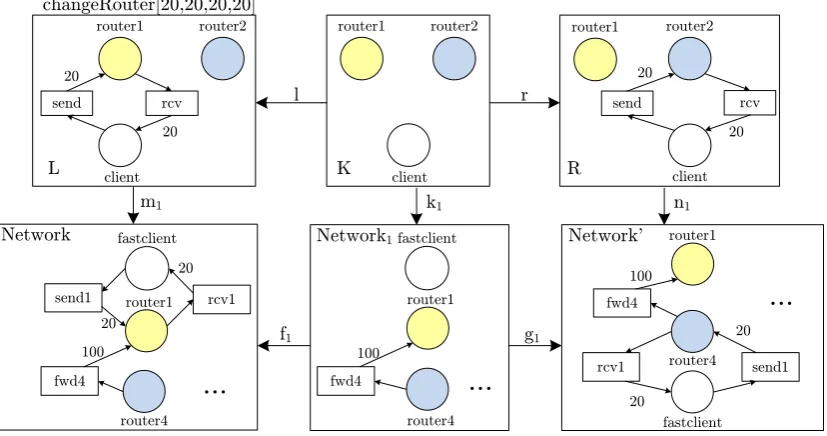
In the DPO diagram in Figure 6, rule changeRouter is applied with router1 mapped onto
router1,router2mapped ontorouter4and the placeclientmapped ontofastclientby the injective
rule match. This results in a new timed P/T net Network’where the client has been moved from
router1torouter4. In this case, we decided to keep the time values (i. e.in0 = in1 = 20, out0 = out1 = 20).
fastclient
send1 router1 rcv1
router4 fwd4
20
20
100
...
Network fastclient
router1
router4 fwd4
100
...
Network1
fastclient send1 rcv1
router1
router4 fwd4
100
...
Network'
f1 g1
m1 k1 n1
20
20
changeRouter[20,20,20,20]
router1
L
send rcv router2
20
20
router1
K
router2
l
router2
R
send rcv 20
20
r
router1
client client client
Figure 6: Application of rulechangeRouter(injective matching)
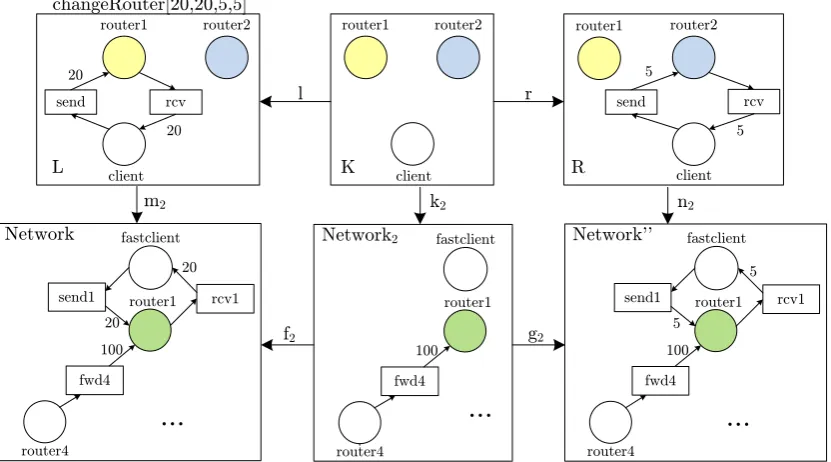
Figure 7 shows the rule to be applied with both router1 and router2 mapped onto router1
client is not moved, however we chose out1 = in1 = 5, resulting in the client being “upgraded” in speed, reducing the time delays of the transitions even further.
fastclient
send1 router1 rcv1
router4 fwd4
20
20
100
...
Network fastclient
router1
router4 fwd4
100
...
Network2
f2 g2
m2 k2 n2
fastclient
send1 router1 rcv1
router4 fwd4
5
5
100
...
Network'' changeRouter[20,20,5,5]
router1
L
send rcv router2
20
20
router1
K
router2
l
router2
R
send rcv 5
5
r
router1
client client client
Figure 7: Application of rulechangeRouter(non-injective matching)
7
Conclusion and Outlook
In this paper we presented a new algebraic approach of timed P/T nets, where transitions have time durations and tokens consist of timestamps. This allows for the modelling of systems with concurrent and time-dependent behaviour as we have shown for our running example presented inSection 3. Due to the algebraic formalisation we are able to define morphisms between timed P/T nets which preserve the firing behaviour as shown in our first main result in Section 5. This enables us to define structuring techniques like the gluing and restriction of timed P/T nets presented inSection 6, leading to an M-adhesive category, which means that our approach is also suitable for rule-based transformation (also called reconfiguration) of timed P/T nets in the sense of graph transformation [EEPT06].
Bibliography
[BD91] B. Berthomieu, M. Diaz. Modeling and Verification of Time Dependent Systems Using Time Petri Nets.IEEE Transactions on Software Engineering17, 1991.
[BEGG10] B. Braatz, H. Ehrig, K. Gabriel, U. Golas. Finitary M-Adhesive Categories. In Ehrig et al. (eds.), Proceedings of Intern. Conf. on Graph Transformation ( ICGT’ 10). Volume 6372, pp. 234–249. 2010.
[BH07] M. Z. Branislav Hruz.Modeling and Control of Discrete-event Dynamic Systems: with Petri Nets and Other Tools. Springer, 2007.
[EEPT06] H. Ehrig, K. Ehrig, U. Prange, G. Taentzer. Fundamentals of Algebraic Graph Transformation. EATCS Monographs in Theor. Comp. Science. Springer, 2006.
[EFS11] C. Ermel, W. Fischer, S. Shareef. RONs Revisited: General Approach and Im-plementation of Reconfigurable Object Nets based on Algebraic High-Level Nets. ECEASST 40, 2011.
[EG11] H. Ehrig, K. Gabriel. Transformation of Algebraic High-Level Nets and Amalga-mation of Processes with Applications to Communication Platforms.International Journal of Software and Informatics5(1):207 – 229, 2011.
[EGH10] H. Ehrig, U. Golas, F. Hermann. Categorical Frameworks for Graph Transfor-mations and HLR Systems based on the DPO Approach. Bulletin of the EATCS 102:111–121, 2010.
[EHP+02] H. Ehrig, K. Hoffmann, J. Padberg, P. Baldan, R. Heckel. High-level net processes. In Brauer et al. (eds.),Formal and natural computing. Pp. 191–219. Springer, 2002.
[Ehr04] H. Ehrig. Behaviour and Instantiation of High-Level Petri Net Processes. Funda-menta Informaticae64:1–37, 2004.
[EM96] C. Ermel, A. Martini. A Taste of Categorical Petri Nets. Technical report 96-9, TU Berlin, 1996.
[EPR94] H. Ehrig, J. Padberg, L. Ribeiro. Algebraic High-Level Nets: Petri Nets Revisited. InRecent Trends in Data Type Specification. Volume 785, pp. 188–206. 1994.
[ER97] H. Ehrig, W. Reisig. An Algebraic View on Petri Nets. Bulletin of the EATCS 61:52–58, February 1997.
[GLMR05] G. Gardey, D. Lime, M. Magnin, O. H. Roux. Romo: A Tool for Analyzing time Petri nets. InProc. CAV’05. LNCS 3576, pp. 418–423. Springer, 2005.
[GVH04] S. Gyapay, D. Varr´o, R. Heckel. Graph Transformation with Time. Fundamenta Informaticae58:1–22, 2004.
[Jen92] K. Jensen. Coloured Petri Nets. Basic Concepts, Analysis Methods and Practical Use. Volume 1: Basic Concepts. Springer, 1992.
[JK09] K. Jensen, L. M. Kristensen. Coloured Petri Nets - Modelling and Validation of Concurrent Systems. Springer, 2009.
[JKW07] K. Jensen, L. M. Kristensen, L. Wells. Coloured Petri Nets and CPN Tools for Modelling and Validation of Concurrent Systems. Int. Journal on Software Tools for Technology Transfer, 2007.
[LGM12] P. Lingnau, K. Gabriel, T. Modica. An Algebraic Approach to Timed Petri Nets with Applications to Communication Networks – Extended Version. Technical re-port 2012/02, Technische Universit¨at Berlin, 2012.
[LS04] S. Lack, P. Soboci´nski. Adhesive Categories. InProc. FOSSACS 2004. LNCS 2987, pp. 273–288. Springer, 2004.
[MGH11] T. Modica, K. Gabriel, K. Hoffmann. Formalization of Petri Nets with Individual Tokens as Basis for DPO Net Transformations. In Ehrig et al. (eds.),Proc. Workshop on Petri Nets and Graph Transformation (PNGT’10). Volume 40. EASST, 2011.
[MM90] J. Meseguer, U. Montanari. Petri Nets Are Monoids.Information and Computation 88(2):105–155s, 1990.
[PEHP08] U. Prange, H. Ehrig, K. Hoffman, J. Padberg. Transformations in Reconfigurable Place/Transition Systems. In Degano et al. (eds.),Concurrency, Graphs and Mod-els: Essays Dedicated to Ugo Montanari on the Occasion of His 65th Birthday. Volume 5065, pp. 96–113. Springer, 2008.
[Pet62] C. A. Petri.Kommunikation mit Automaten.Bonn: Institut fr Instrumentelle Math-ematik, Schriften des IIM Nr. 2, 1962.
[Rei85] W. Reisig.Petri Nets: An Introduction. EATCS Monographs on Theoretical Com-puter Science 4. Springer, 1985.