Gokul et al. World Journal of Engineering Research and Technology
OPTIMAL SIZING OF HYBRID SYSTEM FOR STAND-ALONE
APPLICATION USING GENETIC ALGORITHM
B. Gokul1*, M.Suresh2 and Dr. R. Meenakumari3
1
P.G. Scholar, Dept. of EEE, Kongu Engineering College (Autonomous) Erode, India.
2
Assistant Professor, Dept. of EEE, Kongu Engineering College (Autonomous) Erode, India.
3
Professor, Dept. of EEE, Kongu Engineering College (Autonomous) Erode, India.
Article Received on 14/01/2017 Article Revised on 05/02/2017 Article Accepted on 26/02/2017
ABSTRACT
This paper proposes a new approach for the optimum modeling of Hybrid Energy System. The proposed system is mainly based on the meteorological data of wind speed and solar radiations. Optimize of Hybrid Energy System which includes, minimization of total cost, cost of energy (COE), annualized system cost to make the system more economically for the house hold applications. The optimization is achieved by using Genetic Algorithm. The variables wind turbine capacity, PV array ratings, capacity and number of battery banks, rated power of the diesel generator, system initialization cost and O&M cost are considered as the input chromosomes for the algorithm. MATLAB program is created to formulate the optimization technique.
KEYWORDS: Hybrid energy system; Loss of power supply probability; Renewable energy fraction; Annualized system cost.
1 INTRODUCTION
One cannot live life without some form of energy such as Electrical energy, Mechanical energy, etc. The main form sources of energy has been extract from different sources they are Fossil fuels 60.7%, Nuclear energy is around 1.9%, Hydro power plant 14.0%, and from Renewable energy system is of around 14.9%.[1] The rapid depletion of fossil fuel resources on a worldwide which makes necessitate an urgent search for opportunity strength resources
World Journal of Engineering Research and Technology
WJERT
www.wjert.org
SJIF Impact Factor: 4.326*Corresponding Author B. Gokul
to care the present day demand. The alternative energy sources are divided into two types they are, Traditional renewable energy like Biomass, and Large Hydropower plants, and the new alternative energy sources like solar energy, wind energy, geothermal energy sources, etc. The single alternative energy source does not provide the same amount of energy at all the time. The concept of Hybrid Energy System become popular because of their high efficiency, high load factor, low carbon emission, and the acceptable compared with individual renewable energy source system.[2] The design of Hybrid Renewable Energy Systems requires proper selection and sizing based on the available energy resources.
A.Hybrid System Structure
The proponed optimization for the PV-Wind Turbine-Diesel Generator-Battery system is mainly depends on solar irradiance, wind speed, and including the cost analysis. The suggested approach enlists a technical assessment in combination with cos-per-watts for selection, sizing of solar module, Wind turbine, Battery module and Diesel Generator energy system. The Hybrid Energy System which comprises solar module, Wind Turbine, Diesel Generator, Battery module provides the energy for the household appliances.[5] The modeling of hybrid system combines more than two forms of energy generation, storage or end user the technology and they are compared with single energy system. The schematic block diagram of proponed Hybrid Energy System is represented bellow.
Fig.1 Block of Hybrid Energy System
2 METEOROLOGICALANDLOADDATA
data source for solar irradiance, wind speed.[1] The proposed method is in need of long term record of global insolation and the solar irradiance data, wind speed for every day of each month in of one year. The following Figure 2, 3 and 4 shows the annual wind speed, the solar irradiance.
Fig.2 Annual wind speed Fig.3 Global solar irradiance
3 MATHEMATICAL MODELING
The brief modeling of energy from the PV modules, Wind turbines, Diesel generator, Battery storage system are utilized.[2] [10] The mathematical system which consider the wind speed, the solar irradiance, atmospheric temperature which is observed over a interval of one year.
Fig.4 Load profile of the system for one hour
A.PV Modeling
For PV modeling system two inputs are mainly considered they are solar irradiance and the ambient temperature. The PV modules hourly output which is represented by[2]
(1)
array, the temperature coefficient of PV power, is the PV temperature, is the standard test condition temperature of the PV panel. The area of the panel is given by[4]
The number of PV module requires producing the required amount of solar energy and the number of solar module[4] can be estimated by using
is the PV module maximum power given in the manufacture’s data sheet.
B.Wind Turbine Modeling
Wind Turbine modeling system has three standard wind speeds as the input namely cut in speed, cut out speed and the rated speed. Mathematical model for the power of a wind turbine has been[2][4][10] calculated by using
(4)
in (W/ ) is the total power generated, is the rated power (W). The instantaneous wind speed is V, which are in (m/s).[12] The wind turbine model is of several model among them quadratic model is considered. Where is the rated wind speed, the wind turbine generator produces rated power . If
(5)
The total swept area of the wind turbine in ( ), the electrical efficiency of the wind generator is . According to demand the required number of wind turbine can be calculated by using[4] using
(6)
SF is the safety factor usually 120% and is the output power in (w) of a wind turbine. The required wind turbine model height can be[3] calculated by using
is the measurement height which is the reference value, the required wind speed is obtained at the height and is power low exponent.
C. Battery Bank
Comprehensive analysis is required to choose the required size of battery bank for the HES system. Comprehensive analysis of battery’s charge and discharge mode includes load profile and output energy of the alternative energy sources. The storage capacity of the battery bank system should be in Ampere-hour they are[4] [10] determined by using
(8)
is the battery autonomous day i.e. the battery can supply continuous source energy from the battery in the absence of getting recharge by any renewable energy source, DOD is the maximum allowable depth of discharge of the of the battery and is the system voltage in volts. When the battery power flow towards the battery i.e. the available battery sate of charge at the hour t can be[10] described by
(9)
SOC(t) is the state of charge of battery at any instant time, SOC(t-1) is the previous sate of charge, is the power to the battery, is that the simulation set time which is set equal to one and half hour and is nominal capacity of the battery in kilowatt-hours.
On alternative hand the battery power flows outside the battery i.e. the the battery is in discharge state. Thus the preferred battery sate of charge at hour t will be expressed as[10]
(10)
To prolong the battery life time, the battery shout not be over discharge. The battery SOC at any hour t must be subjected to the constrain
(11)
the maximum depth of discharging permissible and is the allowable depth of state charging permissible respectively.[10]
D.DIESEL GENERATOR
charge. The required net fuel cost of the diesel generator during the operating time period can be calculated by[2] the following equation
(12)
Where is the hourly fuel consumption of the diesel generator, during the poor renewable energy source availability they are calculated by
(13)
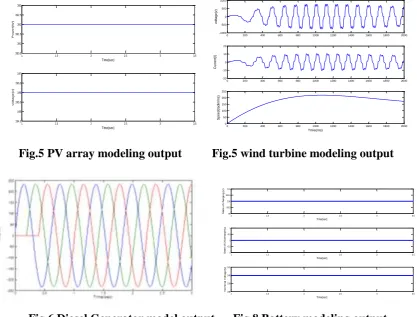
is the Diesel Generator rated power is the power generated (kw), CF is the fuel cost per liter and A=0.246 1/kwh and B=0.0845 l/kWh are the fuel curve coefficient the above equation.[12] In order to regulate the efficiency of DG set, the system should be operated at the optimal loaded condition. The following figure represents the mathematical modeled and the average output of the system at several test condition.
1 1.5 2 2.5 3 3.5
390.5 391 391.5 392 392.5 393 Time(sec) P o w e r( W)
1 1.5 2 2.5 3 3.5
194.5 195 195.5 196 196.5 197 Time(sec) v o lt a g e (v )
0 200 400 600 800 1000 1200 1400 1600 1800 2000 -1000 -500 0 500 1000 vo lt a g e (v)
0 200 400 600 800 1000 1200 1400 1600 1800 2000 -20 -10 0 10 20 C u rr e n t( I)
0 200 400 600 800 1000 1200 1400 1600 1800 2000 0 50 100 150 200 250 Tmie(ms) S p e e d (r a d in /m s)
Fig.5 PV array modeling output Fig.5 wind turbine modeling output
1 1.5 2 2.5 3 3.5
99 99.5 100 100.5 101 Time(sec) S ta te o f ch a rg in g ( v)
1 1.5 2 2.5 3 3.5
-1 -0.5 0 0.5 1 Time(sec) S ta te o f D isch a rg e (v)
1 1.5 2 2.5 3 3.5
238 239 240 241 Time(sec) N o m in a l V o lt a g e (v)
Fig 6 Diesel Generator model output Fig 8 Battery modeling output
4SYSTEMCONSTRAINTSMODELING
deficient energy will be supplied by the battery. Otherwise, if the battery banks SOC is equal to , Diesel generator will be started to supply the load.[7]
If is lesser than then DG set will be operated at its minimum level. While if is higher than and lower than PR, deficient energy will be provided by DG set.
E.Loss Of Power Supply Probability
The loss of power supply probability (LPSP) is defined as, that the load is not satisfied by the renewable or when the energy generated from the source is insufficient and the battery bank is exhausted.[6],[8] The main objective is to maintain the sufficient load management by using the renewable energy system. The probability is sustained between 70-80% throughout the operating system. The Loss of Power Supply Probability[5] is given by
(14)
F. Renewable Enrgy Fraction
The REF is defined as the fraction of energy delivered to the load that original from renewable source and it can be calculated[7] using the following function
(15)
is the load served by the diesel generator. Pure renewable system corresponding to REF=100%, while pure diesel generator system corresponding to REF=0%. So, form these bound condition we can calculate the renewable energy fraction.[8] [9] The REF is maintained in and around the range of 60-90% throughout the system operation.
G.Economical Modeling Of The System
The economical approach is the concept of Cost of Energy is developed as the objective function of the economic modeling is the analysis of system cost in the study and can be expressed as
(16)
easier understanding purposes the annualized cost of the system is the sum of the three cost they are given by
(17)
The annualized capital cost of each component is given by
(18)
is the initial capital cost, CRF is the recovery factor, is the period lifetime. The is the initial capital cost of the hybrid system which is the sum of the purchasing cost the individual cost and they are given by
(19)
The annualized replacement cost is the annualized value of replacement cost occurring through the lifetime of the project and it can be expressed as
(20)
is the replacement cost of the component. SSF is the sink fund factor, is the component lifetime. The unit price, replacement, operation and maintenance cost of the hybrid energy system components and the lifetime are summarized. The technical characteristics of the PV, battery banks and the wind turbine are obtained from the economical modeling system.
3 OPTIMIZATIONOFHYBRIDSYSTEMUSINGGENETICALGORITH(GA)
A.RESULTS AND DISCUSSION
Genetic Algorithm based on MATLAB program code is generated to the optimal sizing of PV/WT/Battery/Diesel Generator System intended to supply a standalone system. The optimization system parameters of the GA consist of 100 to 200 populations of maximum generations. The crossover value and the mutation ratio are of between 0.7 and 0.22 these values are determined by the trial and error method to find out the optimum solutions. LSPS is set to be zero, and the REF is about 75%and the fuel cost for the DG set is assumed to about 67 Rs./liter. The optimization system with one wind turbine, the diesel generator is summarized in Table 1. From the mathematical modeling of wind turbine, solar array, battery bank modeling and their output are represented below. Therefore in this study, the priority sequence for the system is of a wind turbine, PV array, Battery bank and the Diesel generator. The diesel price in the study has an impact on COE value of the system, the COE of the diesel system increases more rapidly than the COE of HES with an increase in the diesel price. The rated Diesel generator system is mathematically model and the rated output of the system is given below and the function is naturally constant, but gradually changes accordingly to load. The COE does not linearly depend on the Renewable energy fraction, the REF is approximately from 80-100%, a small increase in the REF will result in the heavy increase in the COE.
Table 1: Optimized system result.
The modeling of the solar PV array and the regular energy output of the system is given below. And the designed model is of around 382 kW and 192V and the battery bank state of charging and the discharging are also mentioned and the States of discharge shout not beyond 100% which reduces the lifetime of the battery. The optimal sizing method describe can be applied to other design other type of hybrid system listed in table1. ASC and the COE are
HES
HES Components Cost of energy (Rs/kWh)
Annualized cost (Rs/kWh)
Annualized system cost (Rs/kWh)
Fuel Consumption
(Rs/kWh)
Co2
emission (kg/year)
REF (%) NPV NWT NBA NDG
PV/WT/BA/DG 2 1 4 1 39.72 1,11,765 4,43,970 37,962 53147 96.60
PV/WT/DG 2 1 0 1 30.28 32,149 9,723,67 31,074 39647 97.42
PV/WT/BA 2 1 4 0 8.39 1,22,670 1,03,018 0 0 100
PV/BAT/DG 2 0 4 1 30.20 32,206 9,72,857 31,074 43504 99.03
WT/BA/DG 0 1 4 1 119.27 42,451 5,06,314 35,207 49290 17.06
WT/Bat 0 1 4 0 22.57 43,081 9,72,431 0 0 100
PV/Bat 2 0 4 0 13.11 83,345 1,09,297 0 0 100
PV/WT 2 1 0 0 41.30 10,702 4,42,621 0 43504 98.51
WT/DG 0 1 0 1 23.49 28,324 6,65,479 28,319 43504 15.06
chosen as the primary economic evaluation criteria for this study. The optimization examination has been implemented to this kind of system, and the sizing results are given in the table 1. The presences of three independent power sources like PV, WT and DG set in the Hybrid energy system which increases the system reliability. The battery bank systems nominal capacity 1156(Ah), and the battery bank efficiency is around 75%, the DOD is maintained around 70%. The PV module specification which includes the power of 392 W, nominal voltage is 24(V), and its efficiency is around 20%. The major part of the hybrid system is considered as the wind turbine and the system with three blade system and horizontal operating system with rated nominal voltage of 415(V). The diesel system , which have the low ACC, is lees economical than all the other HES configuration, except for those that include PV without WT and those comprises of renewable sources without diesel generator. The relatively low ASC of the hybrid system that have wind rotary engine and diesel generator are unit are well suit for the economic practicability. The reduction in the COE causes the enclose of batteries to WT/DG system and it results in less operation of diesel generator and by this less emission of carbon dioxide. The deciding criteria in finding the most economically settable HES and the Hybrid PV/WT/Bat/DG and the PV/WT are recommended. This may be assumed for the sustained wind speed and the solar irradiance profile in the examined area. Form the consideration of the load demand in this study, the priority sequence for choosing hybrid system are PV/WT/Bat/DG, hybrid PV/WT, hybrid PV/WT/DG, hybrid PV/Bat, hybrid PV/WT/BA systems.
6.CONCLUSIONS
80-100% this hikes the COE of the system. The COE of the system will increases due to the issue of increase with the diesel price. The hybrid system is always feasible as compared to DG set system.
REFERENCE
1. Natural renewable energy resource availability and the meteorological data.[online] http://www.nrel.gov
2. Abdullrahman A. Al-Shamma., Khaled and E. Addoweesh, “Optimum Sizing of Hybrid PV/Wind/Battery/Diesel system considering Wind Turbine Parameters Using Genetic Algorithm”, IEEE international conference on power and energy, 2012; 2349-2358. 3. Satish Kumar Ramoji., Bibhuti Bhusan Rath, and D.Vijay Kumar, “Optimization of
Hybrid PV/Wind Energy System Using Genetic Algorithm (GA)”, International Journal of Engineering Research and Applications, 2014; 10: 29-37.
4. A.S.O. Ogunjuyigbe, T.R. Ayodele , and O.A. Akinola, “Optimal allocation and Sizing of PV/Wind/Split-diesel/Battery Hybrid Energy System for Minimizing Life Cycle Cost, Carbon and Dump Energy of Residential Building”, Applied Energy Elsevier, 2016; 153-171.
5. Antia Gudelj, and Maja Krcum, “Optimization of a Hybrid Stand-Alone Hybrid Solar Wind System With LPSP Technology using HOGA System”, IEEE Transactions on Energy Conversion, 2011; 125-135.
6. Alain Billionnet, Maarie-Christine Cosat, and Pierre-Louis Poirion, “Robust optimal sizing of hybrid energy stand-alone system”, Elsevier, 2016; 565-575.
7. Arnau Gonzalez, Jordi-Roger Rabi, and Antoni Rius, Rita Puig, “Optimal sizing of a hybrid grid-connected photovoltaic and wind power system”, Elsevier applied energy, 2015; 154: 752-762.
8. Hogxing Yang, Wei Zhou, Lin Lu, and Zhaohong Fang, “Optimal Sizing Method for Stand-Alone Hybrid Solar-Wind System With LPSP Technology by Using Genetic Algorithm”, Elsevier, 2008; 82: 354-367.
9. M.S.Ismail, M.Moghavvemi, and T.M,I.Mahlia, “Genetic Algorithm Based Optimization on Modeling and Design of Hybrid Renewable Energy Systems”, Elsevier, 2014; 85: 120-130.
11.Pablo Garcia, Juan P. Torreglosa, and Luis M.Fernandez, “Optimal Energy Management System for Stand-Alone Wind Turbine/Photovoltaic/Hydrogen/Battery Hybrid System With Supervisory Control Based On Fuzzy Logic”, Elsevier, 2013; 38: 14146-14158. 12.Alessandro Bianchin, Niccolo Magnelli Giovanni Ferrara, Ennio Antonio Carnevale, and