Author’s Accepted Manuscript
An adjustable linear Halbach array J.E. Hilton, S.M. McMurry
PII: S0304-8853(12)00100-X
DOI: doi:10.1016/j.jmmm.2012.02.014
Reference: MAGMA57359
To appear in: Journal of Magnetism and Magnetic Materials
Received date: 16 November 2011 Revised date: 25 January 2012
Cite this article as: J.E. Hilton and S.M. McMurry, An adjustable linear Halbach array,
Journal of Magnetism and Magnetic Materials,doi:10.1016/j.jmmm.2012.02.014
This is a PDF file of an unedited manuscript that has been accepted for publication. As a service to our customers we are providing this early version of the manuscript. The manuscript will undergo copyediting, typesetting, and review of the resulting galley proof before it is published in its final citable form. Please note that during the production process errors may be discovered which could affect the content, and all legal disclaimers that apply to the journal pertain.
An adjustable linear Halbach array
J. E. Hiltona,∗, S. M. McMurryb
aCSIRO Mathematics, Informatics and Statistics, Clayton South, VIC 3169, Australia bSchool of Physics, Trinity College Dublin, Ireland
Abstract
The linear Halbach array is a well known planar magnetic structure
ca-pable, in the idealized case, of generating a one-sided magnetic field. We
show that such a field can be created from an array of uniformly magnetized
rods, and rotating these rods in an alternating fashion can smoothly transfer
the resultant magnetic field through the plane of the device. We examine
an idealized model composed of infinite line dipoles and carry out
computa-tional simulations on a realizable device using a magnetic boundary element
method. Such an arrangement can be used for an efficient latching device,
or to produce a highly tunable field in the space above the device.
Keywords:
Magnetic field, Permanent magnet flux source, Halbach array, Simulation
1. Introduction
Applications requiring specifically tailored magnetic fields are widespread
in industry and research. The field sources for such applications come in a
diverse variety of shape and form, but can be approximately divided into
pow-∗Corresponding author
ered and static categories. Powered sources use electromagnets, which require
an electric current to create the field. Static sources consist of arrangements
of permanently magnetized hard magnetic material, possibly augmented with
softer magnetic materials (Coey, 2002). Although far higher field strengths
can be reached with electromagnetic sources, static sources have the natural
advantage that they require no continuous input of energy.
The discovery in the 1970’s of magnetic materials with both high
coer-civity and remanence, such as SmCo and NdFeB compounds, spurred
devel-opment of static field sources as a viable alternative to powered field sources.
Of these an important subset are designs based on particular arrangement
of permanent magnetic sources known as a ‘Halbach array’, or a ‘flux sheet’.
The first such design was described by Mallinson (Mallinson, 1973) as a sheet
of magnetic material with an alternating magnetization pattern. This
partic-ular magnetization pattern gave the design the unique, and counter-intuitive,
ability to confine the magnetic field to only one side of the sheet.
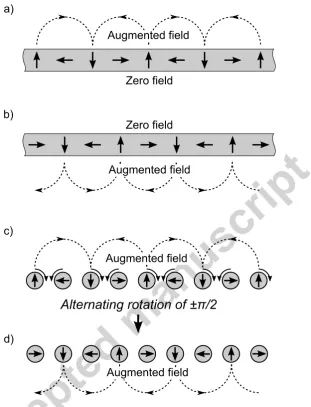
Continu-ous distributions of this pattern are shown in Figs. 1a and 1b, along with a
schematic representation of the resulting field. As the field is augmented on
one side and canceled on the other, the resultant field is effectively doubled
on the augmented side. Mallinson showed the field would be confined in this
manner if the components of magnetization were any Hilbert transform pair,
the simplest of which is m = sin(x)ˆi+ cos(x)ˆj, where m is the
magnetiza-tion vector and x the position along the sheet. A familiar example of such
a magnetization pattern is found in the polymer loaded ferrite material on
the back of fridge magnets. Such magnetic devices are now also widely used
Traveria, 1998), far from the ‘magnetic curiosity’ Mallinson described in his
original paper.
Rolling up such a flux sheet into a cylinder gives a field source known as
a ‘Halbach cylinder’, which was discovered independently by Klaus Halbach
during investigations into magnetic systems for particle accelerators
(Hal-bach, 1980). These remarkable designs can give a uniform, or multi-polar
field, confined entirely within the cylindrical bore of the design. Many
con-figurations and permutations of such cylinder designs are possible. Nesting
two Halbach cylinders allows a variable field within the bore of the device,
which can be precisely controlled by the relative angle between the two
cylin-ders (Ni Mhiochain, 1999). The magnetization distribution required for a
Halbach array can, remarkably, even be created by induced magnetization in
a highly permeable soft magnetic material (Peng, 2003). An idealized
infi-nite length Halbach cylinder produces an entirely uniform homogeneous field
within the bore of the cylinder. However, realizable designs suffer from ‘end
effects’ due to finite length, which reduces the field homogeneity within the
bore. Methods such as shimming and shaping the geometry (Hilton, 2007)
can correct this, significantly improving the uniformity of the field within
such finite length cylindrical designs.
Replacing the individual magnetic segments of a Halbach cylinder with
transversely magnetized rods allows the field within the bore of the design
to be controlled by the relative rotation of each rod. This design, called a
‘magnetic mangle’ was first suggested and investigated by Cugat (Cugat et
al., 1994). In this study we investigate a variation of this design in which an
the cylindrical axes, are arranged into a linear Halbach array. Rotating each
element of the array in the opposite direction to the neighboring elements
is shown to smoothly transfer the magnetic field from one side of the array
to the other. In a similar manner to how a linear Halbach array can be
considered an ‘opened’ Halbach cylinder, the structure investigated here can
be understood as an ‘opened’ magnetic mangle design. Although a wide
range of tunable field sources exist (Coey, 2002; Bjørk et al., 2010), including
designs based on movable Halbach arrays, this design appears to have been
overlooked. Arrangements of this design producing fields above and below
the plane of the rods are shown schematically in Figs. 1c and 1d, respectively.
In the following sections, we first investigate an idealized model of the
device using an array of infinite line dipoles. The resultant torques and
energy of each dipole are evaluated in order to asses the practicalities of any
such device. Then a finite size, realizable device is computationally modeled
using a magnetic boundary element method. We show that such a device
produces a strong, switchable magnetic field in the space above the device
and is not subject to excessive torques. Finally, we suggest a practical design
for such a device based on a simple gearing arrangement.
2. Modelling of the design
2.1. An array of magnetic line dipoles
The arrangement shown in Fig. 1c and 1d can be modeled, to a first
approximation, as a sequence of line dipoles. This basic model allows the
investigation of field and torque behavior on the dipoles as they are rotated
for a magnetic point dipole in Cartesian space, with unit vectorsˆi,ˆj, and kˆ
in the x, y and z directions, respectively. This is given by:
ψ(r) = m·r
4π|r|3 (1)
wherem is the point dipole moment. For a line dipole, confined to thex−y
plane and extending to ±∞ in the z direction, this becomes:
∫ ∞
−∞
m·r
4π|r|3dz =
λ·r
4π|r|2 (2)
where λ is the line dipole moment. The magnetic field of a line dipole is
significantly different to that of a point dipole. In polar co-ordinates the
field magnitude of a line dipole is independent of the polar angle to the
dipole, unlike a point dipole (Cugat et al., 1994). This effect is exploited in
arrangements such as this to provide the augmentation and cancellation of
the field on opposite sides of the plane of the dipoles. The scalar potential
from a collection of N such dipoles is given by:
ψ(r) = 1 4π
N
∑
a=1
λa·(r−ra)
|(r−ra)|2
(3)
where ra is the position of dipolea and the line dipole moment, in this case,
is given by:
λa(ϕ) =λ
(
sin[(−1)aϕ− aπ
2 ]ˆi+ cos[(−1)
aϕ− aπ
2 ]
ˆj) (4)
where ϕ is an overall rotation of the dipoles in the structure. It should be
noted that the rotational dependency onϕ for each dipole is opposite to that
arrangement where the dipoles are evenly spaced along thex axis, separated
by a distancel. This gives a final expression for the magnetic scalar potential
as:
ψ(r, ϕ) = 1 4π
N
∑
a=1
λa·(r−alˆi)
|(r−alˆi)|2 (5)
The torque on each dipole at rotation angle ϕ is an important measure
of the practicality of any device based on this design. The torque on dipole
b,τb, from the dipole array can be evaluated from Eq. (5) as:
τb(ϕ) =−
1
4πλb× ∇ N
∑
a=1,a̸=b
λa·(r−alˆi)
|(r−alˆi)|2 (6)
where the torque vector is aligned with the z axis. The energy of each
dipole allows the stability of the dipole at a particular rotation angle to be
investigated. The energy of a dipole in a field is given by U =−λ·H/µ0, so
the energy of a dipole b in the array is:
Ub(ϕ) = −
1
4πµ0λb · ∇ N
∑
a=1,a̸=b
λa·(r−alˆi)
|(r−alˆi)|2 (7)
2.2. Magnetized finite length segments
In order to investigate the practicalities of an actual magnetic device, the
arrangement was computationally modeled as a sequence of rods of hard
mag-netic material, uniformly magnetized perpendicular to the cylindrical axis.
The fields from these arrangements were calculated using a magnetic
bound-ary element method based on the magnetic charge model (Hilton, 2007). The
surface of each rod was decomposed into triangular sheets of magnetic charge,
as the summation of the fields from each of these sheets. The method has
been applied to a wide range of similar magnetic structures, and has been
carefully validated against existing analytical field solutions, as well as
exper-imental measurements of new magnetic designs (Hilton, 2007). The torque
on each magnet in the design can likewise be calculated from the torque
on each triangular charge sheet about the center of mass of each magnet.
The torque calculations have been verified by comparison to experimentally
measured torques (Ni Mhiochain, 1999) on complex magnetic structures.
3. Results
3.1. Field and torque of the dipole array
The expression for the array of infinite line dipoles was solved using the
computational package Mathematica. For convenience, the constant λ/4π
and the dipole spacing, l, were both set to unity. The resulting scalar
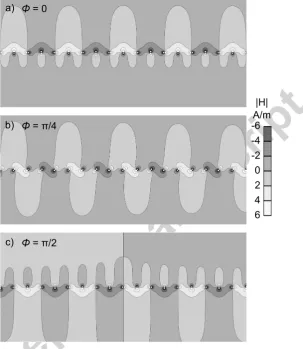
po-tential for a array of 65 line dipoles is shown in Fig. 2 at three rotation
angles. The field clearly reverses from above to below the plane of the line
dipoles as the dipoles are rotated alternately clockwise and anticlockwise as
ϕ is changed from 0 through to π/2 radians. The asymmetry in the scalar
potential is caused by end effects due to the finite number of dipoles in the
array. The scalar potential is symmetrical at ϕ = π/4 as the dipoles are
arranged in pairs orientated at ±π/4 radians to the vertical.
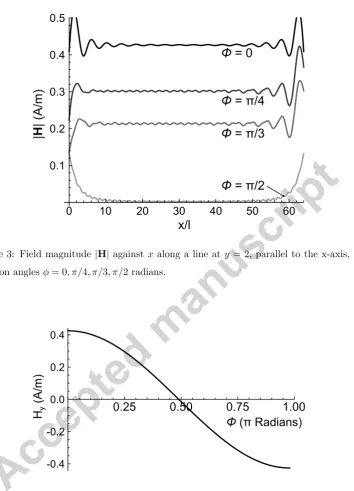
The field magnitude,|H|, along a line parallel to the x-axis at a position
y = 2 is shown in Fig. 3 for a range of ϕ. It should be noted that the
low values for |H|, in comparison to real-world magnetic structures, are due
discussion of the results, as we are concerned with only the form of the field
within this section. Oscillatory effects from the finite number of dipoles are
apparent at the start and end of the array, but the field magnitude over the
mid part is approximately uniform. Rotation of the array, surprisingly, does
not appear to affect the uniformity of the field magnitude, which smoothly
reduces to zero as each dipole in the array is alternately rotated through
ϕ = 0 → π/2 radians. At ϕ = π/2 radians the field magnitude at y = 2 is
reduced to zero.
The Hy field component at the mid point of the array, x = 32, at a
position y = 2 is shown in Fig. 4 for ϕ = 0 → π. The x-component of
the field, Hx ∼ 0 at this point for the entire range of ϕ. The y-component
smoothly varies as the cosine of the rotation angle, ϕ. The field is zero at
ϕ =π/2, as shown in Fig. 3, but reverses in the rangeπ/2→π
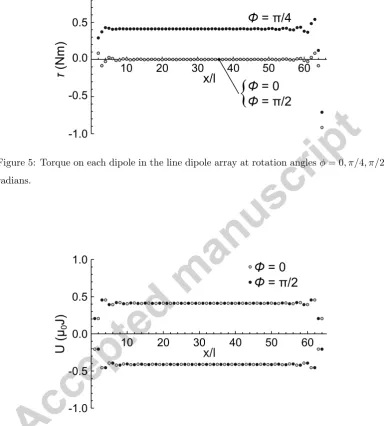
Torques on each dipole in the array were calculated from Eq. (6) and
are plotted against dipole position in Fig. 5. The effect of the finite number
of dipoles is again apparent at the start and end of the array. However, the
torque rapidly reaches a fixed value for dipoles only several steps from the
ends of the array. The torque on each dipole varies as the sine of the rotation
angle, reaching a maximum value at ϕ=π/4, and is approximately zero over
the bulk of the array at ϕ= 0, π/2.
The energy of each dipole in the array was calculated from Eq. (7) and
is plotted against dipole position in Fig. 6 for ϕ = 0, π/2. At ϕ = π/4, all
dipoles have approximately zero energy. The energy minimum of a dipole at
ϕ = 0 orϕ=π/2 was found to occur at the energy maxima of its neighboring
showing that the dipoles are alternately at stable and unstable mechanical
equilibria at these orientations.
A series of line dipoles therefore shows the desired behavior, producing a
field which varies asHy ∼cos(ϕ). The largest torques are experienced by the
dipoles within the stray field regions at the ends of the array. The torques
within the bulk of the array are approximately zero for ϕ = 0 and ϕ =π/2.
However, each dipole at these orientations is either at an energy minimum or
maximum with respect to its neighboring dipoles, showing that mechanical
stabilization of the array is necessary for a practical device.
3.2. Field and torque of a magnetic rod arrangement
In the simple dipole model, end effects caused by the finite number of
dipoles were observed at the start and ends of the array. Practical
mag-netic designs also suffer from additional effects caused by the finite length of
the magnetic components in the design (Ni Mhiochain, 1999; Bjørk , 2011).
These can decrease both the effective magnetic field and the homogeneity
of the field over the working area of the device. To investigate these effects
in a realizable device, a practical sized magnetic design was modeled.
Six-teen transversely magnetized rods were used in the device, N = 16, with
a remnant magnetization of Br = 1.2T, typical of a standard grade of the
hard magnetic material NdFeB. The rods were chosen to be 10cmlong, with
diameter 1 cm, separated by an air gap of 2.5 mm between each rod. The
circular cross-section of each rod was discretized into a 20 sided regular
poly-gon, and the magnetic charge on each element was calculated from the dot
product of the element and the magnetization distribution within the rod,
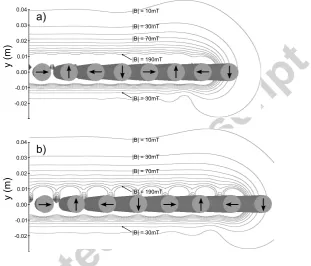
The magnetic flux density, |B|, from the arrangement is shown in Fig.
7, where only half the design is shown as the field is symmetrical about
the y axis. As expected, the field reverses as each rod is rotated alternately
throughϕ = 0→π/2. The magnitude of the field atϕ= 0, π/2 is reasonably
uniform and homogeneous within central part of the design, even for such an
arrangement consisting of only 16 rods.
The flux density, |B|, along a line parallel to the x-axis at y = 2 cm
is shown in Fig. 8 for ϕ = 0, π/4, π/3, π/2. The end of the array is at
approximatelyx= 10cm. The field profile atϕ = 0 is similar to the array of
line dipoles, consisting of a constant field over the central part of the array
with an oscillatory stray field at the ends of the device. The field aty= 2cm
shows almost an ideal reduction from 75mT to zero as the magnetic segments
are rotated.
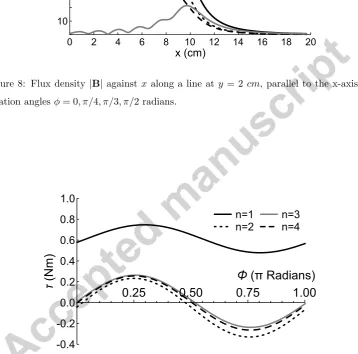
The torque on four rods in the design is shown in Fig. 9, where the torque
is evaluated about the center of mass of the rod. The four rods are labeled
in Fig. 7a as n = 1,2,3,4. The torque on each rod varies sinusoidally with
rotation angle ϕ, as found in the simplified line dipole model. Similarly, the
rods experiencing the maximum torques are located at the ends of the array.
The magnetic rod model therefore qualitatively agrees with the basic line
dipole model, showing the same field and torque variations with rotation
angle, ϕ.
3.3. Variation of the geometry for the magnetic rod arrangement
The design can be readily optimized, as the field shows a non-linear
de-pendency on rod separation. The flux density, |B|, from the arrangement
ϕ = 0. Increasing the rod separation does not affect the field homogeneity
in the central region above the plane of the rods, and appears to slightly
increase the maximum magnetic field strength away from the plane of the
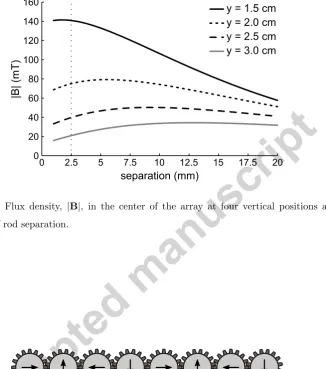
rods. A plot of the flux density against separation is shown in Fig. 11 at
x= 0 for several values of y. At large rod separations, |B| →0. The vertical
dashed line shows the 25 mm separation used in the preceding section. It
can be seen that the optimal spacing, giving the maximum field strength, at
any chosen vertical position above the rods varies with the vertical position.
4. Discussion
The magnetic field strength in the plane above a flux sheet is given, in the
idealized case, by |B|2 = Ke−ky (Mallinson, 1973). As the field varies with
the cosine of the rotation angle, the field in an arrangement of magnetized
rods can therefore be approximated by |B|2 = K′e−k′ycos2(ϕ), where K′, k′
are constants depending on the magnetic remanence, rod separation and
other geometric factors. For the design discussed in the previous section,
with N = 16 and a rod separation of 25 mm, these constants were found
from data fitting to be K′ = 0.923, k′ = 256 for y > 1 cm. The field was
very close to the expected exponential form, with the natural logarithm of
the exponential fit having R2 = 0.9998. For designs with N rods, the field
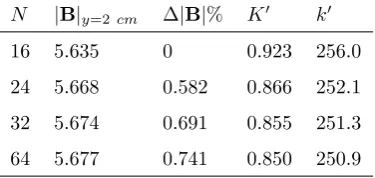
was found to be relatively invariant for N > 16, with < 1% difference in
the measured field at y= 2 cm compared between designs with N = 16 and
N = 64. The field at y= 2 cm and the percentage difference in the field in
comparison to a design with N = 16 is given in Table 1 for a selection ofN,
N |B|y=2cm ∆|B|% K′ k′
16 5.635 0 0.923 256.0
24 5.668 0.582 0.866 252.1
32 5.674 0.691 0.855 251.3
[image:13.595.212.400.128.217.2]64 5.677 0.741 0.850 250.9
Table 1: Flux density |B|at y = 2cm, ϕ = 0 for variousN, % difference in |B| from a
design withN = 16 and fitting parametersK′, k′.
Simulations show that such a design is easily realizable and will not be
subject to excessive torques during rotation on each of the rods. Mechanical
stabilization is required, however, as no global energy minima exist for the
system. Rods at energy minima, and stable mechanical equilibrium, have
neighbors at energy maxima at unstable equilibria. A very straightforward
solution exists, however, giving both mechanical stabilization as well as
al-lowing the ability to rotate rods alternately. This is simply to use an equal
gearing of each rod to the neighboring rod, as shown in Fig. 12. It can be
noted that a flux sheet can be discretized into more sections to give a
mag-netization pattern which varies more smoothly (Bjørk et al., 2010), but this
would require a far more complex gearing mechanism.
Such a design can be used for a range of practical applications. For
example, the latching strength of such a device varies with the cosine squared
of the rotation angleϕ. This can be shown by evaluating the Maxwell stress
tensor in the idealized case of a highly permeable soft magnetic material
parallel to the plane of the rods. The latching strength for each pole in the
device is then given by Flatch =N By2A/4µ0 (Furlani, 2001), where N is the
device, this gives Flatch ∼ Ncos2(ϕ)A/4µ0. For the design in the preceding
section with a rod separation of 25mm, this gives a maximum latch strength
on a soft magnetic plate aty= 2cmofFlatch∼180N, which smoothly varies
to zero as the rods are rotated.
5. Conclusion
A series of magnetized rods, arranged in the form of Mallinson’s flux sheet,
produces a field confined to one side of the plane of the rods. The field can
be transferred through the plane by alternating rotation of each rod. Such
an arrangement can be fabricated into a practical device by a simple gearing
arrangement, as shown schematically in Fig. 12. Such a device would have
a range of applications, such as a mechanical magnetic latching or a variable
field source. Two such parallel arrangements might be used as a variable
wiggler magnet for free electron laser and synchrotron devices. It is our hope
that this simple design, which appears to have been previously overlooked,
will be a useful addition to the family of tunable field source devices.
J. M. D. Coey, Permanent magnet applications, Journal of Magnetism and
Magnetic Materials 248 (2002), 441-456.
J. C. Mallinson, One-Sided Fluxes A Magnetic Curiosity? IEEE
Transac-tions on Magnetics, 9 (1973), 678-682.
J. Juanhuix, M. Traveria, Magnetic design and light characteristics of a
Wig-gler for the LLS, 6th European Particle Accelerator Conference,
K. Halbach, Design of permanent multipole magnets with oriented rare earth
cobalt material, Nuclear Instruments and Methods 169(1) (1980), 110.
T. R. Ni Mhiochain, D. Weaire, S. M. McMurry, J. M. D. Coey, Analysis of
torque in nested magnetic cylinders, Journal of Applied Physics, 86 (1999),
64126424
J. E. Hilton, S. M. McMurry, Halbach cylinders with improved field
homo-geneity and tailored gradient fields, IEEE Transactions on Magnetics 43(5)
(2007), 1898-1902.
Q. Peng, S. M. McMurry, J. M. D. Coey, Cylindrical permanent-magnet
structures using images in an iron shield, IEEE Transactions on Magnetics
39(4) (2003), 19831989.
O. Cugat, P. Hansson, J. D. M. Coey, Permanent Magnet Variable Flux
Sources, IEEE Transactions on Magnetics 30(6) (1994) 4602-4604.
R. Bjørk, C. R. H. Bahl, A. Smith, N. Pryds, Comparison of adjustable
permanent magnetic field sources, Journal of Magnetism and Magnetic
Materials 322 (2010) 36643671.
R. Bjørk, The ideal dimensions of a Halbach cylinder of finite length, Journal
of Applied Physics 109 (2011), 013915
E. P. Furlani, Permanent magnet and electromechanical devices: materials,
Figure 1: a) Continuous magnetization pattern generating a one-sided field above the plane
of the magnet. b) Continuous magnetization pattern generating a one-sided field below
the plane of the magnet. c) Discretization of the continuous distribution generating a field
above the plane of the magnet. d) Discretization of the continuous distribution generating
a field below the plane of the magnet. Alternating clockwise and anti-clockwise rotation
[image:16.595.165.477.133.541.2]Figure 2: Contours of magnetic scalar potential for a element array of line dipoles, with
Figure 3: Field magnitude |H| againstxalong a line aty = 2, parallel to the x-axis, at
[image:18.595.170.479.136.375.2]rotation angles ϕ= 0, π/4, π/3, π/2 radians.
Figure 4: Field componentHy aty = 2 in center of array as a function of rotation angle
Figure 5: Torque on each dipole in the line dipole array at rotation anglesϕ= 0, π/4, π/2
radians.
Figure 6: Energy of each dipole in the line dipole array at rotation angles ϕ= 0, π/4, π/2
[image:19.595.114.499.176.603.2]Figure 7: Flux density, |B| for array of magnetized rods, with rotations a) ϕ = 0, b)
Figure 8: Flux density |B| againstxalong a line at y = 2 cm, parallel to the x-axis, at
rotation angles ϕ= 0, π/4, π/3, π/2 radians.
[image:21.595.125.484.249.603.2]Figure 10: Flux density, |B| for array of magnetized rods, with ϕ = 0 and spacing a)
Figure 11: Flux density, |B|, in the center of the array at four vertical positions as a
function of rod separation.
Figure 12: A straightforward implementation of the device using an equal mechanical
We model an adjustable ‘one sided’ flux sheet made up of a series of dipolar magnetic field sources.
We show that magnetic field can be switched from one side of sheet to other by an swap rotation of each of magnetic sources.
Investigations show that such an arrangement is practical and can easily be fabricated.