ISSN-L: 2501 - 1235 Available on-line at: www.oapub.org/edu
doi: 10.5281/zenodo.1463949 Volume 4 │ Issue 12 │ 2018
EFFECTS OF DIFFERENT WARM-UP TECHNIQUES
ON DYNAMIC BALANCE AND MUSCULAR STRENGTH
ON PLAYERS: A STUDY
Mohammad Ahsan1,
Arif Mohammad2i
1Assistant Professor,
Department of Physical Therapy, College of Applied Medical Sciences, Imam Abdulrahman Bin Faisal University, Dammam, KSA
2Assistant Professor,
Department of Teacher Training and Non-formal Education (IASE), Jamia Millia Islamia, New Delhi, India
Abstract:
up helps the individual to prepare themselves for the strenuous workout. Warm-up is generally executed prior participation in any physical activity or sports. Active warm-up includes low-intensity exercises, whereas passive warm-up includes external heat resources that are useful to enhance body temperature. The objective of the study was to compare the effect of active, passive and combined warm-up techniques on dynamic balance and muscular strength of the players belonging to hand dominated sports such as handball, volleyball, and basketball. To fulfill the objective 15 players of hand dominated sports were recruited as the sample further they were divided into 3 groups i.e. active, passive and combined comprising 5 players each on a random basis. The average chronological age, stature height, and body weight of the subjects were 26.5 ± 5.7 years, 172.4 ± 3.4 cm, and 68.7 ± 5.6 kg, respectively. For dynamic balance, the equilibrium management test was administered by stabilometer (Techno-Body Machine). The test was done with open and closed eyes, with two stability level i.e. 10 & 20. An isokinetic dynamometer (BIODEX) was used to measure muscle strength. The test was started as participant performed 5 repetitions of CON/CON at low speed of 60/60 0/sec. and by a high speed of 180/180 0/sec. Before taking data on dynamic balance
and muscular strength, all 3 groups were given different warm-up techniques which technique was assign to their group. The obtained data were statistically analyzed by using IBM SPSS v.20 software. Descriptive statistic and one-way ANOVA were computed. The results revealed there is no significant difference in any warm-up method on muscular strength as well as on dynamic stability.
Keywords: dynamic stability, muscular strength, active warm-up, passive warm-up, combined warm-up
1. Introduction
The athletes usually participate in a low-level exercise program before any competition or start of the vigorous physical activity. This exercise program is known as warm-ups. Warm-ups help the athletes to prepare themselves for the strenuous demand of workout. The practice of warm-up has been accepted globally. The purpose of the warm-up is to raise the temperature of specific muscle to be used as well as initiate the energy system that is essential for that particular competition or physical activity. An optimal warm-up prior to any physical activity may help athletes in their mental & physical readiness, injury prevention, and overall sports performance. A warm-up increases nerve impulse transmission and metabolic activity, while it decreases joint and muscle stiffness (Leon, Oh, & Rana, 2012).
The traditional warm-up includes moderate jogging which is followed by a number of static stretch exercises, like forward, backward, sideward bending etc. (Baechle & Earle, 2016). Generally, there are two types of warm-up active and passive. Active warm-up includes low-intensity exercises which are useful to enhance body temperature, warm body’s tissue and also improving physiological functions (Bishop, 2003). Passive warm-up includes external heat resources such as whirlpools, diathermy, ultrasound, hot pack, bath and massage (McGowan, Pyne, Thompson, & Rattray, 2015). Researchers who worked on this topic documented that active warm-up reduces muscle stiffness through breakdown the stable bound between myosin and actin filaments (Proske, Morgan, & Gregory, 1993). Active warm-up did improve performance in speed, endurance in swimming, accuracy in basketball shooting (Thompson, 1958), peak torque on a cycle ergometer (McKenna, Green, Shaw, & Meyer, 1987), and 55 meters runtime (Grodjinovsky & Magel 1970). Voluntary resistance methods of stimulating post-activation potentiation can enhance CMJ height (Gullich & Schmidtbleicher, 1996), short-sprint performance (Chatzopoulos et al., 2007), improve vertical-jump performance (Church, Wiggins, Moode, & Crist, 2001), and swimmers were also found 1.5% faster in the 100 m freestyle (Neiva, Marques, Fernandes, Viana, Barbosa, & Marinho, 2014).
In the similar note researchers documented that passive warm-up enhances blood flow into the major muscle group and prevents energy expenditure. Gregson, Drust, Batterham, and Cable, (2005), Bergh and Ekblom (1979), Grose (1958), Asmussen and Boje (1945) studied the performance of untrained, moderate trained and trained male athletes with several warm-ups protocol and concluded that there were significant improvements in sprint time, average speed, peak velocity, peak torque at exercise.
sports performance (Hrysomallis, 2011). Holmstrom and Ahlborg (2005) suggested that a small number of warm-ups might be effective for increasing and maintaining range of motion and muscle endurance for untrained male workers. Increase in the muscle strength reduces sports injuries and improve athletic performance (Opar & Serpell, 2014). Numerous researchers reported that sports performance improved by following an active and passive warm-up while some of the researchers had found that there is no benefit. Due to the unanimity, concerning the effect of active and passive warm-up upon sports performance might be lack of heterogeneity to different exercise protocols and insufficiency of well-controlled studies. Considerable studies have been accomplished on both of these concerns. Hence, this study is undertaken to compare the effect of active, passive and combined warm-up on dynamic balance and muscular strength of the players who belong to hand dominated sports.
2. Methods and Materials
2.1 Participants
The study comprises fifteen (15) active individuals who are the players of basketball, volleyball, and handball. Further, they were divided into three warm-up groups - Active warm-up (AWU) group (n=5), Passive warm-up (PWU) group (n=5), and Combined warm-up (CWU) group (n=5). All the participants were right arm dominant. They were injury-free and volunteered to participate in this study. The age, height and body weight of the subjects was recorded as 26.5 ± 5.7 years, 172.4 ± 3.4 cm, 68.7± 5.6 kg, respectively. The participants were recruited from the Delhi State.
2.2 Activities Given to Warm-up Groups 2.2.1 Active Warm-up (AWU)
This group comprises volleyball players. The intervention which given to this group was 12-minute jog on the self-regulated treadmill followed by five push-ups, pull-ups, five-meter single leg hop to and from with alternate leg, five half and full squats. AWU also followed by stretching for lower leg muscles.
2.2.2 Passive Warm-up (PWU)
Moist heat heating device was used that included eight Chattanooga original hydro-collator moist heat hot packs (Standard-size 10” x 12”) as an intervention. PWU started as packs were applied over the leg and hip muscles (Gluteus, Hamstrings, Quadriceps, Gastrocnemius, and soleus) for the duration of 20 minutes. During the application, participants lay down in the prone position. PWU also followed by stretching for lower leg muscle. This intervention is given to basketball players.
2.2.3 Combined Warm-up (CWU)
hydro-collator moist heat hot packs were applied over the leg and hip muscles for the duration of 12 minutes. CWU also followed by stretching of major muscles in the lower leg.
2.3 Variables of the Study and Test Procedure 2.3.1 Dynamic Balance
The dynamic balance was measured by the equilibrium management test by using stabilometer (Techno-Body Machine). For the bipedal test, each participant stands with both feet in parallel on the platform with their hands on the waist. Each test took 30 seconds. Each test was done with open and closed eyes, with two stability level (Hard 10, Easy 20). Instructions were given to guarantee the consistent performance of the standardized testing procedure.
2.3.2 Muscular Strength
To measure muscle performance Isokinetic dynamometer (BIODEX) was used. The range of motion was set as 0 degree and 100 degrees for away from the body and toward the body, respectively. The weight of the leg was measured by fixing on 90 degrees of flexion. The participant was instructed to perform 3 trails of forceful extension and flexion of the knee. The test was started as participant performed 5 repetitions of CON/CON at low speed of 60/60 o/sec, followed by a high speed of
180/180 o/sec. One minute was give as rest time in between the velocities.
2.4 Procedure
All participants were informed prior about the objective, protocol, and risk associated with experimental procedures. They provide their written consent to be a part of the study. The participants were instructed not to participate in any type of physical exercise program prior to 36 hours of the testing that could affect their performance in the study. Demonstration and instruction of the warm-up protocol and testing procedure were given one day before from the actual testing day to make all participants familiar with the test. Institutional ethical clearance was also obtained for the study.
2.5 Statistical Analysis
3. Results
Table 1: Descriptive statistic of dynamic stability in between different types of warm-up groups with open and closed eyes
Open Eyes
(Easy) Close Eyes (Easy) Open Eyes (Hard) Close Eyes (Hard) AWU PWU CWU AWU PWU CWU AWU PWU CWU AWU PWU CWU Mean 2.50 1.48 1.72 8.94 7.71 8.53 0.59 0.73 0.87 1.86 1.48 3.19
SD 1.38 0.33 1.20 2.33 1.08 2.37 0.27 0.23 0.39 0.37 0.33 2.03
SE 0.62 0.15 0.54 1.04 0.48 1.06 0.12 0.10 0.18 0.17 0.15 0.91
Min. 1.17 1.15 0.58 6.18 6.24 5.28 0.33 0.51 0.27 1.52 1.15 0.87
Max. 4.38 1.96 3.74 11.4 9.03 10.9 0.97 1.08 1.25 2.47 1.96 4.78
Table 2: Descriptive statistic of muscle strength between different types of warm-up groups during extension and flexion with the slow and fast speed level
Extension
(Slow) Flexion (Slow) Extension (Fast) Flexion (Fast) AWU PWU CWU AWU PWU CWU AWU PWU CWU AWU PWU CWU Mean 148.96 147.78 165.42 76.30 69.48 75.72 107.48 91.73 102.32 69.32 59.23 62.98
SD 18.02 33.79 22.25 17.46 12.43 18.11 22.36 18.33 19.71 8.28 10.39 14.43
SE 8.06 15.11 9.95 7.81 5.56 8.10 10.00 8.20 8.81 3.70 4.65 6.45
Min. 136.60 108.60 149.60 48.30 54.00 55.50 79.90 67.00 77.80 56.40 43.90 42.10
Max. 180.20 197.10 203.80 96.00 82.30 102.50 129.00 118.30 132.50 79.50 69.70 80.00
Table 3: ANOVA of dynamic stability among all 3 warm-up groups with open and closed eyes
Open Eyes (Easy) Close Eyes (Easy) Open Eyes (Hard) Close Eyes (Hard) Between
Groups Groups Within Between Groups Groups Within Between Groups Groups Within Between Groups Groups Within Sum of
Squares 2.845 13.802 3.931 48.891 0.196 1.115 8.070 17.489 Mean Square 1.423 1.150 1.965 4.074 0.098 0.093 4.035 1.457
F 1.237 0.482 1.055 2.769
Sig. 0.325 0.629 0.378 0.103
The results of one-way ANOVA (Table 3) for the dynamic stability among different types of warm-up groups with open and close eyes are presented in the above table. It is observed from the table that there is no significant difference existed among active, passive and combined warm-up groups for open and close eyes with easy and hard stability at 0.05 significant levels.
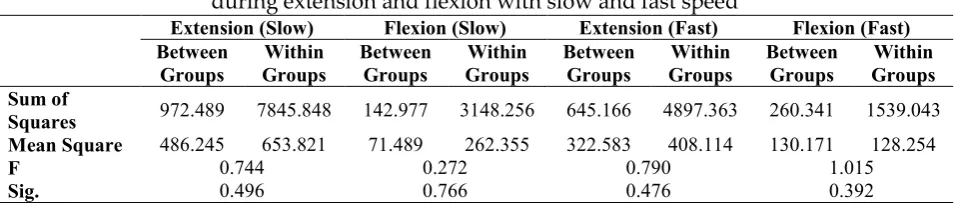
Table 4: ANOVA of muscle strength among all 3 warm-up groups during extension and flexion with slow and fast speed
Extension (Slow) Flexion (Slow) Extension (Fast) Flexion (Fast) Between
Groups Groups Within Between Groups Groups Within Between Groups Groups Within Between Groups Groups Within Sum of
Squares 972.489 7845.848 142.977 3148.256 645.166 4897.363 260.341 1539.043 Mean Square 486.245 653.821 71.489 262.355 322.583 408.114 130.171 128.254
F 0.744 0.272 0.790 1.015
The above ANOVA Table 4 shows the results for the muscle strength (Peak-Torque) among different types of warm-up groups during extension and flexion. It is documented from the table that there is no significant difference among active, passive and combined warm-up groups for extension and flexion in both slow and fast speed with 0.05 significant levels.
4. Discussion
The purpose of this study was to investigate the effect of active, passive and combined warm-up upon the muscular strength and dynamic stability. The main findings revealed that there were no significant effects of any warm-up method on muscular strength and dynamic stability. Erkut, Gelen, and Sunar, (2017) said that both static and dynamic warm-up increases the performance of balancing. Warm-up usually thought to have positive effects on injury prevention for any sports activity. These results are similar to the results of Gogte, Srivastav, and Miyaru, (2017) they found that passive, active and combined types of warm-up have a similar effect on muscle performance and dynamic stability in recreational athletes. Ayala et al. (2017) also documented similar results.
observed no significant effect on vertical jump performance after different warm-up protocols (general warm-up and warm-up with static stretching) in gymnasts. Faigenbaum, Bellucci, Bernieri, Bakker, and Hoorens, (2005) does not fond any significant difference in flexibility by the following three types of warming up protocol. The result of that study reported that it might be desirable for children to execute moderately to high-intensity dynamic exercises before any physical activity that demands a high-power output.
The findings of this research were not confirmed by the studies of Daneshjoo et al., (2012) reported that active and passive warm-up programs enhance proprioception in the dynamic leg while dynamic balance revealed improvement as well as indicating significant difference with the control group. The static balance for opened and closed eyes and dynamic balance (SEBT) were increased in both groups. The active and passive warm-up program have been presented as improve in proprioception and balance. Nejati, Balarin, Gonzolas, and Neal, (2015) noticed that there was a significant effect on balance and agility performance with static and dynamic stretching warm-up as compare to no stretching warm-up. The static stretching warm-up had no influence on balance while comparing to no stretching, but it did effect on agility. The static versus dynamic warm-up group presented similar statistics but depend upon the effect size analysis, the static group had a smaller effect size than dynamic. Morales-Artacho, Lacourpaille, and Guilhem, (2017) suggested that the cycling performance does not have an acute superior effect on muscle stiffness with a combined warm-up, while muscle stiffness is reduced with an active warm-up. The time among warm-up and competition should be considered when optimizing the effects on muscle stiffness. The whole body warm-up on the treadmill increase aerobic capacity, enhance muscle performance during competition or any activity, it also has a positive effect on balance ability (Carmeli, Kessel, & Coleman, 2002). Woods, Bishop, and Jones, (2007) reported that muscle temperature increased as a result of general and specific warm-up activity, also affect the muscle performance by diminishing the muscle’s viscous resistance.
5. Conclusion
References
Andrade, D. C., Henriquez–Olguín, C., Beltran, A. R., Ramirez, M. A., Labarca, C., Cornejo, M., …… & Ramirez-Campillo, R. (2015). Effects of general, specific and combined warm-up on explosive muscular performance. Biology of Sports, 32(2), 123-128.
Asmussen, E. & Bonde-Petersen, F. (1974). Storage of elastic energy in skeletal muscles in man. Acta Physiologica Scandinavica, 91(3), 385-392.
Ayala, F., Calderon-Lopez, A., DelgadoGosalbez, J. C., Parra-Sanchez, S., Pomares-Noguera, C., Hernandez-Sanchez, S., ….. & Croix, M. D. S. (2017). Acute effects of three neuromuscular warm-up strategies on several physical performance measures in football players. PLoS ONE 12(1), e0169660.
Baechle, T. R. & Earle, R. W. (2016). Essentials of strength and conditioning (4th). Human Kinetics: Champaign.
Bergh, U. & Ekblom, B. (1979). Physical performance and peak aerobic power at different body temperatures. Journal of Applied Physiology, 46(5), 885-889.
Bishop, D., (2003). Warm up II: Performance changes following active warm up and how to structure the warm up. Journal of Sports Medicine, 46, 885-889.
Carmeli, E., Kessel, S., & Coleman, R., (2002). Effects of a treadmill walking program on muscle strength and balance in elderly people with Down syndrome. The Journals
of Gerontology. Series A, Biological Sciences and Medical Sciences, 57, M106-M110.
Chatzopoulos, D. E., Michailidis, C. J., Giannakos, A. K., Alexiou, K. C., Patikas, D. A., Antonopoulos, C. B., & Kotzamanidis, C. M. (2007). Postactivation potentiation effects after heavy resistance exercise on running speed. Journal of Strength and
Conditioning Research, 21(4), 1278-1281.
Church, J. B., Wiggins, M. S., Moode, F. M., & Crist, R. (2001). Effect of warm-up and flexibility treatments on vertical jump performance. Journal of Strength and
Conditioning Research, 15, 332-336.
Curry, B. S., Chengkalath, D., Crouch, G. J., Romance, M., & Manns, P. J. (2009). Acute effects of dynamic stretching, static stretching and light aerobic activity on muscular performance in women. Journal of Strength and Conditioning Research, 23(6), 1811-1819.
Daneshjoo, A., Mokhtar, A. H., Rahnama, N., & Yusof, A. (2012). The effects of comprehensive warm-up programs on proprioception, static and dynamic balance on male soccer players. PLoS ONE 7(12), e51568.
Edouard, P., Arnal, P., Gimenez, P., Samozino, P., Jimenez-Reyes, P., Brughelli, M., …… & Morin, J. (2016). Athletic injury prevention: Determinants of sprint performance. Annals of Physical and Rehabilitation Medicine, 59S, e22-e23.
Faigenbaum, A. D., Bellucci, M., Bernieri, A., Bakker, B., & Hoorens, K. (2005). Acute effects of different warm-up protocols on fitness performances in children.
Journal of Strength and Conditioning Research, 19(2), 376-381.
Fletcher, I. M. & Monte-Colombo, M. M. (2010). An investigation into the effects of different warm-up modalities on specific motor skills related to soccer performance. Journal of Strength Conditioning Research, 24(8), 2096-2101.
Gogte, K., Srivastav, P., & Miyaru, G. B. (2017). Effects of passive, active and combined warm up on lower limb muscle performance. Journal of Clinical and Diagnostic Research, 11(3), 5-8.
Gregson, W., Drust, B., Batterham, A., & Cable, N. (2005). The influence of pre-warming on the physiological responses to prolonged intermittent exercise. Journal of Sports Sciences, 23(5), 455-464.
Grodjinovsky, A. & Magel, J. R. (1970). Effect of warming-up on running performance.
Research Quarterly for Exercise and Sport 41(1), 526-533.
Grose, J. E. (1958). Depression of muscle fatigue curves by heat and cold. Research Quarterly for Exercise and Sport, 29, 19-31
Gullich, A. & Schmidtbleicher, D. (1996). MVC-induced short-term potentiation of explosive force. New Studies in Athletics, 11(4), 67-81.
Holmstrom, E. & Ahlborg, B. (2005). Morning warming-up exercise-effects on musculoskeletal fitness in construction workers. Applied Ergonomics, 36, 513-519. Hrysomallis, C. (2011). Balance ability and athletic performance. Journal of Sports
Medicine, 41(3), 221-232.
Judge, J. O., Lindsey, C., Underwood, M., & Winsemius, D. (1993). Balance improvements in older women: effects of exercise training. Physical Therapy, 73, 254-262.
Kar, S. & Banerjee, A. (2013). Influence of active & passive warming up on the motor performance of the athletes, Journal of Humanities and Social Science, 10(6), 14-21. Leavey, V., Sandrey, M., & Dahmer, G. (2010). Comparative effects of 6-week balance,
gluteus medius strength, and combined programs on dynamic postural control.
Journal of Sports Rehabilitation, 19, 268-287.
Leon, C., Oh, H-J, & Rana, S. (2012). A purposeful dynamic stretching routine. Strategies, 25(51), 16-19.
McGowan, C. J., Pyne, D. B., Thompson, K. G., & Rattray, B. (2015). Warm- up strategies for sport and exercise: Mechanisms and applications. Journal of Sports Medicine, 45, 1523-1546.
McKenna, M. J., Green, R. A., Shaw, P. F., & Meyer, M. (1987). Tests of anaerobic power and capacity. Australian Journal of Science and Medicine, 19, 13-17.
Neiva, H. P., Marques, M. C., Fernandes, R. J., Viana, J. L., Barbosa, T. M., & Marinho, D. A. (2014). Does warm-up have a beneficial effect on 100-m freestyle?
International Journal of Sports Physiology and Performance, 9(1), 145-150.
Nejati, N., Balarin, G. B., Gonzolas, A., & Neal, J. (2015). Acute effects of dynamic and static stretching during warm-up on balance and agility for untrained adults. In Proceedings: 11th Annual Symposium on Graduate Research and Scholarly
Projects. Wichita, KS: Wichita State University, p. 58
Opar, D. A. & Serpell, B. G. (2014). Is there a potential relationship between prior hamstring strain injury and increased risk for future anterior cruciate ligament injury? Archives of Physical Medicine and Rehabilitation, 95(2), 401-405.
Ozengin, N., Yildirim, N. U., Baltac, G., & Masiulis, N. (2011). Acute effects of different stretching durations on vertical jump performance in rhythmic gymnasts.
Ugdymaskunokultura, 82(3), 16-22.
Proske, U., Morgan, D. L., & Gregory, J. E. (1993). Thixotropy in skeletal muscle spindles: A review. ProgNeurobiol, 41, 705-721.
Romero-Franco, N, (2014). Warm-up on postural stability. Annals of Sports Medicine and Research, 1, 1001-1005.
Thompson, H. (1958). Effect of warm-up upon physical performance in selected activities. Research Quarterly, 29(2), 231-246.
Creative Commons licensing terms