ISSN: 2501 - 1235 ISSN-L: 2501 - 1235 Available on-line at: www.oapub.org/edu
doi: 10.5281/zenodo.1521454 Volume 5 │ Issue 1 │ 2018
BICYCLE - AN EFFECTIVE SOLUTION TO RESERVE GREEN,
CLEAN AND SUSTAINABLE ENVIRONMENT
Nguyen Duc Thanhi PhD, Physical and Defense Education Center, Ho Chi Minh University of Technology and Education,
Vietnam
Abstract:
At present, environmental pollution is increasing in Vietnam in particular and in the world in general, and it is a ringing alarm. Humans have caused too many negative impacts on the environment, resulting in a series of pollutions such as water, land, especially air pollution. Increasing the number of vehicles that are uncontrolled closely causes frequent traffic congestion and the emission of more harmful gases. According to statistics, 70% of air pollution is caused by exhaust gases from cars and motorbikes. These toxins are factors that reduce memory, cognitive ability, coordination between the eyes and hands, stress and increase the rate of cancer... Confronting the situation, people, civil servants, especially students, need to establish healthy traveling habits through the use of bicycles as a practical solution to promote health, contributing to restrict environmental pollution as well as reducing traffic accidents.
Keywords: bicycle, clean, environment, green, solution, sustainable
1. Introduction
The environmental pollution, natural disasters and floods in Viet Nam in particular and the world, in general, are raising the alarm for current environmental protection. According to scientists, within the next 30 years, if we do not stop the greenhouse effect, the sea level will rise from 1.5 to 3.5 meters, the average temperature of The Earth will increase by about 3.60C, and each decade will increase by 0.30C, in which Vietnam will be one of the countries most affected.
degradation and environmental incidents caused by human activities and the impact of nature. Traveling is a practical solution to help protect the green environment, clean and sustainable development. [7]
2.Situation of air pollution
Air pollution is a significant change in the composition of the air. Mainly due to smoke, dust, vapors or strange air being introduced into the air, there is an odor, reduced visibility, climate change, human disease. They can also be harmful to other organisms such as animals and food crops and can damage natural or built environments. Human activity and natural processes can cause air pollution.
A. The state of the air environment in the world
Air pollution makes more than three million people die each year prematurely, threatening almost all residents of major cities in developing countries. According to Fox News, 80% of cities in the world do not meet the World Health Organization (WHO)’s air quality standards, which are mainly concentrated in developing countries. Global urban air pollution has increased by 8% despite improvements in some areas. This results in risks such as stroke, heart disease, lung cancer, and a range of respiratory problems.
WHO has collected data on the air environment in 4,300 cities in 108 countries for the period 2008-2015 and states that nine out of ten people in the world are breathing in high pollution air. According to CNN, about 7 million people die each year from air pollution.
Another study conducted by Imperial College London found that passengers on buses, taxis or cars would breathe in more gas than cyclists or walkers. Correctly, one taxi ride, on average, can breathe 100,000 ultrafine particles per cubic centimeter. These superfine particles can be lodged in the lungs and cause damage to the cells. For bus passengers, the number may be less, but significant, for those who sit in cars, the number falls to about 40,000 particles per cubic centimeter. Meanwhile, cyclists only inhale about 8,000 particles per cubic centimeter. This vast disparity is due to the fact that cyclists often walk at the edge of the road and do not go directly between the exhaust fumes like the cars.
B. The current state of the air environment in Vietnam
Over the past years, with the trend of innovation and integration, Vietnam has created new impetus for the development process, overcoming the impact of the global recession and maintaining the annual economic growth rate, an average of 5.7% per year. However, Vietnam still faces many challenges including pollution of the air environment. [5]
Under the system, the default of the forest has a built, the 40% overlay, but the quality of the wood being shrunk. In urban areas, the density of trees does not meet the coverage criteria. Specifically, in Ha Noi and Ho Chi Minh, this area is only <4mm2/person, lower than the requirement of the standard (10-15m2/person) and it does
not fulfill the role of the green lung to reduce the air pollution.
Air pollution is not just a hot issue in the developed cities and industrial clusters that have become the concern of the whole society. Air pollution is considered to be one of the leading causes of serious health risks for the community. With the aim of providing an overall picture of the quality of the air environment, the Ministry of Natural Resources and the Environment has developed a National Environment Report in 2013 with the theme of Atmosphere. The report analyzes the current status of the surrounding air environment for the period 2008-2013, identifying the causes of pollution, and providing solutions for the coming years.
3. Major causes of air pollution
Today, the problem of air pollution has become more and more serious and challenging to overcome in Vietnam as well as in the world. The cause of this situation is mainly due to human activities, in addition to some other natural activities having a negative impact on the environment.
A. Air pollution due to natural factors
Natural factors that cause air pollution are volcanic ash, forest fires, dust storms, or the decay of animal and natural vegetation, etc. Those are objective reasons, so it is difficult to prevent.
B. Air pollution caused by human factors
Industry: This is the biggest source of infection caused by man. Pollution is the process of burning fossil fuels such as coal, oil and gas that produce toxic gases, organic substances that have not yet burned, soot, dust. Industrial sources of high toxicity, concentrated in a small space and depending on the scale of production and fuel used, the amount of toxic and toxic substances will vary.
Activity: Mainly due to cooking using fuel that produces harmful gases that cause local pollution in households and surrounding households.
understand the harmful effects of emissions; Many personal vehicles do not strictly follow the routine maintenance; Many vehicles are old or overdue.
4. Bicycles - healthy enhancing solution and environmental efficiency
Bicycles have been made around since the 19th century and since then have brought many different uses. With many outstanding features that it still meets the requirements of speed, lightweight, safe and economical, especially not polluting the ecological environment. Bicycles have become a new traveling trend in the future.
A. Effects to exercise
Cycling is the best way to improve health, reducing the risk associated with a sedentary lifestyle today.
Exercise by biking is a method that helps to improve the function of the muscles, increase the body's immunity, prevent disease, reduce blood cholesterol, improve cardiopulmonary function, reduce the risk of stroke and heart attack due to blood clots, reduce the risk of high blood pressure, reduce the risk of diabetes, etc.
"Cycling helps increase blood and oxygen levels in the brain, replicates the receptors, thus
eliminating Alzheimer's," said Arthur Kramer, a specialist at George's Hospital. There is
plenty of evidence that cycling helps prevent cancer. A long-term study by Finnish scientist concluded that cycling reduces the risk of cancer by 30% and that a regimen of cycling to work every day. For women, cycling reduces the incidence of breast cancer by 34%. [1]
Cycling is also a way to reduce stress, improve psychologically, enjoy life. Neuroscientists at the University of Bonn measured the amount of endorphin in the brain of 10 people before and after doing a cardio exercise within 2 hours. Results showed that, after exercise, the amount of endorphin hormone in the brain increased. Endorphin is considered a "happy hormone" that can help people relieve stress.
Regular bicycling is a great way to increase your longevity. King's London University conducted a study of 2,400 twins and found that 45-minute cycles of three days a week would have a 9-year lifespan compared with those who did not. "People who exercise regularly reduce the risk of heart disease, diabetes, cancer, high blood pressure and
Figure 1: Cyclists ride in a campaign for low-carbon transport in Zhengzhou, capital of Henan province, which marked the World Car Free Day. [8]
B. Economic efficiency
The choice of bicycles also brings a lot of economic benefits. In particular, Americans save $ 19 billion a year because they are less dependent on cars than people in other countries, or if the Britons can ride as much as the Danes, they can saving £ 17 billion over 20 years.
Especially when the price escalates, gas prices soaring in Vietnam today, the bike can help each citizen save up to millions of VN dong each year.
C. Reducing pollutant emissions and noise
The use of bicycles minimizes the use of gasoline, does not produce toxic gas, so pollution is almost no. The bike does not make noise, so it is not as uncomfortable as a motorcycle. On the other hand, using lighter bicycles can result in less road wear, increased street life.
The production of a bicycle loses 5% of its energy and raw materials compared to the production of a car, and unlike automobiles, bicycles do not emit any pollutants. A report by the City of Copenhagen shows that up to 70% of CO2 emitted by vehicles comes from vehicles, while cyclists here reduce their CO2 emissions by 90,000 tons per year. Research by Professor John Whitelegg shows that a car with only one driver occupies 20 times more space than a cyclist. He emphasized that urban space planning is one of the major issues of building sustainable cities.
D. Reduce traffic accidents
According to statistics from the Organization for Economic Co-operation and Development (OECD), in countries where the number of people traveling by bicycle is increasing, the number of cyclists experiencing an accident after every 1 billion km of travel the less. Thus, more and more cyclists also mean fewer traffic accidents.
E. Environmentally friendly and positive transportation
In many developed countries around the world, bicycles are seen as a friendly and positive transport solution to the environment.
In the United States, for example, people use bicycles to lose weight and feel better because cycling helps to consume 600 calories per hour. Statistics show that the number of cyclists in the twelve months from 2008 to 2017 in the United States amounted to 66.21 million. [3]
However, in China or some other country. Everybody likes to use bicycles to travel. There are more than 1 billion bicycles in the world, double the number of cars. Over the past several years, about 100 million bicycles have been produced each year.
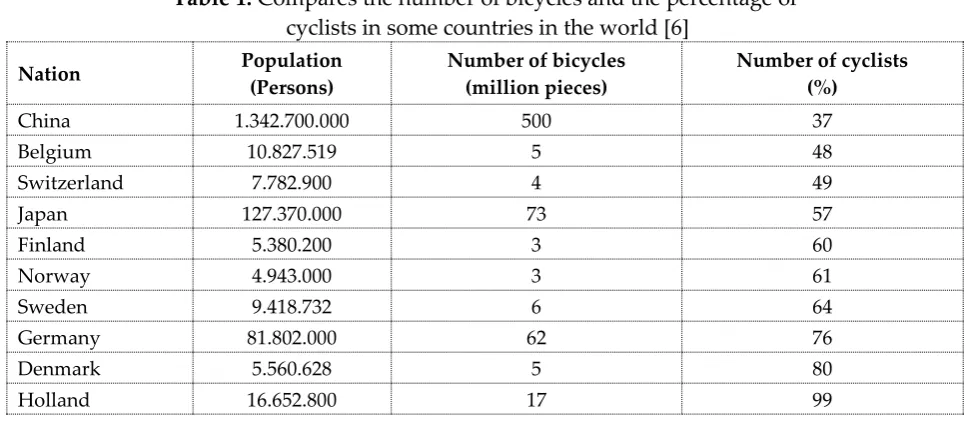
In developed countries such as the Netherlands, Denmark, Germany, Sweden, Norway, Finland... the proportion of people choosing bicycles as the primary means of transport accounted for more than 60%. The highest was the Netherlands with 99.1% of cyclists, followed by Denmark (80.01%), Germany (75.8%), Sweden (63.7%), Norway 60.7%), Japan (56.9%), etc.
Table 1: Compares the number of bicycles and the percentage of cyclists in some countries in the world [6]
Nation Population (Persons)
Number of bicycles (million pieces)
Number of cyclists (%)
China 1.342.700.000 500 37
Belgium 10.827.519 5 48
Switzerland 7.782.900 4 49
Japan 127.370.000 73 57
Finland 5.380.200 3 60
Norway 4.943.000 3 61
Sweden 9.418.732 6 64
Germany 81.802.000 62 76
Denmark 5.560.628 5 80
Chart 1: Bicycles and percentage of cyclists in some countries around the world
In Vietnam, Hanoi, Ho Chi Minh City and many other cities, bike lovers have gathered into clubs with many members. On social networks, forums and groups for cyclists are getting more and more popular.
Recently, the Prime Minister has issued documents instructing the ministries, branches and five centrally-run cities to pilot a scheme to provide public bicycle services to reduce the pressure of traffic, the rules. The Transport Department (the Ministry of Transport) is the unit in charge of elaborating the scheme.
It is expected that at the beginning of 2015, two major cities, Hanoi and Ho Chi Minh City, will launch public bicycle service for residents and visitors. With the advantages such as environmentally friendly, low cost, high mobility... the project to deploy public bicycle service is widely supported. The development of public bicycles will contribute to increased connectivity with other public transport vehicles such as buses, metro.
In April 2018, Ho Chi Minh City National University has piloted the E-bike intelligent bike project with the desire to protect the environment and improve the landscape of urban areas. E-bike is an automatic bike rental system, and users can use Easy Move software installed on mobile devices. Just register your account, confirm your personal information and then use the QR code scanning application on each vehicle, so students, officials and public employees can use the service. Intelligent bicycles begin to conquer students in Ho Chi Minh City National University. [4]
5. Conclusions
The problem of air pollution and traffic jams has become more and more serious and challenging to overcome in Vietnam as well as in the world. The cause of this situation is mainly due to human activities; in addition to some other natural activities have a negative impact on the environment.
It is necessary to educate the public about bicycle use as a means of circulation to both good health and active participation in environmental protection.
References
Matthew Barbour, “30 great benefits of cycling”. Retrieved from BikeRadar website:
https://www.bikeradar.com/beginners/gear/article/30-reasons-to-take-up-cycling-23965/. Accessed Apr 01, 2014.
Joshua Samuel Brownon, “Taiwan: from Bike Kingdom to Cyclist’s Paradise”. Taiwan Business TOPICS, April 22, 2016.
The Statistics Portal, “Number of cyclists/bike riders within the last 12 months in the United States from spring 2008 to spring 2017 (in millions)”. Retrieved from statista.com website:
https://www.statista.com/statistics/227415/number-of-cyclists-and-bike-riders-usa/. Accessed May, 2017.
Tất Đạt, “Intelligent bicycles begin to conquer students in Ho Chi Minh City National University”. Retrieved from TTO website:
https://tuoitre.vn/xe-dap-thong-minh-bat-dau-chinh-phuc-sinh-vien-dhqg-tphcm-2018040714262972.htm. Accessed
Apr 7, 2018.
Hoang Duong Tung, “Status of the air environment in Vietnam”. Source: Journal of the Environment, No.9.2014.
Top10Hell, “Top 10 Countries with Most Bicycles per Capita”. Retrieved from Top10Hell.com website:
http://top10hell.com/top-10-countries-with-most-bicycles-per-capita/. Accessed Mar 14, 2011.
Le Van Trinh, “Environmental protection is a key task towards the goal of sustainable development”, Retrieved from Electronic Information From The General Department Of Environment. Accessed Dec 13, 2010.
Yang Yijun, “Cyclists bare bodies for green cause”, Retrieved from China Daily website:
http://www.chinadaily.com.cn/china/2011-09/23/content_13775667.htm.
Creative Commons licensing terms