Exploring EFL Learners' Preferences, Perceived
Needs, and Perceptions about Language Learning
Strategies
Maryam Alsadat Mortazavi
Department of Language and Literature, Islamic Azad University, Ayatollah Amoli Branch, Amol, Iran
Hamed Barjesteh
Department of Language and Literature, Islamic Azad University, Ayatollah Amoli Branch, Amol, Iran
Abstract—This study was to investigate the impact of language experience and academic level on the perceived needs of Iranian undergraduate EFL learners. Two groups of Iranian TEFL female students (freshmen and senior) were compared regarding their preferences, perceived needs and perceptions of different activity types about language learning. To collect data, Sihong's (2007) needs analysis questionnaire for English language needs was utilized. Thirty two freshman and twenty nine senior MA students with the age range of 25-35 were considered as the subject of this study. They were asked to fill out the questionnaire through email and they were given the confidence that the collected data would remain anonymous. Results revealed that there was a significant difference between freshman and senior EFL learners in their preferences, needs and opinions about various types of activities, and various aspects of language education. The findings also revealed that freshmen students required more practice in grammar and pronunciation than vocabulary for them. The most difficult components of language were pronunciation, vocabulary and grammar respectively; however, the senior students reported that vocabulary and grammar were the most difficult component of language skill and pronunciation was the least one.
Index Terms—EFL learners, language learning strategies, needs analysis, perceived needs, perceptions of different activity types, preferences
I. INTRODUCTION
The first model of Needs Analysis (NA) in language pedagogy was proposed by Richterich (1972 as cited in Hutchinson & Water, 1987). Primarily, NA was applied to provide a definition of the contents and goals of language educational curriculums; since then, it has played role in English as a Foreign Language (EFL) education and curriculum design (Hutchinson & Water, 1987). According to Hutchinson and Waters (1987), most English for Specific Purpose (ESP) courses are developed according to the needs of sponsors, i.e. universities, companies, and agencies. For example, in Iran, nearly all English courses at institutional or university level is designed based on a target situation analysis of authorities who mainly rely on their own past experiences. The problem is that this view is incomplete; it overlooks the views of other parties involved such as the ESP teachers, the learners, and the teaching institutes.
Developing a program which matches the students’ requirements, and help both educators and learners to achieve the objectives of a language program, especially at Master of Art (MA) level, could best be fulfilled through initiating an inclusive analysis of the students’ needs. Various definitions of "needs" are given in the literature. Richards, Platt, and Platt, (1992) give a definition of needs analysis as the processes of finding out the needs of learners for learning a language and organizing them consistent with the main concerns. According to them, ‘needs’ could be interpreted in various ways according to the viewpoints of those who define it, e.g., instructors, students, supervisors, personnel, parents and investors might interpret ‘needs’ of learners in different ways. Overall, there is a common point in all definitions that knowing about the needs of learners provides teachers with a wealth of information leading to a better curriculum development by teachers exactly in line with their real educational needs. Also, Hyland (2006) defines needs analysis as the methods for collection and assessment of information related to curriculum development, or as the processes of determining the content and quality of an educational program. The second gap is that, unfortunately not many English teachers accept their learners' needs. In NA, not only we must pay attention to the learners’ preferences but also we must consider instructors’ alertness of those favorites, which plays a significant role in inspiring their policymaking practices and performance in teaching and learning context (Spratt, 1999 as cited in Hyland, 2006).
and professional domains were discovered. Atai and Shoja (2011) examined the language requirements of Iranian university learners studying computer engineering where writing abilities and constituents of language, including four skills, caused difficulties for the learners. Pourshahian et al. (2012) have also explored the needs of Iranian learners in an EFL setting and found that the learners had difficulties to deal with in developing their writing skills and applying grammatical rules. The results of one other research conducted by Allami et al. (2009) on the language needs of students and the current conditions of teaching materials for English language learners revealed that it deemed necessary to reconsider the curriculum and the resources generated for the school education in Iran. Nevertheless, , no particular research has so far considered the needs of students in General English course, which is offered as a three-credit compulsory course throughout the Iranian academic settings.
Thus far, lots of studies have been conducted to analyze the language needs of various collections of learners round the world (Kim, 2006) few studies have focused on the variable of language experience and academic level on the needs of the students and particularly how these needs change over time. Most of the academic English courses in Iran are designed based on no robust needs analysis and teachers do not feel the need to ask their students about or consider their needs. Another problem is that as learners gain more experience, their perception of their educational needs change. For example, Iranian ELT students' experience at first year (freshman) affects their perception of their needs, expectations, and preferences which may differ considerably as they gain more experience during the senior year; therefore, the main goal of this research is to examine the influence of language experience and academic level on the perceived needs of Iranian TEFL students and to find out the difference between freshman and senior EFL Learners' preferences, needs, and perceptions of different activity types about language learning. This study also aims at investigating the difference between freshman and Senior EFL Learners' preferences about language learning as their views are compared. To comply with the objectives of the study, the following quantitative research questions are addressed:
Q1. Is there any significant difference between freshman and senior EFL Learners' perceived needs about language learning?
Q2. Is there any significant difference between freshman and senior EFL Learners' preferences about language learning?
Q3. Is there any significant difference between freshman and senior EFL Learners' perceptions of different activity types about language learning?
Q4. What are the perceived needs, preferences, perceptions of different activity types of EFL learners about language learning?
II. METHODOLOGY
A. Participants
Thirty two freshman and twenty nine senior female TEFL (Teaching English as a Foreign Language) students at MA level in Islamic Azad University, Amol, participated in this study. They were selected based on available sampling. They were selected from the first and the last year of their MA studies on ELT program. Their age ranged from 25-35. They were native speakers of Persian who had at least 6 years of experience in learning English as a foreign language.
B. Instruments
To comply with the objectives of this study and in order to explore the EFL learners’ perceived needs and preferences, the following questionnaires were used as data gathering instruments: First, a demographic questionnaire which included sections to extract personal and educational information about the selected sample of the study, e.g., age, gender, marital status, and proficiency level and previous background in English language. Then, the needs analysis questionnaire for English language needs by Sihong (2007) which was adapted by Moiinvaziri (2014) in Iranian context was used as the main instrument of this study. This questionnaire was piloted and adapted into the context of Iran. It was explored by two professionals to see if the questionnaire was comprehensible, and then piloted amongst 30 learners resembling the sample for main study. The questionnaire enjoyed high reliability with the Cronbach-alpha of 0.875. It consisted of four sections: The first section was about biographical information. The second section (Part B) tried to explore the students' viewpoints towards what they needed to learn addressing the first and the fourth questions of this study; this part included 3questions with five point Likert scale answers and asked students views about three language components (grammar, vocabulary, pronunciation). The third part (Part C) investigated the learners' preferred learning styles and strategies to probe the second and the fourth questions of the study. The last part (Part D) was comprised of one main question. It addressed the students' expectations of the language activities to find answer to the third and the fourth questions of the study.
C. Procedure
them back. The questionnaire comprised four parts and each part was used to reflect one of the research questions posed earlier in this study. More specifically, the questionnaire comprised four parts: Part A enquired about biographical data. Part B included three Likert scale questions which aimed to probe the freshman and senior TEFL MA students’ perceived needs about three language components (grammar, vocabulary, pronunciation). Answers given to Part B of the needs analysis questionnaire by the two groups of subjects were compared. The third part (Part C) of the questionnaire aimed to uncover learners' preferred learning styles and strategies. This part included five questions to which aimed to uncover learners preferences about language learning.The last question in part C was designed to answer question four of the study qualitatively. The last section in the questionnaire probed the perception of different activity types. Part D of the questionnaire comprised eight subcategories with the aim to compare the problem between the freshman and senior TEFL MA students’ attitudes toward the various types of activities and expectations about language learning.
III. RESULTS
In order to test the first null hypothesis stating that there is no significant difference between freshman and senior EFL Learners' perceived needs about language learning, both descriptive and inferential statistics were run. The first three questions from Part B of the NA questionnaire included the given importance to each component of the language (vocabulary, grammar, pronunciation) (Q1), the frequency of practice required for each component (Q2) and components with the most and the least difficulty (Q3) (Table 1). Part B probed the learners' perceptions toward what they need to learn addressing the answer to the first and the fourth questions of this study; this part included five point Likert scale answers. Table 1 illustrates the descriptive statistics about the learners’ viewpoints toward the components of language (grammar, vocabulary, pronunciation).
TABLE 1.
EFL LEARNERS’ VIEWPOINTS TOWARD THE COMPONENTS OF LANGUAGE (GRAMMAR, VOCABULARY, PRONUNCIATION), DESCRIPTIVE STATISTICS
Part B level N Mean SD
Q1 grammar freshman 32 4.25 .718
senior 29 3.07 1.163
Q1 vocabulary freshman 32 4.22 .706
senior 29 4.03 1.149
Q1 pronunciation freshman 32 4.53 .567
senior 29 2.03 .823
Q2 grammar freshman 32 4.19 .859
senior 29 2.00 .655
Q2 vocabulary freshman 32 3.13 .833
senior 29 2.00 .655
Q2 pronunciation freshman 32 3.47 .671
senior 29 1.41 .682
Q3grammar freshman 32 3.38 1.070
senior 29 2.55 .506
Q3vocabulary freshman 32 3.72 1.114
senior 29 2.69 .604
Q3pronunciation freshman 32 4.13 .660
senior 29 2.41 .733
Q1= Degree of Importance for each component (Grammar, vocabulary, pronunciation) Q2= The Amount of practice required
Q3=The most and the least difficult components
Results of Table1 showed that freshman students considered pronunciation (M= 4.53, SD= .567), and grammar (M=4.25, SD= .718) as the most important language components while seniors believed that vocabulary was the most important component (M= 4.03, SD= 1.149).The freshmen felt they needed more practice in grammar (M= 4.19, SD= .859) and pronunciation (M= 3.47, SD= .671) rather than vocabulary (M=3.13, SD= .833) as they believed the first two were more important. The most difficult component of language for freshman students was pronunciation (M=4.13, SD= .660), vocabulary (M= 3.72, SD= 1.114), and grammar (M=3.38, SD=1.070) in order, but for the seniors vocabulary (M= 2.69, SD= .604). After vocabulary, grammar was the most difficult language skill for the senior subjects (M= 2.41, SD = .733); as opposed to the freshmen, pronunciation was the least difficult skill for senior students (M= 2.55, SD = .506) (Table 1).
TABLE2.
INDEPENDENT SAMPLES T-TEST FOR THE FIRST RESEARCH QUESTION
PART B OF THE QUESTIONNAIRE T DF SIG. (2-TAILED) MEAN DIFFERENCE Q1 GRAM Q1 VOCABULARY Q1 PRONUNCIATION 4.82 .762 13.90 59 59 59 .000 .449 .000 1.18 .18 2.49 Q2 GRAM Q2 VOCAB Q2 PRONUNCIATION 11.09 5.82 11.84 59 59 59 .000 .000 .000 2.18 1.12 2.05 Q3 GRAM Q3 VOCAB Q3 PRONUNCIATION 3.77 4.41 9.59 59 59 59 .000 .000 .000 .82 1.02 1.71 Q1= Degree of Importance for each component (Grammar, vocabulary, pronunciation)
Q2= The Amount of practice required Q3=The most and the least difficult components
Results from Table 2 showed that there was no statistically significant difference between the scores of the two groups in vocabulary; t (59) = .762, Sig. (2-tailed) = .449, P> .05. The mean difference (.18) was small. Hence, the first null hypothesis was accepted in the case of vocabulary. On the contrary, there was a significant difference between the perception of the two groups about the importance of grammar, t (45.77) = 4.71, Sig. (2-tailed) = .000, P< .05. The mean difference (1.18) was large. Hence, the first null hypothesis was rejected in the case of grammar. Also, there was a significant difference between the perception of the two groups about the importance of pronunciation, t (49.07) = 13.66, Sig. (2-tailed) = .000, P< .05. The mean difference (2.49) was very large. Hence, the first null hypothesis was rejected in the case of pronunciation.
Table 2 also demonstrated that there was statistically significant difference between the scores of the two groups in all of the three language components with regard to the amount of practice they needed: Grammar: t (57.37) = 11.24, Sig. (2-tailed) = .000, P< .05, MD =2.1; Vocabulary: t (57.89) = 5.89, Sig. (2-tailed) = .000, P< .05, MD =1.12; Pronunciation: t (58.21) = 11.83, Sig. (2-tailed) = .000, P< .05, MD =2.05. Therefore, the first null hypothesis was rejected in the case of the amount of practice that the two groups felt they needed in all of the three language skills. However, the mean difference was greatest for pronunciation and smallest for vocabulary.
Results from Table 2 demonstrated that there was statistically significant difference between the scores of the two groups in all of the three language components with regard to the most difficult language components: Grammar: t (45.14) = 3.89, Sig. (2-tailed) = .000, P< .05, MD =.82; Vocabulary: t (56.64) = 9.54, Sig. (2-tailed) = .000, P< .05, MD =1.71; Pronunciation: t (48.69) = 4.54, Sig. (2-tailed) = .000, P< .05, MD =1.02.Hence, the first null hypothesis was rejected in the case of the most difficult language components that the two groups perceived; although, the mean difference was greatest in vocabulary and smallest in grammar.
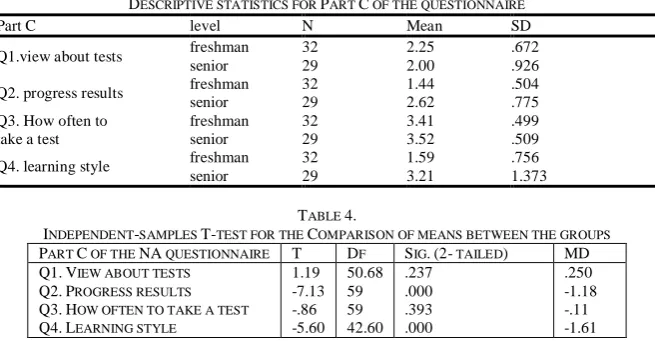
Tables 3 and 4 showed the comparison of the mean scores of freshman and senior students to discover if there was a significant difference between freshman and senior EFL Learners' preferences about language learning and test the second null hypothesis.
TABLE3.
DESCRIPTIVE STATISTICS FOR PART C OF THE QUESTIONNAIRE
Part C level N Mean SD
Q1.view about tests freshman 32 2.25 .672
senior 29 2.00 .926
Q2. progress results freshman 32 1.44 .504
senior 29 2.62 .775
Q3. How often to take a test
freshman 32 3.41 .499
senior 29 3.52 .509
Q4. learning style freshman 32 1.59 .756
senior 29 3.21 1.373
TABLE 4.
INDEPENDENT-SAMPLES T-TEST FOR THE COMPARISON OF MEANS BETWEEN THE GROUPS PART C OF THE NA QUESTIONNAIRE T DF SIG. (2- TAILED) MD Q1. VIEW ABOUT TESTS
Q2. PROGRESS RESULTS Q3. HOW OFTEN TO TAKE A TEST Q4. LEARNING STYLE
1.19 -7.13 -.86 -5.60 50.68 59 59 42.60 .237 .000 .393 .000 .250 -1.18 -.11 -1.61
Tables 3 and 4 indicated that there was no significant difference between the preferences of freshman (M= 2.25, SD= .672) and senior students (M=2, SD=.926); t (50.68) = 1.19, sig. (2-tailed) = .237, p>.05. Hence, the second null hypothesis was accepted for this part.
freshman (M= 3.41, SD= .499) and senior students (M=3.52, SD=.509) about how often they preferred to take a test; t (59) = -7.13, sig. (2-tailed) = .393, p>.05. Hence, the second null hypothesis was accepted for this part.
In addition, there was a significant difference between the preferences and learning styles of freshman (M= 1.59, SD= .756) and senior students (M=3.21, SD=1.373); t (42.60) = -5.60, sig. (2-tailed) = 000, p<.05. Hence, the H02 is rejected for this part. To sum up, there was no statistically significant difference between the preferences of freshman and senior EFL learners about tests; however, there was a significant difference between their learning styles and general preferences about language learning; therefore, the second null hypothesis was rejected.
Part D of the NA questionnaire included 1 question to test the third null-hypothesis and answer to the third question of this study. This part addressed the students' expectations of the language activities with 8 possible answers. Tables 5 and 6 show the descriptive statistics and the results of the comparison of means to test the third null hypothesis which states that there is no significant difference between freshman and senior EFL Learners' perceptions of different activity types about language learning.
TABLE5.
DESCRIPTIVE STATISTICS FOR PART D OF THE QUESTIONNAIRE
Part D of the questionnaire Level N Mean SD
Freshman and senior EFL Learners' perceptions of different activity types about language learning.
freshman 32 2.78 1.680
senior 29 6.66 1.173
TABLE 6.
INDEPENDENT-SAMPLES T-TEST FOR THE COMPARISON OF MEANS BETWEEN THE GROUPS
Part C of the NA questionnaire T Df Sig. MD
Freshman and senior EFL Learners' perceptions of
different activity types about language learning. -10.33 59 .000 -3.87
Results showed that the third null hypothesis was rejected and there was a significant difference between freshman (M= 2.78, SD= 1.680) and senior (M= 6.66, SD=1.173) EFL Learners' perceptions of different activity types about language learning; t (59) = -10.33, sig. (2-tailed) = .000, p<.05 and the mean difference was -3.87.
The last question of the study was qualitative and related data was collected through the same NA questionnaire and descriptive statistics and frequency tables (Tables 7 & 8).
TABLE 7.
STUDENTS' LEARNING STYLES AND PREFERENCES
Part C, Answers Freshman students Senior students
Frequency Percent Frequency Percent
Q1. What is your view of tests?
both 4 12.5 12 41.4
necessary 16 50.0 5 17.2
useful 12 37.5 12 41.4
Total 32 100.0 29 100.0
Q2. What source(s) could help you find out about your progress?
Test results Teacher- evaluation Self -reflection
18 14 0
56.3 43.8 0
5 1 23
17.2 3.4 79.3
Total 32 100.0 29 100.0
Q3. How often do you expect to take a test?
Once a week 0 0 1 3.44
Once a month 0 0 6 20.68
Twice a semester 19 59.4 14 48.27
Never Total
13 32
40.6 100.0
8 29
27.58 100.0 Q4. What kinds of learning
styles do you like?
1 18 56.3 0 0
2 9 28.1 14 48.3
3 5 15.6 5 17.2
4 0 0 0 0
5 0 0 10 34.5
Total 32 100.0 29 100.0
Although more than half of the freshman students believed that tests are necessary and useful, 59.4% of them preferred not to take tests ever and chose Never as compared with 27.68% of seniors who would rather not take tests at all. The remaining students chose to take tests twice a month which is as rarely as possible. Fear of tests can have roots in the cultural and educational background of Iranian students. On the other hand, the percentages of answers for seniors show that as the academic level of the students goes up, their understanding of the usefulness of tests increases, too (48.27% twice a semester, 20.68% once a month, 3.44% once a week).An interesting result from table 7 is related to social and individual styles as defined in chapter 2. While no freshman student preferred social style and group work, 34.5% of senior students preferred social style. Also, the majority of seniors 948.3%) preferred a more active role for students in the classroom and believed that teachers should provide opportunities for more practice for students, and no one in the senior group preferred to be a passive listener while the teacher gives lectures.
The last question in Part C of the NA questionnaire was used to answer the fourth question of this study. This part investigated students' opinions about the qualities of an English teacher in a qualitative way. Students' answers are reported in Table 8.
TABLE 8.
STUDENTS' PREFERENCES ABOUT ENGLISH LANGUAGE TEACHERS Part C, learning
styles preferences
Answers Freshman students Senior students
Frequency Percent Frequency Percent
Q5. Attitudes on what English instruc tor ought to do
4 8 25.0 1 3.4
5 10 31.3 0 0
6 4 12.5 3 10.3
8 5 15.6 5 17.2
9 0 0 10 34.5
10 0 0 4 13.8
11 12 Total
5 0 32
15.6 0 100.0
0 6 29
0 20.7 100
Neither freshmen nor senior students believed that the teacher should lecture and delivers knowledge, be the authority in the classroom or talk for most of the class time (Table 8). However, more freshman students (25%) preferred that the teacher gives time for student talk than seniors. While 31.3% of freshman preferred that the teacher should correct every mistake that students make, no one in the senior group agrees with this. Approximately the same number of students in both groups agreed that the teacher should respond to students positively and encourage students to ask questions. It looks as if the senior students paid more attention to the learning environment than the other group as 34.5% of them suggested that the tutor ought to build a pleasant and satisfying learning atmosphere and pay attention to students' needs. As it turns out, the higher the academic level of the students, the higher their awareness of the necessity of paying attention to the students' needs will be. While about 15% of freshman students prefer to stick to the textbooks and have more structured language activities, senior students prefer more unstructured and unpredictable activities and about 20% of them prefer that some learning strategies be taught to them.
IV. DISCUSSION
Results showed that freshman students considered pronunciation and grammar as the most important language components while senior students believed that vocabulary was the most important component, results from the t-test have also shown that there was no statistically significant difference between the scores of the two groups in vocabulary. Nevertheless, there was a significant difference between the attitudes of the two groups toward the importance of grammar. Hence, the first null hypothesis was rejected in the case of grammar. Also, there was a significant difference between the attitudes of the two groups toward the importance of pronunciation. An independent-samples t-test was conducted to compare the perceived needs of freshman and senior EFL learners with regard to the amount of practice they felt they need in each of the language components.
mostly emphasize the students reading comprehension skills and do not consider other skills and components of language.It is also worth mentioning that even in Iranian state education system the skill of reading is regarded as the most important skill as well (Sadeghi & Bidel Nikou, 2012).In addition, these textbooks are not well-complied either qualitatively or quantitatively (Ahmadi &Bajelani,2012) and do not consider the students, real needs and constraints of the social life in which they should act in near future (Shamsaee & Shams,2010).
Based on White (1988), the impression that equal importance should be given to all four langkuage abilities is not suitable to all students is one of the perceptions generated through ESP and needs analysis. White (1988) declares that varying performance levels in four skill areas can be achieved. As a result, it is not needed to attain equality in all four skills. These results are found to be consistent with the findings of the present research. Selecting which of four skills to improve first could be one of the concerns of EFL learners. These findings are in line with those from Atai and Shoja (2011) and Pourshahian, et al. (2012) who founded that the learners in their study had difficulties in their writing abilities and the application of grammatical rules. While exactly half of the freshman students regarded tests as
necessary, only 17.5% of seniors believed that tests are necessary; instead, nearly half of the senior students (41.4%) thought that tests are both necessary and useful. Distribution and frequency of responses also show that more than half of the freshmen (56.3%) regarded test results as the best source to know about their progress, and maybe that's why they believed that tests are necessary. The rest of the freshman students (14 out of 32) relied on teacher-evaluation as a source of feedback on their progress (43.8%). As opposed to the freshmen who did not rely on self-reflection at all, 79.3% of senior students believed in self-reflection as the best measure of their progress; respectively 17.2% and 3.4% of these students needed test result and teacher evaluation. The fact that only 1 out of 29 senior students relied on teacher evaluation about 43% of freshmen in the same type of evaluation, can indicate that EFL learners gain more autonomy as their experience increases.
V. CONCLUSION
The findings of this research might be helpful for curriculum developers at English unit of Language School in Ayatollah Amoli University in determining the English language needs of TEFL learners and upgrading the current program to better satisfy the requirements of the learners. When the language skills are talked about, practicing speaking and listening skills as well as presentation skill should be more emphasized. For freshman students, pronunciation and grammar and then vocabulary while for seniors vocabulary and grammar are the priority. Through analyzing and interpreting the data, it was revealed that learners were needed to do more preparation in listening and speaking skills as the unnoticed skills. Hence, full practice is required to improve reading and writing skills of the learners. Furthermore, the self-assessments of the learners showed that more practical activities were also required to observe improvement in reading and writing skills. An accurate assessment of the needs of learners could also pave the way for further investigations in the areas such as curriculum and resource design and development, and application of the courses in the syllabus.
While this research could not be generalized to all the academic centers in Iran, it attempted to detect the different needs and requirements of the learners at one academic center hoping that this describing and analyzing the learners’ requirements in IAU of Iran, Amol Branch can work as a point of departure to draw the attention of university instructors, as well as syllabus designers and developers toward the significance of such courses together with specifically introduced courses. Moreover, it is hoped that this research could pave the way for those researchers in non-native ESL/EFL contexts to conduct further studies on the learning requirements of learners in the area of English language teaching and learning.
REFERENCES
[1] Ahmadi, A., & Bajelani, M. R. (2012). Barriers to English for Specific Purposes Learning among Iranian University Students.
Procedia-Social and Behavioral Sciences. 47,792-796.
[2] Allami, H., Jalilifar, A., Hashemian, M., & Shooshtari, Z. (2009). Are Iranian school students' language needs taken into consideration? Iranian Journal of Language Studies, 3(1), 125-141.
[3] Atai, M. R., & Shoja, L. (2011). A triangulated study of academic language needs of Iranian students of computer engineering: Are the courses on track. RELC Journal, 42(3), 305-323.
[4] Chan,V. (2001). Determining students’ language needs in a tertiary setting. English Teaching Forum, 39(3) 16-27.
[5] Chia, H. U, Johnson, R., Chia H. L, & Olive, F. (1998). English for college students in Taiwan. A study of perceptions of English needs in a tertiary setting. English for Specific Purposes, 18(2), 107-119.
[6] Hutchinson, T., & Waters, A. (1987). English for specific purpose: A learning centered approach. Cambridge: Cambridge University Press.
[7] Hyland, K. (2006). English for academic purposes: An advanced resource book. London: Routledge.
[8] Kim, S. (2006). Academic oral communication needs of East Asian International graduate students in non-science and non- engineering fields. English forSpecific Purpose, 2, 479-489.
[9] Moiinvaziri, M. (2014). Students’ Voice: A Needs Analysis of University General English Course in Iran. Journal of Language
Studies, 14 (1), 57-75.
[11] Rahimpour, M., & Hashemi, R. (2011). Textbook selection and evaluation in EFL Context. World Journal of Education. 2, 62-68
[12] Richards, J., C., Platt, J., & Platt, H. (1992). Longman dictionary of language teaching and applied linguistics. Harlow: Longm [13] Shamsaee, S., & Shams, A. (2012). ESP teachers “pedagogical agenda vs. University Students” educational ambitions: A needs
analysis project. Journal of Technology &Education. 4(4), 267-273.
[14] Sihong, L. (2007). Situation analysis and needs analysis in Chinese EFL context: A case of a senior high school in south-west China. CELEA Journal, 30(4), 17-28.
[15] White, R. (1988). The ELT curriculum. Oxford: Blackwell.
Maryam Alsadat Mortazavi is a graduate student in TEFL. She has taught in many English language institutes and different high schools on Iran. She is interested in language teaching, materials development and SLA.