NOVEL
[(3-NITRO-2-OXO-2H-CHROMEN-4-YLAMINO)-PHENYL]PHENYL-AZETIDIN-2-ONES AND THEIR
ANTIMICROBIAL ACTIVITY
Ramiz Hoti,
[a]Naser Troni
[,a]*Aferdita Nura-Lama,
[b]Gjyle Mulliqi-Osmani,
[c]Hamit Ismaili
[a]and Veprim Thaci
[a]Keywords: azetidin-2-one, 3-nitrobenzopyran-2-one; condensation; cyclization; antmicrobial citvity.
Synthesis of new azetidin-2-ones on the basis of aminophenyl-3-nitrobenzopyran-2-one is reported. By condensation reaction of 4-chloro-3-nitrobenzopyran-2-one 2 and phenylenediamine, 4-(4-aminophenylamino)-3-nitrochromen-2-one 3 is synthesized in high yield. Catalytic condensation of product 3 and benzaldehyde, salicylaldehyde and 3-nitrobenzaldehyde, afforded novel derivatives of 4-[4-(benzylideneamino)phenylamino]-3-nitrobenzopyran-2-one, 4a-4c. In the following series of reactions, by cyclization of the products 4a-4c
with acetyl chloride, corresponding substituted azetidinones 5a-5c are synthesized. Structural characterization of the synthesized products is done on the basis of spectrometric data. Compounds of series 4a-4c and 5a-5c are examined for their antibacterial activity against S. aureus, E. coli, and Klebsiella. Antibacterial activity is examined by measuring the inhibition zones around the disks marked with the corresponding product solutions in DMF concentration 2 mg mL-1, 4 mg mL-1, and 6 mg mL-1. Compounds of series 4 have shown
moderate antibacterial activity against these microorganisms, whereas compounds of series 5 have shown significant activity. The impact of substitutions in antimicrobial activity is also explored.
* Corresponding Authors: Naser Troni Fax: +381 38 244187
E-Mail: [email protected]
[a] Department of Chemistry, Faculty of Nature Sciences, University of Prishtina, 10000 Prishtina, Kosovo
[b] Faculty of Mining and Metallurgy, University of Mitrovica, 40000 Mitrovica, Kosovo
[c] Institute of Public Health of Kosovo, 10000 Prishtina, Kosovo
Introduction
Coumarin derivatives are an important class of compounds and are well-known for their biological activity. Many of heterocyclic derivatives on the basis 2H[1]-benzopyran-2-one play an important role in various life processes, and they are found as an ingredient in the plant world. Many such derivatives exhibit various biological activities,1 such as anticoagulant,2 antimicrobial,3 antibacterial,4, 5 antifungal6 and antimalarial.7 Some of coumarin analogs also exhibited antioxidant,8,9 anti-tubercular10 and anticonvulsant activity.11 It was reported that a significant number of substituted derivatives of benzopyran-2-one also show, sedative,12 analgesicand anti-inflammatory,13 anti-HIV,14 and hepatoprotective activity.15 According to that, many of them have found widespread usage in pharmacies.16 On the other hand, azetidin-2-one derivatives reported having a wide range of biological activities,17 including those antimicrobial,18 anti-fungal,19 anti-convulsant,20 and anti-HIV activity.21 The biological activity of these derivatives is conditioned by their structure, so the presence of different substituents on the benzopyrone ring indicates their impact on the type and potency of biological activity. Despite continuous efforts, the relationship between structure and biological activity of these derivatives so far has not yet been sufficiently clarified. Extraordinary biologically importance of such derivatives on the basis of thiazolidine-4-one has generated a constant
interest for their synthesis and research. In continuation of our previous studies and attempt to synthesize the new derivates,22, 23 in this paper we had intended to synthesize some new amino-phenylamino)-3-nitro-chromen-2-ones and substituted thiazolidyne-4-ones with benzopyran-2-one moiety, which could serve as pro-pharmaceutical products.
Methods and materials
The compounds are synthesized using commercial reagents of Aldrich company as precursors under catalytic conditions. Reactions are monitored by TLC using Merck Kieselgel-60 (F-254) as the stationary phase and a mixture of benzene, toluene, glacial acetic acid (v/v/v, 80:10:10) as the mobile phase. The synthesized products are purified by crystallization from methanol and ethanol. Melting points are determined used a paraffin oil bath with an open capillary tube. IR spectra are recorded in KBr discs on Shimadzu 8400xFT-IR spectrometer with 4 cm-1 resolution. 1H-NMR and 13C-NMR spectra are recorded in DMSO on UNITYplus-500“NMR 1” spectrometer. Chemical shifts were reported in ppm downfield from TMS as internal standard (δ 0.00). Examination of the antibacterial activity of the synthesized compounds is done using standard discs (d=5.0 mm, maximum capacity 10 pg) on the basis of Standard Disc Method. Standard discs are previously impregnated with 2 mg mL-1, 4 mg mL-1 and 6 mg mL-1 solutions of compounds in -DMF.
Preparation of 4-(4-Amino-phenylamino)-3-nitro-chromen-2-one, 3
benzene-1,2-diamine in 5 mL of ethanol and then 2-3 drops of triethylamine was added to the mixture. The content is mixed for 10 min at room temperature, then refluxed for about 90 minutes. After cooling, the mixture is concentrated in the rotary evaporator, and the crystalline product is filtered off under vacuum and washed with 2 × 1 mL of ethanol. The crystalline product is dried and crystallized from methanol, giving) 4-(4-aminophenylamino)-3-nitrocrhromen-2-one, yield was 79.68 %, mp = 240-242 °C. IR (KBr disc, cm-1): 3470.92, 3386.12, 3220.86, 3058.34, 2872.24, 2595.12, 1708.54, 1614.38, 1511.25, 1327.77, 1220.36, 1130.62, 1067.34, 905.94, 757.95.
General procedure for preparation of 4-[4-(benzylidene-amino)-phenylamino]-3-nitrobenzopyran-2-ones, 4(a-c)
Product 3 (0.3 g, 1.0 mmol) is dissolved in 20 mL of absolute ethanol and to this mixture was added in small portions 1.5 mmol of aromatic aldehyde (benzaldehyde, salicylaldehyde or 3-nitrobenzaldehyde respectively) dissolved in 10 mL of absolute ethanol. Then there was added 2 drops of piperidine as a catalyst and the mixture was mixed for 15 min at room temperature and refluxed for 10 to 12 hours. After cooling, the mixture is concentrated and the crystals are filtered off under reduced pressure, then washed with 2x1 mL of ethanol and dried in the air. crystallization of the products 4a-4c was conducted from ethanol or methanol.
4-[4-(Benzylidene-amino)-phenylamino]-3-nitro-chromen-2-one, 4a
Yield: 87.26 %, m.p.= 224-226 oC, IR (KBr disc, cm-1): 3461.45, 3292.27, 3075.24, 2934.85, 1694.15, 1642.76, 1603.07, 1551.15, 1517.34, 1428.72, 1326.42, 1221.34, 1055.46, 902.05, 756.85. 1H-NMR; (δ, ppm) 8.35 (s, 1H, N=C-H), 7.4-7.6 (m, 4H, Ar), 7.2-7.4 (m, 5H, Ar), 7.1 (d, 2H, Ar), 6.5 (d, 2H, Ar),3.9 (1H,NH). 13C-NMR (δ, ppm); 165.4 (C=N), 162.3 (C=O), 160.2, 148.9, 141.5, 131.7, 130.6, 128.3, 127.6, 127.2, 126.8, 126.4, 123.8, 122.1, 115.8, 105.2.
4-{4-[(2-Hydroxy-benzylidene)-amino]-phenylamino}-3-nitro-chromen-2-one, 4b
Yield: 39.88 %, m.p.= 205-207 oC, IR (KBr disc, cm-1): 3451.94, 3307.35, 3079.24, 2934.74, 2872.64, 2386.73, 1684.15, 1608.97, 1552.51, 1514.34, 1431.54, 1320.49, 1278.62, 1211.64, 1197.59, 1055.44, 903.53, 761.67. 1 H-NMR; (δ, ppm) 8.38 (s, 1H, N=C-H), 7.4-7.6 (m, 4H, Ar), 7.2-7.5 (m, 4H, Ar), 7.0 (d, 2H, Ar), 6.4 (d, 2H, Ar), 4.8 (1H, OH), 4.1 (1H, NH). 13C-NMR (δ, ppm); 163.8 (C=N), 161.2 (C=O), 160.6, 148.3, 141.6, 132.4, 128.6, 126.8, 125.2, 123.4, 121.2, 120.2, 118.6, 115.6, 115.2, 105.8.
3-Nitro-4-{4-[(3-nitro-benzylidene)-amino]-phenylamino}-chromen-2-one, 4c
Yield: 63.57 %, m.p.= 225-227 oC, IR (KBr disc, cm-1): 3455, 3081.54, 3072.38, 2952,84, 2364.72, 1687.18, 1629.75, 1615.48, 1552.32, 1347.86, 1205.48, 1065.88, 764,53. 1H-NMR; (δ, ppm) 8.5 (s, 1H, N=C-H), 8.3-8.1 (m,
3H, Ar), 7.4-7.7 (m, 5H, Ar), 7.1 (d, 2H, Ar), 6.7 (d, 2H, Ar), 4.2 (1H, NH). 13C-NMR (δ, ppm); 163.7 (C=N), 162.6 (C=O), 158.8, 148.4, 141.2, 134.6,131.6, 128.5, 127.4, 126.4, 125.2, 125.0, 124.6, 123.2, 121.8, 114.4, 103.2.
General procedure for preparation of 3-[4-(3-nitro-2-oxo-2H-chromen-4-ylamino)-phenyl]-4-phenylazetidin-2-ones, 5a-5c
In the solution that containing 0.5 mmol of the corresponding product 4a-4c dissolved in 10 mL of benzene, 0.12 g (1.5 mmol) acetyl chloride was added. The mixture is stirred for 10 min at room temperature and then is refluxed for 12-13 hours. After cooling the product is concentrated and the remaining solid is dissolved in 5 mL of methanol, then heated to boiling and the excess of acetic acid is neutralized by adding 0.3 mmol sodium bicarbonate NaHCO3 (controlled paper litmus until the solution undertake the blue color). The mixture is cooled in an ice bath and then filtered off under vacuum, then is washed with 2×1 mL of ether and dried in the air. The products are crystallized from methanol.
1-[4-(3-Nitro-2-oxo-2H-chromen-4-ylamino)-phenyl]-4-phenyl-azetidin-2-one, 5a
Yield: 45.85 %, m.p.= 236-238 oC, IR (KBr disc, cm-1): 3490-3400, 3241.24, 3086.34, 2933.88, 2379.36, 1687.18, 1611.68, 1588.55, 1516.35, 1422.67, 1328.68, 1206.66, 1062.47, 852.30, 756.92, 581.59. 1H-NMR; (δ, ppm) 7.0-7.5 (m, 8H, Ar), 6.9 (d, 2H, Ar), 6.7 (d, 2H, Ar), 5.6 (t, 1H, N-C-H), 4.2 (1H, NH), 3.5 (d, 2H, CH2). 13C-NMR (δ, ppm); 172.5 (C=O), 162.6 (C=N), 161.8 (C=O), 149.4, 137.4, 130.2, 129.7, 128.5, 128.1, 127.3, 127.0, 126.7, 126.3, 125.8, 125.4, 124.6, 120.4, 114.7, 105.3, 55.4 (CH-N), 36.4 (CH2).
4-(2-Hydroxy-phenyl)-1-[4-(3-nitro-2-oxo-2H-chromen-4-ylamino)-phenyl]-azetidin-2-one, 5b
Yield: 61.84 %, m.p.= 234-235 oC, IR (KBr disc, cm-1): 3540-3280, 3111.04, 2942.48, 2559.92, 2376.62, 1924.46, 1721.68, 1669.12, 1614.88, 1544.06, 1418.32, 1341.35, 1340.06, 1184.28, 1052.68, 1002.06, 886.64, 706.14, 654.26. 1H-NMR; (δ, ppm) 7.1-7.4 (m, 7H, Ar), 6.8 (d, 2H, Ar), 6.6 (d, 2H, Ar), 5.7 (t, 1H, N-C-H), 5.1 (1H,OH), 4.0 (1H, NH), 3.6 (d, 2H, CH2). 13C-NMR (δ, ppm); 170.5 (C=O), 162.8 (C=N), 161.8 (C=O), 160.2, 156.4, 149.6, 130.2, 129.8, 129.3, 128.1, 127.4, 126.9, 126.5, 126.2, 125.7, 124.4, 124.1, 120.3, 120.0, 114.5, 114.2, 105.4, 56.5 (CH-N), 37.2 (CH2).
1-[4-(3-Nitro-2-oxo-2H-chromen-4-ylamino)-phenyl]-4-(3-nitro-phenyl)-azetidin-2-one, 5c
Results and discussion
During the condensation reactions of 4-chloro-3-nitrobenzopyran-2-one 2 and phenylenediamine, 4-(4-amino-phenylamino)-3-nitro-chromen-2-one, 3 is synthesized in good yield. By condensation reaction of product 3 and benzaldehyde, salicylaldehyde and 3-nitrobenzaldehyde, new derivatives of 4-[4-(benzylidene-amino)phenylamino]-3-nitrobenzopyran-2-ones, (4a-4c) are synthesized, as condensation products. In the last series of reactions, by cyclization of the product 4(a-c) and thioacetic acid, corresponding 1-[4-(3-nitro-2-oxo-2H-chromen-4-ylamino)phenyl]-azetidin-2-ones (5a-5c) are synthesized. Structural characterization of the synthesized products is based on spectrometric IR and NMR data. In the IR spectrum of the product, 3 appeared an absorption signal absorption at 3470.92 cm-1 which are responsible for ν(NH
2) stretching vibrations. The absorption signal at 3055.16 cm-1, appeared due to ν(CH) stretching vibrations of the aromatic ring. The sharp peak at 1708.54 cm-1 region is responsible for ν(C=O) stretching vibrations, whereas the absorption peak at 1614.38 cm-1 region resulted from ν(C=C) stretching
vibrations of the aromatic ring. The peak at 1511.25 cm-1 resulted from the absorptions of asymmetric ν(NO2) stretching vibrations, while the peak at 1327.77 cm-1 resulted from symmetric ν(NO2) stretching vibrations. On the other hand, the absorption peak at 1220.36 cm-1 is characteristic for vibrations of the lactonic stretching system (C-O-C), while the sharp peak at 750.71 cm-1 resulted from characteristic bending vibrations δ(C-H) oop of the aromatic ring.
In the IR spectrum of 4a, an absorption signal appeared at 3461.45 cm-1 which are responsible for ν(NH) stretching vibrations, while absorption signal at 3075.24 cm-1 corresponds to ν(CH) of the aromatic ring. At 1694.15 cm-1 appeared the absorption signal which response to ν(C=O) stretching vibrations, whereas the sharp peak at 1642.76 cm -1 and a signal at 1603.07 cm-1 correspond due to ν(C=N) and ν(C=C) stretching vibrations of the aromatic system. The characteristic absorption at 1551.15 cm-1 resulted from asymmetric ν(NO2) stretching vibrations whereas at 1326.42 cm-1 for symmetric ν(NO
2) stretching vibrations.
O O
OH
O O
HN
NO2
+
1 2
3
4a
4b
4c
5a
5b
5c
NH2 H2N
H
O H
O
NO2
H O
OH
H3C C Cl O H3C C Cl
O
H3C C Cl O NO2
POCl3
NN-DMF
O O
Cl NO2
NH2
O O
HN
NO2
N C H
O O
HN
NO2
N C
H O O
HN
NO2
N C H
O O
HN
NO2
N C
O
O O
HN
NO2
O O
HN
NO2
H
OH OH
NO2
NO2
N C
O H
N C
O H
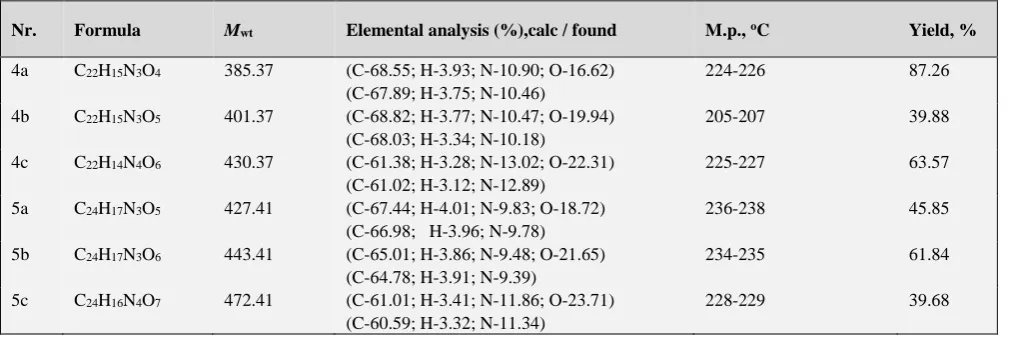
Table 1. Physical properties of compounds 4a-4c and 5a-5c and their elemental analysis
Nr. Formula Mwt Elemental analysis (%),calc / found M.p., oC Yield, %
4a C22H15N3O4 385.37 (C-68.55; H-3.93; N-10.90; O-16.62)
(C-67.89; H-3.75; N-10.46)
224-226 87.26 4b C22H15N3O5 401.37 (C-68.82; H-3.77; N-10.47; O-19.94)
(C-68.03; H-3.34; N-10.18)
205-207 39.88 4c C22H14N4O6 430.37 (C-61.38; H-3.28; N-13.02; O-22.31)
(C-61.02; H-3.12; N-12.89)
225-227 63.57 5a C24H17N3O5 427.41 (C-67.44; H-4.01; N-9.83; O-18.72)
(C-66.98; H-3.96; N-9.78)
236-238 45.85 5b C24H17N3O6 443.41 (C-65.01; H-3.86; N-9.48; O-21.65)
(C-64.78; H-3.91; N-9.39)
234-235 61.84 5c C24H16N4O7 472.41 (C-61.01; H-3.41; N-11.86; O-23.71)
(C-60.59; H-3.32; N-11.34)
228-229 39.68
Absorption at 1221.34 cm-1 is also characteristic for stretching(C-O-C) vibrations of the lactonic ring, whereas the sharp peak at 756.85 cm-1 is characteristic for bending δ(C-H) oop vibrations of the aromatic ring. On the other hand, signals from 1H-NMR spectrum correspond to the absorption of respective protons. A proton singlet displayed at 8.35 ppm resulting from N=C-H. Also in the 13C-NMR spectrum is displayed a signal at 165.4 ppm which corresponds to the C=N carbon.
The IR spectra of compound 4b, showed the absorption signal at 3451.94 cm-1 which is responsible for ν(NH) stretching vibrations, the broad band at 3307.35 cm-1 correspond to stretching ν(OH) absorption, and a signal at 3079.24 cm-1 resulted due to ν(CH) stretching vibrations of the aromatic ring. The sharp peak at 1684.15 cm-1 resulted from ν(C=O) stretching vibrations, whereas signals at 1608.97 and 1552.51 cm-1 result from ν(C=N) and ν(C=C) stretching vibrations. The peak at 1514.34 cm-1 corresponds to absorptions of asymmetric ν(NO2) stretching vibrations, while the one at 1320.49 cm-1 due to symetric ν(NO
2) stretching vibrations. Absorption signal at 1211.64 cm-1 is characteristic for stretching vibrations of the lactonic (C-O-C) system, and the sharp peak at 761.67 cm-1 resulted from δ(C-H) bending oop vibrations of the aromatic ring. In the 1H-NMR spectrum, besides multiplets of aromatic protons, a proton singlet resulting from N=C-H appears at 8.38 ppm. In the 13C-NMR spectrum are also displayed a signal at 163.8 ppm, which correspond to C=N carbon.
The IR spectra of 4c showed an absorption peak at 3455 cm-1 which are responsible for ν(NH) stretching vibrations, while the absorption signal at 3081.54 cm-1 resulted from ν(CH) aromatic vibrations. The peak at 1687.18 cm-1 is responsible for absorbing the ν(C=O) stretching vibrations whereas two signals at 1629.75 and 1615.48 cm-1 results from ν(C=N) and ν(C=C) stretching vibrations of the aromatic ring. The sharp peak in the wavelength of 1552.32 cm-1 resulted due to asymmetric ν(NO
2) stretching vibrations, while absorption signal at 1347.86 cm-1 reflects symmetric ν(NO2) stretching vibrations. A signal at 1204.76 cm-1 is characteristic for (C-O-C) stretching vibrations of the
lactonic system, while the sharp peak at 764.53 cm-1 appeared from δ(C-H) bending oop vibrations of the aromatic ring. In the 1H-NMR spectrum, the multiplet signals of aromatic protons appeared at 8.1-8.3 ppm and 7.7-7.4 ppm. A proton singlet resulting from N=C-H appears at 8.5 ppm. In the 13C-NMR spectrum also displayed a signal at 163.7 ppm, that correspond to C=N and a signal at 162.6 ppm resulted from C=O carbon.
In the IR spectra of the compound 5a, a sharp absorption signal appeared at 3490 cm-1, which is responsible for ν(NH) stretching vibrations whereas the absorption peak at 3086.34 cm-1 resulted from ν(CH) vibrations of the aromatic system. The medium band at 2933.88 cm-1 resulted from the absorptions of ν(CH) stretching vibrations of aliphatic protons, whereas the sharp peak at 1687.18 cm-1 from ν(C=O) stretching vibrations. The absorption signal at 1611.68 cm-1 resulted from ν(C=C) stretching aromatic vibrations. The characteristic signals of the nitro group appeared at 1516.35 cm-1 due to asymmetric stretching, whereas at 1328.68 cm-1 for symmetric ν(NO
2) stretching vibrations. The absorption peak at 1206.66 cm-1 resulted from lactonic ν(C-O-C) stretching vibrations, whereas at 756.92 cm-1 appeared the absorption signal resulted from δ(CH) oop vibrations of the aromatic system. In the 1 H-NMR spectra, a proton singlet at 5.6 ppm resulted from N-C-H, while two doublets at 6.7 and 6.9 ppm and a multiplet at 7.5-7.0 ppm correspond to aromatic protons. A doublet at 3.5 ppm resulted from aliphatic CH2 protons of the azetidinone system. 13C-NMR spectra appeared three peaks at 172.5, 162.6 and 161.8 which results from C=O and C-N carbons, whereas a signal at 55.4 ppm resulted from the CH-N of the azetididinone ring. An absorption signal at 36.4 ppm appeared due to methylene carbon.
vibrations. The characteristic peak at 1669.12 cm-1 resulted from ν(C=C) stretching vibrations of aromatic moiety. Signals at 1544.06 and 1341.35 cm-1 appeared due to ν(NO
2) asymmetric and symmetric stretching vibrations, whereas the characteristic signal at 1184.28 cm-1 is responsible for
lactonic ν(C-O-C) vibrations. In the 1H-NMR spectra are shown characteristic signals at 3.6 ppm (d, 2H, CH2), and at 5.7 ppm (t, 1H, N-C-H). 13C-NMR spectra also showed a signal at 162.8 (C=N) and absorptions at 56.5 ppm (CH-N) and 37.2 ppm (CH2).
Table 2. Zones of inhibition (mm) of the discs impregnated with various concentration of the synthesized compounds
No. S. aureus E. coli Klebsiella
2 mg mL-1 4 mg mL-1 6 mg mL-1 2 mg mL-1 4 mg mL-1 6 mg mL-1 2 mg mL-1 4 mg mL-1 6 mg mL-1
4a 6.5 7.0 8.0 6.0 6.5 8.0 6.0 6.0 6.5
4b 6.5 8.0 8.5 7.5 8.0 6.5 7.5 7.5 8.5
4c 7.0 7.5 8.5 7.0 8.0 9.0 6.5 7.0 9.0
5a 8.0 8.5 9.5 9.0 9.5 11.0 10.0 10.5 13.0
5b 11.5 13.5 15.5 9.0 10.0 12.0 9.0 10.0 12.0
5c 9.0 12.0 14.0 9.5 8.5 9.5 7.5 8.0 9.0
Compound 5c appeared the absorption signal at 3433 cm-1 which is responsible for ν(NH) stretching vibrations and the absorption signal at 3078.38 cm-1, which resulted from aromatic ν(CH) stretching vibrations. The peak at 2915.68 cm-1 resulted from ν(CH) stretching vibrations of the methylene group, while the signal at 1682.17 cm-1 absorption reflects the vibrations ν(C=O) stretching. The peak at the wavelength of 1628.55 cm-1 resulted from vibrations ν(C=C) stretching mode. The absorption peak at 1506.43 cm-1 resulted from ν(NO2) asymmetric stretching vibrations, while symmetric ν(NO2) stretching vibrations resulted by absorption peak at 1322.48 cm-1. The absorption signal at 1215.25 cm-1 is characteristic for (C-O-C) stretching vibrations of the lactonic system, while the sharp peak at 708.19 cm-1 is characteristic for δ(C-H) oop bending vibrations of the aromatic ring. On the other hand, characteristic signals from the 1H-NMR spectrum, a triplet at 5.8 ppm and a doublet at 3.7 pm correspond to proton absorptions of N-C-H and CH2 of the azetidinone ring. Also in the 13C-NMR spectra, the azetidinone carbon signals appear at 54.6 ppm (CH-N) and 38.6 ppm, (CH2).
Antibacterial activity of the products 4a-4c and 5a-5c
Following this study, compounds 4a-4c and 5a-5c are investigated for their antibacterial activity. Our research is oriented to test the activity against bacteria S. aureus, E. coli, and Klebsiella, on the basis of Standard Disc Method,24 by measuring the zones of inhibition around the standard discs. The discs have previously been impregnated with solutions of the products in DMF with concentrations of 2 mg mL-1, 4 mg mL-1and 6 mg mL-1. Results are shown in Table 2.
Compounds of series 4 showed moderate antimicrobial activity against these microorganisms, whereas those of series 5 exhibited significant activity. Products 5b and 5c
were most active against S. aureus, compounds 5b and 5a
showed the most activity against E. Coli whereas 5a and 5b were more active against Klebsiella.
Antibacterial activity against E. Coli and Klebsiella
appeared as bactericide activity is displayed in large-scale. Furthermore, these compounds expressed both bacteriostatic and bactericide activity against S. Aureus.
Figure 1. The graphical presentation of zone of inhibition (mm) against S. Aureus.
Figure 2. The graphical presentation of zone of inhibition (mm) against E. Coli.
Bacteriostatic activity is exhibited in a large range (+2.0 mm), whereas bactericide activity showed in small diameter. Azetidin-2-one moiety showed significant impact on antimicrobial activity, whereas the impact of polar groups also was distinct. It is particularly noted the impact of the hydroxy group of 5b, which has affected the increase in antibacterial activity. Moreover, nitro group of 5b has shown significant impact on the range of inhibition of E. coli.
The assumption is that antibacterial activity may result as a consequence of the involvement of these products in enzymatic reactions. These products can cause enzymatic inhibition, by inhibiting cell wall construction of the microorganisms. However, mechanism of enzymatic inhibition is not yet fully studied. In general, by increasing the concentration of solvents, their antimicrobial activity increased.
Conclusions
New derivatives of 4-[4-(benzylidene-amino)-phenylamino]-3-nitrobenzopyran-2-ones, 4a-4c and respective azetidin-2-ones, 5a-5c are synthesized in the moderate and high yield. Compounds 5b and 5c were most active against S. aureus, compounds 5b and 5a showed more activity against E. Coli, while 5a and 5b were more active against Klebsiella bacteria. The impact of polar groups in antibacterial activity was significant. Antibacterial activity is shown to be proportional to the concentration of these compounds.
Acknowledgement
We are grateful to Biserka Zinic, Division of Organic Chemistry and Biochemistry Institute “Rudjer Boskovic” and Hrvoj Vancik, Department of Organic Chemistry and Biochemistry, University of Zagreb, Croatia, for their support and facilities.
References
1Kontogiorgis, C. A., Hadjipavlou-Litina, D. J., Bioorg. Med. Chem. Lett., 2004, 14(3), 611–614.
https://doi.org/10.1016/j.bmcl.2003.11.060
2Stockley, I., Brit. Med. J. (Clin. Res. Ed.), 1982, 285(6350), 1278.
https://doi.org/10.1136/bmj.285.6350.1278-b
3Mohamed, H. M. Abd Wahab, A. H. F., Ahmed, K. A.,
El-Agrody, A. M., Bedair, A. H., Eid, F. A. and Khafagy, M. M.,
Molecules, 2012, . 17, 971-988.
https://doi.org/10.3390/molecules17010971
4de Souza, S. M. Delle Monache, F. Smânia, A. J., Z Naturforsch C, 2005, 60(9-10), 693-700. https://doi.org/10.1515/znc-2005-9-1006
5Rajasekaran, S., Rao, G. K., Pai, S., Rajan, A., Int. J. ChemTech Res., 2011, 3(2), 555-559.
http://sphinxsai.com/vol3.no2/chem/chempdf/CT=06(555-559)AJ11.pdf
6Montagner, C. de Souza, S. M., Groposoa, C., Delle Monache, F.,
Smania, E. F., Smania A., Jr, Z. Naturforsch. C.,2008, 63(1-2), 21-8. https://doi.org/10.1515/znc-2008-1-205
7Pingaew, R., Saekee, A., Mandi, P., Nantasenamat, C.,
Prachayasittikul, S., Ruchirawat, S. and Prachayasittikul, V.,
Eur. J. Med. Chem., 2014, 6(85), 65-76.
https://doi.org/10.1016/j.ejmech.2014.07.087
8Bubols, G. B., Vianna Dda, R., Medina-Remon, A., von Poser,
G., Lamuela-Raventos, R. M., Eifler-Lima, V. L., Garcia, S. G., Mini Rev. Med. Chem., 2013, 13(3), 318-34.
9Rodriguez, S. V. Guinez, R. F., Matos, M. J., Santana, L., Uriarte,
E., Lapier, M., Maya, J. D., Azar, C. O., Med. Chem.
Commun., 2013, 4, 993-1000.
https://doi.org/10.1039/c3md00025g
10Keri, R. S. Sasidhar, B. S., Nagaraja, B. M., Santos, M. A., Eur. J. Med. Chem., 2015, 100, 257-69.
https://doi.org/10.1016/j.ejmech.2015.06.017
11Amin, K. M., Abdel Rahman, D. E., Al-Eryani, Y. A., Bioorg. Med. Chem., 2008, 16(10), 5377–5388.
https://doi.org/10.1016/j.bmc.2008.04.021
12Muhammad, N., Saeed, M., Khan, H., Adhikari, A., Khan, K.
M., J. Chem.,2013, 10(1155), 326263.
https://www.hindawi.com/journals/jchem/2013/326263/
13Ghate, M., Kusanur, R. A., Kulkarni, M. V., Eur. J. Med. Chem., 2005, 40(9), 882-7.
https://doi.org/10.1016/j.ejmech.2005.03.025
14Kostova, I., Curr HIV Res., 2006, 4(3), 347-63.
https://doi.org/10.2174/157016206777709393
15Atmaca, M. Bilgin, H. M. Obay, B. D. Diken, H. Kelle, M. Kale,
E., J. Physiol. Biochem., 2011, 67(4), 569-576.
https://doi.org/10.1007/s13105-011-0103-5
16Küppers, J., Schulz-Fincke, C. A., Palus, J., Giurg, M.,
Skarżewski, J., Gütschow,M., Pharmaceuticals, 2016, 9(3),
43. file:///C:/Users/CCKS/Downloads/pharmaceuticals-09-00043.pdf
17Rajasekaran, A., Periasamy, M., Venkatesan, S., J. Dev. Biol. Tissue Eng., 2010, 2(1), 5-6.
18Desai, S. R., Laddi, U. V., Bennur, R. S., Bennur, S. C., Indian J. Pharm. Sci., 2011, 73(4), 478–482.
19Gupta, A. Halve, A. K., Open Chem. J., 2015, 2, 1-6..
https://doi.org/10.2174/1874842201502010001
20Gilani, S. J., Alam, O., Khan, S. A., Siddiqui, N., Kumar, H., Pharm. Lett., 2009, 1(2), 1-8.
21Rao, A., Carbone, A., Chimirri, A., De Clercq, E., Monforte, A.
M., Monforte, P., Pannecouque, C., Zappala, M., Farmaco,
2000, 57(9), 747-51. https://doi.org/10.1016/S0014-827X(02)01268-5
22Nura-Lama, A., Bicaj, M. Hoti, R., Musaj, A., Int. J. Chem. Sci., 2012, 10(1), 80-87.
23Hoti, R., Nura-Lama, A., Mulliqi-Osmani, Gj., Troni, N., Gashi,
F., Ismaili, H., Thaçi, V., Orbital: The Electronic J. Chem., 2014, 6(3), 184-90 .
http://www.orbital.ufms.br/index.php/Chemistry/article/view/ 564
24Bauer, A. W., Kirby, M. M., Sherris, J. C., Turck, M., Am. J. Clin. Pathol., 1966, 44, 493.
http://www.asm.org/ccLibraryFiles/FILENAME/0000000295 /105bauer.pdf