Contents
Section
Page
1. Introduction 4
1.1 Overview 4
2. Context 7
2.1 Transport Policy Context 7
2.2 Organisation and Approach to Delivering the NMD 10 2.3 Borough Network Hierarchy 13
3. Challenges and Options 16
3.1 NMD Theme 1: Managing Network Efficiency, Demand and Future Growth 16 3.2 NMD Theme 2: Planning and Managing Works and Events 22 3.3 NMD Theme 3: Contingency Planning and Incident Management 24 3.4 NMD Theme 4: Performance Monitoring & Management 28 3.5 NMD Theme 5: Communications 31
4. NMD Strategy for LTP3 34
4.1 Introduction 34
4.2 NMD Theme 1: Managing Network Efficiency, Demand and Future Growth 34 4.3 NMD Theme 2: Planning and Managing Works and Events 35 4.4 NMD Theme 3: Contingency Planning and Incident Management 35 4.5 NMD Theme 4: Performance Monitoring and Management 36 4.6 NMD Theme 5: Communications 37
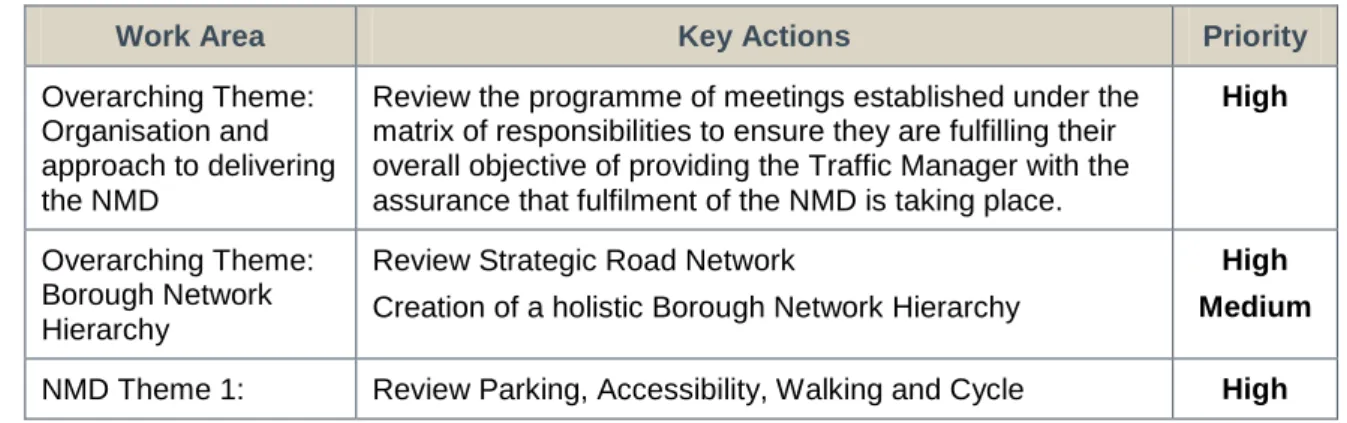
4.7 Strategy Priorities 37
List of Tables
Table 1.1 – Use of NMD Techniques by Work Stream 6 Table 2.1 – SBC‟s LTP3 Objectives 8 Table 2.2 – NMD Delivery at SBC 11 Table 2.3 – Programme of Meetings 11 Table 2.4 – SBC Transport Strategies and Plans 12 Table 4.1 - Forward Plan Key Actions 37
List of Figures
Figure 1.1 - Approach to Network Management at SBC 5 Figure 3.1 - SBC Cascade Call-out System 27
Appendices
Appendix A 40
Appendix B 43
1. Introduction
1.1 Overview
This document sets out the role that the Borough‟s Network Management Duty will have for Slough during the third Local Transport Plan (LTP3) period. LTP3 commences on 1st April 2011 when the Borough‟s previous Local Transport Plan (LTP2) expires, and provides the framework for the borough‟s transport strategy and associated implementation plan.
The Borough also has a statutory duty to ensure the expeditious movement of traffic on the Borough‟s and neighbouring local authorities‟ road network, which is encapsulated through the Network Management Duty.
This document therefore sets out in detail how the approaches and measures to ensure the expeditious movement of traffic in Slough will help to achieve both the objectives and outcomes of the LTP3, and the responsibilities of the Network Management Duty (NMD) itself.
The key challenge for Slough during LTP3 will be to develop creative solutions to overcome the fact that it is not often practical or even possible to provide more road space to accommodate the increasing demands of the traffic flow. This means that it is therefore necessary to manage the existing network more effectively and efficiently.
The Network Management Duty
Part two, Section 16(1) of the Traffic Management Act (2004) states:
„It is the duty of a local traffic authority to manage their road network with a view to achieving, so far as reasonably practicable having regard to their other obligations, policies and objectives, the following objectives:
Securing the expeditious movement of traffic on the authority‟s road network; and
Facilitating the expeditious movement of traffic on road networks for which another authority is the traffic authority.‟
It is stated within the Act that the term „traffic‟ includes all road users including pedestrians. Therefore, consideration needs to be given to the efficient management of all users of the network.
Under the Network Management Duty the Local Transport Authority (LTA) also needs to consider the impacts of their actions on the networks within neighbouring authorities to achieve the best operation possible of the wider network.
One of Slough Borough Council‟s (SBCs) long term visions is to achieve „more balanced and well managed local transport‟. This vision aligns with the Traffic Management Act (2004) which now places a Network Management Duty on local authorities to keep traffic flowing and to manage local transport more efficiently.
Slough‟s Network Management Plan This Plan outlines how SBC:
currently manages its network;
identifies opportunities for improvement during LTP3; and
uses performance measurements to monitor the level of success achieved in network management and sets appropriate targets to stretch performance in future management of the network.
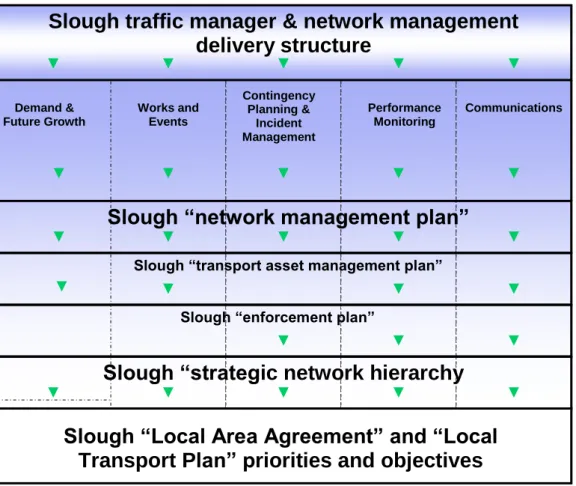
The approach to Network Management at SBC extends beyond just reducing delays or co-ordinating and managing issues that may affect network operation, although those elements are clearly important. Our approach outlined in Figure 1.1 has at its core priorities and objectives set out in SBC‟s Local Area Agreement and Local Transport Plan (outlined in Chapter 2), meaning it is aligned with wider policies and objectives in Slough.
Figure 1.1 - Approach to Network Management at SBC
A delivery structure has been established to assure network performance through management of five key work streams. They are:
NMD Theme 1: Network Efficiency, Demand and Future Growth (EDG)
NMD Theme 2: Planning and Management of Works and Events (MWE)
NMD Theme 3: Contingency Planning and Incident Management (CIM)
NMD Theme 4: Performance Monitoring and Management (PMM)
NMD Theme 5: Communications (COM)
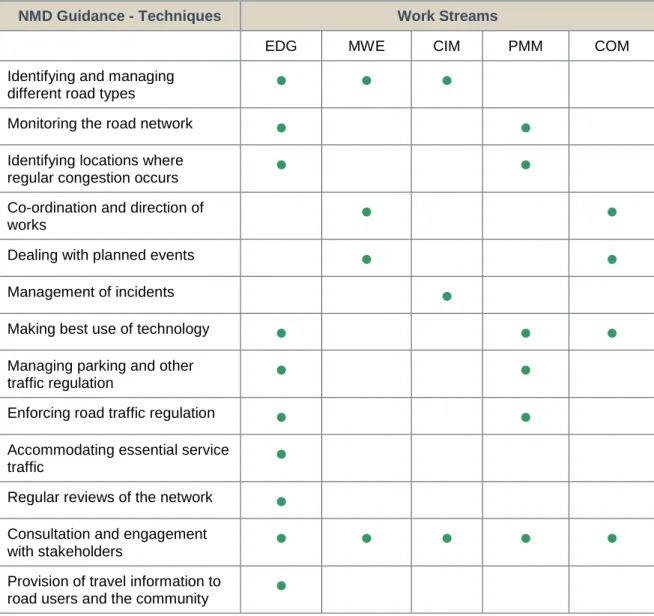
Delivery of these work streams relies on the application of a range of good practice techniques as highlighted in the Department for Transport‟s (DfT) „Network Management Duty Guidance (2004)‟ document. The table below identifies the extent to which the five work streams utilise the
techniques of traffic management set out in the DfT document in undertaking Network Management in Slough.
Slough “strategic network hierarchy” (chapter 3)
Slough traffic manager & network management
delivery structure
Demand & Future Growth Works and Events Contingency Planning & Incident Management Performance Monitoring CommunicationsSlough “network management plan”
Slough “transport asset management plan” Slough “enforcement plan”
Slough “Local Area Agreement” and “Local
Transport Plan” priorities and objectives
▼ ▼ ▼ ▼ ▼ ▼ ▼ ▼ ▼ ▼ ▼ ▼ ▼ ▼ ▼ ▼ ▼ ▼ ▼ ▼ ▼ ▼ ▼ ▼ ▼ ▼
Slough “strategic network hierarchy
Table 1.1 – Use of NMD Techniques by Work Stream
NMD Guidance - Techniques Work Streams
EDG MWE CIM PMM COM Identifying and managing
different road types
●
●
●
Monitoring the road network
●
●
Identifying locations whereregular congestion occurs
●
●
Co-ordination and direction ofworks
●
●
Dealing with planned events
●
●
Management of incidents●
Making best use of technology
●
●
●
Managing parking and othertraffic regulation
●
●
Enforcing road traffic regulation
●
●
Accommodating essential servicetraffic
●
Regular reviews of the network
●
Consultation and engagementwith stakeholders
●
●
●
●
●
Provision of travel information toroad users and the community
●
This report identifies our transport priorities that are relevant to network management, the network hierarchy and the organisation and approach to delivering the NMD, and is structured as follows:
Chapter 2 – Context
Chapter 3 –Challenges and Options
Chapter 4 – NMD Strategy
2. Context
2.1 Transport Policy Context
2.1.1 Local Context
The way in which SBC‟s NMD is fulfilled, is influenced by the wider policy framework in SBC. In turn, this policy framework stems from the unique conditions of the local environment and the ambitions of SBC and the wider community.
Slough is a compact urban borough, covering an area of just 32.5 square kilometres and is one of the smallest unitary authorities in the UK. It is also a borough of extremes. On one hand, it plays an important part in the foremost economy in the Thames Valley due in part to its close proximity to Heathrow airport and London, as well as its excellent east–west transport links. There are however pockets of deprivation with 6% of super output areas (SOAs) within the 20% most deprived areas nationally, with the worst areas located in the south of Langley, Chalvey and Colnbrook. In terms of the seven individual deprivation domains, Slough performs worse on income and crime deprivation, with 22% and 53% of SOAs respectively within the 20% most deprived SOAs nationally,
One of the main challenges for the Council is the growing problem of traffic congestion. Traffic levels have increased greater than expected over the period of the LTP2 (2006-2011). Data from the DfT National Road Traffic Estimates (NRTE) suggests that Traffic growth on the local road network in Slough was 7.4% between 2004 and 2007.
2.1.2 The Local Area Agreement
SBC is currently leading the revision of the Local Area Agreement (LAA) in partnership with the wider Local Strategic Partnership (LSP). Transport is firmly placed at the centre of the revised LAA, reflecting the general concern in the Borough over congestion. Transport is one of the cross cutting themes of the LAA and agreement has been reached within the LSP for the inclusion of three transport related national indicators in the LAA all of which seek to ease congestion by focusing on modes of travel other than the car. The agreed indicators are
N1 198 – Children Travelling to School – mode of transport usually used;
N1 175 – Access to services and facilities by public transport, walking and cycling; and
NI 177 – Local bus journeys originating in the authority area.
The wider context provided by the LAA is important not least because it assures us that transport and network management - as an integral component - is a key issue for the LSP and as such, our plans are supported by the wider delivery work of the LSP.
2.1.3 Transport and LTP
SBC‟s Second Local Transport Plan 2 (LTP2) set out the Council‟s five-year transport objectives (2006-2011), several of which were directly influenced by network management objectives. To achieve the LTP2 objectives SBC concentrated on a range of measures based on maximising opportunities within the existing network, promoting a change in travel behaviour, managing demand, and widening travel choice.
To date good progress has been made in delivering the objectives, such as:
A number of Strategy documents, such as the Freight Strategy, Walking and Cycling Strategy, and Intelligent Transport Strategy have been produced,;
Management of street works has been tightened up with much improved identification of and action against major works carried out without notification;
An urban traffic control (UTC) scheme to link traffic signals to a Strategic Control Centre, improving traffic flow and assisting bus services is under development;
Greater understanding and fulfilment of the Council‟s obligations under the Traffic Management Act is being achieved;
The Quality Bus Partnership with First Berkshire has led to improvements in vehicles and infrastructure;
Delivery of a number of schemes to promote walking and cycling including „Route Q‟ to Wexham Park Hospital and new and better crossings;
A number of travel plans implemented in partnership with schools and major employer;
Implementation of programme of SBC Parking Watch schemes.
This Plan will support the preparation of the Council‟s Third Local Transport Plan (LTP3), which comes into effect from April 2011 when LTP2 expires. The Council‟s contribution to national and local transport goals are discussed further in the LTP3 document. The Department for Transport (DfT) has published a set of five key national transport goals, with related challenges, for developing future transport infrastructure in its document „Delivering a Sustainable Transport System‟ (DaSTS) (2009) as follows:
We want our transport system
To support national economic competitiveness and growth, by delivering reliable and
efficient transport networks
To reduce transport’s emissions of carbon dioxide and other greenhouse gases, with the desired outcome of tackling climate change
To contribute to better safety security and health and longer life-expectancy by reducing
the risk of death, injury or illness arising from transport and by promoting travel modes that are beneficial to health
To promote greater equality of opportunity for all citizens, with the desired outcome of
achieving a fairer society;
To improve quality of life for transport users and non-transport users, and to promote a
healthy natural environment
The new coalition Government has expressed its support for these „DfT‟ objectives, although with greater emphasis placed on the economic and climate change objectives.
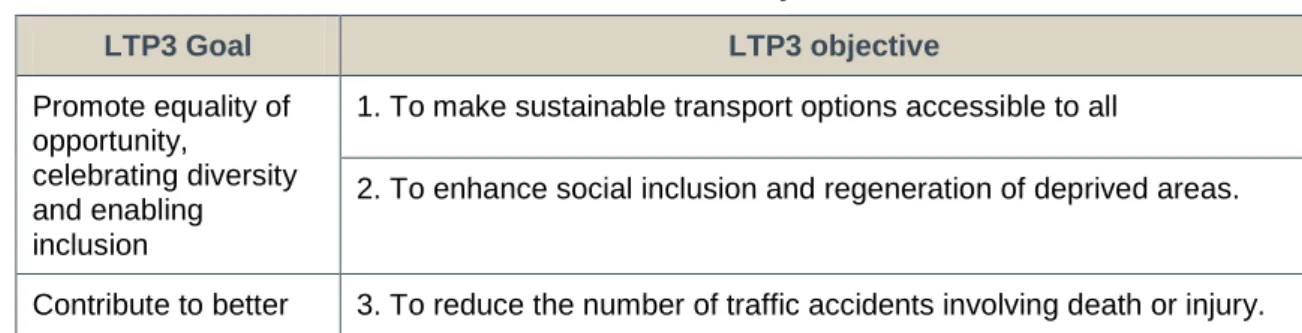
Based on the DfT over-arching goals listed above, as well as the previous LTP2 objectives and objectives set out in the Sustainable Community Strategy SBC has developed a set of 12 high level objectives for the LTP3 period described in the following table:
Table 2.1 – SBC’s LTP3 Objectives LTP3 Goal LTP3 objective Promote equality of opportunity, celebrating diversity and enabling inclusion
1. To make sustainable transport options accessible to all
2. To enhance social inclusion and regeneration of deprived areas.
safety and security and adding years to life and life to years
4. To minimise the opportunity for crime, anti-social behaviour and terrorism and maximise personal safety on the transport network. 5. To protect and improve personal health.
Reduce carbon emissions
6. To reduce transport‟s CO2 emissions and make the transport network
resilient to the effects of climate change Improve quality of life
by making Slough a cleaner, greener place to live, work and play
7. To minimise the noise generated by the transport network, and its impacts.
8. To mitigate the effects of travel and the transport system on the natural environment, heritage and landscape.
9. To achieve better links between neighbourhoods and access to the natural environment.
10. To improve the journey experience of transport users across Slough‟s transport networks.
Support economic growth, creating prosperity for all
11. To ensure that the transport system helps Slough sustain its
economic competitiveness and retain its position as an economic hub of the South East.
12. To facilitate the development of new housing in accordance with the LDF
Effective network management has an important role to play in supporting the delivery of these LTP3 objectives, and the continual updating of the Network Management Plan has considered how the objectives of LTP3 can best be met.
Network management has a part to play in all the DfT goals, related challenges, and LTP3 objectives, but it has particular relevance to the following:
Support Economic Growth
Reduce lost productive time including by maintaining or improving the reliability and predictability of journey times on key local routes for business, commuting and freight (DaSTS challenge)
Improve the connectivity and access to labour markets of key business centres (DaSTS challenge)
Deliver the transport improvements required to support the sustainable provision of housing, and in particular the PSA target of increasing supply to 240,000 net additional dwellings per annum 2016 (DaSTS challenge)
Ensure local transport networks are resistant and adaptable to shocks and impacts such as economic shocks adverse weather, accidents, terrorist attacks and impacts of climate change (DaSTS challenge)
Promote Equality of Opportunity
To make sustainable transport options accessible to all (LTP3 objective)
Enhance social inclusion and the regeneration of deprived or remote areas by enabling disadvantaged people to connect with employment opportunities, key local services, social networks and goods through improving accessibility, availability, affordability and
acceptability (DaSTS challenge)
Contribute to Better Safety, Security and Health
Improve the health of individuals by encouraging and enabling more physically active travel. (DaSTS challenge)
Reduce the vulnerability of transport networks to terrorist attack. (DaSTS challenge)
Improve Quality of Life and a Healthy Natural Environment (DaSTS challenge)
Improve the experience of end‑to‑end journeys for transport users. (DaSTS challenge)
Sustain and improve transport‟s contribution to the quality of people‟s lives by enabling them to enjoy access to a range of goods, services, people and places (DaSTS challenge)
SBC will seek to deliver the LTP3 objectives through a programme of works which focuses on both hard (on-street) and soft (campaign / education) measures. In practical terms this means a range of activities and schemes will be undertaken as part of the Network Management Plan which contributes towards LTP2 objectives, including improvements to the:
Operating environment for buses;
Walking environment;
Cycling environment;
Information for travellers including smarter choices;
Management of parking;
Enforcement of parking regulations;
Use of road space;
Predicting and managing future network pressures;
Management of road works and events; and
Contingency planning and incident management
2.2 Organisation and Approach to Delivering the
NMD
2.2.1 Traffic Manager
Joe Carter (Head of Transport) is the Traffic Manager for SBC. The Traffic Manager has a statutory role, under the Traffic Management Act 2004, to exercise SBC‟s Network Management Duty (NMD) to:
Secure the expeditious movement of traffic on SBC‟s road network. Traffic includes all road users, pedestrians and cyclists as well as motorised vehicles, whether engaged in the transport of goods or people; and
Facilitate the expeditious movement of traffic on road networks for which another authority is the traffic authority i.e. motorways and trunk roads and other roads in the greater area.
2.2.2 Network Management Engineer
The Traffic Manager is supported by a Network Management Engineer, Eddie Hewitt, who provides day-to-day support by helping to ensure that all teams within SBC that are associated with activity on, or related to, the highway network are considering SBC‟s Network Management Duty. The Network Management Engineer also chairs the Network Management Assurance Group and Network Management Steering Group meetings, discussed below.
2.2.3 Network Management through Matrix Delivery
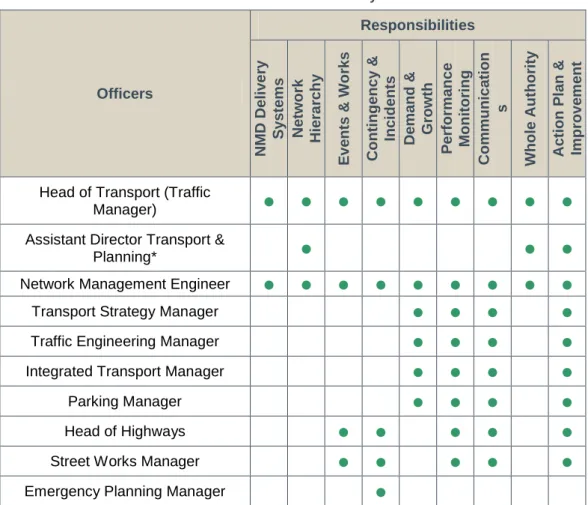
The Traffic Manager does not have management of all service areas within SBC responsible for delivering the NMD. Instead a matrix of responsibilities has been established with regular reporting to the Traffic Manager.
Table 2.2 details the matrix of responsibilities associated with NMD delivery at SBC.
Table 2.2 – NMD Delivery at SBC Officers Responsibilities NMD De liv e ry S ys tem s Net w o rk Hier a rch y E ve n ts & W o rks Co n ting ency & Incid ent s Deman d & G ro w th P er fo rman c e Mon it o ring Co mm u n ica tion s W h o le Au th o rit y Act ion P lan & Imp ro ve m ent
Head of Transport (Traffic
Manager)
●
●
●
●
●
●
●
●
●
Assistant Director Transport &Planning*
●
●
●
Network Management Engineer
●
●
●
●
●
●
●
●
●
Transport Strategy Manager●
●
●
●
Traffic Engineering Manager●
●
●
●
Integrated Transport Manager●
●
●
●
Parking Manager●
●
●
●
Head of Highways●
●
●
●
●
Street Works Manager●
●
●
●
●
Emergency Planning Manager●
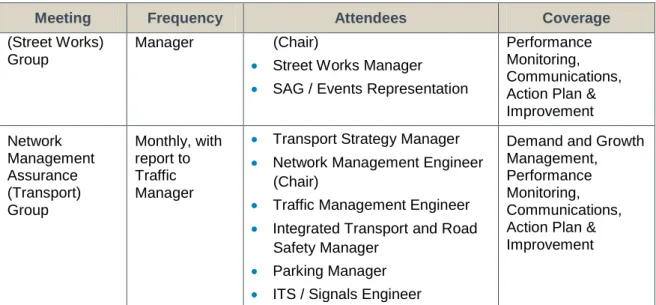
Management of the matrix arrangements is achieved through a regular programme of meetings as detailed in Table 2.3.
Table 2.3 – Programme of Meetings
Meeting Frequency Attendees Coverage
Network Management Steering Group
Quarterly Traffic Manager (Head of Transport)
Network Management Engineer (Chair)
Assistant Director Transport & Planning (Whole Authority Advocate)
Head of Highways
Emergency Planning Officer
All aspects of Network Management Network Management Assurance Monthly, with report to Traffic Head of Highways
Network Management Engineer
Events & Works, Contingency & Incidents,
Meeting Frequency Attendees Coverage
(Street Works) Group
Manager (Chair)
Street Works Manager
SAG / Events Representation
Performance Monitoring, Communications, Action Plan & Improvement Network Management Assurance (Transport) Group Monthly, with report to Traffic Manager
Transport Strategy Manager
Network Management Engineer (Chair)
Traffic Management Engineer
Integrated Transport and Road Safety Manager
Parking Manager
ITS / Signals Engineer
Demand and Growth Management, Performance Monitoring, Communications, Action Plan & Improvement
* The role of the Assistant Director Transport & Planning is not to direct the Traffic Manager who is delegated the full statutory role but as an advocate to encourage wider whole authority involvement. Examples include: 1) Better Integration of Local Authority functions associated with delivery of the NMD and 2) SBC travel planning to secure more sustainable travel by staff within SBC.
In addition to the above, Network Management is an agenda item on all highway and transport planning / strategy meetings that take place.
2.2.4 SBC Strategies and Plans
To support implementation of its wider community and transport objectives, SBC has established a number of strategies and plans which have been developed so as to be wholly consistent with the SBC‟s Network Management Duty. Many of these have been updated and enhanced as LTP3 Supplementary Documents. A list of the relevant plans and “owners” responsible for ensuring that implementation of the plans fully takes account of the borough‟s Network Management Duty are shown in the table below.
Table 2.4 – SBC Transport Strategies and Plans
Plan Owner
LTP3 Supplementary Strategy Documents:
SBC Travel Plan Gillian Ralphs Public Transport Strategy Rub Nawaz Cycling Strategy Savio De Cruz Walking Strategy Savio De Cruz Road Safety Strategy Savio De Cruz Smarter Choices Strategy Rub Nawaz Intelligent Transport Systems Strategy Chris Weedon Parking Strategy Kam Hothi Freight Strategy Rub Nawaz Accessibility Strategy Rub Nawaz
Other Plans:
Transport Asset Management Plan Bill Dawes Rights of Way Improvement Plan Jackie Wheeler
2.2.5 Monitoring
An annual performance review is undertaken at which results of the previous year are considered, objectives for the following year set and the opportunities for more effective working identified. No specific organisational performance indicators have been established. This is discussed further in Chapter 4.
2.3 Borough Network Hierarchy
2.3.1
Background
The purpose of a Road Network Hierarchy is to help prioritise a particular network of roads by function or usage. It can provide the basis for a maintenance strategy and enable the prioritisation of works activities and is an important tool for the overall management and maintenance of the public road network. SBC has, since its establishment in 1998, managed the highway network through the utilisation of a range of hierarchies. Some of these have been built around statutory requirements while others have evolved through the implementation of strategies and plans that support the full range of users of roads in Slough.
SBC currently has a range of hierarchies, discussed below, and these serve as important tools for the Council in helping to balance the competing demands on its network and to fulfil its Network Management Duty of facilitating the movement of traffic.
The hierarchies also support the LTP3 Objectives of improving the journey experience of transport users across Slough‟s transport networks and ensuring that the transport system supports
economic growth.
2.3.2 Strategic Road Network
The Borough‟s Strategic Road Network is a road hierarchy which has the primary task of
supporting the movement of people and goods including more extensive bus priority on significant bus routes (Slough Bus Network) and priority to freight (Slough Freight Network).
The Strategic Road Network covers the main roads in the Borough, the most important of which are the A4 and M4 east-west routes, and several north-south routes such as the A355 Farnham Road, the A412, and the B416.
2.3.3 Other Hierarchies
Examples of other network hierarchies currently in place at SBC include:
The network of “road classifications” to support
- Highway inspection regime and maintenance prioritisation; - Application of certain development control functions; and - Application of certain street works functions.
“Protected streets”, “Traffic sensitive streets” or “Streets with special engineering difficulties” arising out of street work definitions and requirements;
Abnormal Load Routes that define suitable routes in the borough; and
Winter Maintenance Routes.
Strategic Walking Network (see Appendix A);
Strategic Cycle Network (see Appendix B);
Freight Network
ITS Hierarchy
Safer Routes to School; and
20mph zones and other routes where speed is managed.
2.3.4 Best Practice
SBC recognises that whilst it adopts a hierarchical approach to Network Management to secure best allocation of road space the present approach may not always provide the transparency necessary to demonstrate “best practice” network management.
In particular, the present arrangements make it difficult to ensure that the needs of users or activities which do not fall into a specific plan and service area are adequately considered. For example:
Vulnerable users (non-safety);
Servicing;
Taxis;
Powered Two-Wheelers;
Accessibility;
Persons using the network as a “place to be”; and
Parking.
In the past the needs of the above groups have largely been met reactively within development of schemes which have other primary objectives. However, going forward SBC is committed to developing a suite of Plans such as the Cycling, Walking, Freight, and Smarter Choices
Strategies, which will help to rebalance provision for the needs of other users. These Plans will be used to help inform planning consultation.
In the town centre environment a road user hierarchy might give particular attention to the accessibility needs of pedestrians and vulnerable users. This may result in a road user hierarchy such as:
1. Vulnerable Users;
2. Pedestrians;
3. Cyclists;
4. Buses and Public Transport (including taxis and private hire vehicles);
5. Freight (including loading / servicing facilities);
6. Private cars and powered two-wheelers; and
In other environments a different hierarchy might result, giving more emphasis to the movement of people and goods.
3. Challenges and Options
This chapter sets out the challenges that face the Boroughs Network Management Duty, and the potential options to be considered to inform an updated Network Management Duty strategy for the LTP3 period. As identified in Figure 1.1, these challenges and options have been grouped around the following NMD themes:
NMD Theme 1 : Managing Network Efficiency, Demand and Future Growth
NMD Theme 2: Planning and Managing Works and Events
NMD Theme 3: Contingency Planning and Incident Management
NMD Theme 4: Performance Monitoring & Management
NMD Theme 5: Communications
3.1 NMD Theme 1: Managing Network Efficiency,
Demand and Future Growth
3.1.1 Background
Slough suffers from congestion, which is generally worst at the eastern end of the Borough, as well as at the M4 junctions, along the A4 corridor, and at pinch points where roads cross rivers and railway lines. Traffic levels in Slough are predicted to increase and it remains vital that SBC manages this increase in demand for the network through policy and implementation of traffic management measures.
SBC has a commitment to improving journey reliability for all users and this contributes to its LTP3 objective of ensuring that the transport system helps Slough sustain its economic
competitiveness. Congestion, resulting in poor journey reliability, arises for a number of reasons that may be acute or chronic. Acute congestion is usually the result of accidents/incidents, road works, special events, adverse weather or other temporary conditions affecting network
performance. Chronic congestion may arise due to limited offer of alternative transport choices, inefficient network operation, unconstrained car travel or insufficient network capacity.
SBC has adopted a five strand strategy to improve journey reliability:
Strand 1: Widening Sustainable Travel Choices for Essential Journeys (LTP3 Objectives 1, 5, 6, 7, 8, 10, 11 & 12)
Strand 2: Encouraging Smarter Travel and Behavioural Change (LTP3 Objectives 1, 5, 6, 7, 8, 10, 11 & 12);
Strand 3: Managing Parking (LTP3 Objectives 8, 10, 11 & 12) ;
Strand 4: Managing the Road Network more efficiently (LTP3 Objectives 6, 7, 8, 10, 11 & 12).
Strand 5: Providing new Infrastructure to meet local needs where appropriate (LTP3 Objectives 1, 2, 4, 8, 9, 10, 11 & 12)
3.1.1.1
Strand 1: Widening Sustainable Travel Choices for Essential Journeys
Fundamental to our Network Management Plan is the thorough appreciation of how all sectors of the population use the network, not just those in cars. SBC is working closely with stakeholders to assist with the delivery of a number of detailed strategies focused on improving opportunities for
people on foot, cyclists and public transport users. The Strategies that are currently in place and which will be developed further are summarised below.
Public Transport Strategy – Initiatives and Actions
Buses offer the biggest opportunity to make alternatives to private car travel more attractive. SBC‟s Bus Strategy has a key role in widening travel choices in Slough. Initiatives/actions being developed include:
Bus Priority: SBC continues to invest in selective bus priority at key junctions across the network as part of the Quality Bus Partnership (QBP) and Bus Punctuality Partnership (BPP). It will also form part of our work on the wider deployment of ITS in Slough. ITS work is currently taking place to implement a more sophisticated „Intelligent Priority‟ system for buses at key signalised
junctions, which will link into a real-time information facility for passengers. Examples of our ongoing activity to improve links with Heathrow and West London are:
Enhanced bus services to Heathrow Airport, including infrastructure enhancements and information & marketing initiatives;
Phase 2 Heathrow „quality corridor‟ infrastructure;
A4 bus priority measures;
Bus strategy – town centre bus priority enhancements;
Bus & accessibility strategies – Phase 1;
A4 corridor ITS deployment (SCOOT/UTC);
Travel planning – Heathrow & major Slough employers.
Real Time Information (RTI) at Bus Stops: SBC is investigating how and where to implement RTI at key stops. Initially this work is focussing on the transport hub in the Heart of Slough project and on key bus routes, including those to Heathrow Airport.
Quality Bus Partnership (QBP) and Bus Punctuality Partnership (BPP): SBC operates a Quality Bus Partnership and Bus Punctuality Partnership with First Berkshire.
Accessibility: SBC is looking at ways of improving public transport accessibility, especially by bus services.
Bus Stops and Access: SBC has a programme of bus stop improvements and initiatives emerging from Slough‟s Public Transport Information Strategy. SBC is continuing to work to overcome physical barriers preventing people with mobility impairments from gaining access to the transport system.
Interchange: Slough‟s Heart of Slough project includes proposals for a new multi-modal
interchange replacing the existing Brunel Bus Station and significantly raising the profile of public transport.
Concessionary Fares: The concessionary fares scheme has been implemented to ensure that price does not act as a barrier to travel for a segment of the population.
Partnership Working: SBC is committed to working in partnership with transport operators, the police and the public.
Taxis: SBC has delimited hackney carriage licenses to increase travel choice in the borough.
Walking and Cycling Initiatives and Actions
In Slough 23% of households do not have access to a car, and in many one car households the majority of trips are made by non-car modes. Ensuring that there is safe and convenient access to jobs, education, health care, other services, and local facilities for non-motorised road users is
an essential part of promoting social inclusion in Slough. Walking and cycling are low-cost travel modes available to almost all ages and have an important role to play.
Despite its relatively compact size only 10% of journeys to work in 2001 in Slough were made on foot. Similarly the number of cycle journeys in Slough is lower than may be expected and there is clearly considerable potential for increasing the role of walking and cycling within Slough.
To encourage more people to walk and cycle SBC has established walking and cycling strategies, which are described below. The primary objectives of both are to reduce dependence upon the private car, provide efficient and attractive infrastructure for walking/cycling, and integrate policies. Other ongoing initiatives include walking and cycling safety improvements, Safer Routes to Schools, 20mph zones, and the Rights of Way Improvement Plan.
SBC is also developing an interactive mapping system that will be available to the public by autumn 2010 and will help people to plan walk and cycle routes within the Borough.
Strategic Walking Network
SBC has, in consultation with residents associations and local interest groups, identified a strategic walking network for Slough, to cater for commuters, shoppers, journeys to schools and those walking for pleasure. 26 key routes have been identified, as shown in Appendix A. Prioritisation has been given to the routes where the number of pedestrians expected to use the route is highest in addition to those improvements on the proposed routes which are most required.
The network was devised independently in 2005 and has been reviewed in the Walking supplementary strategy document.
Strategic Cycle Network
A plan of Slough‟s Strategic Cycle Network is included in Appendix B. It comprises a high quality network of cycle routes that make cycling an attractive, safe and sustainable form of transport for all standards of cyclist and should encourage more people to cycle as an alternative to using the car. Measures to improve the infrastructure on the strategic network include:
On carriageway cycle lanes / Shared bus lanes
Shared / Segregated Cycle Tracks
Toucans and other Improved crossings
Junction treatment/traffic management
Better route signage
Traffic calming
20 mph zones
Traffic reduction
The network was devised independently in 2005 and has been reviewed in the Cycling supplementary strategy document.
3.1.1.2
Strand 2: Encouraging Smarter Travel and Behavioural Change
SBC continues to pursue a successful programme of travel awareness, promotion of sustainable modes and behavioural change initiatives. The programme is based on relevant strands of the DfT‟s “Smarter Choices” toolkit. Smarter Choices are a set of techniques promoted by the DfT to influence people's travel behaviour towards more sustainable options such as walking, cycling and use of public transport. It includes measures such as workplace and school travel plans,
Research commissioned by the DfT found that an intensive smarter choices programme over 10 years could cut congestion significantly, with urban peak-hour traffic cut by as much as 21% and off-peak traffic by 13%. Nationally, traffic volumes could be cut by 11%.
Specific “Smarter Choice” work-streams include:
Work Place Travel Planning: Workplace Travel Plans aim to reduce the number of cars arriving to employment sites by encouraging staff to travel to work by public transport, on foot, by bike, by car share or through reducing the need to travel. SBC is nearing adoption of its own Travel Plan and is working closely with developers to adopt Work Place Travel Plans as a part of the planning process.
School Travel Plans: SBC presently has School Travel Plans in place for 60% of its schools, compared with a national average of just 48% and is continuing to implement the School Travel Strategy. Linked to this is the production of Safer Routes to School Plans for all schools in the borough, which is currently an on-going process. In addition SBC will continue to promote a range of national and local travel awareness events, including „Walk to School Week‟, National Bike Week and SBC‟s own „Big Green Day Out‟.
Development Planning and Control: SBC development control and land use officers ensure that travel demand requirements are embedded within the Local Development, travel plans are
requested as part of the planning process, best use is made of S 106 and S 278 funds for the purpose of Network Management.
For LTP3, the Council‟s Smarter Choices programme has been reviewed in the associated Smarter Choices supplementary strategy document, including recommendations for a step-change enhancement to such activities in the Borough.
3.1.1.3
Strand 3: Managing Parking
The availability of and charges made for car parking can have a major impact on travel behaviour. Unlimited free or cheap car parking often encourages car use, even when other sustainable modes may be available. SBC recognises that our parking policy has a significant impact on the levels of congestion in Slough, particularly around the town centre. The vision for SBC‟s Parking Strategy is therefore as follows:
‘Through improved parking management, the parking framework in Slough aims to facilitate access to opportunity, and support economic development of the Borough, whilst reducing the impact of the private vehicle on our environment and contributing towards increased usage of sustainable modes by those who have an alternative to the private car’.
The Parking Strategy is currently under review, and will replace the previous (2004) version, which set objectives, policies and proposed actions for Slough for the next 10 – 20 years together with performance indicators to measure success.
The Borough‟s enforcement policy is applied to actively discourage parking that adversely affects the expeditious movement of traffic
Recent changes to the Traffic Management Act allow SBC wider scope for enforcement in the future. This may be useful in supporting the network management role. During the next 12 months a study will be undertaken to investigate the benefits of expanding our enforcement
responsibilities to cover areas such as bus lanes, prescribed and prohibited movements and speed limits. Remote enforcement of parking and bus lanes is currently being considered as a long-term goal. Also, SBC are to sign a Parking Enforcement Contract in 2010, which will include a clause to enable moving-vehicle offences.
3.1.1.4
Strand 4: Managing the Road Network more efficiently
Efficient management of the existing road network can provide significant congestion benefits and may represent a value for money alternative to the provision of new roads and maximise the benefits of existing assets.
Traffic Data and Identifying Congestion Hotspots
Intelligence is the key to understanding how the network is operating and identifying how its performance may be improved. In Slough traffic data, in the form of classified vehicle numbers and speeds, is collected continuously from a network of 20 Automatic Traffic Counters (ATC). Continuous cycle counts are collected at a further 3 permanent sites. Ad-hoc counts are also undertaken as and when required for schemes and projects. SBC also presently has four key junctions monitored by CCTV and are looking to monitor other sites.
LTP guidance does not require mandatory congestion monitoring be undertaken by SBC. However SBC recently commenced the phased introduction of UTC/SCOOT to cover 6 key junctions during phase one, and plan to implement further phases during the course of the next three years. The Council is exploring how it will utilise the data UTC generates to monitor congestion on key routes. In addition the Council intends to look at other measures of congestion when data sources become available. These may include Real Time Passenger Information Systems (being explored in partnership with adjacent authorities), floating vehicle where made available through the DfT to support monitoring in accordance with DfT indicator LTP7.
Additionally, SBC has agreed with the DfT that the Department will provide congestion monitoring using NI167 data under Variant 3 and SBC is about to begin development of a Common Database which will allow monitoring of SCOOT, traffic and bus journey time data.
Re-allocation of Road Space
We will continue to make more efficient use of highway space through providing more priority and space to non-car modes. SBC is currently looking at re-allocating highway space on the A4 corridor.
Intelligent Transport Systems and Use of Technology
Intelligent Transport Systems (ITS) make use of a wide range of measures, including Urban Traffic Control (UTC), Variable Message Signs (VMS), Air Quality Monitoring sites, Real Time Passenger Information (RTPI), Journey Time Monitoring etc. SBC is committed to delivering significant investment in a range of Intelligent Transport systems to improve management of the transport network and has established an ITS Project Board to oversee delivery of this work stream.
The ITS Project Board is currently overseeing updating of the traffic signals along the A4, that is aimed at improving traffic flow on this key road corridor.
SBC has installed two Variable Message Signs, at either end of the borough on the A4, and is considering a number of uses for these signs, including providing information on events and managing traffic after incidents.
As a longer term aspiration SBC is considering introducing an Urban Traffic Management and Control (UTMC) system designed to allow the different applications, used within modern traffic management, to communicate and share information with each other and even other
neighbouring authorities.
The ITS strategy for the LTP3 period is being articulated in the associated ITS supplementary strategy document.
Freight Strategy
SBC is developing a freight supplementary strategy which sets out the Council‟s policies on freight and aims to develop more sustainable freight practices in the future. The Strategy is to be
approved by Cabinet, but is likely to see the development of a freight map and Freight Quality Partnership during LTP3.
3.1.1.5
Strand 5: Providing new Infrastructure to meet local needs
SBC has developed a core programme of investment largely based around making best use of existing resources and infrastructure rather than proposing significant new infrastructure. For example, SBC is proposing significant investment in a range of intelligent transport systems to improve our management of the existing transport network and provide better public transport information.
Heart of Slough
Land-use planning objectives or the need for regeneration may occasionally dictate that investment in new infrastructure is required. An example is “Heart of Slough” where major road infrastructure changes should help reduce congestion but more importantly improve public transport journey times, reliability and accessibility.
Heart of Slough is a £400 million master plan programme to revitalise and re-energise Slough incorporating 1,500 new homes, 34 000 m2 of new office space, a new bus station and hotel (as a hub for a restaurant quarter). The transport aspects of the master plan include major junction re-modelling on the A4.
Junction Improvements
Small junction improvements can make an important contribution to optimising network performance and, hence, ease congestion. Through network monitoring and identification of “congestion hotspots” SBC has identified a number of key junctions with current problems. Minor changes at these junctions can sometimes significantly improve the way they operate.
Critical to delivering these improvements is consultation with a range of organisations. This is discussed more fully in Chapter 9, but includes for example, consultation on strategic traffic management work undertaken with the Highways Agency. Slough has the benefit of three motorway junctions from the M4. Whilst this affords quick and easy access to the motorway, it also means that adverse traffic conditions on the M4 can have a significant impact on the local road network, particularly the A4 which runs parallel to the M4.
Modelling Future Growth
SBC is in the fortunate position of possessing a SATURN model of Slough. This was originally commissioned in 2004 to forecast and assess the traffic impacts of Local Plan development and highway improvement proposals and has been updated several times. The model covers morning and evening peak times and an inter-peak hour and is used to confirm assumptions of where congestion occurs. The SATURN model is currently being updated and road and public transport user surveys have been conducted to gain route choice information for inclusion in the model. In the future, SBC will seek to use the model to include forecasting and assessment of the traffic impacts of:
Local Plan development proposals and alternative housing and employment allocations;
Future year land-use/network scenarios coming forward as part of the Slough Core Strategy of the LDF;
Proposals which emerge from the Local Enterprise Partnership (LEP);
local planning applications put forward by developers, including a potential retail park in eastern Slough;
local highway improvement proposals, such as the Heart of Slough traffic management scheme;
improvements to the strategic trunk road/motorway network;
special events, including current Olympic Development Authority proposals for the Eton Dorney rowing event (forming part of the 2012 Olympics);
other traffic management measures, junction improvements, and highway safety schemes.
Scheme Prioritisation
To support decisions on scheme investment in Slough SBC has introduced a Scheme Prioritisation Process. This enables us to identify how network improvement options perform when measured against Slough‟s LTP3 Transport Objectives. This will ensure SBC invests only in those schemes which support the transport vision for Slough. As the prioritisation process is tied into LTP3 objectives which are closely linked to reducing car dependence and avoiding congestion it is considered the process will be useful in highlighting schemes that support SBC‟s approach to network management.
3.2 NMD Theme 2: Planning and Managing Works
and Events
All those involved in the planning, supervision, execution and monitoring of street works and highway works in Slough are encouraged to implement works whilst carrying out their respective duties under the New Roads and Street Works Act 1991 (NRSWA), the Highways Act 1980 and health and safety legislation.
SBC monitors all works on the highway network and tries to ensure co-ordination and parity between the different service providers. It understands that effective programming and
management can reduce delays to motorists but also ensures an efficient and joined-up method of working. SBC regards parity as a key concept that helps to demonstrate the impartiality and integrity of the Council and is seeking to further improve the way it handles works requests from both internal and external parties.
SBC has a dedicated New Road and Street Works Act (NRSWA) team who co-ordinate and monitor the works being undertaken on the highway network.
3.2.1 Co-ordination of Works
SBC co-ordinates the execution of works on the highways to comply with the requirements contained in the Highways Authorities and Utilities Committee (HAUC) Code of Practice. The principal forums through which planning and co-ordination take place are the South East Highway Authorities & Utilities Committee (dealing with Highways Agency liaison) and the
Berkshire HAUC Quarterly Co-ordination Meeting (dealing with neighbouring local authorities and the statutory undertakers to discuss forthcoming schemes and works that cross boundaries). Internal feedback on programmes and co-ordination issues is undertaken in a monthly Scheme Delivery Risk meeting.
The Mayrise street works management system is utilised to spatially co-ordinate works. The Mayrise system is one of the principal street works management systems, used widely by local authorities and utility companies in the South. It holds the Local Street Works Register, supports maintenance of the National Street Works Gazetteer, manages inspections and defect reporting, eliminates paperwork, ensures best practice and provides up to date information on the status of all works. The system handles the electronic transfer and posting of street works notices (ETON), inspection results and can be configured to handle fixed penalty notices and permits in the future.
All works undertaken by statutory undertakers are notified through the National Street Gazetteer which interfaces with Mayrise. Specific traffic management associated with works is agreed by SBC in advance of commencement on site.
In general, works are undertaken on the highway network by the following agencies:
SBC highways and transportation teams;
Statutory undertakers; and
Private developers
SBC has identified a number of traffic sensitive streets that require special authorisations for any works to be undertaken on them. The list is currently being updated and will be re-issued once all relevant parties have had the opportunity to consult on the list.
3.2.2 Planning and Managing Works
The three main types of works undertaken on the network are detailed below.
Highway Works
All of Slough‟s highway works are managed within the principles of the New Roads and Street Works Act 1991 (NRSWA) with proposed highway works properly notified and traffic management arrangements put in place. Traffic management requirements are discussed with key stakeholders such as the Police, Highways Agency and the local bus company, when required.
Programmes of planned works are provided to SBC by the term maintenance contractor and regular Highways Operations meetings are held between these two parties. The forward programmes for both Transport and Highways department proposed schemes are shared between departments on an annual basis to ensure collaboration and a joined up approach. Monthly Highways and Transportation Coordination meetings are held, chaired by the Network Management Engineer, to discuss and review new schemes and co-ordination with other works on the network. In addition details of major works are shared with other authorities through the HAUC Quarterly Co-ordination Meetings.
Statutory Undertakers
SBC‟s Street Works Team monitors the activities of all statutory undertakers (SUs) within the borough and inspects approximately 30% of all SU works, as per the Code of Practice for Inspections. Provisions within NRSWA require SU reinstatements to comply with Codes of Practice. If at any time during the guarantee period of an SU works the reinstatement fails SBC instructs the SU to remedy them and charges the SU for re-inspecting remedial work.
SBC also has the power to fine SUs for works that overrun, under Section 74 of the NRSWA, and effective processes have been put in place to ensure this happens.
SBC has recently assessed the advantages and disadvantages and associated costs of operating a permit scheme for street works under the new powers of the Traffic Management Act. This exercise has provided preparation for a strategic decision to be made in the future. SBC is also following the findings of a trial introduction of such a scheme by Kent County Council.
Private Developers
Staff from the Highways and Transport teams work closely with the Planning team during the planning application process for new developments to assess the implications on the highway network. For example, the development may require the provision of additional pedestrian facilities or a new bus stop. These teams also work closely to ensure that when these schemes are due for implementation on site adequate Traffic Management and pedestrian management is provided to ensure the safe and effective operation of the network adjacent to the site.
SBC‟s team of highway inspectors monitor progress and activities being undertaken by developers on or in the vicinity of new developments.
3.2.3 Planning and Managing Events
SBC has a Safety Advisory Group (SAG) which plans and manages events within Slough. Members of the SAG include SBC‟s highways and transport, communications, licensing, health and safety and emergency planning teams along with the emergency services, the term contractor and the event organisers. A guidance document „Event Safety – Guidance and Information for organisers‟ has been produced by SBC which includes details on basic principles for organising an event including highway and transport implications.
At the SAG meetings proposals for events are discussed and traffic management and
arrangements are produced to minimise disruption. Plans indicating advance notice signing, traffic direction signing and road closures are circulated to all members for approval and then forwarded to the term contractor to be implemented.
SAG communicates with local residents regarding forthcoming events.
During the event the highways and transport aspects are monitored by the term contractor, and on some occasions a member of the transport team is in attendance at the event. Debrief meetings are held after each event to understand if the management of the event was successful and to propose any changes for future related events if required.
3.2.4 Other Works on the Highway
SBC regulates the provision of skips and scaffolding and their use on the highway network. Licenses and approvals are required for both and this, together with other pertinent information, is contained on the SBC‟s website. Any proposals for these items are managed and monitored to ensure they:
Do not impact on the operation of the network; and
Do not remain after the agreed approval period.
SBC has a dedicated resource dealing with abnormal loads movements across the Slough transport network. A network of abnormal load routes has been compiled and these routes are provided to operators when requested. The routes are currently being reviewed as part of a continual improvement process.
3.3 NMD Theme 3: Contingency Planning and
Incident Management
3.3.1 Background
Slough has a large concentration of key transport infrastructure either within its boundary or in the near vicinity. This includes major motorway and trunk routes, such as the M4, M40 and the A4, and also significant rail routes connecting London with the West of England and Wales. Slough also borders Heathrow airport and the flight paths approaching the airport are in or near Slough‟s boundaries.
As a result of this concentration of transport infrastructure the effects of any major incidents or accidents can have a significant impact on the operation of the transport network within Slough. It is therefore important for the Borough Council to maintain an effective contingency plan to
manage incidents (large and small) and minimise associated disruption and congestion on the road network. Efficient management of incidents helps keep SBC resilient to shock which in turn helps to support its LTP3 goal of supporting economic growth and creating prosperity for all.
3.3.2 Contingency Planning
3.3.2.1
Thames Valley Community Risk Register
The Thames Valley Community Risk Register has been published by the Thames Valley Local Resilience Forum, in accordance with the Civil Contingencies Act 2004. The purpose of the Register is to reassure the communities of Berkshire, Buckinghamshire, Oxfordshire and Milton Keynes that potential hazards have been assessed, and that effective preparation arrangements and response plans exist.
Currently SBC is a member of this Forum and has an input into the risk measures that are put in place. A number of the risks identified relate to transport issues, such as an accident on the motorway network, and outline previous incidents, what the effects were, proposed mitigation measures and controls already in place.
3.3.2.2
Slough Borough Council Emergency Plan
SBC has an active Emergency Planning Department with a dedicated Officer. A current Emergency Plan for Slough exists and details the following:
How SBC will manage emergencies and ensure they maintain essential council services;
How SBC would work with the local emergency services and other organisations to provide support. If a major incident occurred SBC would collaborate with the five other Berkshire Councils as part of the Berkshire Major Incident Protocol; and
The structure of dealing with responses including the emergency cascade system for dealing with incidents. Each department within SBC is responsible for producing its own contingency plans which fit in place under the umbrella emergency plan document.
The Emergency Plan is reviewed approximately every 6 months by the Emergency Planning Officer and any reviews or revisions are discussed with the Emergency Planning Group, which includes all Heads of Department within SBC.
There is good communication between the transport, highways and emergency planning teams within the Borough. The emergency planning team is aware of the key contacts for emergency advice within the transport and highways teams.
Some contingency planning work is currently being undertaken with regards to transportation infrastructure, including:
Wexham Park Hospital Major Incident - The transport team are working with emergency planning and the hospital to ensure that in the case of a major incident a traffic management plan can be put into place around the hospital site.
3.3.2.3
Local Transport and Highways Contingency Plans
There are a number of contingency plans that are currently in place but SBC is aware that a number need to be formalised and prepared in detail. Contingency plans that SBC currently operates include:
A Winter Maintenance Plan whereby a number of key principal routes have been identified. These have been ranked so that should the temperatures drop below a certain level, there is an order of priority for implementing the plan;
A flood risk plan whereby locations along key routes which are susceptible to flooding have been identified and flood relief measures will be implemented in response to potential flooding;
Motorway and Trunk Road Diversion Routes – details the signing of routes for traffic diverted through Slough in the event of an incident on the Highways Agency network.
A number of other transport contingency plans are due to be investigated in the near future and these are summarised below.
Prioritisation of key routes – in an emergency event such as flooding resources will need to be directed to keep priority routes open (such as the route to Wexham Park Hospital). This already occurs as the highways team and Slough ACCORD undertake this but it is not recorded formally.
Major road/other transport mode interface – it is understood that if a major incident occurs close to a major road or bridge then this would cause severe congestion on the traffic network. Diversionary contingency plans need to be completed so that any response can be actioned in a quick and efficient manner.
Major Weather Incidence Plan – Major weather incidences, such as heavy snowfall or heat waves, can cause serious disruption and SBC should have plans in place to maintain an operating network during such events.
Non-Trunk Road Diversionary Route plan – A diversionary plan should be produced for the non-Highways Agency key road network indicating the routes traffic would be diverted in the event of a major incident on a key route.
3.3.3 Highways Agency Partnership
SBC has a Partnership working arrangement with the Highways Agency and it has worked closely with it to agree routes and junctions within the borough that would be used to direct motorists on or off the motorway network in the event of a major incident on the motorway network. This is documented in the „Operator‟s Handbook: Partnership Working Arrangement between Slough Borough Council and the Highways Agency‟ document
3.3.4 Multi Agency Communication
There are a number of multi-agency meetings held and attended by SBC Officers. The Emergency Planning Officer attends both the Berkshire wide and Thames Valley emergency planning meetings.
There is a transport sub-group as part of the Berkshire emergency planning meeting that is co-ordinated by the Royal Borough of Windsor and Maidenhead.
All of the Category 1 responders attend the above meetings. Category 1 responders are those that are at the core of emergency response, as defined by the Civil Contingencies Act 2004, and include the emergency services, local authorities, health bodies, and the Environment Agency.
3.3.5 Incident Management
3.3.5.1
Emergency Cascade System
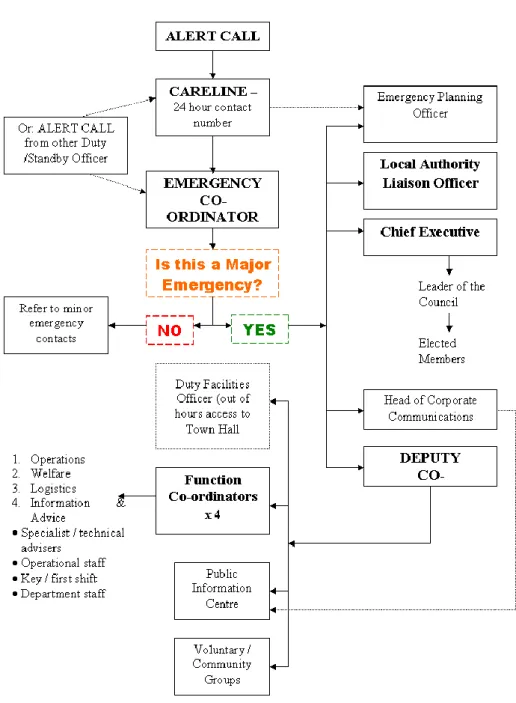
SBC operates an emergency cascade system, from which an on-call Director can implement a major emergency plan, as shown in Figure 3.1 This cascade system is initiated by a call from either the emergency services or a neighbouring Local Authority. If this plan is implemented then function co-ordinators liaise with the relevant department within SBC. The function co-ordinators have contact lists of relevant persons within SBC who can deal with the various responses
required, this could include members of staff in Highways and Transport and their term contractor ACCORD.
If an incident is mainly transport or highways orientated then the relevant specialist from that department is seconded to the emergency control team to provide specialist advice and response. As part of this emergency cascade system a media plan can be brought into effect which includes informing the general public through all known media sources.
Figure 3.1 - SBC Cascade Call-out System
3.3.5.2
Local Highways and Transport Incident Management Response
Responses to incidents are co-ordinated by Slough ACCORD the term contractor. On being advised of an incident they will respond and provide temporary traffic management and diversion control as required.
The term contractor can be brought into service through a direct emergency number which is available to the Police, SBC‟s CCTV control room and members of the transport and highways team.
SBC‟s Network Management Engineer is informed of incidences and attends the scene to evaluate the effects on the network and ensure that traffic movement is facilitated as promptly as possible.
Any issues relating with traffic signals are advised through SBC‟s red-light monitoring system. As soon as a red light is indicated as not being in operation a call is made to Siemens SBC‟s term maintenance traffic signal contractor to repair the fault.
However, as part of the Intelligent Transport System (ITS) SBC is in the process of assessing the benefits of a traffic control centre, which when operational will provide a one-stop location for incident monitoring and response.
3.3.6 Immediate Statutory Undertaker Works
In addition to planned works Statutory Undertakers have rights to carry out “immediate” i.e. emergency or urgent works in certain circumstances. Procedures for handling such works are based on contingency planning and incident management techniques rather than works planning. For immediate works there is a requirement that notice is provided to SBC within 2 hours of commencing works on site. SBC requests notification by phone as early as possible so that a good working relationship with the utilities can be maintained.
On receipt of such notices the Street Works team consult the signals team and Siemens to establish if changes to signal plans / timings would help reduce congestion and where appropriate publicise possible disruption through their press office.
3.4 NMD Theme 4: Performance Monitoring &
Management
3.4.1 Introduction
Historically SBC has introduced mandatory indicators required under the LTP. Such indicators provide useful information on the performance of Slough‟s road network. It is also recognised that the Traffic Manager‟s delivery arrangements will require monitoring.
3.4.2 Strategic Network Hierarchy
SBC has LTP indicators covering the performance of a range of modes. They are described later in this chapter. These indicators are monitored and reported on annually. Success in achieving the various targets set is evidence that the present modal networks and hierarchies are likely to be adequate. Likewise failure to achieve targets may indicate that the hierarchies need to be
reviewed. As indicated in Chapter 2, SBC is about to commence a review of its strategic highway network including its value to different users/modes/functions (including buses, accessibility, freight and servicing, cyclists, pedestrians, vulnerable users, taxis, motorcycles, parking and place (e.g. shopping, work, leisure, home)). The output of this piece of work will be a Strategic Network Hierarchy. The Strategic Network Hierarchy is unlikely to change regularly and therefore SBC will review it every five years.
3.4.3 Delivery Structure and Organisation
The Traffic Manager has established the Network Management Steering Group to establish an evidence led approach to decisions that affect network operation. The Steering Group will own the Network Management Improvement Plan
At present no performance measurement of our organisation delivery structure takes place, however work to identify suitable metrics is in progress. Performance Indicators will be related to compliance with procedures and an internal audit process will back up the PIs. The internal audit will produce a report to support regular review of the structure and arrangements.
3.4.4 Managing Works and Events
It may not be economic to establish a monitoring regime that directly measures delays arising from works and planned events – and therefore continuous improvement in that regard. As an alternative SBC presently measures the efficiency of managing planned works and events through a number of indirect indicators.
BV100 Monitors the number of days of temporary traffic controls or road closure on traffic sensitive streets or road closures caused by road works per km of traffic sensitive road
We monitor licensing of third party activities on the highway (skips, scaffolding, materials, hoardings) and the enforcement of any activities that illegally interfere with the safety or accessibility
Planned works and events are coordinated through the Street Works Manager. The notification system is monitored for compliance with statutory requirements
In the future the introduction of a permit system may present a number of additional opportunities for establishment of new performance indicators that better measure performance in this area. A network register with mapping interface is likely to be a key tool in achieving co-ordination of activities on the highway network and would be an important source of performance data.
Contingency Planning and Incidents
No monitoring presently takes place that would be useful in identifying the effectiveness of contingency planning or managing incidents. In the future it may be possible to develop indicators around the following:-
Successful application of SBC‟s Borough Emergency Plan for major incidents.
E-mail dispatches on network incidents and accidents that may cause disruption, to a wide range of stakeholders.
the future introduction of CCTV and ITS which will allow us to recognise network issues in real-time and so intervene to minimize disruption.
Percentage of incidents where information is passed on to local radio within 30 minutes.
Percentage of strategic routes covered by Network Contingency Plans
3.4.5 Managing Demand & Future Growth
SBC has agreed with the DfT that the Department will provide congestion monitoring using NI167 data under Variant 3 and SBC is about to begin development of a Common Database which will allow monitoring of SCOOT, traffic and bus journey time data.
SBC also monitors a basket of indicators that allow interpretation of Network Management trends, as described below.