Julie Kenney
BPMN
T
RAINING
C
OURSE
:
1
BPMN Training Course:
NEEDS ASSESSMENT:
The following is the needs assessment for the BPMN training course:
Training Goal:
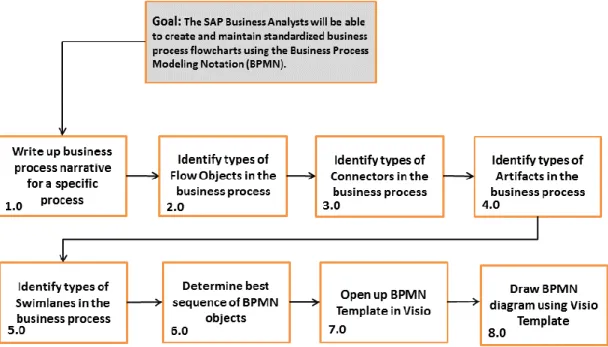
The SAP Business Analysts will be able to create and maintain standardized business process flowcharts using the Business Process Modeling Notation (BPMN).
Training Justification:
This course is being prepared for a large life sciences organization that has grown by acquisition and mergers and has ended up with not one, but many ERP programs. The have decided at a corporate level to convert all ERP systems into one SAP implementation. While they are standardizing on the SAP platform, they must standardize and consolidate their business processes in order to configure SAP correctly. With the SAP business analysts geographically dispersed and at different levels of business analysis expertise, the way the business processes are documented can be haphazard or nonexistent. Consequently, the Corporate office has decided that a standard business process modeling technique be used across the board. The Business Process Modeling Notation (BPMN) was chosen for this purpose, but most of the SAP Business Analysts have never used it before. BPMN is a flow-chart based notation for depicting the steps in the end to end flow of a Business Process.BPMN is an internationally accepted standard that has been published for free use and adoption by OMG who owns the standard.
Since BPMN is a modeling notation with many different components and
techniques, the company has further
defined what the standard BPMN uses and templates are within the company for the SAP business analysts.
This course is meant to educate the SAP Business Analysts on what BPMN is, how to use it and what specific corporate BPMN modeling guidelines should be used.
BPMN has been chosen to be the standard for describing and communication SAP-related business processes.
2
Instructional Analysis
The steps in this process fall into two of Gagné’s (1985) domains of learning:
Verbal. The SAP Business Analysts must recall the characteristics of the BPMN standard, to include the following characteristics:
o Flow Objects
o Connectors
o Artifacts
o Swimlanes
Intellectual. The learners must use the verbal information and apply rules to make decisions in order to properly construct a BPMN diagram.
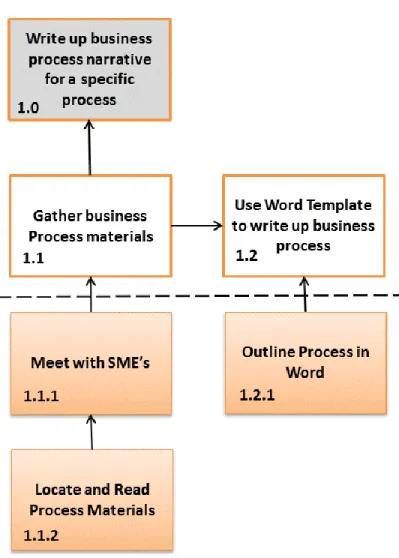
3 Figure 2 - Subskill Analysis of write up of business process
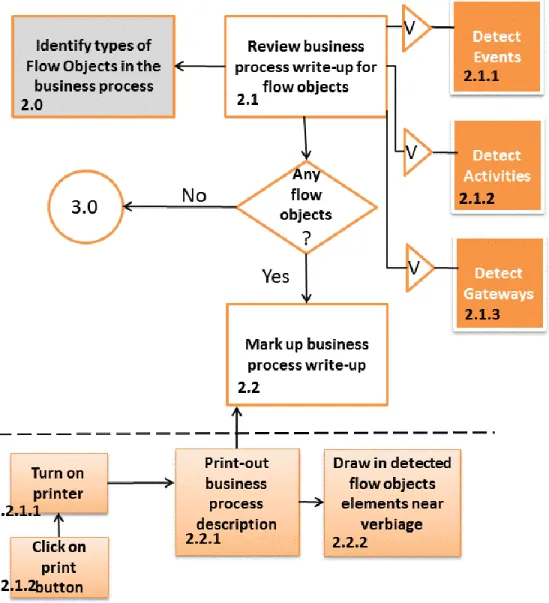
4 Figure 3 - Subskill Analysis of Identification of Flow Objects
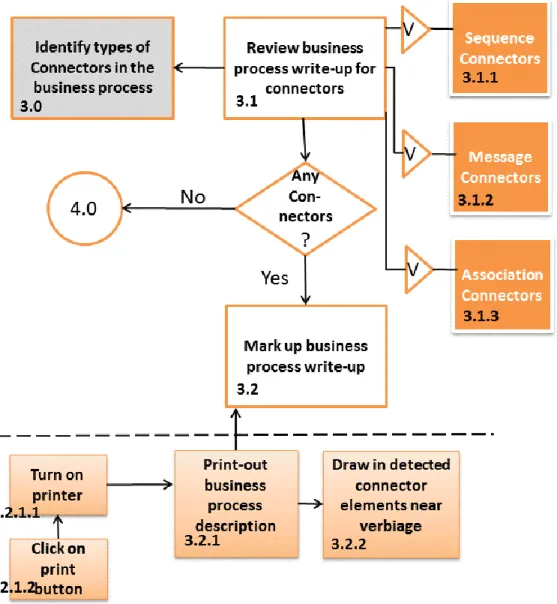
5 Figure 4 - Subskill Analysis of Identification of Connectors
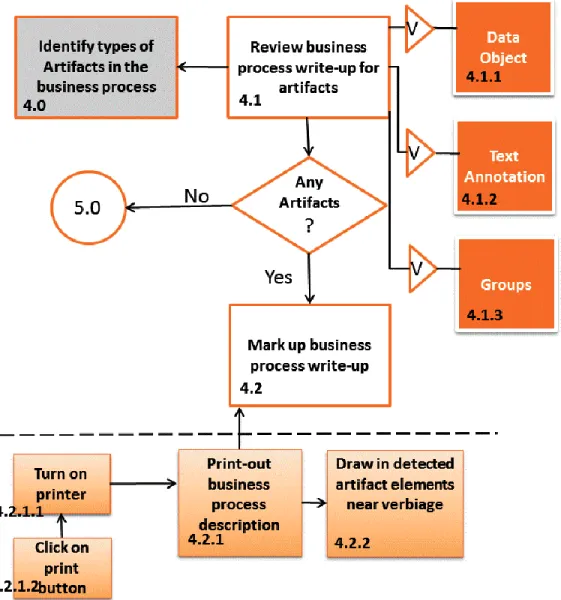
6 Figure 5 - Subskill Analysis of Identification of Artifacts
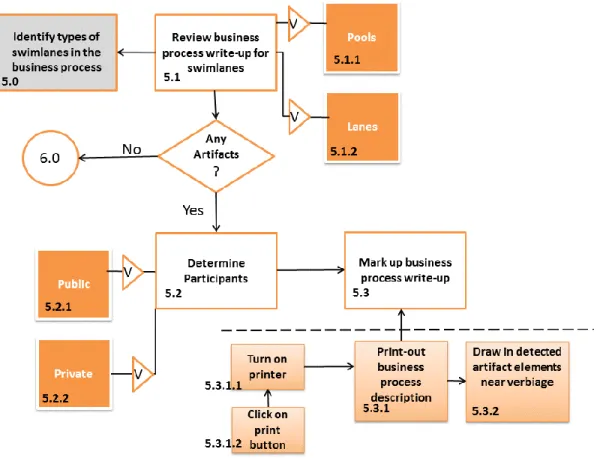
7 Figure 6 - Subskill Analysis of Identification of Swimlanes
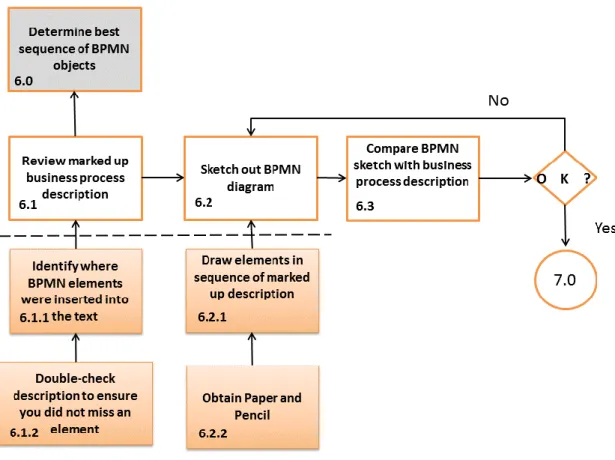
8 Figure 7 - Subskill Analysis of determing sequence of BPMN diagram
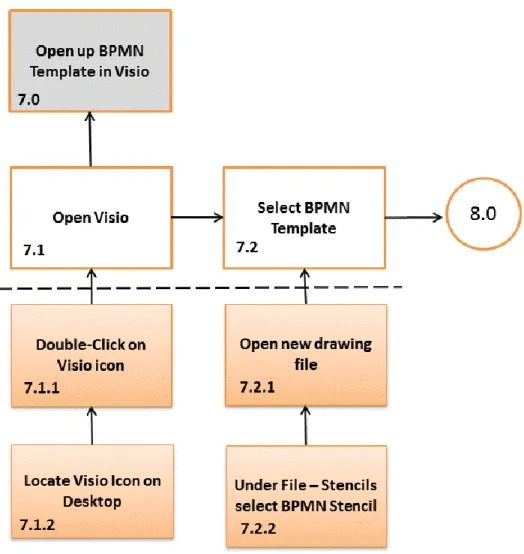
9 Figure 8 - Subskill Analysis of opening BPMN Template
10 Figure 9 - Subskill Analysis of Drawing BPMN Diagram
11
Entry Behaviors
Students need to be proficient in the following entry behaviors to successfully perform the instructional goal of creating and maintaining BPMN diagrams for business processes that are implemented within the SAP application:
SAP Business Analysts are expected to be computer literate to the extent that they know how to operate MS Office applications as well as print out documents. SAP Business Analysts are expected to understand and practice good business
analysis skills, such as interviewing SME’s.
SAP Business Analysts are expected to know how to use and operate the Visio application.
Learner Analysis
In general, the business analysts do have flowcharting experience, but are not knowledgeable about modeling techniques. There is some resistance in standardizing their diagrams using BPMN, but when they realize it is not a big change to what they are doing and that it will be directly related to their duties, the resistance will lessen.
The overall impression is that the training must be efficient and interactive to keep the learners engaged. Use of real-world SAP examples would be ideal. Explanation of why this training would benefit them is important.
Information Categories Data Sources Learner Characteristics Entry Skills Prior knowledge and
assumptions Learners have no prior experience using BPMN. Some have used other flowcharting models or software previously. None have had any formal training using a modeling standard.
Prior Knowledge of Topic
Area Prior knowledge and assumptions Learners have a general knowledge of flowcharting concepts and software.
However, some do not know how to do this successfully and have picked up some negative habits.
Attitudes toward content Prior knowledge and
assumptions There is some resistance by the learners to use a consistent modeling approach. Learners believe this is one more thing for them to do and do not currently see the benefit of using BPMN.
Attitudes toward potential
12 them to not only take it when their schedule allows, but they can also go back and use it as a reference tool. Motivation for instruction Prior knowledge and
assumptions This is directly related to the SAP business analyst’s duties. They will have to use BPMN model for all of their business process diagrams. Their management will be reviewing their BPMN diagrams for accuracy. Educational and ability
levels
Prior knowledge and assumptions
Learner’s educational levels are such that most have college degrees. Learners have heterogeneity when it comes to their SAP knowledge. However, some of the business analysts have differing levels of business analysis training and experience
General Learning
preferences Prior knowledge and assumptions Learners are comfortable with a variety of learning approaches. However, most prefer online learning so that they can fit it into their busy schedules.
Attitudes toward training
organization Prior knowledge and assumptions Learners are neutral toward the training organization. They realize that the mandate is coming from management and are able to separate any feelings they have for them from the training
organization. General Group
characteristics Prior knowledge and assumptions The learners are not entirely heterogeneous in their business analysis experience.
Most do not have any experience with BPMN.
There will be about 30-40 learners who will participate in this training. The students range from 25 – 50 years of age.
13
Learning Context
The basic learning context for the BPMN Course is web-based instruction that will reside as a link on their Corporate Intranet portal. This will be on demand training so that they can take the training whenever their daily work schedule permits. Delivering the training in this way means that there is very little setup needed for learners to connect to their training. They should be able to use the laptop or desktop they currently use in the office they reside. Since they all have previous access to the Corporate Portal, there is also no need to ensure logins or connectivity needs to be tested.
Information Category Data Sources Learning Site Characteristics Number/Nature of Sites Prior knowledge and
assumptions
Number: Most learners are located in the Corporate office in Woburn, MA. However, there could be 10 other additional sites within the U.S.
Facilities: The web-based instruction will be delivered directly over the Internet and onto their desktop/laptops.
Equipment: The only hardware or equipment needed is their desktop or laptop. They must have access to the Internet and the ability to login into the company Intranet Portal. Adobe
Flashplayer must be loaded on the HW. They also must have speakers as there may be audio.
Constraints: Ideally, they would like the content run-time to be no more than 1 hour. Site Compatibility with
Instructional Needs Prior knowledge and assumptions The sites all synced with the same level of software, which meet our instructional needs. This includes the installation of Flashplayer
The HW meets the minimum requirements of an XP operating system with 1 gig of memory. And they all have access to the Corporate Portal.
Site Compatibility with
Learner Needs Prior knowledge and assumptions Since the learners will be taking the instruction from their own offices on their own desktop/laptops, they are already comfortable in this environment. Feasibility for Simulating
Workplace Prior knowledge and assumptions With the instruction taking place on a computer, this resembles the way they will create BPMN diagrams. Typically, they will use the same laptop/desktop within the same office environment for the training as they will be in creating BPMN diagrams.
14
Performance Context
Since learners will use the laptop or desktop they currently use in the office they reside to access the training, it will exactly mimic the same environment in which they will apply the training.
Additionally, the training is directly related to their core business analysis task and they will be able to put their new skills into practice as soon as they complete their training. The BPMN skills will be reinforced by their Project Managers and Project Leaders on the SAP project as they will have to go through a review and approval process on their BPMN diagrams.
Information Category Data Sources Performance Site Characteristics Managerial/Supervisory
Support Prior knowledge and assumptions Managers and project leads will be expecting the business process diagrams to be delivered using BPMN. Since it is now the standard, this will be reinforced up through the management chain. BA’s will have to go through a review process of their materials and one of the criteria is for diagrams to comply with the BPMN standard.
Physical Aspects of site Prior knowledge and
assumptions The physical aspects are a typical office environment which contains offices and cubes.
The learners will need their
desktop/laptops and their current offices. Social Aspects of site Prior knowledge and
assumptions Project Managers work closely with the BA’s to help determine and approve business processes and how they are implemented within SAP.
There is daily contact between the PM’s and the BA’s and weekly project meetings. Depending upon the project team,
members can be geographically dispersed. This means that meetings and
conversations may take place over conference calls and Webex/Genesys type internet meetings.
Relevance of skills to
workplace Prior knowledge and assumptions BPMN skills will be directly related to their everyday tasks. As soon as their training is taken they should be applying their new skills immediately.
15
Assessment Strategy
For the BPMN Course, the assessment strategy will use the following assessment instruments:
Entry Skills Tests: The BPMN Course will not use an Entry Skills Tests. The learners in this case should already be proficient with the Entry skills as outlined in the Entry Behaviors section.
Pre-Test: The BPMN Course will not use a Pre-Test due to the fact that no one has used the BPMN model before and therefore could not be measured in their BPMN knowledge prior to the course.
Practice Tests: The BPMN Course will use practice tests after each task or skill is introduced. An objective test will be administered to measure whether the learner understands the new concept and when it is appropriate to use it. Five to ten practice questions will be given after each module or task section. These will include a combination of multiple choice, fill in the blank and true and false. Some questions will be based off a case study and/or an existing SAP-related BPMN diagram. After a learner enters their answer they will be told whether they were correct or not. If they are correct some additional reinforcing information will be given. If they were
incorrect an explanation of why they were incorrect and what the correct answer is will be given.
Sample Practice Test Questions: Flow Object Practice Test
1. Flow Objects are the main graphical elements that define the behavior of a Business Process. True or False?
Correct Answer: True.You are correct! Anytime you want to depict something that “happens”, a decision to be made or work that is to be done you would use a Flow Object.
Incorrect Answer: False. Sorry, but the correct answer is True.Anytime you want to depict something that “happens”, a decision to be made or work that is to be done you would use a Flow Object.
2. You would use an event object to depict:
a. Something that “happens” b. A decision to be made c. Work that is to be done
Correct Answer: A. Something that “happens”. An Event denotes something that “happens” during the course of a business process and is represented by a circle. Incorrect Answer: Sorry, but A is the correct answer. An Event denotes something that “happens” during the course of a business process and is represented by a circle
3. Imagine that you are tasked with documenting the business process on how to drive a car. How would you denote the first step that starts the process?
16
a. b. c.
Correct Answer: BYes, this symbol - depicts the start of a business process – it is called the Start Event. Use this to indicate the start of a business process.
Incorrect Answer: Sorry, but B is the correct answer. depicts the start of a business process – it is called the Start Event. Use this to indicate the start of a business process.
Post-Tests: The BPMN course will culminate with a post-test using an alternative
assessment. This post-test will be an actual SAP scenario/business process that the learner must use to create a BPMN diagram. A rubric will be used (see below) to measure the effectiveness of the resulting BPMN SAP diagram.
Sample BPMN Post-Test Rubric
Brief description of assignment that will be assessed using this rubric: Creation of a SAP BPMN diagram using Visio Software
Assignment
Criteria
Needs
Improvement
Acceptable
Proficient
1. Write up the business process narrative Write up is not in the right sequence Write up has left out
more than 2 business process steps Write-up has more
than 3 grammar errors and vaguely worded.
Write up is in the right sequence 80% of the time
Write up has left out less than 2 business process steps
Write-up is has less than 3 grammar errors and verbiage is sometimes vague.
Write up is in the right sequence 100% of the time
Write up contains all business process steps
Write-up is has 0 grammar errors and verbiage is clear.
2. Identify types
of Flow Missed more than 2 opportunities to use
Missed more than 1 opportunities to use
Correctly identified all opportunities to
17 Objects in the business process a flow object Incorrectly identified
the flow object type more than 2 times
a flow object Incorrectly
identified the flow object type more than 1 times
use a flow object Correctly identified
the specific flow object type 3. Identify types of Connectors in the business process
Missed more than 2 opportunities to use a connector
Incorrectly identified the connector type more than 2 times
Missed more than 1 opportunities to use a connector Incorrectly
identified the connector type more than 1 times
Correctly identified all opportunities to use a connector Correctly identified the specific connector type 4. Identify types of Artifacts in the business process
Missed more than 2 opportunities to use an artifact
Incorrectly identified the artifact type more than 2 times
Missed more than 1 opportunities to use an artifact
Incorrectly identified the artifact type more than 1 times
Correctly identified all opportunities to use an artifact Correctly identified
the specific artifact type 5. Identify types of Swimlanes in the business process
Missed more than 2 opportunities to use a swimlane
Incorrectly identified the swimlane type more than 2 times
Missed more than 1 opportunities to use a swimlane
Incorrectly identified the swimlane type more than 1 times
Correctly identified all opportunities to use a swimlane Correctly identified
the specific swimlane type 6. Sequence the BPMN Objects BPMN sketch has more than 2 sequence issues BPMN sketch is
missing more than 2 steps
BPMN sketch does not correctly use BPMN elements in more than 2 places
BPMN sketch has less than 2 sequence issues BPMN sketch is
missing less than 2 steps
BPMN sketch does not correctly use BPMN elements in less than 2 places
BPMN sketch has more than 0 sequence issues BPMN sketch is not
missing any steps BPMN sketch correctly uses BPMN elements in all instances 7. Open up the BPMN Template
BPMN Template was not opened up correctly on the first try
BPMN Template was
opened up correctly on the first try
8. Draw the BPMN diagram
The BPMN drawing does not include 2 or more of the
following: A discernable
The BPMN drawing does not include any one of the following: A discernable beginning and The BPMN drawing includes A discernable beginning and end Proper use of flow
18 beginning and end
Proper use of flow objects, connectors, artifacts and swimlanes Descriptive labeling of each step The resulting sequence of steps should be evident and easy to follow.
end
Proper use of flow objects, connectors, artifacts and swimlanes Descriptive labeling of each step The resulting sequence of steps should be evident and easy to follow. objects, connectors, artifacts and swimlanes Descriptive labeling of each step The resulting sequence of steps should be evident and easy to follow.
19
Performance Objectives and Outline of Instructional Strategy:
Training Goal: The SAP Business Analysts will be able to create and maintain
standardized business process flowcharts using the Business Process Modeling Notation (BPMN).
Terminal Objective: Using simulated SAP business process materials and Visio software, SAP Business Analysts will be able to create a BPMN model. The BPMN drawing should include a discernable beginning and end, proper use of flow objects, connectors, artifacts and swimlanes, descriptive labeling of each step and the resulting sequence of steps should be evident and easy to follow.
1. Preinstructional Activities:
a. Welcome: Instructor will welcome the student to the course and discuss what the course is about.
b. Why am I here? Explain the new corporate policy regarding BPMN and how it will be used throughout the organization.
c. Show Examples: Show examples of different flowchart diagrams used today and how they differ. Show how details differ and why consistency is key. d. Course Outline: Instructor will present high level performance objects of the
course and how the course will proceed.
2. Lesson 1: How to write up the Business Process Narrative
a. Performance Objective: Using a pre-defined Word Business Process template, write up the business process narrative for a specific process. Learner must include what data comes into the process, what data results from the process, what user roles are involved and a sequential step by step description of the business process.
b. Content Presentation:
Using audio, visual and textual presentation, the instructor will give a short lecture covering:
The basics of the Word template and how to fill it in. How to identify and document input into the process How to identify and document outputs from the process
How to use proper and measurable language to document the business process steps
20 c. Student Participation:
Since the student will be taking this course online, they will be working alone and at their own pace. They will be expected to click on a button to advance to each new section. At the end of the module, they will take the practice test. During the Content Presentation the student will be presented with a two exercises to complete. One will have them identify measurable language from a list and another will give them steps out of sequence, which they must then put in the right sequence.
d. Assessment:
An objective test will be administered to measure whether the learner
understands the new concept and when it is appropriate to use it. Five to ten practice questions will be given. These will include a combination of multiple choice, fill in the blank and true and false. Several questions will involve testing whether the student learned the appropriate use of inputs and outputs and how
A couple of to identify them as well as the qualities of measurable language.
questions will involve comparing notes taken of a business process against a write-up. Students are expected to identify 5 problems with the business process narrative. And then one question will ask them to match labels and identifiers to the area of the Word template where they belong. The students will be given immediate feedback on their answers, giving them encouragement and always reinforcing the correct concept.
21 3. Lesson 2: Understanding and Identifying Flow Objects
a. Performance Objective: Given the business process narrative document, identify types of Flow Objects in the business process. Learners should correctly classify the three different types of flow objects and manually draw the correct flow object within the business process document.
b. Content Presentation
Audio, visual and textual presentation will be used to help convey the instructor’s short lecture covering Flow Objects.
During the Flow Objects lesson, the instructor will discuss:
What is a Flow Object?
When are they used?
The three different objects within the Flow Objects element category. These three objects are:
Events
Activities and
Gateway
The symbols for each object and their proper use will be discussed.
Examples of Flow Objects in use
c. Student Participation
Since the student will be taking this course online, they will be working alone and at their own pace. They will be expected to click on a button to advance to each new section. At the end of the module, they will take the practice test. The students will be given immediate feedback on their answers, giving them encouragement and always reinforcing the correct concept.
During the Content Presentation the learner will be given an exercise and be asked to match the object with their rightful name.
d. Assessment
An objective test will be administered to measure whether the learner understands the new concept and when it is appropriate to use it. For some questions, they will be given a short business process sentence(s) and will be asked to identify from a list of flow objects which is appropriate to use in this case. In other questions, they will be asked to identify a symbol with its name or
. Five to ten practice questions in all will be given. The when it should be used
student will answer the above questions using a combination of multiple choice, fill in the blank and true and false.
22 4. Lesson 3: Understanding and Identifying Connectors
a. Performance Objective: Given the business process narrative document, identify types of Connectors in the business process. Learners should correctly classify the three different types of connectors and manually draw the correct connector within the business process document.
b. Content Presentation
Audio, visual and textual presentation will be used to help convey the instructor’s short lecture covering Connectors.
During the Connectors lesson, the instructor will discuss:
What is a Connector?
When are they used?
The three different objects within the Connectors element category. These three objects are:
Sequence Flow
Message Flow and
Association
The symbols for each object and their proper use will be discussed.
Examples of Connectors in use
c. Student Participation
Since the student will be taking this course online, they will be working alone and at their own pace. They will be expected to click on a button to advance to each new section. At the end of the module, they will take the practice test. The students will be given immediate feedback on their answers, giving them encouragement and always reinforcing the correct concept.
During the Content Presentation the learner will be given an exercise and be
.
asked to match the object with their rightful name
d. Assessment
An objective test will be administered to measure whether the learner understands the new concept and when it is appropriate to use it. For some questions, they will be given a short business process sentence(s) and will be asked to identify from a list of connectors, which is appropriate to use in this case. In other questions, they will be asked to identify a symbol with its name or
Five to ten practice questions in all will be given. The when it should be used.
student will answer the above questions using a combination of multiple choice, fill in the blank and true and false.
23 5. Lesson 4: Understanding and Identifying Artifacts
a. Performance Objective: Given the business process narrative document, identify types of Artifacts in the business process. Learners should correctly classify the three different types of Artifacts and manually draw the correct artifact within the business process document.
b. Content Presentation
Audio, visual and textual presentation will be used to help convey the instructor’s short lecture covering Artifacts.
During the Artifacts lesson, the instructor will discuss:
What is an Artifact?
When are they used?
The three different objects within the Artifacts element category. These three objects are:
Data
Text and
Groups
The symbols for each object and their proper use will be discussed.
Examples of Artifacts in use
c. Student Participation
Since the student will be taking this course online, they will be working alone and at their own pace. They will be expected to click on a button to advance to each new section. At the end of the module, they will take the practice test. The students will be given immediate feedback on their answers, giving them encouragement and always reinforcing the correct concept.
During the Content Presentation the learner will be given an exercise and be asked to match the object with their rightful name.
d. Assessment
An objective test will be administered to measure whether the learner understands the new concept and when it is appropriate to use it. For some questions, they will be given a short business process sentence(s) and will be asked to identify from a list of artifacts, which is appropriate to use in this case. In other questions, they will be asked to identify a symbol with its name or when it should be used. Five to ten practice questions in all will be given. The student combination of multiple choice, fill in the will answer the above questions using a
24 6. Lesson 5: Understanding and Identifying Swimlanes
a. Performance Objective: Given the business process narrative document, identify types of swimlanes in the business process. Learners should correctly classify the two different types of swimlanes and manually draw the correct swimlane within the business process document.
b. Content Presentation
Audio, visual and textual presentation will be used to help convey the instructor’s short lecture covering Swimlanes.
During the Swimlanes lesson, the instructor will discuss:
What is a Swimlane?
When are they used?
The two different objects within the Swimlanes element category. These two objects are:
Pools and
Lanes
The symbols for each object and their proper use will be discussed.
Examples of swimlanes in use
c. Student Participation
Since the student will be taking this course online, they will be working alone and at their own pace. They will be expected to click on a button to advance to each new section. At the end of the module, they will take the practice test. The students will be given immediate feedback on their answers, giving them encouragement and always reinforcing the correct concept.
During the Content Presentation the learner will be given an exercise and be asked to match the object with their rightful name.
d. Assessment
An objective test will be administered to measure whether the learner understands the new concept and when it is appropriate to use it. For some questions, they will be given a short business process sentence(s) and will be asked to identify from a list of artifacts, which is appropriate to use in this case. In other questions, they will be asked to identify a symbol with its name or when it should be used. Five to ten practice questions in all will be given. The student combination of multiple choice, fill in the will answer the above questions using a
25 7. Lesson 6: How to Sequence BPMN objects
a. Performance Objective: Given the marked up business process description, manually sketch the sequence of BPMN objects on a piece of paper. The BPMN object sequence should include a discernable beginning and end and a set
sequential steps using BPMN objects that match the business process document.
b. Content Presentation
Audio, visual and textual presentation will be used to help convey the instructor’s short lecture covering how to translate the business process description into BPMN elements and sequence them correctly.
During the lesson, the instructor will discuss:
How to break down business process text into BPMN elements
How to mark up the business process text with BPMN elements
How to sequence the BPMN elements
Step by step examples of text being translated into a BPMN diagram
c. Student Participation
Since the student will be taking this course online, they will be working alone and at their own pace. They will be expected to click on a button to advance to each new section.
During the step by step examples, they will first be asked to drag and drop the BPMN elements onto a business process narrative. If they are incorrect, they will get immediate feedback and asked to try again.
Using the information they gained during the drag and drop exercise, the
learners will be shown how the elements they marked fit together in a sequence. Then for another exercise, they will be presented with puzzle pieces they have to fit together in the right sequence.
At the end of the module, they will take the practice test. The students will be given immediate feedback on their answers, giving them encouragement and always reinforcing the correct concept.
d. Assessment
An objective test will be administered to measure whether the learner understands the new concepts and how to piece them together. For some questions, they will be given a short business process sentence(s) and will be asked to identify which BPMN element is missing. In others they will be asked if a piece of a BPMN diagram is in the right sequence or drawn correctly. Then they will be asked to sequence the different BPMN elements based off of a short paragraph describing a portion of a business process.
26 8. Lesson 7: How to use Visio to draw the BPMN Diagram
a. Performance Objectives:
i. Using the Visio software, open up the BPMN Template.
ii. Using the Visio BPMN Template and the BPMN Object sketch, draw the BPMN diagram. The resulting Vision BPMN drawing should match the sketch.
b. Content Presentation:
Audio, visual and textual presentation will be used to help convey the instructor’s short lecture covering how to use Visio to draw a BPMN from a previously
generated sketch.
During the lesson, the instructor will discuss:
How to launch the Visio software, locate the BPMN Template and open it.
How to drag and drop BPMN elements from the stencil onto the drawing area.
How to sequence and connect the BPMN elements.
How to save the BPMN diagram
c. Student Participation
Since the student will be taking this course online, they will be working alone and at their own pace. They will be expected to click on a button to advance to each new section.
After the initial discussion on how to open Visio and open the template, the student will be given a simulation where they will be asked to repeat the template steps using a Visio model presented in the course. If they click on the wrong area they will be corrected and pointed to the right area.
After the drag and drop capabilities are demonstrated, the student will be given a simulation where they will be asked to repeat the drag and drop steps using a Visio model presented in the course. If they click on the wrong area they will be corrected and pointed to the right area.
At the end of the module, they will take the practice test. The students will be given immediate feedback on their answers, giving them encouragement and always reinforcing the correct concept.
27 d. Assessment
An objective test will be administered to measure whether the learner
understands the new Visio concepts and how to use it for BPMN purposes. The learner will be given a simulation that they have to work through. For the simulation they will be given step-by-step instructions as to what they should be doing. In general the steps will be:
i. Open up Visio ii. Open up the sentcil
iii. Drag a Start flow object onto the drawining area. iv. Drag an End flow object onto the drawing area.
v. Drag a task after the start flow object and label it vi. Drag a task before the end flow object and label it. vii. Add a gateway and label it
28 9. Lesson 8: Case Study – To me this is where the bulk of the assessment for this
course is performed.
a. Performance Objective: Using simulated SAP business process materials and Visio software, SAP Business Analysts will be able to create a BPMN model. The BPMN drawing should include a discernable beginning and end, proper use of flow objects, connectors, artifacts and swimlanes, descriptive labeling of each step and the resulting sequence of steps should be evident and easy to follow.
b. Content Presentation:
This lesson will not have any new content to relate via lecture. Instead
instructions will be given on how to perform the Case Study exercise. The Rubric will be given to show how they will be measured. Any additional materials will be presented and explained.
c. Student Participation
Since the student will be taking this course online, they will be working alone and at their own pace. They will be expected to click on a button to advance to each new section.
The student is expected to complete the Case Study as outlined in the Content Presentation. They will be expected to use the Visio program on their desktop to complete the exercise.
d. Assessment
The BPMN course will culminate with a post-test using an alternative
assessment. This post-test will be an actual SAP scenario/business process that the learner must use to create a BPMN diagram. A rubric will be used (see below) to measure the effectiveness of the resulting BPMN SAP diagram. When they are done with the exercise, they will be required to send in the Visio diagram to the instructor who will evaluate it and send back feedback to the student.
Assignment
Criteria
Needs
Improvement
Acceptable
Proficient
1. Write up the business process narrative Write up is not in the right sequence Write up has left out
more than 2 business process steps Write-up has more
than 3 grammar errors and vaguely worded.
Write up is in the right sequence 80% of the time
Write up has left out less than 2 business process steps
Write-up is has less than 3 grammar errors and verbiage is sometimes
Write up is in the right sequence 100% of the time
Write up contains all business process steps Write-up is has 0
grammar errors and verbiage is clear.
29 vague. 2. Identify types of Flow Objects in the business process
Missed more than 2 opportunities to use a flow object Incorrectly identified
the flow object type more than 2 times
Missed more than 1 opportunities to use a flow object
Incorrectly identified the flow object type more than 1 times
Correctly identified all opportunities to use a flow object
Correctly identified the specific flow object type
3. Identify types of Connectors in the business process
Missed more than 2 opportunities to use a connector
Incorrectly identified the connector type more than 2 times
Missed more than 1 opportunities to use a connector
Incorrectly identified the connector type more than 1 times
Correctly identified all opportunities to use a connector
Correctly identified the specific connector type 4. Identify types
of Artifacts in the business process
Missed more than 2 opportunities to use an artifact
Incorrectly identified the artifact type more than 2 times
Missed more than 1 opportunities to use an artifact
Incorrectly identified the artifact type more than 1 times
Correctly identified all opportunities to use an artifact
Correctly identified the specific artifact type 5. Identify types
of Swimlanes in the business process
Missed more than 2 opportunities to use a swimlane
Incorrectly identified the swimlane type more than 2 times
Missed more than 1 opportunities to use a swimlane
Incorrectly identified the swimlane type more than 1 times
Correctly identified all opportunities to use a swimlane
Correctly identified the specific swimlane type 6. Sequence the
BPMN Objects BPMN sketch has more than 2 sequence issues BPMN sketch is
missing more than 2 steps
BPMN sketch does not correctly use BPMN elements in more than 2 places
BPMN sketch has less than 2 sequence issues BPMN sketch is missing
less than 2 steps BPMN sketch does not
correctly use BPMN elements in less than 2 places
BPMN sketch has more than 0 sequence issues BPMN sketch is not
missing any steps BPMN sketch correctly uses BPMN elements in all instances 7. Open up the BPMN Template
BPMN Template was not opened up correctly on the first try
BPMN Template was
opened up correctly on the first try
8. Draw the
BPMN diagram The BPMN drawing does not include 2 or more of the
following: A discernable
The BPMN drawing does not include any one of the following:
A discernable beginning and end
The BPMN drawing includes
A discernable beginning and end Proper use of flow
30 beginning and end
Proper use of flow objects, connectors, artifacts and swimlanes Descriptive labeling of each step The resulting sequence of steps should be evident and easy to follow.
Proper use of flow objects, connectors, artifacts and swimlanes Descriptive labeling of each step The resulting sequence of steps should be evident and easy to follow. artifacts and swimlanes Descriptive labeling of each step The resulting sequence of steps should be evident and easy to follow.
Follow-Through Activities:
Students will be expected to complete the subsequent follow-through activities:
Meet with instructor either over the phone or in person to review their case study project.
Meet with their manager to review their first three BPMN diagrams they create on the job.
Be provided with a job aid that will give them a quick reference checklist to follow.
Descriptions of student groups and media selections:
Since this is an online class there is no limit on the number of students that can take this at a time. Learners are expected to proceed at their own pace and do not have complete the course in one sitting. However, they will have until January 1, 2011 to complete the course as that is when the new BPMN standards will be in place across the enterprise. The
learners will have the ability to email the instructor with any questions or clarifications they may need. However, students will not be able to interact with other students via the online course.
Each student will be provided with the BPMN Reference and Modeling Guide by Stephen White and will be given a list of BPMN websites that will provide additional explanation.