MEDICAID EXPANSION PROGRAMS: EFFECTS ON MEDICAID ENROLLMENT AND HEALTHCARE EMPLOYMENT
Marisa R. Morrison
A dissertation submitted to the faculty at the University of North Carolina at Chapel Hill in partial fulfillment of the requirements for the degree of Doctor of Philosophy in the Department of Health Policy and Management in the Gillings School of Global Public
Health.
Chapel Hill 2015
ABSTRACT
Marisa R. Morrison: Medicaid Expansion Programs: Effects on Medicaid Enrollment and Healthcare Employment
(Under the direction of Jonathan Oberlander)
This dissertation examines the effects of Section 1115 coverage expansions on health insurance coverage and healthcare employment. Although Section 1115 expansions had smaller enrollments than the Patient Protection and Affordable Care Act’s (ACA) Medicaid expansion, they—like the ACA’s Medicaid expansion—extended publicly financed health insurance to low-income adults who were previously ineligible for such coverage. Therefore, studying the effects of Section 1115 expansions can provide insights into the longer-term effects of the ACA’s Medicaid expansion.
In the dissertation’s first analysis, I construct multinomial probit models in Current Population Survey Annual Social and Economic Supplement data to evaluate Section 1115 expansions’ effects on health insurance coverage for “pre-expansion eligible” parents and children. These pre-expansion eligible individuals were eligible for Medicaid or the
Second, I use ordinary least squares (OLS) models with county and year fixed effects to estimate Section 1115 expansions’ effects on county-level health care and social assistance employment. This study’s principal data set is County Business Patterns data. I find that Section 1115 expansions were associated with increases in county-level health care and social assistance employment across all states with changes in expansion status during the study period. This finding suggests that healthcare employment could grow in response to public coverage expansions.
Finally, I use OLS models with hospital and year fixed effects to examine Section 1115 expansions’ effects on hospital employment. This study’s key data source is the American Hospital Association annual survey. I find that these expansions were not
ACKNOWLEDGMENTS
I could not have carried out my dissertation work without the support of many people. First, I would like to thank my advisor Jon Oberlander for his assistance in developing this dissertation. Throughout the dissertation process, he has helped me stay focused on the big picture. In general, Jon has been an excellent advisor throughout all stages of my graduate school experience—from talking with me about which classes to take to editing my cover letters for job applications.
I would also like to thank Mark Holmes for his invaluable advice on both quantitative methods and Stata coding. Mark always finds creative solutions to methods issues and is a great source for research ideas. I am grateful for Marisa Domino’s, Krista Perreira’s, and Pam Silberman’s thorough feedback on my dissertation papers, which greatly improved the papers’ quality.
I am indebted to Erin Fraher, who let me retain my research assistant position in the Program on Health Workforce Research and Policy at the Cecil G. Sheps Center for Health Services Research despite my move to Atlanta. Working with Erin and others at the Sheps Center for more than three years was an incredibly rewarding experience. My time at the Sheps Center helped me develop as a researcher and a writer and provided me with the inspiration for the two healthcare workforce–focused studies in this dissertation.
curiosity about the world and introducing me—through their careers—to the subjects of health care and public health. My mother requires a special mention for teaching me the value of clear writing. I would also like to thank my mother-in-law and father-in-law for their encouragement.
TABLE OF CONTENTS
LIST OF TABLES ... xii
LIST OF FIGURES ... xiv
LIST OF ABBREVIATIONS ... xv
CHAPTER 1. INTRODUCTION ... 1
Overview of Medicaid ... 2
Overview of Medicaid Waivers ... 3
Overview of Dissertation ... 5
Contribution to the Literature ... 5
Policy Implications ... 6
Dissertation Organization ... 8
REFERENCES ... 9
CHAPTER 2. THE EFFECT OF MEDICAID EXPANSION ON HEALTH INSURANCE COVERAGE FOR PRE-EXPANSION ELIGIBLE PARENTS AND CHILDREN ... 13
Background ... 14
Overview of Section 1115 Waiver-Based Health Insurance Coverage Expansions ... 14
Prior Research on How Medicaid and CHIP Coverage Expansions Affect “Pre-Expansion” Eligible Parents and Children ... 15
Effects of Coverage Expansion on Pre-Expansion Eligible Children’s Coverage ... 15
The Current Study’s Contribution to the Literature ... 20
Conceptual Framework ... 20
Hypotheses ... 23
Data and Samples ... 23
Data Sources ... 23
Sample Creation ... 27
Variables ... 34
Dependent Variable ... 34
Expansion Indicator ... 35
Control Variables for Children ... 35
Control Variables for Parents... 36
State and Year Indicators ... 37
Methods... 37
Selecting between Maximum Likelihood Estimation Models ... 37
Multinomial Probit Models ... 37
Results ... 38
Descriptive Statistics ... 38
Multinomial Probit Model Estimates ... 41
Discussion ... 44
Limitations ... 46
Implications for the ACA... 47
REFERENCES ... 61
CHAPTER 3. THE EFFECT OF EXPANDING MEDICAID ON HEALTHCARE EMPLOYMENT ... 67
Background ... 68
Prior Research On the Healthcare Workforce and Health
Insurance Coverage Expansion ... 70
Conceptual Framework ... 73
Hypotheses ... 75
Data and Sample ... 76
Data Sources ... 76
Sample Creation ... 77
Variables ... 81
Methods... 84
Average Effect of Section 1115 Expansions on Healthcare Employment ... 84
State-Specific Effects of Section 1115 Expansions on Healthcare Workforce Employment... 85
Specification Testing ... 86
Sensitivity Analysis ... 86
Supplemental Analyses ... 87
Results ... 89
Descriptive Statistics ... 89
Multivariate Analyses ... 89
Sensitivity Analysis ... 94
Supplemental Analyses ... 96
Discussion ... 98
Limitations ... 99
Implications for the Affordable Care Act ... 100
REFERENCES ... 102
Prior Research on the Effects of Health Insurance Coverage
Expansion on Employment ... 109
Coverage Expansions’ Effects on Healthcare Employment at the State Level ... 109
Coverage Expansions’ Effects on Healthcare Employment at the Organizational Level ... 111
Background on Section 1115 Waivers ... 112
Conceptual Framework ... 113
Hypothesis... 117
Data and Sample ... 117
Data Sources ... 117
Sample Creation ... 118
Variables ... 123
Full-Time Equivalent Hospital Employment ... 123
Section 1115 Expansion Indicator ... 124
County Demographic and Economic Characteristics ... 124
Hospital Characteristics ... 125
Methods... 126
Model Specification ... 128
Results ... 130
Summary Statistics... 130
Multivariate Analyses ... 130
Discussion ... 134
Limitations ... 134
Implications for the Affordable Care Act ... 135
CHAPTER 5: CONCLUSION ... 143
Summary of Findings ... 143
Limitations ... 145
Policy Implications ... 147
Future Research ... 149
REFERENCES ... 151
LIST OF TABLES Table 2.1. States Included in This Study that Implemented Section 1115 Expansions to Parents or Low-Income Adults
Without Dependent Children between 2000 and 2010 ... 26 Table 2.2. Summary Statistics for Pre-Expansion Eligible
Children (Ages 1-18), Unweighted ... 39 Table 2.3. Summary Statistics for Pre-Expansion Eligible Parents,
Unweighted ... 40 Table 2.4. Predicted Probabilities for Public, Private, or No Health
Insurance Coverage for Pre-Expansion Eligible Children and Parents
in Expansion States and Non-Expansion States... 44 Table 2.5. Average Differential Effects of Section 1115 Expansions
on the Probabilities of Having Public, Private, or No Health Insurance
Coverage for Pre-Expansion Eligible Children and Parents ... 44 Table 2.6. Rules for Pre-Expansion Eligibility for Children and
Parents, By State and Year... 49 Table 2.7. Multinomial Probit Estimation of Coverage Outcomes
for Pre-Expansion Eligible Children ... 57 Table 2.8. Multinomial Probit Estimation of Coverage Outcomes for
Pre-Expansion Eligible Parents... 59 Table 3.1. States That Implemented Section 1115 Expansions to
Parents or Low-Income Adults Without Dependent Children
between 2000 and 2010 ... 78 Table 3.2. Healthcare and Social Assistance Employment by Subsector ... 82 Table 3.3. Summary Statistics for County-Year Observations ... 90 Table 3.4. Regression Estimates of the Effect of Section 1115
Expansions on County-Level Counts of Healthcare and Social
Assistance Employment ... 92 Table 3.5. Estimates of State-Specific Effects of Section 1115
Expansions on County-Level Healthcare and Social Assistance
Employment ... 93 Table 3.6. Regression Estimates of the Effect of Section 1115
Expansions on County-Level Ambulatory Healthcare Services
Table 3.7. Estimates of State-Specific Effects of Section 1115 Expansions on County-Level Ambulatory Healthcare Services
Employment ... 95 Table 3.8. Regression Estimates of the Effect of Section 1115
Expansions on State-Level Medicaid Enrollment... 97 Table 4.1. States that Implemented Section 1115 Waiver–Based
Coverage Expansions to Parents or Low-Income Adults Without
Dependent Children Between 2000 and 2010 ... 119 Table 4.2. Summary Statistics for Hospital-Year Observations ... 129 Table 4.3. Estimates of the Effects of Section 1115 Expansions
on FTE Hospital Employment ... 131 Table 4.4. Estimates of State-Specific Effects of Section 1115
LIST OF FIGURES
Figure 2.1. Creating a sample of pre-expansion eligible children. ... 32 Figure 2.2. Creating a sample of pre-expansion eligible parents. ... 33 Figure 3.1. Section 1115 expansions’ effect on healthcare and
social assistance employment. ... 75 Figure 3.2. Creating a sample of county-year observations. ... 80 Figure 3.3. State-specific effects of Section 1115 expansions on
county-level healthcare and social assistance employment. ... 93 Figure 3.4. State-specific effects of Section 1115 expansions on
county-level ambulatory healthcare services employment. ... 96 Figure 4.1. Section 1115 expansions’ effects on FTE hospital employment... 117 Figure 4.2. Creating a sample of hospital-year observations. ... 123 Figure 4.3. State-specific effects of Section 1115 expansions
LIST OF ABBREVIATIONS ACA Patient Protection and Affordable Care Act AHA American Hospital Association
CBP County Business Patterns
CHIP Children’s Health Insurance Program
CMS Centers for Medicare and Medicaid Services
CPS ASEC Current Population Survey Annual Social and Economic Supplement FTE Full-time equivalent
IPUMS Integrated Public Use Microdata Series
CHAPTER 1. INTRODUCTION
The 2010 Patient Protection and Affordable Care Act (ACA) authorized the most significant expansion of Medicaid coverage since the program’s creation in 1965. As of April 2015, 29 states and Washington, DC, have adopted the ACA’s Medicaid expansion, which has been in effect since January 2014 (Kaiser Family Foundation, 2015). As a result of this policy change, Medicaid and Children’s Health Insurance Program (CHIP) enrollment grew by 26% in “expansion” states and 8% in “non-expansion” states between summer 2013 and January 2015 (Artiga et al., 2015). Because additional states may adopt the ACA’s Medicaid expansion at a later date and because the Medicaid expansion has only been in effect for slightly more than a year, looking back at the effects of pre-2014 Medicaid expansions can provide insights into the longer-term effects of the ACA’s Medicaid expansion.
This dissertation specifically draws lessons from pre-ACA Medicaid expansions in two areas: the effects of Medicaid expansion on health insurance for individuals already eligible for coverage under pre-expansion rules and the effects of Medicaid expansion on health care employment. The pre-ACA public coverage expansions on which this dissertation focuses are Section 1115 waiver-based expansions.
insurance market changes. Furthermore, federal spending on Section 1115 expansions was much more constrained than is federal spending on the ACA’s Medicaid expansion.
Because the ACA’s Medicaid expansion is an unprecedented event no prior
expansion is exactly comparable to the ACA’s Medicaid expansion. Massachusetts’s 2006-2007 health care reforms, on which the ACA is modeled, provide the closest approximation to the ACA’s coverage expansions. However, Massachusetts already had relatively high rates of health insurance coverage and a large healthcare workforce supply compared to other U.S. states prior to 2006 (Long, Stockley, & Dahlen, 2012; Staiger, Auerbach, & Buerhaus, 2011). Focusing on expansions carried out through Section 1115 waivers allows this dissertation to take into consideration public coverage expansion experiences in multiple states.
Overview of Medicaid
Prior to the ACA’s Medicaid expansion, more than three-fourths of children in poverty were enrolled in Medicaid coverage while 9.8% were uninsured (Majerol, Newkirk, & Garfield, 2015). In contrast, only 35.2% percent of non-elderly adults in poverty were enrolled in Medicaid coverage, and 37.2% of adults in poverty were uninsured (Majerol, Newkirk, & Garfield, 2015). One reason that so many low-income U.S. adults were uninsured is that many states had income eligibility limits for parents that were below the federal poverty level (limits that still exist in some states). In addition, elderly, non-disabled adults without dependent children (“childless adults”) were ineligible for Medicaid in most states prior to the ACA’s enactment (Kaiser Commission on Medicaid and the Uninsured, 2013).
States that have accepted the ACA’s Medicaid expansion have extended Medicaid eligibility to all individuals with household incomes below 138% of the federal poverty level (FPL) (Heberlein et al., 2013). The ACA also includes provisions simplifying Medicaid enrollment and renewal processes and eliminating assets as a factor for determining Medicaid eligibility (Heberlein et al., 2013; Somashekhar & Tumulty, 2013).
Overview of Medicaid Waivers
Prior to the implementation of the ACA’s Medicaid expansion in 2014, states had limited options for providing coverage to parents whose incomes were otherwise too high to qualify for Medicaid or to childless adults who were otherwise excluded from Medicaid coverage.
Some states used their own funds to extend health insurance to individuals otherwise ineligible for Medicaid. For example, Pennsylvania used National Tobacco Settlement
individuals with incomes up to 200% FPL through a Basic Health Plan (Kaiser Commission on Medicaid and the Uninsured, 2010; Dorn & Alteras, 2004).
Another option for expanding Medicaid eligibility for parents—but not for childless adults—was a Section 1931 expansion. The Personal Responsibility and Work Opportunity Reconciliation Act of 1996 removed the connection between welfare receipt and Medicaid eligibility, providing states with opportunities to expand coverage to parents not eligible for welfare (Guyer & Mann, 1998). Section 1931 of the Social Security Act allowed states to disregard a certain portion of a Medicaid applicant’s income or assets when determining that applicant’s Medicaid eligibility—a policy that effectively makes more parents eligible for Medicaid coverage (Birnbaum, 2000). Under Section 1931 rules, states could receive matching funds from the federal government to cover parents eligible for Medicaid under Section 1931 expansions (Guyer & Mann, 1998)
The third option for expanding publicly financed health insurance to adults was a Section 1115 waiver. In addition to being a tool for expanding coverage, the waivers
provided states with opportunities to try new methods for administering Medicaid and CHIP programs (Centers for Medicare and Medicaid Services, n.d.). States submitted waiver applications outlining coverage expansion plans to the Centers for Medicaid and Medicaid Services (CMS). CMS and the states then negotiated waiver details (Artiga, 2009). CMS only approved waivers that were budget neutral—that is, CMS required each waiver to be
projected to not increase federal spending above what the federal government would spend in the waiver’s absence (Artiga, 2009). To maintain budget neutrality while expanding
insurance coverage or capping expansion program enrollment (Government Accountability Office, 2013). CMS approves waivers for five-year periods, after which a state must renew a waiver (Centers for Medicare and Medicaid Services, n.d.).
Overview of Dissertation
This dissertation examines the effects of Section 1115 expansions on health insurance coverage and on the healthcare workforce employment to provide lessons for the possible longer-term effects of the ACA’s Medicaid expansion. It includes three separate studies. The first study evaluates how Section 1115 expansions affect health insurance coverage for “pre-expansion eligible” parents and children. This study defines pre-“pre-expansion eligible
individuals as parents or children who are eligible for Medicaid or CHIP either under pre-expansion Medicaid and CHIP rules in pre-expansion states or under public coverage rules in states without Section 1115 expansions.
The second study examines the effects of Section 1115 expansions on health care and social assistance employment at the county level between 2000 and 2010. The third study assesses the effect of Section 1115 expansions on full-time equivalent (FTE) hospital employment between 2000 and 2010.
Contribution to the Literature
The second and third studies contribute to the limited research on the link between coverage expansion and healthcare employment (Buchmueller et al., 2014; Cozad, 2012; Shin & Rosenbaum 2012; Missouri Economic Research and Information Center, 2014; Staiger, Auerbach, & Buerhaus, 2011; Turner, 2014). Only two prior studies on this topic have used multivariate techniques to assess how coverage expansion affects specific types of healthcare workers (Buchmueller et al., 2014; Cozad, 2012). This dissertation’s second study is the first to use multivariate techniques to assess coverage expansions’ effects on
employment within the entire healthcare sector in multiple states. The third study in this dissertation focuses on the effects of coverage expansions on hospital employment in multiple states rather than just in Massachusetts (Cozad, 2012).
Policy Implications
The studies in this dissertation also have implications for the ACA. First, by
examining the effects of Section 1115 expansions on uninsurance, private health insurance coverage, and Medicaid or CHIP coverage for pre-expansion eligible populations, the first study in this dissertation can identify changes in health coverage patterns that could be repeated on a broader scale as a result of the ACA’s Medicaid expansion. Prior to the ACA Medicaid expansion’s implementation, there were approximately 9.1 million non-elderly individuals who were eligible for Medicaid but were uninsured (Sommers & Epstein, 2011). Due to the publicity surrounding the ACA, outreach efforts, changes to Medicaid enrollment procedures, and the ACA’s requirement that most individuals have health insurance
coverage, states expected many of these individuals to come out of the woodwork to enroll in public coverage (Sommers & Epstein, 2011).
funding only for covering individuals newly eligible for Medicaid under ACA rules (Sommers & Epstein, 2011; Sommers & Epstein, 2013). When individuals who are not newly eligible for Medicaid enroll in public coverage, the federal government provides states with pre-ACA levels of federal matching funds to cover these enrollees’ costs (Sommers & Epstein, 2011). In fact, anecdotal evidence from California and Rhode Island suggests that “woodwork” enrollment has contributed to increased state Medicaid spending (Millman, 2014).
At present, there is limited information on woodwork enrollment under the ACA because CMS and other organizations are not publicly releasing data on health insurance coverage trends for “new eligibles” and woodwork individuals (Centers for Medicare and Medicaid Services, 2015; Levy, 2015; Urban Institute, 2014). Thus, it is only possible to identify the woodwork effect in states that have so far rejected the ACA’s Medicaid expansion and not in states that have expanded Medicaid coverage (Artiga et al., 2015).
At the same time, it is important to evaluate whether pre-ACA coverage expansions influenced healthcare employment because the potential job-creating effects of the ACA’s Medicaid expansion are cited as a benefit of expansion (Gruber, 2009; White House Council of Economic Advisors, 2014). Moreover, 10.6% of the employed U.S. population worked in health care in January 2015, and the healthcare sector represented 17.4% of the U.S. gross domestic product in 2013 (Bureau of Labor Statistics, 2015; Hartman et al., 2015). It is especially useful to examine the effects of pre-ACA coverage expansions on hospital
Dissertation Organization
REFERENCES
Artiga S. The role of Section 1115 waivers in Medicaid and CHIP: looking back and looking forward. Washington, DC: Kaiser Commission on Medicaid and the Uninsured; March 2009. http://kaiserfamilyfoundation.files.wordpress.com/2013/01/7874.pdf. Accessed April 21, 2015.
Artiga S, Rudowitz R Gates A, Snyder L. Recent trends in Medicaid and CHIP enrollment as of January 2015: early findings from the CMS Performance Indicator Project.
http://kff.org/medicaid/issue-brief/recent-trends-in-medicaid-and-chip-enrollment-as-of-january-2015-early-findings-from-the-cms-performance-indicator-project.
Published March 31, 2015. Accessed April 21, 2015.
Birnbaum M. Expanding coverage to parents through Medicaid Section 1931. Washington, DC: State Coverage Initiatives; May 2000.
http://www.statecoverage.org/files/Expanding%20Coverage%20to%20Parents%20thr ough%20Medicaid%20Section%201931.pdf. Accessed April 21, 2015.
Buchmueller T, Miller S, Nasseh K, Vujicic M. How do providers respond to public health insurance expansions? evidence from adult Medicaid dental benefits.
http://www.nber.org/papers/w20053. National Bureau of Economic research working paper w20053. Published April 2014. Accessed October 29, 2014.
Bureau of Labor Statistics. Current Employment Statistics [database online]. Washington, DC: Bureau of Labor Statistics; 2015. http://data.bls.gov/cgi-bin/dsrv?ce. Accessed May 17, 2015.
Centers for Medicare and Medicaid Services. Section 1115 demonstrations. Medicaid.gov.
http://www.medicaid.gov/medicaid-chip-program-information/by-topics/waivers/1115/section-1115-demonstrations.html. Accessed April 21, 2015. Centers for Medicare and Medicaid Services. Medicaid & CHIP: January 2015 monthly
applications, eligibility determinations and enrollment report. Baltimore, MD: Centers for Medicare and Medicaid Services; March 2015.
http://medicaid.gov/medicaid-chip-program-information/program- information/downloads/medicaid-and-chip-january-2015-application-eligibility-and-enrollment-data.pdf. Accessed April 21, 2015.
Cozad MJ. A Consideration of the Potential Side Effects of Health Insurance Coverage [dissertation]. Knoxville, TN: University of Tennessee; 2012.
Dorn S, Alteras T. Washington state: pioneer and innovator in covering low-income workers. Dublin, Ireland: Economic and Social Research Institute; August 2004.
Dorn S, Meyer J. Pennsylvania: a case study in childless adult coverage. Dublin, Ireland: Economic and Social Research Institute; August 2004.
http://kaiserfamilyfoundation.files.wordpress.com/2013/01/medicaid-and-other-public-programs-for-low-income-childless-adults-pennsylvania.pdf. Accessed April 21, 2015.
Government Accountability Office. Medicaid demonstration waivers: approval process raises cost concerns and lacks transparency. GAO publication GAO-13-384.
http://www.gao.gov/assets/660/655483.pdf. Published Jun 25, 2013. Accessed April 21, 2015.
Gruber J. Universal health insurance coverage or economic relief—a false choice. N Engl J Med. 2009;360(5):437-439.
Guyer J, Mann C. Taking the next step: states can now expand health coverage to low-income working parents through Medicaid. Washington, DC: Center on Budget and Policy Priorities; August 1998. http://www.cbpp.org/archives/702mcaid.htm#N_13_. Accessed April 21, 2015.
Hartman M, Martin AB, Lassman D, et al. National health spending in 2013: growth slows, remains in step with the overall economy. Health Aff (Millwood). 2015;34(1):150-160.
Heberlein M, Brooks T, Artiga S, Stephens J. Getting into gear for 2014: shifting new Medicaid eligibility and enrollment policies into drive. Washington, DC: Kaiser Commission on Medicaid and the Uninsured; November 2013.
http://kff.org/medicaid/report/getting-into-gear-for-2014-shifting-new-medicaid-eligibility-and-enrollment-policies-into-drive/. Accessed April 21, 2015.
Kaiser Commission on Medicaid and the Uninsured. Expanding Medicaid to low‐income childless adults under health reform: key lessons from state experiences. Washington, DC: Kaiser Commission on Medicaid and the Uninsured; July 2010.
http://kff.org/health-reform/issue-brief/expanding-medicaid-to-low-income-childless-adults/. Accessed April 21, 2015.
Kaiser Commission on Medicaid and the Uninsured. Medicaid: a primer—key information on the nation’s health coverage program for low-income people. Washington, DC: Kaiser Family Foundation; March 2013. http://kff.org/medicaid/issue-brief/medicaid-a-primer/. Accessed April 21, 2015.
Levy J. In U.S., Uninsured rate sinks to 12.9%. Gallup.
http://www.gallup.com/poll/180425/uninsured-rate-sinks.aspx?utm_source=CATEGORY_HEALTHCARE&utm_medium=topic&utm_c ampaign=tiles. Published January 7, 2015. Accessed April 11, 2015.
Long SK, Stockley K, Dahlen H. Massachusetts health reforms: uninsurance remains low, self-reported health status improves as state prepares to tackle costs. Health Aff (Millwood). 2012 Feb;31(2):444-451.
Majerol M, Newkirk V, Garfield R. The uninsured: a primer—key facts about health insurance and the uninsured in America. Washington, DC: Kaiser Commission on Medicaid and the Uninsured; January 2015. http://kff.org/uninsured/report/the-uninsured-a-primer/. Accessed April 25, 2015.
Missouri Economic Research and Information Center. Missouri healthcare employment decline analysis. Jefferson City, MO: Missouri Department of Economic
Development; June 2014.
http://www.missourieconomy.org/pdfs/Hospital_JobDecline_MERICAnalysis_June-21-2014.pdf. Accessed April 25, 2015
Millman J. Medicaid enrollment is growing faster than expected in some states. It’s going to cost them. Washington Post. May 24, 2014.
http://www.washingtonpost.com/blogs/wonkblog/wp/2014/05/14/medicaid-enrollment-is-growing-faster-than-expected-in-some-states-thats-going-to-cost-them/. Accessed April 9, 2015.
Shin P, Rosenbaum S. Medicaid and community health centers: the relationship between coverage for adults and primary care capacity in medically underserved communities. Washington, DC: Kaiser Commission on Medicaid and the Uninsured; March 2012. http://kaiserfamilyfoundation.files.wordpress.com/2013/01/8293.pdf. Accessed April 25, 2015.
Somaschekhar S, Tumulty K. With new year, Medicaid takes on a broader health-care role. Washington Post. December 31, 2013.
http://www.washingtonpost.com/national/health-science/with-new-year-medicaid- takes-on-a-broader-health-care-role/2013/12/31/83723810-6c07-11e3-b405-7e360f7e9fd2_story.html. Accessed May 17, 2015.
Sommers BD, Epstein AM. Why states are so miffed about Medicaid—economics, politics, and the "woodwork effect". N Engl J Med. 2011;365(2):100–102.
Sommers BD, Epstein AM. U.S. governors and the Medicaid expansion—no quick resolution in sight. N Engl J Med. 2013 Feb 7;368(6):496–499.
Turner A. Medicaid expansion does not appear to explain the recent acceleration in health sector job growth [blog post]. Ann Arbor, MI: Altarum Institute; December 11, 2014.
http://altarum.org/health-policy-blog/medicaid-expansion-does-not-appear-to-explain-the-recent-acceleration-in-health-sector-job-growth. Accessed April 25, 2015. Urban Institute. Health Reform Monitoring Survey. Urban Institute Health Policy Center.
http://hrms.urban.org/index.html. 2015. Accessed April 11, 2015.
White House Council of Economic Advisors. Missed opportunities: the consequences of state decisions not to expand Medicaid. Washington, DC: White House Council of
Economic Advisors; July 2014.
CHAPTER 2. THE EFFECT OF MEDICAID EXPANSION ON HEALTH INSURANCE COVERAGE FOR PRE-EXPANSION ELIGIBLE PARENTS AND
CHILDREN
The Patient Protection and Affordable Care Act (ACA) enables states to expand Medicaid coverage to all adults with household incomes below 138% of the federal poverty level (FPL). In addition to expanding coverage to adults newly eligible for Medicaid, the ACA’s Medicaid expansion is likely to increase Medicaid participation—through publicity, outreach and administrative simplification—among the millions of individuals who were Medicaid-eligible under pre-ACA rules (Sommers & Epstein, 2010). This increase in Medicaid participation among pre-ACA Medicaid-eligible individuals is known as the “woodwork effect” (Sommers & Epstein, 2011).
States are concerned about the “woodwork” population because of its budgetary implications for Medicaid (Millman, 2014). Although the federal government will pay no less than 90% of the costs of Medicaid enrollees newly eligible through the ACA, it will not provide funds beyond the traditional match rate to cover spending on enrollees eligible for Medicaid under pre-ACA rules (Centers for Medicare and Medicaid Services, 2013). The traditional match rate varies by state, covering between 50% and 74% of Medicaid enrollee costs, so any increase in woodwork enrollment entails additional costs to states (U.S. Department of Health and Human Services, 2014).
separate total Medicaid and CHIP enrollment into “newly ACA eligible” enrollment and “eligible under pre-ACA rules” enrollment.
The ACA’s Medicaid expansion is unprecedented in its magnitude. Yet examining the effects of prior Medicaid expansions on health insurance coverage for individuals eligible for Medicaid or CHIP prior to these expansions could provide insight into the ACA’s
potential woodwork effects. This study assesses the effects of Section 1115 waiver-based public coverage expansions on Medicaid coverage, uninsurance, and private coverage for parents and children eligible for Medicaid and CHIP coverage prior to these expansions or in states without coverage expansions. I refer to these individuals as the “pre-expansion
eligible” population. In this study, individuals who are pre-expansion eligible can be enrolled in Medicaid or CHIP, covered by private coverage, or uninsured.1
Background
Overview of Section 1115 Waiver-Based Health Insurance Coverage Expansions Before the ACA’s Medicaid expansion, states had three options for expanding publicly financed health insurance to adults. First, states could create public insurance
options that were entirely state-funded, such as Washington state’s Basic Health Plan (Kaiser Commission on Medicaid and the Uninsured, 2010; Dorn & Alteras, 2004). A second option was a Section 1931 expansion, created by Personal Responsibility and Work Opportunity Reconciliation Act of 1996 (PRWORA). Section 1931 of the Social Security Act allowed states to expand Medicaid eligibility for parents and children by increasing the amount of a Medicaid applicant’s income or assets that could be disregarded when determining that applicant’s Medicaid eligibility (Birnbaum, 2000).
Finally, states could expand publicly financed health insurance through the Section 1115 waiver process. These waivers allowed states to waive key federally mandated features of the Medicaid program and still obtain Medicaid matching funds from the federal
government. To obtain a Section 1115 waiver, a state submitted an application to CMS. The state and CMS then negotiated the waiver’s terms (Artiga, 2009). CMS required waivers to be projected to not increase federal spending above what the federal government would spend in the waiver’s absence—a condition known as “budget neutrality” (Artiga, 2009).
Prior Research on How Medicaid and CHIP Coverage Expansions Affect “Pre-Expansion” Eligible Parents and Children
Below, I summarize research on the effects of public insurance expansions on coverage for pre-expansion eligible children and parents. In particular, I review prior
literature on how expansions affect parents’ and children’s substitution of public coverage for private coverage.
Effects of Coverage Expansion on Pre-Expansion Eligible Children’s Coverage Researchers have examined how three types of coverage expansions—parental Medicaid expansions, CHIP implementation, and Massachusetts’s 2006–2007 healthcare reforms—have affected children’s health insurance coverage.
participation in Medicaid only increased 3 percentage points during the same period. However, this descriptive study, which uses Current Population Survey Annual Social and Economic Supplement (CPS ASEC), does not control for other factors that affect coverage.
Using multivariate techniques, CPS ASEC data, and a larger sample of states, Aizer and Grogger (2003) find that parental Medicaid expansions increased the probability of children’s enrollment in Medicaid by 5.3 percentage points. Dubay and Kenney (2003) find that Massachusetts’s expansion of Medicaid coverage for parents in 1997 was associated with a 14.2 percentage point increase in the percent of Medicaid-eligible children enrolled in Medicaid and an 11 percentage point increase in insurance coverage compared to other U.S. states (Dubay & Kenney, 2003).
Two studies indicate that CHIP was associated with increases in Medicaid coverage for low-income children. An uncontrolled analysis from Dubay and colleagues (2007) using the National Health Interview Survey finds that CHIP implementation corresponded with an 11.2 percentage point increase in public coverage among Medicaid-eligible children. Because the authors do not control for other factors, it is impossible to rule out other explanations besides CHIP implementation for increases in children’s Medicaid participation. Using multivariate methods in Medical Expenditure Panel Survey data, Hudson, Selden, and Banthin (2005) find not only increases in Medicaid participation among Medicaid-eligible children but also decreases in uninsurance after CHIP implementation.
I identified one study that examines how Massachusetts’s healthcare reforms in 2006–2007 affected Medicaid coverage for low-income children (Kenney, Long, & Luque, 2010). Using CPS ASEC data from 2005–2009, the authors find that children in
likely to be enrolled in Medicaid coverage and 5.1 percentage points less likely to be uninsured compared to children in other New England states (Kenney, Long, & Luque, 2010). Like Dubay and Kenney’s study (2003), Kenney, Long, and Luque’s study (2010) focuses only on changes in one state and therefore its results may be less generalizable to the rest of the United States.
Taken together, these studies suggest that Medicaid expansions increase public coverage and reduce uninsurance for pre-expansion eligible children.
Enrollment of Pre-Expansion Eligible Parents into Coverage after Coverage Expansions to Adults
Two studies use difference-in-difference models to estimate the enrollment of pre-expansion eligible parents into Medicaid after coverage pre-expansions. Sommers, Kenney, and Epstein (2014) use American Community Survey data to examine changes in health
insurance coverage for previously Medicaid-eligible parents after ACA-related Medicaid expansions in Washington, DC, and Connecticut in 2010. The authors observe an increase in coverage rates for previously Medicaid-eligible parents after Medicaid expansion in
Connecticut but not in Washington, DC (Sommers, Kenney, & Epstein, 2014). Sonier, Boudreaux, and Blewett (2013) find that Massachusetts’s 2006–2007 healthcare reforms increased Medicaid enrollment by 16.3 percentage points among previously Medicaid-eligible parents in Massachusetts compared to their peers in surrounding states (Sonier, Boudreaux, & Blewett, 2013).
Both Sommers and colleagues’ (2014) and Sonier and colleagues’ (2013) studies are limited by their focus on states with relatively high Medicaid income eligibility limits for parents and relatively high Medicaid participation rates among Medicaid-eligible
particular, Sommers and colleagues’ mixed findings may be due to the fact that both Connecticut and Washington, DC, had state-funded coverage expansions for adults prior to adopting the ACA’s early expansion option. However, the studies by Sommers and
colleagues (2014) and Sonier and colleagues (2013) together suggest that Medicaid expansions increase parental Medicaid coverage.
Substitution of Private Coverage for Public Coverage after Medicaid and CHIP Expansions
The substitution of private coverage for Medicaid or CHIP—usually described as “crowd-out”—has been studied extensively. Public coverage can crowd out private coverage in two ways. First, individuals can drop private insurance coverage—either
employer-sponsored coverage or non-group coverage—in favor of Medicaid or CHIP after an
expansion of public coverage (Gruber & Simon, 2008). Second, firms can respond to public insurance expansions by making changes to employer-sponsored insurance that result in employees’ moving from employer-sponsored coverage to public coverage (Gruber & Simon, 2008).
Massachusetts’s state-level healthcare reforms caused substitution of employer-sponsored insurance for public coverage, the reforms did appear to decrease non-group coverage among children already eligible for public coverage in Massachusetts (Kenney, Long, & Luque, 2010).
Besides these studies, there is a substantial body of literature on the effect of
expansions on crowd-out rates among low-income children and parents. The initial study of crowd-out, conducted by Cutler and Gruber (1996), finds that nearly half of the individuals newly insured as a result of Medicaid expansions in the late 1980s and early 1990s were previously privately insured.
Although the literature on crowd-out is extensive, there are no studies that focus on crowd-out among pre-expansion eligible parents. Furthermore, most crowd-out studies use linear probability models, which can result in nonsensical negative predicted probabilities (Hudson, Selden, & Banthin, 2005). This study avoids the problem of out-of-range predictions by using multinomial probit models. Finally, the lack of consensus on public coverage expansions’ effects on crowd-out suggests that there are still opportunities to study this topic.
The Current Study’s Contribution to the Literature
This study contributes to the literature on the effects of public insurance expansions on coverage for pre-expansion eligible individuals because it includes a broad group of states. In contrast, Dubay and Kenney (2003); Long, Kenney, and Luque (2010); Sommers and colleagues (2014); and Sonier and colleagues (2013) focus on a narrow set of states with higher family income eligibility limits for public coverage and higher-than-average Medicaid participation rates (Sonier, Boudreaux, & Blewett, 2013). Furthermore, this study is the first to examine the effects of Medicaid expansion on pre-expansion eligible parents’ enrollment in private health insurance coverage.
Conceptual Framework
In this study, I assume that parents face two key decisions regarding health insurance: whether to obtain any insurance and whether to substitute public coverage for private
coverage. All parents and children included in this study are assumed to be eligible for public coverage even if they are uninsured.
parental knowledge, family incomes, characteristics of state Medicaid and CHIP programs, and stigma surrounding public coverage (Davidoff & Garrett, 2001; Wolfe & Scrivner, 2005; Currie, 2004). A parent’s or child’s demographic and health-status characteristics can affect how much value a parent places on obtaining coverage for herself and her children. For example, parents with children in poor health are more likely to place a higher value on coverage than would parents with children who are in good health (Davidoff et al., 2000). In turn, parents who place more value on coverage are more likely to enroll themselves and their children in coverage.
Parents’ perceptions of the value of coverage may reflect their knowledge of public insurance programs. For example, some low-income parents do not know that they or their children are eligible for public coverage and thus remain uninsured (Baicker, Congdon, & Mullanaithan, 2012). Other parents may believe that enrolling their children in public coverage will expose unauthorized-immigrant family members to deportation (Ojeda & Brown, 2005). In this study, such knowledge cannot be measured.
I propose that family income influences decisions about whether or not to obtain insurance. For the lower-income families considered in this study, private coverage—in particular, non-group coverage—could be too expensive (Davidoff et al., 2004). Public coverage entails relatively low out-of-pocket costs for families but premiums or cost-sharing can deter participation in public insurance programs (Kronebusch & Elbel, 2004; Wright et al., 2010).
parents and children to remain uninsured (Baicker, Congdon, & Mullainathan, 2012).
Simpler enrollment processes could raise the value of public coverage relative to uninsurance and therefore increase an individual’s probability of public insurance enrollment (Baicker, Congdon, & Mullainathan, 2012). The stigma surrounding participation in public programs like Medicaid or CHIP could also influence the decision to enroll in coverage. Stigma can lower the value of enrolling in public insurance and thus reduce an individual’s probability of public coverage enrollment—though prior research suggests that the magnitude of this effect could be small (Currie, 2004).
Pre-expansion eligible individuals with access to private health insurance coverage have the ability to decide whether or not to substitute their private health insurance coverage with public coverage. For low-income individuals, a primary factor in this choice is
affordability. For many low-income individuals, Medicaid—with its low out-of-pocket costs—represents a more affordable choice than private health insurance coverage does (Gruber & Simon, 2008). Furthermore, parents, based on their and their children’s
demographic characteristics and health status, may favor the more comprehensive benefits of Medicaid to private coverage’s less generous benefits (Gruber & Simon, 2008). Public coverage–eligible individuals could retain private coverage for a number of reasons. First, they may perceive that they have better access to care through private coverage than through Medicaid or CHIP (Gruber & Simon, 2008). Parents also could be unaware that they or their children qualify for public insurance or could be concerned about the potential stigma associated with such coverage (Currie, 2004).
individuals aware that they are eligible for Medicaid or CHIP and can include assistance with enrollment in insurance (Aizer, 2003). Such outreach activities, by increasing knowledge and reducing hassle, increase the perceived value of such coverage—which should lead to
increased public insurance enrollment (Aizer, 2003). Furthermore, by increasing the pool of people eligible for public coverage, expansions could increase the value of Medicaid or CHIP by reducing the stigma associated with these programs. Finally, expansions could motivate employers to change the terms of the insurance they offer to employees, prompting
employees to switch to public coverage (Gruber & Simon, 2008). Hypotheses
Based on this conceptual framework, this study tests two hypotheses:
Hypothesis 1a. Pre-expansion eligible children are i) more likely to be enrolled in Medicaid, ii) less likely to be covered under private health insurance, and iii) less likely to be uninsured in states with active Section 1115 expansions than in states without such
expansions.
Hypothesis 1b. Pre-expansion eligible parents are i) more likely to be enrolled in Medicaid, ii) less likely to be covered under private health insurance, and iii) less likely to be uninsured in states with active Section 1115 expansions than in states without such
expansions.
Data and Samples Data Sources
Integrated Public Use Microdata Current Population Survey Annual Social and Economic Supplement (IPUMS CPS ASEC). This study’s main data source is the IPUMS Current Population Survey Annual Social and Economic Supplement (CPS ASEC) data from the years 2001 to 2011 (King et al., 2010). This study uses IPUMS CPS ASEC data to
describe coverage status, individual demographic characteristics, individual health status, and characteristics of the households in which each individual lives.
The Current Population Survey is a monthly survey of U.S. households. The U.S. Census Bureau and the Bureau of Labor Statistics field the Annual Social and Economic Supplement to the CPS every March. The CPS ASEC provides detailed employment, demographic, and socioeconomic information about members of approximately 100,000 surveyed households (U.S. Census Bureau, 2012; U.S. Census Bureau, 2013).
The IPUMS CPS data set, available from the University of Minnesota, is an edited version of the U.S. Census Bureau’s CPS data (King et al., 2010). This study uses the IPUMS version of the CPS ASEC for several reasons. First, the IPUMS CPS ASEC corrects for biases resulting from the imputation of survey answers for approximately 10% of CPS ASEC survey respondents (Ziegenfuss & Davern, 2011). Second, the IPUMS CPS ASEC fixes coding errors in the original CPS ASEC related to health coverage status (Ziegenfuss & Davern, 2011). Third, the IPUMS CPS ASEC groups related individuals into health
insurance coverage units. These health insurance units define the family relationships on which an individual’s eligibility for either private or public health insurance coverage is based (State Health Access Data Assistance Center, 2012).
Medicaid, due in large part to Medicaid enrollees mistakenly reporting that they did not have Medicaid coverage in the prior year (Davern et al., 2009). The CPS’s Medicaid undercount therefore will depress this analysis’s estimates of individuals’ probability of Medicaid enrollment, but there is no evidence that this underreporting varies across states and years (Gilmer, Kronick, & Rice, 2005).
Centers for Medicare and Medicaid Services (CMS) Web site. The primary source of information on the years in which states implemented Section 1115 expansions is the CMS Section 1115 waivers Web site (Centers for Medicare and Medicaid Services, n.d. (a)). I use information from the CMS Web site to create this study’s key independent variable.
Kaiser Commission on Medicaid and the Uninsured 50-state surveys. Since 2000, the Kaiser Commission on Medicaid and the Uninsured (KCMU) has commissioned surveys that provide information on Medicaid and CHIP income eligibility limits for children by age, parents by employment status, and pregnant women. These surveys also provide information on Medicaid and CHIP program features by state, such as whether states consider household assets when making determinations about a parent’s or child’s eligibility for Medicaid or CHIP (“asset tests”). In addition, these surveys provide information about non-Section 1115 expansions by state and year. Because the KCMU 50-state Medicaid and CHIP survey from 2000 only includes information about Medicaid and CHIP coverage for children and
Table 2.1. States Included in This Study that Implemented Section 1115 Expansions to Parents or Low-Income Adults Without Dependent Children between 2000 and 2010
Expansion state
Year expansion implemented
Expansion program enrollment as of June 2011
Expansion program enrollment as of June
2011
Arizona 2001 224,500 childless adults 16%
California
10 counties in 2007, 35 primarily rural counties in 20111
184,200 childless adults and parents
2%
Delaware 1996 37,100 childless adults 19%
Hawaii 1994 Not reported N/A
Illinois 2002. Expansion discontinued in 2007
129,994 parents on December 31, 20062
7% of June 2006 enrollment
Indiana 2008 16,100 childless adults 2%
Iowa 2005 46,000 childless adults and
parents 11%
Maine 2002 16,500 childless adults 6%
Maryland 20073 56,800 childless adults 7%
Massachusetts 20074 114,700 childless adults
10% (but accompanied by other coverage changes)
Michigan 2004 77,900 childless adults 4%
Minnesota
1995; amendment to expand parental coverage in 1999
90,455 parents and childless adults in MinnesotaCare5
11% of total Medicaid enrollment for
December 2012
New Jersey 2001
156,598 adults ever enrolled in 2011 fiscal year6 (monthly enrollment count not available)
N/A
New York 2001 949,300 childless adults 19%
Utah 2002 16,800 parents and
childless adults 6%
Vermont 1996
34,400 childless adults in June 2012 (June 2011 data not available)
24% of total Medicaid enrollment in June 2012
Wisconsin 1999 34,200 childless adults 4%
Notes: Unless indicated otherwise, data on expansion enrollments and monthly Medicaid enrollments come from Kaiser Commission on Medicaid and the Uninsured, Medicaid enrollment: June 2013 data snapshot. Washington, DC: Kaiser Family Foundation; January 2014.
http://kaiserfamilyfoundation.files.wordpress.com/2014/01/8050-07-medicaid-enrollment-june-2013-data-snapshot1.pdf.
1. California’s Section 1115 expansions were not implemented on a statewide basis.
3. Maryland’s limited-benefit coverage expansion to low-income adults without dependent children was an addition to a Section 1115 waiver that implemented Medicaid managed care in Maryland in 1997. 4. Massachusetts’ major expansion of coverage in 2006-2007 was carried out through Massachusetts’
pre-existing Section 1115 waiver.
5. Minnesota expansion program enrollment count from Minnesota Department of Human Services. Managed care enrollment figures, July 2011.
http://www.dhs.state.mn.us/main/idcplg?IdcService=GET_DYNAMIC_CONVERSION&RevisionSel ectionMethod=LatestReleased&dDocName=dhs16_141529. Accessed June 25, 2015.
6. New Jersey expansion program enrollment count from the Centers for Medicare and Medicaid Services. New Jersey Family Coverage under SCHIP. Baltimore, MD: Centers for Medicare and Medicaid Services; April 2012.
Sample Creation
This study includes two distinct samples: one sample contains pre-expansion eligible parents and the other contains pre-expansion eligible children.
Imputing pre-expansion eligibility status for children. I use CPS ASEC data on income, age, employment, and state of residence to impute whether or not a U.S.-citizen parent or child could be eligible for Medicaid or CHIP prior to or in the absence of a Section 1115 expansion (Davidoff & Garrett, 2001; Sommers, 2007).
I impute a child’s pre-expansion eligibility for Medicaid and CHIP by state and year based on the child’s age, the annual income of the health insurance unit to which the child belongs, and income eligibility rules for the child’s state of residence. The first step in this process is converting the total income of the health insurance unit to which the child belongs to a percentage of the federal poverty level. Calculations of income as a percent of poverty take into account family size, changes in federal poverty levels by year, and higher federal poverty levels in Alaska and Hawaii.
Then, I compare income as a percent of poverty in the child’s health insurance unit to the appropriate state-specific income eligibility limits for public coverage. A child is
below Medicaid and CHIP upper income limits. Pre-expansion eligible income limits by state are available in Table 2.6 in this paper’s Appendix.
Imputing pre-expansion eligibility status for parents. Imputing a parent’s pre-expansion eligibility for Medicaid requires additional considerations. First, the pre-pre-expansion eligible income limits for parents in this study differ by employment status in some states. Second, pre-expansion eligible income limits for parents attempt to account for the fact that some states do not adjust income eligibility limits for parents in Medicaid for inflation. For these states, I use the 2010 Medicaid income limit as a percent of poverty to determine pre-expansion eligibility.
Limitations of the imputation process. This imputation process has several limitations. First, the CPS ASEC does not provide information on family assets. Having assets above a certain dollar amount disqualified children and adults from public coverage in certain states included in this study. The lack of information on assets means that some individuals who are imputed to be eligible for Medicaid or CHIP were in fact not eligible for coverage under these programs. Second, the CPS ASEC does not provide detailed
eligibility limits for families of three people, the imputation process does not account for these differences in income limits by family size.
Years included in the study. The samples for parents and for children use IPUMS CPS ASEC for the survey years 2001 through 2011. The CPS ASEC reports health insurance coverage status from respondents for the prior year, so the CPS surveys years 2001–2011 provide information on survey respondent health insurance coverage status during 2000– 2010.
The year 2000, corresponding to the 2001 CPS ASEC, is the start of the study period because by 2000 all but two states had implemented CHIP programs. Furthermore, by the 2001 CPS, the U.S. Census Bureau had changed how it determined whether or not CPS respondents were uninsured, resulting in reduced estimates of uninsurance rates (State Health Access Data Assistance Center, 2002). Therefore, I do not use CPS ASEC data from 2000 and before. The 2011 CPS ASEC, which provides health insurance coverage information from 2010, is the last year included in the study because of the ACA’s passage in 2010.
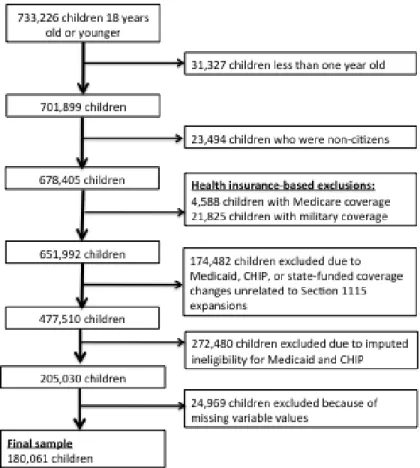
Sample creation for pre-expansion eligible children. Developing the final study sample of children required subjecting the initial sample of individuals 18 years old or younger to several exclusion criteria. There were 733,226 total children (unweighted) in the 2001–2011 CPS ASEC files. First, I removed 31,327 children who were less than one year old from the sample, because a child can receive Medicaid coverage if his or her mother was enrolled in Medicaid on the child’s birth date (Centers for Medicare and Medicaid Services, n.d. (b)).
information on whether or not these children are authorized immigrants. Unauthorized immigrants are only eligible for emergency Medicaid services (Wasem, 2014). Next, I excluded 4,588 children on Medicare and 21,825 children with military coverage from the sample because neither Medicare coverage nor military coverage is a coverage option for most children (Hamersma & Kim, 2013).
In addition, I excluded 174,482 children because of public coverage changes
unrelated to the Section 1115 expansions included in this study. Most of these exclusions are due to changes to Medicaid and CHIP program income eligibility limits that are not the result of Section 1115 expansions (in 24 states). For example, Hawaii increased CHIP income eligibility limits in 2006, so all children from Hawaii in the CPS ASEC from 2007 onward are excluded from the study sample. This exclusion ensures that I compare coverage for expansion eligible individuals in Section 1115 expansion states only to coverage for pre-expansion eligible individuals in states with no Medicaid or CHIP income eligibility changes.
Other policy-based exclusions relate to changes to state-funded coverage programs for adults (in 4 states). For instance, Washington, DC, implemented a locally funded health insurance program in 2001, so all children from Washington, DC, from 2002 onwards are excluded from the sample. Children from 4 states are excluded from the study sample after those states implemented Section 1115–based premium assistance programs. Individuals from premium-assistance states are excluded from the sample because eligibility for premium assistance is related to an employer’s offer of health insurance coverage or employment at a small firm—information not available in the IPUMS CPS ASEC.
generally closed to adult enrollment soon after the expansion’s implementation (Broaddus et al., 2002). All children from Oregon were excluded from the final sample because changes to the state’s waiver program resulted in large declines in program enrollment (Oberlander, 2007). These policy-based exclusions make it easier to isolate the effects of Section 1115 expansions on the health insurance coverage status of pre-expansion eligible children. (Table 2.6 in the Appendix explains exclusions by state and year in greater detail.)2
Only children who are imputed to be pre-expansion eligible are included in the final study sample, resulting in the exclusion of 272,480 children. Finally, 24,969 children are excluded from the sample due to missing variable values. The variables with missing values describe the citizenship status of a child’s parents (17,192 missing values), the number of siblings in a child’s family (6,520 missing values), whether or not a child lives in a
metropolitan area (1,214 missing values), and the educational attainment of the household head (43 missing values). Figure 2.1 shows the process for creating the study sample of pre-expansion eligible children.
2
Figure 2.1. Creating a sample of pre-expansion eligible children.
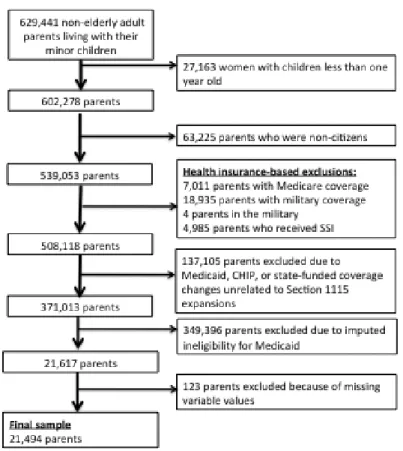
Sample creation for pre-expansion eligible parents. The 2001–2011 IPUMS CPS ASEC data includes 629,441 non-elderly adult parents living with their minor children. This initial group of parents was subject to a number of exclusion criteria. First, I excluded 27,163 women whose youngest child was less than a year old were because these women were assumed to be pregnant in the prior year, and income eligibility limits for parents are different from those for pregnant women (Kenney et al., 2012).
lacked military coverage.) I removed 4,985 parents who reported receiving Supplemental Security Income (SSI) from the sample because, in most states, people who qualify for SSI automatically receive Medicaid (Social Security Administration, n.d.; Sonier, Boudreaux, & Blewett, 2013).
Public coverage policy changes, such as increases or decreases in CHIP income eligibility limits, resulted in the exclusion of 137,105 parents from the sample. These policy-based exclusions are identical to those discussed in the previous section. Next, I excluded 349,396 parents who were not pre-expansion eligible from the sample. Finally, I dropped 123 parents from the sample because their data included missing variable values. Figure 2.2 shows the process for creating this sample of parents.
Sample sizes and characteristics. There are 180,061 children from 47 states and the District of Columbia in this study’s sample of pre-expansion eligible children. The total number of children in states with active Section 1115 expansions during the study period is 90,156.
There are 21,494 parents from 47 states and the District of Columbia in the sample of pre-expansion eligible parents. Among all parents in all study years, 12,305 are from states that had active Section 1115 expansions during the study period, and 9,189 are from states without such expansions.
Variables
The analysis that focuses on pre-expansion eligible children and the analysis that focuses on pre-expansion eligible parents share the same dependent variable and key independent variable. The control variables differ between these two analyses because parental characteristics are associated with health insurance coverage outcomes for children (Davidoff and Garrett, 2001).
Dependent Variable
This study’s dependent variable is a construct that describes whether or not an individual had Medicaid or CHIP coverage (or other non-military or non-Medicare public coverage),3 had private health insurance, or had no health insurance in the year prior to the CPS survey year. Private health insurance includes both employer-sponsored coverage and non-group coverage.
final sample for children, 12,655 children (7.0% of the sample) had both public and private coverage. Similarly, 702 parents in the study’s sample of parents (3.3% of the sample) reported having both public and private coverage. Because low-income individuals who move from private to public coverage are likely to face lower out-of-pocket costs and lower premiums, I consider individuals reporting both Medicaid coverage and private coverage to be covered under Medicaid (Shaefer, Grogan, & Pollack, 2011).
Expansion Indicator
Because the CPS ASEC records respondents’ health coverage status for the prior year, this study’s key independent variable describes Section 1115 expansion status at the state level in the previous year. The variable is set to 1 in a given year if a state had an active Section 1115 expansion in the previous year and is set to 0 otherwise. For example, because Arizona’s Section 1115 expansion was first implemented in 2001, the expansion indicator for Arizona is set to 0 for “CPS year” 2001 and set to 1 for “CPS years” 2002 to 2011.
Control Variables for Children
The analysis for pre-expansion eligible children’s coverage includes variables that describe a child’s demographic and socioeconomic characteristics, the demographic and socioeconomic characteristics of the child’s household, and state-level Medicaid and CHIP program characteristics. Individual child characteristics that affect a child’s probability of public insurance enrollment, private insurance enrollment, or having no health insurance include age, gender, race and Hispanic origin, whether or not a child lives in a metropolitan area, and whether or not a child is reported by a parent to be in fair or poor health (Davidoff & Garrett, 2001; Kincheloe, Brown, & Frates, 2007).
the number of siblings in the child’s health insurance unit, whether or not the child has a parent or minor sibling in fair or poor health, the age of the head of the household in which the child lives, the citizenship status of the child’s parents, the household head’s employment status, the household head’s educational attainment, and the household head’s marital status (Davidoff & Garrett, 2001; Kronebusch & Elbel, 2004).
Finally, state Medicaid and CHIP program characteristics can affect health insurance outcomes for children. State Medicaid and CHIP program characteristics that are controlled for in this analysis are whether or not a state has an asset test to determine Medicaid
eligibility for children, whether or not a state has an asset test to determine CHIP eligibility for children, and whether or not a state’s CHIP program is administered separately from its Medicaid program (Kronebusch & Elbel, 2004; Wolfe & Scrivner, 2005).
Control Variables for Parents
State and Year Indicators
The models for adults and children also include indicators to describe an individual’s state of residence and the year in which that individual was included in the CPS ASEC.
Methods
Selecting between Maximum Likelihood Estimation Models
I considered several maximum likelihood estimation models for evaluating the effects of Section 1115 expansion on coverage for pre-expansion eligible parents and children. Multinomial logit models are useful for examining choices between multiple options, but these models require the restrictive Independence of Irrelevant Alternatives (IIA)
assumption. The IIA assumption requires that the ratio of the predicted probabilities for any two alternatives in a multinomial logit model remain the same even when other available alternatives change. Tests using seemingly unrelated estimation rejected the null hypothesis that the IIA assumption holds in multinomial logit models for pre-expansion eligible parents and children.
Nested logit models are an alternative to multinomial logit models. In this case, nested logit models failed to converge and therefore could not be used. I therefore selected multinomial probit models, which also do not impose the IIA assumption on choice, to model health insurance coverage status in this study.
Multinomial Probit Models
n.d.). It is worth noting that 15,991 children and 2,168 parents in the final samples of children and parents have survey weights of zero.
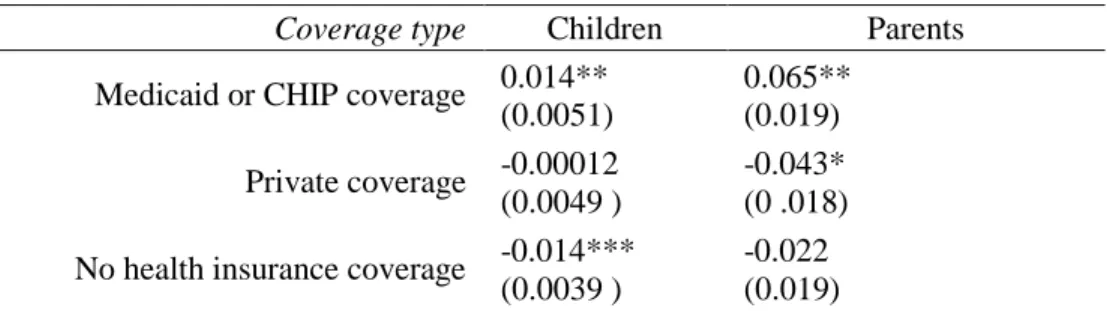
For both parents and children, I evaluate the association between Section 1115 expansion and health insurance status by computing the average differential effects of Section 1115 expansion on the predicted probabilities of having private health insurance coverage, having public coverage, and having no health insurance coverage. I calculate the average differential effects using the method of recycled predictions. I produce standard errors for the average differential effect estimates using bootstrapping with 500 replications. I also calculate predicted probabilities associated with Medicaid coverage, no health insurance coverage, and private coverage for individuals in expansion states and non-expansion states using the method of recycled predictions and bootstrapping with 500 replications to produce standard errors. In addition, I use bivariate tests to compare unadjusted differences in
coverage, individual characteristics, family characteristics, and state Medicaid and CHIP program characteristics between individuals in expansion states and individuals in non-expansion states.
Results Descriptive Statistics
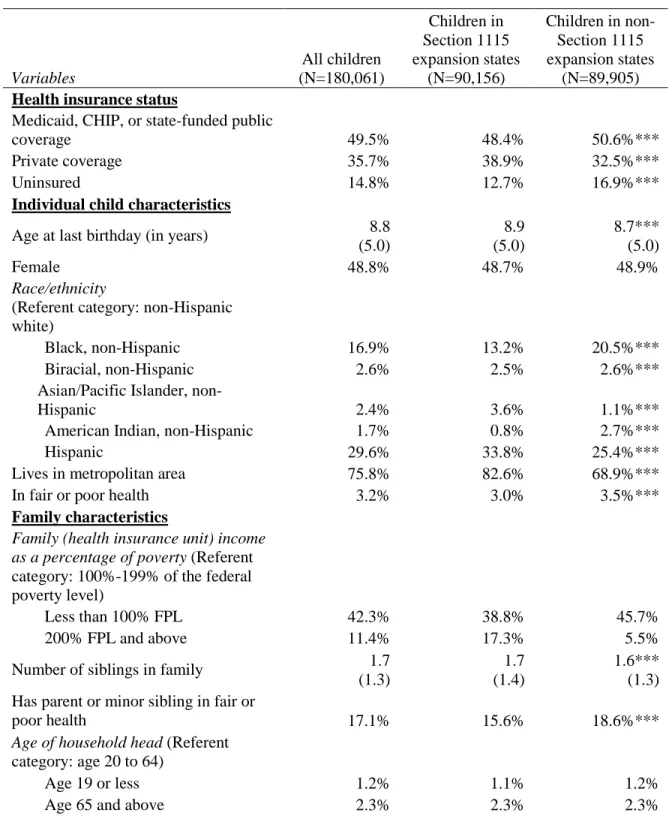
Tables 2.2 and 2.3 provide descriptive statistics for the samples of pre-expansion eligible children and pre-expansion eligible parents.
one-children in the sample from expansion states and nearly 17% of one-children in non-expansion states were uninsured. All of these differences are statistically significant (p<0.001).
Table 2.2. Summary Statistics for Pre-Expansion Eligible Children (Ages 1–18), Unweighted
Variables All children (N=180,061) Children in Section 1115 expansion states (N=90,156)
Children in non-Section 1115 expansion states
(N=89,905) Health insurance status
Medicaid, CHIP, or state-funded public
coverage 49.5% 48.4% 50.6%***
Private coverage 35.7% 38.9% 32.5%***
Uninsured 14.8% 12.7% 16.9%***
Individual child characteristics
Age at last birthday (in years) 8.8
(5.0)
8.9 (5.0)
8.7*** (5.0)
Female 48.8% 48.7% 48.9%
Race/ethnicity
(Referent category: non-Hispanic white)
Black, non-Hispanic 16.9% 13.2% 20.5%***
Biracial, non-Hispanic 2.6% 2.5% 2.6%***
Asian/Pacific Islander,
non-Hispanic 2.4% 3.6% 1.1%***
American Indian, non-Hispanic 1.7% 0.8% 2.7%***
Hispanic 29.6% 33.8% 25.4%***
Lives in metropolitan area 75.8% 82.6% 68.9%***
In fair or poor health 3.2% 3.0% 3.5%***
Family characteristics
Family (health insurance unit) income as a percentage of poverty (Referent category: 100%-199% of the federal poverty level)
Less than 100% FPL 42.3% 38.8% 45.7%
200% FPL and above 11.4% 17.3% 5.5%
Number of siblings in family 1.7
(1.3)
1.7 (1.4)
1.6*** (1.3) Has parent or minor sibling in fair or
poor health 17.1% 15.6% 18.6%***
Age of household head (Referent category: age 20 to 64)
Age 19 or less 1.2% 1.1% 1.2%