THE NATURE, DEVELOPMENT, AND REVERSAL OF POSITIVE ATTITUDES TOWARD NONSUICIDAL SELF-INJURY: IMPLICATIONS FOR PREDICTION AND
TREATMENT
Joseph C. Franklin, M.A.
A dissertation submitted to the faculty of the University of North Carolina at Chapel Hill in partial fulfillment of the requirements for the degree of Doctor of Philosophy in the
Department of Psychology (Clinical Psychology).
Chapel Hill 2013
Approved by:
Mitchell J. Prinstein, Ph.D.
Anna Bardone-Cone, Ph.D.
B. Keith Payne, Ph.D.
Gabriel S. Dichter, Ph.D.
iii ABSTRACT
JOSEPH C. FRANKLIN: The Nature, Development, and Reversal of Positive Attitudes toward Nonsuicidal Self-Injury: Implications for Prediction and Treatment
(Under the direction of Mitchell J. Prinstein, PhD)
Nonsuicidal self-injury (NSSI; e.g., cutting or burning the skin without suicidal intent) is a
dangerous and increasingly prevalent health-risk behavior. Despite advances in NSSI
research over the past decade, many aspects of NSSI remain poorly understood. In particular,
there are few strong predictors of NSSI, it is unclear how positive attitudes toward NSSI
develop, and there are no empirically supported treatments for NSSI. In the present study, I
addressed these topics with a multi-method, experimental, and longitudinal approach. For
Aim 1 of the study, I examined baseline differences between NSSI (n = 58) and control (n =
86) adult participants on NSSI-themed versions of five measures that cover different aspects
of attitudes: the implicit association test (IAT); the affect misattribution procedure (AMP);
explicit affective ratings; startle eyeblink reactivity; and startle postauricular reactivity.
Compared to the control group, the NSSI group displayed significantly more positive
attitudes on all five measures. Moreover, AMP scores and explicit ratings prospectively
predicted self-cutting frequency over the ensuing six months. For Aim 2, I employed pain
offset relief conditioning in an attempt to induce more positive implicit attitudes toward
NSSI in the control group. This conditioning significantly diminished startle eyeblink
reactivity in the context of NSSI images, but did not significantly affect any other measures.
iv
implicit attitudes toward NSSI and to reduce NSSI behaviors over the subsequent six months.
Aversive conditioning normalized startle eyeblink and postauricular reactivity, but did not
significantly affect any other measures. Results also provided preliminary support for the
hypothesis that aversive conditioning prospectively reduces self-cutting. In conjunction with
my other recent studies (Franklin et al., 2010; 2011, 2012, 2013), these findings have
v
TABLE OF CONTENTS
LIST OF TABLES………...………vii
LIST OF FIGURES………..…………..viii
ABBREVIATIONS………...…...ix
THE NATURE, DEVELOPMENT, AND REVERSAL OF POSITIVE ATTITUDES TOWARD NONSUICIDAL SELF-INJURY: IMPLICATIONS FOR PREDICTION AND TREATMENT………...…………...……….…………...…1
Nonsuicidal Self-Injury………….………...………...…….…...1
A New Approach: Attitudes and Conditioning……….…...3
Using Multiple Attitude Components to Longitudinally Predict NSSI………...6
The Development of Positive Attitudes toward NSSI……….10
Attitude formation and change…………...………..11
Pain offset relief conditioning……..……….………...11
The Reversal of Positive Attitudes toward NSSI: A Potential Treatment…………...15
General Overview of Experimental Design.………...……….16
Summary………...18
Methods………....18
Participants……...………...18
Control Group………..………19
NSSI Group……….……….19
Self-Report Measures………..………...20
vi
Psychophysiological Measures………...26
Electrocutaneous stimulation………...29
Procedure………...………...29
Data Analytic Plan………...32
Results………...34
Diagnoses………...35
PreliminaryAnalyses...35
Baseline Group Differences and Prediction...39
Conditioning Effects...41
Prospective Effect of Aversive Conditioning on NSSI...43
Discussion………...45
The Aversion Barrier to NSSI………..……….………..….47
The Identification Barrier to NSSI………..……….…………..…………..…50
Prospective Prediction of Self-Cutting………..……….……..……...53
ConditioningEffects on Attitudes toward Self-Cutting……….………...54
Prospective Effects of Aversive Conditioning on Self-Cutting Behaviors…...58
Limitations and Future Directions………..……….………..…..61
Conclusion………..………...…………..……….………..………….65
vii
LIST OF TABLES
Table
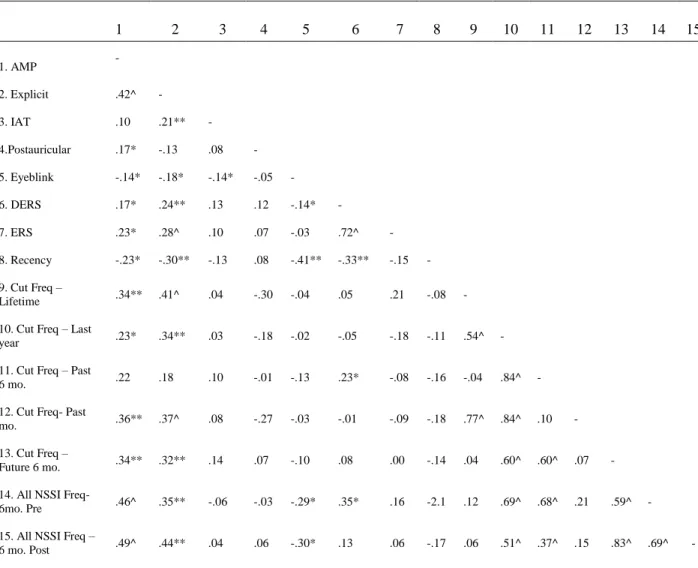
1. Correlations among attitudes, ERS/DERS, and NSSI recency/frequency ………...66
2. Hierarchical multiple regression analyses predicting self-cutting frequency during the six months post-lab visit……...………..67
viii
LIST OF FIGURES
Figure
1. Model of primary and opponent processes presented
separately (top) and combined (bottom).………..……….………..69
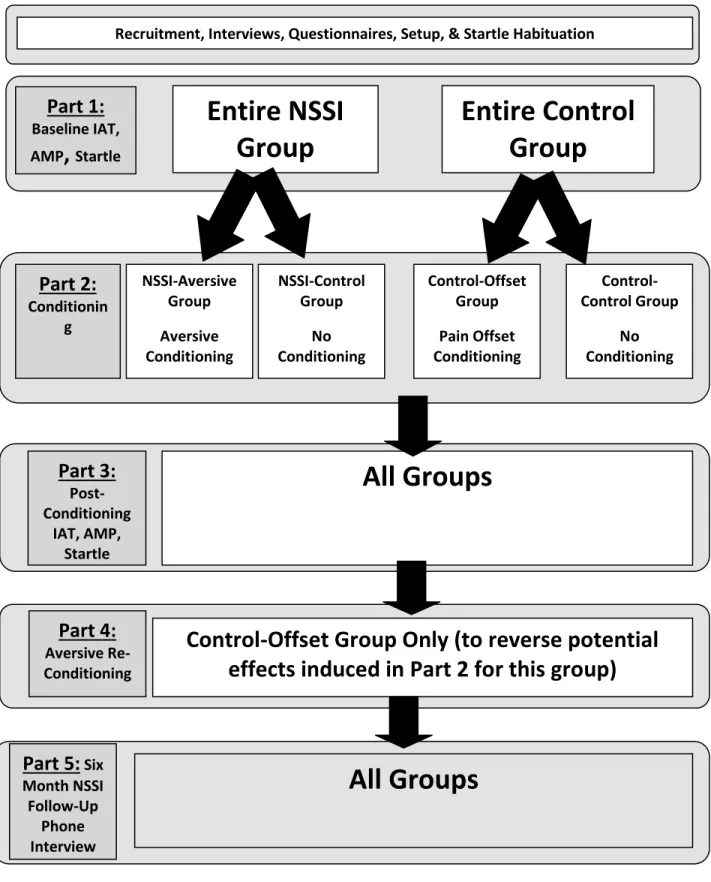
2. Overview of Experimental Procedure….……….70
3. Example of screen during the NSSI version of the IAT………..71
4. Mean DERS (emotion dysregulation) and ERS (emotion
reactivity) scores by group………..………...………….………72
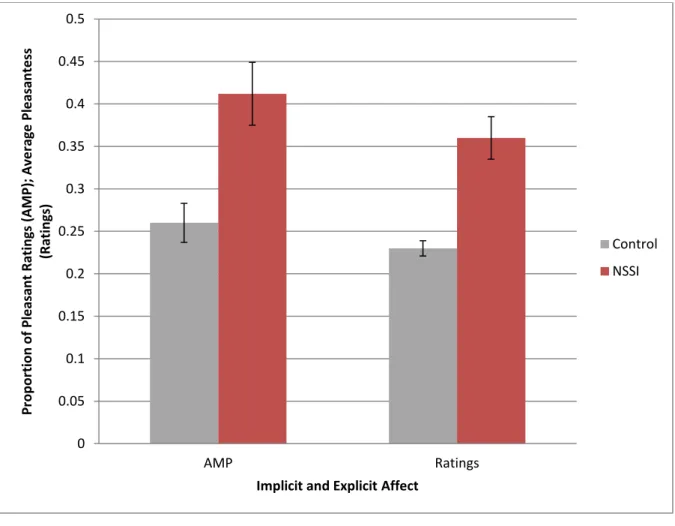
5. AMP scores (performance-based implicit affect) and
explicit affective ratings of NSSI images by group………....….…....………73
6. IAT scores (implicit associations between the self and
self-cutting) by group...74
7. Startle eyeblink (defensive motivation) and postauricular
reactivity (appetitive motivation) by group….….….………...….….….……75
8. Startle eyeblink reactivity pre- and post-conditioning by
conditioning type………...……..76
9. Postauricular reactivity pre- and post-conditioning by conditioning type…………...77
10.Self-cutting frequency (in six month windows) pre- and
post-lab visit by conditioning type in the NSSI group…...………..……...78
11.Self-cutting frequency six months pre- and six months post-
lab visit by conditioning type in the NSSI group…..………...79
12.NSSI frequency (in six month windows) pre- and post-lab
ix
LIST OF ABBREVIATIONS
APA American Psychiatric Association
AMP Affect Misattribution Procedure
DERS Difficulties in Emotion Regulation Scale
DSM Diagnostic and Statistical Manual
EMG Electromyographic
ERS Emotion Reactivity Scale
IAT Implicit Association Test
IAPS International Affective Picture System
MINI Mini International Neuropsychiatric Interview
NSSI Nonsuicidal Self-Injury
THE NATURE, DEVELOPMENT, AND REVERSAL OF POSITIVE ATTITUDES TOWARD NONSUICIDAL SELF-INJURY: IMPLICATIONS FOR PREDICTION
AND TREATMENT
Nonsuicidal Self-Injury
Nonsuicidal self-injury (NSSI) is self-inflicted tissue damage that is direct,
intentional, socially unacceptable, and without suicidal intent (e.g., cutting or burning the
skin; Nock, 2010). In contrast to repetitive self-injury in autism spectrum disorders (e.g.,
repetitive head-banging) and severe self-injury in psychotic disorders (e.g., limb amputation),
NSSI is non-repetitive and moderate in intensity. NSSI is surprisingly common, with 1 to 5%
of adults, 17% of college students, and 13 to 23% of adolescents reporting that they have
engaged in NSSI at least once in their lives (Gratz, 2001; Jacobson & Gould, 2007; Klonsky,
2011). Rates in clinical samples are even higher, with some studies finding that 40% - 61%
of adolescent psychiatric inpatients engage in NSSI (Darche, 1990; DiClemente, Ponton, &
Harley, 1991). In addition to being a health risk behavior itself (DiClemente et al., 1991),
NSSI also may increase the risk of suicidal self-injury (Andover & Gibb, 2010; Joiner,
2005). In fact, recent studies have found that a history of NSSI was a stronger predictor of
future suicide attempts than a history of suicide attempts (Asarnow et al., 2011; Guan, Fox,
& Prinstein, 2012).
Although large gains have been made in the understanding of NSSI over the last
2
gaps in knowledge about NSSI are (1) how to longitudinally predict NSSI, (2) how positive
attitudes toward NSSI develop, and (3) how to effectively treat NSSI.
NSSI prediction. There are very few longitudinal studies of NSSI. Consequently, very little is known about predictors of NSSI beyond general factors (e.g., stress) and specific
but relatively weak factors (e.g., history of NSSI). Two recent investigations found that
depressive symptoms and stress longitudinally predict NSSI (Guerry & Prinstein, 2010;
Hankin & Abela, 2011). Similar to the prediction of suicide attempts, such factors may have
high sensitivity for predicting NSSI, but they may not have high specificity for predicting
NSSI (cf. Nock et al., 2010). In other words, such predictors may be limited because nearly
everyone who engages in NSSI may have elevated depressive symptoms and stress, but most
people with elevated depressive symptoms and stress will never engage in NSSI. Similarly,
Glenn and Klonsky (2012) recently found that the frequency of prior NSSI longitudinally
predicted future NSSI, but this prediction was relatively weak and the majority of NSSI
behaviors in this sample were not severe (e.g., hair-pulling, scratching, biting). Given the
limitations of these traditional approaches for the prediction of self-injury, a new approach
may be necessary to provide a substantial improvement in the ability to predict future NSSI.
The development of positive attitudes toward NSSI. Knowledge about how positive attitudes toward NSSI develop would provide crucial insights into one of the most
perplexing aspects of self-injury: how individuals overcome the natural instinct to avoid
stimuli associated with pain and injury (e.g., blood, wounds) so thoroughly that they seek out
these stimuli. Such knowledge may establish important new targets for NSSI prevention and
treatment efforts; however, there are major obstacles to studying this question. Because
3
Wilson, 1977), it is difficult to examine the development of positive attitudes toward NSSI
with self-report methods. Similarly, it is difficult to investigate this question with traditional
laboratory methods because such investigations may not be ethically feasible. Such obstacles
limit the potential of traditional approaches to yield new knowledge about the development
of positive attitudes toward NSSI. A new approach may be necessary to advance knowledge
on this topic.
NSSI Treatment. There are currently no empirically supported treatments for NSSI (Nock, 2010). Studies involving behavior therapy, dialectical behavior theory, cognitive
therapy, and psychodynamic therapy have all been unable to show significant reductions in
NSSI in the experimental group compared to the control group (Levy et al., 2007; Linehan et
al., 2006; Lynch & Cozza, 2009; Newman, 2009; Rathus & Miller, 2002; Tyrer et al., 2003).
Wood et al. (2001) found that adolescents in a group therapy condition were less likely to
engage in NSSI than adolescents assigned to a treatment usual condition. In a replication
study, however, Hazell et al. (2009) reported that adolescents assigned to this group therapy
condition were more likely to engage in NSSI. Given the prevalence and dangerousness of
NSSI, it is concerning that there are no empirically supported treatments for this behavior.
Even more troubling, NSSI appears to be resistant to all of the major forms of therapy that
have been shown to be efficacious for many other forms of psychopathology. Within the
realm of traditional therapeutic approaches, few options remain for designing potentially
efficacious interventions for NSSI. This suggests the need for a new treatment approach for
4 A New Approach: Attitudes and Conditioning
Attitude research may provide an effective new avenue for studying the prediction,
development, and treatment of NSSI. This section will provide a brief overview of attitude
research and its potential relevance to NSSI.
Attitude has been defined as “the psychological tendency to evaluate a given entity
with some degree of favor or disfavor” (Gawronski & Bodenhausen, 2006, p. 693). There
are two major types of attitudes: implicit and explicit. Based on the model proposed by
Gawronski and Bodenhausen (2006), implicit attitudes are governed by associative
processes. Associative processes are activated automatically when a given stimulus is
encountered. They are independent of formal reasoning; an individual may even consider
their implicit attitudes to be inaccurate. For example, repeated pairings of a shock with a
kitten may eventually lead to a person to develop a negative implicit attitude towards all
kittens. This may occur even if this person self-reports that kittens are harmless and pleasant.
This latter type of evaluation is called an explicit attitude. Explicit attitudes are based on
propositional processes, which are concerned with assessing the truth value of beliefs
(Gawronski & Bodenhausen, 2006). In our example, this person may reason that kittens pose
no obvious dangers and are regarded by most people as pleasant. Accordingly, this person
may have opposing implicit and explicit attitudes toward kittens.
In many instances, implicit attitudes may explain and predict behavior more
effectively than explicit attitudes. Continuing the above example, despite having a positive
explicit attitude toward kittens, this person may avoid kittens because of a negative implicit
attitude toward kittens. In this case, the implicit attitude would more accurately predict
5
investigating attitudes for which people lack insight or are motivated to conceal. For
example, there is a high correspondence between implicit and explicit measures of racial bias
for people who are not particularly motivated to appear unprejudiced; in contrast, there is a
low correspondence for people who are motivated to appear unprejudiced (e.g., Payne,
Cheng, Govorun, & Stewart, 2005). Similarly, Payne, Govorun, and Arbuckle (2008) found
that social pressure to under-report drinking alcoholic beverages significantly affected
self-report measures of drinking, but not implicit attitudes toward drinking.
People are often motivated to conceal their self-injurious behaviors, and the majority
of self-injurers may lack insight into why they are self-inflicting pain or whether they will do
it again (Janis & Nock, 2009; Nock, 2010; Nock et al., 2010). Accordingly, implicit
measures may be particularly valuable for studying self-injury. Nock et al. (2010) provided a
dramatic demonstration of this point. Results showed that implicit associations with suicide
were the best predictors of future suicide attempts, far outpacing well-known predictors such
as previous attempts, suicidal ideation, depressive symptoms, patient prediction, and clinician
prediction. Although similar longitudinal studies have not been conducted on NSSI, initial
evidence indicates that implicit associations powerfully discriminate between NSSI and
non-NSSI participants (Nock & Banaji, 2007). These studies suggest that implicit attitudes may
play an important role in NSSI (Nock, 2010), with implicit measures having the potential to
provide unprecedented insight into these behaviors. In particular, information about the
development and reversal of positive implicit attitudes toward NSSI may provide a unique
window into the development and potential reversal of NSSI. This new approach may
6
In the present study, I employed this new approach to investigate three major aims:
(1) the ability of various components of attitudes to discriminate between people with and
without a history of NSSI at baseline and to longitudinally predict NSSI; (2) the development
of positive attitudes toward NSSI; and (3) the efficacy with which aversive conditioning
reverses positive attitudes toward NSSI and reduces future NSSI behaviors. I discuss each of
these aims in detail below.
Using Multiple Attitude Components to Longitudinally Predict NSSI
Five attitude measures were utilized in the present study. Three of these measures are
traditionally categorized as attitude measures (explicit ratings, affect misattribution procedure
[AMP], and implicit association test [IAT]) and the other two are traditionally categorized as
psychophysiological measures of motivational direction (startle eyeblink and postauricular
reactivity). However, consistent with the views of many social psychologists who employ
psychophysiological methods (e.g., Ito & Cacioppo, 2007), I posit that these latter measures
are also effective for examining attitudes. Below, I delineate these five measures and discuss
how each may provide insight into attitudes toward NSSI.
Measure 1: Explicit affect. As noted above, explicit attitudes arise from propositional reasoning and are typically measured with self-report instruments (cf.
Gawronski & Bodenhausen, 2006). In the present study, I measured explicit affective
attitudes toward NSSI with a computerized survey that asked participants to rate the valence
of NSSI stimuli.
Implicit attitudes. The remaining four measures gauged different components of implicit attitudes. Implicit associations and implicit affect are perhaps the most commonly
7
(e.g., Payne et al., 2008), meaning that simultaneously examining these components maybe
provide greater discrimination between NSSI and non-NSSI groups, and may improve the
ability to predict future NSSI. Compared to implicit association research, implicit affect
research is newer and less common. Indeed, NSSI research has only involved implicit
associations (Nock & Banaji, 2007). Interestingly, initial research suggests that implicit
affect may more effectively explain behaviors strongly associated with affect regulation, such
as drinking alcohol (e.g., Payne et al., 2008). Given that people who engage in NSSI may
overcome powerful natural instincts to avoid mutilation stimuli (e.g., blood, wounds), affect
may be a particularly important aspect of implicit attitudes towards NSSI.
Measure 2: Implicit associations. Implicit associations are most often measured with a brief behavioral test called the implicit association test (IAT; Greenwald, McGhee, &
Schwartz, 1998). The IAT compares the reaction time for classifying one set of semantic
stimuli (e.g., “death” and “me”) to the reaction time for classifying another set of semantic
stimuli (e.g., “life” and “me”). This comparison is quantified as a difference score. Greater
difference scores are thought to reflect stronger implicit associations for one set of semantic
stimuli compared to another. Implicit associations have been shown to predict future
behavior, especially in socially sensitive domains (e.g., prejudice; see Greenwald, Poehlman,
Uhlmann, & Banaji, 2008). As noted above, Nock et al. (2010) demonstrated that a
death/suicide version of the IAT is currently the best known predictor of future suicide
attempts.
Measure 3: Implicit affect – performance-based. In social psychology research, implicit affect is often measured with a brief behavioral test called the Affect Misattribution
8
emotionally evocative) for 75 ms, followed by a blank screen for 125 ms, then a Chinese
pictograph for 100 ms, and finally a gray screen that remains until the participant presses a
button. Participants are instructed to ignore the emotional picture and to judge whether the
Chinese pictograph seems to be more pleasant or less pleasant than the average symbol. Once
the gray screen appears, participants press one button for "more pleasant" or another button
for "less pleasant." Even though participants are told to ignore the emotional image, the
evaluation of the Chinese pictograph is strongly influenced by the nature of the emotion
image that preceded the Chinese pictograph. Specifically, the Chinese pictograph is more
likely to be judged as pleasant if the picture that preceded it was pleasant (Payne et al., 2005).
This is believed to occur because participants misattribute the affect inspired by the
emotional picture as being inspired by the Chinese pictograph (see Loersch & Payne, 2011).
The AMP has been employed to examine such things as addictive behaviors (Payne,
McClernon, & Dobbins, 2007; Payne et al., 2008), prejudice (Imhoff & Rainer, 2009),
morals (Hofmann & Baumert, 2010), and voting behavior (Payne et al., 2005, 2010).
Measures 3 and 4: Implicit affect – psychophysiological. Based on constructionist views of emotion (e.g., Barrett, 2012), psychophysiological measures of affect may provide a
more direct measure of “core affect” (i.e., a state of pleasure or displeasure combined with
arousal and grounded in the body; see Barrett & Bliss-Moreau, 2009) than
performance-based measures such as the AMP. This is because psychophysiological measures directly
assess the physiological states that constitute core affect. In contrast, performance-based
measures include psychological factors that go beyond these physiological states, such as the
mental processes involved in making the decision to press a certain key during the AMP.
9
implicit affect, with psychophysiological measures indexing specific components of core
affect (e.g., defensive motivation) and performance-based measures gauging overall core
affect combined with various psychological factors (e.g., memory, decision-making).
In psychophysiological research, affective-valence startle modulation is often
employed to measure motivational aspects of implicit affect. Startle eyeblink is a defensive
reflex that occurs in response to a sufficiently intense and sudden stimulus, such as a sudden
and loud sound (Blumenthal et al., 2005). Because it is a defensive reflex, startle eyeblink
reactivity is heightened by unpleasant stimuli (particularly threatening stimuli; Vaidyanathan
et al., 2009) and reduced by pleasant stimuli (see Lang, Bradley, & Cuthbert, 1990). Eyeblink
reactivity is quantified as the EMG activity of the orbicularis oculi muscle, which surrounds
the eye and contracts to produce an eyeblink (see Blumenthal et al., 2005). Startle eyeblink
reactivity is one of the few psychophysiological measures specific to defensive motivation
(Lang et al., 1990). In other words, startle eyeblink reactivity tends to increase with the
degree to which physiological resources are gathered in response to a perceived threat (cf.
Lang, 2010). In the affective-valence startle modulation paradigm, startle eyeblink reactivity
reliably increases with the degree to which picture stimuli are perceived as threatening (e.g.,
Bradley, Cuthbert, & Lang, 1999; Lang, Bradley, & Cuthbert, 1990).
The postauricular reflex is often measured simultaneously with startle eyeblink. The
postauricular muscle is located behind the ear and is used by most infant mammals to pull
back the ear during nursing; however, it is largely vestigial in humans (Johnson,
Valle‐Inclán, Geary, & Hackley, 2012). Although it has no apparent functional use in
humans, the postauricular muscle can still be primed by pleasant stimuli (especially those
10
intense stimulus like a startling sound is presented, it synchronizes the motor units of the
postauricular muscle, generating a sudden spike in activity that is larger the more primed the
muscle is (i.e., during pleasant affective states; see Johnson et al., 2012). Accordingly,
postauricular reactivity shows a pattern of affective modulation that is opposite to that of
startle eyeblink reactivity (Benning et al., 2004). Startle postauricular reactivity is one of the
few psychophysiological measures specific to appetitive motivation (Gable & Harmon-Jones,
2009). In other words, postauricular reactivity tends to reflect the degree to which
physiological resources are marshaled to approach a perceived source of nurturance.
Interestingly, despite being measured at the same time to the same stimuli and displaying
inverse patterns, multiple studies have shown that startle eyeblink and postauricular reactivity
display near-zero correlations (e.g., r = -.07 in Franklin et al., in press; r = -.12 in Sandt et al.,
2009). This highlights that value of including multiple measures of affect.
The first aim of the present study was (a) to investigate how attitudes toward NSSI
stimuli discriminate between NSSI and Control groups at baseline, and (b) to examine how
attitudes toward NSSI prospectively predict NSSI six months later. This portion of the study
has the potential to advance knowledge about the nature of attitudes toward NSSI and how to
predict future NSSI.
The Development of Positive Attitudes toward NSSI
Although preliminary evidence indicates that people with a history of NSSI display
more positive implicit attitudes toward NSSI stimuli (Nock & Banaji, 2007), it is unclear
how these attitudes might develop. This knowledge would provide insight into on how
people overcome the instinct to avoid mutilation stimuli and how these counter-instinctual
11
Attitude formation and change. Much research has been aimed at examining how attitudes can be formed and altered. This research has usually employed conditioning
paradigms such as concurrently pairing pictures (e.g., a neutral object) with other pictures
(e.g., an angry face). These studies have demonstrated that such conditioning can decrease
racial prejudice (Olson & Fazio, 2006), increase body satisfaction (Martijn, Vanderlinden,
Roefs, Huijding, & Jansen, 2010), improve self-esteem (Dijksterhuis et al., 2004), and alter
food preferences (Hollands, Prestwich, & Marteau, 2011), among many other things (for a
review, see De Houwer, Thomas, & Baeyens, 2001; Hofmann, De Houwer, Perugini,
Baeyens, & Crombez, 2010). Interestingly, paradigms that employ electrocutaneous
stimulation (i.e., shocks) as the unconditioned stimuli appear to be the most effective at
altering attitudes (see Hofmann et al., 2010). Positive attitudes toward NSSI may develop due
to many different naturalistic forms of conditioning. For example, several movies depict
admirable characters and attractive celebrities engaging in NSSI (Whitlock, Eckenrode, &
Silverman, 2006). In effect, such movies pair pleasant stimuli with NSSI, which should
condition positive (or less negative) implicit attitudes toward NSSI. Such social mechanisms
may influence attitudes for a subset of people who engage in NSSI, but another conditioning
pathway may influence implicit attitudes for nearly everyone who engages in NSSI: pain
offset relief conditioning.
Pain offset relief conditioning. Pain has been defined as the unpleasant sensory and emotional experience associated with actual or potential tissue damage (International
Association for the Study of Pain Task Force on Taxonomy, 1994). In sharp contrast to the
negative affect associated with pain, recent research has shown that pain offset leads to
12
“neutral” state; rather, it seems to generate a pleasant emotional state. People who engage in
NSSI may unintentionally (or intentionally in some cases) access this pain offset relief
phenomenon in order to reduce stress. As discussed below, stimuli present during
NSSI-related pain offset relief (e.g., blood, knives) may gradually gain a more positive valence.
This “pain offset relief conditioning” may accordingly represent one pathway through which
many individuals acquire positive attitudes toward NSSI.
This phenomenon of pain offset relief is consistent with the opponent process theory
of acquired motivation (Solomon, 1980). The opponent process theory proposes that in
response to every stimulus there are two major reactions: a primary process and an opponent
process (see Figure 1). The primary process reaches maximum intensity soon after stimulus
onset and diminishes completely soon after the stimulus offset. Conversely, the opponent
process reaches maximum intensity slowly and lingers long after the offset of the stimulus.
At any given time, the state of an organism is determined by taking the absolute value of the
difference between the intensity of the primary process and the opponent process (see Figure
1). As such, the primary process is most salient immediately after the onset of a stimulus
whereas the opponent process is most salient after the offset of a stimulus. For NSSI, the
primary processes are pain and fear, and the opponent process is relief. Accordingly, relief
should be most salient soon after pain offset during NSSI.
Several laboratory studies have directly demonstrated pain offset relief. For example,
Leknes, Brooks, Wiech, and Tracey (2008) found that pain offset diminished physiological
arousal and increased self-reported pleasantness in healthy controls. For both NSSI and
non-NSSI groups, Franklin et al. (2010) showed that pain offset diminished defensive motivation
13
specified that pain offset simultaneously stimulated appetitive motivation (postauricular
reactivity) and diminished defensive motivation (startle eyeblink reactivity). In a second
follow-up study, Franklin et al. (2013) found a similar pattern in individuals with a history of
NSSI and clarified that the degree of pain offset relief was not correlated with NSSI
frequency. Taken together, these findings indicate that pain offset relief is a natural
mechanism that powerfully regulates affect regardless of self-injury history.
One potential problem with the pain offset relief conditioning hypothesis is that pain
may not completely offset during an episode of NSSI. For example, wounds from cutting or
burning may hurt for days after the episode. Interestingly, basic pain studies suggest that
complete pain offset may not be necessary to generate relief. Grill and Coghill (2002) found
that a one degree increase in the intensity of a painful heat stimulus (e.g., from 49 to 50
degrees) led to a one unit increase in perceived pain intensity (on a 1 – 10 scale). Strikingly, a
one degree decrease (e.g., from 50 to 49 degrees) led to a 3.5 unit decrease in perceived pain
intensity. The authors concluded that pain intensity reduction activates powerful analgesic
mechanisms that serve to “amplify awareness of stimulus offset and to reinforce escape
behaviors” (p. 2205). Such findings suggest that an individual may induce several instances
of pain offset relief (even if the offset is not complete) during a single NSSI session. For
example, an individual may cut themselves several times over the course of one minute and
feel intense pain throughout that minute. Yet, because of small variations in pain intensity
during that minute (e.g., variations in how the knife is cutting through the skin), the
individual may experience numerous instances of relief.
Within NSSI episodes, this relief may become associated with stimuli present during
14
these surrounding stimuli may be increased due to their association with relief. This may
cause individuals who engage in NSSI to develop positive associations with things like
blood, knives, wounds, and similar stimuli that people normally find extremely aversive (e.g.,
Bradley, Codispoti, Cuthbert, & Lang, 2001). Several studies are consistent with this
hypothesis. In a study with fruit flies, Tanimoto, Heisenberg, and Gerber (2004) paired one
neutral odor with the onset of pain and another with the offset of pain. The flies avoided the
odor associated with the onset of pain and approached the odor associated with the offset of
pain. In humans, Zanna, Kiesler, and Pilkonis (1970) paired one set of adjectives with the
onset of a painful electric shock and another set of adjectives with the offset of shock.
Participants developed negative attitudes toward adjectives paired with the onset of shock
and positive attitudes toward adjectives paired with the offset of shock. Interestingly, these
effects generalized to adjectives that were similar to those included in the word sets. This
suggests that this effect involves conditioning with concepts (e.g., ideas related to NSSI)
rather than specific stimuli (e.g., a single word or a specific picture).
Andreatta et al. (2010) obtained similar results using neutral shapes as stimuli and
startle eyeblink reactivity as the dependent measure. Specifically, startle eyeblink was larger
in the presence of shapes paired with pain onset and smaller in the presence of shapes paired
with pain offset. Finally, Glenn and Klonsky (2010) found that a large proportion of
self-cutters reported that they engage in NSSI in order to see blood, and that blood is what brings
them relief. This finding fits well with the above hypothesis because (a) blood is present
during pain offset and is likely to become associated with relief and (b) suggesting a learning
mechanism, participants with a longer history of NSSI were more likely to report a positive
15
The second aim of the present study was to test the hypothesis that pain offset relief
conditioning is one route through which people develop positive attitudes toward NSSI.
Such attitudes could greatly increase the likelihood of future NSSI by reducing avoidance of
NSSI-related stimuli that are normally regarded as aversive (cf. Bradley et al., 2001). To test
this, in a group of people with no history of NSSI, I examined attitudes toward NSSI before
and after a pain offset conditioning procedure that paired NSSI stimuli with pain offset. This
test has the potential to provide unique insight into how positive attitudes toward NSSI
develop and, correspondingly, may establish new treatment targets for NSSI.
The Reversal of Positive Attitudes toward NSSI: A Potential Treatment
As noted above, traditional treatment approaches have not been effective for reducing
NSSI (Nock, 2010). Counter-conditioning of attitudes may represent a new route through
which NSSI can be reduced. Specifically, given that attitudes strongly predict behavior (e.g.,
Nock et al., 2010), changes in attitudes may systematically change behavior. Several studies
clearly demonstrate that attitudes can be changed (for reviews, see De Houwer et al., 2001;
Hofmann et al., 2010). This is true even for heavily ingrained attitudes such as racial
prejudice (Olson & Fazio, 2006). More directly relevant to the present study, there is also
evidence that conditioning can alter implicit attitudes toward, and prospectively reduce,
addictive behaviors. For example, Houben, Schoenmakers, and Wiers (2010) paired
beer-related pictures with negative words and pictures within a conditioning procedure. Compared
to the control group, the experimental group displayed more negative implicit attitudes
toward beer, experienced less craving for beer, and consumed less beer immediately after the
16
The third aim of the present study was to reduce or reverse positive attitudes toward
NSSI in participants with a history of NSSI (who presumably have positive implicit attitudes
toward NSSI, cf. Nock & Banaji, 2007), and to determine whether this reduces NSSI over the
following six months. The manipulation involved pairing NSSI stimuli with the onset of pain
(cf. Andreatta et al., 2010). Half of the NSSI participants received this manipulation and the
other half received a control manipulation. If the experimental NSSI group displays reduced
NSSI, this would provide empirical support for aversive conditioning as a potential treatment
for NSSI. Conditioning with painful stimuli may not be ideal for therapy, but meta-analytic
evidence indicates that painful electrocutaneous stimulation generates the largest effect sizes
for changing attitudes (Cohen’s d = 1.16 for painful electrocutaneous stimulation vs. d = .5
for other forms of unconditioned stimuli; Hofmann et al., 2010). Accordingly, painful
stimuli may be optimal for investigating the feasibility of conditioning procedures as a
treatment for NSSI. This may open the door for future investigations with forms of
conditioning that may be more amenable to therapy. For example, pairing NSSI stimuli with
pictures of snakes or spiders may be sufficient to reverse positive implicit associations with
NSSI and to reduce NSSI behaviors (cf. Houben et al., 2010).
General Overview of Experimental Design
All participants were adults recruited through Introductory Psychology classes and
advertisements posted in the community, university, and hospital. Because a recent national
survey found that there were no NSSI differences based on gender, ethnicity, or income level
(Klonsky, 2011), participants were not selected based on these factors. Given that self-cutting
is the prototypical NSSI behavior and attitude measures were specific to self-cutting, NSSI
17
findings may have implications for all NSSI behaviors, the present primary hypotheses
focused on self-cutting. An overview of the experimental design is provided in Figure 2.
After recruitment, assessment, and startle habituation there were five major parts of the
experimental portion of the study.
In part one, I administered the five attitude measures (i.e., the IAT, AMP, startle
eyeblink, and startle postauricular, and explicit ratings) to all participants. This partially
addressed the first aim of the present study by testing baseline differences in these measures
between the NSSI (i.e., self-cutting) and Control groups.
Part two was the conditioning phase of the experiment. Portions of the NSSI group
underwent an aversive conditioning procedure whereas portions of the control group
underwent a pain offset relief conditioning procedure. In part three, I re-administered the five
attitude measures to all participants post-conditioning. Parts two and three addressed the
second aim of the present study by examining the effect of pain offset relief conditioning on
attitudes toward self-cutting in participants without a history of self-cutting. Parts two and
three also partially addressed the third aim of the experiment by testing the ability of aversive
conditioning to reverse positive implicit attitudes toward self-cutting in participants with a
history of self-cutting. Part four of the experiment involved administering an aversive
conditioning procedure to the portion of the control group that received pain offset relief
conditioning. The purpose of this was to counteract any positive implicit attitudes toward
self-cutting engendered by pain offset relief conditioning.
Part five of the experiment consisted of a six month follow-up survey for all NSSI
participants to assess NSSI behaviors. This part of the experiment addressed portions of the
18
attitude measures prospectively predicted future self-cutting behaviors. Additionally, this
allowed for a preliminary test of the efficacy of aversive conditioning as a method for
reducing self-cutting behaviors.
Summary
Millions of people engage in NSSI each year, with great costs to mental and physical
health. Unfortunately, this trend is likely to continue because knowledge about several
fundamental aspects of NSSI remains inchoate. The present study has the potential to greatly
advance knowledge about NSSI prediction, development, and treatment. To accomplish these
aims, I conducted a novel study with a multi-method, experimental, and longitudinal
approach. The findings of the present study may lay the foundation for much-needed
improvements in the understanding of this perplexing behavior.
Methods Participants
General Inclusion/Exclusion Criteria. Participants were excluded if they were below age 18 or endorsed auditory problems, blindness, or psychosis. Although adolescents
report high rates of NSSI (Jacobson & Gould, 2007), for two major reasons, the present study
only included adults. First, it is less feasible to conduct a study involving electrocutaneous
stimulation and NSSI stimuli in adolescents (e.g., harder to obtain consent from parents to
enact this procedure on their children). Second, among adults who endorse NSSI, the average
onset age is 16 (Klonsky, 2011). This gives adult participants more time to develop stronger
positive attitudes toward NSSI (cf. Glenn & Klonsky, 2010), thereby increasing the
19
stringent test of the efficacy of the aversive conditioning procedure: if this intervention can
reverse heavily ingrained attitudes toward NSSI, it should be even more powerful for
individuals who recently began engaging in NSSI. Because the NSSI stimuli only depicted
cutting (see below), individuals who engaged in forms of NSSI other than self-cutting were
excluded from the study (unless these behaviors were in addition to cutting). As mentioned
above, a recent national survey of randomly sampled adults in the United States found that
NSSI status and function did not vary with gender, ethnicity, or household income (Klonsky,
2011). Accordingly, participants were not selected or excluded based on these demographic
variables. Posthoc tests indicated that no demographic variable (age, gender, ethnicity) was
significantly associated with any of the five self-cutting attitude variable (all ps > .05).
Control Group. The control group consisted of 86 (46 females) college
undergraduates who participated to partially fulfill an introductory psychology research
option. Participants were only included in this group if they reported no history of any form
of NSSI, as assessed by the Self-Injurious Thoughts and Behaviors Interview (SITBI, Nock
et al., 2007; see below). This group had an average age of 19.24 (Mdn = 19.00; SD = 1.31)
and an ethnic composition of 67.4% Caucasian American, 11.6% African American, 11.6%
Asian American, and 9.3% mixed/other. Nearly half of these participants (n = 40) were
sorted into the control-offset subgroup and received pain offset relief conditioning. The
remaining participants (n = 46) comprised the control-control subgroup and underwent the
random conditioning procedure. Participants were randomly sorted into groups based on the
week that they participated in the present study. This is because it required an hour to alter
the conditioning setup and to ensure that the setup worked properly after being altered (e.g.,
20
trials). Because participants were often scheduled consecutively throughout the day, it was
not feasible to randomly assign conditioning procedures on a participant-by-participant basis.
Accordingly, the conditioning procedure alternated each week, resulting unequal subgroup
sizes.
NSSI Group. The NSSI group consisted of 58 (43 females) participants recruited from campus, community, and hospital advertisements that offered $75 for study
participation. This group had an average age of 23.24 (Mdn = 21.00; SD = 6.90) and an
ethnic composition of 63.8% Caucasian American, 6.9% African American, 13.8% Asian
American, 3.4% Hispanic American, and 12.1% mixed/other. Participants were only
included in this group if they reported a history of self-cutting as assessed by the SITBI.
Self-cutting was selected as a necessary behavior because: (a) our experimental tests were specific
to cutting; (b) in contrast to behaviors such as biting, cutting is an unambiguously severe
NSSI behavior; and (c) several studies have reported that cutting is the most common NSSI
behavior (e.g., Nock & Prinstein, 2004). The mean number of lifetime self-cutting episodes
for this group was 146.02 (Mdn = 25; SD = 469.25; Range = 1 to 3000). The mean number
of months since the last self-cutting episode was 12.12 (Mdn = 1.00; SD = 27.06; Range = 0
to 162).
Over half of these participants were sorted into the NSSI-aversive subgroup (n = 33)
and received aversive conditioning. The remaining participants constituted the NSSI-control
subgroup (n = 25) and underwent the random conditioning procedure. As with the control
group, the conditioning procedure alternated each week, producing unequal subgroup sizes.
21
survey to assess a variety of factors related to their self-injury; 49 participants completed this
follow-up survey.
Self-Report Measures
Self-Injurious Thoughts and Behaviors Interview (SITBI; Nock, Holmberg, Photos, & Michel, 2007). The SITBI is a structured interview that measures the presence, frequency, and characteristics of various types of self-injurious thoughts and behaviors. It
has modules for suicidal ideation, suicide plans, suicide gestures, suicide attempts, and NSSI.
The SITBI has strong interrater reliability (average K = .99; r = 1.0) and test-retest reliability
(average K = .70; intraclass correlation coefficient = .44) over a six month interval (Nock et
al., 2007). The SITBI shows strong construct validity, converging with other measures of
suicidal ideation (average K = .54), suicide attempts (average K = .65), and NSSI (average K
= .87). In the present study, I utilized the NSSI behaviors module, which consists of ten
questions.
Mini International Neuropsychiatric Interview (MINI; Sheehan et al., 1998). The MINI is a short, structured diagnostic interview that assesses constructs from the Diagnostic
and Statistical Manual of Mental Disorders, fourth edition (DSM-IV). The MINI has shown
high interrater reliability (K = 1.0) and test-retest reliability (K = .87), and shows strong
convergent construct validity with longer structured clinical interviews of general
psychopathology (Sheehan et al., 1995, 1998) In the present study, all participants were
administered the MINI modules for mood, anxiety, substance abuse/dependence, eating, and
psychotic disorders.
Difficulties in Emotion Regulation Scale (DERS; Gratz & Roemer, 2004). The DERS is a 36-item self-report questionnaire about emotion regulation (and dysregulation),
22
to 5 (“almost always”) Likert scale, resulting in a possible score range of 36 to 205 (M =
77.99; SD = 20.72 for women; M = 80.66; SD = 18.79 for men). The DERS contains six
subscales: Nonacceptance (e.g., “when I’m upset, I feel guilty for feeling that way”); Goals
(e.g., “when I’m upset, I have difficulty concentrating”); Impulse (e.g., “when I’m upset, I
lose control over my behaviors”); Awareness (e.g., “I am attentive to my feelings” [reverse
scored]); Strategies (e.g., “when I’m upset, I believe I’ll end up feeling very depressed”); and
Clarity (e.g., “I have difficulty making sense of my feelings”). The DERS shows high
internal consistency, good test-retest reliability, adequate construct and predictive validity,
and is positively correlated with NSSI in both men and women (see Gratz & Roemer, 2004).
Because NSSI and Control groups differed on emotion dysregulation (see below), including
this measure permitted me to statistically control for emotion dysregulation, thereby ruling
out this variable as a potential explanation for group differences.
Emotion Reactivity Scale (ERS; Nock, Wedig, Holmberg, & Hooley, 2008). The ERS measures emotion reactivity, a component of emotion regulation that specifically
involves emotional sensitivity, intensity, and persistence. The ERS is a 21-item self-report
questionnaire that displays strong internal consistency, convergent and divergent construct
validity, and criterion-related validity (Nock et al., 2008). The ERS is positively correlated
with self-injury and has been shown to mediate the association between psychopathology and
self-injury (Nock et al., 2008). Similar to the DERS, NSSI and control groups differed on
emotion reactivity (see below) and controlling for ERS scores eliminated this difference as a
potential explanation for group differences.
23
module of the SITBI plus several additional questions. Participants were asked about the
nature and frequency of their self-injury (a) over their entire lifetime; (b) during the six
months prior to coming into the laboratory (the SITBI did not include this specific
assessment); and (c) during the six months after coming into the laboratory.
Brief Behavioral Tests
The NSSI Implicit Association Test (IAT; Nock & Banaji, 2007). The IAT is a brief computer-based task that measures implicit associations. The NSSI IAT (identity
version) assesses the strength of the association that participants hold between themselves
and self-cutting (Nock & Banaji, 2007). As depicted in Figure 3, participants are presented
with four words or phrases at the top of the screen. Two of these words are opposing
concepts (e.g., Cutting, No Cutting) and two of these words are opposing attributes (e.g., Me,
Not Me). The screen also contains a picture that is either related to self-cutting (e.g., pictures
of skin that had been cut) or neutral (e.g., non-injured skin). The pictures in the present study
were identical to those of Nock and Banaji (2007). Participants are asked to press one key
(e.g., “e”) if the concept on the left correctly classifies the picture (e.g., “Cutting” for a
picture of skin that had been cut), and another key (e.g., “i”) if the concept on the right
correctly classifies the picture (e.g., “Not Cutting” for a picture of non-injured skin).
Reaction time is recorded for each trial on which a correct classification was made. If an
incorrect classification is made, the trial is repeated.
The NSSI IAT is composed of two blocks. In one block, NSSI concepts (e.g.,
cutting) are on the same side as self-related attributes (e.g., “me”). Compared to non-NSSI
participants, participants with a history of self-cutting classify self-cutting pictures more
24
are not on the same side as self-related concepts. In this kind of block, non-NSSI participants
are faster at correctly classifying pictures related to self-cutting (Nock & Banaji, 2007). The
strength of association between cutting and oneself is quantified by taking a standardized
difference score (i.e., response latencies for the Cutting/Me block subtracted from the
Cutting/Not Me block) for each participant (Greenwald, Nosek, & Banaji, 2003). Positive
difference scores reflect stronger associations.
The Affect Misattribution Procedure (AMP; Payne et al., 2005). The AMP is a brief computer-based task that measures implicit affect. On each trial of the AMP, the
computer flashes an emotionally evocative picture for 75ms, a blank screen for 125ms, a
Chinese symbol for 100ms, and finally a gray screen until the participant presses a key.
Participants are instructed to press one key if they judge the Chinese symbol to be more
pleasant than the average symbol and another key if they judge it to be less pleasant that the
average symbol. Participants are instructed to ignore the emotionally evocative pictures
during their judgments of the Chinese symbols. Despite this instruction, evaluations are
influenced by the nature of the picture, with more pleasant pictures generating more pleasant
evaluations of subsequent Chinese symbols (Payne et al., 2005). The dependent variable for
the AMP is the proportion of trials on which a positive evaluation occurs to the total number
of trials within a given picture category (note: results were nearly identical when AMP scores
were calculated as the percent difference from neutral category responses). The AMP
typically includes standard pleasant, neutral, and unpleasant picture stimuli categories. In the
present study I created a version of the AMP designed specifically to examine implicit affect
toward self-cutting. In addition to pleasant, neutral, and unpleasant categories, the NSSI
25
consisted of 12 pictures, each presented twice during the AMP (cf. Payne et al., 2005, 2008).
Pictures were presented in a random order. This resulted in 96 total trials. Although the NSSI
AMP included four picture categories, the primary hypotheses of the present study only
involved the NSSI category.
Explicit affective rating survey. Explicit affect toward the same 48 images used in the NSSI AMP was assessed with a computerized self-report survey. On each trial, a picture
was presented and participants were asked to rate it on a scale of -4 (extremely unpleasant) to
0 (neutral) to +4 (extremely pleasant). After participants made their ratings, they clicked on a
button to move on to the next trial. Ratings were transformed into a 0 to 9 score and then
divided by 9. This produced a proportion score that facilitated comparisons with AMP
scores.
Picture stimuli. The pleasant, neutral, and unpleasant pictures were chosen from the International Affective Picture System (IAPS; Lang, Bradley, & Cuthbert, 2005). The NSSI
pictures were developed specifically for this project with a combination of digital art and
theatrical makeup techniques. These images depicted various features of a self-cutting
episode (e.g., knife approaching the skin, knife on the skin, knife having just cut the skin,
multiple self-cutting wounds with blood). Posthoc analyses revealed that all NSSI picture
subtypes (e.g., blood vs. no blood) were similarly related to the major variables of interest.
To establish the construct validity of these images (i.e., negatively valenced, regarded
as less negative by individuals with a history of NSSI), 304 Introductory Psychology students
evaluated these pictures as part of a separate pilot study conducted before the present study
began. On a scale ranging from very pleasant (+9) to very unpleasant (0), all participants
26
NSSI (n = 273; ratings: M = 1.52, SD = .54) rated these images as significantly more
unpleasant than individuals with a history of NSSI (n = 31; ratings: M = 1.74, SD = .63), F(1,
303) = 4.58, p = .03, d = .37. These preliminary findings support the construct validity of the
self-cutting images, even with an NSSI group that self-reported infrequent (M = 5.48
episodes; SD = 7.84 episodes; Median = 2 episodes) and nonspecific behaviors (primary
form: cutting = 51.6%, scraping = 19.4%, burning = 6.5%, hitting = 12.9%, and other =
9.7%). In conjunction with the fact that the self-cutting images were specific to self-cutting,
these factors may have diminished group differences in the evaluation of these images.
Psychophysiological Measures
Startle eyeblink reactivity. Startle eyeblink reactivity typically has been regarded as psychophysiological measure of two closely related constructs: defensive motivation and
negative affective valence (Lang et al., 1990; Vaidyanathan et al., 2009). Although some
regard motivation and affective valence as essentially the same (Lang, 2010), others note
differences between these constructs (e.g., Carver & Harmon-Jones, 2009). Based on the sum
of the evidence in the startle eyeblink reactivity literature, I conceptualize startle eyeblink
reactivity as reflecting the degree to which physiological resources are marshaled to defend
against a perceived threat (cf. Lang, 2010).
Following recommended guidelines (Blumenthal et al., 2005), I measured reactivity
by placing two electrodes on the orbicularis oculi, the muscle that surrounds the eye and
generates a blink when it contracts. A third electrode was placed on the temple to serve as a
ground. Eyeblink is measured because it is among the fastest and most habituation-resistant
components of the startle reflex (Blumenthal et al., 2005). Startle was elicited by a
27
Lane, Franklin, & Curran, 2013), startle stimuli were delivered randomly every 13 – 23s in
the absence of foreground stimuli. During the affective-valence startle modulation blocks,
startle stimuli were presented between 3.5s and 6.5s after the onset of IAPS and self-cutting
pictures (cf. Bradley et al., 1999; Benning et al., 2004). To facilitate comparisons across
measures, these pictures were identical to those used in the AMP. Similar to the AMP,
primary hypotheses for startle modulation only concerned the self-cutting picture category.
Startle Postauricular Reactivity. Startle postauricular reactivity is a
psychophysiological measure of appetitive motivation (Gable & Harmon-Jones, 2009;
Johnson et al., 2012). Similar to the affect versus motivation interpretations noted for startle
eyeblink reactivity above, appetitive motivation overlaps substantially with the construct of
positive affect (e.g., Lang, 2010), but there are important differences between these
constructs (see Carver & Harmon-Jones, 2009). In particular, whereas positive affect may
refer to any pleasant state, appetitive motivation specifically reflects the degree to which
resources are gathered to approach an object in the environment.
Following recommended guidelines, I measured postauricular reactivity by placing
two electrodes along the postauricular muscle behind the ear – one on the backside of the
pinna and the other on the scalp (Benning et al., 2004). Because startle eyeblink and
postauricular reactivity were measured concurrently, startle postauricular reactivity used the
same ground electrode, startle stimulus, and foreground stimuli as startle eyeblink reactivity.
Equipment. All equipment and methods were in accord with currently accepted guidelines (Blumenthal et al., 2005). Startle stimuli were 100dB(A) broadband white noises
(20hz – 20kHz) with an immediate rise/fall time and a duration of 50ms. These stimuli were
28
with pictures being displayed on a monitor in front of the participants and startle stimuli
being presented through Sennheiser PX200 headphones on the participants. InVivo Metric
electrodes with an 11mm outer diameter and a 4mm inner diameter transmitted
electromyographic (EMG) activity from the eyeblink and postauricular muscles to Biopac
EMG amplifiers and a Biopac MP150 work station, which concerted muscle activity to
digital information. The MP150 sampled the data at a rate of 1,000Hz and stored four
versions of the EMG data: raw unfiltered EMG, filtered EMG in a passband of 28 – 500Hz, a
rectification of the filtered EMG signal, and a rectified derivation of the filtered signal
smoothed with a five-sample boxcar filter. This latter form of the EMG data was presented
in Acqknowledge and was the basis for analyzed EMG data.
EMG scoring. EMG data were scored offline in Acqknowledge. For startle eyeblink reactivity, the scoring window was 20 – 120 ms after on the onset of the startle stimulus
(Blumenthal et al., 2005). For startle postauricular reactivity, the scoring window was 8 – 20
ms after the onset of the startle stimulus (Benning et al., 2004). Response magnitude for both
types of startle reactivity was the average of the difference between peak and onset voltage of
the smoothed EMG. Trials on which a response cannot be detected were assigned a value of
0. Trials on which a response could not be detected even if it were presented (e.g., EMG
noise contamination due to a yawn) were scored as “missing.”
Quantification of startle eyeblink and postauricular reactivity on NSSI trials. There is no universally accepted way to quantify affective-valence startle modulation data
within stimulus categories (e.g., pleasant, neutral, unpleasant). Some studies simply average
raw reactivity within categories, others compare reactivity in specific categories to reactivity
29
t-scores (see Blumenthal et al., 2005 and Vaidyanathan et al., 2009). In the present study, I
used a combination of the latter two methods in an attempt to quantify reactivity in a way
that was standardized, clearly interpretable, and robust against potential group and
conditioning effects on overall reactivity (e.g., higher overall startle eyeblink reactivity in the
NSSI group). Specifically, reactivity for pleasant, unpleasant, and NSSI categories were
calculated as: [Valenced Category Mean – Neutral Category Mean]/Neutral Category Mean.
This transformed reactivity in each valenced category into a “percent difference from
reactivity on neutral trials” score. This method was more conservative compared to other
calculation methods (e.g., raw reactivity), but all methods produced very similar patterns of
reactivity data.
Electrocutaneous stimulation. Electrocutaneous stimulation was generated by a Biopac STM100C, routed through a Biopac STMISOE, and delivered to the nondominant
forearm via two disposable Biopac EL-503 electrodes connected to the STIMISOE with two
Biopac 110 lead wires. Electrocutaneous stimulus intensity varied across participants
depending on the intensity that each participant rated as ‘moderate’ (see procedure below),
but each stimulus lasted 200ms and had an immediate rise/fall time (cf. Andreatta et al.,
2010).
Procedure
Figure 2 provides a general overview of the study procedure. Below, the procedure
of each portion of the study is described in detail. In total, the experiment lasted
approximately 2.5 hours for each participant.
30
(the DERS and ERS) were administered. Depending on the degree of psychopathology and
NSSI history, this portion lasted 15 to 30 minutes.
Startle preparation and habituation. To prepare for startle measurement, two electrodes were placed around the eye, two behind the ear, and one on the temple (cf.
Benning et al., 2004; Blumenthal et al., 2005). These remained on until the end of the
experiment. Headphones were then placed on the participants. The first block was the startle
habituation block, which consisted of 15 trials of 100dB stimuli being presented at intervals
of 13 to 23secs. The purpose of this block was to bring startle reactivity in each participant to
an asymptotic level. Traditionally, startle studies have employed very few habituation trials
(i.e., 0 to 3); however, in a recent empirical study of startle habituation, my colleagues and I
determined that startle eyeblink reactivity reaches an asymptote around 13 trials (Lane,
Franklin, & Curran, 2013). This block lasted approximately ten minutes.
Baseline attitude measurement. Next, I administered the five attitude measures (AMP, IAT, startle eyeblink/postauricular, and explicit ratings). Together, it took
approximately 40 minutes to administer these measures.
Electrocutaneous conditioning procedures. All groups underwent a conditioning procedure. Each conditioning procedure involved randomly presenting 18 IAPS pictures (6
each from pleasant, neutral, and unpleasant categories) and 18 self-cutting pictures (the 12
from the AMP/AVSM/explicit tasks and the 6 from the IAT). Each image was presented for
2 seconds and the intertrial intervals varied from 15 to 25 seconds. Each procedure lasted
approximately 15 minutes and involved 18 shocks. These shocks consisted of 200ms 150Hz
electrocutaneous stimulations delivered via two electrodes attached to the left bicep. Similar
31
intensity was adjusted for each participant until they rated the shocks as a “30” on a 0 (no
pain) to 100 (worst pain imaginable) scale. This level was assessed twice to ensure the
validity of the ratings. The only differences among the procedures were the contingencies
between the shocks and the pictures.
The aversive conditioning procedure was administered to the NSSI-aversive group.
This procedure involved the presentation of a shock immediately after a self-cutting picture
disappeared from the screen. This established a contingency whereby the self-cutting pictures
predicted a painful shock.
The pain offset relief conditioning procedure was administered to the control-offset
group. This procedure involved the presentation of a self-cutting image 6 seconds after each
shock. This interval was chosen because a prior pain offset relief conditioning study
(Andreatta et al., 2010) and my own basic pain offset relief work (Franklin et al., in press)
indicated that pain offset relief is most powerful around 6 seconds after pain offset (and
disappears around 14 seconds). The procedure established a contingency where self-cutting
images were associated with relief.
The random conditioning procedure was administered to the control-control and
NSSI-control groups. This procedure was designed to provide a strong experimental control
for the procedures above, ruling out the contributions of pain assessment, electrode
attachment, shock anticipation, and number of shocks to group differences. In this procedure,
six shocks occurred six seconds before normative images (i.e., two shocks before two
pleasant, neutral, and unpleasant pictures), and six shocks occurred immediately after
normative images. For the remaining six shocks, three occurred six seconds before
32
Post-conditioning assessment with implicit measures. Post-conditioning assessment was identical to the baseline assessment.
Aversive conditioning for the control-offset group. Because the conditioning procedure for the control-offset group may have induced a positive implicit attitude toward
self-cutting, the aversive conditioning procedure was administered to obviate any such
effects. This procedure was identical to that administered to the NSSI-aversive group.
Compensation. After completing their final task, participants were debriefed, compensated (credit for Introductory Psychology students, $75 for other participants), and
allowed to leave.
Six month follow-up procedure. Contact information was collected from all NSSI participants at baseline (name, email, phone number). During debriefing, participants were
informed of a six-month follow-up survey option for which they would be compensated $10.
Six months after their laboratory visit, each NSSI participant was contacted and asked to
complete the online follow-up survey (see above). Upon completion of this survey,
participants were mailed their compensation.
Data Analytic Plan
Preliminary analyses. Before examining the primary hypotheses, I conducted several preliminary analyses. First, I attempted to replicate the finding of increased ERS and
DERS scores in individuals with a history of NSSI (Gratz & Roemer, 2008; Nock et al.,
2008). This finding would indicate that ERS/DERS scores should be employed as covariates
in analyses that examine differences between NSSI and control groups. Second, as a
manipulation check, I attempted to replicate the linear patterns across pleasant, neutral, and
33
measures. Third, I examined zero-order correlations among the five attitude measures,
ERS/DERS scores, self-cutting frequency (raw number of lifetime, past year, past six
months, past month, and post-lab past six months; note: class interval and rank-order
analyses yielded the same results), and self-cutting recency (raw number of months since last
self-cutting episode; note: year-based and rank-order analyses yielded the same results).
Common Features of Major Analyses
All major analyses that examined differences between control and NSSI groups
included ERS and DERS scores as covariates. Analyses that included diagnoses as a
covariate produced nearly-identical results to analyses without this covariate. Additionally,
consistent with prior studies (e.g., Nock et al., 2008), any effects of diagnoses were
completely redundant with ERS and DERS scores. Accordingly, diagnoses were not included
as covariates in the presented analyses. Longitudinal analyses controlled for self-cutting
frequency over the six months pre-lab visit. Most ‘prior self-cutting frequency’ variables
were strongly intercorrelated (see Table 1). Given that the outcome variable in prospective
analyses was self-cutting during the six months post-lab visit, the ‘self-cutting frequency six
months pre-lab visit’ was the most natural conceptual covariate. However, as noted in the
results section, analyses that included other self-cutting variables as covariates yielded
similar results.
For concurrent analyses, the dependent variables were the five attitude measures
(IAT, AMP, explicit affective ratings, startle eyeblink, and startle postauricular). Although
the four affective measures included categories for pleasant, neutral, and unpleasant stimuli,
primary hypotheses only involved the NSSI category. For prospective analyses, the