MAKING THEIR MARK: LEADER BRANDS AND THEIR INFLUENCE ON POLITICAL BEHAVIOR
Emily B. Carty
A dissertation submitted to the faculty of the University of North Carolina at Chapel Hill in partial fulfillment of the requirements for the degree of Doctor of Philosophy in the Department of Political Science.
Chapel Hill 2018
Approved by:
Pamela Johnston Conover
Graeme B. Robertson
Frank R. Baumgartner
Rahsaan Maxwell
ABSTRACT
Emily B. Carty: Leader Brands and their Influence on Political Behavior (Under the direction of Pamela Johnston Conover)
ACKNOWLEDGEMENTS
I would not be the scholar I am and this dissertation would not be what it is today without my advisors Pam Conover and Graeme Robertson. I will forever be grateful for their mentorship and patience, even when their lives were just as chaotic as mine. From helping me talk through my half-baked ideas to encouraging me to work through the road blocks, their guidance and advice in this endeavor and others has been invaluable these years of my life.
I also must thank the other members of my dissertation committee for their support and patience. Both individually and as a diverse collective, their pragmatic and sincere feedback has immeasurably improved this dissertation as well as the broader research agenda that will follow it. Frank Baumgart-ner, for his honesty, support, and helping me not miss the forest for the trees. Rahsaan Maxwell for his direct and thoughtful feedback, and always being ready to help. And Elizabeth Zechmeister, one of the most generous and efficient people I have met, for helping me navigate the path of comparative behavior both through her guidance and by being an example for all young scholars to admire.
To the faculty in the Political Science Department at UNC – I could not have imagined a more challenging and nurturing place to attend graduate school. Many helped both directly and indirectly with this dissertation by providing support and encouragement and played an important role in forming me into the scholar I am today. To Evelyne Huber, who even after I turned my focus toward political psychology, always had her door, ears, and mind open. To her, John Stephens, and Jonathan Hartlyn for providing me with opportunities to grow as a scholar and finance some of my research at the same time. To Tom Carsey, who made the hard things easier and helped me to laugh through the struggles. And the many other professors who gave me feedback on pieces and parts of this dissertation in various stages – Santiago Olivella, Timothy Ryan, Cecilia Martinez-Gallardo, Jason Roberts, Don Searing, Mike MacKuen, Liesbet Hooghe, and Gary Marks.
Thank you to the Department of Political Science staff – Shannon Eubanks, Christine Reynolds, Susan Heske, Carol Nichols, Dana Sadek, Kim Barbour, and Megan Taylor – for guiding me through any and every bureaucratic step of graduate school.
I am very grateful to my friends in Chapel Hill and beyond. Thank you to Jason Roberts and Sarah Treul and to Graeme Robertson and Cecilia Martinez-Gallardo for welcoming me into their homes and providing me with “therapy” – Eleanor, Catherine, Tomas, and Emilia were a source of happiness and laughter and a reminder to enjoy the simple joys of life. To Natalia, Micaela, and Krista for their love and support over our life-long friendship. And, of course, to my fellow graduate students who have not only been my peers, but my friends and community in Chapel Hill – Eric Hansen, Chelsea Estancona, Kelsey Shoub, Menevis Cilizoglu, Jelle Koedam, Andrew Tyner, Kiran Auerbach, Dan Gustafson, Kate McKiernan, Zoila Ponce de Leon, Federico Fuchs, Amy Sentementes, Leah Christiani, Steven Sparks, Bailee Donahue, and Claire Dunn. I could not have made it through this program or project without you.
To Mariano Torcal, without whose encouragement I never would have pursued a PhD. I could not have done this without your personal and professional support. Thank you for always believing in me and encouraging me every step of the way.
TABLE OF CONTENTS
LIST OF TABLES . . . viii
LIST OF FIGURES . . . ix
CHAPTER 1: INTRODUCING A THEORY OF LEADER BRANDS . . . 1
A Theory of Leader Brands . . . 1
Overview and Contribution . . . 3
Extending the Research Agenda . . . 5
CHAPTER 1: INTRODUCING A THEORY OF LEADER BRANDS . . . 7
Why Study Candidate Brands Now? . . . 8
Candidate Brands – “Old Wine” in New Bottles? . . . 8
A Theory of Candidate Brands . . . 10
Candidate Brands and Evaluations . . . 10
Brand Attachment . . . 11
Brand Identity . . . 12
The Trump Brand . . . 13
Data and Methods . . . 14
Findings . . . 14
The Trump Brand – Evaluations . . . 14
Brand Attachment and Identity . . . 15
Explaining Membership in the Trump “Base” . . . 17
The Social Nature of Brands: Political Participation . . . 20
Discussion and Conclusions . . . 24
CHAPTER 3: Incumbent and Challenger Leader Brands: Evidence from Argentina . . . 27
Leader Brands: Going Beyond Trait Evaluation . . . 27
Brand-Based Identities: Incumbency’s Double-Edged Sword . . . 30
Testing the Theory with the Argentine Case . . . 33
The Kirchner and Macri Brands . . . 37
Anti-Incumbent, Pro-Challenger Behavior . . . 37
Discussion . . . 43
CHAPTER 4: The Role of Leader Brands in Political Support: Evidence from Spain . . . 46
Introducing the Concept of Leader Brands . . . 47
Using Brands to Reevaluate Effect of Leader Traits on Behavior . . . 49
Data and Methods . . . 51
Leader Brand Evaluation and Attachment . . . 54
Leader Brand Identification and Vote Choice . . . 56
Discussion . . . 64
LIST OF TABLES
Table 1 Determinants of Brand Evaluation, Brand Attachment, and Group Identity . . . . 17
Table 2 Effect of Demographics, Attitudes, and Brand Variables on Trump’s Base . . . 19
Table 3 Effect of Brand Variables on Social Political Participation . . . 21
Table 4 Mean Agreement to Treatment Statement by Trump Base . . . 23
Table 5 Mean Agreement to Treatment Statement by Brand Attachment . . . 23
Table 6 P-values for Pairwise Comparisons Difference in Agreement Re-sponse by Trump Base . . . 24
Table 7 P-values for Pairwise Comparisons Difference in Agreement Re-sponse by Brand Attachment . . . 25
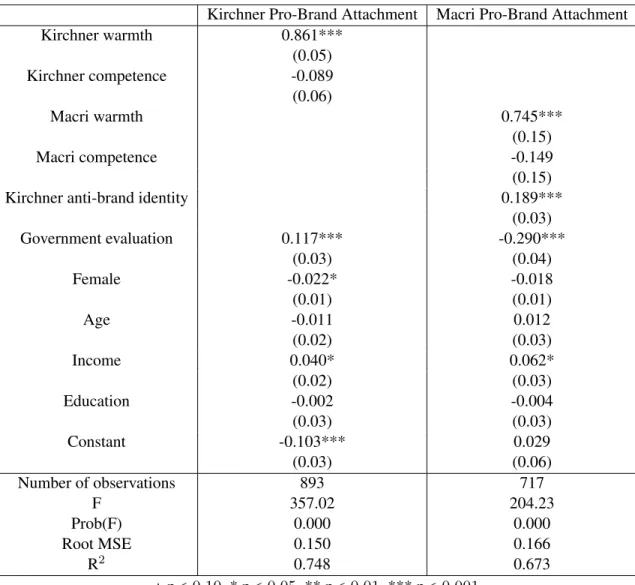
Table 8 Determinants of Kirchner and Macri Brand Attachment . . . 38
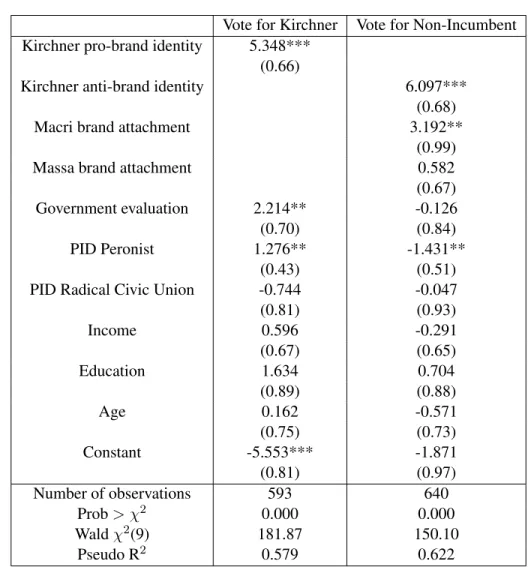
Table 9 Pro– versus anti-incumbent vote . . . 39
Table 10 Attending a Rally in Favor of Incumbent versus Opponent . . . 42
Table 1 Effect of Leader Brands on Vote Choice: Conditional Logit Results . . . 59
LIST OF FIGURES
Figure 1 Mean Trait Evaluations at Extreme Levels of Support . . . 15
Figure 2 Distribution of “Trump Base” Variable . . . 18
Figure 3 Probability of Voting for Incumbent or Challenger . . . 40
Figure 4 Probability of Attending a Rally in Support of the Incumbent and Challenger . 44 Figure 1 Rajoy (PP) Brand Personality Evaluations . . . 55
Figure 2 S´anchez (PSOE) Brand Personality Evaluations . . . 56
Figure 3 Brand Attachment Explanatory Variables . . . 57
Figure 4 Effect of Leader Brand Evaluation on Probability of Voting for the PP . . . 61
CHAPTER 1: INTRODUCING A THEORY OF LEADER BRANDS
What is it that makes some leaders so successful in attracting followers? Some are so effective in capturing the public’s loyalty that they can win unexpected electoral victories, create new parties around themselves, and, in extreme cases, some leaders even reach legendary status. Groups of loyal followers form around these leaders, willing to sacrifice their time, effort, money, and whatever else they can to support the leader and their group. Likewise, groups of loyal opponents also form around some leaders, willing to do whatever it takes to remove them from power. Drawing on consumer and social psychology, my dissertation takes a new approach to the effect of leaders’ traits on political outcomes by introducing the concepts leader brands and brand identification. By examining the content and diversity of leader brands and how they affect citizens’ attitudes, identities, and behaviors in three different countries, I provide an innovative framework to better understand the relationship between political leaders and citizens.
A Theory of Leader Brands
reexamines the effect of leaders’ traits by exploring the concepts of leader brands, brand attachment, and brand identification.
As originally developed in marketing, a brand is a unique name and image for a product that aims to establish a differentiated and significant presence in the market. Brands provide an ideal, a vision, of a product with which people can form loyalties (AMA 1960; Keller 2003). While we typically think of brands as commercial in nature, they have been applied to politics as well, where research has primarily centered on party brands (Kavanagh 1995; Needham 2006; Smith 2009) or nation branding in the international arena (Aronczyk 2008). Some attention has been given to the relevance of branding for political leaders, but largely in reference to contributing to a party’s brand (Smith 2009; Smith and French 2009; Speed, Butler and Collins 2015). While partisan and ideological organizations are able to form brands as well, these types of brands are based more on issues and abstract ideas (Poole and Rosenthal 1997; Cox and McCubbins 1993) than leader brands. Leader brands are grounded in human characteristics similar to the brands of commercial products (Smith and French 2009). Individuals form clearer and stronger opinions about people than they do about abstract concepts (Converse 1964;?; Zaller and Feldman 1992; Hamilton and Sherman 1996; Lavine 2002; McGraw, Hasecke and Conger 2003) and are therefore likely to form stronger evaluations of leaders’ brands than ideological or party brands.
develop group brand identitieswith other people who share their brand attachments. The more well-known a leader and the longer they have been in the public eye, the stronger the assessments an individual can make about the brand and has more opportunity to share their assessments and experiences with others. In this way, brands of well-known leaders, like incumbents, give birth to more socialized brand interactions, leading to brand-based social identities.
While brand identification can be positive and supportive of a leader, socialized identities can also be negative and anti-leader. Anti-brands are often conceptualized as a perceived incongruence between how an individual sees themselves and how they see the brand (Elsbach and Bhattacharya 2001; Park, Eisingerich and Park 2013), but, a richer conceptualization explains anti-brand identity formation as a product of three types of factors: experiential, symbolic identity incongruence, and ideological or moral incompatibility (Lee, Motion and Conroy 2009). While anti-brand identifications can have characteristics that are the opposite equivalent of the pro-brand counterpart, they can also have their own unique characteristics (Chatzidakis and Lee 2009). As with other social identities, brand-based identities play a key role in political behavior, affecting attitudes and mobilizing people to participate (Conover 1984, 1988; Tate 1993; Huddy 2003). Thus, by adopting the brand concept it is possible to simultaneously capture personalized and social attachments to leaders.
The development of pro– and anti– brand identities is dependent on the presence of strong leader brands. Because people have more exposure to and experience with incumbents, they are likely to be very well-known by people and therefore the most likely political figures to have strong pro– and anti-brands. Particularly strong brands should be present where the incumbent has been in power for an extended period of time (by either democratic or non-democratic means) and in contexts where a leader is particularly divisive or polemic. Where party system institutionalization and institutional limits on the executive branch are weaker, strong leader brands should be even more likely.
Overview and Contribution
My dissertation seeks to answer an increasingly pressing question in political science: why are some leaders so successful in attracting and keeping loyal followers?. With the occasional
of politics in well-established democracies as well. The ‘personalization of politics’ has increased the visibility and power of individual leaders with much more prevalence than before(Karvonen 2010; McAllister 2007; Rahat and Sheafer 2007; van Aelst, Sharif and Stanyer 2012), due to the changing nature of political parties (Garzia 2011) and the weakening of traditional linkages between voters and parties (Dalton and Wattenberg 2000; Mair 2005), and changes in the media, particularly, the rise of television as an important source of political information (Mazzoleni 2000; Meyrowitz 1985). This has made individual leaders and the personalized connections between them and citizens likely matter more as a general rule than they did in the past, as evidenced by the surprising electoral gains of more personalistic leaders like Marine LePen in France and Donald Trump in the United States. In my dissertation, I offer the concept of ‘leader brands’ as a way to better understand these personalized relationships that form between leaders and citizens.
leader brands to sway individuals’ political decisions and actions. Without undermining the role of traditional explanatory factors like ideology and party identification, the results from my study show that how individuals evaluate leaders’ personal characteristics and the extent to which they form an attachment to a leader’s brand has a significant influence on their vote choice.
Previously in political science, very little attention has been given to the branding of political leaders. There is a substantial literature on the branding of political parties and how political parties can come to be ‘owners’ of certain issues, but this borrows little from the consumer psychology literature and pays very little attention to individual leaders. In this way, by drawing upon conceptu-alizations and measurement strategies from consumer psychology, my dissertation can contribute to contentious reemerging debates in political science and to help develop a better understanding of the relationship between citizens and leaders.
Extending the Research Agenda
While survey data allows me to examine the content and consequences of leader brands, another key part of the puzzle is how these leader brands form in the first place. I hypothesize that the media plays a key role in this dynamic. Exposure to the media, both in regards to the frequency and ideological content, should be directly related to how individuals perceive leaders and therefore their leader brand attachment. I have gathered newspaper stories from four different newspapers in Spain to match with the survey data collected in order to test this hypothesis. I also have access to a dataset that I have been constructing with a team of fellow graduate students and faculty advisors (The Chapel Hill American Media Project) to test this hypothesis in the United States. This dataset consists of a wide range of political news and commentary programs on seven broadcast networks from 2000 through 2015. By using automated dictionary-based text analysis methods I can use these data to assess the content of leader brands in the media and how they map onto the way individuals in my surveys perceive leaders. The analysis of how brands develop is therefore a logical next step to pursue in this research agenda.
CHAPTER 1: INTRODUCING A THEORY OF LEADER BRANDS
Emily B. Carty and Pamela Johnston Conover
“Six months into his presidency, Donald Trumps approval ratings stand at its lowest point in CNN pollingThese numbers have soured in recent months, particularly among Trump’s core supporters.”CNN News, August 8, 2017
“The Trump base is far bigger & stronger than ever before (despite some phony fake news polling).”Donald J. Trump, August 7, 2017
Currently, pollsters report that Donald Trump’s base is beginning to erode, but Trump unsurpris-ingly claims otherwise. Is he just “blowing smoke”? Or does he truly understand his base better than “experts”? During the 2016 election, Hillary Clinton was the odds on favorite to win. Virtually every poll predicted it. But then, too, Trump disagreedloudly and confidently. He promised his supporters a victory, and on Election Day he delivered. Afterwards, political scientists and pundits, alike, scrambled to explain his unexpected winand their failure to foresee it. Some wondered if a decisive role might have been played by factors beyond the control of the campaigns, such as fake news spread by Russian bots (Allcott and Gentzkow 2017), or F.B.I. Director James Comey’s ill-timed letter to Congress about Clinton’s emails (Silver 2017). Others blamed Clinton’s campaign strategy and messaging for the loss.
that are the foundation of ideals around which people form loyalties (Keller 2003). And we offer a theory about candidate/leader brands. Specifically, we suggest that voters have attachments to candidates that are both personalized and social. Then, using survey data from October 2016, we explore the nature of the Trump “brand,” and test the loyalty of his followers via a survey experiment. We conclude by considering the implications of our findings for his support in the future.
Why Study Candidate Brands Now?
Two key changes in the political environment have made it conducive to the emergence of candidate “brands.” First, over the last few decades, there has been a trend toward personalization in politics that has affected electoral systems, media coverage, and candidate behavior (Rahat and Sheafer 2007). By “personalization,” we refer to the visibility and power of individual politicians as compared to parties and institutions (Garzia 2011; McAllister 2007). The power of television, and more recently the rapid changes in mass communications have greatly contributed to this trend (Garzia 2011; McAllister 2007). Indeed, Takens et al. 2015 show that personalized media coverage primes personalized voting. But also the shifting nature of political parties (Garzia 2011) and the weakening of their connections to traditional groupings of voters may leave them vulnerable to the consequences of personalization: namely, the success of an outsider candidate like Donald Trump.
A second change in the political environment that has been crucial in fostering candidate brands is the growth of social media. For example, political candidates and incumbents, alike, are increasingly turning to Twitter to stay in touch with the public (Conway, Kenski and Wang 2013; Evans, Cardova and Sipole 2014). This is critical because social media platforms give citizens the ability to feel as though they are “interacting” with candidates: for example when they “like” on Facebook something the candidate has done, or they re-tweet one of the candidate’s tweets. Such “interaction” is important for facilitating identification with the candidate brand. So, the growth of both personalization in politics and social media in political communication has created a setting favorable for the development of strong candidate brands.
Certainly, it is not new to suggest that voters care about the personality traits of candidates, and that citizens evaluate the characters of their leaders. In previous research, scholars have largely focused on how individuals evaluate the traits of political leaders and the impact this has on vote decisions (King 2002b). Those explaining individual-level consequences like vote choice have found that perceptions of candidate or leader traits matter (Kelley and Mirer 1974; Kelley 1983; Stokes 1966; Rosenberg et al. 1986; Rahn et al. 1990; Bean and Mughan 1989), while those who examine the effects of candidate traits on aggregate-level election outcomes have found only moderate effects at best (Miller and Shanks 1996; Bartels 2002; King 2002a). But these studies have focused almost exclusively on explaining the outcomes of single elections; consequently, they are theoretically ill equipped to explain why individuals develop strong loyalties to leaders that influence their attitudes and behavior both during and well after the election. What gives candidate trait evaluations their “staying power” long after a candidate has taken office and the campaign has finished?
Students of comparative politics might claim to have the answer: charisma. The ‘charismatic bonding’ literature describes the conditions under which people’s perceptions of a political leader’s personal traits lead to the formation of strong bonds with the leader. Originally elaborated by Madsen and Snow 1991, this theory posits that in times of crisis, individuals feel less secure and efficacious about their ability to survive in the unpredictable environment in which they find themselves. This, in turn, leads them to seek out a leader who they believe can handle the problems that they no longer can. For example, Madsen and Snow 1991 argue that Adolf Hitler and Juan Per´on were highly charismatic leaders, though they offer little elaboration on the meaning of charisma. But others (Merolla, Ramos and Zechmeister 2007) offer a more elaborate characterization of charisma as a bundle of traits that includes: confident, caring, enthusiastic, goal-oriented, optimistic, and inspiring. Moreover, Merolla, Ramos and Zechmeister 2007 show that charisma, so defined, can both attract people to a leader, and affect how they evaluate the leaders performance. Still, this conception of charisma is too narrow in its range to account for all the leader brands that likely exist, and the theory fails to account for the psychological mechanisms of attachment and identification that explain the loyalty of citizens over time.
personality. Thus, people are drawn to support candidates and leaders who resemble them in their personality traits. This congruency model has been most fully tested by Caprara et al. 2007, and they found that both American and Italian voters prefer candidates who have personality traits similar to their own. We build on this work in developing a theory of candidate brands that accounts for collective loyaltiesa task that we turn to now.
A Theory of Candidate Brands
As originally developed in marketing, a brand is a unique name and image for a product that aims to establish a differentiated and significant presence in the market. Brands provide an ideal, a vision, of a product with which people can form loyalties (AMA 1960; Keller 2003). While we typically think of brands as commercial in nature, they have been applied to politics as well, where research has primarily centered on party brands (Kavanagh 1995; Needham 2006; Smith 2009) or nation branding in the international arena (Aronczyk 2008). Some attention has been given to the relevance of branding for political leaders, but largely in reference to contributing to a party’s brand (Smith 2009; Smith and French 2009; Speed, Butler and Collins 2015).
Our theory of candidate brands has four key elements. First, people develop “brand evaluations” based on their perceptions of the traits and vision encompassed by a candidate’s brand. Second, voters form “brand attachments” to candidates that have brands containing traits that they both admire and that are similar to their own, thus personalizing their relationship with the candidate. Third, there is a social element to political branding: people develop group identities with other people who share their brand attachments to a candidate. And finally, the combined effects of brand attachment and brand identity generate brand loyalty over time. Thus by adapting the brand concept, we can simultaneously capture personalized and social attachments to candidates.
Candidate Brands and Evaluations
Individuals form clearer and stronger opinions about people than they do about abstract concepts (Converse 1964; Zaller 1992; Zaller and Feldman 1992; Hamilton and Sherman 1996; Lavine 2002; McGraw, Hasecke and Conger 2003); therefore, they are likely to form stronger evaluations of leaders brands than party brands. Beyond this distinction, the actions of leaders and their parties may intentionally distinguish between party and leader brands (Needham 2005; de Landtsheer and de Vries 2015).
In specific terms, we conceptualize of a leader’s brandits contentas the combination of the leader’s personality traits; thus “brand evaluations” are how people assess those traits. Earlier work on candidate personality and image relied on a variety of models in specifying the traits for study (see Garzia 2013), typically emphasizing traits dealing with leadership or agency. However, in recent years, there is a growing consensus in psychology that there are two basic dimensions in person and group perception labeled as warmth and competence, or alternatively communion and agency (Cuddy et al. 2008; Fiske, Cuddy and Glick 2007; Malone and Fiske 2013). Evaluations of warmth include whether an individual is sincere, trustworthy, honest, good-natured, friendly, and kind. Competence is attributed to individuals who are perceived to be skillful, capable, intelligent, efficient, and possessing the resources and confidence to achieve their goals. Because both warmth and competence are relevant for how people evaluate others, warmth traits should be considered just as relevant in how individuals perceive leaders as their competence as a politician. Recent research (Cislak and Wojciszke 2008; Bertolotti et al. 2013) shows that both trait dimensions matter in the assessments of candidates and their behavior. But which traits are especially important for particular candidates should reflect their ideals and visions.
Brand Attachment
of the leader’s brand. Then, they judge the degree to which they admire and share those traits. The higher their personal evaluations of and connection to those traits, the greater their attachment with the brand. Therefore, brand attachment goes beyond a simple evaluation of traits; individuals are making a more personal appraisal by assessing the traits in comparison to their own traits and ideals. Moreover, they are taking the first step toward building a “personal” relationship with the brand that says something about, not only the candidate, but who they are as well. In effect, voters, too, are now personalizing politics by personalizing their relationships with candidates.
Brand Identity
Social identities are psychological attachments to a group that become part of one’s self-concept (Tajfel 1981); they play a key role in political behavior, affecting attitudes and mobilizing people to participate (Conover 1984, 1988; Tate 1993; Huddy 2003). Given that people readily form identities around political parties and ideologies (Green, Palmquist and Schickler 2002; Huddy, Mason and Aaroe 2015), it is likely that they also will develop social identities as “supporters” of political leaders.
Indeed, with consumer brands, individuals form group identities based on their assessments of and attachments with brands (Schneider 2004); Apple users, for example, come to identify with other Apple users. Applying this to the concept of leader brands, brand attachment should encourage the formation of a group identity as a supporter of the leader. In particular, leaders who inspire citizens to admire and identify with them should be the most effective in creating a brand that inspires group identification and loyalty. Moreover, it is here, especially, where social media can play a critical role in fueling the development of connections between supporters that is vital to nurturing the emergence of shared identities. Thus, two types of connections develop and fuel loyalty to the leader’s brand: a personal connection between the leader and the individual, and a social connection between individuals, where the common bond of supporting a leader gives them the basis for a shared social identity.
with attachment to one’s brand-oriented in-group should strengthen an individual’s evaluations and emotions towards the leader, resulting in a higher willingness and likelihood to defend the brand group. Those with a leader brand identity should actively support that leader and his/her associated institutional entities (political party, government, etc.) through various forms of political participation, such as voting, donating time or money, or engaging in political rallies, protests, or other mobilizations.
The Trump Brand
Why were voters attracted to Donald Trump, the man? Analysts have spent months addressing this question. But most have actually focused on identifying the traits of Trump’s voters, rather than Trump’s appealing features. For example, MacWilliams 2016 found that authoritarianismmore than race, education, or incomeexplained support for Trump. Similarly, racial resentment was important in motivating Trump voters (Tesler 2016). Finally, Trump voters were decidedly sexist, more so than voters of all other Republican candidates except Ted Cruz (Maxwell and Shields 2016).
But what about Donald Trump would make him appealing to authoritarian, racially resentful, and sexist voters? On our account, voters are attracted to candidates that share their basic qualities suggesting that Trump, himself, manifests authoritarian (Klein 2017), racist (Berney 2017), and sexist tendencies (Tiernan 2017) – observations bandied about in the media. And Trump signaled these qualities during his campaign by, for example, strategically employing racial “dog whistles” (L´opez 2016).
while those from the warmth dimensionlike honesty and caringshould be less important. We turn now to examine these possibilities.
Data and Methods
In order to assess the content and relevance of Trump’s brand, we rely upon original individual-level survey data collected days before the 2016 United States Presidential election. Conducted using Amazons MTurk, the sample consists of 441 respondents who identify as either independents or Republicans. We recruited people who identified as either Republican or Independent because we were interested in the dynamics among potential Trump core supporters; Respondents who later identified as Democrats were filtered out given that they should not have been in the sample in the first place.
In the sections to follow, we first provide some descriptive analyses on Trump’s brand evaluation. We then attempt to answer the question of what factors best explain behavioral support for Trump, going beyond simple trait evaluation to include brand attachment and group identity.
Findings
The Trump Brand – Evaluations
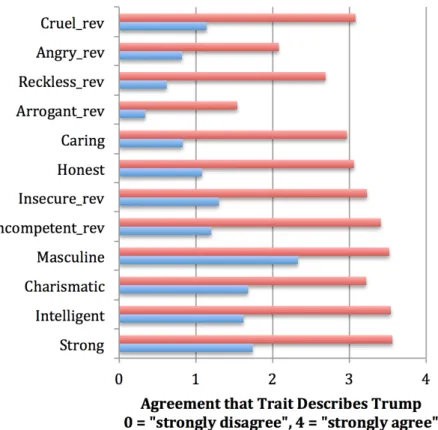
Figure 1: Mean Trait Evaluations at Extreme Levels of Support
According to the Stereotype Content Model (see, for example, Cuddy et al. 2008), for most candidates both warmth and competence should be important components for a candidate’s brand; however, as elaborated above, there is reason to believe that how an individual evaluates Trump on competence traits should be more relevant than how they evaluate him on warmth traits in determining their support. While a factor analysis confirmed these two factors, individuals evaluate Trump more positively on competence traits such as strong, intelligent, and charismatic, than they do for warmth characteristics like cruel and arrogant (see Figure 2 below). This is true for individuals who never supported Trump as well as for those who voted for Trump in both the primary and the general election.
We begin by explaining evaluations of Trump’s brand – his traits – and the attachments and identifications stemming from Trump’s brand. We use three brand-based measures as dependent variables for the models below and use these variables as explanatory variables in subsequent sections. Using the loadings from the two-factor solution derived from factor analysis, we created a brand evaluation measure. This measure uses the factor loadings as weights for each trait and then creates an additive index of those weighted sums for the warmth and competence dimensions. Warmth and competence are then added together and standardized to 0-1. Brand attachment is the additive index of brand admiration and brand-self similarity. Group identity is measured as the additive index of two responses, the degree to which being a Trump supporter says something about yourself and identification with other Trump supporters. Both brand attachment and group identity are additive indices with the components weighted equally and standardized to 0-1.
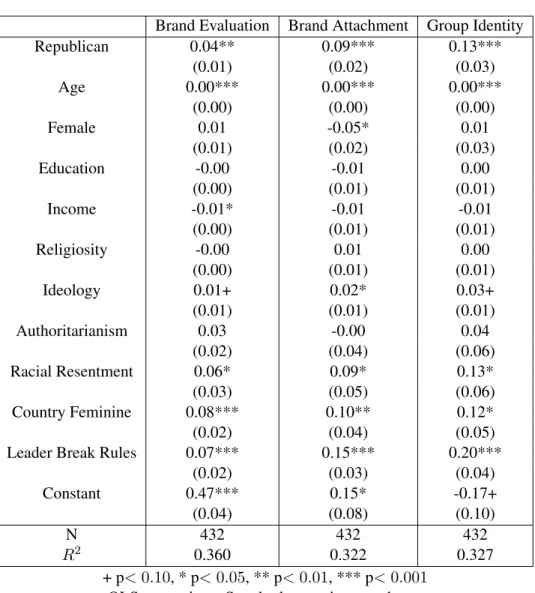
In the following models presented in Table 1, we use demographics and attitudinal variables as predictors of brand evaluation, brand attachment, and group identity. As shown in Table 1, in this exploratory study of Republicans and Independents, the more strongly people identify with the Republican party the more likely they are to evaluate Trump’s traits more positively, to be more attached to his brand defined by those traits, and to identify with other Trump supporters. In effect, these Trump loyalists are also strong Republicans.
Beyond party identity, both racial resentment and especially fears that the country is becoming “too feminine” lead to higher Trump brand evaluations, as well as brand attachment and identity. Thus media portrayals of racist and sexist strains characterizing Trump’s appeal receive some support in these data. But what is important to note is that the impact of these factors on Trump’s brand attachment and identity show that these factors have personal meaning as well as social power. Trump’s vow to “Make America Great Again” promises a return to an America where whites dominate and traditional gender roles are once again respected. It is a vow that both resonates with what individuals feel – especially men – and that is the rallying call for a collective identity built around the Trump brand.
Table 1: Determinants of Brand Evaluation, Brand Attachment, and Group Identity
Brand Evaluation Brand Attachment Group Identity
Republican 0.04** 0.09*** 0.13***
(0.01) (0.02) (0.03)
Age 0.00*** 0.00*** 0.00***
(0.00) (0.00) (0.00)
Female 0.01 -0.05* 0.01
(0.01) (0.02) (0.03)
Education -0.00 -0.01 0.00
(0.00) (0.01) (0.01)
Income -0.01* -0.01 -0.01
(0.00) (0.01) (0.01)
Religiosity -0.00 0.01 0.00
(0.00) (0.01) (0.01)
Ideology 0.01+ 0.02* 0.03+
(0.01) (0.01) (0.01)
Authoritarianism 0.03 -0.00 0.04
(0.02) (0.04) (0.06)
Racial Resentment 0.06* 0.09* 0.13*
(0.03) (0.05) (0.06)
Country Feminine 0.08*** 0.10** 0.12*
(0.02) (0.04) (0.05)
Leader Break Rules 0.07*** 0.15*** 0.20***
(0.02) (0.03) (0.04)
Constant 0.47*** 0.15* -0.17+
(0.04) (0.08) (0.10)
N 432 432 432
R2 0.360 0.322 0.327
+ p<0.10, * p<0.05, ** p<0.01, *** p<0.001
OLS regressions. Standard errors in parentheses
even a bit of arrogance – to effectively do just that. So, while opponents of Trump worry about the way he ignores political norms, his supporters see it as one of his biggest attractions.
Explaining Membership in the Trump “Base”
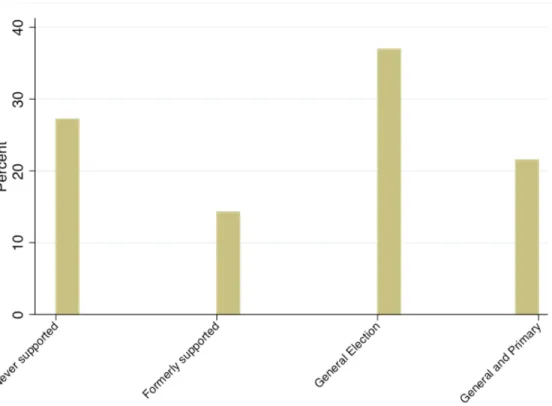
him in the general election are coded as ‘2’, those that once supported him but no longer do are coded as ‘1’, and those that never supported Trump as coded as ‘1’. We see in Figure 2 below the distribution of voting behavior toward Trump among this sample of Republicans and Independents. The respondents in the “Trump base” category constitute less than 25% of our sample of Republicans and Independents.
Figure 2: Distribution of “Trump Base” Variable
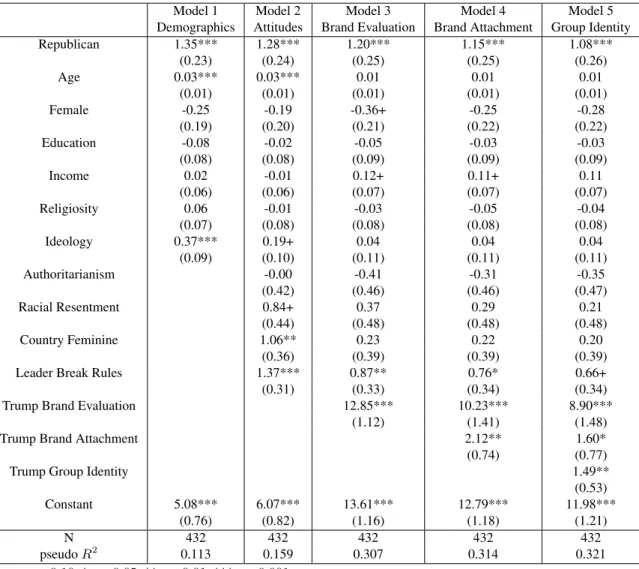
are important to identifying the Trump voting base. But contrary to popular media themes, neither racial resentment nor authoritarianism proves significant in defining the Trump voting base in these data.
Table 2: Effect of Demographics, Attitudes, and Brand Variables on Trump’s Base
Model 1 Model 2 Model 3 Model 4 Model 5
Demographics Attitudes Brand Evaluation Brand Attachment Group Identity
Republican 1.35*** 1.28*** 1.20*** 1.15*** 1.08***
(0.23) (0.24) (0.25) (0.25) (0.26)
Age 0.03*** 0.03*** 0.01 0.01 0.01
(0.01) (0.01) (0.01) (0.01) (0.01)
Female -0.25 -0.19 -0.36+ -0.25 -0.28
(0.19) (0.20) (0.21) (0.22) (0.22)
Education -0.08 -0.02 -0.05 -0.03 -0.03
(0.08) (0.08) (0.09) (0.09) (0.09)
Income 0.02 -0.01 0.12+ 0.11+ 0.11
(0.06) (0.06) (0.07) (0.07) (0.07)
Religiosity 0.06 -0.01 -0.03 -0.05 -0.04
(0.07) (0.08) (0.08) (0.08) (0.08)
Ideology 0.37*** 0.19+ 0.04 0.04 0.04
(0.09) (0.10) (0.11) (0.11) (0.11)
Authoritarianism -0.00 -0.41 -0.31 -0.35
(0.42) (0.46) (0.46) (0.47)
Racial Resentment 0.84+ 0.37 0.29 0.21
(0.44) (0.48) (0.48) (0.48)
Country Feminine 1.06** 0.23 0.22 0.20
(0.36) (0.39) (0.39) (0.39)
Leader Break Rules 1.37*** 0.87** 0.76* 0.66+
(0.31) (0.33) (0.34) (0.34)
Trump Brand Evaluation 12.85*** 10.23*** 8.90***
(1.12) (1.41) (1.48)
Trump Brand Attachment 2.12** 1.60*
(0.74) (0.77)
Trump Group Identity 1.49**
(0.53)
Constant 5.08*** 6.07*** 13.61*** 12.79*** 11.98***
(0.76) (0.82) (1.16) (1.18) (1.21)
N 432 432 432 432 432
pseudoR2 0.113 0.159 0.307 0.314 0.321
+ p<0.10, * p<0.05, ** p<0.01, *** p<0.001 Ordered Logit results with standard errors in parentheses.
Trumps ability to tap into that need is not a “one-off,” but rather an indicator of what the future holds in a political environment where politics is increasingly personalized and social media is pervasive. Finally, once the three brand variables are entered into the model, only two other variables prove significant in predicting membership in the Trump voting base: strength of identity with the Republican party, and the desire for a leader that will break the rules. This would seem to suggest that the most loyal Trump votersat least in this samplewere motivated by somewhat contradictory impulses. On the one hand, they were driven by a strong identity with the Republican Party. But that identity does not prevent them from wanting a leader that will challenge the “rules” – presumably of how Washington runs.
The Social Nature of Brands: Political Participation
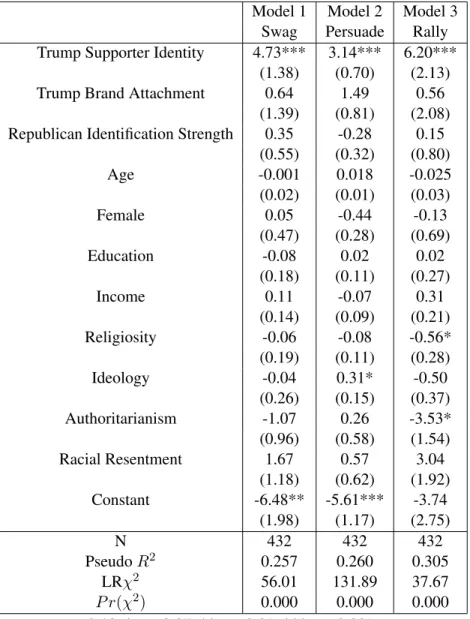
So far, we have shown that attachment to and identification with his leader brand has conse-quences on whether people choose to vote for Trump. However, due to the social nature of this brand-follower connection, particularly the presence of group social identities, we should expect brand-based identities to have an even greater effect on public and interactive forms of political participation. To vote for a candidate behind a closed curtain where others cannot see the choice you make arguably has a lower social cost than advertising your opinions openly. In the following section, we examine the relationship between brand-based supporter identity (having a social identity as a Trump supporter) and three political participation actions in support of Trump’s campaign: using swag such as a button or a yard sign, trying to persuade someone to vote for Trump, and attending a rally, meeting, or other campaign event.
Table 3: Effect of Brand Variables on Social Political Participation
Model 1 Model 2 Model 3 Swag Persuade Rally Trump Supporter Identity 4.73*** 3.14*** 6.20***
(1.38) (0.70) (2.13)
Trump Brand Attachment 0.64 1.49 0.56
(1.39) (0.81) (2.08) Republican Identification Strength 0.35 -0.28 0.15
(0.55) (0.32) (0.80)
Age -0.001 0.018 -0.025
(0.02) (0.01) (0.03)
Female 0.05 -0.44 -0.13
(0.47) (0.28) (0.69)
Education -0.08 0.02 0.02
(0.18) (0.11) (0.27)
Income 0.11 -0.07 0.31
(0.14) (0.09) (0.21)
Religiosity -0.06 -0.08 -0.56*
(0.19) (0.11) (0.28)
Ideology -0.04 0.31* -0.50
(0.26) (0.15) (0.37)
Authoritarianism -1.07 0.26 -3.53*
(0.96) (0.58) (1.54)
Racial Resentment 1.67 0.57 3.04
(1.18) (0.62) (1.92)
Constant -6.48** -5.61*** -3.74
(1.98) (1.17) (2.75)
N 432 432 432
PseudoR2 0.257 0.260 0.305
LRχ2 56.01 131.89 37.67
P r(χ2) 0.000 0.000 0.000
+ p<0.10, * p<0.05, ** p<0.01, *** p<0.001
Logistic regression results with standard errors in parentheses.
These results confirm that the social nature of the brand-based leader-follower connection has consequences beyond the voting booth. Individuals who form social identities with other supporters using the leader’s brand as a foundation for their shared identity are more likely to engage in public and higher-cost forms of political participation. This suggests a level of loyalty and dedication that cannot be accounted for by existing concepts and measures, an idea we continue in the following section with evidence from a survey experiment.
Brand Loyalty – an Experimental Test
To further assess how voting and brands affect loyalty, we conducted a simple survey experiment. Specifically, how do citizens react when presented with a message about campaign violence presented by Donald Trump? In one treatment, Trump defends the violence of his own campaign supporters, in part, because “people fight all the time in America.” In a second treatment, Trump discourages the campaign violence of his own campaign supporters warning, “the Democrats are trying to make us look bad.” What is the reaction of Trump supporters, especially, when receiving such messages? Do they remain loyal and agree with the position that Trump is staking out, or do they disagree?
those strongly attached to Trump’s brand or belonging to Trump’s base buck these expectations and follow him regardless, we will have a gauge of the power of his base and brand.
We consider reactions to these two treatments looking at membership in Trump’s base and support for Trump’s brand. An examination of the mean agreement with Trump’s statements either discouraging or encouraging violence in the treatments in Table 4 reveal a clear trend. The more people are part of Trump’s voting base, the more they agree with his statements. While the level of agreement with the statement discouraging violence is greater across all values of the Trump base measure, the supporters from his base also follow his cues on the violence treatment with a mean response of 2.42, falling in between the response categories “neither agree nor disagree” (3) and “agree” (2).
Table 4: Mean Agreement to Treatment Statement by Trump Base
Never Supported Formerly Supported General Vote Primary and General Vote
Violence not okay 3.09 2.18 1.54 1.37
Violence okay 3.98 3.43 2.81 2.42
Note: Dependent variable is an ordinal variable scaled 1-5, where 1=“strongly agree” and 5= “strongly disagree”.
Critically, when looking at the difference in mean agreement across individuals’ degree of attachment to Trump’s brand in Table 5, we see an even more striking difference. Again, it is clear that the more people are attached to the Trump brand, the more they follow his cues, regardless of whether the cues promote or discourage violence. However, the difference in mean between the lowest level of brand attachment (1) and the highest (4) is greater than the differences between those in Trump’s base and those that never supported him. Additionally, the mean level of agreement with his statements promoting violence is greater in the high brand attachment category (1.96) than in amongst his voting base (2.42).
Table 5: Mean Agreement to Treatment Statement by Brand Attachment
Never Supported Formerly Supported General Vote Primary and General Vote
Violence not okay 2.93 2.18 1.49 1.23
Violence okay 4.11 3.23 2.70 1.96
Note: Dependent variable is an ordinal variable scaled 1-5, where 1=“strongly agree” and 5= “strongly disagree”.
discouraging violence (?). The Kruskal-Wallis H test showed that there was a statistically significant difference in agreement across values of the Trump base support variable. To obtain a more detailed understanding, we then conducted Dunn non-parametric pairwise multiple comparisons to see if the differences in agreement to Trumps statements are significant across level of support (Dunn 1961;?). As displayed in Table 6, all comparisons are statistically significant (at the conventional 0.95 level), except for the mean agreement to the treatment statements of his core base (voted for Trump in General and Primary elections) and those who voted for him in the general. The difference falls just short of statistical significance for the pro-violence treatment. The non-statistical significance of the anti-violence treatment is logical, given the high level of agreement with his statement discouraging violence. This cue is more socially acceptable and therefore easier to agree with and follow.
Table 6: P-values for Pairwise Comparisons Difference in Agreement Response by Trump Base
Never Supported Formerly Supported General Vote
Formerly Supported Violence: 0.024
Anti-Violence: 0.001
Voted for in General Violence: 0.000 Violence: 0.013
Anti-Violence: 0.000 Anti-Violence: 0.001
Voted for in General and Primary Violence: 0.000 Violence: 0.001 Violence: 0.058
Anti-Violence: 0.000 Anti-Violence: 0.000 Anti-Violence: 0.139
Note: Dependent variable is an ordinal variable scaled 1-5, where 1=“strongly agree” and 5= “strongly disagree”. P-values determined by Dunns non-parametric pairwise multiple comparison following a Kruskal-Wallis test.
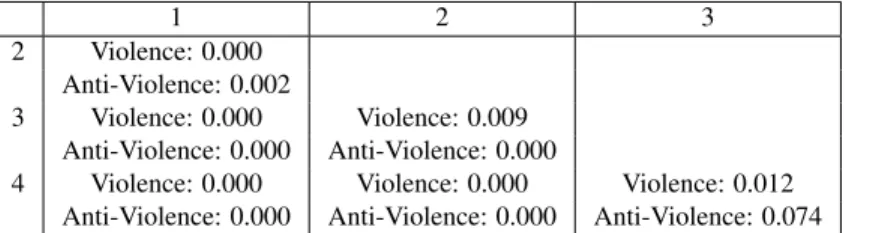
The same Kruskal-Wallis H tests and Dunn pairwise comparisons were performed to see if there are differences across the four ordinal levels of brand attachment. Similar results emerge. Again, the differences in level of agreements across brand attachment in both treatments were statistically significant. As can be seen in Table 7, using the brand attachment variable all pairwise comparisons are statistically significant, except for the difference in agreement to the anti-violence statement for the top two quintiles of brand attachment. However, the difference comes much closer to statistical significance than using the Trump base variable, suggesting that the psychological brand attachment variable may provide more leverage in understanding why individuals stick with Trump, even when he leads them down paths that may not be as socially desirable.
Table 7: P-values for Pairwise Comparisons Difference in Agreement Response by Brand Attachment
1 2 3
2 Violence: 0.000
Anti-Violence: 0.002
3 Violence: 0.000 Violence: 0.009
Anti-Violence: 0.000 Anti-Violence: 0.000
4 Violence: 0.000 Violence: 0.000 Violence: 0.012
Anti-Violence: 0.000 Anti-Violence: 0.000 Anti-Violence: 0.074
Note: Dependent variable is an ordinal variable scaled 1-5, where 1=“strongly agree” and 5= “strongly disagree”. P-values determined by Dunns non-parametric pairwise multiple comparison following a Kruskal-Wallis test.
In 2016, Donald Trump surprised the pundits and experts alike with the support that he generated. Now, commentators are scrambling to determine if his “base” will stand by him. But how do we best determine who his base is and what their loyalty is likely to be?
Herein, we have argued that Trump’s support is not exceptional, but rather is illustrative of what we can expect in the future – an era of personalized politics and social media. To better understand voters, we have proposed thinking of candidate and leader support in terms of branding – a concept that captures both the personalized and social nature of how people relate to leaders in our contemporary era. People want leaders that share their traits and ideals, and they also want to bond with other people who support those leaders. Thus, we can no longer understand candidate and leader support with static, one-sided concepts. Rather we must probe how citizens insert themselves into the evaluative process when judging leaders. Likewise, we must recognize the power of social influence in organizing people who have personal attachments to leaders. Hence, the concepts of brand attachment and identity are timely and needed.
Trump brand attachments were more likely to follow his cues on an issue. Thus, brand attachment and identity should provide a good gauge of who is likely to remain loyal to Donald Trump.
CHAPTER 3: Incumbent and Challenger Leader Brands: Evidence from Argentina
Emily B. Carty
Consumers make purchasing decisions based on what brands they like, but also choose to avoid or even act against the brands they dislike. This paper argues that how individuals make political choices can function the same way. People may choose to support a candidate because they like the personal characteristics of the candidate, but they might also support that candidate because they represent a choice against a leader they dislike.
The pages to follow will present a theory of pro– and anti– leader brands and their effect on political choices and participation. Through a series of analyses based on original survey data, this study will demonstrate that individuals can form personalized and socialized connections with leader’s brands that influence how they think about and interact with the political system. These brands and the connections individuals make with them can vary in strength; the stronger brand, the more influential the connection. Due to their notoriety, well-known political figures are likely to have strong leader brands that can provide them with loyal supporters, but can also be used by their challengers to generate a strong opposition group.
Leader Brands: Going Beyond Trait Evaluation
not account for why individuals develop strong loyalties to leaders that influences their attitudes and behavior both in the voting booth and in other forms of political action.
Some theories have gone a step further in looking at how perceptions of a leader’s personality traits can create a connection between leaders and those that support them. The ‘charismatic bonding’ theory originally elaborated by Madsen and Snow posits that in times of crisis individuals feel less secure and efficacious about their ability to survive in the unstable environment in which they find themselves (Madsen and Snow 1991). As a result, individuals seek out a leader who possesses the personality traits necessary to handle the problems that they no longer can. Others have built upon this theory, offering a more elaborate characterization of charisma and show that it can both attract people to a leader, and affect how they evaluate the leader’s performance (Merolla, Ramos and Zechmeister 2007). Political psychologists have offered the “congruency model” as a different explanation of how citizens identify with candidate/leader traits. This theory maintains that voters are attracted to candidates that are similar to them, and that this holds when it comes to personality. Thus, people are drawn to support candidates and leaders who resemble them in their personality traits (Caprara and Zimbardo 2004; Caprara et al. 2007). While these theories contribute to our understanding how perceptions of a leader’s personality can attract voters, their focus is on explaining behavior only in support of a leader and therefore do not provide a full picture of leader-oriented behavior. Building upon these theories and borrowing from marketing and consumer psychology, this paper proposes the concept of pro– and anti– leader brands as a more holistic way of looking at the connection between leaders and citizens.
Leader brands are grounded in human characteristics similar to the brands of commercial products (Smith and French 2009). Individuals form clearer and stronger opinions about people than they do about abstract concepts (Converse 1964; Zaller 1992; Zaller and Feldman 1992; Hamilton and Sherman 1996; Lavine 2002; McGraw, Hasecke and Conger 2003) and are therefore likely to form stronger evaluations of leaders’ brands than ideological or party brands. Beyond this distinction, the actions of leaders and the organizations with which they are affiliated may intentionally distinguish between organization and leader brands (Needham 2005; de Landtsheer and de Vries 2015).
This study presents a theory on incumbent leader brands and their effects on supporter and opponent behavior. When thinking about how leader brands can influence political behavior of individuals, there are various stages of assessment and connection to the brand. To begin, individuals evaluate a leader’s brand based on their perceptions of the brand’s traits, orbrand evaluations. Second, individuals formbrand attachmentsto the brands of political figures containing traits that they both admire and that are similar to their own, thus personalizing their relationship with the leader. Third, there is a social element to political branding: people develop group identities with other people who share their brand attachments. Thus by adapting the brand concept, we can simultaneously capture personalized and social attachments to leaders. While it is possible for any leader to have a brand, due to their exposure to the public, incumbents are more likely to develop stronger brands that can become socialized and shared around which people form social identities. Therefore, this third stage is more likely to occur with well-known politicians, particularly incumbents.
the perceived warmth of a leader. Not only should warmth be just as important as competence; it often should be more important. Research has demonstrated that warmth traits are processed more rapidly than competence traits (Abele and Bruckmuller 2011), individuals are more interested in gathering warmth-related information than information on competence (Brambilla, Carnaghi and Ravenna 2011; De Bruin and Lange 2000), and in many studies on person-perception evaluations of warmth have been shown to carry more weight than assessments of competence in shaping emotional and behavioral reactions towards social targets (Abele and Bruckmuller 2011; Brambilla and Leach 2104; De Bruin and Lange 1999, 2000; Vonk 1996; Wojciszke, Bazinska and Jaworski 1998). Therefore, although warmth and competence should both make up part of a leader’s brand content, it should be expected that warmth should be the primary dimension.
Drawing on the disciplines of political, consumer, and social psychology, an individual’sbrand attachmentis determined by two factors: admiration of the brand personality, and self-brand similarity, or the degree to which a person shares the same traits as the brand (Caprara and Zimbardo 2004; Caprara et al. 2007; Stokburger-Sauer, Ratneshwar and Sen 2012). The development of a brand attachment begins with the perception of a leader’s traits. First, individuals evaluate the leader’s warmth and competence in terms of specific traits representing those dimensions, resulting in their assessment of the leader’s brand. Then, they judge the degree to which they admire and share those traits. The higher their personal evaluations of and connection to those traits, the greater their attachment with the brand. Therefore, brand attachment goes beyond a simple evaluation of traits; individuals are making a more personal appraisal by assessing the traits in comparison to their own traits and ideals. Moreover, they are taking the first step toward building a “personal” relationship with the brand that says something about, not only the politician, but who they are as well. In effect, voters, too, are now personalizing politics by personalizing their relationships with political leaders.
Brand-Based Identities: Incumbency’s Double-Edged Sword
individual and the leader’s brand. However, the more a leader is exposed to the public, the more developed their brand becomes and the stronger the assessments an individual can make. The more exposure to the leader’s brand, the greater the tendency an individual has to share their assessments with others. In this way, brands of well-known leaders, like incumbents, should give birth to more socialized brand interactions, leading to brand-based social identities.
Social identities are psychological attachments to a group that become part of one’s self-concept (Tajfel 1981); they play a key role in political behavior, affecting attitudes and mobilizing people to participate (Conover 1984, 1988; Tate 1993; Huddy 2003). Given that people readily form identities around political parties and ideologies(Green, Palmquist and Schickler 2002; Huddy, Mason and Aaroe 2015), it is likely that they also will develop social identities as “supporters” of political leaders. With consumer brands, individuals form group identities based on their assessments of and attachments with brands (Schneider 2004); Apple users, for example, come to identify with other Apple users. Applying this to the concept of leader brands, brand attachment should encourage the formation of a group identity as a supporter of the leader. In particular, leaders who inspire citizens to admire and identify with them should be the most effective in creating a brand that inspires group identification and loyalty. Thus, two types of connections develop and fuel loyalty to the leader’s brand: a personal connection between the leader and the individual, and a social connection between individuals, where the common bond of supporting a leader gives them the basis for a shared social identity. Following the literature on the consequences of social identity, identifying as a supporter of a leader brand should cause individuals to form attitudes that promote a positive image of their in-group of fellow identifiers (Conover 1988; Huddy 2003). The ‘us’ versus ‘them’ distinction coupled with attachment to one’s brand-oriented in-group should strengthen an individual’s evaluations and emotions towards the leader, resulting in a higher willingness and likelihood to defend the brand group. Those with a leader brand identity should actively support that leader and his/her associated institutional entities (political party, government, etc.) through various forms of political participation, such as voting, donating time or money, or engaging in political rallies, protests, or other mobilizations.
traditionally been considered to be fueled by a perceived incongruence between how an individual sees themselves and how they see the brand (Elsbach and Bhattacharya 2001; Park, Eisingerich and Park 2013). A more detailed conceptualization contends anti-brand identity formation is driven by three types of factors: experiential, symbolic identity incongruence, and ideological or moral incompatibility (Lee, Motion and Conroy 2009). The first, experiential factors, are rather straightforward. Negative experiences with the brand, such as unmet expectations, contribute to brand avoidance and anti-brand identity formation. With leaders, this is something that is easy to conceptualize – disappointment with a leader’s performance should contribute to the development of a leader’s anti-brand. Symbolic identity incongruence is the perception that supporting the brand contributes negatively to how the individual wants to be – their desired self. This is influenced by factors like seeing those who support the leader as an inferior or otherwise negative group, or the thought that supporting the brand makes themselves inauthentic, which leads to the development of a social basis for the anti-brand. Finally, moral incompatibility is the idea that an individual sees the brand as in direct conflict with their morals or ideological principals. Moral incongruence in this sense would be that an individual sees the leader as possessing the traits they believe to be at odds with their moral values or beliefs.
There are many contexts in which we should expect to find strong leader brands. Because people have more exposure to and experience with incumbents, they are likely to be very well-known by people and therefore the most likely political figures to have strong pro– and anti-brands. Particularly strong brands should be present where the incumbent has been in power for an extended period of time (by either democratic or non-democratic means) and in contexts where a leader is particularly divisive or polemic. In thinking of how this affects brands of opposing politicians, challengers to the incumbent should fall into two general categories. If challengers are well-known, more of their brand will be based on their characteristics as a candidate. In other words, an established challenger will have a more stand-alone brand. A newcomer’s characteristics are less known to the public and their brand less established. This leaves room for anti-brand sentiments towards the incumbent to be incorporated into the challenger brand.
Therefore, the hypotheses in reference to brand attachment are the following:
H2: In the case of a newcomer, incumbent anti-brand identity in addition to warmth and competence should predict pro-challenger brand attachment.
Just as pro-leader brand identities should cause supporters to mobilize in favor of a leader, so should leader anti-brands motivate behavior. Previous studies have shown that anti-brand identities can lead to a variety of behavioral consequences (Elsbach and Bhattacharya 2001; Lee, Motion and Conroy 2009). Anti-brand identifiers may be more passive and simply avoid the brand they perceive as negative, or they may be more active in their brand behavior acting directly against the negative brand (Elsbach and Bhattacharya 2001). In regards to the effects of pro– and anti-brand identification on electoral and non-electoral political behavior, the following hypotheses are presented:
H3: The greater identification one feels with the incumbent pro-brand, the more likely they should be to vote for the incumbent.
H4: The greater identification one feels with the incumbent anti-brand, the more likely they should be to vote for a challenger.
H5: The more one identifies with the incumbent pro-brand, the more likely they will be to engage in pro-incumbent activism.
H6: The more one identifies with the incumbent anti-brand, the more likely they will be to engage in pro-challenger activism.
Testing the Theory with the Argentine Case
The data used are from an original online survey of respondents in Argentina and was conducted in September of 2016.1 Although the data were collected in an online survey, through the use of quotas the survey sample is an accurate representation of the general population on relevant socioeconomic variables, such as income, education, locality, age, and gender.2Respondents were asked questions on four political leaders: Cristina Fern´andez de Kirchner, the incumbent who was prevented from running for re-election due to term limits; her successor, Daniel Scioli, who ran with Kirchner’s full support; and two challengers to the incumbents, Mauricio Macri, the leader of the large opposition coalitionCambiemosorCoalition for Change; and Sergio Massa, a former
1Data obtained from a survey designed by Dr. Mariano Torcal of the Universitat Pompeu Fabra and Emily Carty of the
University of North Carolina and administered by Netquest. 2
Kirchner supporter who broke with the President to run as the candidate of a new party, the Renewal Front. Because the interest of this paper is the dynamics of incumbent and challenger brands, the results to be presented focus on Kirchner and Macri, the incumbent and the main challenger. Cristina Fern´andez de Kirchner, had been the President of Argentina for the eight years prior to the 2015 elections. Her policies were often seen as a continuation of her husband’s, Nestor Kirchner, who was President before her from 2003 to 2007. The Kirchner brand, therefore, developed over more than a decade, beginning in 2003. Although she was legally not permitted to run for a third consecutive term, she fully supporterd Daniel Scioli as the candidate for the political party she created, theFrente para la VictoriaorFront for Victory. Daniel Scioli was therefore seen as the “Kirchnerista” candidate and a continuation of the Kirchner regime.
As a multiparty system, there were many candidates running against the Kirchneristas, but the primary opposition candidate was Mauricio Macri. Macri ran as the candidate ofCambiemos, a coalition of parties that formed with the explicit goal of removing the Kirchneristas from power. Although Mauricio Macri had run for local-level office in the capital of Buenos Aires in 2003, it was not until 2005 that he was elected to public office as a representative in the lower house. He held various local-level positions until his candidacy for the Presidency in 2015. As such, Macri did not gain national notoriety until the 2015 elections.
The analyses in this paper use two sets of variables measuring individuals’ connections to leader brands. The first are the non-socialized variables including evaluations of the brand content and their attachment to the brand. To measure perceptions of leader warmth and competence, respondents were asked to what extent they would use specific adjectives to describe each leader on a 7-point Likert scale. These included four warmth traits (‘caring’, ‘trustworthy’, ‘dishonest’, and ‘arrogant’) and four competence traits (‘assertive’, ‘charismatic’, ‘intelligent’, and ‘incompetent’). Exploratory factor analysis of all the traits together confirmed the two-factor solution along warmth and competence dimensions. Factor loadings from a principle component analysis are then used to create a weighted additive index for the perception of leader warmth and competence variables which were then rescaled to 0-1.3 Immediately following these leader trait evaluation questions, respondents were asked to what extent they admire those traits and the degree to which they feel those traits also represent how
3
they see themselves with five response options on a scale from ‘none’ to ‘a lot’. The responses for these two items were added together to create the measure ofbrand attachmentranging from 0-8 and then rescaled to 0-1.4All questions used to compose these measures about brand personalities and attachment ask explicitly about the leader’s traits and make no reference to the political party or ideological group with which they are affiliated nor any other contextual information besides the leader’s first and last name. The measure of brand attachment is therefore created in a way that attempts to tap into perceptions of the personal traits of the leader and avoid contamination effects from political affiliation or incumbency. The first statistical analysis in this paper tests hypotheses H1andH2by looking at the determinants of brand attachment. In these models,brand attachment is the dependent variable. In subsequent analyses, brand attachment as an independent variable to explain political behavior.
The second set of brand variables used are those relating to the social identity component of brands. As Macri was fairly new on the national political scene before the 2015 presidential campaign, there should be no social identity built upon the socialization of a pro-Macri brand. In this context, the only candidate with enough time in the public eye for brand attachments to be socialized and shared is Cristina Kirchner. As such, the analyses looking at pro-Kirchner behavior contain the variablepro-Kirchner identity. This is measured as an additive index of responses to a battery of questions on social identification with the Kirchner brand.5 For models looking at pro-challenger behavior, both pro-challenger brand attachment andanti-Kirchner brand identityare included as explanatory variables. Anti-Kirchner brand identity is measured as an additive index of responses to a battery of questions on identification with the Kirchner anti-brand.6 Because the two pro-brand measures are so highly correlated for Kirchner (at 0.92), pro-brand identity is included in the models and brand attachment is omitted.
4αbrandattachment=0.85 for Kirchner and 0.89 for Macri.
5
Respondents were asked the extent to which they agreed with the following statements: “I identify with others who support Cristina Fern´andez de Kirchner”, “Being a supporter of Cristina Fern´andez de Kirchner says a lot about me to other people”, “I generally use ‘us’ instead of ‘them’ when I talk about the Kirchneristas” and “I prefer to be around
Kirchneristas”. Response options along a five-point scale range from ‘strongly disagree’ to ‘strongly agree’.α=0.88
6Respondents were asked the extent to which they agreed with the following statements: “I identify with others who
oppose Cristina Fern´andez de Kirchner”, “Being an opponent of Cristina Fern´andez de Kirchner says a lot about me to other people”, “I enjoy seeing the failure of Cristina Fern´andez de Kirchner”, “I prefer to be around anti-Kirchneristas”, “The type of person Cristina Fern´andez de Kirchner is conflicts with my values”, and “Cristina Fern´andez de Kirchner always disappoints me”. Response options along a five-point scale range from ‘strongly disagree’ to ‘strongly agree’.
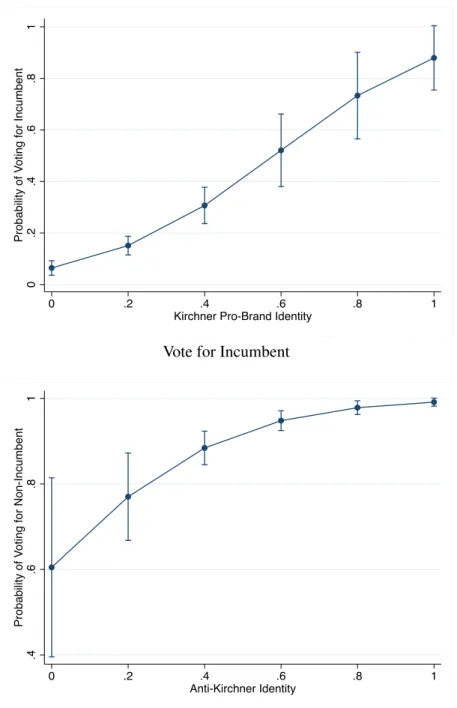
One of the analyses in this paper explores vote choice as the dependent variable. The relevant distinction of interest in this paper is choosing to vote for the incumbent, in this case, voting for Kirchner’s party, Front for Victory, or choosing to vote for a challenger. As such, two models are presented. The first is a logistic regression where voting for the incumbent is dichotomous. Respondents who voted for the incumbent party were coded as ‘1’ and those that voted for another party’s candidate were coded as ‘0’. In the second model, respondents who voted for a challenger candidate (from any party other than Front for Victory) were coded as ‘1’. Those that voted for the incumbent were coded as ‘0’.
To explore the effects of brand attachment and identities on political activism, the last set of dependent variables is a count of the frequency with which an individual has attended a rally, protest, or political meeting in support of either the incumbent, Kirchner, or her main challenger, Macri. Respondents were asked how frequently they engaged in one of these activities either in support of or against each of the two leaders in the last 12 months. The responses of those who had never attended were coded as ‘0’. Those that had participated were coded according to the frequency with which they attended such an event, ranging from 1-5 where ‘1’ indicates “once every couple of months”, and ‘5’ signifies “two times or more per week”.
Other variables are included in the models to control for other potential sources of leader-oriented identification.Government evaluationis a measure of how well an individual evaluates the performance of the current government. Variables controlling for gender, age, level of education, and income are also included. Because the majority of political parties in Argentina were formed very recently, including those Kirchner and Macri represent, we do not expect individuals to have strong partisan attachments to most parties. Dummy variables for identification are included for the two traditional parties, the Peronist or ‘Justicicialista’ and the Radical Civic Union.7 There is much debate as to whether ideological self-placement is well-distinguished among average citizens in Latin
7