Mapping: A Collaborative Ethnography of Postcolonial Gameplay.
Open
Library of Humanities, 4(1): 19, pp. 1–31, DOI: https://doi.org/10.16995/
olh.290
Published: 10 April 2018
Peer Review:
This article has been peer reviewed through the double-blind process of Open Library of Humanities, which is a journal published by the Open Library of Humanities.
Copyright:
© 2018 The Author(s). This is an open-access article distributed under the terms of the Creative Commons Attribution 4.0 International License (CC-BY 4.0), which permits unrestricted use, distri-bution, and reproduction in any medium, provided the original author and source are credited. See http://creativecommons.org/licenses/by/4.0/.
Open Access:
Open Library of Humanities is a peer-reviewed open access journal.
Digital Preservation:
POSTCOLONIAL PERSPECTIVES IN GAME STUDIES
Hybridity, Reflexivity and Mapping:
A Collaborative Ethnography of
Postcolonial Gameplay
Sybille Lammes and Stephanie de Smale
University Leiden, NL
Corresponding author: Sybille Lammes ([email protected])
I am going to play Civilization VI for the first time since its release. I have downloaded the game and now click on the play button in my Steam library, anticipating that the game will soon start. Instead the text ‘Loading. . . Please wait’ appears on my computer screen. Taking advantage of this moment, I think about the last time I played Civilization and feel a bit uneasy since it has been almost 10 years since I last engaged with games like this and examined them as postcolonial practices. Will I still understand the basic principles? Will play-researching this new version bring any new insights?
As the cutscene opens, I see a full moon that reflects its light on the waves of the sea. A creaking sound can be heard and the camera pans back to a wooden ship where a man, clad in robes, is sitting with a map spread in front of him. He dips his wooden pen in ink and makes notes on map. The dirty white map displays some sea and some islands. I can read the name of the island Corsica at the centre of the map. Now I see a close-up of a woman opening the door of the room where the man is working. She has slightly brown skin, freckles and big brown eyes. She speaks with a British accent when she speaks to the man: ‘You are plotting a new course again, aren’t you?’ The man replies in a less identifiable accent for me: ‘The currents before us are always changing. We must adapt and press forward, before we know how our journey ends.’ He puts his ruler over the map and draws a straight line over the island of Corsica. The woman replies: ‘And how do we know when we get there?’ After this long opening, short scenes follow at a fast pace, showing me a series of architectural, artistic, military and technical developments. The last image is that of a desolate moon-like landscape, in sepia hues, with a big statue of Atlas carrying the world on his shoulders. The logo of the game appears: ‘Civilization VI by Sid Meier’.
deal of time reading the copyright info. I can now tap a button that seems to bring me to the start of the game.
As Espen Aarseth wrote in 2000: ‘[t]he defining element in computer games is spatiality. Computer games are essentially concerned with spatial representation and negotiation, and therefore a classification of computer games can be based on how they represent – or, perhaps, implement – space’ (Aarseth, 2000: 154). By sandwiching the opening cinematics between two ‘mapping moments’ (Dodge et al., 2011: 220–43), a strong emphasis is placed on mapping as a dominant and constant technology needed to explore and dominate the world, thereby fitting neatly in a (post)colonial cartographical discourse in which mapping is an essential ‘immutable mobile’ (Latour, 1990): a technology that does not lose shape when put in a different context, and is used to create and sustain asymmetrical power relations (Lammes, 2016). Thus, the opening scene of the game largely seems to celebrate colonial exploration by implementing space through mapping and other technologies.
At first glance this seems to match many postcolonial readings on Civilization, which provide critical analyses of the game’s Western-centric narration of his-tory (Mukherjee, 2015), arguing that the game’s structure develops an imperialist narrative (Ford, 2016), where discourses of geopolitical order become naturalised (Nohr, 2010). Although we don’t contest that this game is resonating with neo-liberal ideologies through emphasising the connection between mapping and mastering territory – as our opening vignette indeed confirms – our aim is to unearth ‘ alternative’ affordances in which mapping gains new meaning that can be critical and reflective at the same time. After all, as has also been learned from cultural studies, master narratives may often adhere to dominant ideologies, but it is through doing and making our own stories that we appropriate meaning and start to make our own personal itineraries.
seeks to document the feelings, thoughts, and experiences generated by research and embodied by the researcher’ (Brown, 2015: 85). It illustrates how ‘research is always personal and iterative’ as it ‘changes shape as it proceeds’ (Crang & Cook, 2007: 157). This subjective method allows us to focus on the embodied affective dimensions of gameplay in relation to narrative construction. The question we ask is how such stories unfolded for us and to what extent we can literally play with dominant discourses.
method. On the other hand, the empirical insights drawn from of our vignettes foreground the spatio-temporal hybridity of gameplay and the entanglement of the player as a postcolonial subject in the construction of CIV ’s spatial narrative.
Vignette 1: Mapping
We intentionally opened this article with an auto-ethnographical vignette of Sybille Lammes’s experience of starting up the game Civilization VI and watching the cinematic openings, not least because it presents us with the most important tropes in the game in relation to postcolonial play as spatial practice: we see the act of writing, of plotting a course, of pushing buttons and of interacting between subjects. We see that the map is not a static object, but a thing or ‘actor’ mediating an assemblage (Latour, 2005), and a central artefact in how the story unfolds.
another layer is added to the meaning of mapping in the game: through mapping, civilizations can be built, which is a mighty task that comes with a prize.
In postcolonial readings of Civilization, most authors concentrate on the meta-level of the game, as we also do in our description and analysis of the opening cinematics in the introduction. In his article, Dom Ford (2016), for example, explores whether Civilization V can be a tool for critical thinking in an educational setting. His answer is a negative one as he argues that the narrative of empire building in
Civilization creates a ‘Western-centric notion of history’, which makes it difficult to
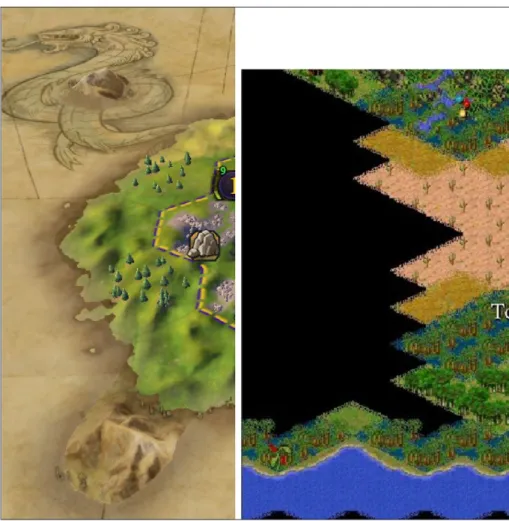
stimulate alternative ways of thinking in classroom settings. Like Souvik Mukherjee (2016), he draws on the work of Spivak and Troullot to argue that the subaltern position of the other becomes invisible and therefore impossible to identify with. To sustain the existing power construction that the game presents players with, abstraction Figure 1: Cover of Mercator Atlas 1595 (Creative Commons) and a screenshot of the
is key in this process as it enables alternative ‘voices’ to be erased. Ford’s analysis is based on a semiotic reading of the game as an ideological representation in which the player is treated as a theoretical construct. He mainly focuses on landing screens, timeline and the tech tree to examine the neoliberal overtones of the game. What he engages less with is processual approaches to gameplay (what happens when one is playing) and players’ experience.
In a more critical stance, and positioning himself in the tradition of Edward Said (2003), Souvik Mukherjee (2016, 2017), one of the few authors who explicitly links his interpretation of computer games as postcolonial to mapping, argues that the dominant system of the game frames the theoretical player in a (post)colonial discourse of othering and domination. In his book Videogames and Postcolonialism:
Empire Plays Back (2017) and his article ‘Playing Subaltern: Videogames and
postco-lonialism’ (2016), he discusses postcolonial games as pushing players into a system that resonates mostly with Western colonial ideologies of domination and othering and leaves little space for alternative meanings:
Alternative narratives can be written into being in the game world but only within the system that the game provides. The player, whether from the erstwhile colonized countries or elsewhere, nevertheless, both writes and writes back in games that engage with the questions relating to colonialism whether he or she chooses to or not. (Mukherjee, 2016: 15)
Yet Mukherjee stresses that such games can also invite players to step outside this dominant discourse as they can include the logic and affordances of protest and counter-readings. Indeed, some authors have drawn attention to how subversive meanings can be created through counterplaying games, thereby proposing alternative approaches to reading such games as propagating hegemonic discourse. Whilst his focus is on masculinity and history rather than postcolonialism, Emil Hammar, for example, writes in this context about how the playing of a game like
Assassin’s Creed from a counter-perspective can actually bring about a ‘recognition
More directly related to postcolonial culture is the work of counterplaying artist Ricardo Miranda Zúñiga, which demonstrates how an active and creative countering of dominant gaming strategies can create new meanings that do not fit neatly into dominant discourses of borders and colonisation (Taylor, 2011).
Although counterplaying is a strong example of new creative methods that have the potential of appropriating postcolonial meanings – resonating with insights developed in British cultural studies (e.g. Fiske, 2010) – to a certain extent they still start from the assumption that the game ‘in itself’ propagates a clear hegemony and conveys a Western-centred message regarding race, geopolitics, gender and history. The use of the term counterplay or counter-hegemony, after all, still points to a dichotomy between the dominant meanings that games ‘convey’ and how players/ researchers can oppose them.
Even though such an approach can yield very interesting results, we would like to go a step further in thinking about games and power, especially in relation to postcolonialism. On the whole, we don’t disagree with interpretations of games like Civilization V propagating hegemonic notions of colonial history, race and gender. Neither do we contest that alternative stories can unfold when such games are approached in alternative ways. Yet when we are really addressing postcolonialism we have to also take notice of how our position as players cannot be reduced to either one of these positions. We actually should approach such games as presenting players with affordances to hybridise both positions, being neither one or the other and both at the same time. Or as Emma Fraser (2016) argues in relation to ruins in games as ‘breaks in the teleological march of history’, games can simultaneously reinforce and resist hegemonic discourse.
aware of the many definitions and conceptual frameworks that have been developed in postcolonial studies to understand contemporary global culture in relation to colonial pasts and heritages (e.g. Appadurai, 1996, 2016). Yet we relate most strongly to work in this field that is more concerned with how new transcultural exchanges have emerged that make it more problematic to speak of the colonised and the coloniser, especially during daily practices. This is even more the case in games where positions of being played by the system and playing the system become trickier. Take, for example, the development side of a game and the active role of players in the development process. From a very early phase in a game’s production, players are enlisted in testing and shaping the gameplay experience. Although testers still have to work within the ideological framework as devised by the designers, there is some play in such gaming assemblages, that is, testers can play to some extent a role in the (moral) value system in the game. As de Smale, Kors and Sandovar (2017), for instance, show, a tester can create game-play surrounding complex (war) histories and cultural trauma, thereby modifying ‘the’ system. And this is not even taking into account the continuous tweaking and developing of a product when it is being released whose immateriality affords it being in a constant state of change, as illustrated in the release of downloadable content, new features or patches.
Thus, as Nash writes: ‘the “post” in postcolonial registers neither a celebration of the end of colonialism nor the simple reproduction of the colonial in the present, but the mutated, impure and unsettling legacies of colonialism’ (Nash, 2002: 225). Likewise, we approach ‘the’ postcolonial as a non-dichotomous cultural phenomenon that can be best approached through the lens of hybridity. So, although games like
Civilization tap into a nostalgia for a colonial past in which players are free to conquer
Space places
During the stages of game development, when the game’s architecture is set up through players’ input, strategies are developed for how an individual should operate within the game’s parameters. But these parameters are by no means totally fixed and a player can deploy tactics to appropriate and change meanings, for instance by communicating with others through headsets – as the game rules allow – or using cheats to advance in the game. The interactions between the game as an architectural assemblage and the player’s (embodied) actions are best conceptualised by the terms ‘strategies’ and ‘tactics’ as coined by de Certeau (1984).
Influenced by Michel Foucault, the French philosopher and Jesuit (a significant detail in this context), Michel de Certeau (1984) differentiates between dominant institutions and structures that construct places, and between individuals moving through these places. While place is constructed through strategies of those in power, this does not mean that those with little power are powerless. Instead, individuals use everyday tactics in which they manipulate and divert these places, turning them into a space. In the case of this article, we focused on governing structures and rules that informed our spatial narrative. Furthermore, as indicated before, we argue that in digital games a clear distinction between the two terms becomes untenable, as the game architecture enables play, thereby not simply superimposing place on the player, but also explicitly inviting players to tinker with places and spaces as distinct categories. In other words, the player is engaged in creating places as well, primarily through creating mini-maps – places – while touring the landscape.
the player’s game world nonetheless. Combined, these structures afford possibilities for action that the player may deploy when moving through the places in the game world while translating them back to spaces on the mini-map. This is exactly where our argument transcends the discourse of hegemonic gaming vs. counter-gaming.
What we can learn from de Certeau is that the hybridisation of tactics and strategies may be observed by zooming in on the spatial practices while playing – in other words, by describing the way in which players traverse a game space through different modes of operations. As individuals move through space, they craft personal stories that they imbue with meaning and translations. These personal itineraries, as de Certeau rightly argues, are conveyed to others through writing, and are important in the formation of social structures in everyday life. For de Certeau (1984: 118), ‘space is a practiced place’ and can be seen as the effect produced by different mobile elements. Spatial stories are a culmination between spatial practices and ‘textual’ narratives. Spatial stories of games concern for us the everyday tactics of individual players, in which they describe the structures that govern the place (the order and logic of the places encountered) but also how they produce the geographies of action. For de Certeau, these geographies of action are objective spatial relations (‘first I went here’ or ‘then I clicked this button’), but also subjective spatial descriptions, which are concrete, dynamic and personal descriptions (‘because of my inexperience I chose this route’ or ‘I was interested in maps, so my eye drifted there’). de Certeau maintains that during such daily processes mapping and touring are both encountered, although they do not combine very well. We take this a step further by showing how Civilization invites players to hybridise them, thereby introducing a postcolonial flux between master narratives and personal stories.
Method: Vignettes as collaborative auto-ethnographic
spatial narratives
con-duct, they allow us to acknowledge our subjective dual role as player and researcher. Our epistemological premise is that to know the construction of postcolonial stories is to understand the embodied experience of playing. By choosing auto-ethnography as our main method we were able to pay attention to the different material and immaterial relationships that were at work when co-constructing our spatial narratives. Furthermore, for this qualitative study we incorporated a collaborative element into our auto-ethnographic experience. Collaborative auto-ethnography, as the term suggests, focuses on group interaction between researchers (Chang, Ngunjiri & Hernandez, 2013). As can be derived from the two vignettes that follow, we not only opted for thick descriptions of sections of the game through auto-ethnography, but also decided to play together, thereby adding the experimental method of co-ethnography to our analysis of the game.
As we will return to later, waiting had an important reflective function in this co-ethnographic process.
Our analysis of the spatial narrative of Civilization VI rests on several vignettes of our recordings and field diaries. Narratives vignettes are ‘vivid portrayals of the conduct of an event of everyday life’ (Erickson in Humphreys, 2005: 842). The aim is to bring the reflexive experience to life and to gain understanding in the lifeworld of the researcher. Approaching the analysis from a feminist perspective in which game researchers are adopting a ‘researcher-as-player’ perspective (Aarseth, 2003; Lankoski & Björk, 2015), we believe vignettes provide micro-ethnographies of play (Giddings, 2014) that narrate the researcher’s subjective, embodied and situated experience.
Vignette 2: Mapping True Start Location Earth
Stephanie de Smale: When discussing maps with Sybille, there are several options to determine the type of map, map size, and city states already on the map (Fig. 2). We
discuss how we want the geography of our world to be and look at the options together. Some of the maps are clear geographic shapes related to different parts and areas of our world, like Panagea, island plates, inland seas, continents, but what particularly strikes me is the option ‘True Start Location Earth’. When choosing this option, we are not able to adjust the map settings. The consequence of this setting is that the number of city states that are included in the game is 12, and the map size is standard. We are intrigued to find out what True Start Location Earth means for our colonial gameplay, and after discussing it with Sybille I choose this setting.
reactions to choices. Discovering a procedure in the game that claimed to have a ‘true start location’ is something that we both found intriguing through our active spatial touring for mapping elements that looked to structure our player experience.
This brings us to one of the main points of our argument about hybridisation: how Civilization VI merges ways of doing and seeing and how this relates to postcolonialism. Before the Internet and digital games really kicked off, de Certeau tried to understand the tension between how spaces are lived and experienced and how they are represented. He introduced a difference between going as how we make sense of spatial relations ‘on our feet’ and seeing as the main modus operandi for looking at spaces from above through maps and other abstractions. He respectively referred to these positions as touring and mapping. The latter could indeed be inter-preted as a colonial gaze, an expression of ‘orientalism’ (Said, 2003) in which maps figure as means of surveillance and domination of the ‘other’. Or as Beardsell defines the colonial gaze: ‘establishing the subject/object relationship . . . it indicates at its point of emanation the location of the subject, and at its point of contact the location of the object’ (Beardsell, 2000: 8).
Figure 3: Screenshot of Lammes playing Civilization VI compared with Civilization II (Sid Meier, 1996).
going, or gazing and looking, is directly related to postcolonialism when subject and object positions are no longer easily distinguishable and we are travelling through spacetime by constantly translating between spatial stories and master narratives about our postcolonial identities. Furthermore, play, in this setting, is an important tool for opening this third space, enabling processes of hybridisation (Bhabha, 1995) or creolisation to be set in motion that are so central to this postcolonial era.
Vignette 3: Loading, please wait. . . (Waiting & talking)
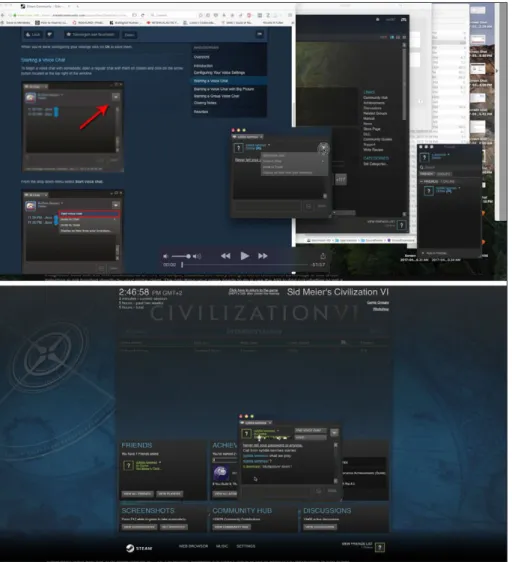
Stephanie de Smale: ‘Shall we play?’ Sybille asks me via Steam Chat. We agree to connect via voice chat and talk through our first gameplay. After I look up in the Steam forum how to start a voice chat, we connect and start the game. I click play and the familiar ‘loading please wait’ stage commences. Skipping the opening cutscene [which I have watched too many times], I click the multiplayer > internet > option and create a new game.
Waiting again. Finally decided on the settings; however, the challenge we face now is connecting to find each other online. After reading about it on a post on the Steam forum, I now know that we have to befriend each other. As of yet, I’ve always refrained from using community functionalities on Steam, because I don’t like how it draws you in, notifies you when another player is online, or when it compares your statistics to the other. I already feel a sense of discomfort seeing the number of hours I played – did I really do a 6-hour playing binge yesterday? After befriending Sybille, we try the voice chat option; again I have to search on Google how to create a connection, which redirects me to the Steam forum again. Ok, we are connected now and I’m starting up the game. As I click create multiplayer game, I am notified through a pop-up that Sybille is also playing the game. This is the second in-game notification I’ve received from Steam in Civilization VI. The first one notified me I was able to switch between the game and Steam by using ALT-TAB. The design of the pop-up is clearly different from the design of CIV. This small window is a reminder that there is another place which is part of the game world I am currently traversing.
Figure 4: Screenshot of de Smale starting up playing Civilization VI.
instability of the spatial experience, and how different actants perform to shape the gameplay experience. This conceptualisation alters the way in which gameplay is not perceived as an isolated experience but a dynamic one, full of connections, errors and waiting time. And the rules that technically govern these connections are protocols issued by platforms.
Vignette: Reflexive Play
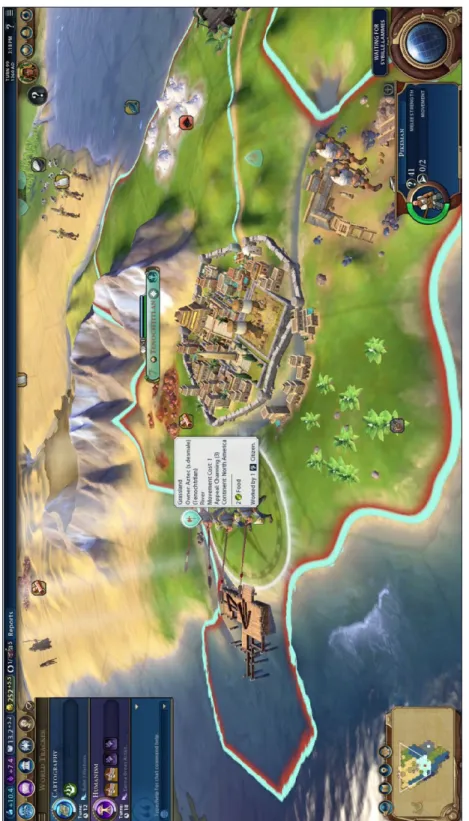
Stephanie de Smale: I am just filling my time by drinking some more tea, I say to Sybille. To pass the time Sybille asks me what my avatar looks like. Zooming into the map (Fig. 5),
almost from a third person perspective, I focus on my avatars and describe what they look like. My warriors have some sort of animal head as a helmet, and their skin tone is tinted. Sybille’s are definitely dark-skinned, she tells me. We discuss the way in which race is embedded in the avatars of the game.
Sybille Lammes: I am waiting for Stephanie and having a good look at the screen. I wonder how to pronounce that guy’s name; it sounds African to me. It also strikes me that he looks slightly like a figure from a comic book. Nose, ears and mouth are over-pronounced. I also wonder if I should call Mvemba my avatar. He is a figure who will disappear from the screen very soon, as I know from having played the single player game before. I will from then on look through his strategic eyes, playing the god trick. I stop reminiscing as it is my turn again and I have to play.
Figure 5:
37
in relation to the game state. However, the material dependency of our hardware affected our play time, since it took more time to load each new game state. ‘Turn Time’ is an option that dictates how much time a player has to complete their turn. As Juul (ibid.) states, the difference between a real-time game and turn-based game is that the amount of play time is not set in advance. Although in Civilization there is an option to limit the amount of play time allotted to each player, the standard setting for turn time in creating an online multiplayer game is unlimited. The consequence of having no timer is that the turn only ends when each player is finished with their turn. The effect of this decision is that an asymmetry in turns emerges. Because de Smale has a higher number of units who need to be assigned tasks, her turns take longer. However, this experience of waiting provided time for Lammes to reflect on her situation and gameplay, and discuss this with de Smale through voice chat. In other words, the social affordance of voice chat in combi-nation with the time afforded by unlimited time-setting in the multiplayer session allowed us to foreground reflexive gameplay. Reflexivity is understood here as the methodological, theoretical and practical experiences discussed in the game and how we as researchers relate to our object of study: the game vis-à-vis ourselves as playing subjects (Humphreys, 2005).
bring playing the game and reflecting on the game into the equation. As two Western women and interdisciplinary researchers, we, for example, had our own way of dealing with the combative spirit of the game. Precisely because we don’t believe in making general statements about gender or whiteness vis-à-vis playing CIV, our focus on micro-interactions offers a situated standpoint in our game analysis. This also means that the player’s own history is intertwined with the game’s postcolonial narrative, a translation that in our view is crucial for understanding the postcolonial condition. As Lammes has previously written:
This fluidity of time may be linked to a postcolonial and contemporary disorientation of belonging. At a time where great groups of people from mainly poor countries have migrated to the land of former colonisers, history cannot be easily retold in a singular way. Civilization III shows this postco-lonial bewilderment by making time anachronistic. It nevertheless counters this unsettled feeling by emphasizing the uniformity within borders and making space and nations unproblematic categories. It thus still strives to overcome this heterogeneity of civilization. Seen from this perspective space is represented as in accordance with dominant ideologies, whilst time has a more unstable character in the game and is played out differently. It is at this temporal level that culture becomes messier and paradoxical qualities of postcolonial cultures seep through. (2003: 127)
(Sicart, 2009). In this mode, we were able to reflect on the meaning of specific deci-sions, for instance when Lammes accidentally demolished a forest. Actively aware of how the decision conflicted with her own moral values, the time spent waiting for de Smale to finish her turn was spent in conversation on the way in which absent-mindedness can make you do things that go against your own moral compass.
Reflexivity is, in our view, even more of a challenge to draw out when we want to understand processual practices like play as we engage with an ongoing activity that leaves little room for taking a step back. As Bissell illustrates, dominant narratives (strategies) may be temporarily suspended through waiting, which allows for a different experience, in which a player can:
[. . .] to consider some of the ways in which all forms of transportational mobilities are constituted as much through the inactivity, the pauses and various suspensions experienced as part of the journey through time/ space through the necessarily hybrid event of waiting. Considering how one comes to wait, endures waiting and experiences waiting as a corporeal phenomenon illuminates a conduit to explore and critique the notion of purposeful activity. (Bissell, 2007: 18)
Echoing Bissell, our shared experience of waiting helped us to overcome the dominant lack of reflection permitted during gameplay. In our above vignettes this is, for example, visible when we discuss the ways to set up collaborative play and how to make a decision to start playing. Yet it is not only the discussion of what needs to be done or what the other does on the spur of the moment that is foregrounded through a co-auto-ethnography. Collaborative play also made us think more about our own position, such as Lammes in the vignette below realising that she is less fanatical than de Smale in building a civilisation and the Lammes’ disappointment when she discovered that she had destroyed a rainforest.
employ these tactics in order to traverse the strategies of the game space. Materially, these connections are visible through pop-ups, and via statistics tracked on the player’s Steam account.
Conclusion
To summarise, this article was centred around a dual argument. First, we set out to illustrate how collaborative ethnography is a useful method to examine the situated experience of gameplay. Second, in presenting our empirical data we showed how postcolonial stories are constructed by players in the game space of Civilization by focusing on mapping a process of hybridisation. In building on, but adapting, de Certeau’s differentiation between strategies and tactics, we argued that while the architecture of Civilization VI game space may be imbued with colonial ideologies, the playing subject may manipulate this environment by employing a combination of tactics and strategies, while when mapping the landscape, although players have little agency or power over the game’s environment (except as testers of the game), their calculated actions are not powerless either. Indeed, it is by analysing the spatial stories of the player that this differentiation between ordering structures (mappings) and the subjective embodied experience of the player (touring) can be discerned. The potential of this hybridisation became particularly apparent during those moments of gamic action that we described in our vignettes: mapping and touring were no longer separate categories, while waiting and talking added a mode of reflection to playing the game. By analysing our dealings with (failing) technologies we also drew attention to the player as a very particular cyborg (Haraway, 2006, 2013), negotiating bodies, software, machines and other actors through playful interaction with, and interventions in, postcolonial ideologies.
showing that this is a processual practice in which dichotomies collapse and representational ideological reading loses its value. In the third vignette, we focused on the tactics we as players used during our gameplay session and how this extended the formal game space. In particular, we illustrated the importance of platforms such as Steam in nudging us to adopt specific translational practices of place-making. This vignette also drew attention to the importance of reflectivity in play. The social affordance of voice chat in congruence with the turn-based mechanic set by the players constructing the multiplayer game session accidentally afforded reflective waiting time, where we both were able to talk and think about their characters and actions, and what subjectivities this produced.
Our experiences of playing Civilization VI were a double-edged sword: they enabled reflective play but also raised ethical questions. On the positive side, in combination with the default setting of the turn timer in Multiplayer Mode, it allows pauses in gameplay, which stimulates playing subjects to think and reflect upon their behaviour. However, it is via offering these free services and stimulating players to create content and play together that spaces of racialised informational labour emerge (Nakamura, 2009). These spaces do not limit themselves to a critique of race on the representational plane, but as Nakamura’s articulation of Asian worker players in World of Warcraft illustrates (2009), they emerge in the spatial practices of players in virtual worlds. So, while these researcher-players may have articulated and reflected on race from a theoretical point of view in a private multiplayer game, another view emerges in public online multiplayer games, where players are singled out, ridiculed and discriminated against by other players. In this article, we offer a perspective that situates how postcolonial narratives and postcolonial subjects are hybrids, visualised through the active and reflective process of constructing spatial narratives that focus on mapping and touring. In short, they are both an object to think with and a process to reflect on.
Competing Interests
References
Aarseth, E 2000 Allegories of Space: The Question of Spatiality in Computer Games. In: Eskelinen, M and Koskimaa, R (Eds.), Cybertext Yearbook, pp. 152–71. Saarijärvi: Publications of The Research Centre for Contemporary Culture, University of Jyväskylä.
Aarseth, E 2003 Playing Research: Methodological Approaches to Game Analysis.
Proceedings of the Digital Arts and Culture Conference, pp. 28–9.
Akerman J R 2008 The Imperial Map: Cartography and the Mastery of Empire (Vol. 15): Chicago: University of Chicago Press.
API Overview 2017 (Steamworks Documentation) Available at: https://partner. steamgames.com/documentation/api (Last accessed 23 May 2017).
Appadurai, A 1996 Modernity at Large: Cultural Dimensions of Globalization. Minneapolis, MN: University of Minnesota Press.
Appadurai, A 2016 Fear of Small Numbers. Durham, NC: Duke University Press. Beardsell, P R 2000a Europe and Latin America: Returning the Gaze. Manchester
University Press.
Bhabha, H K 1995 Cultural Diversity and Cultural Difference. In: Ashcroft, B, Griffiths G and Tiffin, H (Eds.), The Post-Colonial Studies Reader, pp. 206–209. London: Routledge.
Bissell, D 2007 Animating Suspension: Waiting for Mobilities. Mobilities, 2(2): 277–98. DOI: https://doi.org/10.1080/17450100701381581
Borges, J L 1975 Of Exactitude in Science. In: A Universal History of Infamy, p. 325. London: Penguin Books.
Brown, A M L 2015 Awkward: The Importance of Reflexivity in Using Ethnographic Methods. In: Lankoski, P and Björk, S (Eds.), Game Research Methods: An
Overview, pp. 77–92. Halifax, NS: ETC Press.
Carr, D 2006 The Trouble with Civilization. In: King, G and Krzywinska, T (Eds.), Videogame, Player, Text, pp. 222–33. Manchester: Manchester University Press. Certeau, M de 1984 The Practice of Everyday Life, trans. Rendall, S. Berkeley, CA:
Chang, H, Ngunjiri, F W and Hernandez, K-A C 2013 Collaborative Autoethnography. Walnut Creek, CA: Left Coast Press.
Cosgrove, D 2001 Apollo’s Eye: A Cartographic Genealogy of the Earth in the Western
Imagination. Baltimore, MD: Johns Hopkins University Press.
Crang, M and Cook, I 2007 Doing Ethnographies. Los Angeles: SAGE. DOI: https:// doi.org/10.4135/9781849208949
Dodge, M, Kitchin, R and Perkins, C 2011 Rethinking Maps: New Frontiers in
Cartographic Theory. Routledge.
Fiske, J 2010 Television Culture. 2nd edition. London: Routledge.
Ford, D 2016 ‘eXplore, eXpand, eXploit, eXterminate’: Affective Writing of Postcolonial History and Education in Civilization V. Game Studies, 16(2): n.p.
Fraser, E 2016 Awakening in Ruins: The Virtual Spectacle of the End of the City in Video Games. Journal of Gaming & Virtual Worlds, 8: 177–96. DOI: https://doi. org/10.1386/jgvw.8.2.177_1
Fuller, M and Jenkins, H 1995 Nintendo® and New World Travel Writing: A Dialogue. In: Jones, S G (Ed.), Cybersociety: Computer-Mediated Communication
and Community, pp. 57–72. London; Thousand Oaks; New Delhi: Sage Publication.
Galloway, A 2006 Gaming: Essays On Algorithmic Culture. Minneapolis, MN: University of Minnesota Press.
Galloway, A R and Thacker, E 2007 The Exploit: A Theory of Networks. Minneapolis, MN: University of Minnesota Press.
Giddings, S 2014 Gameworlds: Virtual Media and Children’s Everyday Play. New York: Bloomsbury Publishing USA.
Hammar, E L 2016 Counter-Hegemonic Commemorative Play: Marginalized Pasts and the Politics of Memory in the Digital Game Assassin’s Creed: Freedom Cry.
Rethinking History, 0(0): 1–24. DOI: https://doi.org/10.1080/13642529.2016.1
256622
Haraway, D 2006 A Cyborg Manifesto: Science, Technology, and Socialist-feminism in the Late 20th Century. In: Weiss, J, Nolan, J, Hunsinger, J and Trifona, P (Eds.),
The International Handbook of Virtual Learning Environments, Vol. 1, pp. 117–58.
Haraway, D 2013 Simians, Cyborgs, and Women: The Reinvention of Nature. New York: Routledge.
Huizinga, J 1938 Homo Ludens: Proeve eener Bepaling van het Spel-element der Cultuur. Haarlem: Tjeenk Willink.
Humphreys, M 2005 Getting Personal: Reflexivity and Autoethnographic Vignettes.
Qualitative Inquiry, 11(6): 840–60. DOI: https://doi.org/10.1177/10778004042
69425
Hunt, N R 2002 Tintin and the Interruptions of Congolese Comics. In: Landa, P S and Kaspin, D D (Eds.), Images and Empires: Visuality in Colonial and Postcolonial
Africa, pp. 90–123. Berkeley, CA: University of California Press. DOI: https://doi.
org/10.1525/california/9780520229488.003.0004
Juul, J 2005 Half-Real: Video Games Between Real Rules and Fictional Worlds. Cambridge, MA: The MIT Press.
Lammes, S 2003 On the Border: Pleasures of Exploration and Colonial Mastery in
Civilization III Play the World. In: Copier, M and Raessens, J (Eds.), Level Up: Digital Games Research Conference, pp. 120–29. Utrecht: Utrecht University.
Lammes, S 2008 Spatial Regimes of the Digital Playground: Cultural Functions of Spatial Practices in Computer Games. Space and Culture, 11(3): 260–272. DOI: https://doi.org/10.1177/1206331208319150
Lammes, S 2009 Terra Incognita: Computer Games, Cartography and Spatial Stories. In: van den Boomen, M, Lammes, S, Lehmann, A-S, Raessens, J and Schaefer Tobias, M (Eds.), Digital Material: Tracing New Media in Everyday Life and
Technology, pp. 223–38. Amsterdam: Amsterdam University Press.
Lammes, S 2010 Postcolonial Playgrounds: Games and Postcolonial Culture. Eludamos: Journal for Computer Game Culture, 4(1): 1–6.
Lammes, S 2016 Digital Mapping Interfaces: From Immutable Mobiles to Mutable Images. New Media & Society, 22 January (n. p.). DOI: https://doi. org/10.1177/1461444815625920
Lammes, S, Perkins, C and Wilmott, C 2016 GoGoGozo: The Magic of Playful Mapping Moments. In: Playful Mapping Collective (Ed.), Playful Mapping in the
Lankoski, P and Björk, S (Eds.) 2015 Game Research Methods: An Overview. Halifax, NS: ETC Press.
Latour, B 1990 Visualisation and Cognition: Drawing Things Together. In: Lynch, M and Woolgar, S (Eds.), Representation in scientific activity, pp. 19–68. Cambridge, Mass: MIT Press.
Latour, B 2005 Reassembling the Social: An Introduction to Actor-Network-Theory.
Clarendon Lectures in Management Studies. Oxford: New York: Oxford University
Press.
Mukherjee, S 2015 The Playing Fields of Empire: Empire and Spatiality in Video Games. Journal of Gaming & Virtual Worlds, 7(3): 229–315. DOI: https://doi. org/10.1386/jgvw.7.3.299_1
Mukherjee, S 2016 Playing Subaltern: Video Games and Postcolonialism. Games and
Culture, 9 February (n. pag.). DOI: https://doi.org/10.1177/1555412015627258
Mukherjee, S 2017 Videogames and Postcolonialism: Empire Plays Back. Basingstoke: Palgrave Macmillan. DOI: https://doi.org/10.1007/978-3-319-54822-7
Nakamura, L 2009 Don’t Hate the Player, Hate the Game: The Racialization of Labor in World of Warcraft. Critical Studies in Media Communication, 26(2): 128–44. DOI: https://doi.org/10.1080/15295030902860252
Nakamura, R and Wirman, H 2005 Girlish Counter-Playing Tactics. Game Studies, 5: 1 (Accessed May 29, 2017).
Nash, C 2002 Cultural Geography: Postcolonial Cultural Geographies. Progress in
Human Geography, 26(2): 219–30. DOI: https://doi.org/10.1191/0309132502
ph365pr
Nohr, R F 2010 Strategy Computer Games and Discourses of Geopolitical Order.
Eludamos: Journal for Computer Game Culture, 4(2): 181–95.
Pickles, J 2004 A History of Spaces: Cartographic Reason, Mapping, and the
Geo-Coded World. London: Routledge.
Said, E W 2003 Orientalism. New York: Vintage.
Sicart, M 2009 The Banality of Simulated Evil: Designing Ethical Gameplay. Ethics
and Information Technology, 11(3): 191–202. DOI: https://doi.org/10.1007/
s10676-009-9199-5
Sid Meier 1996 Civilization II. Alameda, CA: Microprose. Sid Meier 2016 Civilization VI. Novato, CA: 2K Games.
Smale, S de, Kors, M J L and Sandovar, A M 2017 The Case of This War of Mine: A Production Studies Perspective on Moral Game Design. Games and Culture, August. DOI: https://doi.org/10.1177/1555412017725996
Smith, D K 2016 The Cartographic Imagination in Early Modern England: Re-Writing
the World in Marlowe, Spenser, Raleigh and Marvell. New York: Routledge.
Taylor, C 2011 Resistant Gaming and Resignifying the Border Online: Ricardo Miranda Zúñiga’s Vagamundo, A Migrant’s Tale. Journal of Latin American
Cultural Studies, 20(3): 303–21. DOI: https://doi.org/10.1080/13569325.2011.
617362
Taylor, T L 2009 The Assemblage of Play. Games and Culture, 4(4): 331–9. DOI: https://doi.org/10.1177/1555412009343576
Thrift, N 1996 Spatial Formations, Theory, Culture & Society. London: Sage.
Thrift, N 2004 Movement-space: The Changing Domain of Thinking Resulting from the Development of New Kinds of Spatial Awareness. Economy and Society, 33(4): 582–604. DOI: https://doi.org/10.1080/0308514042000285305
Thrift, N 2008 Non-representational Theory: Space, Politics, Affect. London: Routledge.
How to cite this article: Lammes, S and de Smale, S 2018 Hybridity, Reflexivity and
Mapping: A Collaborative Ethnography of Postcolonial Gameplay. Open Library of Humanities, 4(1): 19, pp. 1–31, DOI: https://doi.org/10.16995/olh.290
Published: 10 April 2018
Copyright: © 2018 The Author(s). This is an open-access article distributed under the
terms of the Creative Commons Attribution 4.0 International License (CC-BY 4.0), which permits unrestricted use, distribution, and reproduction in any medium, provided the original author and source are credited. See http://creativecommons.org/licenses/by/4.0/.
OPEN ACCESS Open Library of Humanities is a peer-reviewed open