Exploring the HIV continuum of care among
young black MSM
Lisa Hightow-Weidman
1☯*
, Sara LeGrand
2☯, Seul Ki Choi
3‡, Joseph Egger
2‡, Christopher
B. Hurt
1‡, Kathryn E. Muessig
3☯1 Institute of Global Health and Infectious Diseases, University of North Carolina at Chapel Hill, Chapel Hill, North Carolina, United States of America, 2 Duke Global Health Institute, Duke University, Durham, North Carolina, United States of America, 3 Department of Health Behavior, Gillings School of Public Health, University of North Carolina at Chapel Hill, Chapel Hill, North Carolina, United States of America ☯These authors contributed equally to this work.
‡ These authors also contributed equally to this work. *[email protected]
Abstract
Background
HIV disproportionately impacts young, black men who have sex with men (YBMSM) who
experience disparities across the HIV care continuum. A more nuanced understanding of
facilitators and barriers to engagement in care, missed visits, antiretroviral uptake,
adher-ence and viral suppression could improve care and intervention design.
Methods
A randomized controlled trial of an online intervention, healthMpowerment, enrolled 465
YBMSM (18–30 years); 193 identified as HIV-positive. Bivariable and multivariable analyses
of baseline data explored predictors of: engagement in care, missed visits, antiretroviral
uptake, self-reported adherence, and viral suppression.
Results
Mean age was 24.9 years; most identified as gay (71.0%) and were receiving HIV care
(89.1%). Among those in care, 52.1% reported no missed visits in the past 12 months, 41
(24.6%) reported one missed visit, and 39 (23.4%) reported two or more. Having insurance
(prevalence odds ratio [POR] 4.5; 95% CI: 1.3, 15.8) and provider self-efficacy (POR 20.1;
95% CI: 6.1, 64.1) were associated with being in care. Those with a college degree (POR
9.1; 95% CI: 1.9, 45.2) and no recent marijuana (POR 2.6; 95% CI: 1.2, 5.6) or
methamphet-amine use (POR 5.4; 95% CI: 1.0, 28.5) were less likely to miss visits. Most (n = 153, 84.1%)
had been prescribed antiretroviral therapy. A majority of participants (70.8%) reported
90%
adherence; those with depressive symptoms had 4.7 times the odds of reporting adherence
<
90% (95% CI: 1.65, 13.37). Of participants who reported viral load testing in the past six
months, 65% (n = 102) reported an undetectable viral load. Disclosure to sex partners was
associated with viral suppression (POR 6.0; 95% CI: 1.6, 22.4).
a1111111111
a1111111111
a1111111111
a1111111111
a1111111111
OPEN ACCESS
Citation: Hightow-Weidman L, LeGrand S, Choi
SK, Egger J, Hurt CB, Muessig KE (2017) Exploring the HIV continuum of care among young black MSM. PLoS ONE 12(6): e0179688.https://doi.org/ 10.1371/journal.pone.0179688
Editor: Dimitrios Paraskevis, National and
Kapodistrian University of Athens, GREECE
Received: February 22, 2017
Accepted: June 3, 2017
Published: June 29, 2017
Copyright:©2017 Hightow-Weidman et al. This is
an open access article distributed under the terms of theCreative Commons Attribution License, which permits unrestricted use, distribution, and reproduction in any medium, provided the original author and source are credited.
Data Availability Statement: All relevant data are
within the manuscript and supporting information files.
Funding: NIMH R01MH093275-01
Competing interests: The authors have declared
Conclusions
Multi-level facilitators and barriers to engagement across the continuum of care were
identi-fied in this sample of YBMSM. Understanding the distinct needs of YBMSM at each stage of
the continuum and addressing them through tailored approaches is critical for long term
suc-cess in care.
Background
Black men who have sex with men (BMSM) experience disparities along all stages of the HIV
care continuum. Compared with other men who have sex with men (MSM), BMSM are more
likely to test positive or have undiagnosed HIV [
1
,
2
]. More BMSM compared to White or
Latino MSM are infected-but-unaware [
1
,
3
]. Moreover, HIV-positive BMSM are less likely to
be engaged in care, access or adhere to antiretroviral therapy (ART), or be virally suppressed
compared with other HIV-positive MSM [
1
,
3
–
5
]. Data from 3 waves (2008, 2011, 2014) of the
National HIV Behavioral Surveillance (NHBS) found that despite improvements in ART
cov-erage among all groups of MSM, BMSM were less likely to be taking ART in each of the 3
study years, even after controlling for education, income and health insurance [
6
]. While
many continuum-based studies have focused on groups who are already engaged in care [
7
–
10
], one notable exception is Rosenberg, et al., who used Centers for Disease Control and
Pre-vention (CDC) estimates of infection to construct HIV care continua for Black and White
MSM for 2009–2010. Their modeling suggested that only 24% of BMSM were in care and 16%
were virally suppressed [
11
].
There are also disparities in the care continuum related to age. Among those aged 13–24
years diagnosed with HIV in the United States (US), approximately 38% have achieved viral
suppression [
12
]. One recent study conducted within the Adolescent Medicine Trials Network
for HIV Interventions (ATN) found that among 1548 adolescents and young adults (81%
male, 72% Black, 70% gay/bisexual) initially identified with HIV infection, 68% were linked to
care, 54% were engaged in care, 31% started antiretroviral therapy (ART), and 7% reached an
undetectable viral load (VL) during the study period. This is substantially lower than the
esti-mated 50% of persons achieving viral suppression across all age groups [
12
,
13
].
While much of the literature has focused on identifying factors that affect HIV rates among
young BMSM (YBMSM) [
3
,
4
], the relationship between psychosocial, structural, and social
network factors (e.g. social isolation, social support) and HIV care outcomes has been less fully
explored. Two recent studies focusing on YBMSM in care reported disparate results. While
Hussen, et al., observed no associations between social support, psychological distress and
con-tinuum of care outcomes in a study of 132 HIV-positive YBMSM recruited from adolescent
medicine HIV clinics [
14
], Magnus, et al., found that among a sample of newly engaged in
care HIV-positive young MSM of color (n = 224, 73% Black), those with a history of
depres-sion were less likely to report missed visits [
15
]. In a population-based sample of 214 YBMSM,
a history of criminal justice involvement was found to be positively associated with both
reten-tion in care and viral suppression [
16
]. These prior studies notwithstanding, a greater
under-standing of how multilevel barriers and facilitators experienced by YBMSM impact the care
continuum, from engagement through viral suppression, can provide valuable information to
improve provision of care and the design of interventions.”
HealthMpowerment.org
(HMP) is a mobile- phone-optimized, Internet-based intervention
transmitted infection (STI) prevention and care information, resources, tailored feedback,
game-based elements and a social networking platform to offer and receive social support
from peers [
17
,
18
]. This paper presents baseline data from HIV positive participants in the
HMP study to explore potential sociodemographic, psychosocial, and HIV care-related
predic-tors of outcomes along the HIV care continuum among YBMSM.
Methods
Sample
A randomized controlled trial comparing HMP to a control website that provided HIV/STI
information enrolled 465 YBMSM between November 2013 and October 2015. Participants
completed an online baseline survey at an in-person visit and follow-up assessments were
con-ducted online at 3, 6 and 12-months post enrollment. Baseline data from 193 participants who
identified as HIV positive at baseline are presented here. Written informed consent was
obtained from participants at the time of study enrollment. This study was approved by the
University of North Carolina at Chapel Hill Institutional Review Board.
Eligibility criteria
Study eligibility criteria at enrollment were: (1) age 18 to 30; (2) born biologically male; (3)
self-identify as Black; (4) currently reside in North Carolina; (5) currently have access to a
mobile device (e.g. smartphone, tablet) that connects to the internet and has texting
capabili-ties; (6) any of the following in the past six months: (a) condomless anal sex with a male
part-ner, (b) any anal sex with more than three male sex partners, (c) exchange of money, gifts,
shelter, or drugs for anal sex with a male partner, or (d) anal sex while under the influence of
drugs or alcohol (i.e., high or drunk within two hours of sex).
Recruitment
Study flyers inviting individuals to participate were posted at local college campuses and
previ-ously identified off-campus venues (bars, clubs, coffee shops) frequented by YBMSM.
Advertise-ments and targeted messages were posted on websites, including Craigslist, relevant Facebook
groups, and Grindr. Participants were also recruited through word of mouth and flyers at local
case management organizations, and HIV/STI clinics.
Measures
Sociodemographic items assessed age, level of education, income, arrests (last 3 months),
homelessness (past 6 months), health insurance, and sexual identity (gay vs. non-gay).
Psychosocial. Social support: The Medical Outcomes Study Social Support Survey
(MOS-SSS) was used to measure perceived social support [
19
]. Subscales for
emotional/infor-mational (8 items) (alpha = 0.97), tangible (4 items) (alpha = 0.92), affectionate (3 items)
(alpha = 0.94), and positive social interaction (3 items) (alpha = 0.96) were calculated. Item
responses were based on a 5-point Likert scale. Subscale scores were transformed so that the
lowest possible score was 0 and the highest possible score was 100; higher scores indicate
greater perceived social support.
Depression: Depressive symptoms were assessed with the Center for Epidemiologic Studies
Depression Scale (CES-D), a 20-item validated survey of clinically significant distress as a
marker for clinical depression (alpha = 0.90) [
21
]. A dichotomous depression variable was
cre-ated using a CES-D score of
16, which suggests clinically relevant depressive symptomology.
Anxiety: The seven-item version of the General Anxiety Disorder scale (GAD-7) was used
to measure anxiety (alpha = 0.93) [
22
]. Items measured the frequency with which respondents
experienced anxiety symptoms in the past two weeks. Scores of 0, 1, 2, and 3, were assigned to
the response categories of “not at all,” “several days,” “more than half the days” and “nearly
every day,” respectively (range 0–21). Scores of 5, 10, and 15 represent cut points for mild,
moderate, and severe anxiety, respectively.
Substance use: Substance use items assessed any use of alcohol, marijuana or synthetic
mar-ijuana, crack or powder cocaine, methamphetamine, club drugs (e.g., ketamine,
methylene-dioxymethamphetamine [MDMA], gamma-hydroxybutyrate [GHB]), opiates and inhalants in
the past 3 months.
HIV disclosure: Participants were asked to indicate how many friends, family and sex
part-ners they had disclosed their HIV status to with response options of none, a few, most, or all.
Each disclosure variable was dichotomized to indicate disclosure to none versus a few, most,
or all.
HIV care related. Self-efficacy for communicating with health care provider: Six items
based on a 5-point Likert scale were adapted from Shively et al. [
23
] to measure
communica-tion with HIV care providers among HIV-positive participants (alpha = 0.96). Scores of 1
through 5 were assigned to responses of “not at all sure,” “somewhat sure,” “moderately sure,”
“very sure” and “totally sure,” respectively. Mean scores
4 were categorized as high
self-effi-cacy for communicating with health care provider, while scores
<
4 were categorized as low
self-efficacy.
Engagement in care: To assess engagement in HIV care, participants were asked if they
were currently enrolled in or receiving HIV care of any kind. Participants were also asked to
describe reasons for not being in care.
Missed HIV care appointments: Adherence to scheduled medical appointments with HIV
care providers over the past 12 months was assessed by self-reported number of missed visits.
We dichotomized missed appointments into no missed HIV medical appointments or having
one or more missed appointments [
24
,
25
]. Missed visits are the most immediately available
measure of retention in care and are associated with mortality [
25
].
Antiretroviral (ART) uptake: Participants were asked about current and ever (start date)
ART use. Participants who had never used ART were asked to describe their reasons (e.g.
don’t need them, no money or insurance, worried about side effects).
Medication adherence/viral suppression: A Visual Analogue Scale was used to assess
medi-cation adherence. Participants selected a value ranging from 0–100% to indicate their
adher-ence on a regular basis [
26
]. A dichotomous variable was created with values greater than or
equal to 90% classified as adherent [
27
]. Viral suppression was provided via self-report for
those who reported having had a viral load performed in the past 6 months using a two-part
question: 1) was your viral load undetectable and 2) If not undetectable, participants were
asked to indicate the range that most closely matched their last viral load (e.g. 20–500 copies,
501–9,999 copies).
Statistical analysis
visits, ART uptake, self-reported adherence and viral suppression. Independent predictors of
these outcomes were selected based on empirical considerations established through formative
work and a thorough review of the literature. The final selection of variables chosen were those
found to impact both HIV acquisition risk and engagement in the HIV continuum of care for
both YBMSM, our target population, as well as other HIV infected populations. Prevalence
odds ratios (POR) with 95% confidence intervals were calculated as the measure of association.
Bivariate logistic regression was conducted with each independent variable for all five outcome
variables and multivariable logistic regression models with stepwise backward selection
con-structed for each outcome variable. All independent factors significant at the p
0.1 level in
bivariable analyses were included in multivariable logistic regression analysis and predictors
with the highest p-value were deleted from the model in a step-wise fashion. The model with
lower Akaike Information Criterion (AIC) values was considered the better model. For
signifi-cant bivariable factors that were highly correlated with one another (i.e., collinear, r
0.70),
the factor with the lowest AIC in the model was retained in the final multivariable model. No
alpha adjustment for multiple testing was applied. All analyses were performed using SAS 9.4
(SAS Institute, Cary, NC).
Results
Description of sample
Mean age was 24.9 years; most identified as gay (71.0%) (
Table 1
). Forty percent of the sample
was socially isolated and 112 (58.6%) received a CES-D score that met criteria for clinical
depression. About one-third (33.2%) of the sample had a history of homelessness in the prior
six months. Substance use was common with 79.3% reporting alcohol use, 68.4% reporting
marijuana use, 14.0% crack/cocaine use and 7.3% methamphetamine use.
Engagement in care
Most participants, 172 (89.1%) reported being currently enrolled in or receiving HIV care. The
most common reasons for not being in care were inconvenient location or transportation
issues (n = 9, 42.9%) and cost concerns (n = 7, 33.3%). A majority of participants (n = 146.
80.2%) reported a high degree of self-efficacy for communicating with their health care
pro-vider. In multivariable analyses (
Table 2
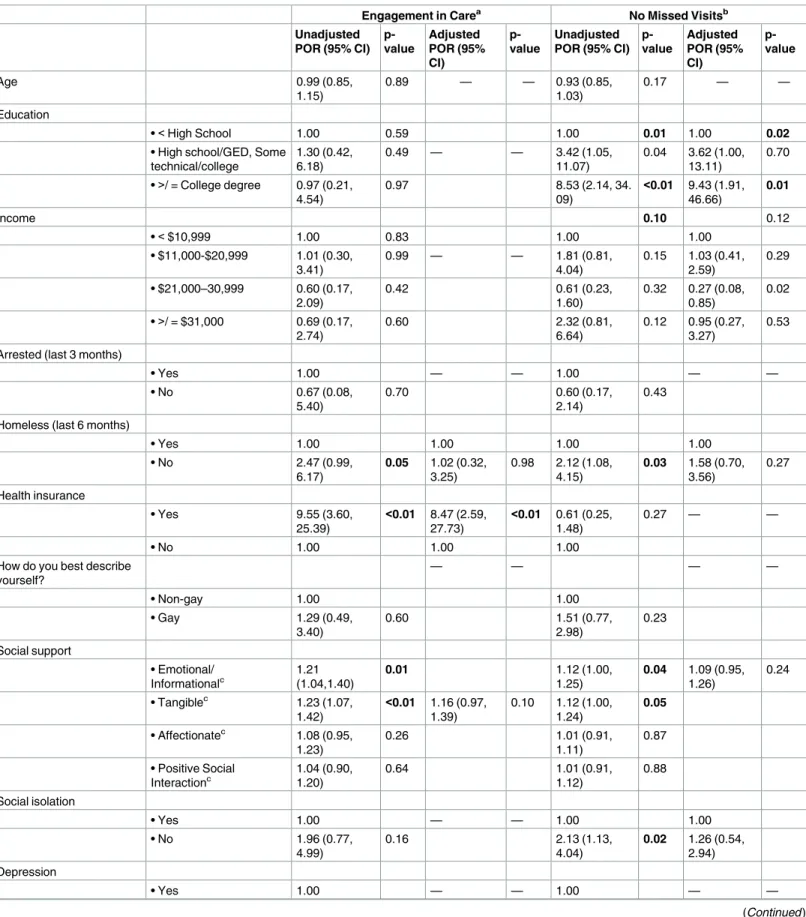
), having insurance (POR 8.47; 95% CI: 2.59, 27.73)
and having high self-efficacy for communication with a health care provider (POR 13.19; 95%
CI: 3.72, 46.77) were associated with being in care.
No missed HIV care visits
Among those in care, 87 (52.1%) reported no missed visits in the past 12 months, 41 (24.6%)
reported one missed visit, and 39 (23.4%) reported two or more. Of those reporting missed
vis-its (n = 80), most had missed visvis-its in the past 3 months (70.0%). In multivariable analysis,
those with a college degree (POR 9.43; 95% CI: 1.91, 46.66) and those with no marijuana use
(POR 2.49; 95% CI: 1.14, 5.44) and no methamphetamine use in the prior 3 months (POR
5.42, 95% CI: 1.03, 28.52) were less likely to miss visits.
Antiretroviral uptake
Table 1. Descriptive statistics of HIV-positive HMP participants at study entry.
(n = 193)
N (%)
Mean [SD]
Age (n = 192) 24.91 [3.11]
Education
•<High school 21 (10.9)
• High school/GED, Some technical/college 138 (71.5)
• College degree or more 34 (17.6)
Income (n = 191)
•<$10,999 102 (53.4)
• $11,000-$20,999 41 (21.5)
• $21,000–30,999 26 (13.6)
•>/ = $31,000 22 (11.5)
Arrested (last 3 months) 13 (6.7)
Homeless (last 6 months) 64 (33.2)
Health insurance 155 (80.3)
How do you best describe yourself?
• Gay 138 (71.5)
• Non-gay 55 (28.5)
Social support
• Emotional/Informational (n = 191) 69.9 [29.2]
• Tangible (n = 191) 65.2 [31.0]
• Affectionate (n = 189) 68.7 [32.6]
• Positive social interaction (n = 191) 68.5 [30.6]
Social isolation (n = 192) 77 (40.1)
Depression (n = 191) 112 (58.6)
Anxiety (n = 189)
• Minimal/Mild 130 (68.8)
• Moderate/Severe 59 (31.2)
Substance use (past 3 months)
• Alcohol 153 (79.3)
• Marijuana 132 (68.4)
• Crack and powder cocaine 27 (14.0)
• Methamphetamine 14 (7.3)
• Club drugs (Ecstasy, Ketamine, GHB) 14 (7.3)
• Opiates 10 (5.2)
• Inhalants 14 (7.3)
Disclosure of HIV status to friends (n = 168)
• None 25 (14.9)
• A few/Most people/All 143 (85.1)
Disclosure of HIV status to family (n = 168)
• None 39 (23.2)
• A few/Most people/All 129 (76.8)
Disclosure of HIV status to sex partners (n = 168)
• None 15 (8.9)
• A few/Most people/All 153 (91.1)
Self-efficacy for health care provider (HCP) communication
multivariable analysis (
Table 3
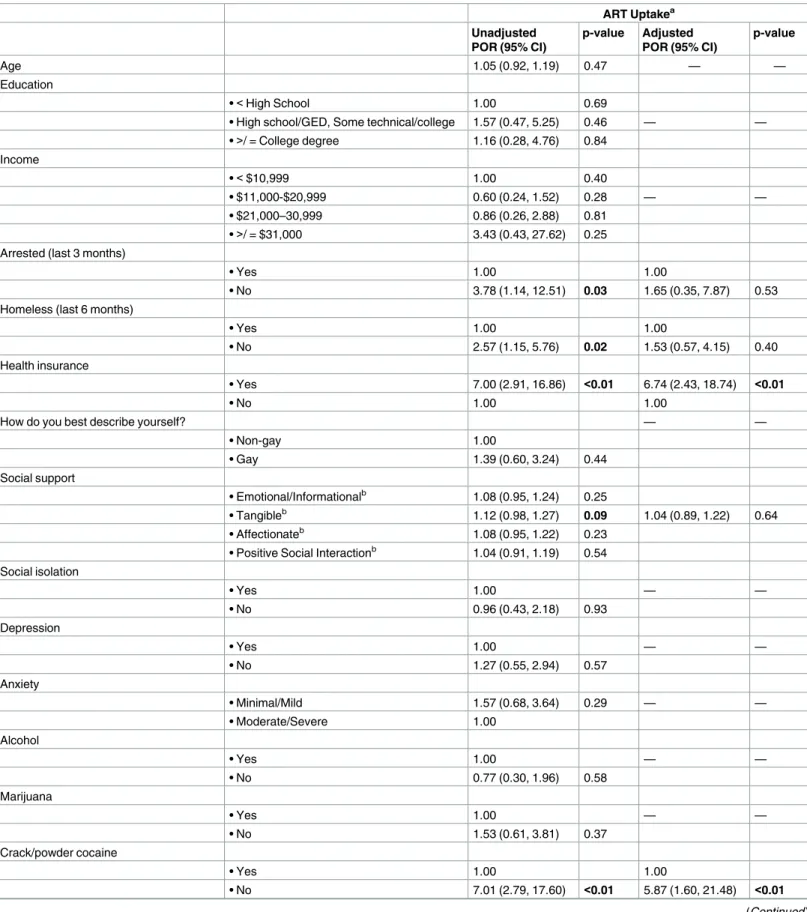
), having insurance (POR 6.74; 95% CI: 2.43, 18.74) and not
using cocaine or crack (POR 5.87; 95% CI: 1.60, 21.48) were associated with ART uptake.
Self-reported adherence and viral suppression
A majority of participants (70.8%) reported
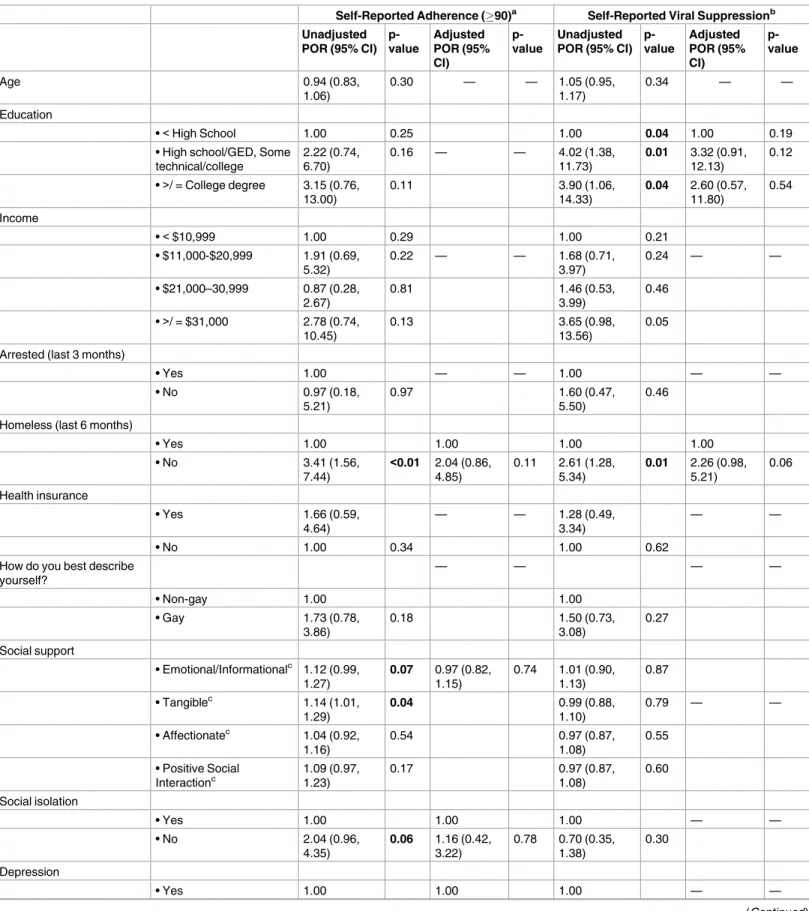
90% adherence. In bivariable analyses (
Table 4
),
lack of depressive symptoms, higher levels of tangible support, and not being homeless in the
past 6 months were associated with self-reported adherence
90%. In multivariable analyses,
those with depressive symptoms had 4.7 times the odds of reporting adherence
<
90% (95%
CI: 1.65, 13.37).
Sixty-five percent of HIV-positive YBMSM who reported completing viral load testing in
the past six months reported an undetectable viral load (n = 102). In multivariable analyses,
any disclosure to sex partners was associated with higher likelihood of viral suppression (POR
6.03; 95% CI: 1.62, 22.40). Not reporting homelessness in the past 6 months approached
statis-tical significance (p = 0.06).
Discussion
This analysis revealed a range of factors and characteristics associated with suboptimal
out-comes for YBMSM on five indicators along the HIV care continuum. Notably, some
associa-tions—such as the beneficial effect of health insurance and the detrimental effect of drug use—
were significant across more than one continuum outcome. Yet, overall, each outcome had a
unique set of associated factors. Understanding these distinct needs of YBMSM at each stage
of the continuum and addressing them through tailored approaches is critical for achieving
the prevention benefits of viral suppression through “treatment as prevention” and sustaining
long-term optimal health outcomes. Below we discuss our findings at each step of the
contin-uum and potential intervention implications for YBMSM.
The majority of HIV-positive men in this study were engaged in care. This is likely related
to the fact that among those who were HIV-infected, about half (n = 102) were recruited
through case management organizations or HIV providers. Although a potential source of
bias, this also highlights the importance of community and health-care related partnerships
with research groups to enroll HIV-infected YBMSM in large studies. Further, participants in
this study reported a high overall self-efficacy for communicating with their health care
pro-viders. While not directly measured in this study, perception of racism and medical mistrust
by Black patients, including BMSM, has been found to impact patient-provider
communica-tion, health care access, and uptake of prevention services [
28
,
29
]. In prior studies, BMSM
Table 1. (Continued)
(n = 193)
N (%)
Mean [SD]
• Mean<4 47 (24.4)
• Mean4 146 (80.2)
Engagement in care 172 (89.1)
No missed HIV care visits (n = 167) 87 (52.1)
Antiretroviral uptake (n = 182) 153 (84.1)
Antiretroviral adherence (VAS) (>= 90) (n = 137) 97 (70.8)
Virally suppressed (n = 157) 102 (65.0)
Table 2. Bivariable and multivariable analysis for engagement in care and no missed visits.
Engagement in Carea No Missed Visitsb
Unadjusted POR (95% CI)
p-value Adjusted POR (95% CI) p-value Unadjusted POR (95% CI)
p-value Adjusted POR (95% CI) p-value
Age 0.99 (0.85,
1.15)
0.89 — — 0.93 (0.85,
1.03)
0.17 — —
Education
•<High School 1.00 0.59 1.00 0.01 1.00 0.02
• High school/GED, Some technical/college
1.30 (0.42, 6.18)
0.49 — — 3.42 (1.05,
11.07)
0.04 3.62 (1.00, 13.11)
0.70
•>/ = College degree 0.97 (0.21,
4.54)
0.97 8.53 (2.14, 34.
09)
<0.01 9.43 (1.91, 46.66)
0.01
Income 0.10 0.12
•<$10,999 1.00 0.83 1.00 1.00
• $11,000-$20,999 1.01 (0.30, 3.41)
0.99 — — 1.81 (0.81,
4.04)
0.15 1.03 (0.41, 2.59)
0.29
• $21,000–30,999 0.60 (0.17, 2.09)
0.42 0.61 (0.23,
1.60)
0.32 0.27 (0.08, 0.85)
0.02
•>/ = $31,000 0.69 (0.17,
2.74)
0.60 2.32 (0.81,
6.64)
0.12 0.95 (0.27, 3.27)
0.53
Arrested (last 3 months)
• Yes 1.00 — — 1.00 — —
• No 0.67 (0.08,
5.40)
0.70 0.60 (0.17,
2.14)
0.43
Homeless (last 6 months)
• Yes 1.00 1.00 1.00 1.00
• No 2.47 (0.99,
6.17)
0.05 1.02 (0.32, 3.25)
0.98 2.12 (1.08, 4.15)
0.03 1.58 (0.70, 3.56)
0.27
Health insurance
• Yes 9.55 (3.60,
25.39)
<0.01 8.47 (2.59, 27.73)
<0.01 0.61 (0.25, 1.48)
0.27 — —
• No 1.00 1.00 1.00
How do you best describe yourself?
— — — —
• Non-gay 1.00 1.00
• Gay 1.29 (0.49,
3.40)
0.60 1.51 (0.77,
2.98) 0.23 Social support • Emotional/ Informationalc 1.21 (1.04,1.40)
0.01 1.12 (1.00,
1.25)
0.04 1.09 (0.95, 1.26)
0.24
• Tangiblec 1.23 (1.07,
1.42)
<0.01 1.16 (0.97, 1.39)
0.10 1.12 (1.00, 1.24)
0.05
• Affectionatec 1.08 (0.95, 1.23)
0.26 1.01 (0.91,
1.11)
0.87
• Positive Social Interactionc
1.04 (0.90, 1.20)
0.64 1.01 (0.91,
1.12)
0.88 Social isolation
• Yes 1.00 — — 1.00 1.00
• No 1.96 (0.77,
4.99)
0.16 2.13 (1.13,
4.04)
0.02 1.26 (0.54, 2.94) Depression
• Yes 1.00 — — 1.00 — —
Table 2. (Continued)
Engagement in Carea No Missed Visitsb
Unadjusted POR (95% CI)
p-value Adjusted POR (95% CI) p-value Unadjusted POR (95% CI)
p-value Adjusted POR (95% CI) p-value
• No 1.47 (0.56,
3.83)
0.43 1.48 (0.80,
2.76)
0.22
Anxiety
• Minimal/Mild 1.42 (0.55, 3.62)
0.47 — — 0.90 (0.46,
1.75)
— —
• Moderate/Severe 1.00 1.00 0.75
Alcohol
• Yes 1.00 — — 1.00 — —
• No 1.13 (0.36,
3.55)
0.84 1.04 (0.49,
2.22)
0.91
Marijuana
• Yes 1.00 — — 1.00 1.00
• No 1.56 (0.54,
4.43)
0.42 2.62 (1.32,
5.19)
0.01 2.49 (1.14, 5.44)
0.02
Crack/powder cocaine
• Yes 1.00 — — 1.00 — —
• No 1.52 (0.47,
4.93)
0.48 1.68 (0.68,
4.18)
0.26
Methamphetamine
• Yes 1.00 — — 1.00 1.00
• No 2.44 (0.62,
9.57)
0.20 4.72 (0.97,
22.95)
0.05 5.42 (1.03, 28.52)
0.05
Club drugs
• Yes 1.00 — — 1.00 — —
• No 0.71 (0.15,
3.42)
0.67 1.11 (0.33,
3.79)
0.87
Opiates
• Yes 1.00 — — 1.00 — —
• No 2.16
(0.43,10.91)
0.35 0.42 (0.08,
2.23)
0.31
Inhalants
• Yes 1.00 — — 1.00 — —
• No 2.44 (0.62,
9.57)
0.20 3.11 (0.80,
12.17)
0.10
Disclosure of HIV status to friends
— — — —
• None 1.00 1.00
• A few/ Most people/All 0.62 (0.08, 5.12)
0.66 1.61 (0.66,
3.95)
0.29
Disclosure of HIV status to family
— — — —
• None 1.00 1.00
• A few/ Most people/All 1.45 (0.36, 5.91)
0.60 1.20 (0.56,
2.58)
0.63
Disclosure of HIV status to sex partners
— — — —
• None 1.00 1.00
were found to be less likely to report primary care provider awareness of their sexual
orienta-tion compared to White MSM [
30
]. However, few studies have examined the relationships
between BMSM and primary care providers, particularly among those who are HIV-positive.
Additional in-depth research is needed to elucidate barriers and facilitators to optimal and
productive patient-provider communication that can be targeted for interventions to impact
engagement in care.
Despite high levels of care engagement there were also high rates of missed visits. Missed
visits have multiple negative consequences: interruptions in ART due to lapses in insurance or
drug assistance coverage, delays in health care (e.g. sexually transmitted infection screening
and immunizations), and timely evaluations for ART toxicity and adherence. In this study,
missed visits were associated with lower education. These results align with findings from a
linkage-to-care study of 1891 adolescents and young adults living with HIV (27.8% perinatally
infected; 72.2% behaviorally infected) which found that missed appointments were common
among those with less education living in economically disadvantaged areas [
31
]. While not
measured in this study, Harper et al. found that in a sample of 200 HIV-positive male
adoles-cents, 66% of whom were Black, those with a stronger connection to their racial/ethnic identity
were less likely to have missed an HIV medical appointment during the prior 3 months, while
those with more negative attitudes towards gay/bisexual people were more likely to have
missed appointments [
32
]. These findings thus highlight the importance of addressing
individ-ual, developmental and structural factors when possible.
Missed visits among YBMSM in this sample were also associated with marijuana use. The
impact of marijuana on continuum of care metrics has been less studied than other substances
[
33
,
34
] and the limited studies have reported that the effect of marijuana on retention in care
are inconclusive. In a study of 212 HIV seropositive YBMSM in Chicago, there was no
signifi-cant association found between intermittent or heavy marijuana use and retention in care
[
35
]. Another study, however, found weekly or daily marijuana use to be associated with loss
to follow-up [
36
]. Given the high proportion of marijuana use among people living with HIV
[
37
–
41
] as well as increasing trends towards legalization of marijuana, additional research
Table 2. (Continued)
Engagement in Carea No Missed Visitsb
Unadjusted POR (95% CI)
p-value
Adjusted POR (95% CI)
p-value
Unadjusted POR (95% CI)
p-value
Adjusted POR (95% CI)
p-value
• A few/ Most people/All 1.14 (0.14, 9.69)
0.90 0.81 (0.25,
2.68)
0.73
Self-efficacy for HCP communication
• Mean<4 1.00 1.00 1.00 — —
• Mean4 20.12 (6.12,
64.05)
<0.01 13.19 (3.72, 46.77)
<0.01 0.66 (0.29, 1.50)
0.32
a 193 were included in bivariable analysis; 191 were included multivariable analysis due to missing independent variable values. Emotional/Informational social support and tangible social support were significant in bivariable analysis, but tangible social support was included in the multivariable model with lower AIC.
b 167 were included in bivariable analysis; 162 were included multivariable analysis due to missing independent variable values. Emotional/Informational social support and tangible social support were significant in bivariable analysis, but emotional/informational social support was included in the multivariable model with lower AIC.
c The odds for 10 units increase in social support.
Table 3. Bivariable and multivariable analysis for antiretroviral therapy uptake.
ART Uptakea Unadjusted
POR (95% CI)
p-value Adjusted POR (95% CI)
p-value
Age 1.05 (0.92, 1.19) 0.47 — —
Education
•<High School 1.00 0.69
• High school/GED, Some technical/college 1.57 (0.47, 5.25) 0.46 — —
•>/ = College degree 1.16 (0.28, 4.76) 0.84
Income
•<$10,999 1.00 0.40
• $11,000-$20,999 0.60 (0.24, 1.52) 0.28 — —
• $21,000–30,999 0.86 (0.26, 2.88) 0.81
•>/ = $31,000 3.43 (0.43, 27.62) 0.25
Arrested (last 3 months)
• Yes 1.00 1.00
• No 3.78 (1.14, 12.51) 0.03 1.65 (0.35, 7.87) 0.53
Homeless (last 6 months)
• Yes 1.00 1.00
• No 2.57 (1.15, 5.76) 0.02 1.53 (0.57, 4.15) 0.40
Health insurance
• Yes 7.00 (2.91, 16.86) <0.01 6.74 (2.43, 18.74) <0.01
• No 1.00 1.00
How do you best describe yourself? — —
• Non-gay 1.00
• Gay 1.39 (0.60, 3.24) 0.44
Social support
• Emotional/Informationalb
1.08 (0.95, 1.24) 0.25
• Tangibleb 1.12 (0.98, 1.27) 0.09 1.04 (0.89, 1.22) 0.64
• Affectionateb 1.08 (0.95, 1.22) 0.23
• Positive Social Interactionb 1.04 (0.91, 1.19) 0.54 Social isolation
• Yes 1.00 — —
• No 0.96 (0.43, 2.18) 0.93
Depression
• Yes 1.00 — —
• No 1.27 (0.55, 2.94) 0.57
Anxiety
• Minimal/Mild 1.57 (0.68, 3.64) 0.29 — —
• Moderate/Severe 1.00
Alcohol
• Yes 1.00 — —
• No 0.77 (0.30, 1.96) 0.58
Marijuana
• Yes 1.00 — —
• No 1.53 (0.61, 3.81) 0.37
Crack/powder cocaine
• Yes 1.00 1.00
• No 7.01 (2.79, 17.60) <0.01 5.87 (1.60, 21.48) <0.01
specifically addressing the context and frequency of marijuana use and its impact on HIV care
and treatment is warranted.
Most participants in this sample were on ART and reported adhering to
90% of their
pre-scribed medication. While health insurance and not using cocaine (including crack) were
posi-tively associated with ART uptake, depressive symptomology was the sole factor associated
with poor adherence. More than half of the sample (59.4%) reported clinically relevant
depres-sive symptoms. It is clear that depression negatively impacts adherence; a meta-analysis across
nearly 100 independent samples found that depression was significantly associated with
non-adherence (p
<
0.0001) [
42
]. Addressing mental health must be an element of care provision
across the continuum and in the development of interventions for those YBMSM living with
HIV.
Despite overall high levels of engagement in care, ART uptake, and self-reported
medica-tion adherence, it is concerning that only 65% of HIV-positive YBMSM in this sample
reported an undetectable viral load in the past six months. The finding that disclosure was
associated with viral suppression may be interpreted in at least two ways. Disclosure is
impor-tant for accessing support, which can impact engagement in care, medication adherence and
ultimately, viral suppression [
43
]. Given the cross-sectional nature of this analysis, it is also
Table 3. (Continued)
ART Uptakea
Unadjusted POR (95% CI)
p-value Adjusted POR (95% CI)
p-value
Methamphetamine
• Yes 1.00 — —
• No 2.56 (0.73, 8.95) 0.14
Club drugs
• Yes 1.00 1.00
• No 0.35 (0.10, 1.23) 0.10 0.92 (0.10, 8.61) 0.94
Opiates
• Yes 1.00 1.00
• No 4.74 (1.19, 18.85) 0.03 2.35 (0.22, 25.44) 0.48
Inhalants
• Yes 1.00 1.00
• No 3.78 (1.14, 12.51) 0.03 1.35 (0.28, 6.53) 0.71
Disclosure of HIV status to friends — —
• None 1.00
• A few/ Most people/All 0.20 (0.03, 1.52) 0.12
Disclosure of HIV status to family — —
• None 1.00
• A few/ Most people/All 1.98 (0.80, 4.88) 0.14
Disclosure of HIV status to sex partners — —
• None 1.00
• A few/ Most people/All 0.83 (0.18, 3.90) 0.81 Self-efficacy for HCP communication
• Mean<4 1.00 1.00
• Mean4 3.13 (1.32, 7.42) 0.01 1.98 (0.63, 6.16) 0.24
a 182 were included in bivariable analysis; 180 were included multivariable analysis due to missing independent variable values. b Odds for 10 unit increase in social support.
Table 4. Bivariable and multivariable analysis for self-reported antiretroviral adherence and viral suppression.
Self-Reported Adherence (90)a Self-Reported Viral Suppressionb Unadjusted
POR (95% CI) p-value Adjusted POR (95% CI) p-value Unadjusted POR (95% CI)
p-value Adjusted POR (95% CI) p-value
Age 0.94 (0.83,
1.06)
0.30 — — 1.05 (0.95,
1.17)
0.34 — —
Education
•<High School 1.00 0.25 1.00 0.04 1.00 0.19
• High school/GED, Some technical/college
2.22 (0.74, 6.70)
0.16 — — 4.02 (1.38,
11.73)
0.01 3.32 (0.91, 12.13)
0.12
•>/ = College degree 3.15 (0.76,
13.00)
0.11 3.90 (1.06,
14.33)
0.04 2.60 (0.57, 11.80)
0.54
Income
•<$10,999 1.00 0.29 1.00 0.21
• $11,000-$20,999 1.91 (0.69, 5.32)
0.22 — — 1.68 (0.71,
3.97)
0.24 — —
• $21,000–30,999 0.87 (0.28, 2.67)
0.81 1.46 (0.53,
3.99)
0.46
•>/ = $31,000 2.78 (0.74,
10.45)
0.13 3.65 (0.98,
13.56)
0.05
Arrested (last 3 months)
• Yes 1.00 — — 1.00 — —
• No 0.97 (0.18,
5.21)
0.97 1.60 (0.47,
5.50)
0.46
Homeless (last 6 months)
• Yes 1.00 1.00 1.00 1.00
• No 3.41 (1.56,
7.44)
<0.01 2.04 (0.86, 4.85)
0.11 2.61 (1.28, 5.34)
0.01 2.26 (0.98, 5.21)
0.06
Health insurance
• Yes 1.66 (0.59,
4.64)
— — 1.28 (0.49,
3.34)
— —
• No 1.00 0.34 1.00 0.62
How do you best describe yourself?
— — — —
• Non-gay 1.00 1.00
• Gay 1.73 (0.78,
3.86)
0.18 1.50 (0.73,
3.08)
0.27
Social support
• Emotional/Informationalc 1.12 (0.99, 1.27)
0.07 0.97 (0.82, 1.15)
0.74 1.01 (0.90, 1.13)
0.87
• Tangiblec 1.14 (1.01,
1.29)
0.04 0.99 (0.88,
1.10)
0.79 — —
• Affectionatec 1.04 (0.92, 1.16)
0.54 0.97 (0.87,
1.08)
0.55
• Positive Social Interactionc
1.09 (0.97, 1.23)
0.17 0.97 (0.87,
1.08)
0.60 Social isolation
• Yes 1.00 1.00 1.00 — —
• No 2.04 (0.96,
4.35)
0.06 1.16 (0.42, 3.22)
0.78 0.70 (0.35, 1.38)
0.30
Depression
• Yes 1.00 1.00 1.00 — —
Table 4. (Continued)
Self-Reported Adherence (90)a Self-Reported Viral Suppressionb
Unadjusted POR (95% CI)
p-value Adjusted POR (95% CI) p-value Unadjusted POR (95% CI)
p-value Adjusted POR (95% CI) p-value
• No 4.91 (1.98,
12.19)
<0.01 4.70 (1.65, 13.37)
<0.01 1.15 (0.59, 2.24)
0.68
Anxiety
• Minimal/Mild 1.29 (0.59, 2.83)
0.53 — — 0.73 (0.35,
1.56)
0.42 — —
• Moderate/Severe 1.00 1.00
Alcohol
• Yes 1.00 — — 1.00 — —
• No 0.48 (0.20,
1.17)
0.11 1.10 (0.49,
2.48)
0.82
Marijuana
• Yes 1.00 — — 1.00 — —
• No 1.78 (0.76,
4.17)
0.19 1.33 (0.66,
2.67)
0.43
Crack/powder cocaine
• Yes 1.00 — — 1.00 1.00
• No 1.09 (0.31,
3.75)
0.90 3.28 (1.25,
8.60)
0.02 2.59 (0.84, 8.00)
0.10
Methamphetamine
• Yes 1.00 — — 1.00 1.00
• No 1.23 (0.29,
5.18)
0.78 4.04 (0.97,
16.84)
0.06 3.61 (0.64, 20.37)
0.15
Club drugs
• Yes 1.00 — — 1.00 1.00
• No 1.03 (0.19,
5.56)
0.97 0.33 (0.09,
1.24)
0.10 1.68 (0.35, 8.00)
0.52
Opiates
• Yes 1.00 — — 1.00 — —
• No 1.65 (0.27,
10.27)
0.59 2.59 (0.56,
12.00)
0.23
Inhalants
• Yes 1.00 — — 1.00 — —
• No 0.80 (0.15,
4.13)
0.79 2.45 (0.63,
9.53)
0.20
Disclosure of HIV status to friends
• None 1.00 — — 1.00 — —
• A few/ Most people/All 1.83 (0.71, 4.72)
0.21 0.57 (0.20,
1.66)
0.30
Disclosure of HIV status to family
• None 1.00 — — 1.00 — —
• A few/ Most people/All 0.71 (0.26, 1.94)
0.51 0.86 (0.37,
2.00)
0.73
Disclosure of HIV status to sex partners
• None 1.00 — — 1.00 1.00
plausible that those who achieved viral suppression were more likely to disclose their status
to an intimate partner. Importantly, both interpretations point toward a need for greater
support for status disclosure. Currently, there is a lack of interventions targeting disclosure
to sex partners. In a recent review, Conserve et al. identified five trials, of which only three
were efficacious and all were delivered in multiple small group sessions limiting widespread
implementation [
44
].
Several cross-cutting factors stand out across the care continuum for YBMSM in this sample.
First, substance use among HIV-infected YMSM creates challenges in health care provision and
has been previously associated with decreased engagement in care and poor adherence to care
and medications [
45
–
47
]. Substance use can lead to inaccurate perceptions of time, the inability
to adhere to routines, and impaired decision making, all important barriers to retention in care
[
48
]. Future studies should examine both the patterns of use as well as the pathways in which
both frequent and infrequent use impact care seeking and adherence behaviors. Co-location or
integration of HIV care with substance use treatment to improve long-term health outcomes
for YMSM should be considered to address these issues.
Second, a majority of the sample was insured (80.3%). This aligns with data from the NHBS
that found that between 2008 and 2014, current insurance status among HIV-positive MSM
increased from 75% to 86% (6). Many of the participants in the current study may have
consid-ered Ryan White and ADAP (AIDS Drug Assistance Program) benefits as insurance. Another
explanation for the high percentage insured given the young age of the sample is the ability to
be maintained on parents’ insurance plans. It should also be noted that the Patient Protection
and Affordable Care Act was signed into law on March 23rd, 2010, and implementation began
in late 2013 –coinciding with HMP enrollment (2013–2015). Indeed, the overall percentage of
U.S. adults who were uninsured dropped from 18% in the third quarter of 2013 to 11% in the
first quarter of 2016 [
49
]. Given that having insurance was associated with greater engagement
in care and ART uptake in this sample, continued efforts to ensure HIV-positive young men
have access to insurance or provision of ART benefits through other means is critical.
This exploratory study has some important limitations. Study outcomes were not rare (i.e.,
<
10%) so odds and odds ratios should not be interpreted as risks. The data included in these
analyses are from the baseline survey for an online intervention and are thus cross-sectional in
Table 4. (Continued)
Self-Reported Adherence (90)a Self-Reported Viral Suppressionb
Unadjusted POR (95% CI)
p-value
Adjusted POR (95% CI)
p-value
Unadjusted POR (95% CI)
p-value
Adjusted POR (95% CI)
p-value
• A few/ Most people/All 1.30 (0.37, 4.61)
0.69 5.18(1.51,
17.79)
0.01 6.03 (1.62, 22.40)
0.01
Self-efficacy for HCP communication
• Mean<4 1.00 1.00 1.00 — —
• Mean4 2.25 (0.92,
5.51)
0.08 1.24 (0.46, 3.32)
0.68 1.05 (0.43, 2.57)
0.91
a 137 were included in bivariable analysis; 134 were included multivariable analysis due to missing independent variable values. Emotional/Informational social support and tangible social support were significant in bivariate analysis, but emotional/informational social support was included in the multivariable model with lower AIC.
b 157 were included in bivariable analysis; 145 were included multivariable analysis due to missing independent variable values. c Odds for 10 unit increase in social support.
nature, limiting our ability to determine causality. Our engagement and viral suppression
mea-sures were assessed via self-report, thus introducing the possibility of both recall and reporting
bias [
50
]. However, all our surveys were conducted online which has been shown to be a reliable
and valid method for collecting sensitive information among young adults [
51
,
52
]. Finally, as
mentioned above, many of the HIV-positive participants in the intervention were recruited
from HIV clinics and community based organizations and thus may not be reflective of the
population of those YBMSM who are out of care.
Findings from this study have implications for both future research as well as
interven-tion development for HIV-positive YBMSM. The high rates of depression, social isolainterven-tion
and substance use behaviors seen in this study have been found in other work focused on
YBMSM, including those who are HIV-positive [
53
–
55
]. These psychosocial conditions,
particularly in combination are likely to have an additive impact on continuum of care
outcomes for YBMSM. While prior work has established the impact of syndemics on
heightened risk for HIV infection among BMSM [
55
–
58
], longitudinal studies that not
only address the combined impact of syndemics over time, but also provide guidance on
how to effectively intervene as early as possible in these men’s lives are needed. Validated
clinical screening tools for mental health [
59
,
60
] and substance use disorders [
61
,
62
]
should be administered upon initial care engagement and at regular intervals to identify
those YBMSM in need of additional services [
63
]. Given the high reported rates of social
isolation experienced by YBMSM in this study, network based interventions, such as
Proj-ect nGage, which focuses on helping YBMSM identify supportive relationships as a
mecha-nism to promote retention in care, could be beneficial [
64
].
Conclusion
The results from this large sample of YBMSM revealed multi-level barriers to engagement
across the continuum of care. To our knowledge, this is the largest sample of YBMSM in
which each stage of the care continuum was separately addressed. Structural barriers such as
insurance status and homelessness as well individual- level behaviors and psychosocial factors
such as drug use and depression limited engagement in care and virologic suppression.
How-ever, a focus on barriers alone is insufficient to understand and address the complex process of
engagement in care and ultimately sustained virologic suppression for YBMSM.
Supporting information
S1 File. COC paper data.
(XLSX)
Author Contributions
Conceptualization: Lisa Hightow-Weidman, Sara LeGrand, Kathryn E. Muessig.
Data curation: Sara LeGrand, Seul Ki Choi, Joseph Egger.
Formal analysis: Sara LeGrand, Seul Ki Choi, Joseph Egger.
Funding acquisition: Lisa Hightow-Weidman.
Investigation: Lisa Hightow-Weidman, Sara LeGrand, Kathryn E. Muessig.
Methodology: Lisa Hightow-Weidman, Sara LeGrand, Kathryn E. Muessig.
Supervision: Lisa Hightow-Weidman.
Visualization: Lisa Hightow-Weidman, Sara LeGrand, Seul Ki Choi.
Writing – original draft: Lisa Hightow-Weidman.
Writing – review & editing: Lisa Hightow-Weidman, Sara LeGrand, Christopher B. Hurt,
Kathryn E. Muessig.
References
1. Millett GA, Peterson JL, Flores SA, Hart TA, Jeffries WLt, Wilson PA, et al. Comparisons of disparities and risks of HIV infection in black and other men who have sex with men in Canada, UK, and USA: a meta-analysis. Lancet. 2012; 380(9839):341–8.https://doi.org/10.1016/S0140-6736(12)60899-X
PMID:22819656
2. Marks G, Millett GA, Bingham T, Bond L, Lauby J, Liau A, et al. Understanding differences in HIV sexual transmission among Latino and black men who have sex with men: The Brothers y Hermanos Study. AIDS Behav. 2009; 13(4):682–90.https://doi.org/10.1007/s10461-008-9380-6PMID:
18752064
3. Maulsby C, Millett G, Lindsey K, Kelley R, Johnson K, Montoya D, et al. HIV among Black men who have sex with men (MSM) in the United States: a review of the literature. AIDS Behav. 2014; 18(1):10– 25.https://doi.org/10.1007/s10461-013-0476-2PMID:23620241
4. Millett GA, Flores SA, Peterson JL, Bakeman R. Explaining disparities in HIV infection among black and white men who have sex with men: a meta-analysis of HIV risk behaviors. AIDS. 2007; 21(15):2083–91.
https://doi.org/10.1097/QAD.0b013e3282e9a64bPMID:17885299
5. Oster AM, Wiegand RE, Sionean C, Miles IJ, Thomas PE, Melendez-Morales L, et al. Understanding disparities in HIV infection between black and white MSM in the United States. AIDS. 2011; 25 (8):1103–12.https://doi.org/10.1097/QAD.0b013e3283471efaPMID:21505305
6. Hoots BE, Finlayson TJ, Wejnert C, Paz-Bailey G, National HIVBSSG. Updated Data on Linkage to Human Immunodeficiency Virus Care and Antiretroviral Treatment Among Men Who Have Sex With Men-20 Cities, United States. J Infect Dis. 2017.
7. Kahana SY, Fernandez MI, Wilson PA, Bauermeister JA, Lee S, Wilson CM, et al. Rates and correlates of antiretroviral therapy use and virologic suppression among perinatally and behaviorally HIV-infected youth linked to care in the United States. J Acquir Immune Defic Syndr. 2015; 68(2):169–77.https://doi. org/10.1097/QAI.0000000000000408PMID:25590270
8. Mugavero MJ, Davila JA, Nevin CR, Giordano TP. From access to engagement: measuring retention in outpatient HIV clinical care. AIDS patient care and STDs. 2010; 24(10):607–13.https://doi.org/10.1089/ apc.2010.0086PMID:20858055
9. Mugavero MJ, Lin HY, Allison JJ, Giordano TP, Willig JH, Raper JL, et al. Racial disparities in HIV viro-logic failure: do missed visits matter? J Acquir Immune Defic Syndr. 2009; 50(1):100–8.https://doi.org/ 10.1097/QAI.0b013e31818d5c37PMID:19295340
10. Howe CJ, Cole SR, Napravnik S, Eron JJ. Enrollment, retention, and visit attendance in the University of North Carolina Center for AIDS Research HIV clinical cohort, 2001–2007. AIDS Res Hum Retrovi-ruses. 2010; 26(8):875–81.https://doi.org/10.1089/aid.2009.0282PMID:20672995
11. Rosenberg ES, Millett GA, Sullivan PS, Del Rio C, Curran JW. Understanding the HIV disparities between black and white men who have sex with men in the USA using the HIV care continuum: a modeling study. Lancet HIV. 2014; 1(3):e112–e8.https://doi.org/10.1016/S2352-3018(14)00011-3
PMID:25530987
12. Centers for Disease Control and Prevention Monitoring selected national HIV prevention and care objectives by using HIV surveillance data—United States and 6 dependent areas—2013 HIV Surveil-lance Supplemental Report 2015;20(No 2)http://wwwcdcgov/hiv/library/reports/surveillance/Published July 2015 Accessed December 27, 2015 [Internet].
13. Kapogiannis B, Xu J, Mayer KH, Loeb J, Greenberg L, Monte D, et al. he HIV continuum of care for ado-lescents and young adults (12–24 years) attending 13 urban US centers of the NICHD-ATN-CDC-HRSA SMILE collaborative. 8th International AIDS Society Conference on HIV Pathogenesis, Treat-ment and Prevention; Vancouver2015.
15. Magnus M, Jones K, Phillips G 2nd, Binson D, Hightow-Weidman LB, Richards-Clarke C, et al. Charac-teristics associated with retention among African American and Latino adolescent HIV-positive men: results from the outreach, care, and prevention to engage HIV-seropositive young MSM of color special project of national significance initiative. J Acquir Immune Defic Syndr. 2010; 53(4):529–36.https://doi. org/10.1097/QAI.0b013e3181b56404PMID:19755914
16. Schneider JA, Kozloski M, Michaels S, Skaathun B, Voisin D, Lancki N, et al. Criminal justice involve-ment history is associated with better HIV care continuum metrics among a population-based sample of young black MSM. AIDS. 2017; 31(1):159–65.https://doi.org/10.1097/QAD.0000000000001269PMID:
27662544
17. Hightow-Weidman LB, Fowler B, Kibe J, McCoy R, Pike E, Calabria M, et al.HealthMpowerment.org: development of a theory-based HIV/STI website for young black MSM. AIDS Educ Prev. 2011; 23(1):1– 12.https://doi.org/10.1521/aeap.2011.23.1.1PMID:21341956
18. Hightow-Weidman LB, Muessig KE, Pike EC, LeGrand S, Baltierra N, Rucker AJ, et al.
HealthMpowerment.org: Building Community Through a Mobile-Optimized, Online Health Promotion Intervention. Health Educ Behav. 2015; 42(4):493–9.https://doi.org/10.1177/1090198114562043
PMID:25588932
19. Sherbourne CD, Stewart AL. The MOS social support survey. Soc Sci Med. 1991; 32(6):705–14. PMID:
2035047
20. Lubben J, Blozik E, Gillmann G, Iliffe S, von Renteln Kruse W, Beck JC, et al. Performance of an abbre-viated version of the Lubben Social Network Scale among three European community-dwelling older adult populations. Gerontologist. 2006; 46(4):503–13. PMID:16921004
21. Radloff LS. The CES-D scale: A self-report depression scale for research in the general population. Applied Psychological Measurement. 1977; 1:385–401.
22. Spitzer RL, Kroenke K, Williams JB, Lowe B. A brief measure for assessing generalized anxiety disor-der: the GAD-7. Archives of internal medicine. 2006; 166(10):1092–7.https://doi.org/10.1001/archinte. 166.10.1092PMID:16717171
23. Shively M, Smith TL, Bormann J, Gifford AL. Evaluating Self-Efficacy for HIV Disease Management Skills. AiDS and Behavior. 2002; 6(4):371–9.
24. Berg MB, Safren SA, Mimiaga MJ, Grasso C, Boswell S, Mayer KH. Nonadherence to medical appoint-ments is associated with increased plasma HIV RNA and decreased CD4 cell counts in a community-based HIV primary care clinic. AIDS Care. 2005; 17(7):902–7.https://doi.org/10.1080/
09540120500101658PMID:16120506
25. Mugavero MJ, Westfall AO, Cole SR, Geng EH, Crane HM, Kitahata MM, et al. Beyond core indicators of retention in HIV care: missed clinic visits are independently associated with all-cause mortality. Clin Infect Dis. 2014; 59(10):1471–9.https://doi.org/10.1093/cid/ciu603PMID:25091306
26. Giordano TP, Guzman D, Clark R, Charlebois ED, Bangsberg DR. Measuring adherence to antiretrovi-ral therapy in a diverse population using a visual analogue scale. HIV Clin Trials. 2004; 5(2):74–9.
https://doi.org/10.1310/JFXH-G3X2-EYM6-D6UGPMID:15116282
27. Sam TS, Hutton HE, Lau B, McCaul ME, Keruly J, Moore R, et al. Antiretroviral Therapy Use, Medica-tion Adherence, and Viral Suppression Among PLWHA with Panic Symptoms. AIDS and behavior. 2015; 19(11):2049–56.https://doi.org/10.1007/s10461-015-1064-4PMID:25903506
28. Hausmann LR, Hannon MJ, Kresevic DM, Hanusa BH, Kwoh CK, Ibrahim SA. Impact of perceived dis-crimination in healthcare on patient-provider communication. Med Care. 2011; 49(7):626–33.https:// doi.org/10.1097/MLR.0b013e318215d93cPMID:21478769
29. Eaton LA, Driffin DD, Smith H, Conway-Washington C, White D, Cherry C. Psychosocial factors related to willingness to use pre-exposure prophylaxis for HIV prevention among Black men who have sex with men attending a community event. Sex Health. 2014; 11(3):244–51.https://doi.org/10.1071/SH14022
PMID:25001553
30. Petroll AE, Mosack KE. Physician awareness of sexual orientation and preventive health recommenda-tions to men who have sex with men. Sex Transm Dis. 2011; 38(1):63–7.https://doi.org/10.1097/OLQ. 0b013e3181ebd50fPMID:20706178
31. Kahana SY, Jenkins RA, Bruce D, Fernandez MI, Hightow-Weidman LB, Bauermeister JA, et al. Struc-tural Determinants of Antiretroviral Therapy Use, HIV Care Attendance, and Viral Suppression among Adolescents and Young Adults Living with HIV. PLoS One. 2016; 11(4):e0151106.https://doi.org/10. 1371/journal.pone.0151106PMID:27035905
33. Malta M, Magnanini MM, Strathdee SA, Bastos FI. Adherence to antiretroviral therapy among HIV-infected drug users: a meta-analysis. AIDS Behav. 2010; 14(4):731–47.https://doi.org/10.1007/ s10461-008-9489-7PMID:19020970
34. Hendershot CS, Stoner SA, Pantalone DW, Simoni JM. Alcohol use and antiretroviral adherence: review and meta-analysis. J Acquir Immune Defic Syndr. 2009; 52(2):180–202.https://doi.org/10.1097/ QAI.0b013e3181b18b6ePMID:19668086
35. Morgan E, Khanna AS, Skaathun B, Michaels S, Young L, Duvoisin R, et al. Marijuana Use Among Young Black Men Who Have Sex With Men and the HIV Care Continuum: Findings From the uConnect Cohort. Subst Use Misuse. 2016; 51(13):1751–9.https://doi.org/10.1080/10826084.2016.1197265
PMID:27556866
36. Weber R, Huber M, Battegay M, Stahelin C, Castro Batanjer E, Calmy A, et al. Influence of noninjecting and injecting drug use on mortality, retention in the cohort, and antiretroviral therapy, in participants in the Swiss HIV Cohort Study. HIV medicine. 2015; 16(3):137–51.https://doi.org/10.1111/hiv.12184
PMID:25124393
37. Center for Behavioral Health Statistics and Quality. Key substance use and mental health indicators in the United States: Results from the 2015 National Survey on Drug Use and Health (HHS Publication No. SMA 16–4984, NSDUH Series H-51). Rockville, MD: Substance Abuse and Mental Health Services Adminstration. Available from:http://www.samhsa.gov/data. Accessed November 2016.; 2016. 38. D’Souza G, Matson PA, Grady CD, Nahvi S, Merenstein D, Weber KM, et al. Medicinal and
Recrea-tional Marijuana Use Among HIV-Infected Women in the Women’s Interagency HIV Study (WIHS) Cohort, 1994–2010:. JAIDS Journal of Acquired Immune Deficiency Syndromes. 2012; 61:618–26.
https://doi.org/10.1097/QAI.0b013e318273ab3aPMID:23011399
39. Mimiaga MJ, Reisner SL, Grasso C, Crane HM, Safren SA, Kitahata MM, et al. Substance use among HIV-infected patients engaged in primary care in the United States: findings from the Centers for AIDS Research Network of Integrated Clinical Systems cohort. American journal of public health. 2013; 103 (8):1457–67.https://doi.org/10.2105/AJPH.2012.301162PMID:23763417
40. Centers for Disease Control and Prevention. Behavioral and Clinical Characteristics of Persons Receiv-ing Medical Care for HIV Infection—Medical MonitorReceiv-ing Project, United States, 2009. Morb Mortal Wkly Rep 2014; 63(SS-5).
41. Allshouse AA, MaWhinney S, Jankowski CM, Kohrt WM, Campbell TB, Erlandson KM. The Impact of Marijuana Use on the Successful Aging of HIV-Infected Adults. Journal of acquired immune deficiency syndromes. 2015; 69(2):187–92.https://doi.org/10.1097/QAI.0000000000000562PMID:25647530
42. Gonzalez JS, Batchelder AW, Psaros C, Safren SA. Depression and HIV/AIDS treatment nonadher-ence: a review and meta-analysis. J Acquir Immune Defic Syndr. 2011; 58(2):181–7.https://doi.org/10. 1097/QAI.0b013e31822d490aPMID:21857529
43. Kalichman SC, Kalichman MO, Cherry C, Grebler T. HIV Disclosure and Transmission Risks to Sex Partners Among HIV-Positive Men. AIDS patient care and STDs. 2016; 30(5):221–8.https://doi.org/10. 1089/apc.2015.0333PMID:27158850
44. Conserve DF, Groves AK, Maman S. Effectiveness of interventions promoting HIV serostatus disclo-sure to sexual partners: a systematic review. AIDS and behavior. 2015; 19(10):1763–72.https://doi.org/ 10.1007/s10461-015-1006-1PMID:25645328
45. Murphy DA, Belzer M, Durako SJ, Sarr M, Wilson CM, Muenz LR. Longitudinal antiretroviral adherence among adolescents infected with human immunodeficiency virus. Archives of pediatrics & adolescent medicine. 2005; 159(8):764–70.
46. Samet JH, Horton NJ, Meli S, Freedberg KA, Palepu A. Alcohol consumption and antiretroviral adher-ence among HIV-infected persons with alcohol problems. Alcoholism, clinical and experimental research. 2004; 28(4):572–7. PMID:15100608
47. O’Neil C, Palmer A, Coulter S, O’Brien N, Shen A, Zhang W, et al. Factors associated with antiretroviral medication adherence among HIV-positive adults accessing highly active antiretroviral therapy (HAART) in British Columbia, Canada. Journal of the International Association of Physicians in AIDS Care. 2012; 11(2):134–41.https://doi.org/10.1177/1545109711423976PMID:22318879
48. Solowij N, Jones KA, Rozman ME, Davis SM, Ciarrochi J, Heaven PC, et al. Reflection impulsivity in adolescent cannabis users: a comparison with alcohol-using and non-substance-using adolescents. Psychopharmacology. 2012; 219(2):575–86.https://doi.org/10.1007/s00213-011-2486-yPMID:
21938415
49. Gallup. U.S. uninsured rate at 11.0%, Lowest in Eight-Year Trend Washington, D.C.2016 [Available from:http://www.gallup.com/poll/190484/uninsured-rate-lowest-eight-year-trend.aspx.
51. Ramo DE, Hall SM, Prochaska JJ. Reliability and validity of self-reported smoking in an anonymous online survey with young adults. Health Psychol. 2011; 30(6):693–701.https://doi.org/10.1037/ a0023443PMID:21574709
52. Ramo DE, Liu H, Prochaska JJ. Reliability and validity of young adults’ anonymous online reports of marijuana use and thoughts about use. Psychol Addict Behav. 2012; 26(4):801–11.https://doi.org/10. 1037/a0026201PMID:22082344
53. Maksut JL, Eaton LA, Siembida EJ, Driffin DD, Baldwin R. An evaluation of factors associated with sex-ual risk taking among Black men who have sex with men: a comparison of younger and older popula-tions. J Behav Med. 2016; 39(4):665–74.https://doi.org/10.1007/s10865-016-9734-xPMID:27001255
54. Quinn K, Voisin DR, Bouris A, Schneider J. Psychological distress, drug use, sexual risks and medica-tion adherence among young HIV-positive Black men who have sex with men: exposure to community violence matters. AIDS Care. 2016; 28(7):866–72.https://doi.org/10.1080/09540121.2016.1153596
PMID:26917328
55. Mayer KH, Wang L, Koblin B, Mannheimer S, Magnus M, del Rio C, et al. Concomitant socioeconomic, behavioral, and biological factors associated with the disproportionate HIV infection burden among Black men who have sex with men in 6 U.S. cities. PLoS One. 2014; 9(1):e87298.https://doi.org/10. 1371/journal.pone.0087298PMID:24498067
56. Dyer TP, Shoptaw S, Guadamuz TE, Plankey M, Kao U, Ostrow D, et al. Application of syndemic theory to black men who have sex with men in the Multicenter AIDS Cohort Study. J Urban Health. 2012; 89 (4):697–708.https://doi.org/10.1007/s11524-012-9674-xPMID:22383094
57. Buttram ME, Kurtz SP. A mixed methods study of health and social disparities among substance-using African American/Black men who have sex with men. J Racial Ethn Health Disparities. 2015; 2(1):1–10.
https://doi.org/10.1007/s40615-014-0042-2PMID:25960944
58. Mustanski B, Garofalo R, Herrick A, Donenberg G. Psychosocial health problems increase risk for HIV among urban young men who have sex with men: preliminary evidence of a syndemic in need of atten-tion. Ann Behav Med. 2007; 34(1):37–45.https://doi.org/10.1080/08836610701495268PMID:
17688395
59. Chibanda D, Verhey R, Gibson LJ, Munetsi E, Machando D, Rusakaniko S, et al. Validation of screen-ing tools for depression and anxiety disorders in a primary care population with high HIV prevalence in Zimbabwe. J Affect Disord. 2016; 198:50–5.https://doi.org/10.1016/j.jad.2016.03.006PMID:27011359
60. Maurer DM. Screening for depression. Am Fam Physician. 2012; 85(2):139–44. PMID:22335214
61. Pence BW, Gaynes BN, Whetten K, Eron JJ Jr., Ryder RW, Miller WC. Validation of a brief screening instrument for substance abuse and mental illness in HIV-positive patients. J Acquir Immune Defic Syndr. 2005; 40(4):434–44. PMID:16280698
62. Whetten K, Reif S, Swartz M, Stevens R, Ostermann J, Hanisch L, et al. A brief mental health and sub-stance abuse screener for persons with HIV. AIDS Patient Care STDS. 2005; 19(2):89–99.https://doi. org/10.1089/apc.2005.19.89PMID:15716640
63. Edwards M, Quinlivan EB, Bess K, Gaynes BN, Heine A, Zinski A, et al. Implementation of PHQ-9 depression screening for HIV-infected patients in a real-world setting. J Assoc Nurses AIDS Care. 2014; 25(3):243–52.https://doi.org/10.1016/j.jana.2013.05.004PMID:24103743
![Table 1. Descriptive statistics of HIV-positive HMP participants at study entry. (n = 193) N (%) Mean [SD] Age (n = 192) 24.91 [3.11] Education • < High school 21 (10.9)](https://thumb-us.123doks.com/thumbv2/123dok_us/8268665.2190274/6.918.59.864.147.1041/table-descriptive-statistics-positive-participants-study-education-school.webp)