
Instabilities in tensorial nonlocal gravity
Henrik Nersisyan,1,*Yashar Akrami,1,2,†Luca Amendola,1,‡Tomi S. Koivisto,3,§Javier Rubio,1,∥and Adam R. Solomon4,¶ 1Institut für Theoretische Physik, Ruprecht-Karls-Universität Heidelberg,
Philosophenweg 16, 69120 Heidelberg, Germany
2Institute Lorentz, Leiden University, PO Box 9506, Leiden 2300 RA, Netherlands 3
Nordita, KTH Royal Institute of Technology and Stockholm University, Roslagstullsbacken 23, 10691 Stockholm, Sweden
4
Center for Particle Cosmology, Department of Physics and Astronomy, University of Pennsylvania, Philadelphia, Pennsylvania 19104, USA
(Received 7 November 2016; published 27 February 2017)
We discuss the cosmological implications of nonlocal modifications of general relativity containing tensorial structures. Assuming the presence of standard radiation- and matter-dominated eras, we show that, except in very particular cases, the nonlocal terms contribute a rapidly growing energy density. These models therefore generically do not have a stable cosmological evolution.
DOI:10.1103/PhysRevD.95.043539
I. INTRODUCTION
Most extensions of general relativity are manifestly local. A priori, however, we need not impose this restriction. Like general relativity itself, most proposed theories of modified gravity are nonrenormalizable, which is often a sign of new physics at high energies. From a local high-energy theory, nonlocalities often appear in the effective theory describing low-energy physics. For example, nonlocalities appear generically when massless or light degrees of freedom are integrated out of a local fundamental theory[1–4].
Nonlocal modifications of general relativity constructed out of inverse differential operators give rise to infrared effects that become relevant at large temporal and spatial scales. The consequences of these nonlocalities are far-reaching and could provide a dynamical explanation for dark energy. Numerous examples of this line of thinking can be found in the literature [5–11]. Most of the existing nonlocal gravity models are purely phenomenological and are constructed out of nonlocal operators involving the Ricci scalar only for reasons of simplicity[12–15]. It is still an open question whether we should expect these particular nonlocal structures, as opposed to something more complicated, to arise in the low-energy limit of fundamental theories. Tensorial extensions involving elements such as the Ricci or the Riemann tensors should not bea prioriexcluded.
Adding nonlocal interactions can also improve some of general relativity’s more undesirable properties, and these seem to specifically require tensorial nonlocalities. For example, in order to alleviate the ultraviolet divergences of
general relativity, one has to modify the graviton propa-gator, which requires a tensorial term in the action [16]. Considerable recent progress has been made in ghost-free ultraviolet nonlocal gravity[17,18]. Furthermore, nonlocal modifications of general relativity could degravitate a large cosmological constant, providing an appealing solution to the problem of why a large vacuum energy does not gravitate[8]. For the purposes of degravitation, it is likely insufficient to rely on scalar degrees of freedom introduced via nonlocal scalar curvature terms. Tensorial nonlocalities, by contrast, could help implement a consis-tent degravitation mechanism, as is the case in the frame-work of massive gravity where nonlocalities modify the tensor propagator[10,19].
The cosmological consequences of tensorial nonlocal-ities involving inverse powers of the d’Alembertian operator were considered in Refs. [20–22]. Tensor non-localities in these models were shown to contain rapidly growing modes, leading to instabilities in the background expansion.1Note, however, that the inverse d’Alembertian operators considered in these references are certainly not the most general possibility that can be implemented at each order in curvature. It is possible that other well-motivated differential operators might lead to a somewhat different evolution that is consistent with observations.
In this work we extend the analysis of Refs.[20,21]to general nonlocal tensorial actions at quadratic order in the curvature invariants and investigate whether these
*[email protected]‑heidelberg.de
†[email protected] ‡[email protected]‑heidelberg.de
§[email protected] ∥[email protected]‑heidelberg.de ¶[email protected]
1
Note that these instabilities are not directly related to unitarity violation. This can be seen by considering a nonlocal term of the formGαβðm2=□2ÞRαβ, which results in a massive graviton propagator of a unitary form (cf. Ref. [9], where this model corresponds toα¼0and is shown to be unitary.). However, as the action contains, in addition to scalar terms, the tensorial term
modifications are phenomenologically viable. This paper is organized as follows. In Sec.II, we introduce our tensorial nonlocal model. The cosmological consequences of this model during radiation (RD) and matter domination (MD) are discussed in Sec. III. Finally, the conclusions are presented in Sec. IV.
II. THERαβ△−1Rαβ MODEL
Consider the most general action quadratic in the curvature invariants[16]for some differential operator△,
S¼M
2
Pl 2
Z
d4xpffiffiffiffiffiffi−gð−RþRfð△ÞRþRαβgð△ÞRαβ
þRμναβhð△ÞRμναβÞ þ Z
d4xpffiffiffiffiffiffi−gLm; ð1Þ
whereMPl≡ð8πGÞ−1=2is the reduced Planck mass andLm is the matter Lagrangian minimally coupled to gravity. Different nonlocal theories are characterized by different choices of the operator△and of the functionsf,gandh. In the case △¼□, the above action is the most general parity-invariant quadratic curvature action; see Ref. [23] for derivation of the field equations. We generalize this by allowing for more general differential operators, in par-ticular, those with curvature dependence. Note that we would recover the results of Refs.[16,23]for the quadratic truncation of the theory.
It is well motivated to consider more general forms for the operator △; in fact the main rationale for the usual choice △¼□ is just simplicity. For the nonlocally modified theory to be consistent on suitable backgrounds, one may need to implement a regularization [24,25]. For example, Ref.[25]considered a curvature-dependent regu-larization of the form ð□þPˆÞ−1with2
ˆ
P≡Pαβμν¼aRðαðμβÞνÞþbðgαβRμνþgμνRαβÞ
þcRððμαδνβÞÞþdRgαβgμνþeRδμναβ; ð2Þ
anda,b,c,d, andearbitrary constants. For example, in the de Donder gauge the graviton kinetic operator3 would
correspond to a¼−2, b¼0, c¼2, d¼1=3, and
e¼−4=3.
In the following, we also allow the differential part of the operator to assume a more generic form, involving combi-nations of the curvature invariants and covariant derivatives
∇ that arise in explicit loop computations. We consider simple forms for the functionsg andh,
gð△Þ≡M¯1 2
6△; hð△Þ≡
¯
M22
6△ ; ð3Þ
with M¯1 and M¯2 mass scales to be determined by observations. These two properties allow us to simplify the action(1)for a Friedman-Lemaître-Robertson-Walker (FLRW) background
ds2¼H−2dN2−a2dx2; ð4Þ
where N≡lna is the number of e-folds, a is the scale factor, andH≡a=a_ stands for the Hubble rate with the dot denoting derivative with respect to cosmic time. Indeed, by noticing that for an FLRW metric in four dimensions the Weyl tensor
Cμναβ≡Rμναβ−ðgμ½αRβν−gν½αRβμÞ þ1
3gμ½αgβνR ð5Þ
vanishes, and using the fact that△is by construction metric compatible, we can write
Cμναβ△−1Cμναβ¼0⟶
Rμναβ△−1Rμναβ¼−1
3R△−1Rþ2Rαβ△−1Rαβ: ð6Þ Substituting this relation into Eq. (1) we obtain the simplified action
S¼M
2
Pl 2
Z
d4xpffiffiffiffiffiffi−gð−RþRFð△ÞRþRαβgð△ÞRαβÞ
þ
Z
d4xpffiffiffiffiffiffi−gLm; ð7Þ
where we have defined Fð△Þ≡fð△Þ−M¯2
18△−1 with M¯2
being a linear combination ofM¯21andM¯22. For cosmologi-cal backgrounds, the Riemann tensor does not explicitly contribute to the background evolution4; all the dynamical information can be encoded in nonlocal terms constructed out of Ricci scalars and Ricci tensors only.
TheRFð△ÞRpart of Eq.(7)has been extensively studied the literature for several choices of Fð△Þ and △ [12,15,26–28]. In this work we concentrate on the phe-nomenological consequences of the tensorial structure
Rαβgð△ÞRαβ. In particular, we consider the action 2
Here and in the following, (μν) denotes symmetrization over the indices and [μν] denotes the antisymmetrization.
3
In an isotropic and homogeneous background, the action of this operator on a tensor reduces to the action of the scalar operator on each component of the tensor[22], suggesting that the cosmological tensorial instability might be removed by dressing the inverse d’Alembertian into its appropriate tensor representation. Strictly speaking, this would take us beyond the starting point action (1) [or, otherwise, we would consider the four indices in the representation of the ð1=ΔÞμναβ implicitly shuffling those of theRμν]. Explicit construction of such models can be considered as a topic of future study; in this article we focus on the action of a general scalar (derivative) operator1=Δ
on the (Ricci) tensorRαβ. 4Note however that it contributes at the level of perturbations.
S¼M 2
Pl 2
Z
d4xpffiffiffiffiffiffi−g
−RþM¯ 2
6 Rαβ△−1Rαβ
þ
Z
d4xpffiffiffiffiffiffi−gLm; ð8Þ
with
△≡m4þα1□þα2□2þβ1Rαβ∇α∇βþβ2R□
þγð∇αR
αβÞ∇β; ð9Þ
andα1,α2,β1,β2,γ,mconstant parameters. Up to them4
term, the differential operator(9)is the most general fourth-order operator containing at least one covariant derivative acting on the function following it. This choice of operator has a special physical motivation in the celebrated con-formal anomaly [29,30], in which quantum effects break the conformal symmetry of massless fields coupled to gravity. In this case the trace of the energy-momentum tensor receives a nonvanishing contribution from the counterterms introduced by renormalization. The form of this contribution is highly nontrivial and depends on the particle content. In four dimensions, the effective action induced by the conformal anomaly is given by[30]
SA¼− 1 8
Z
d4xpffiffiffiffiffiffi−g
E−2
3□R
△−1
4
×
b0
E−2
3□R
−2bC2μναβ
; ð10Þ
where E≡R2μναβ−4R2μνþR2 is the Gauss-Bonnet term,
C2μναβ ¼R2μναβ−2R2μνþR2=3 is the square of the Weyl tensor, band b0 are numbers that depend on the particle content of the theory, and △4is defined as
△4¼□2þ2R
αβ∇α∇β−23R□þ32ð∇αRαβÞ∇β: ð11Þ
This operator is just a particular case of the operator (9) with m¼0, α1¼0, α2¼1, β1¼2, β2¼−2=3 and γ¼2=3.5
The equations of motion associated to the nonlocal action (8) can be obtained by following a standard procedure for the study of nonlocal theories. We localize the action by introducing two auxiliary fieldsSαβ andKαβ, defined as solutions of the differential equations
△Sαβ ¼Rαβ; □Sαβ ¼Kαβ: ð12Þ
After variation of our nonlocal action (8) with respect to the metric gμν and taking into account the identity δð△−1Þ ¼−△−1δð△Þ△−1 (see Refs. [25,31] for details)
we get the modified Einstein equations
Rαβ−1
2gαβR¼ 1
M2PlðTαβþT
NL
αβÞ; ð13Þ
whereTαβis the energy-momentum tensor associated to the matter LagrangianLm, which is by construction covariantly conserved,∇αTαβ¼0. The interaction termTNL
αβ arises from the variation of the nonlocal termRαβ△−1Rαβ and can be naturally split into six pieces,
TNLαβ ¼TαβNLð0ÞþTNLαβð1ÞþTαβNLð2ÞþTNLαβð3ÞþTαβNLð4ÞþTNLαβð5Þ;
ð14Þ
where we have defined
1 2M4T
NLð0Þ
αβ ≡12RμνSμνgαβ−2RμαSμβ−□Sαβ−gαβ∇μ∇νSμνþ2∇μ∇αSμβ; ð15Þ
1 2α1M4
TNLαβð1Þ≡1
2gαβ∇σSμν∇σSμν−∇αSμν∇βSμν−2Sμν∇ν∇αSμβþ2Sαμ∇ν∇βSνμ ð16Þ
−2∇μSμν∇αSβνþ2∇νSμα∇βSνμþ12gαβSμν∇σ∇σSμν; ð17Þ
1 2α2M4T
NLð2Þ
αβ ≡2Kβν∇μ∇αSμνþ2∇αSμν∇μKβν−2∇μSμν∇αKβν−2Sμν∇μ∇αKβν
−2Kμν∇μ∇αSβν−2∇αSβν∇μKμνþ2∇μSβν∇αKμνþ2Sβν∇μ∇αKμν
−2∇αSμν∇βKμνþgαβ∇σSμν∇σKμνþ12gαβSμν□Kμνþ12gαβKμν□Sμν; ð18Þ
1 2β1M4
TNLαβð3Þ≡−2Rασ∇μSμν∇σSβνþ2Rβσ∇μSαν∇σSμνþ2RβσSαν∇μ∇σSμνþ2RασSμν∇β∇σSμν
þ1
2Rαβ∇σSμν∇σSμνþ 1
2RαβSμν□Sμν− 1
2∇σ∇αðSμν∇β∇σSμνÞ−2RασSμν∇μ∇σSβν
−12gαβ∇σ∇τðSμν∇σ∇τSμνÞ þSμαSμβð∇σ∇τRστÞ−1
2∇σ∇βðSμν∇α∇σSμνÞ þ1
2□ðSμν∇α∇βSμνÞ−Rασ∇βSμν∇σSμν−2ð∇μRμσÞðSνα∇σSβνÞ
−2ð∇μRασÞðSμν∇σSβνÞ þ2ð∇μRβσÞðSαν∇σSμνÞ þ2ð∇μRμσÞ∇σðSανSνβÞ
−ð∇σR
σαÞðSμν∇βSμνÞ þ12ð∇σRαβÞðSμν∇σSμνÞ; ð19Þ
1 2β2M4
TNLαβð4Þ≡Sνα□RSβν−RSνβ□SανþSβν∇μ∇αRSμνþ∇αRSμν∇μSβν−∇μRSμν∇αSβν
−SμνR∇μ∇αSβν−Sμν∇μ∇αRSβν−∇αRSβν∇μSμν
þ∇μRSβν∇αSμνþRSβν∇μ∇αSμν−∇βRSμν∇αSμνþRαβðSμν□SμνÞ
þ1
2gαβ∇σRSμν∇σSμνþ 1
2gαβRSμν□Sμνþgαβ□ðSμν□SμνÞ−∇α∇βðSμν□SμνÞ; ð20Þ 1
2γM4T
NLð5Þ
αβ ≡12gαβ∇τðSμνRτσ∇σSμνÞ−12∇τðSμνRαβ∇τSμνÞ
þSμνð∇τRτα∇βSμνÞ þSμνð∇βRατ∇τSμνÞ
þ1
2∇σ∇α∇βðSμν∇σSμνÞ− 1
2gαβ∇σ∇τ∇σðSμν∇τSμνÞ−∇σðSανSνβð∇μRμσÞÞ; ð21Þ
withM4≡121M¯2M2Pl.
III. Rαβ△−1Rαβ COSMOLOGY
Finding exact solutions for the complicated set of equa-tions derived in the previous section is certainly not an easy task. In what follows, we adopt the approach of Ref.[20] and assume that the energy density contributed by nonlocal effects is subdominant, so that we have the standard radiation- and matter-dominated eras (TNL
αβ ≪Tαβ). We investigate the stability of various regions of parameter space, defined as the presence or absence of growing modes in the energy density contributed by the nonlocal interactions. We assumeα1¼m¼0, which allows us to find certain analytic solutions. We have carried out a preliminary numerical study for nonvanishing values of α1 and m
and found that the inclusion of these parameters does not significantly modify the results presented below. A full numerical study of the parameter space is beyond the scope of this work.
A. Radiation-dominated era
During radiation domination, the Ricci scalar is 0 and the terms proportional toR□andð∇σRστÞ∇τin Eq.(9)vanish (the latter due to the Bianchi identity). On top of that, the symmetry of the FLRW metric (4) allows us to reduce
the tensor Sμν in Eq. (12) to a simple diagonal form,
Sνμ¼diagðS1;−S2;−S2;−S2Þ, that depends on two (homo-geneous) scalar functionsS1 and S2. Taking into account these simplifications, the set of equations (12) can be rewritten as
α2Sðþ4Þ−6α2Sðþ3Þþ3β1S00þ−11α2S00þþ ð60α2−9β1ÞS0þ
þ8ðβ1−4α2ÞSþ¼4a
4 Ω0
R
; ð22Þ
α2Sð−4Þ−6α2Sð−3Þþ ð3β1þ5α2ÞS00−þ ð12α2−9β1ÞS0−¼0; ð23Þ
where 0≡d=dN denotes derivatives with respect to the number ofe-foldsN,Ω0R is the current value of the critical radiation density, and we have defined two dimensionless variables
Sþ≡ðS1þS2ÞH20; S−≡ðS1−3S2ÞH20; ð24Þ
in terms of the Hubble parameter today,H20¼H2a4=Ω0R. Note that for α2¼0, the fourth-order differential equa-tions (22) and (23) reduce to second-order differential equations admitting the simple solution
Sþ¼a32
c1sin
1 2
ffiffiffi
5 3
r
lna
þc2cos
1 2
ffiffiffi
5 3
r
lna
þ a4 5β1Ω0R
; ð25Þ
S− ¼1
3c~1a3þc~2; ð26Þ wherec1,c2,c~1, andc~2are integration constants to be fixed by initial conditions. In the general case α2≠0, the solution of Eqs.(22) and(23)is
Sþ ¼a3=2
c1a−q− þc2aq−þc3a−qþþc 4aqþ
− a5=2 Ω0
Rð24α2−5β1Þ
; ð27Þ
S−¼2a 3=2−y=2 3−y c~1þ
2a3=2þy=2 3þy c~2þ
1
3c~3a3þc~4; ð28Þ
where
q∓¼
ffiffiffiffiffiffiffiffiffiffiffiffiffiffiffiffiffiffiffiffiffiffiffiffiffiffiffiffiffiffiffiffiffiffiffiffiffiffiffiffiffiffiffiffiffiffiffiffiffiffiffiffiffiffiffiffiffiffiffiffiffiffiffiffiffiffiffiffiffiffiffiffiffiffiffiffiffiffiffiffiffiffiffiffi
49α2−6β1∓2
ffiffiffiffiffiffiffiffiffiffiffiffiffiffiffiffiffiffiffiffiffiffiffiffiffiffiffiffiffiffiffiffiffiffiffiffiffiffiffiffiffiffiffiffiffiffiffiffiffi
ð44α2−9β1Þð12α2−β1Þ p
q
2pffiffiffiffiffiα2 ;
y¼
ffiffiffiffiffiffiffiffiffiffiffiffiffiffiffiffiffiffiffiffiffiffiffiffi
25α2−12β1
p
ffiffiffiffiffi
α2
p ; ð29Þ
andciandc~i (i¼1;…;4) are integration constants. Note that in both cases the leading contributions in Sþ, S− at large values of the scale factoratake the power-law forms
Sþ ≈Aa~ A; S
−≈Ba~ B; ð30Þ withA andB being positiveconstants related only to the model parametersfα2;β1g, andA~andB~coefficients keeping track of the integration constants ci and c~i (i¼1;…;4), i.e., keeping track of the initial conditions. Inserting these asymptotic expressions into Eq. (14) and comparing the result with the standard form Tμν¼ diagðρNL;−pNL;−pNL;−pNLÞ for a perfect fluid, we can derive approximate expressions at the lowest order inΩ0Rfor the nonlocal energy densityρNL and the nonlocal equation of statewNL≡pNL=ρNLduring radiation domination, ρNL≈ −3M4Ω0RðA~ðAþ4ÞaA−4þB~ðBþ1ÞaB−4Þ; ð31Þ
wNL≈ −1
3
ðA−1ÞA~ðAþ4ÞaA−4þB~ðB2−1ÞaB−4
~
AðAþ4ÞaA−4þB~ðBþ1ÞaB−4 : ð32Þ
The behavior of wNL at large values ofa depends on the relation between A and B, i.e., on the precise choice of the model parametersfα2;β1g. ForB < A, the equation of state asymptotically approaches wNL¼−13ðA−1Þ, while forB > Ait instead evolves towardswNL¼−13ðB−1Þ. Note that, contrary to the nonlocal energy densityρNL, the asym-ptotic values ofwNLdo not depend on the initial conditions.
Forα2¼0we haveA¼4andB¼3[cf. Eqs.(25)and (26)]. These asymptotic values translate into a constant nonlocal energy density ρNL and a cosmological-constantlike equation of state wNL¼−1. Therefore, nonlocal contributions with α2¼0 can in principle lead to a viable cosmology, as long as the radiation energy density is dominant overρNLfor the entire radiation-dominated era.6 The situation changes completely in the α2≠0 case. Demanding the absence of a growing mode in Eq. (31) imposesA,B≤4. By considering Eqs.(27)and(29)with the restrictionB≤4, we get the constraints
α2>0; β1∈
0;25
12α2
: ð33Þ
Unfortunately, these two conditions are never satisfied for
A≤4. Indeed, a simple inspection of Eq.(27)shows that in order to keep A≤4 we must have qþþ3=2≤4 and
q−þ3=2≤4, or equivalentlyβ1≤24=5α2andβ1≥24=5α2, in clear contradiction with each other and with (33). The growing modes become rapidly dominant unless the prefactor of the nonlocal contribution in the action is largely suppressed.7
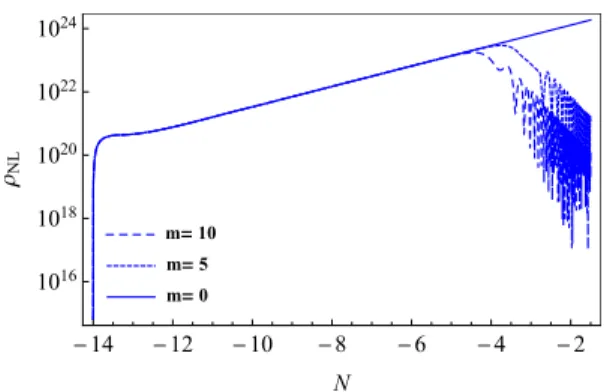
FIG. 1. Functional behavior of the nonlocal energy densityρNL versus the number of e-folds N during radiation domination for an operator △¼α1□þm4 and different values of m. All quantities are expressed in units with H0¼1. Note that the dimensionful parameter α1 is not an independent parameter: together withM¯, it fixes the amplitude of nonlocal effects and does not modify the dynamics. In this plot, we setM¯ ¼H0 and
α1¼H20. The late-time evolution of the nonlocal energy density develops a damped oscillatory pattern in the vicinity ofN¼0
when our radiation-domination ansatz for the scale factorais no longer applicable. Theaverageof this quantity over an oscillation period scales asa−8, i.e., faster than the radiation fluid (ρR∼a−4). A similar damping during radiation domination would require values ofmcomparable to the Hubble rate during that era.
6Note that this conclusion holds only forα
1¼0. As shown in Ref.[20], theα1≠0scenario contains growing modes and leads to an unstable cosmology.
This conclusion does not seem to be modified for an operator△¼α1□þm4with values ofmandα1of order
H0andH20, respectively. As shown in Fig.1, the evolution of the nonlocal energy density in this case develops a damped oscillatory pattern in the vicinity ofN¼0, when
our radiation-domination ansatz for the scale factor a
is no longer applicable. A similar damping during radiation domination would require values of mcomparable to the Hubble rate at that era.
B. Matter-dominated era
Can the instabilities generated during radiation domina-tion be suppressed during the subsequent evoludomina-tion of the Universe? To answer this question we study the behavior of a subdominant nonlocal tensorial contribution during matter domination (ρM≫ρNL). Taking into account the definitions in (24) (with H20¼H2a3=Ω0M), we can write the differential equations in(12) as
4α2Sðþ4Þ−12α2Sðþ3Þþ6β1S00þ−73α2S00þ−12β2S00þ −3S0þð9β1−6γ−41α2þ6β2Þ
þ16Sþð3β1þ7α2þ6β2Þ ¼12a 3 Ω0
M
; ð34Þ
4
3α2Sð−4Þ−4α2Sð−3Þ−ð3α2−2β1þ4β2ÞS00−
−ð9β1−6γ−9α2þ6β2ÞS0−¼−4a
3 Ω0
M
; ð35Þ
withΩ0Mbeing the critical matter density today. As in the case of radiation domination, if we choose α2¼0, then Eqs.(34)and(35)are reduced from fourth-order to second-order differential equations. These equations can be solved analytically,
Sþ¼ 4a
3 Ω0
Mð7β1−22β2þ18γÞ
þc1ap− þc2apþ; ð36Þ
S−¼ 4a
3
9Ω0
Mðβ1þ6β2−2γÞ
þc~1 2ðβ1−2β2Þ 3ð3β1þ2β2−2γÞa
~
yþc~
2;
ð37Þ
with
p ¼9β1þ6β2−6γ
ffiffiffiffiffiffiffiffiffiffiffiffiffiffiffiffiffiffiffiffiffiffiffiffiffiffiffiffiffiffiffiffiffiffiffiffiffiffiffiffiffiffiffiffiffiffiffiffiffiffiffiffiffiffiffiffiffiffiffiffiffiffiffiffiffiffiffiffiffiffiffiffiffiffiffiffiffiffiffiffiffiffiffiffiffiffiffiffiffiffiffiffiffiffiffi −47β2
1þ108β1ðβ2−γÞ þ548β22−72β2γþ36γ2 p
4ðβ1−2β2Þ ; y~ ¼
3ð3β1þ2β2−2γÞ
2ðβ1−2β2Þ : ð38Þ
The detailed solution of Eqs.(34)and(35)for the α2≠0 case is cumbersome and largely irrelevant for the following discussion. On general grounds, the leading contributions to Sþ andS− at large values of the scale factora can be parametrized as8
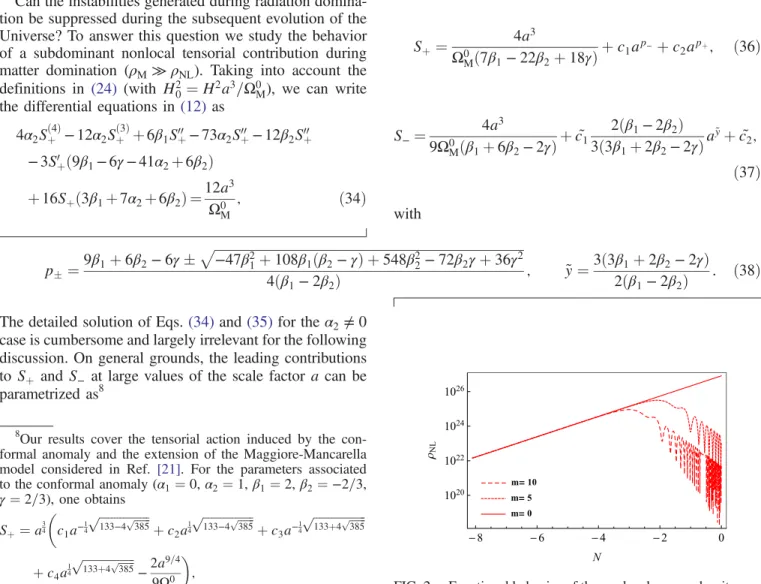
FIG. 2. Functional behavior of the nonlocal energy densityρNL versus the number ofe-foldsNduring matter domination for an operator△¼α1□þm4and different values ofm. All quantities are expressed in units withH0¼1. Note that the dimensionful parameterα1is not an independent parameter. Together withM¯ in the action, it fixes the amplitude of nonlocal effects and does not modify the dynamics. In this plot we setM¯ ¼H0andα1¼H20. The late-time evolution of the nonlocal energy density develops a damped oscillatory pattern. Theaverageof this quantity over an oscillation period scales asa−6, i.e., faster than the matter fluid (ρM∼a−3). Note that whenmis of the order of the Hubble rate at matter-radiation equality, this could alleviate the previous growth during radiation domination.
8
Our results cover the tensorial action induced by the con-formal anomaly and the extension of the Maggiore-Mancarella model considered in Ref. [21]. For the parameters associated to the conformal anomaly (α1¼0,α2¼1,β1¼2,β2¼−2=3,
γ¼2=3), one obtains
Sþ¼a34
c1a−14
ffiffiffiffiffiffiffiffiffiffiffiffiffiffiffiffiffi
133−4pffiffiffiffiffiffi385 p
þc2a14
ffiffiffiffiffiffiffiffiffiffiffiffiffiffiffiffiffi
133−4pffiffiffiffiffiffi385 p
þc3a−14
ffiffiffiffiffiffiffiffiffiffiffiffiffiffiffiffiffiffi
133þ4pffiffiffiffiffiffi385 p
þc4a14
ffiffiffiffiffiffiffiffiffiffiffiffiffiffiffiffiffiffi
133þ4pffiffiffiffiffiffi385 p
−29aΩ9=04
M
;
S−¼2 ~c1a12þ2
3c~2a
3
2þc~3aþc~4− 2a
3
15Ω0 M
;
while for the case △∝□2 (α1¼β1¼β2¼γ¼0, α2≠0) considered in Ref.[21] we find
Sþ¼a−14ð3þ ffiffiffiffiffiffi137
p Þc
2a
ffiffiffiffi 137
p
2 þc3a3þc4a12ð6þ ffiffiffiffiffiffi137
p Þ
þc1−3a
1 4ð15þ ffiffiffiffiffiffi137
p Þ
44Ω0 M
;
S−¼−2 3c~1a−
3 2þ2
3c~2a
3 2þc~3
3a3þc~4−36
lna−44 243Ω0
M
a3:
Sþ≈Ca~ C; S
−≈Da~ D; ð39Þ
with thepositiveconstantsCandDencoding information about the model parameters, and the prefactors C~ andD~
tracing the initial conditions. Note that thea3dependence of the source term in Eqs.(34)and(35)forcesCandDto be asymptotically larger or equal to 3. Using Eq.(14), we can derive the nonlocal energy density
ρNL≈M4ðΩ0MÞ2
32 ðEa~ 2C−6þFa~ 2D−6Þ; ð40Þ with E~ and F~ being some constants built from the free parameters of the theory and the initial conditions. Since the exponents C and D satisfy always the condition C,
D≥3, we have either a constant or growing nonlocal energy density ρNL. Therefore, the instabilities arising during radiation domination cannot be suppressed in the matter-dominated era. Note that this result also holds for the operator△¼α1□þm4with nonvanishing values ofm
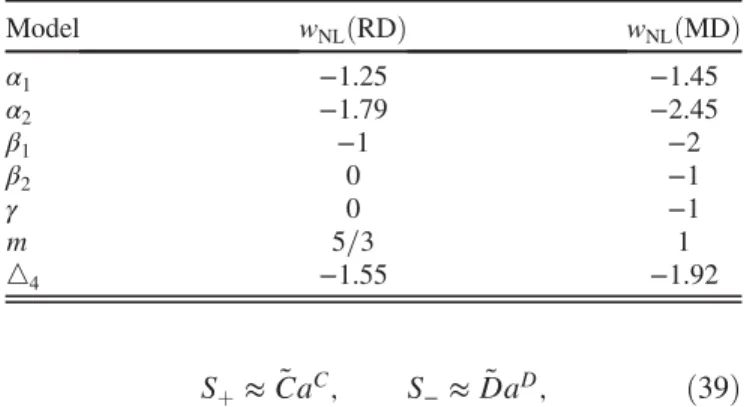
andα1, with numerical results presented in Fig.2. For the sake of completeness, we present in TableIthe asymptotic values of the nonlocal equation of state wNL
when only one of the parameters in the operator (9) is different from 0. The values associated to the conformal anomaly operator(11)are also displayed. This helps us to see in a qualitative way the contribution coming from the different operators in(9)when the conditionTNL
αβ ≪Tαβis satisfied.9
IV. CONCLUSIONS
In this paper, we have explored the stability of a general class of tensorial nonlocal extensions of general relativity. Our result is a direct answer to Ref.[20], where the authors conjectured that the instabilities arising in the tensorial
Rαβ□−1Rαβmodel might be cured by a generalization of the d’Alembertian operator to α1□þm4 or to the conformal anomaly operator △4. We have found that the growing mode and the associated instabilities of tensorial nonlocal models cannot be generically avoided by introducing the most general nonlocal operator at second order in covariant derivatives.
This conclusion holds also for a restricted version of the operator, namely α1□þm4, if the scale m is chosen to be of the order of the Hubble rate today. One could alternatively consider scenarios in whichmis comparable to the Hubble rate at matter-radiation equality. In those cases, an oscillatory pattern arises that could be compatible with our requirement that the nonlocal contribution to the cosmic expansion be subdominant to the matter contribu-tion. This might give rise to phenomenologically interest-ing features in the form of an oscillatinterest-ing early dark energy. In the presence of growing modes, terms at higher and higher order in curvature are expected to become relevant, compromising the validity of the effective action (8). Although one cannot exclude the possibility of some cancellation mechanism among the various terms, a non-perturbative study within the effective nonlocal theory is quite difficult. We believe that the instabilities associated to tensorial nonlocalities should instead be addressed in the framework of local field theories by considering mecha-nisms able to generate well-behaved nonlocal actions in the infrared.
ACKNOWLEDGMENTS
We acknowledge support from DFG through the Project No. TRR33 “The Dark Universe.” H. N. acknowledges financial support from DAAD through the program “Forschungsstipendium für Doktoranden und Nachwuchswissenschaftler.’’ Y. A. acknowledges support from the Netherlands Organization for Scientific Research/ Dutch Ministry of Education, Culture and Science (NWO/ OCW), and also from the D-ITP consortium, a program of the NWO that is funded by the OCW. A. R. S. was supported by funds provided to the Center for Particle Cosmology by the University of Pennsylvania.
TABLE I. Characteristic values of the nonlocal equation of
statewNLduring RD and MD when only one of the parameters in the nonlocal operator (9) is different from 0. Note that the operators associated toβ2andγvanish exactly during radiation domination. The values associated to the conformal anomaly operator(11) are also presented.
Model wNLðRDÞ wNLðMDÞ
α1 −1.25 −1.45
α2 −1.79 −2.45
β1 −1 −2
β2 0 −1
γ 0 −1
m 5=3 1
△4 −1.55 −1.92
[1] A. O. Barvinsky and G. A. Vilkovisky, Beyond the Schwinger-Dewitt technique: converting loops into trees and in-in currents,Nucl. Phys.B282, 163 (1987). [2] A. O. Barvinsky and G. A. Vilkovisky, Covariant
perturba-tion theory. 2: Second order in the curvature. General algorithms,Nucl. Phys. B333, 471 (1990).
[3] A. O. Barvinsky and G. A. Vilkovisky, Covariant perturba-tion theory. 3: Spectral representaperturba-tions of the third order form factors,Nucl. Phys.B333, 512 (1990).
[4] A. O. Barvinsky, Yu. V. Gusev, V. V. Zhytnikov, and G. A. Vilkovisky, Asymptotic behaviors of one loop vertices in the gravitational effective action, Classical Quantum Gravity
12, 2157 (1995).
[5] S. Deser and R. P. Woodard, Nonlocal Cosmology, Phys.
Rev. Lett.99, 111301 (2007).
[6] S. Deser and R. P. Woodard, Observational viability and stability of nonlocal cosmology,J. Cosmol. Astropart. Phys. 11 (2013) 036.
[7] R. P. Woodard, Nonlocal models of cosmic acceleration, Found. Phys.44, 213 (2014).
[8] N. Arkani-Hamed, S. Dimopoulos, G. Dvali, and G. Gabadadze, Nonlocal modification of gravity and the cosmological constant problem,arXiv:hep-th/0209227. [9] G. Dvali, Predictive power of strong coupling in theories
with large distance modified gravity,New J. Phys.8, 326 (2006).
[10] G. Dvali, S. Hofmann, and J. Khoury, Degravitation of the cosmological constant and graviton width,Phys. Rev. D76, 084006 (2007).
[11] M. Maggiore, Phantom dark energy from nonlocal infrared modifications of general relativity,Phys. Rev. D89, 043008 (2014).
[12] M. Maggiore and M. Mancarella, Nonlocal gravity and dark energy,Phys. Rev. D90, 023005 (2014).
[13] S. Foffa, M. Maggiore, and E. Mitsou, Cosmological dynamics and dark energy from nonlocal infrared modifi-cations of gravity, Int. J. Mod. Phys. A A29, 1450116 (2014).
[14] Y. Dirian, S. Foffa, N. Khosravi, M. Kunz, and M. Maggiore, Cosmological perturbations and structure for-mation in nonlocal infrared modifications of general rela-tivity,J. Cosmol. Astropart. Phys. 06 (2014) 033.
[15] H. Nersisyan, Y. Akrami, L. Amendola,
T. S. Koivisto, and J. Rubio, Dynamical analysis of
R□12R cosmology: Impact of initial conditions and
con-straints from supernovae, Phys. Rev. D 94, 043531
(2016).
[16] T. Biswas, E. Gerwick, T. Koivisto, and
A. Mazumdar, Towards Singularity and Ghost-Free Theo-ries of Gravity,Phys. Rev. Lett.108, 031101 (2012). [17] S. Talaganis and A. Mazumdar, High-energy scatterings in
infinite-derivative field theory and ghost-free gravity, Classical Quantum Gravity33, 145005 (2016).
[18] L. Modesto and L. Rachwal, Finite conformal quantum gravity and nonsingular spacetimes,arXiv:1605.04173. [19] C. de Rham, S. Hofmann, J. Khoury, and A. J. Tolley,
Cascading gravity and degravitation,J. Cosmol. Astropart. Phys. 02 (2008) 011.
[20] P. G. Ferreira and A. L. Maroto, A few cosmological implications of tensor nonlocalities, Phys. Rev. D 88, 123502 (2013).
[21] G. Cusin, S. Foffa, M. Maggiore, and
M. Mancarella, Nonlocal gravity with a Weyl-square term, Phys. Rev. D93, 043006 (2016).
[22] N. C. Tsamis and R. P. Woodard, A caveat on building nonlocal models of cosmology,J. Cosmol. Astropart. Phys. 09 (2014) 008.
[23] A. Conroy, T. Koivisto, A. Mazumdar, and A. Teimouri, Generalized quadratic curvature, nonlocal infrared modifi-cations of gravity, and Newtonian potentials, Classical Quantum Gravity32, 015024 (2015).
[24] C. Wetterich, Effective nonlocal Euclidean gravity, Gen. Relativ. Gravit. 30, 159 (1998).
[25] A. O. Barvinsky, Aspects of nonlocality in quantum field theory, quantum gravity, and cosmology,Mod. Phys. Lett. A
30, 1540003 (2015).
[26] G. Cusin, S. Foffa, M. Maggiore, and
M. Mancarella, Conformal symmetry and nonlinear exten-sions of nonlocal gravity,Phys. Rev. D93, 083008 (2016). [27] C. Deffayet and R. P. Woodard, Reconstructing the distortion function for nonlocal cosmology, J. Cosmol. Astropart. Phys. 08 (2009) 023.
[28] T. Koivisto, Dynamics of nonlocal cosmology,Phys. Rev. D
77, 123513 (2008).
[29] D. M. Capper and M. J. Duff, Trace anomalies in dimen-sional regularization,Nuovo Cimento A23, 173 (1974). [30] R. J. Riegert, A nonlocal action for the trace anomaly,Phys.
Lett. B134, 56 (1984).
[31] M. E. Soussa and R. P. Woodard, A nonlocal metric
for-mulation of MOND,Classical Quantum Gravity20, 2737
(2003).
[32] V. F. Mukhanov and G. V. Chibisov, Quantum fluctuations and a nonsingular universe, Pis’ma Zh. Eksp. Teor. Fiz.33, 549 (1981) [JETP Lett. 33, 532 (1981)].
![4 [(2 Hydroxybenzylidene)amino] 5 (2 thienylmethyl) 2H 1,2,4 triazol 3(4H) one](data:image/gif;base64,R0lGODlhAQABAIAAAP///wAAACH5BAEAAAAALAAAAAABAAEAAAICRAEAOw==)