White Paper
Cat. 6A vs. Cat. 6
A
Cat. 6A vs. Cat. 6
A– What’s the Difference and Why Should I Care?
TABLE OF CONTENTS
1. Introduction...3
2. Component Standards Follow...4
3. Confusing Names...6
4. Why Does ISO/IEC Take Longer? ...7
5. Recommendation ...8
Cat. 6A and Cat. 6
AWith the advent of 10Gigabit Ethernet over copper twisted pair cabling, new classes of cabling standards were introduced. EIA/TIA released the Cat. 6A standard in February 2008 and ISO/IEC the Class EA channel
standard in the same timeframe. Unfortunately, these two standards do not define the same performance, leading to confusion in the market. This confusion is compounded when looking at the components,
especially the connecting hardware. EIA/TIA and ISO/IEC specify different performance for the modules, but the component naming is very similar. Therefore special care must be taken or users will not obtain the performance they expect.
1.
Introduction
The IEEE protocol for 10Gb Ethernet over copper twisted pair cabling (802.3an) was released in July 2006. Because it increased the used frequency range to 500MHz and Cat. 6 cabling was only defined to 250 MHz, it was clear that new cabling standards would be required to support this protocol. Of course, Cat. 7 cabling which is specified to 600 MHz was an option from the beginning, but with a world-wide market share of only 4%, it would not ensure the success of this new Ethernet protocol.
In the 802.3an standard, IEEE specified the minimum channel requirements the cabling needed to achieve in order for the protocol to work. In fact, a good Cat. 6 shielded system which operates stably at higher
frequencies could meet these minimum requirements, as evidenced by the R&M Real10 shielded systems.
However, alien crosstalk posed a problem for unshielded systems. Due to the higher frequencies used, as well as complex coding methods, the low signal strength with 10GbE is much more susceptible to outside disturbances than was the case with previous protocols. This translated to a length limitation with standard Cat. 6 unshielded systems.
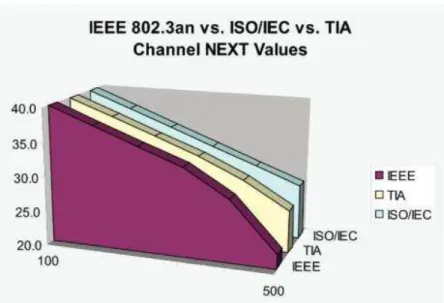
The various cabling bodies thus began work on specifying new cabling classes to 500 MHz which are based on RJ45 technology. EIA/TIA released their Cat. 6A standard in February 2008 and in the same timeframe ISO/IEC approved the channel requirements for Class EA. Unfortunately these standards do not specify the same performance. The chart below (Fig. 1) shows the differences with the Channel NEXT parameter.
Application: Enterprise Cabling, Datacenter Cabling Technology: Copper cabling, 10 Gigabit
Ethernet, IP applications Format: White paper
Topics: Standardisation process EIA/TIA and ISO/IEC, Cat. 6A vs. Cat. 6A,
10Gigabit Ethernet, Channel and module performance
Target: Differentiation of new standards for high end copper cabling, criteria and recommendation for choice of best performance Target groups: System integrators, planners,
installers, users, IT procurement Authors: Regina Good-Engelhardt Published: June 2009
Fig. 1: The differences with the Channel NEXT parameter ISO/IEC specifies a straight line up to 500 MHz. © R&M
The EIA/TIA Cat. 6A channel requirements show a relaxed slope of 27 dB starting at 330MHz, whereas the ISO/IEC Class EA channel specifies a straight line, thus offering the highest performance available using RJ45 technology. At 500MHz, this means that Class EA requires 1.8 dB better NEXT performance than a Cat. 6A channel. In practice, this higher performance translates to higher operational reliability which minimizes errors. In addition, the life of the cabling infrastructure is maximized.
2.
Component Standards Follow
With channel standards clear, the next step is to define the component standards. EIA/TIA defined channel, permanent link and component specifications together and all are included in the ratified Cat. 6A standard (568B.2-10). ISO/IEC defined the channel specifications in Amendment 1 and is working on the permanent link and component definitions which will be released in Amendment 2.
The need for component standards first arose with the customer requirement for interoperability, or the ability to mix and match components from various vendors and still be guaranteed to reach the corresponding channel performance. For example, a Cat. 6 module from vendor X, a Cat. 6 installation cable from vendor Y and a Cat. 6 patch cord from vendor Z should combine to achieve Class E performance.
In the case of 10 Gigabit Ethernet, initially systems were offered which would meet the channel requirements of the protocol. The new component requirements will enable interoperability, or mix and match systems, as in the past. For Cat. 6A (EIA/TIA) and Cat. 6A (ISO) components, re-embedded testing has been introduced.
The overall idea is similar to de-embedded testing, but in this case a reference plug is first qualified by a new, more accurate measurement setup called direct probing. The difference of this reference plug to the 12 de-embedded reference plugs is then calculated. At this point, the connecting hardware is tested with the one reference plug. Afterwards, the results which would have been obtained with the 12 de-embedded reference plugs are calculated rather than individually tested. In essence, the process of finding and testing the 12 de-embedded reference plugs is replaced by one accurate measurement and subsequent difference calculations, thus ensuring faster, but also more consistent testing results.
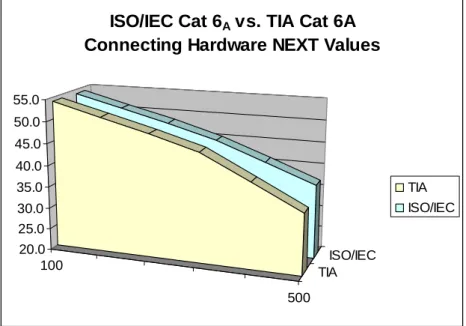
As with the channel, a Cat. 6A connector as specified by ISO will achieve higher performance than a Cat. 6A connector as specified by EIA/TIA. The current draft specifies a 40 dB slope starting at 250MHz for Cat. 6A, and a 30 dB slope for Cat. 6A. At 500 MHz this means that a Cat. 6A module must achieve at least 3dB better NEXT performance than a Cat. 6A module (Fig. 2).
Fig. 2: The differences with the connectors. © R&M
100
500 TIA
ISO/IEC 20.0
25.0 30.0 35.0 40.0 45.0 50.0 55.0
ISO/IEC Cat 6
Avs. TIA Cat 6A
Connecting Hardware NEXT Values
TIA ISO/IEC
3.
Confusing Names
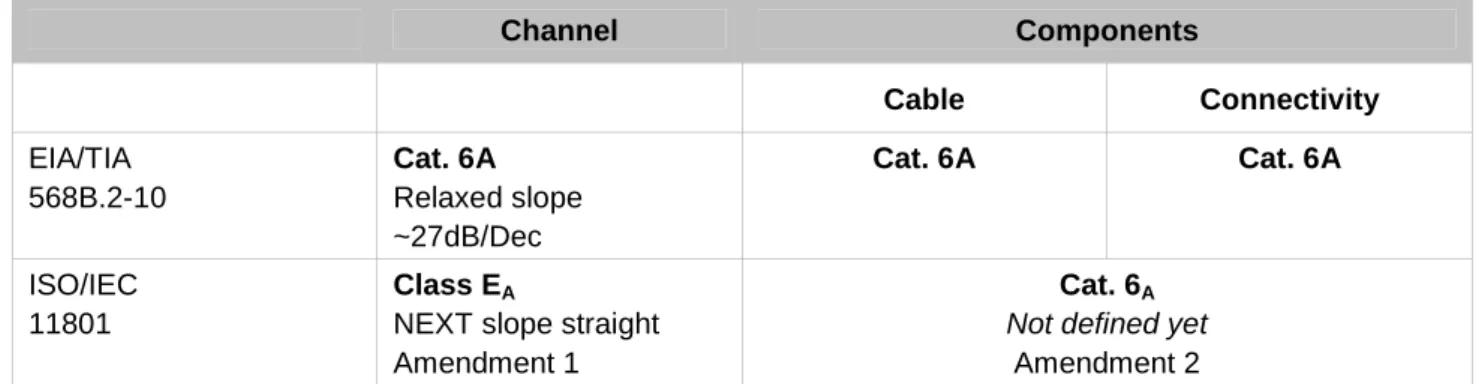
With component standards for connectivity and cabling, it now starts to get confusing. The component specifications needed to achieve a Cat. 6A (EIA/TIA) channel are clearly different and less stringent than those required to achieve a Class EA (ISO) channel. Therefore, users who want to ensure Class EA channel performance must use components that meet Cat. 6A specifications. A channel composed of components meeting Cat. 6A (EIA/TIA) specifications won’t guarantee Class EA performance.
Therefore, the difference in the “A”, specifically whether or not it is written as a subscript, is very important:
Cat. 6A
≠
Cat. 6
A.Channel Components
Cable Connectivity
EIA/TIA 568B.2-10
Cat. 6A
Relaxed slope ~27dB/Dec
Cat. 6A Cat. 6A
ISO/IEC 11801
Class EA
NEXT slope straight Amendment 1
Cat. 6A
Not defined yet
Amendment 2
Table 1: New standards for Channel and Components.
Table 1 shows the two new cabling classes and the associated component naming. Further complicating the situation is that the Cat. 6A specifications have not yet been ratified. Amendment 2 is in progress and the timeframe for release is currently unclear.
4.
Why Does ISO/IEC Take Longer?
You may wonder why ISO/IEC is taking longer to specify the components compared to EIA/TIA. One reason is the difference in organization. ISO/IEC includes different organizations who are responsible for the cabling, cable and connecting hardware specifications. Coordination between the various groups naturally takes longer than in the case of EIA/TIA where all of the interested parties are in the same group.
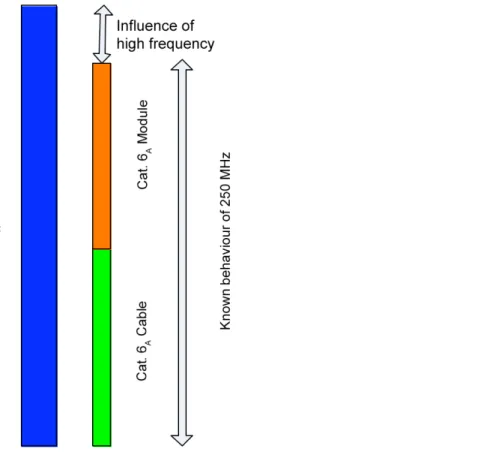
However, another reason is technical complexity and really, forging into new territory. Until now, we have understood the behaviors of the components and how they work together very well up to 250 MHz. We are now doubling the frequency and the modeling methodology to be used for those higher frequencies is not stable. The modeling must take into account second and third effects such as cross modal coupling which significantly increases the complexity. These phenomenon are not as prevalent with Cat. 7 connecting hardware due to the contact geometry which separates the pairs from each other.
Fig. 3: The influence of high frequency is the challenge with Cat. 6A. © R&M
In order to achieve Class EA channel performance, we have seen that a Cat. 6A module must have 3 dB better NEXT at 500 MHz than a Cat. 6A module (Fig. 3). This is significant. To achieve this, it means that new modules need to be developed from the ground up as opposed to modifying existing designs, which is often the case with current Cat. 6A modules on the market. Specifically, more compensation elements are needed to compensate for the additional coupling seen. More care needs to be taken to separate the pairs from each other in the termination. Also, the termination process should be very precise and error-proof to ensure consistent performance.
5.
Recommendation
Today, a Class EA channel is the highest performance channel available based on the prevalent RJ45 technology. It not only ensures support for the 10 Gigabit Ethernet application, but it also extends the life of the cabling and ensures higher operational reliability. For these reasons, R&M recommends installing a Class EA channel in new installations.
If interoperability is a requirement, then it is important to choose Cat. 6A connecting hardware. Cat. 6A modules simply cannot guarantee the higher Class EA performance. Although the Cat. 6A component standards are taking longer, it will be worth the wait for the added performance the cabling system will achieve, which will translate to less headaches for the user.
6.
Sources and Additional Information
• IEEE 802.3an
• ISO/IEC 11801 Amendment 1, Amendment 2 (draft)
• EIA/TIA 568B.2-10