This work is licensed under a Creative Commons Attribution-NonCommercial-ShareAlike License. Your use of this material constitutes acceptance of that license and the conditions of use of materials on this site.
Copyright 2006, The Johns Hopkins University, Patrick Breysse, and Peter S. J. Lees. All rights reserved. Use of these materials permitted only in accordance with license rights granted. Materials provided “AS IS”; no
representations or warranties provided. User assumes all responsibility for use, and all liability related thereto, and must independently review all materials for accuracy and efficacy. May contain materials owned by others. User is responsible for obtaining permissions for use from third parties as needed.
Introduction to
Industrial Hygiene
Patrick N. Breysse, PhD, CIH Peter S.J. Lees, PhD, CIH Johns Hopkins University
Section A
What Is Industrial Hygiene?
Definition
– Science and art devoted to the
anticipation, recognition, evaluation, and control of those workplace
environmental factors which may
cause sickness, impaired health and well-being, or significant discomfort and inefficiency among workers or among citizens of the community
What Is an Industrial Hygienist?
A person who by study, training, and experience can:
– Anticipate
– Recognize
– Evaluate
– Control
workplace environmental hazards
Some Occupational Hazards
Chemical agents
– Gases, vapors and particulate aerosols
Physical (energy) agents
– Noise, ionizing / non-ionizing radiation, heat and cold stress
Biological agents
– Infectious agents, allergens
Psychological stressors
Industrial Hygiene Concepts
Anticipation/recognition of potential or actual hazards through knowledge of:
– Materials
– Operations
– Processes
– Conditions
Scope of IH activities encompasses the “cradle-to-grave” concept (research
through waste disposal)
Industrial Hygiene Concepts
Evaluation of environmental factors through:
– Measurement of exposure intensity
– Determination of exposure frequency, and duration
– Comparison with regulatory,
professional, and internal standards
Control of Exposures
Employ methods to eliminate or reduce exposure resulting in elimination or
reduction of the occurrence of occupational disease through:
– Engineering (including process) interventions
– Administrative/programmatic measures
– Personal protective equipment
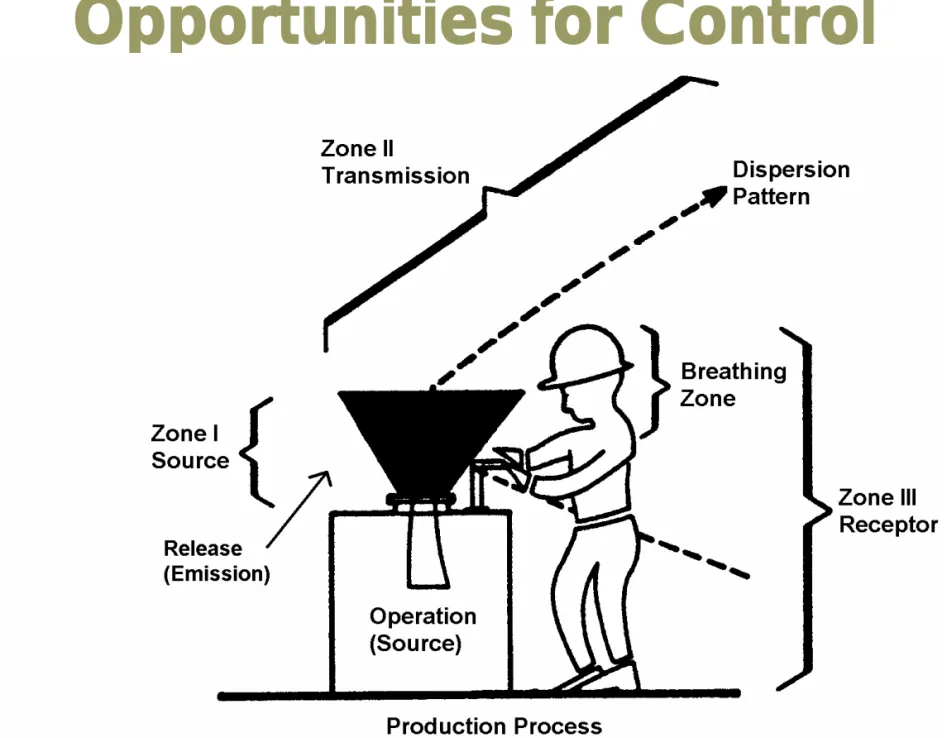
Opportunities for Control
Section B
Environmental/Occupational
Health Paradigm
Environmental/Occupational
Health Paradigm
Source External Exposure Internal Exposure Early Biological Effect Health Effect Exposure Assessment Grinding Chipping Milling Sawing Sweeping Heating Welding Biomarkers Biomarkers Clinical Manifestation Disease DeathIH in the
Exposure-Response Paradigm
Response (individual or population)
Exposure
Exposure
Definitions and Concepts
Contact between outer boundary of the human body (skin, nose, lungs, GI tract) and a pollutant or mixture of pollutants
Requires the presence of a pollutant and the contact between the person and that medium (vs. potential exposure)
Quantified by concentration of the contaminant and the time of contact
Exposure Assessment
Route of exposure: Inhalation, ingestion, dermal, injection
Magnitude of exposure: Concentration in media (ppm, mg/m3, f/cm3)
Duration of exposure: Minutes, hours, days, lifetime
Frequency of exposure: Daily, weekly, seasonally
Section C
Education of an
Industrial Hygienist
Usually requires advanced education in engineering and the biological sciences
A combination of education and
experience is necessary in order to take the American Board of Industrial
Hygiene (ABIH) exam for certification in industrial hygiene (CIH)
Who Is an Industrial Hygienist?
Education
– Undergraduate degree in sciences or engineering (28%)
– Graduate level (68%)
Continued
Who Is an Industrial Hygienist?
Employed by – Industry (47%) – Consulting (23%) – Government (14%) – Academia (5%) – Insurance (3%) – Labor (1%)American Board
of Industrial Hygiene
Established to improve the practice and educational standards of the profession
Primary influence through certification
– CIH by written exam and five years practice
– Not required for practice (no licensing)
– Five-year recertification cycle
Professional Organizations
American Industrial Hygiene Association (AIHA)
– Founded 1939
– Nonprofit professional society for IH professionals
– Exists to promote the field
– 12,500 members in 2000
Professional Organizations
American Conference of Governmental Industrial Hygienists (ACGIH)
– Founded 1938
– Free exchange of ideas and promotion of standards and techniques in industrial health
Professional Organizations
ACGIH
– Approximately 5,000 members
– Full members government and academic IHs only
– Increased role for associate members
– Publish threshold limit values (TLVs) and Biological Exposure Indices
(BEIs)
Section D
Risk Assessment
Risk Assessment
Risk assessment is usually considered
to be an environmental term, but it is an essential part of the industrial hygiene profession
Broadly defined as the methodology
that predicts the likelihood of unwanted events (explosions, injuries, natural
catastrophes, diseases, death)
Risk Assessment
Comparison of Terminology
Industrial Hygiene Environmental
Anticipation and Recognition
Hazard identification Evaluation Exposure and toxicity
assessment and Risk characterization
Control Risk management Hazard communication Risk communication
Risk Assessment
The act of comparing exposure
measurements with exposure limits (TLVs, PELs, etc.) is a fundamental
aspect of risk characterization which is the final step in the risk assessment
process
Risk Assessment
Risk assessment Equation 1:
(
Level of Exposure)
Exposure of Unit Effect Health of Prob. Risk × ⎟⎟ ⎠ ⎞ ⎜⎜ ⎝ ⎛ = Continued 28Risk Assessment
Another form of Equation 1:
(
Absorbed Dose)
Dose Absorbed Effect Health of Prob. Risk × ⎟ ⎠ ⎞ ⎜ ⎝ ⎛ = Continued 29Risk Assessment
Equation 1: Determining the probability of a negative health effect by combining the dose-response and exposure
assessment over some relevant period of time
Exposure is an approximation for dose
Absorbed dose is the relative or specific amount of material that gets into the