RESEARCH PAPER
Physician support of HPV vaccination school-entry requirements
Sophia Califanoa, William A. Calob,y, Morris Weinbergerb, Melissa B. Gilkeyc, and Noel T. Brewerd,e
a
Department of Internal Medicine, VA Medical Center, Durham, NC, USA;bDepartment of Health Policy and Management, Gillings School of Global Public Health, University of North Carolina, Chapel Hill, NC, USA;cDepartment of Population Medicine, Harvard Medical School & Harvard Pilgrim Health Care Institute, Boston, MA, USA;dDepartment of Health Behavior, Gillings School of Global Public Health, University of North Carolina, Chapel
Hill, NC, USA;eLineberger Comprehensive Cancer Center, University of North Carolina, Chapel Hill, NC, USA
ARTICLE HISTORY
Received 22 October 2015 Revised 12 January 2016 Accepted 26 January 2016
ABSTRACT
School-entry requirements in the US have led to high coverage for several vaccines, but few states and jurisdictions have adopted these policies for human papillomavirus (HPV) vaccination. Because physicians play a key role in advocating for vaccination policies, we assessed physician support of requiring HPV vaccine for school entry and correlates of this support. Participants were a national sample of 775 physicians who provide primary care, including vaccines, to adolescents. Physicians completed an online survey in 2014 that assessed their support for school-entry requirements for HPV vaccination of 11 and 12 y olds. We used multivariable logistic regression to assess correlates of support for these requirements. The majority of physicians (74%) supported some form of school-entry requirements, with or without opt-out provisions. When opt-opt-out provisions were not specified, 47% agreed that laws requiring HPV vaccination for school attendance were a“good idea.”Physicians more often agreed with requirements, without opt-out provisions, if they: had more years in practice (ORD1.49; 95% CI: 1.09-2.04), gave higher quality HPV vaccine recommendations (ORD2.06; 95% CI: 1.45-2.93), believed that having requirements for Tdap, but not HPV, vaccination undermined its importance (ORD3.33; 95% CI: 2.26-4.9), and believed HPV vaccination was as or more important than other adolescent vaccinations (ORD2.30; 95% CI: 1.65-3.18). In conclusion, we found that many physicians supported school-entry requirements for HPV vaccination. More research is needed to investigate the extent to which opt-out provisions might weaken or strengthen physician support of HPV vaccination school-entry requirements.
KEYWORDS
adolescent health; HPV vaccine; human papillomavirus; physician attitudes; vaccination laws
Introduction
Human papillomavirus (HPV) is responsible for almost all cer-vical cancers, and will affect an estimated 12,900 US women in
2015 and lead to 4,100 deaths.1Persistent HPV infections also
cause a significant proportion of other cancers in both men and
women, including oropharyngeal and several anogenital
can-cers.2Most HPV-associated cancers are caused by types 16 and
18; as HPV vaccines are highly protective against these strains,
most HPV-associated cancers could potentially be prevented.3,4
The Advisory Committee on Immunization Practices (ACIP) recommends that children ages 11-12 routinely receive 3 doses of HPV vaccine, with catch-up vaccination until age 21 for
males and 26 for females.5 Despite these recommendations,
that are based on the demonstrated efficacy and safety of HPV
vaccination,6-9coverage is low in the US. In 2014, only 40% of
females and 22% of males ages 13-17 had received all 3 doses of
HPV vaccine.10 These coverage levels were substantially lower
than for other adolescent vaccines, such as tetanus, diphtheria
and pertussis (Tdap) that had coverage of 88%.10
One factor that, in part, accounts for the differences in ado-lescent vaccine coverage is that most states have school-entry
requirements for Tdap vaccination but not HPV vaccination.11
Immunization requirements for school entry have led to high
coverage rates for many other vaccines in the US, including Tdap, measles, mumps and rubella (MMR), polio, haemophilus
(Hib), varicella, and hepatitis B vaccines.11-13The Task Force
on Community Preventive Services recommends school-entry
requirements to increase vaccination coverage in children.14
Although about half of US states have at some point proposed legislation requiring HPV vaccination for school entry, such a requirement has come into effect only in Virginia and the Dis-trict of Columbia through legislation, and more recently in
Rhode Island through a state health department rule.15Laws in
Virginia and Washington DC include an opt-out clause, which
might lessen their impact on coverage.16
Previous studies conducted in 5 southeastern North Caro-lina counties and in Los Angeles, California reported that 46% and 59% of parents of adolescents supported HPV vaccine
school-entry requirements, respectively.17-18These studies also
reported that support increased when the requirements included opt-out provisions. However, one potential negative consequence of opt-out provisions for HPV vaccination is parents requesting exemptions for other adolescent vaccines,
which may contribute to a culture of vaccination refusal.16 If
so, opt-out provisions may undermine school-entry vaccination requirements.
CONTACT Noel T. Brewer [email protected] Health Behavior, Gillings School of Global Public Health, University of North Carolina, 325 Rosenau Hall, CB 7440,
Chapel Hill, NC 27599-7440, USA.
ySharedfirst authorship.
© 2016 Taylor & Francis 2016, VOL. 12, NO. 6, 1626–1632
Data are currently limited regarding physicians’ attitudes about such school-entry vaccination requirements with or without opt-out provisions. Adopting school-entry vaccina-tion requirements usually requires a broad coalivaccina-tion, includ-ing legislators, state health departments, and immunization champions, with physicians often leading or playing key roles in these efforts. Opposition from physician groups can slow or derail adoption of policies, such as pharmacist
pro-vision of HPV vaccination.19,20Better understanding of
phy-sician attitudes about HPV vaccination requirements can
inform states’ policy-related efforts. Our study sought to
assess the acceptability of HPV vaccination school-entry requirements among a national sample of physicians, describe correlates of physician support for such require-ments, and evaluate the effect of including opt-out provisions on support.
Results
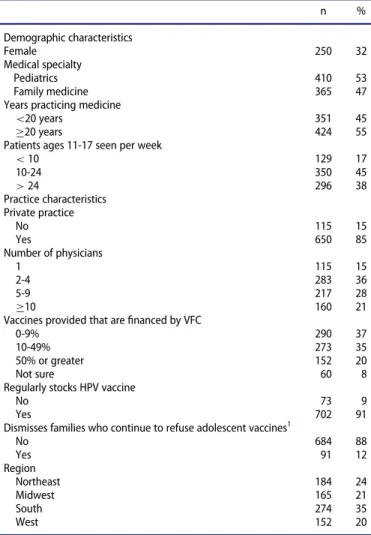
Approximately half of the surveyed physicians were pediatri-cians (53%) and had been in practice for at least 20 y (55%) (Table 1). The majority were in private practices (85%), saw 10 or more adolescent patients per week (83%), and provided 10% or more vaccine doses through the Vaccine for Children (VFC) program (55%). Fewer than 10% were in practices that did not stock HPV vaccine regularly, and about 12% practiced in clinics that had a policy allowing dismissal of patients or families that continued to refuse recommended vaccines.
Overall, 47% of physicians agreed with the general statement that laws requiring HPV vaccination for school attendance are
a good idea (Table 2). When asked whether such laws were
only okay if parents are able to opt out, 18% supported
school-entry requirements only without opt-out provisions (agree to“I
think these laws are a good idea”and disagree to“okay only if
parents can opt out”), while 8% switched to neither agree nor
disagree. Forty seven percent of physicians agreed with the statement that it is okay to have these laws if parents can opt out if they want to. Eighteen percent of physicians supported school-entry requirements only with opt-out provisions
(dis-agree to“I think these laws are a good idea”and agree to“okay
only if parents can opt out”). In total, 74% of physicians agreed
with at least one statement of support for school-entry require-ments (either with or without opt-out provisions), and only 12% of physicians did not support such requirements under any circumstances (disagree to both statements).
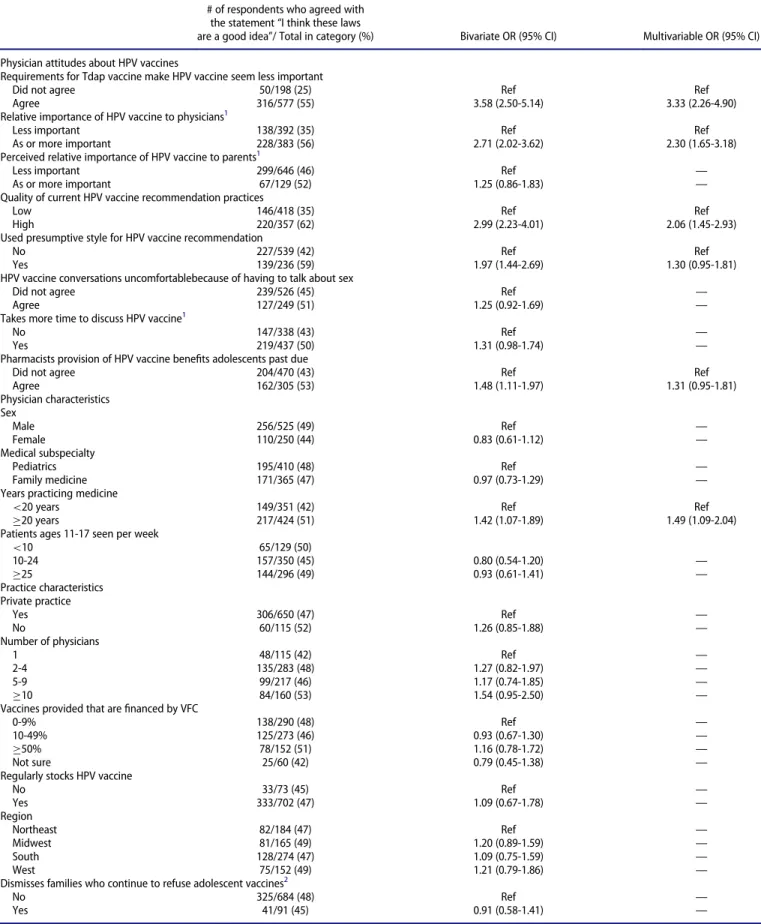
In multivariate analyses, 4 variables were associated with
agreement that HPV vaccine requirement laws “are a good
idea” (Table 3). Physicians who had been in practice longer
(20 years) more often agreed with these laws than physicians
who had been in practice for less time (ORD1.49, 95% CI,
1.09-2.04). Support for these laws was more common among physicians who described giving high-quality HPV vaccine
rec-ommendations (ORD2.06, 95% CI, 1.45-2.93) and those who
rated the importance of HPV vaccine as at least on par with
Tdap and meningococcal vaccines (ORD2.30, 95% CI,
1.65-3.18). Support was also more common among physicians who agreed that having a requirement for Tdap vaccine, but not for HPV vaccine, undermined the importance of immunization
against HPV (ORD3.33, 95% CI, 2.26-4.90).
Bivariate analyses found support for HPV vaccination
school-entry requirements correlated with a “presumptive”
style of recommendation, meaning that physicians began con-versations about HPV vaccine with a statement that the child was due for the vaccine, rather than eliciting questions or giving information. Support of having trained pharmacists deliver HPV vaccines also correlated with support of school-entry requirements for HPV vaccination. However, neither variable
remained statistically significant in multivariable analysis.
Discussion
Physicians are highly respected authorities on HPV vaccina-tion, with their recommendations being the strongest predictor
of parents’acceptance of the vaccine for their adolescent
chil-dren.21-24Physicians also play a key role in advocating for the
adoption of vaccination laws and policies, including school-entry requirements. Our national study found that most pedia-tricians and family physicians (74%) supported some form of school-entry requirement for HPV vaccine, though the inclu-sion of opt-out proviinclu-sions played a complex role in support. Support for school-entry HPV vaccination requirements was higher among more experienced physicians who valued the Table 1.Physician and practice characteristics (ND775).
n %
Demographic characteristics
Female 250 32
Medical specialty
Pediatrics 410 53
Family medicine 365 47
Years practicing medicine
<20 years 351 45
20 years 424 55
Patients ages 11-17 seen per week
<10 129 17
10-24 350 45
>24 296 38
Practice characteristics Private practice
No 115 15
Yes 650 85
Number of physicians
1 115 15
2-4 283 36
5-9 217 28
10 160 21
Vaccines provided that arefinanced by VFC
0-9% 290 37
10-49% 273 35
50% or greater 152 20
Not sure 60 8
Regularly stocks HPV vaccine
No 73 9
Yes 702 91
Dismisses families who continue to refuse adolescent vaccines1
No 684 88
Yes 91 12
Region
Northeast 184 24
Midwest 165 21
South 274 35
West 152 20
Note. VFCDVaccines for Children program. HPVDhuman papillomavirus
1Have a policy to dismiss patients or families who continue to refuse Tdap,
vaccine, and who gave higher-quality recommendations to patients.
Almost half (47%) of physicians supported HPV vaccination school-entry requirements when the survey did not mention an opt-out provision. This was slightly higher than the 42%
sup-port for “mandated HPV vaccination” in a 2008 survey of
Texas physicians25 and comparable to previous studies of US
parents when no opt-out was mentioned (46% in North
Caro-lina17and 59% in Los Angeles18). At face value, this moderate
level of support may explain why few states have pursued such requirements.
Previous studies of US parents have shown that mentioning an opt-out provision for HPV vaccine school-entry require-ments increased support to 92%, which is both promising and
problematic.18However, we found similar support among
pri-mary care physicians (47%) regardless of opt-out provisions, with a large number switching positions from for to against, and vice-versa. It would appear that some physicians would support the requirements only if there was no easy opt-out. Opt-out provisions were legislated in 2 of the 3 states that have HPV vaccination school-entry requirements and are likely to
be important in passing similar laws in other states.26Our study
highlights the need to determine how different stakeholders understand this policy language, in addition to implications for vaccine uptake and effectiveness.
Little research has examined parents’use of vaccination
opt-outs, exemptions and refusals to follow the requirements with regard to HPV vaccination. A model-based study estimated that school-entry requirements for HPV vaccination could reduce the time it will take the US to reach 70% HPV
vaccina-tion coverage from 23 y to 8 y.27 However, while school-entry
requirements for vaccination of young children have generally been effective in the US, they have largely failed for HPV
vacci-nation.28 It appears that allowing parents to opt-out, which
may increase acceptability and contribute to family’s
auton-omy, decreases the effectiveness of the HPV vaccination
requirements.16,29 People opting out in large numbers likely
contributed to the disappointing impact of Virginia and the
District of Columbia’s school-entry requirements on HPV
vac-cination coverage.16
While our findings offer one of the first looks at
physi-cian attitudes on HPV vaccine opt-out provisions, some information regarding attitudes toward departures from
routine vaccination practice is available. A recent study
from Kempe and colleagues30 found that physicians often
favor parental autonomy over best practice; although 87% of physicians felt that spreading out vaccines (including HPV vaccine) put children at risk, 72% agreed to an alter-native schedule to foster greater trust between physician and family. Evidence also suggests that physicians are more comfortable with refusals or exemptions for some
vaccina-tions than others,31 with some physicians considering HPV
vaccine to be more “optional” than other vaccines.32-34
Fur-thermore, health care providers in Arizona had low support
(37%) for a policy requiring them to sign off on parent’s
decision to refuse vaccination.31 It would be valuable to
gather qualitative data on how physicians think about requiring HPV vaccination as well as permissive and strict opt-out provisions.
Correlates of support paint a picture of experienced physi-cians who value HPV vaccine and might be good leaders and spokespersons for advocacy efforts. In the present study, the strongest predictor of support for HPV vaccination school-entry requirements was recognizing the importance of
consis-tent policy and messaging (agreement that“Having a
school-entry requirement for Tdap vaccine, but not for HPV vaccine,
makes some parents think HPV vaccine is less important”);
this further suggests that physicians recognize the weight of leg-islation in vaccine discussions with individual patients. Other predictors include having more years in practice, believing that HPV vaccine is as or more important than other adolescent vaccines, and giving high-quality HPV vaccine recommenda-tions. Although previous studies have reported that physicians
find communication about HPV vaccine can be
burden-some,25,35neither anticipation of discomfort surrounding
dis-cussion of a sexually transmitted infection nor higher time burden compared to other vaccines were associated with physi-cian support of school-entry requirements. This is particularly important because physician recommendation remains the
strongest known predictor of HPV vaccination,36 suggesting
that physician support of HPV vaccination school-entry requirements is not expected to replace this important discussion.
Strengths of our study include our large, national sample of primary care physicians. Study limitations included relying on
physicians’ self-report of their clinical practices, such as HPV
Table 2.Physician support of HPV vaccination school-entry requirements (ND775). “Some states are trying to pass
laws that would require all 11 and 12 year-olds to get HPV vaccine
before they are allowed to start sixth grade.” “I think these laws are a good idea.”
Agree (%)
Neither agree nor disagree (%)
Disagree (%) Total (%)
Agree 163 (21) 65 (8) 139 (18) 367 (47)
“It is okay to have these laws only if parents can opt out if they want to.”
Neither agree nor disagree 60 (8) 59 (8) 38 (5) 157 (20) Disagree 143 (18) 16 (2) 92 (12) 251 (32) Total 366 (47) 140 (18) 269 (35) 775 (100)
Table 3.Correlates of physician support of HPV vaccination school-entry requirements (ND775).
# of respondents who agreed with the statement“I think these laws
are a good idea”/ Total in category (%) Bivariate OR (95% CI) Multivariable OR (95% CI)
Physician attitudes about HPV vaccines
Requirements for Tdap vaccine make HPV vaccine seem less important
Did not agree 50/198 (25) Ref Ref
Agree 316/577 (55) 3.58 (2.50-5.14) 3.33 (2.26-4.90)
Relative importance of HPV vaccine to physicians1
Less important 138/392 (35) Ref Ref
As or more important 228/383 (56) 2.71 (2.02-3.62) 2.30 (1.65-3.18) Perceived relative importance of HPV vaccine to parents1
Less important 299/646 (46) Ref —
As or more important 67/129 (52) 1.25 (0.86-1.83) —
Quality of current HPV vaccine recommendation practices
Low 146/418 (35) Ref Ref
High 220/357 (62) 2.99 (2.23-4.01) 2.06 (1.45-2.93)
Used presumptive style for HPV vaccine recommendation
No 227/539 (42) Ref Ref
Yes 139/236 (59) 1.97 (1.44-2.69) 1.30 (0.95-1.81)
HPV vaccine conversations uncomfortablebecause of having to talk about sex
Did not agree 239/526 (45) Ref —
Agree 127/249 (51) 1.25 (0.92-1.69) —
Takes more time to discuss HPV vaccine1
No 147/338 (43) Ref —
Yes 219/437 (50) 1.31 (0.98-1.74) —
Pharmacists provision of HPV vaccine benefits adolescents past due
Did not agree 204/470 (43) Ref Ref
Agree 162/305 (53) 1.48 (1.11-1.97) 1.31 (0.95-1.81)
Physician characteristics Sex
Male 256/525 (49) Ref —
Female 110/250 (44) 0.83 (0.61-1.12) —
Medical subspecialty
Pediatrics 195/410 (48) Ref —
Family medicine 171/365 (47) 0.97 (0.73-1.29) —
Years practicing medicine
<20 years 149/351 (42) Ref Ref
20 years 217/424 (51) 1.42 (1.07-1.89) 1.49 (1.09-2.04)
Patients ages 11-17 seen per week
<10 65/129 (50)
10-24 157/350 (45) 0.80 (0.54-1.20) —
25 144/296 (49) 0.93 (0.61-1.41) —
Practice characteristics Private practice
Yes 306/650 (47) Ref —
No 60/115 (52) 1.26 (0.85-1.88) —
Number of physicians
1 48/115 (42) Ref —
2-4 135/283 (48) 1.27 (0.82-1.97) —
5-9 99/217 (46) 1.17 (0.74-1.85) —
10 84/160 (53) 1.54 (0.95-2.50) —
Vaccines provided that arefinanced by VFC
0-9% 138/290 (48) Ref —
10-49% 125/273 (46) 0.93 (0.67-1.30) —
50% 78/152 (51) 1.16 (0.78-1.72) —
Not sure 25/60 (42) 0.79 (0.45-1.38) —
Regularly stocks HPV vaccine
No 33/73 (45) Ref —
Yes 333/702 (47) 1.09 (0.67-1.78) —
Region
Northeast 82/184 (47) Ref —
Midwest 81/165 (49) 1.20 (0.89-1.59) —
South 128/274 (47) 1.09 (0.75-1.59) —
West 75/152 (49) 1.21 (0.79-1.86) —
Dismisses families who continue to refuse adolescent vaccines2
No 325/684 (48) Ref —
Yes 41/91 (45) 0.91 (0.58-1.41) —
Note. VFCDVaccines for Children program; HPVDhuman papillomavirus; RefDReferent group; Dashes (–) indicate the variable was not included in the multivariable model because it was not statistically significant at the bivariate analysis.
1Relative to Tdap and meningococcal vaccines
vaccine recommendation quality, which may over- or under-estimate the frequency of these practices. The study had a mod-est response rate, which is a common challenge in physician surveys. As we studied only pediatricians and family physicians,
we do not know whether thefindings are generalizable to other
physicians who provide HPV vaccine such as gynecologists; and we do not know how other important members of primary care, such as nurse practitioners and physician assistants, would view these requirements.
Conclusion
Voluntary school-located provision of HPV vaccine has quickly led to impressive coverage in other developed
coun-tries,37,38 but this approach has been challenging in the US.
Alternatively, some US experts continue to consider school-entry requirements. One line of thinking is that HPV vacci-nation school-entry requirements are not for general use, but instead that they are best for states that have already achieved high vaccination rates, like Rhode Island which is the state to most recently adopt a requirement. Another suggestion has been that shifting vaccine policymaking from
a purely legislative process to one involving health officials,
as allowed by health codes in many states, might engender
more public trust and support.39 In the present study,
nearly 3 quarters of primary care providers supported some form of school-entry requirement for HPV vaccination among 11 and 12 y olds. Thus, physicians expressing gen-eral opposition to the requirements in any form was uncommon. Support correlated with high quality of current HPV vaccine practices, high value placed on the vaccine, recognition of the role of policy in vaccine messaging, and years of experience. Further research is needed to investi-gate the extent to which opt-out provisions might weaken or strengthen support of school-entry requirements on HPV vaccination among health care professionals.
Materials and methods
Participants and procedures
Study participants were members of an existing national panel
of physicians, maintained by a survey research company.40The
current study was limited to pediatricians and family physi-cians who provided preventive care, including vaccination, to adolescent patients ages 11-12. From April to June 2014, the survey research company sent invitations to 2,368 panel mem-bers who met preliminary eligibility criteria. Of the physicians invited, 1,022 (43%) accessed the survey site, 776 (76%) of whom met eligibility criteria and completed the survey. After excluding one participant who did not provide data on the
out-come variable, thefinal analytic sample consisted of 775
physi-cians. Respondents provided informed consent and completed the survey online. They received compensation of $25 to $45 for taking the survey, with higher amounts paid toward the end of the study to encourage participation. The University of North Carolina Institutional Review Board approved the study protocol.
Measures
Support for school-entry requirements
The survey introduced the concept of school-entry requirement
for HPV vaccination with this text,“Some states are trying to
pass laws that would require all 11 and 12 year-olds to get HPV
vaccine before they are allowed to start 6th grade.”The first
survey item assessed support for school-entry requirements
without mention of an opt-out provision: “I think these laws
are a good idea.” The second item specifically mentioned an
opt-out provision:“It is okay to have these laws only if parents
can opt out if they want to.”The language used in these 2 items
matched previous survey measures assessing support for HPV
vaccination school-entry requirements among parents.17-18
Both items used 5-point response scales. We dichotomized responses as agreeing (strongly agree or somewhat agree) and not agreeing (strongly disagree, somewhat disagree, or neither agree nor disagree).
Correlates
The survey assessed HPV vaccine recommendation quality on
the following dimensions: gender-specific timeliness,
consis-tency, urgency, and strength of endorsement. Timeliness was assessed by questions regarding the age at which the provider currently recommends HPV vaccine to males (before or after age 13) and to females (before or after age 13). Consistency was assessed by whether physicians used a risk-based approach, rather than the recommended age-based approach, to selec-tively recommend HPV vaccine. Urgency was assessed by whether physicians recommended HPV vaccine at the current visit, versus at a later visit. Lastly, strength of endorsement was assessed by physician self-report of importance of HPV vaccine for 11- to 12- year olds on a 5-point response scale that ranged from not important to extremely important. We used the
approach of Gilkey and colleagues41 to combine these 5 items
to create an overall index of recommendation quality by award-ing one point for each indicator of quality. Followaward-ing Gilkey
et al.,41we classified scores of 0-3 as“low quality”and 4-5 as
“high quality.”
To evaluate perceived importance of HPV vaccine require-ments relative to a vaccine with established school-entry requirement, the survey assessed agreement with the statement:
“Having a school-entry requirement for Tdap vaccine, but not
for HPV vaccine, makes some parents think HPV vaccine is
less important.”This item had a 5-point response scale, ranging
from strongly disagree to strongly agree, which we
dichoto-mized to reflect agreement or lack of agreement with the
state-ment. The survey also assessed importance of HPV vaccination
with the following statement:“When I recommend HPV
vac-cine for 11-12 y olds, I say it is…,”with a response scale that
ranged from not important to extremely important. The survey repeated the same statement for meningococcal and Tdap vac-cines. We calculated relative vaccine importance, giving a score of 1 when physicians rated HPV vaccine as important as, or more important than, the average score for Tdap and meningo-coccal vaccines and 0 otherwise.
when compared to Tdap and meningococcal vaccines, or
the same or less time. The survey also assessed physicians’
vaccine recommendation style. We coded responses as “
pre-sumptive” if physicians began the conversation about HPV
vaccine by saying the child was due, rather than soliciting
questions or offering information first. The survey assessed
physician discomfort with the conversation about HPV vac-cination with 2 questions, one asking generally if physicians anticipated an uncomfortable conversation when
recom-mending HPV vaccine, and another which specifically asked
whether having to talk about sexually transmitted infections made conversations about HPV vaccine uncomfortable. The survey also assessed support for pharmacist provision of
HPV vaccines with the statement “It benefits 13-17 y olds
who are past due for HPV vaccine to receive it from
spe-cially trained pharmacists.”
The survey assessed physicians’sex, medical specialty, years
in practice since residency training, region where they practice
medicine (based on US Census classifications), practice setting
(private practice vs. other), number of clinicians in the clinic, number of adolescent patients seen in a typical week, and the percentage of vaccine doses provided through the federally-funded VFC program that provides free vaccines to under-served populations.
Data analyses
We calculated proportions for the primary (“these laws are a
good idea”) and secondary (inclusion of opt-out provisions)
outcome variables and by participants’characteristics and
atti-tudes about the vaccine. We calculated odds ratios (ORs) and
95% confidence intervals (CIs) using bivariate logistic
regres-sion to examine correlates of support for school-entry require-ments. We then entered variables that were statistically
significant (P < .05) into a multivariable regression model.
Analyses used SAS version 9.4 (Cary, NC) and used 2-tailed tests with a criticalaof 0.05.
Abbreviations
ACIP Advisory Committee on Immunization Practices
HPV Human papillomavirus
Hib Polio haemophilus
MMR Measles, mumps & rubella
Tdap Tetanus, diphtheria & pertussis
VFC Vaccines for Children
Disclosure of potential conflicts of interest
Brewer has received HPV vaccine-related grants from or been on paid advisory boards for Merck, GlaxoSmithKline, and Pfizer; he served on the National Vaccine Advisory Committee Working Group on HPV Vaccine and is chair of the National HPV Vaccination Roundtable. The other authors have nofinancial disclosures or potential conflicts of interest to report.
Funding
This study was funded via an unrestricted educational grant from Pfizer (#8970803). Authors’time was supported by a career development award
from the National Cancer Institute (K22 CA186979) and the Cancer Care Quality Training Program (R25 CA116369). Funders played no role in: 1) study design; 2) the collection, analysis, and interpretation of data; 3) the writing of the report; or 4) the decision to submit the manuscript for publication.
References
[1] Siegel RL, Miller KD, Jemal A. Cancer statistics, 2015. CA Cancer J Clin 2015; 65:5-29; PMID:25559415; http://dx.doi.org/10.3322/ caac.21254
[2] De Martel C, Ferlay J, Franceschi S, Vignat J, Bray F, Forman D, Plummer M. Global burden of cancers attributable to infections in 2008: A review and synthetic analysis. Lancet Oncol 2012; 13:607-15; PMID:22575588; http://dx.doi.org/10.1016/S1470-2045(12)70137-7 [3] Lowy DR, Schiller JT. Reducing HPV-associated cancer globally.
Cancer Prev Res (Phila) 2012; 5:18-23; PMID:22219162; http://dx. doi.org/10.1158/1940-6207.CAPR-11-0542
[4] Gillison ML, Chaturvedi AK, Lowy DR. HPV prophylactic vaccines and the potential prevention of noncervical cancers in both men and women. Cancer 2008; 113(10 SUPPL):3036-46; PMID:18980286; http://dx.doi.org/10.1002/cncr.23764
[5] Markowitz LE, Dunne EF, Saraiya M, Chesson HW, Curtis CR, Gee J, Bocchini JA Jr, Unger ER, Centers for Disease Control and Preven-tion (CDC). Human papillomavirus vaccinaPreven-tion: recommendaPreven-tions of the Advisory Committee on Immunization Practices (ACIP). MMWR Recomm Rep 2014; 63:10; PMID:25167164
[6] Harper DM, Franco EL, Wheeler CM, Moscicki AB, Romanowski B, Roteli-Martins CM, Jenkins D, Schuind A, Costa Clemens SA, Dubin G, HPV Vaccine Study group. Sustained efficacy up to 4.5 years of a bivalent L1 virus-like particle vaccine against human papillomavirus types 16 and 18: follow-up from a randomised control trial. Lancet 2006; 367:1247-55; PMID:16631880; http://dx.doi.org/10.1016/ S0140-6736(06)68439-0
[7] Markowitz E L, Hariri S, Lin C, Dunne EF, Steinau M, McQuillan G, Unger ER. Reduction in human papillomavirus (HPV) prevalence among young women following HPV vaccine introduction in the United States, National Health and Nutrition Examination Surveys, 2003-2010. J Infect Dis 2013; 208:385-93; PMID:23785124; http://dx. doi.org/10.1093/infdis/jit192
[8] Hariri S, Markowitz LE, Dunne EF, Unger ER. Population impact of HPV vaccines: Summary of early evidence. J Adolesc Health 2013; 53:679-82; PMID:24263069; http://dx.doi.org/10.1016/j.jadohealth.2013.09.018 [9] Slade BA, Leidel L, Vellozzi C, Woo EJ, Hua W, Sutherland A,
Izur-ieta HS, Ball R, Miller N, Braun MM, Markowitz LE, Iskander J. Postlicensure safety surveillance for quadrivalent human papilloma-virus recombinant vaccine. JAMA 2009; 302:750-7; PMID:19690307; http://dx.doi.org/10.1001/jama.2009.1201
[10] Reagan-Steiner S, Yankey D, Jeyarajah J, Elam-Evans LD, Singleton JA, Curtis CR, MacNeil J, Markowitz LE, Stokley S. National, Regional, State, and Selected Local Area Vaccination Coverage Among Adolescents Aged 13-17 Years - United States, 2014. MMWR Morb Mortal Wkly Rep 2015; 64:784-92; PMID:26225476; http://dx.doi.org/10.15585/mmwr.mm6429a3
[11] Bugenske E, Stokley S, Kennedy A, Dorell C. Middle School Vaccina-tion Requirements and Adolescent VaccinaVaccina-tion Coverage. Pediatrics 2012; 129:1056-63; PMID:22566425; http://dx.doi.org/10.1542/ peds.2011-2641
[12] Hinman AR, Orenstein WA, Williamson DE, Darrington D. Child-hood immunization: laws that work. J Law Med Ethics 2002; 30:122-127; PMID:12508514
[13] Averhoff F, Linton L, Peddecord KM, Edwards C, Wang W, Fishbein D. A middle school immunization law rapidly and substantially increases immunization coverage among adolescents. Am J Public Health 2004; 94:978-84; PMID:15249302; http://dx.doi.org/10.2105/ AJPH.94.6.978
coverage in children, adolescents, and adults. Am J Prev Med 2000; 18:92-6; PMID:10806981; http://dx.doi.org/10.1016/S0749-3797(99) 00121-X
[15] National Conference of State Legislatures. HPV vaccine: State legis-lation and statutes [Internet]. Washington DC: National Conference of State Legislatures; 2015. Retrieved from http://www.ncsl.org/ research/health/hpv-vaccine-state-legislation-and-statutes.aspx [16] Gilkey MB, Brewer NT. Mandatory HPV vaccination. JAMA 2012;
307:252-3; PMID:22253386; http://dx.doi.org/10.1001/jama.2011.2018 [17] Smith JS, Brewer NT, Chang Y, Liddon N, Guerry S, Pettigrew E,
Markowitz LE, Gottlieb SL. Acceptability of school requirements for human papillomavirus vaccine. Hum Vaccin 2011; 7:952-7; PMID:22024912; http://dx.doi.org/10.4161/hv.7.9.15995
[18] Robitz R, Gottlieb SL, De Rosa CJ, Guerry SL, Liddon N, Zaidi A, Walker S, Smith JS, Brewer NT, Markowitz LE. Parent attitudes about school requirements for human papillomavirus vaccine in high-risk communities of Los Angeles, California. Cancer Epidemiol Biomarkers Prev 2011; 20:1421-9; PMID:21551243; http://dx.doi. org/10.1158/1055-9965.EPI-10-1236
[19] Shah PD, Gilkey MB, Pepper JK, Gottlieb SL, Brewer NT. Promising alternative settings for HPV vaccination of US adolescents. Expert Rev Vaccines 2014; 13:235-46; PMID:24405401; http://dx.doi.org/ 10.1586/14760584.2013.871204
[20] Brewer NT, Chung JK, Baker HM, Rothholz MC, Smith JS. Pharma-cist authority to provide HPV vaccine: novel partners in cervical can-cer prevention. Gynecol Oncol 2014; 132 Suppl 1:S3-8; PMID:24361732; http://dx.doi.org/10.1016/j.ygyno.2013.12.020 [21] Holman DM, Benard V, Roland KB, Watson M, Liddon N, Stokley S.
Barriers to human papillomavirus vaccination among US adolescents: a systematic review of the literature. JAMA Pediatr 2014; 168:76-82; PMID:24276343; http://dx.doi.org/10.1001/jamapediatrics.2013.2752 [22] Lau M, Lin H, Flores G. Factors associated with human
papillomavi-rus vaccine-series initiation and healthcare provider recommenda-tion in US adolescent females: 2007 Narecommenda-tional Survey of Children’s Health. Vaccine 2012; 30:3112-8; PMID:22425179; http://dx.doi.org/ 10.1016/j.vaccine.2012.02.034
[23] Reiter PL, Brewer NT, Gottlieb SL, McRee AL, Smith JS. Parents’ health beliefs and HPV vaccination of their adolescent daughters. Soc Sci Med 2009; 69:475-80; PMID:19540642; http://dx.doi.org/ 10.1016/j.socscimed.2009.05.024
[24] Brewer NT, Gottlieb SL, Reiter PL, McRee AL, Liddon N, Markowitz L, Smith JS. Longitudinal predictors of human papillomavirus vac-cine initiation among adolescent girls in a high-risk geographic area. Sex Transm Dis 2011; 38:197-204; PMID:20838362; http://dx.doi. org/10.1097/OLQ.0b013e3181f12dbf
[25] Kahn JA, Cooper HP, Vadaparampil ST, Pence BC, Weinberg AD, LoCoco SJ, Rosenthal SL. Human papillomavirus vaccine recommen-dations and agreement with mandated human papillomavirus vacci-nation for 11-to-12-year-old girls: A statewide survey of Texas physicians. Cancer Epidemiol Biomarkers Prev 2009; 18:2325-32; PMID:19661092; http://dx.doi.org/10.1158/1055-9965.EPI-09-0184 [26] Laugesen MJ, Paul RR, Luft HS, Aubry W, Ganiats TG. A
compara-tive analysis of mandated benefit laws, 1949-2002. Health Serv Res 2006; 41:1081-1103; PMID:16704673; http://dx.doi.org/10.1111/ j.1475-6773.2006.00521.x
[27] Dempsey AF, Mendez D. Examining future adolescent human papil-lomavirus vaccine uptake, with and without a school mandate. J Adolesc Health 2010; 47:242-8; PMID:20708562; http://dx.doi.org/ 10.1016/j.jadohealth.2009.12.009
[28] Moss JL, Reiter P, Young K, Brewer NT. Vaccination coverage, time-liness, and seasonality: Effect of states’ school entry requirements from 2007 to 2012. Under Rev
[29] Haber G, Malow RM, Zimet GD. The HPV vaccine mandate contro-versy. J Pediatr Adolesc Gynecol 2007; 20:325-31; PMID:18082853; http://dx.doi.org/10.1016/j.jpag.2007.03.101
[30] Kempe A, O’Leary ST, Kennedy A, Crane LA, Suh CA, Kennedy AM, Basket MM, Stokley SK, Dong F, Babbel CI, Seewald LA, Dickinson LM. Physician Response to Parental Requests to Spread Out the Rec-ommended Vaccine Schedule. Pediatrics 2015; 135:666-77; PMID:25733753; http://dx.doi.org/10.1542/peds.2014-3474 [31] Haenchen SD, Jacobs ET, Bratton KN, Carman AS, Oren E,
Pot-tinger HL, Regan JA, Ernst KC. Perceptions of personal belief vaccine exemption policy: a survey of Arizona vaccine providers. Vaccine 2014; 32:3630-5; PMID:24814551; http://dx.doi.org/10.1016/j. vaccine.2014.04.081
[32] McRee A-L, Gilkey MB, Dempsey AF. HPV vaccine hesitancy:fi nd-ings from a statewide survey of health care providers. J Pediatr Health Care 2014; 28:541-9; PMID:25017939; http://dx.doi.org/ 10.1016/j.pedhc.2014.05.003
[33] Hughes J, Cates JR, Liddon N, Smith JS, Gottlieb SL, Brewer NT. Dis-parities in how parents are learning about the human papillomavirus vaccine. Cancer Epidemiol Biomarkers Prev 2009; 18:363-72; PMID:19190161; http://dx.doi.org/10.1158/1055-9965.EPI-08-0418 [34] Hughes CC, Jones AL, Feemster KA, Fiks AG. HPV vaccine decision
making in pediatric primary care: a semi-structured interview study. BMC Pediatr 2011; 11:74; PMID:21878128; http://dx.doi.org/ 10.1186/1471-2431-11-74
[35] Vadaparampil ST, Kahn JA, Salmon D, Lee JH, Quinn GP, Roetz-heim R, Bruder K, Malo TL, Proveaux T, Zhao X, Halsey N, Giuliano AR. Missed clinical opportunities: provider recommendations for HPV vaccination for 11-12 year old girls are limited. Vaccine 2011; 29:8634-41; PMID:21924315; http://dx.doi.org/10.1016/j. vaccine.2011.09.006
[36] Rosenthal SL,Weiss TW,ZimetGD,MaL,GoodMB,VichninMD.Predic-tors of HPV vaccine uptake among women aged 19-26: importance of a physician’s recommendation. Vaccine 2011; 29:890-5; PMID:20056186; http://dx.doi.org/10.1016/j.vaccine.2009.12.063
[37] Howe M. Australian HPV vaccination programme yields results. Lancet Oncol 2014; 15:e591; PMID:25499291; http://dx.doi.org/ 10.1016/S1470-2045(14)71039-3
[38] Mesher D, Soldan K, Howell-Jones R, Panwar K, Manyenga P, Jit M, Beddows S, Gill ON. Reduction in HPV 16/18 prevalence in sexually active young women following the introduction of HPV immunisa-tion in England. Vaccine 2013; 32:26-32; PMID:24211166; http://dx. doi.org/10.1016/j.vaccine.2013.10.085
[39] Colgrove J, Ph D, Abiola S, Mello MM, Ph D, Carolina S. HPV Vac-cination Mandates—Lawmaking amid Political and Scientific Con-troversy. N Engl J Med 2010; 363:785-791; PMID:20818883; http:// dx.doi.org/10.1056/NEJMsr1003547
[40] GfK. KnowledgePanel Design Summary [Internet]. Palo Alto, CA: GfK; 2013. Retrieved from: http://www.knowledgenetworks.com/ knpanel/docs/KnowledgePanel%28R%29-Design-Summary-Descrip tion.pdf