DEVELOPMENT OF TWO ORGANOCATALYTIC PHOTOREDOX
TRANSFORMATIONS: THE ENANTIOSELECTIVE CATION RADICAL DIELS-ALDER REACTION AND THE ANTI-MARKOVNIKOV HYDROAMINATION OF ALKENES
Tien M. Nguyen
A dissertation submitted to the faculty at the University of North Carolina at Chapel Hill in partial fulfillment of the requirements for the Degree of Philosophy in the Department of Chemistry.
Chapel Hill 2014
Approved by: David A. Nicewicz Wei You
Jillian L. Dempsey Maurice S. Brookhart
© 2014 Tien M. Nguyen ALL RIGHTS RESERVED
ABSTRACT
Tien M. Nguyen: Development of Two Organocatalytic Photoredox Transformations: The Enantioselective Cation Radical Diels-Alder Reaction and the Anti-Markovnikov Hydroamination of
Alkenes
(Under the direction of David A. Nicewicz)
Herein we describe the development of two research projects within the field of organic photoredox catalysis. Both works involve the single electron oxidation of alkenes to generate cation radical intermediates which possess unique reactivity. The cation radical Diels-Alder reaction circumvents traditional electronic restraints on the substrates and allows for cycloaddition to occur between two electron-rich partners. We aimed to render this valuable reaction enantioselective by merging the fields of photoredox catalysis and chiral counteranion catalysis. The precedent for our research proposal and details of our findings are disclosed. We also employed cation radical intermediates for the development of an anti-Markovnikov hydroamination reaction catalyzed by an organic photoredox system. This transformation provides access to important pharmacological agents through the direct addition of amines to alkenes. The products are formed with complete anti-Markovnikov regioselectivity, a feature that is challenging to obtain without precious transition metals. We demonstrate 38 examples of the intra- and intermolecular anti-Markovnikov hydroamination reaction. Notably, the substrate scope includes trisubstituted aliphatic alkenes as well as heteroaromatic amines.
To my family for always supporting me and providing a loving and carefree safety net. To my advisor Dave Nicewicz for his kindness and support. To my amazing lab for being cheering me on and being the most pleasant and interesting group of people I have had the pleasure of seeing every day. To my friends
who were quick to commiserate and made life in graduate school so enjoyable.
ACKNOWLEDGEMENTS
I’d like to acknowledge my advisor Dave Nicewicz for his guidance and assistance throughout my time in graduate school. I would also like to thank my labmates, past and present, for many
discussions in lab, listening and providing feedback for presentations and for a lovely work atmosphere. Special thanks to the Crimmins, Alexanian, Johnson and Meek lab for their helpfulness in sharing equipment and chemicals.
PREFACE
The results and supporting information disclosed regarding the intramolecular anti-Markovnikov hydroamination reaction were published in the Journal of the American Chemical Society in 2013.
TABLE OF CONTENTS
LIST OF TABLES………ix
LIST OF FIGURES………...x
LIST OF ABBREVIATIONS……….xiii
CHAPTER 1: BACKGROUND FOR THE DEVELOPMENT OF AN ENANTIOSELECTIVE CATION RADICAL DIELS-ALDER REACTION……….1
Introduction………...………...….1
1.1 Normal and Inverse Demand Diels-Alder Reactions………..2
1.2 Cation Radical Diels-Alder Reactions………..…..3
1.3 Photoinduced Electron Transfer………..…….12
Triaryloxopyrylium Salts as Photo-Oxidants……….13
1.4 Chiral Counteranion Directed Catalysis………...………15
Summary……….18
REFERENCES………..……….…..19
CHAPTER 2: PROGRESS TOWARDS AN ASYMMETRIC PHOTOCATALYTIC DIELS-ALDER REACTION………..22
Introduction……….…22
2.1 Initial Investigation of Racemic Reaction……….22
2.2 Optimization of the Enantioselective Cation Radical Diels-Alder Reaction………23
2.3 Chiral Catalyst Screen for the Enantioselective Cation Radical DA………...….33
2.4 Miscellaneous Optimization Strategies………...……..38
Summary……….………40
REFERENCES………..……….……..41
CHAPTER 3: BACKGROUND FOR THE DEVELOPMENT OF AN ANTI-MARKOVNIKOV HYDROAMINATION REACTION OF ALKENES………...………42
Introduction……….…42
Ni-catalyzed Anti-Markovnikov Hydroamination Reactions…...43
Cu-catalyzed Anti-Markovnikov Hydroamination Reactions………..….44
Rh and Ru-catalyzed Anti-Markovnikov Hydroamination Reactions………...45
La-catalyzed Anti-Markovnikov Hydroamination of Vinylarenes………...….48
Alkaline Earth Metal-Catalyzed Anti-Markovnikov Hydroamination of Vinylarenes………...….48
3.2 Anti-Markovnikov Hydroamination Promoted by an Organic Sensitizer………....49
3.3 Formal Anti-Markovnikov Hydroamination Reactions………....50
3.4 Research Proposal for an Anti-Markovnikov Hydroamination Reaction……….51
3.5 Precedent for the Photocatalyzed Addition of Nucleophiles to Radical Cations………..52
Summary……….55
REFERENCES……..………...56
CHAPTER 4: DEVELOPMENT OF AN ANTI-MARKOVNIKOV HYDROAMINATION OF ALKENES CATALYZED BY A NOVEL PHOTOREDOX SYSTEM……….….58
Introduction……….………58
4.1 Initial Development of an Anti-Markovnikov Hydroamination Reaction………58
of Alkenes 4.2 Scope of the Intramolecular Anti-Markovnikov Hydroamination Reaction………63
4.3 Mechanistic Investigations of the Anti-Markovnikov Hydroamination Reaction…………....65
4.4 Development of the Intermolecular Anti-Markovnikov Hydroamination Reaction………...67
4.5 Scope of the Intermolecular Anti-Markovnikov Hydroamination Reaction………....71
Summary………...74
REFERENCES……….………75
APPENDIX 1: SUPPORTING INFORMATION FOR THE CATION RADICAL DIELS-ALDER REACTION………..76
APPENDIX 2: SUPPORTING INFORMATION FOR THE ANTI-MARKOVNIKOV HYDROAMINATION REACTION……….…..94
LIST OF TABLES
Table
1. General Solvent Screen………..27
2. Optimization of the Anti-Markovnikov Hydroamination of
Isoprenylamine………...…………59 3. Optimization of Concentration and Base Loading for the
Intermolecular anti-Markovnikov Hydroamination Reaction………..…….70
LIST OF FIGURES
Figure 1.1 - Proposal for an Enantioselective Cation Radical Diels-Alder Reaction………....2
Figure 1.2 - Electronic Restrictions of the Normal and Inverse Demand Diels-Alder Reaction………...…3
Figure 1.3 - First Report of Cation Radical Diels-Alder by Bauld in 1981………...3
Figure 1.4 - Proposed Mechanism for the Cation Radical DA by Bauld………..….4
Figure 1.5 - Expanding Scope of Cation Radical Diels-Alder to Electron Rich Substrates………..5
Figure 1.6 - Mechanistic Investigation of Radical vs. Brønsted Acid Catalyzed Pathways………..6
Figure 1.7 - Cation Radical Diels-Alder Reaction Between Cis and Trans-Anethole and Cp………..6
Figure 1.8 - Photosenzitized Cation Radical Diels-Alder by Jones et al………..…….7
Figure 1.9 - Comparison of Electron Acceptors for the Cation Radical Diels-Alder Reaction………..…...7
Figure 1.10 - Testing Orbital Symmetry Control in the Cation Radical Diels-Alder………...…….9
Figure 1.11 - Photolytic Cation Radical DA Reaction of Indole and Electron-Rich Dienes…………...…10
Figure 1.12 - Cation Radical DA Reactions with Electron-Rich Allene Dienophiles……….10
Figure 1.13 - Photocatalysis of the Cation Radical DA Reactions by Ru(bpz)3(BArF)2 ………11
Figure 1.14 - Enantioselective Cation Radical Diels-Alder reported by Schuster and Kim………....12
Figure 1.15 - Redox Potentials of Various Alkenes and Single Electron Oxidants……….…13
Figure 1.16 - Synthesis of Oxopyrylium Salts……….14
Figure 1.17 - Catalytic Asymmetric Transfer Hydrogenation through ACDC………....16
Figure 1.18 - Asymmetric Opening of Meso-Aziridines Using Chiral Counteranion Catalysis………….17
Figure 1.19 - Asymmetry Cross-Dehydrogenative Coupling Using Chiral Counteranion Catalysis…..…17
Figure 1.20 - Proposal for an Asymmetric Cation Radical Diels-Alder Reaction………...18
Figure 2.1 - Initial Racemic Cation Radical Diels-Alder Catalyzed by a TPT Salt………...….23
Figure 2.2 - Synthesis of 3,3’ Substituted BINOL and H8-BINOL Catalysts……….24
Figure 2.3 - Initial BINOL-Derived Catalyst Screen………...25
Figure 2.4 - Comparing Dielectric Constant vs. Conversion and Selectivity………..26
Figure 2.6 - Screening for Reaction Temperature………29
Figure 2.7 - Failed Substrates for the Racemic Cation Radical Diels-Alder Reaction………....30
Figure 2.8 - Substrates that Resulted in Low Yields and Selectivity………...31
Figure 2.9 - Comparison of 2,3-Dimethyl Butadiene and Cyclopentadiene………...….32
Figure 2.10 - Optimization for Concentration with Cyclopentadiene Reaction Partner……….….32
Figure 2.11 - Substrate Scope for the Enantioselective Cation Radical Diels-Alder………..33
Figure 2.12 - Effect of Modifications on the 3,3’-SiAr3-H8-BINOL Catalyst Scaffold……….34
Figure 2.13 - Optimization using the 3,3’-Si(xylyl)3-H8-BINOL Catalyst 13………....35
Figure 2.14 - Screening of Various Catalyst Scaffolds………...36
Figure 2.15 - Effect of Additional Chiral Brønsted Acid………....36
Figure 2.16 - Effect of Light Sources on the Racemic Reaction……….39
Figure 2.17 - Effect of Oxygen as an Additive………....39
Figure 3.1 - Ni-catalyzed Anti-Markovnikov Hydroamination Reaction of Activated Olefins……….….43
Figure 3.2 - Ni-catalyzed Anti-Markovnikov Hydroamination Reaction of Acrylonitrile………..44
Figure 3.3 - Cu-catalyzed Anti-Markovnikov Hydroamination of Electron Deficient Olefins…………...44
Figure 3.4 - CuH-catalyzed Anti-Markovnikov Hydroamination of Unactivated Alkenes………...45
Figure 3.5 - Rh-catalyzed Anti-Markovnikov Hydroamination of Styrenes, Beller et al………...46
Figure 3.6 - Rh-catalyzed Anti-Markovnikov Hydroamination of Styrenes, Hartwig et al………....46
Figure 3.7 - Ru-catalyzed Anti-Markovnikov Hydroamination of Styrenes, Hartwig et al………....47
Figure 3.8 - Rh-catalyzed Intramolecular Anti-Markovnikov Hydroamination of Styrenes………...47
Figure 3.9 - La-catalyzed Anti-Markovnikov Hydroamination of Vinylarenes………..…48
Figure 3.10 - Ca, Sr, Ba-catalyzed Anti-Markovnikov Hydroamination of Vinylarenes………....49
Figure 3.11 - Photoamination of Styrenes Promoted by Dicyanobenzene………..49
Figure 3.12 - Formal Intramolecular Anti-Markovnikov Hydroamination………...50
Figure 3.13 - Formal Intermolecular Anti-Markovnikov Hydroamination……….51
Figure 3.14 - Proposed Mechanism of Photo-NOCAS Reactions………...52
Figure 3.16 - Proposed Mechanism for the Anti-Markovnikov Hydroetherification of Alkenols……..…54
Figure 4.1 - Evaluation of Various Protecting Groups on Isoprenyl Amine Substrate………...60
Figure 4.2 - Detection of Undesired Side Product with Isoprenyl Benzylamine Substrate……….61
Figure 4.3 - Evaluation of H-atom Donors for a Styrenyl Substrate………...62
Figure 4.4 - Control and Optimization Studies of Isoprenyl Substrate………....63
Figure 4.5 - Scope of the Intramolecular Anti-Markovnikov Hydroamination Reaction………....64
Figure 4.6 - Probing Mechanistic Pathways for the Anti-Markovnikov Hydroamination………..65
Figure 4.7 - Probing Thiol-Ene Pathway for the Anti-Markovnikov Hydroamination………...66
Figure 4.8 - Proposed Mechanism for the Anti-Markovnikov Hydroamination of Alkenes…………..….67
Figure 4.9 - First Examples of Intermolecular Anti-Markovnikov Hydroamination………..67
Figure 4.10 - H-Atom Donor Screen for Intermolecular Hydroamination Reaction………..68
Figure 4.11 - Screening of Diphenyl Disulfide Loading……….68
Figure 4.12 - Proposed Mechanism for the Intermolecular Hydroamination Reaction………..….69
Figure 4.13 - Screening of Amine Nucleophiles with β-Methylstyrene………..70
Figure 4.14 - Scope of Intermolecular Anti-Markovnikov Hydroamination Reactions with Styrenes………...…71
Figure 4.15 - Scope of the Intermolecular Anti-Markovnikov Hydroamination Reactions with alkenes……… ..72
Figure 4.16 - Scope of the Intermolecular Anti-Markovnikov Hydroamination Reactions with Heterocyclic Amines……….………73
LIST OF ABBREVIATIONS
ACDC asymmetric counteranion-directed catalysis
Anethole β-methyl-p-methoxystyrene
BDCN 1,1’-bis(2,4-dicyanonaphthalene)
BDE bond dissociation energies
BINOL 1,1’-bi-2-napthyl
Boc tert-butylcarbonyl
Cp cyclopentadiene
DA Diels-Alder
DCA 9,10-dicyanoanthracene
DCB dicyanobenzene
DCE dichloroethane
DCM dichloromethane
DFT density functional theory
DMAP dimethyl amino pyridine
EDC 1-Ethyl-3-(3-dimethylaminopropyl)carbodiimide
ee enantiomeric excess
GC gas chromatography
HOMO highest occupied molecular orbital
LED light-emitting diode
LUMO lowest occupied molecular orbital
MeCN acetonitrile
NMR nuclear magnetic resonance
Na2SO4 sodium sulfate
PET photoinduced electron transfer
PhSH thiophenol
PMN 2-phenylmalononitrile
SCE saturated calomel electrode
TEMPO (2,2,6,6-tetramethylpiperidin-1-yl)oxidanyl
TFE trifluoroethanol
THF tetrahydrofurans
TMSCl trimethylsilylchloride
TRIP 2,4,6-triisopropylphenyl phosphate BINOL
Ts p-toluenesulfonyl
TPT triaryloxopyrylium tetrafluoroborate
RBF round bottom flask
UV ultraviolet
Xylyl 3,5-dimethylphenyl
1
CHAPTER 1: BACKGROUND FOR THE DEVELOPMENT OF AN ENANTIOSELECTIVE CATION RADICAL DIELS-ALDER REACTION
Introduction
Synthetic organic chemists require an extensive array of transformations to construct complex molecules for drug discovery, industrial processes or new materials. We sought to develop a novel methodology that would also provide access to a relatively unexplored area of chemical space. As the platform on which to develop a new method, we looked to the Diels-Alder (DA) reaction, a well-established and powerful cycloaddition that forms two bonds and can set up to four stereocenters in a single step.1 This transformation is strictly regulated by the electronic properties of the two coupling partners, generally limiting reaction between partners with mismatched electronic substitution. One strategy to circumvent this challenge is through the cation radical Diels-Alder, which relies on single electron oxidation to induce reactivity between two electronically matched starting materials.2 The cation radical Diels-Alder has attracted the interest of many research groups and their findings will be discussed in turn.
Building on existing precedent we wanted to explore the possibility of rendering the cation radical Diels-Alder reaction enantioselective. We saw an opportunity to introduce chirality through a unique non-covalent interaction between the key cation radical intermediate and a chiral counteranion. Other research labs have reported asymmetric induction through ionic interaction, though most rely on a chiral cationic species, with limited examples in organic catalysis. We set out to construct a novel photo-oxidant with a chiral counteranion to catalyze a cation radical Diels-Alder reaction to furnish
2
Figure 1.1 Proposal for an Enantioselective Cation Radical Diels-Alder Reaction
1.1 Normal and Inverse Demand Diels-Alder Reactions
In the classic Diels-Alder, reaction occurs between a diene and a dienophile in a concerted manner. Productive reactivity can be rationalized using frontier molecular orbitals.3 In a normal demand Diels-Alder reaction, the orbitals of relevance are the highest occupied molecular orbital (HOMO) of the diene and the lowest occupied molecular orbital (LUMO) of the dienophile (Figure 1.2). The band gap between the two orbitals has to be sufficiently small in order for reaction to occur. Strategies to increase the likelihood of reaction involve adding electron density to the diene through substitution to raise its HOMO energy level or making the dienophile more electron-deficient to lower the LUMO energy level.
Conversely, the inverse demand Diels-Alder reaction relies on an electron deficient diene and an electron rich dienophile. This effectively allows for reaction to occur between the LUMO of the diene and the HOMO of the dienophile (Figure 1.2).3 In both the normal and inverse demand Diels-Alder, partners of mismatched electronics are required. Over the years many research groups have taken advantage of substitutions on the reaction partners like imine or carbonyl groups on either starting material to coordinate to catalysts, chiral or racemic, to influence the rate of reactivity. Generally these interactions are covalent, as seen in Lewis4 or Brønsted5 acid and also amine catalysis6 which involves the
3
Figure 1.2 Electronic Restrictions of the Normal and Inverse Demand Diels-Alder Reaction
1.2 Cation Radical Diels-Alder Reactions
The cation radical Alder reaction offers a pathway into a new chemical space for the Diels-Alder. Research groups began exploring this transformation which occurs between two electron rich coupling partners with success in the 1980s. To the best of our knowledge, the first report came from the lab of Nathan Bauld in 1981, when they demonstrated the dimerization of cyclohexadiene with a radical cation catalyst, tris(p-bromophenyl)aminium hexachlorostibnate in 15 minutes at 0 °C in 70% yield (Figure 1.3).2 This marked quite a breakthrough as the uncatalyzed thermal [4+2] of cyclohexadiene only occurs at 200 °C after 20h in a lower 30% yield.
Figure 1.3 First Report of Cation Radical Diels-Alder by Bauld in 1981
The report also included the [4+2] cross-cycloaddition between cyclohexadiene and
4
They demonstrated that dienes which were not locked in the cis conformation were competent reaction partners as 1,1-dicyclopentenyl was dimerized in 50% yield by GC. With this initial finding, they offered a mechanistic proposal which began with single electon oxidation of the dienophile by the radical cation catalyst to produce a cation radical intermediate. This intermediate could then react with the diene forming a cyclic cation radical intermediate which could be reduced to give the desired cyclohexene (Figure 1.4). The following year the Bauld group disclosed the results of further investigation into the cation radical Diels-Alder to support their assertion that reaction occurs through formation of a dienophile cation radical and not a diene cation radical.7 Using frontier molecular orbitar theory, they show that reaction between a neutral ethene and a diene radical cation in a [3+2] fashion is symmetry forbidden. Figure 1.4 Proposed Mechanism for the Cation Radical DA by Bauld
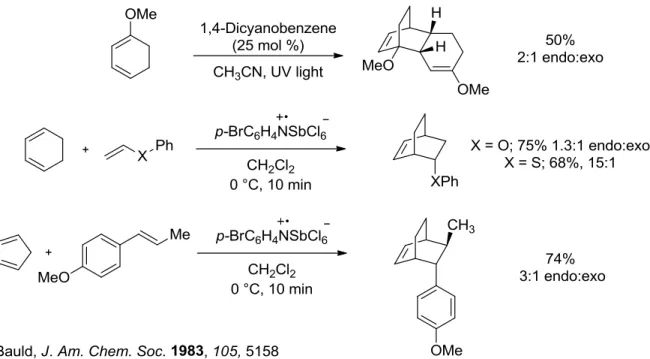
In 1983, Bauld and co-workers expanded the scope of the cation radical Diels-Alder to include more electron-rich dienophiles (Figure 1.5).8 They recognized the advantageous nature of the cation radical DA, in which electron-rich partners are essentially converted to electron-poor dienophiles through one-electron oxidation. Attempts to dimerize 1-methoxy-cyclohexadiene with their aminium radical cation catalyst proved unfruitful, hampered by polymerization. After switching to a photoinduced electron transfer sensitizer, 1,4-dicyanobenzene activated by UV-light, they were able to obtain the dimerized product in 70% yield. Light activated single electron oxidants have unique properties that will be discussed in-depth later in the chapter. Vinyl enol ether and phenyl vinyl sulfide both reacted with
5
required. In this paper, they also show the first example of a styrene substrate, anethole, as a competent dienophile partner for cyclopentadiene in 74% yield and 3:1 dr.
Figure 1.5 Expanding Scope of Cation Radical Diels-Alder to Electron Rich Substrates
The Bauld group performed extensive investigations of pericyclic cation radical reactions and also reported [2+2] cycloadditions,9 though this class of reactions will not be discussed here. In their mechanistic investigations, they observed that in the case of 2,4-dimethyl-1,3-pentadiene, dimerization by the aminium salt or photoinduced electron transfer (PET) gave two different products (Figure 1.6).9 It was only when the dimerization was promoted by the aminium salt in the presence of 2,6-di-tert-butyl lutidine did the products’ identity match. The Bauld group suggests that for certain substrates, catalysis by the aminium salt may proceed through a Brønsted acid pathway, a pathway not seen in photoinduced electron transfer.
6
Figure 1.6 Mechanistic Investigation of Radical vs. Brønsted Acid Catalyzed Pathways
which did not produce any of the cis products. They also exposed the cis and trans products to the triarylaminium radical cation and observed isomerization to the trans product in the case of the cis
product but no isomerization of the trans product (Figure 1.7). They assert that the cis product becomes oxidized and undergoes single bond rotation to relieve the unfavorable eclipsing interaction between the methyl and p-OMe phenyl groups. This finding supports the notion that the cis isomer of anethole is going through a stepwise mechanism and this leads them to suggest that it is likely that the trans isomer is operating under a similar mechanism. They noted that the same results are obtained when using
photosensitized electron transfer conditions as well.
Figure 1.7 Cation Radical Diels-Alder Reaction Between Cis and Trans-Anethole and Cp
UV-7
activated 9,10-dicyanoanthracene (DCA) gave the desired cycloadducts in 60% yield in a 4:1 endo:exo dr (Figure 1.8).11 In photoinduced electron transfer manifolds, the sensitizers are activated by light and act as strong electron acceptors in their excited state. In contrast to Bauld’s aminium catalyzed cation radical DA, Jones suggests the formation of a exciplex in which free radical cations may not form but instead exist as a radical cation/anion pair. Extended irradiation in the presence DCA did result in the formation of very small amounts of adduct formation from the reaction between diene and sensitizer.
Figure 1.8 Photosenzitized Cation Radical Diels-Alder by Jones et al.
In 1985, Mattay and colleagues introduced ketone-LiClO4 salts as competent electron acceptors
for the photolytic generation of radical cations. They evaluated these new electron acceptors against reported oxidants in photolytic cycloadditions (Figure 1.9).12 The Mattay group found that each catalyst gave the desired cycloadducts in good yields but with varying endo to exo selectivities. The ketone-LiClO4 mixtures showed no preference for either diastereomer while the aminium salt demonstrated a 4:1
(endo:exo) diastereoselectivity and triaryloxopyrylium tetrafluoroborate (TPT) gave 6:1 dr, also favoring the endo diastereomer.
8
These results led the group to suggest that the mechanism of all cation radical reactions cannot simply be rationalized by a chain reaction mechanism. They present an alternative to Bauld’s assertion on the role selectivity in the cation radical DA, in which cation radical intermediates arise from the
dienophile. In the presence of excess diene, the Mattay group observed an increase in the formation of the exo isomer, leading them to suggest the formation of a diene radical cation intermediate. To support their claim, they drew on previous studies reported by Gross.13 In the report by Gross, they investigated the gas phase cation radical DA with mass spectrometry methods and observed the acyclic octadienyl
intermediate along with the cyclohexene radical cation. Gross and colleauges then proposed a step-wise mechanism for the DA reaction of 1,3-butadiene, with a radical cation diene intermediate instead of the concerted pericyclic mechanism in which a [3+2] cyclization would be symmetry forbidden.
In 1987, the Steckhan lab demontrated evidence for the presence of the cation radical of the diene.14 They were able to electrochemically generate the radical cation of the diene in the presence of less oxidizable dienophiles and obtain the Diels-Alder cycloadducts, supporting a [3+2] mechanistic pathway. The role selectivity for the diene and dienophile in the cation radical Diels-Alder has been debated by many groups. Given that the Steckhan report contradicts Bauld’s original assertion that the reaction went through a dienophile radical cation as a [4+1] cycloaddition, in 1990 Bauld and colleagues published another report that rigorously tested their understanding of the role selectivity in the cation radical Diels-Alder.15 They evaluated the Diels-Alder reaction between two dienes with sufficiently different oxidation potentials, with the assumption that the more easily oxidizable partner would become the radical cation intermediate, even if it was the diene partner. The product distribution should reveal whether a diene or dienophile radical cation was formed.
The Bauld lab irradiated 1,3-cyclohexadiene (Eox = 1.53 V) and 1,2-diethylidenecyclohexane (Eox
9
cation radical Diels-Alder. This suggests that the oxidation potential of the two reaction partners plays a very important role in determining the mechanistic pathway.
Figure 1.10 Testing Orbital Symmetry Control in the Cation Radical Diels-Alder
The Steckhan lab reported the cation radical DA reaction between indoles and electron-rich dienes in 1991, expanding the scope of competent dienophile partners for this transformation.16 Initially, irradiation of indole, cyclohexadiene and TPT catalyst gave only very low yields of the DA cycloadducts. Their calculations showed that the expected product had a much lower oxidation potential than the starting indole (Eox = 0.7 V vs. Eox = 1.28 V vs NHE), and that the excited catalyst was being quenched by
the product as it became present in higher concentrations. The Steckhan lab circumvented this challenge by including acetyl chloride and sodium bicarbonate into the reaction mixture and obtained the N-acylated cycloadduct product in 70% yield in 3.3:1 endo:exo diastereoselectivity. Other electron-rich dienes reacted with indoles in good yields, with the exception of dienes without rigid s-cis conformations of their double bonds, which gave slightly lower yields (Figure 1.11).
Substituted indoles did not react to give desired product, likely due to steric hindrance around the dienophile. A variety of nitrogen protecting groups were evaluated and methyl chloroformate and
10
Figure 1.11 Photolytic Cation Radical DA Reaction of Indole and Electron-Rich Dienes
In 1995, the Schmittel group reported the cation radical Diels-Alder reaction of electron-rich allenes (Figure 1.12).17 Beyond expanding the scope of the dienophile partner, this transformation also provides access to valuable exo-alkylidine products, which can readily undergo further manipulation. They obtained the desired products in moderate to good yields. All reactions were run in the presence of 2,6-di-tert-butylpyridine as a base to suppress the acid catalyzed process which leads to rearrangement of the products. Electron withdrawing substituents were not tolerated at any position on the allene.
11
Recently, in 2011, the Yoon lab demonstrated the radical cation Diels-Alder reaction promoted by an inorganic ruthenium polypyridyl photocatalyst (Figure 1.13).18 Using very low loadings of Ru(bpz)3(BArF)2 activated by visible light in the presence of air, they obtained the desired cycloadducts
in good to excellent yields. Ruthenium complexes have been well-studied as single electron oxidants and in this case, benefit from its ability to be turned over by oxygen. Reactions with terminal styrenes,
styrenes with unprotected alcohols, electron neutral styrenes and trisubstituted styrenes were unsuccessful in the reaction as well as electron deficient dienes and Danishefsky’s electron rich diene.
Figure 1.13 Photocatalysis of the Cation Radical DA Reactions by Ru(bpz)3(BArF)2
The cation radical Diels-Alder reaction has been optimized by many groups to include a variety of electron-rich substrates and excellent reaction yields. To the best of our knowledge, there is only a single report of the enantioselective catalysis of the cation radical Diels-Alder reaction (Figure 1.14).19 This example comes from Schuster and Kim in 1990, in which they report the reaction between
12
to -30 °C or -5 °C gave essentially no enantioselectivity. They propose that enantioselectivity arises from the formation of diastereoselective exciplexes between the chiral catalyst and the prochiral styrene. It is possible that association between the radical cation intermediate and the reduced catalyst could direct reaction with cyclohexadiene with facial selectivity.
Figure 1.14 Enantioselective Cation Radical Diels-Alder reported by Schuster and Kim
An overview of existing cation radical methods has been discussed. All strategies rely on single electron oxidation to access the cation radical intermediates. Of interest to our group is photochemical oxidation for the catalysis of the cation radical Diels-Alder reaction. The next section will discuss basic tenets of photoinduced electron transfer and its advantages and limitations as it applies to the cation radical Diels-Alder reaction.
1.3 Photoinduced Electron Transfer
Photoinduced electron transfer is a fundamental process in chemical reactions. In general, it involves excitation of a compound to its excited state where is can easily gain a single electron from another molecule. One can predict the likelihood of such an event using the modified Rehm-Weller equation which states that the free energy of electron transfer is equal to the difference between the half-wave oxidation potential of a donor molecule and the half-half-wave excited state reduction potential of an acceptor molecule plus the coulombic constant [ΔGet = E1/2(ox) – E*1/2(red) + C].
20
13
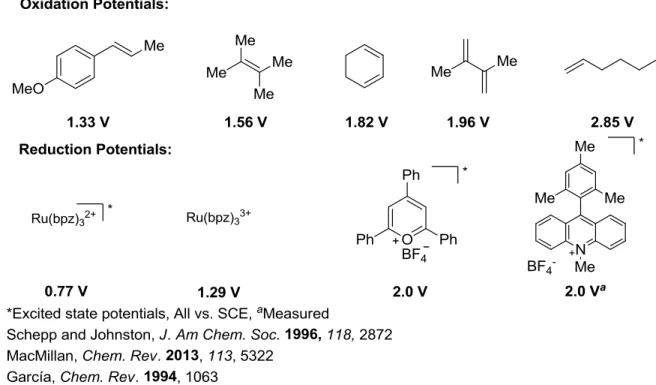
This equation allows researchers to judiciously select photo-oxidants as well as donor substrates. As discussed in the previous section, many groups believe that the role selectivity of the radical cation intermediate arises from the more easily oxizable reacting partner. Oxidation potentials of compounds can be measured by cyclic voltammetry against certain electrodes and are found in the literature (Figure 1.15).21–23 Styrenes are popular substrates for the cation radical Diels-Alder reaction and generally more oxidizable than aliphatic di- or tri-substituted alkenes. Choosing an oxidant with an appropriate reduction potential to access alkenes is also critical in electron transfer reactions. These can be chemical oxidants which operate as oxidants in their ground state or photochemical oxidants, which generally have more oxidizing power. Our lab is particularly interested in the acridinium and triaryloxopyrylium salt photocatalysts as their oxidation potentials are around 2.0 V, which would provide access to substrates beyond styrenes like tri-substituted aliphatic alkenes.
Figure 1.15 Redox Potentials of Various Alkenes and Single Electron Oxidants
Triaryloxopyrylium Salts as Photo-Oxidants
14
have attracted interest for their unique properties. Variants of the salt are commercially available and readily accessible from simple starting materials. They also absorb light in the visible region which allows researchers to avoid using harmful UV-light. Simple substitution of various groups on the arene moiety allows for tunability of the absorbance, with wavelengths ranging from 412 nm for the parent
triphenyloxopyrylium to 577 nm for the p-dimethylaminophenyl diphenyl substituted oxopyrylium. These salts are strong oxidants in their excited state and have been shown to act as an electron acceptor in their singlet or triplet state with an oxidation potential of ~2.0 V vs. SCE (Figure 1.16).23
Figure 1.16 Synthesis of Oxopyrylium Salts
The organic oxopyrylium salts can be easily solubilized in dichloromethane or acetonitrile. They also benefit from their ionic nature. The lack of coulombic attraction between the radical cation and the oxopyrylium radical after electron transfer reduces the likelihood of non-productive back electron transfer, which is a major issue for other oxidants. This feature also suggests that the coulombic term in the Rehm-Weller equation would be essentially negligible for this electron transfer event as it lacks net charge separation. However, the oxopyrylium radical may be susceptible to dimerization with an identical species at low temperatures as observed by García and colleagues, which would sequester the active catalyst. They report that at room temperature this reaction is reversible.
15
Lastly, we were interested in the TPT salts because we saw an opportunity to introduce a chiral organic anion to pair with the cationic oxopyrylium. The synthesis of these chiral salts will be discussed in the next chapter. We drew from the report by Schuster and Kim to hypothesize that the radical cation intermediate could potentially pair with the chiral anion as a means to induce asymmetry. In the next section, previous examples of chiral counteranion catalysis will be shown.
1.4 Chiral Counteranion Directed Catalysis
Chiral ionic catalysis has found extensive utility in phase transfer catalysis by cinchona alkaloid derivatives, in which the ionic pairing generally occurs between an oxygen enolate and a quaternary amine. This area of catalysis should be mentioned but because the chiral information is associated with the cationic partner it will not be discussed in depth. Within the last decade asymmetric counteranion-directed catalysis (ACDC) has emerged as an exciting new concept.
There has been some debate over which transformations can be classified as strictly ACDC. In a 2013 review,24 List and Mahlau define ACDC as the “induction of enantioselectivity in a reaction proceeding through a cationic intermediate by means of ion pairing with a chiral, enantiomerically pure anion provided by the catalyst.” However, it is possible that other stabilizing interactions exist in addition to the coulombic attraction within the ion pair. These interactions include hydrogen bonding, which suggests classic Brønsted acid catalysis,25 transition metal catalysis,26 where the anion is potentially acting as a chiral ligand, as well as anion binding catalysis which generally relies on the binding of an achiral anion to chiral thioureas.27 Phosphoric acid derivatives have also been applied in asymmetric
counteranion-directed Lewis acid catalysis for the opening of meso-aziridines28 and in the Mukaiyama-aldol reaction.29 These examples involve the simultaneous generation of the chiral counteranion and countercation after the transfer of a silyl group, and so will not be discussed. For the purposes of this project, only examples with presumably “pure” asymmetric counteranion directed catalysis will be presented.
16
imidazolidinone salt.30 This transformation relies on chiral secondary amine catalysis but during their investigations, the List group was able to show a proof of concept for the catalytic asymmetric
transformation hydrogenation with chiral phosphoramide salts. This result was unpublished at the time but appears in their 2013 review. Using an achiral morpholine, Hantzsch dihydropyridine and 20 mol % (R)-2,4,6-triisopropylphenyl phosphate BINOL [(R)-TRIP] anion, the authors obtain the hydrogenated product in 90% yield and 99:1 enantiomeric ratio (Figure 1.17).24 They assert that there are no major stabilizing effects present as there are no nitrogen-hydrogen bonds present in the quaternary iminium intermediate. However, it is possible that there are weak hydrogen bonding interactions between the anion and CH. This result was impressive because it gave enantioselectivies even higher than obtained with chiral secondary amine catalysis.
Figure 1.17 Catalytic Asymmetric Transfer Hydrogenation through ACDC
In 2008, Toste and colleagues reported the enantioselective opening of meso-aziridines with alcohols using chiral counteranion catalysis (Figure 1.18).31 This example of reverse polarity phase transfer catalyst represents the one of the clearest examples of using a chiral anion to induce asymmetry. By employing Ag2CO3 and a chiral phosphate silver salt, they abstract a chloride from the starting
material to form the meso-aziridinium. They propose that the positively charged nitrogen of the aziridinium can pair with the chiral phosphate anion and block one face to selectively direct the
17
and excellent ee’s. Given that chiral phosphoric acids have been extensively reported in Brønsted acid catalysis, their use as chiral counteranions is quite appealing.
Figure 1.18 Asymmetric Opening of Meso-Aziridines Using Chiral Counteranion Catalysis
In the last year, Toste reported another example of ACDC with an asymmetric cross-dehydrogenative coupling catalyzed by chiral triazole-containing phosphoric acid (Figure 1.19).32 Though this report appeared after we discontinued research on this project, it serves to represent the growth of this field. Notably, the Toste group is able to access a library of chiral triazole containing phosphoric acid catalysts through the well-established copper catalyzed azide/alkyl click reaction. Figure 1.19 Asymmetry Cross-Dehydrogenative Coupling Using Chiral Counteranion Catalysis
18
demonstrated in good to excellent yield and enantioselectivity. To investigate the role of the triazole in the selectivity of the reaction they synthesized three adamantane substituted isosteres and observed a significant loss in selectivity when the nitrogen atoms of the triazole were replaced with carbon atoms. This finding suggests that electronics of the substituents at the 3,3’ positions play an important role in selectivity.
Summary
We saw an opportunity to develop a method for the enantioselective cation radical Diels-Alder reaction. As disclosed earlier, no previous reports have shown synthetically useful levels of
enantioinduction in this transformation. We wanted to take advantage of an easily synthesized organic photo-oxidant like the triaryloxopyrylium and introduce chirality into the molecule through a chiral 1,1’-bi-2-napthyl (BINOL) derived counteranion. We hoped that a pairing between the radical cation
intermediate and the chiral counteranion would induce asymmetry in the transformation. The next chapter will discuss the synthesis and evaluation of various chiral photo-oxidant salts and the optimization of the enantioselective cation radical Diels-Alder (Figure 1.20).
19
REFERENCES
(1) Norton, J. A. The Diels-Alder Diene Synthesis. Chem. Rev. 1942, 31, 319–523.
(2) Bellville, D. J.; Wirth, D. W.; Bauld, N. L. Cation-Radical Catalyzed Diels-Alder Reaction. J. Am.
Chem. Soc. 1981, 103, 718–720.
(3) Houk, K. N. Generalized Frontier Orbitals of Alkenes and Dienes. Regioselectivity in Diels-Alder Reactions. J. Am. Chem. Soc. 1973, 95, 4092–4094.
(4) Evans, D. A.; Miller, S. J.; Lectka, T. Bis(oxazoline)copper(II) Complexes as Chiral Catalysts for the Enantioselective Diels-Alder Reaction. J. Am. Chem. Soc. 1993, 115, 6460–6461.
(5) Nakashima, D.; Yamamoto, H. Design of Chiral N-Triflyl Phosphoramide as a Strong Chiral Brønsted Acid and Its Application to Asymmetric Diels−Alder Reaction. J. Am. Chem. Soc. 2006,
128, 9626–9627.
(6) Ahrendt, K. A.; Borths, C. J.; MacMillan, D. W. C. New Strategies for Organic Catalysis: The First Highly Enantioselective Organocatalytic Diels−Alder Reaction. J. Am. Chem. Soc. 2000, 122, 4243–4244.
(7) Bellville, D. J.; Bauld, N. L. Selectivity Profile of the Cation Radical Diels-Alder Reaction. J. Am.
Chem. Soc. 1982, 104, 2665–2667.
(8) Pabon, R. A.; Bellville, D. J.; Bauld, N. L. Cation Radical Diels-Alder Reactions of Electron-Rich Dienophiles. J. Am. Chem. Soc. 1983, 105, 5158–5159.
(9) Bauld, N. L.; Bellville, D. J.; Harirchian, B.; Lorenz, K. T.; Pabon, R. A.; Reynolds, D. W.; Wirth, D. D.; Chiou, H. S.; Marsh, B. K. Cation Radical Pericyclic Reactions. Acc. Chem. Res. 1987, 20, 371–378.
(10) Bauld, N. L.; Gao, D. Approaching a Possible Stepwise/concerted Mechanistic Crossover Point in the Cation Radical Cycloadditions of Cis- and Trans-Anethole. J. Chem. Soc. Perkin Trans. 2
2000, 931–934.
(11) Jones, C. R.; Allman, B. J.; Mooring, A.; Spahic, B. Photosensitized [4 + 2] Cyclodimerization of 1,3-Cyclohexadiene. J. Am. Chem. Soc. 1983, 105, 652–654.
(12) Mattay, J.; Gersdorf, J.; Mertes, J. A New Type of Electron Acceptor for Diels–Alder Reactions via Radical Cations. J. Chem. Soc. Chem. Commun. 1985, 1088–1090.
(13) Groenewold, G. S.; Gross, M. L. Cation Radical Diels-Alder Reaction of 1,3-Butadiene: A Two-Step Cycloaddition. J. Am. Chem. Soc. 1984, 106, 6569–6575.
(14) Mlcoch, J.; Steckhan, E. Electrochemically Induced [4+2]-Cycloadditions - a Mechanistic Interpretation of the Cation Radical Diels-Alder Reaction Based on Preparative Results.
Tetrahedron Lett. 1987, 28, 1081–1084.
20
(16) Gieseler, A.; Steckhan, E.; Wiest, O.; Knoch, F. Photochemically Induced Radical-Cation Diels-Alder Reaction of Indole and Electron-Rich Dienes. J. Org. Chem. 1991, 56, 1405–1411. (17) Schmittel, M.; Woehrle, C. Cation Radical Catalyzed Diels-Alder Reaction of Electron-Rich
Allenes. J. Org. Chem. 1995, 60, 8223–8230.
(18) Lin, S.; Ischay, M. A.; Fry, C. G.; Yoon, T. P. Radical Cation Diels–Alder Cycloadditions by Visible Light Photocatalysis. J. Am. Chem. Soc. 2011, 133, 19350–19353.
(19) Kim, J. I.; Schuster, G. B. Enantioselective Catalysis of the Triplex Diels-Alder Reaction: Addition of Trans-.beta.-Methylstyrene to 1,3-Cyclohexadiene Photosensitized with (-)-1,1’-bis(2,4-Dicyanonaphthalene). J. Am. Chem. Soc. 1990, 112, 9635–9637.
(20) Jayanthi, S. S.; Ramamurthy, P. Photoinduced Electron Transfer Reactions of
2,4,6-Triphenylpyrylium: Solvent Effect and Charge-Shift Type of Systems. Phys. Chem. Chem. Phys.
1999, 1, 4751–4757.
(21) Schepp, N. P.; Johnston, L. J. Reactivity of Radical Cations. Effect of Radical Cation and Alkene Structure on the Absolute Rate Constants of Radical Cation Mediated Cycloaddition Reactions1. J.
Am. Chem. Soc. 1996, 118, 2872–2881.
(22) Prier, C. K.; Rankic, D. A.; MacMillan, D. W. C. Visible Light Photoredox Catalysis with Transition Metal Complexes: Applications in Organic Synthesis. Chem. Rev. 2013, 113, 5322– 5363.
(23) Miranda, M. A.; Garcia, H. 2,4,6-Triphenylpyrylium Tetrafluoroborate as an Electron-Transfer Photosensitizer. Chem. Rev. 1994, 94, 1063–1089.
(24) Mahlau, M.; List, B. Asymmetric Counteranion-Directed Catalysis: Concept, Definition, and Applications. Angew. Chem. Int. Ed. 2013, 52, 518–533.
(25) Uraguchi, D.; Terada, M. Chiral Brønsted Acid-Catalyzed Direct Mannich Reactions via Electrophilic Activation. J. Am. Chem. Soc. 2004, 126, 5356–5357.
(26) Hamilton, G. L.; Kang, E. J.; Mba, M.; Toste, F. D. A Powerful Chiral Counterion Strategy for Asymmetric Transition Metal Catalysis. Science 2007, 317, 496–499.
(27) Taylor, M. S.; Jacobsen, E. N. Highly Enantioselective Catalytic Acyl-Pictet−Spengler Reactions.
J. Am. Chem. Soc. 2004, 126, 10558–10559.
(28) Rowland, E. B.; Rowland, G. B.; Rivera-Otero, E.; Antilla, J. C. Brønsted Acid-Catalyzed Desymmetrization of Meso-Aziridines. J. Am. Chem. Soc. 2007, 129, 12084–12085. (29) García-García, P.; Lay, F.; García-García, P.; Rabalakos, C.; List, B. A Powerful Chiral
Counteranion Motif for Asymmetric Catalysis. Angew. Chem. Int. Ed. 2009, 48, 4363–4366. (30) Yang, J. W.; Hechavarria Fonseca, M. T.; Vignola, N.; List, B. Metal-Free, Organocatalytic
Asymmetric Transfer Hydrogenation of Α,β-Unsaturated Aldehydes. Angew. Chem. Int. Ed. 2005,
21
(31) Hamilton, G. L.; Kanai, T.; Toste, F. D. Chiral Anion-Mediated Asymmetric Ring Opening of Meso-Aziridinium and Episulfonium Ions. J. Am. Chem. Soc. 2008, 130, 14984–14986.
(32) Neel, A. J.; Hehn, J. P.; Tripet, P. F.; Toste, F. D. Asymmetric Cross-Dehydrogenative Coupling Enabled by the Design and Application of Chiral Triazole-Containing Phosphoric Acids. J. Am.
22
CHAPTER 2: PROGRESS TOWARDS AN ASYMMETRIC PHOTOCATALYTIC DIELS-ALDER REACTION
Introduction
This chapter will detail our efforts to develop a photocatalytic enantioselective cation radical Diels-Alder reaction. We recognized the great utility of the cation radical Diels-Alder reaction, a powerful transformation that combines two electronically matched partners to form two bonds and up to four contiguous stereocenters. Rendering this reaction asymmetric would represent a significant advance for this area of organic synthesis. We chose to explore
triaryloxopyrylium salts paired with various chiral anions as our chiral photoredox catalysts. Over the course of three years, we extensively evaluated numerous catalysts and reaction conditions but were unable to achieve synthetically practical levels of reactivity and enantioselectivity. We believe this transformation to be highly valuable and herein present our results as a contribution to the field of chiral counteranion directed catalysis.
2.1 Initial Investigation of Racemic Reaction
We began our investigations with the racemic reaction reported by Bauld1 and colleagues between β-methyl-p-methoxystyrene (anethole) and cyclopentadiene (Cp) catalyzed by
triphenyloxopyrylium tetrafluoroborate (TPT) in DCM under irradiation by four 60W fluorescent light bulbs. We used cyclopentadiene in excess (5 equivalents) as reported by Bauld, in hopes of increasing the likelihood of reaction between the anethole radical cation and cyclopentadiene. We assumed that anethole would occupy the role of the cation radical partner given its lower
23
reaction to form dicyclopentadiene at room temperature and must be heated to ~200 °C to obtain the retro-Diels-Alder product and distillate cyclopentadiene, which was kept at low temperatures to ensure its purity. The cation radical Diels-Alder reaction was run at -60 °C for 24 hours and the desired products were obtained in 88% GC yield in 10:1 dr. A chiral GC assay was developed for the isolated products (Figure 2.1).
Figure 2.1 Initial Racemic Cation Radical Diels-Alder Catalyzed by a TPT Salt
2.2 Optimization of the Cation Radical Diels-Alder Reaction
At the outset of the project we were very interested in C2-symmetric 1,1’-bi-2-naphthyl (BINOL) phosphate derivatives as counteranions to oxopyryliums to induce asymmetry in the reaction through the formation of a chiral ion pair. This class of compounds has been extensively used in enantioselective Brønsted acid catalysis3 and allowed us to prepare our acid precursors following existing literature. We recognized that it would be crucial to find an adequately acidic partner to cyclize the ene dione precursor to form the oxopyrylium salt. The subsequently formed counteranion should be poorly nucleophilic to disfavor addition to the radical cation intermediate. While addition of the counteranion could be reversible, if the equilibrium favors addition it could result in a loss of reactivity. For that reason we chose to target N-trifluoromethanesulfonyl (N -trifyl) phosphoramides as opposed to the phosphoric acid analogs. The N-trifyl phosphoramide can delocalize the negative charge between five atoms as opposed to three atoms in the latter.
24
proceeded in good yield to give intermediate 2. This intermediate was treated with a nickel catalyst to install the aryl groups via a Kumada coupling then deprotection with boron tribromide revealed the pendant alcohols. The silyl-substituted BINOL catalysts also began from enantiopure BINOL. Hydrogenation of the back rings promoted by PtO2 then selective bromination furnished
intermediate 5 in quantitative yield. Silylation of intermediate 5 was followed by a retro-Brook rearrangement with tert-butyl lithium to furnish the substituted BINOL 6. Treatment of
intermediates 3 and 6 with phosphorous oxychloride, dimethylamino pyridine, triethylamine and trifluoromenthane sulfonamide produced the substituted N-trifyl phosphoramides 7 along with the phosphate side product, which can be separated via silica gel chromatography. With the
phosphoramides in hand, we were pleased to find that upon heating with triaryl ene dione in ethanol by heat gun to ~80 °C the desired salt was precipitated upon cooling (Figure 2.2). Figure 2.2 Synthesis of 3,3’ Substituted BINOL and H8-BINOL Catalysts
Impurities were removed after washing with hexanes or recrystallization with
25
catalysts. We suspected that there may have been some inorganic counteranion contaminants present, which would lower the observed enantioselectivity. We tried to address this issue by careful recrystallization and drying the catalyst under vacuum at 60 °C overnight.
With the chiral catalysts in hand we tested their efficiency and selectivity in the cation radical Diels-Alder reaction (Figure 2.3). We found that bulky arenes at the 3 and 3’ positions did not provide any useful levels of enantioselectivity. Interestingly, substitution with the bulky 3,3’-SiPh3 gave a promising level of ee (enantiomeric excess) though very low yield was
observed for the closely related tri-isopropyl substituted silane. We were interested in the H8-BINOL scaffold as the fully saturated back rings would increase the steric interaction between the binaphthyl framework. This modification increases the rigidity of the structure and also changes the bite angle close to the anionic center. By employing catalyst 8a, we were pleased to observe an 18% yield with 18% ee and 4:1 dr, which is a similar level of diastereoselectivity obtained by Bauld with TPT.
Figure 2.3 Initial BINOL-Derived Catalyst Screen
Given the promising initial results observed with the 3,3’ SiPh3-BINOL catalyst 8e, we
26
used 5.0 equivalents of cyclopentadiene in keeping with Bauld and co-workers’ previous report. We did not observe any advantage in increasing or decreasing the equivalents of Cp used 5.0 equivalents of cyclopentadiene throughout for consistency. When we inverted the relationship between the starting materials, with anethole present in excess, we obtained many unidentifiable side products in the crude reaction mixture. These new products eluted close to the desired products by chiral gas chromatography (GC), making it difficult to accurately measure yield and selectivity, therefore, we decided to keep anethole as the limiting reagent.
We believed that solvent polarity would play a large role in enantioselectivity as we were relying on ionic interactions to control enantioinduction. We wanted to achieve tight ion pairing between the radical cation and chiral counteranion for good enantiocontrol through non-polar solvents. On the other hand, highly polar solvents would be more conducive for reactivity. The challenge would lie in finding a balance between selectivity and reactivity. When we evaluated our reaction in various solvents we observed inverse trends in yield and ee (Figure 2.4). Figure 2.4 Comparing Dielectric Constant vs. Yield and Selectivity
27
two isomers are formed as opposed to four diastereomers. Although all of the yields are low, the highest yield was obtained using the solvent DCM, which is the most polar. Polarity can be expressed through dielectric constants of the solvents and we saw that as the dielectric constant decreased, the enantioselectivities increased. The two least polar solvents, toluene and xylenes, gave a 20.5% ee and 22% ee, respectively.
We imagined addressing this delicate issue by evaluating the reaction in numerous different solvents as well as solvent mixtures (Table 1).
Table 1. General Solvent Screen
Entry Solvent Temperature Time GC Yield % ee
1 Bromobenzene -30 °C 24 h 9.3% 36%
2 Fluorobenzene -30 °C 24 h 0.2% 22%
3 Acetone -30 °C 24 h 0.1% 1%
4 Toluene -30 °C 24 h 1.8% 23%
5 Toluene 0 °C 6 h 0.4% 12%
6 THF 0 °C 6 h 0.3% 12%
7 1%TFE/Toluene 0 °C 6 h 1.0% 1.2%
8 3% TFE/Toluene 0 °C 6 h 1.1% 0.6%
9 1% DCM/Toluene 0 °C 6 h 0.5% 16%
10 3% DCM/Toluene 0 °C 6 h 0.5% 13%
11 10% DCM/Toluene 0 °C 6 h 0.5% 14%
12 20% DCM/Toluene 0 °C 6 h 0.6% 10%
13 50% DCM/Toluene 0 °C 6 h 1.0% 11%
14 75% DCM/Toluene 0 °C 6 h 1.3% 5%
15 90% DCM/Toluene 0 °C 6 h 2.2% 0%
28
performed poorly. Ultimately, we did not identify any solvent or solvent mixture that provided results superior to 100% toluene.
We also conducted experiments evaluating various catalyst loadings (Figure 2.5). We found that lower catalyst loadings afforded higher enantioselectivities. The yields dropped from 9% to 5% when the catalyst loading was decreased from 5 to 1 mol %, however, moving from 1 mol % to 0.5 mol % did not have any effect on the yield. Moving forward we employed 0.5 mol % catalyst for our test reactions, not only in hopes of high selectivities but to conserve precious chiral catalyst.
Figure 2.5 Catalyst Loading Screen
29 Figure 2.6 Screening for Reaction Temperature
While we were quite pleased at the enantioselectivity observed at -60 °C, the yield was disappointingly low and needed to be addressed for this method to be viable. Moving away from our standard test reaction, we hoped that different substrates, specifically more reactive partners, would improve the observed product yields. There were a variety of substrates that did not participate even in the racemic cation radical Diels-Alder reaction (Figure 2.7). We attempted to react the electron rich trans-1-methoxy-3-trimethylsilyloxy-1,3-butadiene (Danishefsky’s diene) with anethole but surprisingly was unable to detect any desired product. The trimethylsilyl protected analog of Danishefsky’s diene also failed to react. It should be noted that this type of diene also did not react when promoted by ruthenium photoredox catalysts. Cyclohexadiene performed well as a reactive diene with anethole but was not pursued because the diastereomers could not be adequately separated by chiral GC. Reaction of substituted cyclohexadiene with anethole resulted in the formation of many side products. Furans have been reported as
30
Figure 2.7 Failed Substrates for the Racemic Cation Radical Diels-Alder Reaction
We also evaluated a number of dienophile partners that failed to react in the racemic reaction. Unsubstituted β-methylstyrene as well as α-methyl p-OMe styrene resulted in
polymerization. The reaction did not tolerate tertiary amine or vinyl ether substitutions. We were quite interested in 6-methoxy-1,2-dihydronaphthalene as a dienophile that might allow us to explore the reactivity of a cis styrene, however we were unable to detect any desired product. Placing a phenyl ring at the β-position of the styrene resulted in no reaction, potentially because of unfavorable steric interactions or it may have deactivated the styrene towards oxidation.
We found a number of substrates that participated in the racemic cation radical
Diels-Alder reaction yet did not produce synthetically useful levels of reactivity or
enantioselectivity in the asymmetric transformation (
Figure 2.8
). We noticed that acyclic
31
dienophiles was tolerated and in particular the triphenylsiloxy substituted styrene
performed comparably to anethole. We investigated the effect of having the dienophile
partner locked in the cis geometry, but observed no advantage in reactivity or selectivity.
Figure 2.8 Substrates that Resulted in Low Yields and Selectivity
We realized that in order to move forward in the development of this method we had to address the low reactivity. While we were unsure of the cause, the lack of reactivity likely stems from the presence of the chiral anion as the oxopyrylium with the inorganic tetrafluoroborate counteranion catalyzes the racemic reaction quantitatively within a few hours. It was possible that the anion was binding to the cation radical intermediate and suppressing reactivity. We decided to focus on cyclopentadiene as the diene partner over 2,3-dimethyl butadiene because of its
32
comparison of 2,3-dimethyl butadiene and cyclopentadiene did reveal an increase in yield from 1.1% to 29% with Cp; however we observed a loss in enantioselectivity (Figure 2.9).
Figure 2.9 Comparison of 2,3-Dimethyl Butadiene and Cyclopentadiene
We were encouraged by the modest levels of both reactivity and enantioselectivity observed with the use of cyclopentadiene. We hoped to find a way to increase both through optimization of the reaction conditions. We evaluated a series of concentrations and found that more dilute solutions led to higher enantioselectivities (Figure 2.10). Using a concentration of [0.063 M] in toluene gave the most promising result with 38% yield, 10:1 dr and 45% ee after 24 hours. We repeated this result on a large scale for 72 hours and obtained the products in 63% yield, 9:1 dr and 36% ee.
33
We believed we were close to exhausting all remaining optimization strategies for this transformation, save catalyst design and other miscellaneous ideas which will be discussed in a separate section. We synthesized a small set of substrates bearing different aliphatic groups at the β-position of the styrene to probe the substrate scope of this reaction. We had difficulty obtaining reliable results for the β-cyclohexyl substrate as we were unable to purify the starting styrene. We also synthesized the β-adamantyl substrate and developed a chiral GC assay for its reaction with cyclopentadiene but were unable to confidently calculate the enantioselectivity as new side products eluted around the same GC retention time as our products. The only productive variation was synthesizing the β-ethyl para-methoxy styrene which reacted with Cp after four days to give the desired products in a good 85% yield and modest enantioselectivity.
Figure 2.11 Substrate Scope for the Enantioselective Cation Radical Diels-Alder
We then decided to pursue other avenues of exploration, including the intramolecular variant of this transformation with efforts led by fellow graduate student Peter Morse. The subsequent sections disclose the evaluation of various catalysts and strategies that failed to provide a
breakthrough for the project, though these results should be of use if this project is revisited in the future.
2.3 Chiral Catalyst Screen for the Enantioselective Cation Radical DA
34
Early on we recognized that the 3,3’ SiPh3 BINOL N-trifylphosphoramide triaryl
oxopyrylium 8a was a promising catalyst. We were interested in making minor modifications to this scaffold to hopes of gleaning information as to which moieties were critical to reactivity and/or selectivity (Figure 2.12). We evaluated the analogous phosphate catalyst 9 and found that moving away from nitrogen to oxygen resulted in a complete loss in reactivity and selectivity. Figure 2.12 Effect of Modifications on the 3,3’-SiAr3-H8-BINOL Catalyst Scaffold
We hypothesized that the phosphate was too nucleophilic towards to the radical cation intermediate, shutting down reactivity. We then modulated the electronic nature of the
35
yield and enantioselectivity. The N-trifluoromethane sulfonyl phosphoramide moiety appears to be essential for reactivity.
Dr. Nicole Torres Knight in our lab first synthesized the catalysts 12 and 13 which bear
p-tert-butylphenyl and 3,5-dimethylphenyl (xylyl) trisubstituted silanes, respectively. We were
intrigued by initial results from catalyst 12 but eventually abandoned further optimization after attempts to increase the yields were unfruitful. The trixylylsilyl substituted catalyst 13 provided similar but slightly decreased yield and selectivity to the triphenylsilyl catalyst 8a at our
optimized conditions. Upon catalyst loading optimization we observed that yields could be much improved though selectivity did suffer (Figure 2.13).
Figure 2.13 Optimization using the 3,3’-Si(xylyl)3-H8-BINOL Catalyst 13
36
dilute concentrations decreased yields and the diastereoselectivity while increasing the
enantioselectivity for both sets of diastereomers. However, after a certain point the diastereomeric ratio does not decrease to 1:1 or reverse as we had hoped. Ultimately, we were unable to strike a balance between yield and selectivity to give a synthetically useful result.
In 2011, Toste and colleagues reported the use of BINOL catalysts bearing biaryl moieties on the 3 and 3’ positions as Brønsted acids for the enantioselective intramolecular addition of sulfonamides to dienes.4 Following their literature procedure we synthesized the oxopyrylium N-trifylphosphoramide with 10-(2,4,6-(CH3)3-C6H2)-9-anthracenyl groups at the 3,
3’ positions (14). We hoped that the biaryl groups would project further towards the radical cation
intermediate to induce selectivity. We found however, that while a decent 41% yield was
obtained, the enantioselectivity did not exceed 9% (Figure 2.14).
37
Moving away from the BINOL scaffold, we looked at chiral catalysts derived from expensive, yet commercially available VAPOL (15) and VANOL (16). These compounds possessed unique backbone structures that extend out over the anionic moiety instead of relying on substituents that branched out. Unfortunately, we observed very low yield using catalyst 15 and decent yield with catalyst 16 but absolutely no enantioinduction.
We then tried a different tact by exchanging the oxygen linkers in the BINOL scaffold to nitrogen linkers, which would allow for the substitution at nitrogen and hopefully create a chiral pocket closer to the ion pair. Synthesized according to literature procedure we evaluated the anthracenyl substituted chiral catalyst 17, and observed a disappointing 9% yield with no enantioselectivity.
Given that chiral counteranion synthesis is arduous and time-consuming we wanted to try to take advantage of amino acids as potential catalyst scaffolds. Synthesis of chiral catalyst 18 derived from L-alanine was very straightforward and obtained in high yield in just three steps. Its performance as a catalyst for the cation radical Diels-Alder reaction however was poor in terms of reactivity and selectivity; therefore no other amino acid based catalysts were pursued.
Lastly, we evaluated the disulfonimide BINOL catalyst 19, a scaffold reported recently by the List group. List and coworkers employed the 3,3’ arylsubstituted disulfimide for highly selective Mukaiyama aldol reactions.5 They propose that the chiral acid imparts such great enantiocontrol because the acid is more deeply embedded than the phosphoric acid counterpart. We experienced difficulty synthesizing the disulfimide with substituents at the 3,3’ position, however we were able to evaluate the unsubstituted catalyst and unfortunately did not observe any desired product.
38
the results we hoped for, they may be of use in other settings. It is probable that the key to success, as defined by high yield and selectivity, for this transformation still lies in the identification of a chiral catalyst with the right nucleophilicity and chiral environment. 2.4 Miscellaneous Optimization Strategies
Because we were only using 0.5 mol % catalyst in our reactions, we proposed to add additional chiral Brønsted acid to the reaction mixture that could potentially become deprotonated and increase the amount of free chiral counteranion present in solution. We tested a side by side comparison of a reaction with 5 mol % chiral 8a catalyst and one with 5 mol % chiral catalyst in addition to 5 mol % of the corresponding chiral Brønsted acid. We observed very similar yields and selectivities leading us to abandon this course of investigation. We tested the chiral Brønsted acid’s ability to catalyze the reaction by itself and found that it was an incompetent catalyst as expected (Figure 2.15).
Figure 2.15 Effect of Additional Chiral Brønsted Acid
39
fluorescent white light in the racemic reaction with TPT. We indeed observed a considerable increase in yield with the blue LEDs over violet and white light (Figure 2.16). Following this experiment, all of our reactions were irradiated with blue LEDs.
Figure 2.16 Effect of Light Sources on the Racemic Reaction
Throughout our investigations we were diligent in setting up the reactions under an atmosphere of nitrogen. However, we wanted to probe the effect of oxygen on our reaction (Figure 2.17). We found that the addition of oxygen had a pronounced deleterious effect on the yield of the reaction while the selectivities stayed relatively constant. We propose that oxidative cleavage of the anethole reaction partner occurs competitively in the presence of oxygen accounting for the observed loss in yield.
40 Summary
In this chapter our attempts to develop a practical method for the enantioselective cation radical Diels-Alder reaction through chiral anion catalysis has been detailed. While synthetically relevant levels of reactivity and enantiocontrol were not reached, our work serves as a valuable contribution for the advancement of this novel strategy for enantioinduction. We have
41 REFERENCES
(1) Pabon, R. A.; Bellville, D. J.; Bauld, N. L. Cation Radical Diels-Alder Reactions of Electron-Rich Dienophiles. J. Am. Chem. Soc. 1983, 105, 5158–5159.
(2) Schepp, N. P.; Johnston, L. J. Reactivity of Radical Cations. Effect of Radical Cation and Alkene Structure on the Absolute Rate Constants of Radical Cation Mediated Cycloaddition Reactions1. J. Am. Chem. Soc. 1996, 118, 2872–2881.
(3) Uraguchi, D.; Terada, M. Chiral Brønsted Acid-Catalyzed Direct Mannich Reactions via Electrophilic Activation. J. Am. Chem. Soc. 2004, 126, 5356–5357.
(4) Shapiro, N. D.; Rauniyar, V.; Hamilton, G. L.; Wu, J.; Toste, F. D. Asymmetric Additions to Dienes Catalysed by a Dithiophosphoric Acid. Nature 2011, 470, 245–249.
42
CHAPTER 3: BACKGROUND FOR THE DEVELOPMENT OF AN ANTI-MARKOVNIKOV HYDROAMINATION REACTION OF ALKENES
Introduction
Carbon-nitrogen bonds are ubiquitous in highly valuable biologically active compounds. The most direct way to form these bonds is through the addition of an amine to an alkene in the
hydroamination reaction. The hydroamination reaction is advantageous because it employs simple and commercially available starting materials and is completely atom economical. Challenges associated with the hydroamination reaction include the repulsion between the alkene pi-electrons and the nitrogen lone pair as well as the regioselectivity of the addition of the amine.
The majority of existing hydroamination reactions furnish products with amine substitution at the more substituted carbon center as governed by Markovnikov’s rule, which places the cationic charge generated in situ at the most stabilized carbon, either by substitution or electronics. Relatively few methods exist for the direct anti-Markovnikov hydroamination reaction and as will be shown, many require precious metals and are limited to activated alkene partners. In this chapter, previous reports of anti-Markovnikov hydroamination reactions of alkenes will be discussed.
3.1 Anti-Markovnikov Hydroamination Reactions Catalyzed by Transition Metals
43 Ni-catalyzed Anti-Markovnikov Hydroamination Reactions
Nickel complexes have demonstrated some utility in the hydroamination of activated olefins, though with very limited substrate scope. In 2002, Togni and Fadini employed tridentate phosphines as chiral ligands in the Ni(II) catalyzed anti-Markovnikov addition of anilines and morpholine to electron deficient alkenes (Figure 3.1).1 Yields for the hydroamination with anilines ranged from 26% to 91% yield, with increased electron density providing higher yields while ortho substitution on the anilines led to lower yields. Reactions with morpholine as the amine coupling partner gave uniformly good yields. Based on prior computational studies, the authors propose that the reactions proceed via olefin activation followed by nucleophilic attack by the amine.
Figure 3.1 Ni-catalyzed Anti-Markovnikov Hydroamination Reaction of Activated Olefins