TAKEOVER THREATS, JOB SECURITY CONCERNS, AND EARNINGS MANAGEMENT
Edward S. Sul
A dissertation submitted to the faculty at the University of North Carolina at Chapel Hill in partial fulfillment of the requirements for the degree of Doctor of Philosophy in the Kenan-Flagler School of
Business.
Chapel Hill 2017
Approved By:
Robert M. Bushman
Mark H. Lang
Bradley E. Hendricks
Eva Labro
Wayne R. Landsman
iii ABSTRACT
Edward S. Sul: Takeover Threats, Job Security Concerns, and Earnings Management (Under the direction of Robert M. Bushman and Mark H. Lang)
I exploit the international, staggered adoption of takeover laws in order to examine the
effect of increased turnover sensitivity to performance on managers’ financial reporting choices. Using a difference-in-difference design, I find that the enactment of laws designed to promote
takeover activity is associated with greater earnings management (abnormally high accruals, small positive earnings, discretionary earnings smoothing and poor accruals quality) and greater opacity (reduced analyst forecast accuracy and following and greater forecast dispersion). This is
consistent with managers responding to increased risk of termination by distorting earnings information. As predicted, results are particularly pronounced for managers with the highest ex
ante risk of termination and at firms with poor performance. The effects are mitigated in countries in which strong institutions limit the CEOs’ ability to manage earnings and create opacity. Overall, my results suggest that reforms aimed at enhancing governance through higher
iv
v
ACKNOWLEDGEMENTS
I am grateful to my dissertation committee for their guidance and support: Robert Bushman (co-chair), Mark Lang (co-chair), Bradley Hendricks, Eva Labro, Wayne Landsman, and Christian Lundblad. I thank workshop participants at the University of North Carolina at
Chapel Hill, University of Virginia, Indiana University, University of Texas at Austin, Baruch College, University of Colorado at Boulder, Santa Clara University, George Washington
vi
TABLE OF CONTENTS
LIST OF TABLES………...viii
CHAPTER 1: INTRODUCTION………1
CHAPTER 2: BACKGROUND AND HYPOTHESES………..9
CHAPTER 3: METHODOLOGY……….16
Section 3.1: Sample………...16
Section 3.2: Research Design………17
Section 3.3: Dependent Variables……….17
Section 3.3.1: Earnings Management………18
S e c t i o n 3 . 3 .2 : A n a l ys t F o r e c a s t P r o p e r t i e s … … … 2 1 S e c t i o n 3 . 4 : D e s c r i p t i v e S t a t i s t i c s … … … . 2 2 CHAPTER 4: MAIN RESULTS………...23
Section 4.1: Comparison of Earnings Management………..23
Section 4.2: Comparison of Analyst Forecast Properties………..24
Section 4.3: Robustness of Main Results………..25
Section 4.4: Job Security Concerns………..27
CHAPTER 5: ADDITIONAL TESTS………...………31
vii
Section 5.2: Rapid Investment and Growth………32
Section 5.3: Share Issuances………...34
Section 5.4: Additional Controls for Confounding Channels……….34
CHAPTER 6: ROBUSTNESS ANALYSES……….36
Section 6.1: Other Transparency Proxies………36
Section 6.2: Reduced Sample Period………..38
Section 6.3: Pre-2004 Sample……….38
Section 6.4: Dropping the Treatment Year and Year Before Treatment Year…………39
Section 6.5: Dropping Countries One By One………40
CHAPTER 7: CONCLUSION………..41
APPENDIX A: DESCRIPTION OF VARIABLES………..44
viii
LIST OF TABLES
Table 1: List of Countries and Takeover Laws………..47
Table 2: Descriptive Statistics………...48
Table 3: Takeover Laws and Earnings Management……….49
Table 4: Takeover Laws and Analyst Forecast Properties……….51
Table 5: Robustness of Main Results……….53
Table 6: Takeover Laws and Opacity – Performance Splits………...54
Table 7: Takeover Laws and Opacity – CEO Turnover Risk Splits………..58
Table 8: Takeover Laws and Opacity – Investor Protection Splits………...60
Table 9: Takeover Laws and Opacity – Growth Strategy Splits………...61
Table 10: Takeover Laws and Opacity – Share Issuance Splits………63
Table 11: Controls for Confounding Channels………..65
Table 12: Other Transparency Proxies………...67
1
1. INTRODUCTION
Corporate governance is essential to mitigating agency problems and maximizing firm
value. Strong governance helps align managers’ incentives with those of shareholders (Shleifer and Vishny, 1997). The potential benefits of improved corporate governance may lead politicians
and regulators to adopt reforms designed to enhance the governance of firms domiciled within a country. Despite the potential benefits, governance reforms may generate unintended negative consequences. In this paper, I document an example of such unintended negative consequences –
increased earnings management and financial reporting opacity – by exploiting the staggered adoption of country-level takeover legislation.1 These laws promote takeover activity within a
country by reducing barriers to mergers and acquisitions (M&A) transactions, encouraging information dissemination, expanding disclosure, enhancing governance and increasing minority shareholder protection.2 I provide evidence that CEOs manage earnings and create financial
reporting opacity in response to heightened concerns about job security as a result of these governance-enhancing regulations.3
1 I follow Bushman et al. (2004) in defining opacity as the unavailability of firm-specific information to those outside publicly traded firms. While both earnings management and analyst forecast properties represent financial reporting transparency (e.g., Lang et al., 2012; Maffett, 2012), I refer to earnings management separately from ‘transparency’ as represented by analyst forecast properties in this paper since earnings management is a direct manager choice in response to legislation and is my primary focus within this study. I complement this with analyst forecast properties within my analyses in order to confirm that the information environment has indeed deteriorated.
2For instance, the Code on Takeovers and Mergers of Malaysia announced the strengthening of investor protection, instituting of higher standards of governance in takeovers, enhancing transparency and improving efficiency as its key objectives (Khan and Bibi, 2015).
2
Increased takeover pressures created by a shock, such as M&A legislation, affect governance both directly through the threat of takeover and indirectly through changes in a
firm’s internal governance mechanisms (e.g., Fama, 1980; Fama and Jensen, 1983). Among the key components of strong internal governance is the ability of the board to fire poorly
performing managers. In this regard, Lel and Miller (2015) examine takeover laws and find direct evidence that the sensitivity of turnover to performance significantly increases following a country’s adoption of legislation that increases the threat of takeover.
An increase in turnover sensitivity to performance places pressure on CEOs, who fear termination if they do not perform. This pressure can create incentives to manipulate information
in order to improve the impression that CEOs make on monitors (Adams and Ferreira, 2007). When boards and outside investors emphasize accounting information in evaluating a manager, it can exacerbate incentives to manage earnings or hide behind opacity. Furthermore, Hermalin and
Weisbach (2012) posit that more disclosure and the associated increases in monitoring and scrutiny adversely affect managers’ job security and incentivize them to engage in
value-reducing activities in order to appear more able.4 These value-reducing activities include the intentional distortion of accounting information.
However, an enhanced governance mechanism such as turnover sensitivity to
performance could also lead to an improved information environment. Provided the costs of earnings management and opacity to outside investors (e.g., Leuz et al., 2003; Burgstahler et al.,
2006; Lang et al., 2012), boards have incentives to discipline earnings management in addition to
3
poor performance. Hazarika et al. (2012) posit that the proactive monitoring of earnings
management dissuades CEOs from distorting accounting information to serve their own interests.
Moreover, takeover laws were intended to enhance transparency, disclosure and governance in order to attract potential acquirers so that the board could be expected to further monitor the
production of high quality accounting information.
Thus, boards may desire to limit earnings manipulation via strong governance. However, the complete elimination of earnings management and opacity is unlikely to be optimal at a firm
(Hermalin and Weisbach, 2012) and directors likely bear a cost for detecting such manipulations. As such, the effect of an enhanced governance mechanism, such as turnover sensitivity to
performance, on earnings management and opacity remains an empirical question. This paper addresses this question by examining changes in information quality around the time at which takeover laws were enacted.
The sample includes observations from 33 countries, 13 of which passed a takeover law between 1995 and 2004. I exploit the staggered adoption of these country-level laws as a
plausibly exogenous shock to CEO turnover sensitivity to performance, based on the results presented in Lel and Miller (2015). Leuz and Wysocki (2015) argue that cases of staggered implementation of regulation, especially if the dates are exogenously determined, provide a
robust understanding of the consequences of laws. As such, I employ a difference-in-difference design to compare changes in financial reporting characteristics for firms in countries that passed
takeover laws with firms in countries that never passed such laws. I focus on two characteristics: earnings management and analyst forecast properties. Earnings management is a direct response by managers pressured to deliver high performance and analyst forecast properties represent an
4
Results indicate that firms engage in significantly more earnings management activities and become significantly more opaque following their country’s adoption of takeover legislation.
Specifically, firms are more likely to discretionarily smooth earnings, report small positive income, have worse accruals quality, and utilize abnormally high accruals in the post-M&A law
period. Furthermore, analyst following decreases, analyst forecast accuracy worsens and analyst forecast dispersion increases. The results are robust to both a country, industry and year fixed effects specification and a firm and year fixed effects specification.
Findings also suggest that the increased job security concerns– as a result of takeover law initiation– and the associated increases in turnover sensitivity to performance incentivize
managers to pursue earnings management and opacity. Managers with poorer market or
accounting performance at the time of takeover legislation engage in significantly more earnings management and have worse analyst forecast properties following the legislation than do
managers with good performance. Furthermore, I use international officer data to directly calculate ex ante turnover probability. In doing this, I find that managers with higher turnover
risk at the time of takeover legislation subsequently decrease information quality significantly more than managers with low turnover probability. As such, the results are most pronounced for managers expected to have greater job security concerns following a shock to turnover
sensitivity to performance – i.e. those who had been delivering poor performance or have inherently higher turnover risk.
Moreover, I find that having high quality country-level institutions help limit managers’ opportunities to worsen their information environments. Using sample partitions based on the anti-self-dealing index and common vs. code law as my measures of country-level investor
5
opportunistic manipulation of accounting information following takeover law initiation easier. Thus, although the incentives for managers who are concerned about job security to distort
accounting information are likely widespread, countries with strong institutions can combat potentially negative consequences on the information environment.
I conduct a number of sensitivity analyses to provide support for my inferences. I find that growth strategies and share issuances are not viable alternative explanations for higher earnings management and opacity, based on cross-sectional tests that split the sample on these
measures. These findings mitigate the concern that the deterioration of the information environment reflects a change other than increased job security concerns which incentivizes
CEOs to manipulate earnings. My inferences do not change when including controls for other potentially confounding channels (e.g., short selling laws). Furthermore, my inferences are robust to including country-specific time trends, bootstrapping for statistical significance and
using a control sample matched on size and performance, which lend support to the assumptions of the difference-in-difference estimation and to the validity of my research design. My
inferences are also robust when employing alternate transparency proxies, different sample periods and various sample compositions.
My study contributes to existing literature in several ways. First, it contributes to the
governance literature by providing evidence of an unexpected and negative effect of regulations that enhance a key governance mechanism. Using a unique, international setting in which firms
experience a positive shock to turnover sensitivity to performance, an important internal
governance mechanism, my study documents a subsequent increase in earnings management and opacity that is connected to greater turnover pressures on managers. This result indicates that
6
shareholders’ interests and perform well can be beneficial, it is important to also consider the resulting incentives for managers to obfuscate accounting information.
This paper also contributes to the takeover literature by using a set of staggered country-level takeover laws as a plausibly exogenous shock to takeover threats in order to document an
unintended increase in earnings management and opacity. Prior studies (e.g., Mikkelson and Parch, 1997; Gompers et al., 2003; Baber et al., 2015) use takeover defenses or occurrences of completed or attempted takeovers as proxies for takeover threats. However, such studies are
subject to endogeneity concerns because firms themselves establish takeover defenses.
Moreover, completed or attempted takeovers occur because of characteristics of the firm itself. I
mitigate these endogeneity concerns by using a set of takeover laws that serve as a shock to takeover threats in that countries rather than firm characteristics determine the laws’ enactment.5 This study is the first to use international M&A laws to explore firms’ responses to heightened
takeover threats with respect to financial reporting choices.
A third contribution of this research applies to the investor protection literature. I find
that the increased earnings management and opacity following takeover legislation is more pronounced for firms in countries with poor quality institutions. This suggests that undesirable consequences exist mainly in environments in which managers have not only greater incentives,
but also better opportunities for manipulating accounting information. Thus, I identify strong institutions as a mechanism through which countries can limit the ability of CEOs to distort
accounting information for their private benefit. Although prior literature provides evidence that
7
strong investor protection is negatively associated with earnings management and opacity (e.g. Leuz et al., 2003), this paper illuminates the importance of institutions in a setting in which they
help to mitigate undesired consequences of regulations. This is useful for policymakers who seek to improve governance mechanisms, such as performance monitoring, without enabling
managers concerned about job security to manipulate accounting information.
In a related study, Armstrong et al. (2012) exploit a set of U.S. state antitakeover laws and examine their effect on transparency. The study provides evidence that, following the
decreasein takeover threats from these laws, firms’ financial reporting quality improves. My paper extends and complements Armstrong et al. (2012) in several ways. First, I provide
international evidence of the link between takeover threats and information quality. This is significant since the existing U.S. literature on this relation is mixed (e.g. Bowen et al., 2008; Zhao and Chen, 2009; Armstrong et al., 2012; Baber et al., 2015). This paper offers a new take
on this relation using a novel international takeover law setting.
More importantly, I isolate job security concerns as a channel through which takeover
law implementation influences managers’ accounting choices. Prior literature does not directly examine this channel, although Armstrong et al. (2012) partition their sample on ex-ante probability of takeover, finding no differences in transparency across partitions. In the
international sample used in this paper, I also find no significant differences in financial reporting quality when partitioning based on ex-ante takeover probability. However, I further
8
pronounced for the CEOs who are expected to have higher job security concerns at the time of takeover legislation – poor performers and those with greater turnover risks.
It is also possible that a turnover-driven explanation is masked in the U.S. setting. Because the US has strong investor protection, even if job security concerns create incentives to
manipulate accounting information, the country’s institutions limit CEOs’ ability to do so. The cross-country sample thus illuminates the influence of takeover laws in conjunction with varying degrees of investor protection. This allows for the exploitation of greater variation in firm level
characteristics, such as earnings management. As a result, I am able to identify job security concerns as a channel through which takeover laws impact the information environment; this
result is more pronounced in low investor protection countries.
The remainder of this paper proceeds as follows. Section 2 provides background information on the setting and related literature. Section 3 describes the research design,
methodology and relevant variables. Section 4 details the main results and robustness analyses with regard to the estimation assumptions, as well as an explanation for the results. Section 5
9
2. BACKGROUND AND HYPOTHESES
Corporate governance is important because of the inherent agency problems present
when managers are separated from outside investors (Bushman and Smith, 2001). In particular, managers may pursue their private interests– which do not align with the shareholders’ interests
but are often protected by legal mechanisms (Jensen and Meckling, 1976). Corporate governance protects shareholders’ interests and their investments (Shleifer and Vishny, 1997) and existing literature documents that governance can significantly affect firm value.6
The components of corporate governance examined within prior literature include turnover sensitivity to performance (e.g., Shleifer and Vishny, 1997; Volpin, 2002; DeFond and
Hung, 2004; Lel and Miller, 2015). With such mechanisms in place, CEOs, especially those who are underperforming, are under higher pressure and face greater job security concerns. Thus, while improving sensitivity of turnover to performance may increase managerial effort, it can
also increase incentives to manage performance measures and create an opaque information environment.
Prior literature provides evidence that job security concerns can encourage attempts to distort the information by which managers are being evaluated (e.g. DeAngelo, 1988; Graham et al., 2005; Mergenthaler et al., 2012; Ali and Zhang, 2015). Given that CEOs are incentivized to
manipulate information to signal their quality (Adams and Ferreira, 2007), a shock to turnover sensitivity to performance that increases job security concerns for CEOs could magnify these
10
incentives. Further, Hermalin and Weisbach (2012) discuss in their theoretical paper how CEOs can manipulate reporting quality following a shock to the disclosure regime, and the associated
increase in scrutiny imposes more monitoring, which place greater job security concerns on managers. Thus, managers may have incentives to manipulate the accounting information that is
used in their evaluation and hide behind opacity.
Thus, an improvement in corporate governance mechanisms, such as turnover sensitivity to performance, increases job security concerns for CEOs. Moreover, manipulation of accounting
information is not restricted to upwards earnings manipulation or to one period. Fudenberg and Tirole (1995) and DeFond and Park (1997) argue that job security concerns drive managers to
smooth earnings in consideration of both current and future performance, suggesting the
presence of both upwards manipulation for current poor performers and smoothing for those who are more concerned about future performance.
On the other hand, turnover sensitivity to performance is a key internal governance mechanism. Improved governance can also curb earnings management and opacity, which are
not innocuous; they are costly to outside investors and may only benefit the CEOs (e.g., Leuz et al., 2003; Burgstahler et al., 2006; Lang et al., 2012). As a result, boards have incentives to not only monitor performance, but also to discipline financial reporting choices. Thus, enhanced
governance mechanisms could discourage CEOs from engaging in earnings management or hiding behind opacity. Hazarika et al. (2012) confirm that proactive disciplining of aggressive
earnings management exists and they present evidence that such disciplining influences CEOs’ behavior. Other studies within the literature suggest that better corporate governance structures help mitigate earnings management, although most of the structures examined were board
11
managers (e.g., Beasley, 1996; Klein, 2002; Xie et al., 2003; Davidson et al., 2005).7
Nevertheless, earnings management detection imposes costs on boards (Hermalin and Weisbach,
2012), so it may not be common. Whether managers’ incentives to obfuscate accounting
information to save their jobs outplay directors’ efforts to deter earnings management and ensure
transparent financial reporting is an empirical question that I investigate in this study. I use the market for corporate control as the research setting, because the threat of takeover is an important governance mechanism itself and also enhances attributes such as a
CEO’s turnover sensitivity to firm performance (Fama, 1980; Fama and Jensen, 1983;
Hirshleifer and Thakor, 1998; Lel and Miller, 2015). For my primary analyses, I utilize a set of
M&A laws passed in 13 countries between 1992 and 2009 from Lel and Miller (2005), which they gathered from sources including financial law publications such as the International Comparative Legal Guide and International Financial Law Review, papers such as Nenova
(2006) and websites of national regulatory agencies.8 These laws were passed in order to foster M&A activity, presumably to attract more capital into the country’s stock market, improve the
country’s global standing and promote more efficient capital allocation by emphasizing the reduction of barriers to M&As.
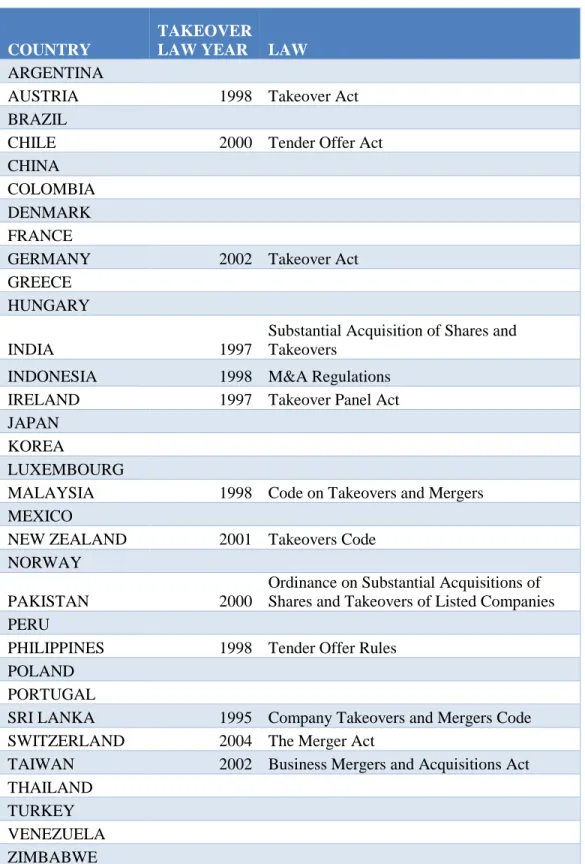
Table 1 lists the 13 countries in the treatment sample and the years of takeover law
initiation as well as the 20 countries in the control sample.9 The countries passed laws between
7 Moreover, Bushman and Smith (2003) state that firms that improve governance could also increase disclosure, improve transparency and reduce information asymmetry, which are associated with capital market benefits.
8 Lel and Miller (2015) exclude Switzerland, which passed a takeover law in 2004 and end their sample in 2003,because of the EU Takeovers Directive that was passed in April 2004. However, research reveals that the effects of this law on takeovers are ambiguous (e.g., Humphery-Jenner, 2012). Thus, to maximize my treatment sample and firm-year observations, I include the 2004 Switzerland law and extend the sample into 2009. I later also exclude Switzerland and end the sample in 2003 and find that this does not affect my results.
12
1995 and 2004, ultimately providing a set of staggered adoptions that help mitigate endogeneity issues. I exclude countries that passed takeover laws prior to the beginning of the sample period
(1992) in order to isolate the effect of these laws and the resulting increase in performance monitoring on financial reporting. An advantage to using such a set of laws is that the decision to
pass takeover legislation and dates of enactment are exogenously determined. It is difficult to imagine that firms have a role in the adoption of these country-level laws.10 Thus, I provide a nice setting in which I can better identify causal effects of such legislation using a
difference-in-difference design with an appropriate control group that consists of countries that had never passed takeover laws.
Prior literature is mixed regarding the relation between takeover threats and earnings quality. While Zhao and Chen (2008, 2009) and Armstrong et al. (2012) find that takeover defenses – which lower the threat of takeover– improve earnings quality, Bowen et al. (2008)
and Baber et al. (2015) provide evidence that decreased takeover threats is consistent with higher discretionary accounting practices and misreporting of financial statements, respectively. This
relation is not documented in a cross-country setting however, and it may be important to
examine other countries in order to illuminate this link and better understand why such a relation occurs.
This paper complements and extends Armstrong et al. (2012), who exploit a set of U.S. state antitakeover laws and provide evidence that firms’ financial reporting quality improves
use. However, as a robustness check, I include observations from the Czech Republic in my control sample and find that inferences do not change.
13
following implementation. Although Armstrong et al. (2012) find that their results can be explained by firms’ need to access the capital markets, they do not specifically test the job
security concerns story. However, Bertrand and Mullainathan (1998) also use antitakeover laws and document a reduction of pressure on top managers, thus lowering managers’ incentives to
distort accounting information (Bushman and Smith, 2001), it is important to examine the role played by job security concerns, or turnover pressure. Although Armstrong et al. (2012) provide evidence that there are no differences in transparency between subsamples partitioned on ex ante
takeover risk, I use measures that directly represent turnover pressure in the face of increasing turnover sensitivity to performance, such as performance itself or turnover probability.11 The
relation between takeover risks and information quality directly driven by changing turnover pressures is not directly investigated in prior U.S. studies that examine this relation.
In contrast, the current paper examines takeover laws which increase takeover threats. A
number of provisions in the international M&A laws resemble those in the US, including fair price laws (Connecticut), registration and disclosure laws (Hawaii) and cash-out laws
(Pennsylvania). The provisions also include unique provisions. For instance, Taiwan grants large tax benefits to acquirers through new types of M&As like cross-border and cash-out mergers. New Zealand allows acquirers to squeeze out minority shareholders. While the Philippines
14
simplified government approval procedures, India eliminated certain takeover defenses; as a result, these factors promote greater takeover activity in these countries.12
Such attempts at fostering greater M&A activity can create distinct incentives. Because they increase pressure on top management, they generate incentives to manage earnings and
create an opaque information environment. This concept of pressure faced by management is especially relevant in a setting in which turnover sensitivity to reported performance increases (Lel and Miller, 2015). Furthermore, I use a broad international setting in which the wide
variation in country institutions and in firm transparency can also be exploited. These aspects are difficult to exploit in a U.S. setting, in which all firms face a similar institutional environment.
For instance, CEOs worldwide may have similar incentives to distort performance measures, but countries with high quality institutions could limit the abilities of these managers to execute the distortions. As such, inter-country studies clarify these incentives in distinct institutional
environments.
To examine the incentives that drive managers to manipulate earnings following takeover
law enactment, I use a firm’s ex ante market and accounting performance to separate managers who are performing poorly from those who are performing well, as performance is a primary determinant of forced CEO turnover. This addresses the hypothesis that managers performing
poorly have greater job security concerns and have higher incentives to manage earnings when turnover sensitivity to performance increases. To emphasize the relationship between my
findings and turnover pressure, I gather annual data on companies’ officers from Worldscope CD
12 Although the laws differ in terms of what provisions they include, neither Lel and Miller (2015) nor I are
15
ROMs and build a turnover prediction model using a set of determinants for forced turnover. I apply the model to each firm in my sample in order to calculate a direct measure of ex ante
turnover pressure, and divide the sample in two based on the median of this measure. This directly tests my job security concerns hypothesis and examines whether CEOs with higher
turnover pressure manage earnings and render financial reporting opaque at a higher rate than those under less pressure.
Competing hypotheses include growth strategies and share issuance. Bertrand and
Mullainathan (2003) and Zhao and Chen (2008) suggest that managers pursue the quiet life after state antitakeover laws are passed. I investigate the possibility that the opposite occurs after the
adoption of takeover laws – that cash flow uncertainty from higher investments and growth strategies increases opacity. Furthermore, Teoh et al. (1998a, b) and Ducharme et al. (2004) suggest that managers who issue shares could have incentives to manipulate accounting
information in order to maximize share price. Therefore, I also examine the possibility that the increased opacity following M&A law adoption is driven by firms planning to create optimism
about their prospects prior to issuing equity.
The analysis begins with an exploration of whether takeover laws that heighten takeover threats increase or decrease the information quality of a country’s firms. I then conduct various
sectional tests to understand what might drive this relation. Because I examine a cross-country sample, I also explore whether stronger investor protection can help mitigate the
increased levels of earnings management and opacity in firms domiciled in countries that passed M&A laws. Although research has studied the effects of the international market for corporate control on governance (Lel and Miller, 2015), it has not addressed the effects on transparency or
16
3. METHODOLOGY 3.1 SAMPLE
The sample comes from the Worldscope database between the years of 1992 and 2009.13 I exclude all of the firms that are not in one of the 33 treatment and sample countries. All of the
firms in the sample have observations in the three years prior to and following M&A law
adoption, which eliminates firms created in the post-law period and firms that became inactive in the pre-law period.14 The firms in the control countries have at least seven observations each.15
From there, I adjust my sample size depending on the set of required variables for the particular regression.16 For my main regressions, the sample size ranges from 29,327 firm-year
observations to 52,692 firm-year observations.
13 The sample period begins in 1992 because Worldscope coverage of international firms is poor prior to 1990, and I require up to three years of financial data to calculate certain earnings management measures such as discretionary smoothing. I chose 2009 as the end of the sample period because that allows up to five years of outcomes following the last regulation I use (Switzerland in 2004). In robustness tests, I use a sample period ending prior to 2004 to avoid certain confounding events, such as the 2004 EU Takeover Directive, 2005 Mandatory IFRS adoption and the 2008 financial crisis. Inferences remain the same as those from the alternative sample period.
14 Relaxing the requirement of having at least three pre-law and three post-law observations does not change the inferences. I also run a balanced panel in those years and the conclusions remain the same.
15 This is to mirror the requirement of the treatment firms, which require three pre-law observations: one observation in the year of law enactment and three post-law observations, for a total of at least seven observations per firm. Also, relaxing this requirement for the control sample does not lead to qualitatively different conclusions.
16 I allow the sample size to change depending on the model in order to preserve sample size when possible.
17 3.2 RESEARCH DESIGN
I utilize a series of difference-in-difference estimations to examine how M&A law
adoption affects a firm’s financial reporting characteristics. The model is as follows:
EARNINGS MANAGEMENT =α + β1 * (TREAT*POST) + β2 * (X) + Fixed Effects OR ANALYST FORECAST
PROPERTIES
EARNINGS MANAGEMENT and ANALYST FORECAST PROPERTIES represent the dependent variables that I describe below. TREAT is an indicator variable that equals one if the firm is in
one of the 13 countries that enact takeover laws and zero otherwise, and POST is an indicator variable that equals one if the observation is from the post-law period and zero otherwise. The
interaction between TREAT*POST is the main explanatory variable, and the coefficient, β1, is negative (positive) if the laws decrease (increase) information quality for the treatment firms more than they decrease (increase) information quality for the control firms from the pre- to
post-law period. X is a set of control variables also expected to have effects on earnings management or on analyst forecast properties. All of the regressions include country, industry
and year fixed effects, so I do not include TREAT and POST in my model. Robust standard errors are clustered at the firm level in order to correct for possible serial correlation and
heteroscedasticity, following Lel and Miller (2015). All of the continuous, unranked and
nonlogarithmic variables are truncated at the 1% level. 3.3 DEPENDENT VARIABLES
Because transparency is not directly observable and prior studies have used a variety of measures, I use various proxies to examine how takeover law initiations affect a firm’s
18
management) and transparency outcomes (analyst forecast properties) to investigate CEO’s direct responses to takeover laws and to understand in-depth how M&A legislation affects a
firm’s information environment, respectively. Detailed descriptions for all of the variables appear in Appendix A.
3.3.1 Earnings Management
I use four different proxies, each capturing a different aspect of earnings management, as well as an aggregate measure of financial reporting quality. I allow for CEOs to use distinct
methods of earnings management to suit their needs, depending on their specific circumstances. I investigate discretionary smoothing (Fudenberg and Tirole, 1995), target beating (Graham et al.,
2005), unsigned accruals quality and signed abnormal accruals levels since accruals are likely used to directly manipulate earnings. Because of measurement error associated with a single earnings management proxy, I examine multiple earnings management variables in order to
cover a broad spectrum of manipulation methods.
The first measure, discretionary smoothing (DIS_SMTHC), is a combination of two
commonly used variables which represent earnings management – variability of net income relative to cash flow and the correlation between accruals and cash flows (e.g., Leuz et al., 2003; Barth et al., 2008; Lang et al., 2012). The intuition is that the discretionary use of accruals to
smooth out fluctuations in underlying cash flows beyond an inherent amount indicates the presence of earnings management. To capture this direct smoothing with the purpose of
19
The second proxy represents instances of small positive income (SPINC), a dummy variable that equals one if net income scaled by total assets is between 0 and 0.01, and zero
otherwise (e.g., Srinivasan et al., 2015).17 Prior literature documents a “kink” in the distribution of reported earnings around zero: a statistically small number of firms with small losses and a
statistically large number of firms with small profits, suggesting that many firms around this heuristic target of “zero” manage their earnings so as to report a profit and avoid a loss (e.g., Burgstahler and Dichev, 1997; Beaver et al., 2003; Dechow et al., 2010). I also investigate
meeting or beating analyst forecasts and prior period earnings as alternative proxies for target beating and inferences are unaffected (untabulated).
Third, I use the Dechow and Dichev (2002) measure of accruals quality (DDEQ), the standard deviation of residuals from a regression of accruals on current, past and future cash flows. Dechow and Dichev (2002) find an association between this standard deviation and poor
accruals quality. Thus, researchers widely use this measure as a proxy for earnings management, including within the international literature (e.g., Barth et al., 2012).
Lastly, I use a measure that represents signed abnormal accruals (ABNACCR), which is the difference between a firm’s accruals for a given year and the firm’s predicted accruals following DeFond and Park (2001) and Francis and Wang (2008). Unlike the Dechow and
Dichev (2002) accruals quality measure, this measure of abnormal accruals is signed. Thus,
ABNACCR can provide insight into a firm’s tendency towards upward or downward earnings
management. Thus, a more positive measure of ABNACCR represents an abnormally
20
leaning earnings management via the manipulation of accruals, indicating greater instances of accruals and earnings inflation.18
Because each of these four measures represents a different type of earnings management (discretionary smoothing, target beating, accruals quality and inflation), I also examine an
aggregate measure of financial reporting quality (FRQ). This measure represents the average ranks of each of these earnings management variables (Lang et al, 2012).19 Before averaging the variable ranks, I adjust the signs so that increasing FRQ values correspond with increasing
financial reporting quality, or decreasing earnings management.20 Aggregating different proxies for earnings management provides greater intuition into how overall financial reporting quality
changes following the adoption of takeover laws than if I were to depend on a single, noisy dimension of earnings management.21
I include a number of variables to control for firm fundamentals that prior literature
explains are also associated with earnings management. The control variables include firm size (LNTOTASS), the natural log of total assets (in USD), book to market ratio (BM), return on assets
(ROA), standard deviation of returns (STDRETURN), an indicator variable for an “old” firm if the firm’s age is above the sample median (OLD), yearly growth in sales (SGROWTH), an
18 Alternative proxies for discretionary accruals, such as the modified Jones model (Dechow et al., 1995) or discretionary estimation errors (Francis et al, 2005) do not change inferences.
19 In calculating FRQ, I require that a firm has observations for SPINC and ABNACCR, but do not require there to be observations for DIS_SMTHC and DDEQ to preserve sample size. If data for either is missing, I take the average of the ranks of the remaining variables to calculate FRQ. Results are robust when using different requirements to calculate FRQ.
20 Since higher values of DIS_SMTHC, SPINC and ABNACCR represent increasing earnings management, I multiply the ranks of these by -1 and average with the rank of DDEQ to calculate the aggregate FRQ measure that represents financial reporting quality.
21
indicator variable for loss firms (LOSS), the percentage of closely held shares (PCNTCLHLD) and cash flows in the fiscal year (CF). More detailed explanations of all of the variables,
dependent or independent, appear in Appendix A.
3.3.2 Analyst Forecast Properties
The next set of dependent variables, analyst forecast properties, are not directly the result of a manager’s decisions (like manipulating accruals), but reflect the transparency outcome of the firm’s overall information environment. Firms that are more transparent are likely to attract
more analysts, and the resulting analyst forecasts are likely to be more accurate and less dispersed.22
The first variable I consider is analyst following (ANALYST). Prior literature, such as Lang et al. (2003), indicates that analysts are attracted to firms that are more transparent, especially in an international context. Further, analyst forecasts for firms that are more
forthcoming are likely to be more accurate and less dispersed (Lang and Lundholm, 1996; Jin and Myers, 2006; Maffett, 2012). As such, I also examine two additional analyst forecast
properties, ACCURACY and DISPERSION, in my analyses.
Moreover, I aggregate the three analyst forecast properties into a single analyst forecast quality variable, AFQ, by taking the average ranks of ANALYST, ACCURACY and
DISPERSION.23 To control for firm fundamentals that are also related to analyst properties, I include the following variables: size (LNTOTASS), return on assets (ROA), return variability
22 In the robustness tests, I also use other transparency proxies to ensure that my results hold even when I use different components of transparency for dependent variables.
23 Similar to when I calculated FRQ, I aim to preserve the sample size and do not require that ACCURACY and
DISPERSION measurements both exist to calculate AFQ. Again, modifying the sample requirements does not
22
(STDRETURN), annual growth in sales (SGROWTH), the earnings surprise when earnings are released (EARNSURP) and old firm indicator (OLD).
3.4 DESCRIPTIVE STATISTICS
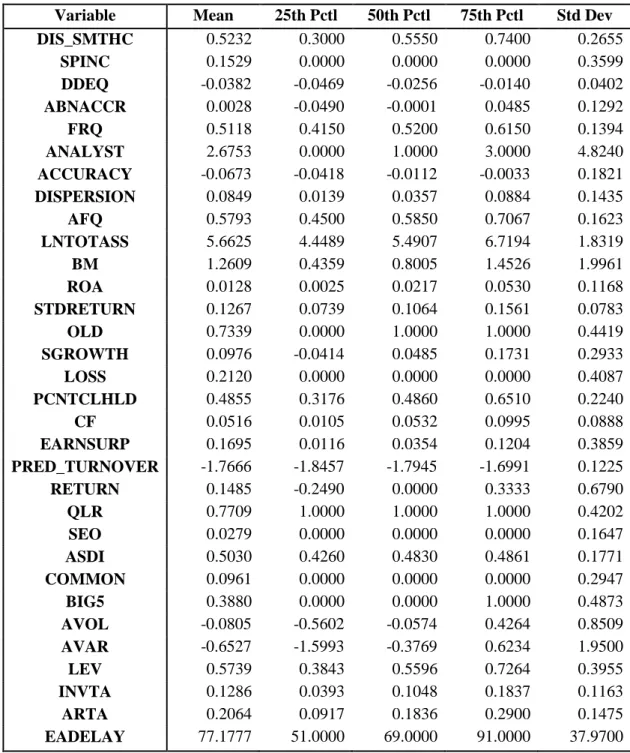
Table 2 presents the descriptive statistics for all of the dependent and control variables that I use. I provide the mean, lower quartile, median, upper quartile and the standard deviation of each variable. Approximately 15% of firms in the sample report small positive income and the
median firm has a slightly negative level of abnormal accruals, although the mean is slightly positive. A single analyst follows the median firm. The average firm has total assets (in U.S.
dollars) of roughly $242 million, corresponding to a logged value of approximately 5.5, which is similar to but slightly less than the median value in Lel and Miller (2015).24 The median firm has a book to market ratio below 1, but the mean is at approximately 1.26. The average firm has
positive growth in sales, slightly less than 50% of the shares closely held, and has positive accounting and market performance.
23
4. MAIN RESULTS 4.1 COMPARISON OF EARNINGS MANAGEMENT
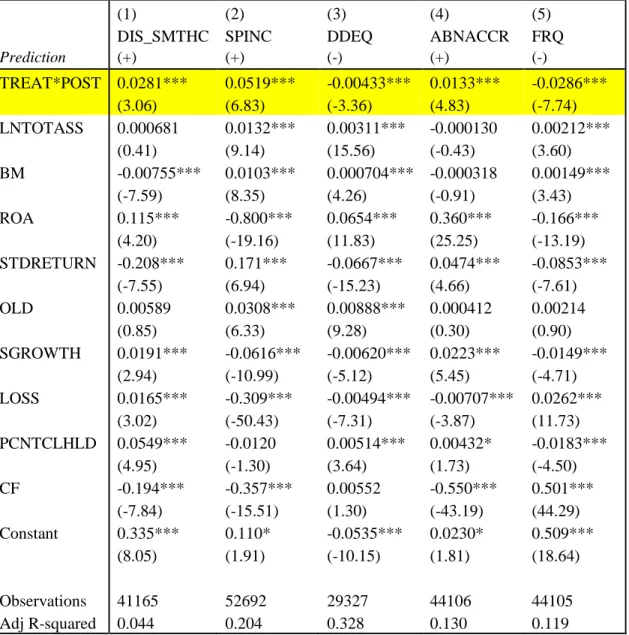
Table 3, Panel A reports the results from difference-in-difference estimations with the five earnings management proxies as the dependent variables. Higher values of DIS_SMTHC,
SPINC and ABNACCR represent higher earnings management, while higher values of DDEQ
and FRQ represent lower earnings management. The independent variable of interest is the interaction term, TREAT*POST. In Columns 1, 2 and 4 – in which the dependent variables are
DIS_SMTHC, SPINC and ABNACCR – the coefficients on TREAT*POST are significantly positive, suggesting that earnings management increases in the period following takeover law
implementation for the treatment firms. The results in Columns 3 and 5 are consistent with the results in Columns 1, 2 and 4, as I find a significantly negative coefficient on TREAT*POST for
DDEQ as well as for the aggregate measure of financial reporting quality, FRQ. Thus, the results
reported in Table 3, Panel A support the hypothesis that after countries pass takeover laws, the managers of firms domiciled there respond by engaging in significantly more earnings
management activities.
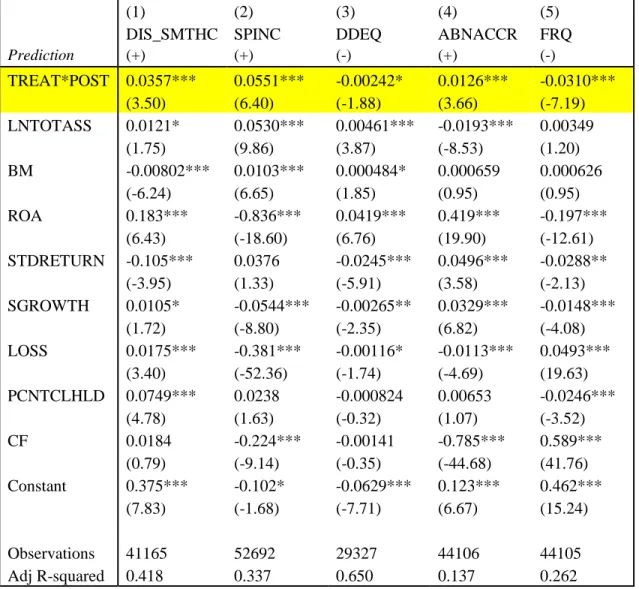
Panel B presents the results of the same regressions depicted in Panel A, but includes firm and year fixed effects rather than country, industry and year effects. Since my observations
are generally measured at the firm-year level, firm fixed effects help control for unobservable firm differences that may serve as omitted correlated variables with earnings management. The
24
law adoption. Thus, even when I control for unobservable firm differences between the treatment and control firms, I find that firms are significantly more likely to smooth earnings
discretionarily, report small positive incomes and have poor accruals quality and abnormally higher levels of accruals.
This effect on earnings management appears to be economically meaningful. Focusing on Column 5 in Panel B for the aggregate financial reporting quality measure, being in the treatment group is associated with a 0.0310 decrease in FRQ. For the median firm, all else being equal, this
represents a 6% decrease in FRQ, or about 15.5% of an interquartile shift in FRQ. The individual earnings management measures are also affected by similar economic magnitudes to the effect
on FRQ.25
4.2 COMPARISON OF ANALYST FORECAST PROPERTIES
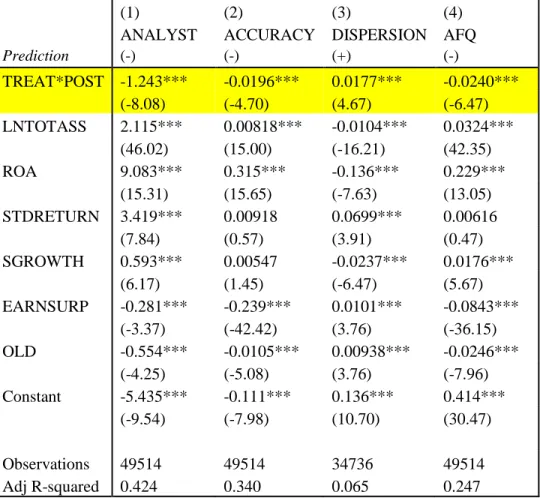
Table 4, Columns 1-4 present the results of difference-in-difference regressions with
ANALYST, ACCURACY, DISPERSION and AFQ as the dependent variables. These estimations elucidate how the post-takeover law period affects the transparency of a firm from the
perspective of analysts, who frequently use the firm’s information. If managers become more prone to manipulating accounting numbers, this creates opacity, and the quality of the firm’s analyst forecast properties reflect this change.
Panel A, Columns 1-3 report that the coefficient of TREAT*POST is significantly negative, negative and positive for the dependent variables ANALYST, ACCURACY and
DISPERSION, respectively. This suggests that following takeover law adoption, treatment firms have significantly lower analyst following, worse forecast accuracy and greater forecast
25
dispersion. Column 4 confirms the previous findings by reporting the coefficient on
TREAT*POST to be significantly negative for the aggregate analyst forecast quality variable,
AFQ. The firm fixed effects specification in Panel B not only suggests similar inferences, but also presents stronger results than in Panel A. The consistency of the results across the different
facets of analyst properties and fixed effects specifications provides convincing evidence that firms facing higher takeover threats following passage of takeover laws in their countries create more opaque information environments.
Similar to the economic effect on FRQ, being in the treatment group is associated with a decrease in the aggregate analyst forecast quality measure by approximately 7% for the median
firm, or roughly 16% of an interquartile shift in AFQ, all else being equal. Thus, the results are economically meaningful and complement the consistent statistical significance of the results found in these tests.
4.3 ROBUSTNESS OF THE MAIN RESULTS
A key assumption in my difference-in-difference estimation is that without the laws, the
treatment and control groups would follow similar patterns in the dependent variables. I conduct tests to ensure that this assumption holds true for my estimations. Another underlying
assumption is that the differences in the dependent variables between the two groups are a result
of the shock and not fundamental differences between the treatment and control firms. Although firm fixed effects mitigate this concern, I also use a matched control sample in order to ensure
that differences in firm fundamentals are not driving my results.
First, I run the main regressions, controlling for country-specific time trends so as to ensure that treatment and control firms follow similar patterns within the time series of the
26
include them as controls in my regressions.26 Table 5, Panel A reports that even with these variables included, TREAT*POST remains significantly negative for both FRQ and AFQ. This
suggests that controlling for country-specific time trends does not change the result, i.e. that increases in earnings management and the deterioration of analyst forecast properties follow
M&A law adoption.
Second, I bootstrap the statistical significance of the coefficient on TREAT*POST. This ensures that the implementation of country-level takeover laws uniquely affects transparency and
that a random assignment into the treatment group does not indicate the same result. I follow the approach in Bushman et al. (2005), who use a set of staggered insider trading laws in their
setting. First, I randomly assign my sample countries into treatment and control groups.27 For the firms chosen to be in the treatment group, I randomly assign an initial year of law
implementation within my sample period (1992-2009) and define TREAT, POST and
TREAT*POST accordingly. I estimate my multivariate models from Tables 3 and 4 using the random country-event dates and examine the coefficients on TREAT*POST. I repeat this
simulation of random assignment and estimation 1,000 times in order to yield an empirical distribution of TREAT*POST coefficients. Table 5, Panel B presents the results: I find that
TREAT*POST remains significantly negative for both FRQ and AFQ with the bootstrapped
statistical significances.
Finally, I rerun the estimations from Tables 3 and 4 using a matched sample of control
firms for a better comparison across the treatment and control groups. Each treatment firm is
26 As another robustness check, I include interactions between my control variables and the POST indicator in order to control for time trends in control variables. In untabulated regressions, opacity continues to increase significantly for treatment firms during the post-M&A law period.
27
matched with a control firm in the same two-digit ICB industry and fiscal year by size
(LNTOTASS) and performance (ROA). This serves as a more robust way of controlling for firm
fundamentals between the treatment and control firms; namely, by restricting the control sample to consist of the most similar firms in my treatment sample. Table 5, Panel C presents the results
of the matched sample tests. I continue to find that treatment firms are significantly more likely to manage earnings and have worse analyst forecast properties.
Overall, Table 5 presents results of the tests, ensuring the robustness of my main findings
from Tables 3 and 4 by satisfying assumptions in difference-in-difference estimations.
Controlling for country-specific time trends, bootstrapping by random assignment and simulation
and using a matched sample of control firms all indicate the same result: that M&A laws drive increased opacity by way of increased earnings management and worsening analyst forecast properties.
4.4 JOB SECURITY CONCERNS
With the market for corporate control serving as a governance mechanism by which to
ensure high performance and thus increasing turnover sensitivity to performance (Lel and Miller, 2015), regulations aimed at increasing takeover activity in a country pressure managers to
perform. The resulting pressure and possible desperation to save their jobs may incentivize CEOs
to manage earnings and become more opaque in way which makes them appear better than what the actual performance would indicate.
If managers make changes to improve their job security, then earnings management and opacity likely increase following takeover legislation more among poorly performing managers. These managers face the most pressure to improve their performance or get fired in the face of
28
likely to have job security concerns and thus, their incentives to distort accounting numbers seem to be less than those of poor performers.
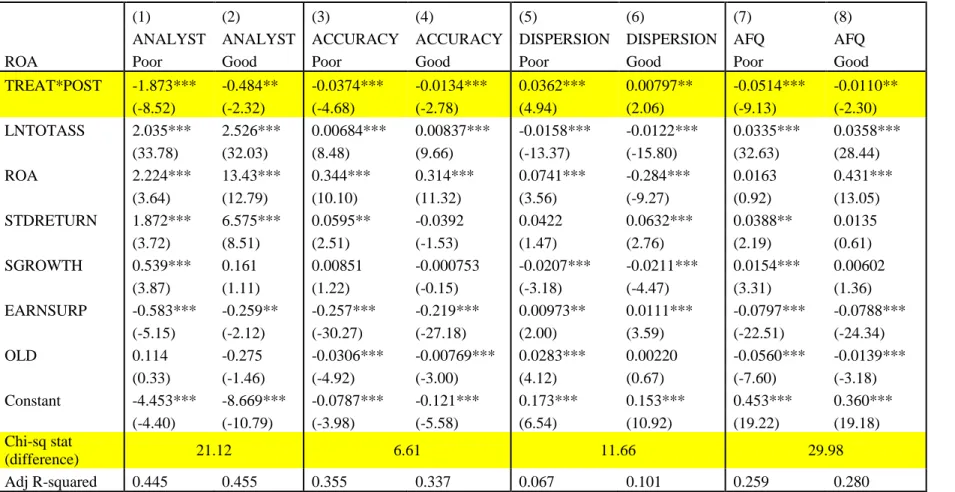
I use two measures of performance to divide the sample into strong and poor performance firms: a market measure (firm yearly return) and an accounting measure (yearly ROA). I make
the split based on the sample median of each measure and run the multivariate regressions from Tables 3 and 4 to compare the strength of the results in each subsample. Table 6, Panels A and C present return split results, while Panels B and D report ROA split results. Panels A and B
contain earnings management measures as the dependent variables, and C and D use analyst forecast properties as the dependent variables.
All but one set of regressions across all of the panels in Table 6 report that the coefficient of TREAT*POST relates more positively to earnings management and opacity for poor
performers than for good performers. The one model that suggests otherwise is in Panel A for
DIS_SMTHC, which reports that high performance firms are more likely to engage in abnormally high levels of earnings smoothing. Considering that smoothing includes both upward and
downward earnings management, this is understandable because good firms may be looking to save for the future rather than inflate earnings now (Fudenberg and Tirole, 1995; DeFond and Park, 1997). The chi-squared statistics of the differences in the coefficients are significant at the
10% level across all of the models presented in Table 6, except for those in the DDEQ models. Taken together, the results are consistent with the job security concerns hypothesis, since poorly
performing CEOs are more desperate to distort accounting information to save their jobs following a shock to turnover sensitivity to performance. In contrast, high performance CEOs may be more encouraged to smooth earnings to protect themselves in the future, but otherwise
29
Next, I directly address turnover concerns by calculating ex ante turnover probability for each firm, based on turnover data collected from Worldscope CD ROMs.28 I follow prior
literature such as Peters and Wagner (2014) and regress a turnover indicator on a set of variables expected to be associated with forced turnover using a logit estimation. These determinants of
forced turnover include industry-adjusted firm yearly ROA, total assets, country-industry return volatility, a loss indicator, leverage and book-to-market ratio.29 I apply the coefficients from this turnover prediction model to each firm in my sample in order to calculate
the turnover probability, PRED_TURNOVER, for each firm’s manager. I split the sample based on the median of this measure and estimate the same multivariate transparency regressions from
Tables 3 and 4.
Table 7, Panels A and B present results consistent with the job security concerns hypothesis. Panel A displays evidence of all of the measures of earnings management being
greater for CEOs with higher ex ante turnover probability. The results in Panel B indicate that the adverse impact of takeover laws on analyst forecast properties is also greater for managers
with higher ex ante turnover pressure. Furthermore, the chi-squared-statistics of differences in the coefficients of TREAT*POST between the high and low turnover probability groups are significant at the 10% level for all of the dependent variables in Panels A and B, except
DISPERSION. Thus, Tables 6 and 7 present results that support the hypothesis that the
unintended consequences of takeover laws on financial reporting are explained by managers with
greater job security concerns – i.e. poor performers or those with greater turnover risks. As such,
28 The CD-ROMs provide only the name and position of each officer. Thus, it is difficult to distinguish between forced and voluntary turnover. I use a forced turnover prediction model using variables known to be correlated with forced turnover when calculating turnover probability. I follow DeFond and Hung (2004) in identifying the top officer in each firm.
30
increases in turnover sensitivity to performance following takeover law adoption encourage CEOs facing increased job security concerns to manage earnings and hide behind opacity, for the
31
5. ADDITIONAL TESTS 5.1 INSTITUTIONAL SPLIT
I explore how the negative effect of takeover laws on the information environment differs among countries. Countries with poor quality institutions are likely to have weaker monitoring
and greater opportunities for managers domiciled in those countries to manipulate accounting information (Leuz et al., 2003). To test this, I explore whether increases in earnings management and opacity surrounding M&A legislation are more pronounced for countries with poorer
institutions.
I employ two measures of institutions. The first variable is the anti-self-dealing index
(ASDI) from Djankov et al. (2008), which measures the level of difficulty for minority shareholders to thwart the consumption of private benefits by controlling shareholders.30 The second variable is an indicator that equals one if the country is a common law regime (English
legal origin) and zero otherwise (COMMON). La Porta et al. (2006) justify the use of legal regime by proving that common law countries typically have stronger investor protection.
Table 8 presents the results for the weak and strong investor protection sample splits when investor protection is measured by ASDI (Columns 1-4) and when it is measured by
COMMON (Columns 5-8). The results suggest that firms in low ASDI and civil law countries
have more negative coefficients of TREAT*POST when the dependent variable is FRQ or AFQ,
32
or FRQ, respectively. The difference between strong and weak institutions is also statistically significant for FRQ within the legal origin split at the 1% level.
Thus, evidence exists that firms domiciled in low ASDI and civil law countries are more likely to commit earnings management and have an information environment characterized by
worse analyst forecast properties. Combined with Lel and Miller’s (2015) finding that turnover sensitivity to performance increases at a greater rate for poorer investor protection countries,31 Table 8 suggests that managers in such countries distort information more in order to prevent
forced turnover. Thus, the presence of strong institutions or investor protection proves to be an important country-level feature that helps deter managers from opportunistically increasing
earnings management and opacity following takeover law initiation. 5.2 RAPID INVESTMENTS AND GROWTH
The literature offers another possible explanation as to why firms’ information
environment could change following an exogenous shock to takeover threats. Known as the “quiet life” hypothesis, it refers to managers going “quiet” by making fewer investments and
pursuing fewer growth options when insulated from takeover threats. This increases the quality of a firm’s financial reports as a result of the decreased uncertainty in cash flows (e.g., Bertrand and Mullainathan, 2003; Giroud and Mueller, 2010; Armstrong et al., 2012) associated with
changes in investing and operating decisions at “quiet life” firms.
This paper examines firms’ behavior under increased takeover threats. Thus, the
literature might predict a reversal of the “quiet life”: lower insulation pressures managers to increase investments and focus on rapid growth in order to thwart a potential takeover.
33
Uncertainty and future cash flow variability might then increase, causing financial reports to appear to be of lower quality.
Similar to Giroud and Mueller (2010) and Armstrong et al. (2012), I identify firms with positive or negative country- and industry-adjusted growth in (1) assets, (2) PP&E, (3) COGS
and (4) SG&A, all from Worldscope.32 In this way, managers of firms with negative adjusted growth in the four variables are seen as pursuers of the “quiet” life. If the increased opacity is a result of managers who are essentially moving away from the “quiet life”, I would expect to see
the positive relation between TREAT*POST and earnings management or opacity to apply moreso for firms with positive country- and industry-adjusted growth in the above four variables.
Results are presented in Table 9, with the sample split into firms that are likely pursuing rapid growth and investments in order to fend off takeovers and firms that are not. I treat firms that have negative adjusted growth in all four variables as firms that are not pursuing rapid
growth. I eliminate firms that have positive or negative growth for fewer than all four of the variables in order to ensure that the measure best captures growth strategies.33
I find no evidence that the positive (negative) relation between TREAT*POST and earnings management (analyst forecast properties) is limited to managers of firms with positive growth. Thus, this relation has no apparent connection to high growth strategies. The chi-squared
statistics suggest that the differences in coefficients between the high growth group and the low growth group are all insignificant, providing no evidence that the resulting increase in earnings
32 Because I use an international sample, unlike Giroud and Mueller (2010) and Armstrong et al. (2012), I make slight modifications such as: adjusting for country and industry, instead of state and industry when measuring growth and by using SG&A expense instead of advertising expenses due to data availability in Worldscope.
34
management and opacity in countries that adopt takeover laws is a result of managers who cease to pursue the “quiet life” and instead, attempt to make more investments and pursue growth.
5.3 SHARE ISSUANCES
While controversy surrounds what actually happens to firms’ accounting quality with
regard to equity issuances, prior literature indicates that companies issuing new equity have increased incentives to manage earnings so as to help inflate prices (e.g., Teoh et al., 1998a, b; Ducharme et al., 2004). Thus, I ensure that my results are not isolated to share issuers. I split the
sample into firms that have a secondary equity offering (SEO) in the following year and firms that do not.34 The SEO data is taken from the SDC: Global New Issues database.
Table 10, Panels A and B present the results for the SEO sample split. There is no clear indication that the increased earnings management and deteriorating analyst forecast properties in the post-law period for treatment firms is isolated to SEO firms. The differences in the
coefficients of TREAT*POST between SEO and non-SEO firms are insignificant. To the extent that there are differences, the non-issuers have more pronounced coefficients than do the issuers.
Therefore, I can also rule out share issuances as the driver behind increased earnings management and opacity following takeover law adoption.
5.4 ADDITIONAL CONTROLS FOR CONFOUNDING CHANNELS
There are other sets of concurrent regulations that could have affected earnings
management or transparency during the sample period. Thus, I include a set of controls to rule
out confounding channels and ensure that the takeover laws are responsible for affecting the post-law information environment. I include corporate governance reforms (Kim and Lu, 2013), short selling regulations (Maffett et al., 2015) and insider trading laws (Bhattacharya and Daouk,
35
2002).35 I also control for country-level investor protection to ensure that the results are incremental to institutions’ effects on financial reporting. I create a dummy variable,
GOODINVPROT, to represent firms in countries with high quality institutions. This dummy variable equals one if ASDI is higher than the sample median and the firm is from a common law
regime, and zero otherwise.
Results are presented in Table 11 with the earnings management variables in Panel A and analyst forecast variables in Panel B. In both panels, I continue to find consistent evidence that
opacity significantly increases for treatment firms following takeover law adoption. Furthermore, it is interesting to note that corporate governance reforms (CGR) tend to be negatively correlated
with information quality despite the reforms’ intentions to improve governance mechanisms. Moreover, as expected, GOODINVPROT tends to be positively correlated with transparency. Nevertheless, takeover law adoption continues to be associated with increasing earnings
management and opacity incremental to all of the other concurrent effects.
36
6. ROBUSTNESS ANALYSES 6.1 OTHER TRANSPARENCY PROXIES
As previously mentioned, transparency is an unobservable measure and can take many forms. While this paper has primarily focused on earnings management and analyst forecasts, the
extant literature uses other facets of transparency as logical proxies. Thus, I make sure that other measures of transparency follow the same pattern as with earnings management and analyst forecast properties.
One measure I examine is whether the firm employs a Big 5 auditor to audit its financial statements (BIG5), which is a dummy variable that equals one if the firm had a Big 5 auditor in a
given firm-year and zero otherwise.36 A number of sources provide auditor data, including point-in-time Worldscope CDs, Compustat Global and Osiris. Prior literature, such as Teoh and Wong (1993), presents evidence that oversight by a Big 5 auditor is associated with a higher quality of
financial reporting. Control variables are chosen from those which prior literature has shown to be correlated with the decision to employ a certain type of auditor (e.g., Fan and Wong, 2005).
These variables include firm size (LNTOTASS), book to market ratio (BM), leverage (LEV), return on assets (ROA), total inventory scaled by total assets (INVTA), accounts receivables scaled by total assets (ARTA), an indicator variable for an old firm (OLD) and cash flows (CF).
The other transparency proxies I also examine are based on users of accounting information. Investors, as well as analysts, use firms’ financial reports to make important