The gravitational field produced by extreme-mass-ratio
orbits on Schwarzschild spacetime
by Seth Hopper
A dissertation submitted to the faculty of the University of North Carolina at Chapel Hill in partial fulfillment of the requirements for the degree of Doctor of Philosophy in the Department of Physics and Astronomy.
Chapel Hill 2011
Approved by:
Charles R. Evans, Advisor
J. Christopher Clemens, Reader
Y. Jack Ng, Reader
Paul Anderson, Committee Member
c
Abstract
SETH HOPPER: The gravitational field produced by extreme-mass-ratio orbits on Schwarzschild spacetime.
(Under the direction of Charles R. Evans.)
A stellar-mass compact object orbiting a supermassive black hole will radiate energy and
angular momentum in the form of gravitational waves, causing it to spiral inward. Such an
extreme-mass-ratio inspiral (EMRI) is an important potential source for a direct gravity wave detection. It will require sufficiently accurate source modeling for such detections to
be made and analyzed. In this thesis I present original research that has furthered the
collective goal of accurate numerical EMRI simulations.
I begin by giving an overview of the extensive work that has been done in this field,
with an eye toward significant headway that has been made in the last decade. I then lay
the groundwork for my own work by reviewing the mathematical foundations for gravity
waves and black hole perturbation theory. Before attacking the subject of gravity waves
on a curved background, I examine the model problem of the scalar field that is induced
by an orbiting charge. This problem, while idealized, introduces many of the mathematical
and numerical techniques which are necessary to solve the perturbed Einstein equations.
At this point, with the foundation laid, I present new work on eccentric orbits of point masses about a Schwarzschild black hole. I show how the method of extended homogeneous
solutions is generalized to find the radiative part of the first-order metric perturbation in
Regge-Wheeler (RW) gauge using frequency domain techniques. Additionally, for the first
time we computed the local point-singular nature of the metric perturbation in RW gauge.
Due mostly to such gauge artifacts, RW gauge is not ideal of performing a local self-force
calculation. Thus, I then present work on transforming the metric perturbation to Lorenz
gauge. This will allow for the direct calculation of the self-force. I end this thesis by
Acknowledgments
My family has been exceptionally generous as I have worked toward my degree. In particu-lar, I’m grateful for all the kindness shown to me by my sister Marie and my brother-in-law Joseph, who allowed me to partake of their hospitality on countless occasions.
Table of Contents
Abstract . . . iii
List of Abbreviations and Symbols . . . xii
1 Introduction . . . 1
1.1 The two-body problem in general relativity . . . 1
1.1.1 Observational interest . . . 1
1.1.2 Extreme-mass-ratio inspirals . . . 2
1.2 Black hole perturbation theory . . . 4
1.3 Flat space self-force . . . 6
1.3.1 Newtonian self-force . . . 6
1.3.2 Radiation reaction in electromagnetism . . . 7
1.4 Curved space self-force . . . 8
1.4.1 Electromagnetic self-force . . . 8
1.4.2 Gravitational self-force . . . 9
1.5 Original work: eccentric orbits on Schwarzschild . . . 16
1.5.1 Background . . . 16
1.5.2 Contributions of this thesis project . . . 17
1.6 Thesis organization . . . 19
2 Mathematical preliminaries: gravitational waves and black hole per-turbation theory . . . 21
2.1 Linearized gravity . . . 22
2.2 Perturbed Einstein equations in curved space . . . 27
2.3 TheM2× S2 decomposition in a spherically symmetric spacetime . . . . . 30
2.3.1 The SubmanifoldM2 . . . . 31
2.3.2 The SubmanifoldS2 . . . . 33
2.4 First-order field equations . . . 43
2.4.1 Harmonic decomposition . . . 43
2.4.2 Regge-Wheeler gauge . . . 46
2.4.3 Lorenz gauge . . . 47
2.5 Chapter summary . . . 53
3 A scalar field model problem . . . 54
3.1 The multipole expansion . . . 55
3.1.1 Circular motion . . . 60
3.2.1 Multipole terms . . . 68
3.3 Scalar fields in curved space . . . 72
3.3.1 Current conservation and source term . . . 73
3.3.2 The wave equation . . . 78
3.3.3 Asymptotic expansion as r, r∗ → ∞ . . . 80
3.3.4 Scalar field jump condition . . . 82
3.4 Eccentric orbits on Schwarzschild . . . 84
3.4.1 The frequency domain . . . 85
3.4.2 Extended homogeneous solutions . . . 88
3.5 Chapter summary . . . 89
4 Gravitational perturbations and metric reconstruction: Method of ex-tended homogeneous solutions applied to eccentric orbits on a Schwarzschild black hole . . . 90
4.1 Introduction . . . 91
4.2 Background on the standard RWZ approach to gravitational perturbations in the frequency domain . . . 97
4.2.1 Bound orbits on a Schwarzschild black hole . . . 98
4.2.2 The Regge-Wheeler-Zerilli formalism in the frequency domain . . . . 100
4.3 The method of extended homogeneous solutions in the gravitational case . . 103
4.3.1 Brief review of Barack, Ori, and Sago’s method of extended homoge-neous solutions . . . 103
4.3.2 Application to gravitational perturbations . . . 105
4.3.3 Computing normalization coefficients in the gravitational case . . . . 110
4.4 Numerical method and results from mode integrations . . . 113
4.4.1 Algorithmic roadmap . . . 113
4.4.2 Energy and angular momentum fluxes at r∗ =±∞ . . . 114
4.4.3 Code validation . . . 115
4.4.4 Results . . . 117
4.5 Reconstruction of the metric perturbation amplitudes . . . 119
4.5.1 Even parity . . . 121
4.5.2 Odd parity . . . 124
4.6 Conclusion . . . 125
4.A The fully evaluated form of distributional source terms . . . 126
4.B Source terms for eccentric motion on Schwarzschild . . . 128
4.B.1 Even parity . . . 128
4.B.2 Odd parity . . . 129
4.C Metric perturbation formalism in the Regge-Wheeler gauge . . . 129
4.C.1 Even parity . . . 130
4.C.2 Odd parity . . . 132
4.D Asymptotic expansions for Jost functions atr∗→ ∞ . . . 134
5 Eccentric EMRI orbits on a Schwarzschild black hole: Transformation of the Regge-Wheeler gauge solutions to Lorenz gauge using new fre-quency domain based methods . . . 138
5.3 Transformation from RW to Lorenz gauge . . . 142
5.3.1 Gauge transformations on theM2 sector . . . 144
5.3.2 Gauge transformations on theS2 sector . . . 145
5.3.3 The Sago, Nakano, Sasaki decomposition . . . 147
5.4 Solution techniques for extended sources . . . 148
5.4.1 Partial annihilators and higher order EHS: general considerations . . 149
5.4.2 Extended particular solutions method . . . 151
5.5 Odd-parity gauge generator . . . 153
5.5.1 Partial annihilator method . . . 154
5.5.2 Second order approach, using the method of extended particular so-lutions . . . 156
5.6 Even-parity gauge generator . . . 162
5.6.1 Scalar part . . . 162
5.6.2 Divergence-free vector part . . . 166
5.7 Conclusion . . . 167
5.A Gauge transformation of metric perturbation amplitudes . . . 167
5.B Asymptotic expansions and boundary conditions . . . 168
5.B.1 Boundary conditions for the odd-parity gauge generator amplitude . 168 5.B.2 Boundary conditions for the even-parity scalar gauge generator am-plitude . . . 169
6 Conclusions and future directions . . . 174
6.1 Summary of original contributions . . . 174
6.2 Future directions . . . 176
List of Figures
3.1 With the inclusion of time to our diagram, we must compressyandzinto one
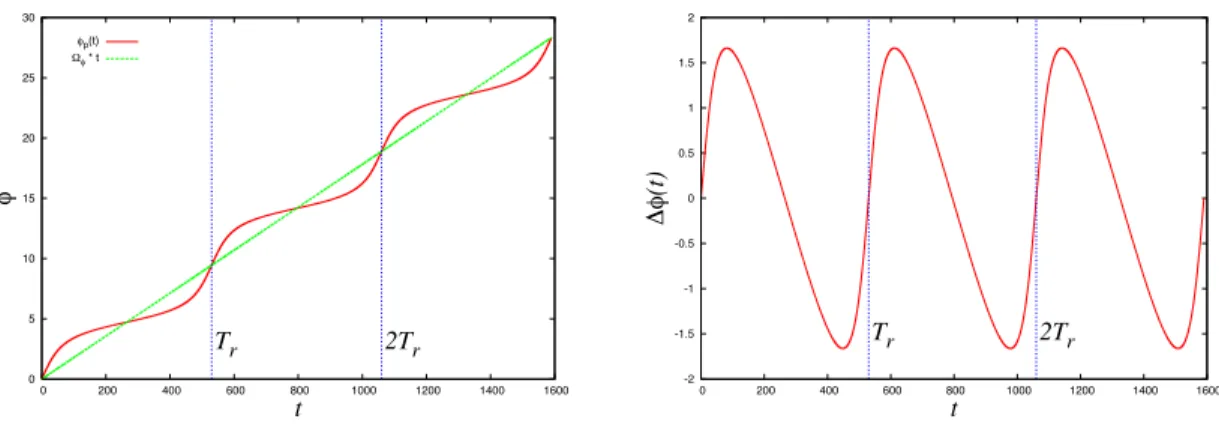
dimension. Hence, each sheet of time represents a three dimensional snapshot. 74 3.2 In red on the left we plot the azimuthal advance of a particle in eccentric
orbit around a Schwarzschild black hole. Its average advance Ωφtis plotted in
green. Subtracting off this average advance leaves the right panel. Note that this oscillation about the mean value of φhas a period of Tr, corresponding
to the radial motion of the particle. . . 87
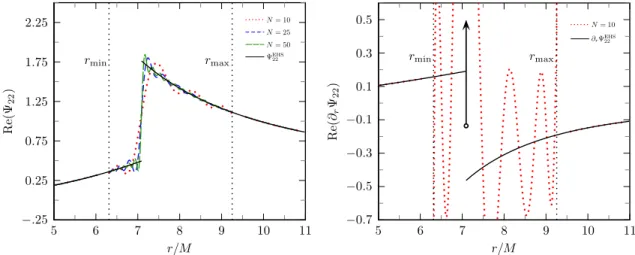
4.1 The standard FD approach to reconstructing the TD master function and its r derivative. The left panel shows Ψstd
22 and the right shows ∂rΨstd22 at
t= 51.78M for a particle orbiting with p= 7.50478 ande= 0.188917. This
figure is analogous to FIG. 1 of BOS [1]. Partial sums are computed with Eq. (4.3.3) and shown for different N. For contrast we plot the converged
solution from the new method with a solid curve (see FIG. 4.3). The arrow in the right panel gives a notional representation of the delta function singularity present in ∂rΨ22; the amplitude of this singular term is related to the jump in Ψ22 seen in the left panel. . . 106 4.2 An alternate view of the behavior presented in FIG. 4.1. A change in the
scale in the left panel emphasizes the Gibbs overshoots in Ψ22. On the right, a zoom-out of the vertical scale more clearly indicates the attempt of the Fourier synthesis to capture the delta function at rp(t). . . 106
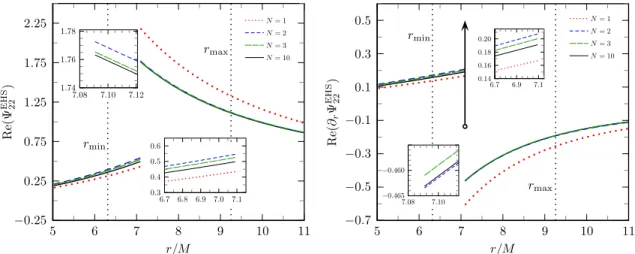
4.3 The EHS approach to reconstructing the TD master function and its radial derivative. As in FIG. 4.1, we give ΨEHS
22 and ∂rΨEHS22 at t = 51.78M for a particle orbiting with p = 7.50478 and e= 0.188917. Partial sums of ΨEHS
22 are computed from Eq. (4.3.5), with a range of−N ≤n≤N. The full ΨEHS
22 and itsr derivative result from N = 10, which gives agreement in the jumps
in ΨEHS
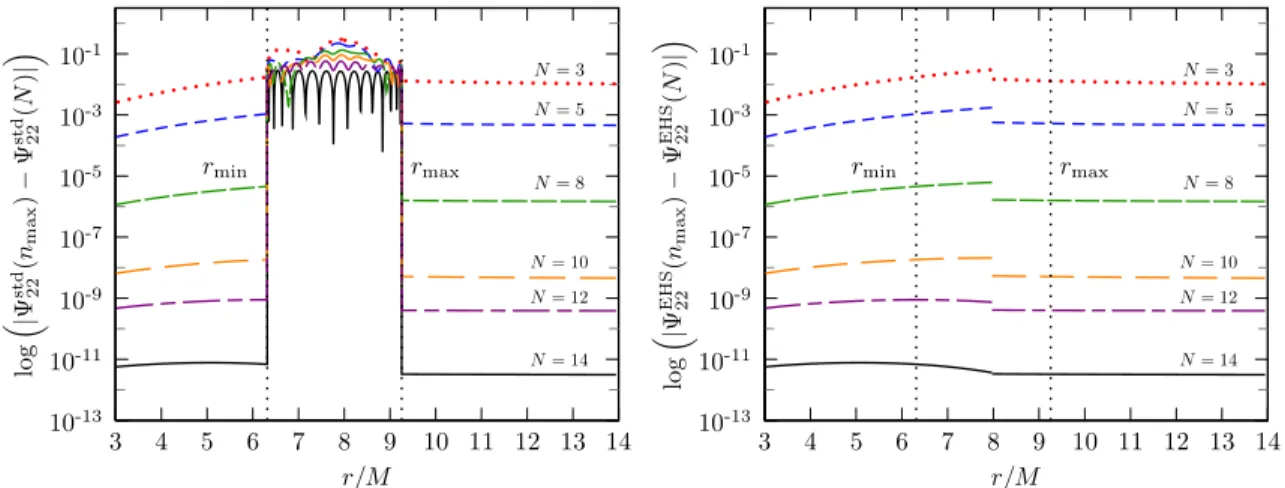
4.4 A plot of the convergence of the master function using the two methods. For a particle orbiting with p = 7.50478 and e = 0.188917 at t = 51.78M
we compute the master function Ψ22(nmax) by summing over modes ranging from −nmax ≤ n ≤ nmax for nmax = 15. We plot the log of the difference between Ψ22(nmax) and the partial sum Ψ22(N), for differentN < nmax. For the standard approach (left), we see exponential convergence in the homoge-neous region, but only algebraic convergence in the region of the source. The method of extended homogeneous solutions (right) yields exponentially con-verging results at all points outside and inside the region of the source. The method of extended homogeneous solutions gives exponential convergence for
∂rΨEHS`m as well. . . 118
4.5 The EHS approach to reconstructing the TD MP amplitudes. We consider a particle orbiting withp= 7.50478 and e= 0.188917 att= 80.62M. The left
plot shows the odd-parity MP amplitudes h21
r and h21t . The right shows the
even-parityh22
tt,h22rr,h22tr, andK22. Note that the amplitudesh22tt,h22rr, andh22tr
are singular along the particle’s worldline, as indicated by arrows in the plot on the right. The magnitude of these singularities are given in Eqs. (4.5.10), (4.5.13), (4.5.14). The remaining three MP amplitudes approach the particle location smoothly, and have only a finite jump at that point. . . 125
5.1 The Regge-Wheeler gauge metric perturbation amplitudeh21
t . As the particle
orbits between periapsis and apapsis, we examine the real and imaginary parts of this amplitude at a moment in time. In the left panel, note the (very slight) discontinuity at the location of the particle. In the right panel, note the lack of asymptotic flatness. . . 142 5.2 The Regge-Wheeler gauge metric perturbation amplitudeh21
r . As the particle
orbits between periapsis and apapsis, we examine the real and imaginary parts of this amplitude at a moment in time. In the left panel, note the discontinuity at the location of the particle. In the right panel, note the lack of asymptotic flatness. . . 143 5.3 The odd-parity RW → Lorenz gauge generator amplitudeξodd
21 . This differs from the Lorenz gauge metric amplitudeh21
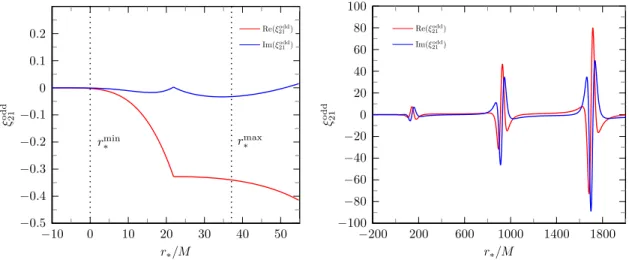
2 (where the21are`, mindices on the amplitudeh2) by a factor of−2. Note that the fieldh212 grows asymptot-ically because it is a metric perturbation amplitude on the two-sphere, where an extra factor of r2 is present in spherical coordinates. Transforming to an orthonormal frame would produce a field which falls off like 1/r, as radiation. 160
5.4 The Lorenz gauge metric perturbation amplitude h21
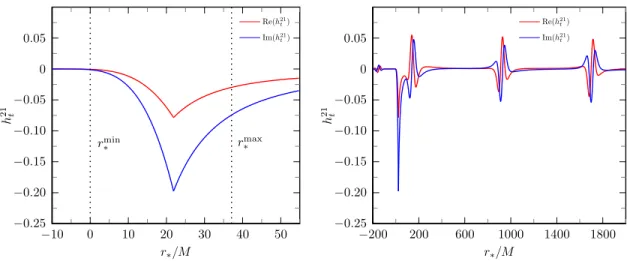
t . Note (comparing to
Fig. 5.1) the discontinuity at the location of the particle has vanished and the wave is not asymptotically flat. Note that the amplitudeh21
t is an off-diagonal
element of the metric perturbation, which introduces an extra factor of r in
5.5 The Lorenz gauge metric perturbation amplitude h21
r . Note (comparing to
Fig. 5.2) the discontinuity at the location of the particle has vanished and the wave is not asymptotically flat. Note that the amplitudeh21
r is an off-diagonal
element of the metric perturbation, which introduces an extra factor of r in
List of Tables
4.1 Total energy and angular momentum fluxes for eccentric orbits, compared with those from Fujita et al., published in [2]. . . 136 4.2 Energy and angular momentum fluxes for eccentric orbits, compared with
those from Fujita et al. [3]. Partial sums for all four orbits are truncated at
`max = 20 for both papers. Fujita et al. obtained their numbers from inte-grating the Teukolsky equation. We include this table to show the agreement of our horizon energy flux values. . . 136 4.3 Energy and angular momentum fluxes for an eccentric orbit withp= 8.75455,
e = 0.764124. Note that we have folded the negative m modes onto the
List of Abbreviations and Symbols
α, β, γ, . . . Spacetime coordinates indices running from 0 to 3 i, j, k, . . . Spatial coordinates indices running from 1 to 3
a, b, c, . . . Schwarzschild coordinates indices on the M2 submanifold, {t, r}
A, B, C, . . . Standard two-sphere coordinate indices on the S2 submanifold, {θ, φ} g,Γ,R, . . . Sans-serif symbols indicate perturbed versions of their serifed counterparts µ Mass of the orbiting particle
M Mass of the central supermassive black hole
ηµν Minkowski metric
gµν Background metric
gab Schwarzschild metric on submanifold M2
ΩAB Metric on the unit two-sphere
gAB Metric on submanifold S2,gAB =r2ΩAB
Gµν Einstein tensor
Rαµβν Riemann tensor
Rµν Ricci tensor
R Ricci scalar
Γα
βγ Connection coefficients
∂µ or,µ Partial derivative
4∇
µ,∇µ,or|µ Four-dimensional covariant derivative of the background manifold ∇a Two-dimensional covariant derivative on submanifold M2
DA Two-dimensional covariant derivative on submanifold S2
.
= Tensor components in a specific set of coordinates ∗
= Equality holds in a locally Lorentz frame
GW Gravity wave
EMRI Extreme-mass-ratio inspiral SMBH Supermassive black hole
FD Frequency domain
TD Time domain
RW Regge-Wheeler
EHS Extended homogeneous solutions EPS Extended particular solutions
MiSaTaQuWa Mino, Sasaki, Tanaka, Quinn and Wald BOS Barack, Ori, and Sago
Chapter 1
Introduction
1.1
The two-body problem in general relativity
The two-body problem stands as one of the classic unsolved problems of general relativity. The challenge is to take two gravitationally interacting objects with arbitrary initial
posi-tions and velocities (and potentially spins) and solve for their posiposi-tions and the gravitational
field at all future times. Given the complexity of the nonlinear, coupled Einstein equations,
it is impossible to solve such a problem, in general, through analytical approaches.
Re-searchers have therefore turned to numerical methods to provide solutions. Early work
involved post-Newtonian theory—work that goes back to Einstein at the dawn of general
relativity and Einstein, Infeld, and Hoffmann [4]. The first numerical relativity simulation
of a two-body system was made by Hahn and Lindquist, who attempted to collide two
non-rotating black holes head on [5] in 1964. Their code only ran for a brief time, and was not able to model the merger of the two holes. Still, it was the first step in what has
be-come an active and mature field. In recent years, interest in such simulations has increased
dramatically with the prospect of detecting gravitational waves.
1.1.1 Observational interest
Even beyond the inherent theoretical motivation for solving the two-body problem, there
exists a strong observational need to study this system. The detection of gravitational
bars) have been designed and built, interferometers have reached the most promising levels
of sensitivity. Gravity waves (GWs) produce slight time-dependent changes in the distances
between objects. Interferometers can detect these changes by measuring the time it takes
for photons to travel down to a mirror and back. Due to the extremely weak nature of
GWs, these detectors must be unprecedentedly sensitive. Detected GWs are anticipated to
cause fractional distance shifts of no more than one part in 1021[6].
Detections will most likely be made by the Laser Interferometer Gravity-Wave
Obser-vatory LIGO [7]. LIGO is currently offline, as it is being upgraded with new components. When the upgrade is complete it will enter its third stage, dubbed Advanced LIGO.
Re-searchers are hoping the first gravity waves will be detected shortly after Advanced LIGO
goes online in 2014. If detected at LIGO’s two sites, and at the VIRGO [8] and GEO600
[9] detectors, a source of GW will be identified, localized and analyzed. These detections
will not happen, however, without sufficiently accurate theoretical models of GW sources.
Even the strongest astrophysical sources will produce GW signals that are buried deeply
in the noise of a detector’s data stream. Therefore, accurate theoretical models of a large
number of waveforms will be necessary in order to correlate with detector output. Processes
such as matched filtering can be used to extract a signal that has been masked by the various noise sources in a detector (e.g., seismic, thermal, and shot noise) [10].
In addition to their use in GW detection, accurate waveforms are also needed for source
parameter estimation. Black hole binaries produce complicated wave forms with as many
as fifteen parameters. For the case where the black holes have comparable mass, the field
of numerical relativity (NR) has been quite successful at modeling late-time waveforms. As
the mass-ratio becomes smaller NR calculations become progressively more challenging. At
this point, mass-ratios of 1:100 appear to be the outside limit of what is possible [11], and
even then the accuracy leaves much to be desired.
1.1.2 Extreme-mass-ratio inspirals
Hz −1 kHz, a range ideal for detection of binaries with comparable mass (∼ 1−10M) companions. Another likely astrophysical source of GWs are extreme-mass-ratio inspirals
(EMRIs) where solar-mass objects (∼1−10M) orbit supermassive black holes (SMBHs,
∼ 105−107M
). These sources are thought to exist in the centers of all major galaxies. For instance, the SMBH at the center of the Milky Way, Sagittarius A*, has a mass of
∼ 4.3×10⁶ M
. M31 (the Andromeda Galaxy) has a SMBH of ∼108 M at its center. Small (µ . 100 M) compact objects orbiting such SMBH will radiate GWs at lower frequencies outside the LIGO passband.
In order to detect them, the European Space Agency (ESA) is planning a space based
interferometer detector. Until recently, this was to be a joint NASA-ESA mission named
the Laser Interferometer Space Antenna (LISA) [12]. NASA funding issues led to their
backing out [13]. At this point, ESA is reworking the mission to fit within a tighter budget.
It is not yet clear how the revised mission will change in specifications (or even name) from
the original joint plan. For the purposes of this discussion I will continue to call the mission
LISA and use the old specifications.
LISA will have a passband of ∼10−4 −10−2 Hz, several orders of magnitude below
LIGO. An EMRI is expected to stay in LISA’s passband for up to one million orbits as it spirals toward the SMBH and eventually plunges. The final stages of the inspiral will be
marked by an increase in frequency and amplitude until the small body plunges toward the
event horizon and a last burst of radiation is released. This increase in frequency and in
amplitude of the signal is called a chirp. The SMBH will then ring down exponentially as
it settles back to its usual stationary state.
As with ground based detectors, LISA’s detections will have to be pulled out of the noise
of its data stream. Therefore, tables of simulated waveforms will be needed for matched
filtering and parameter estimation. Given the types of different orbits that can exist and
the number of parameters, this is a formidable task. Astrophysical SMBHs are thought to be Kerr black holes, probably spinning at near maximal rates. In general, bound orbits in
the Kerr spacetime will be eccentric and out of the plane of the black hole’s rotation. The
distance to the source and its orientation relative to the detector. Finally, the small body
itself may be spinning, which can give rise to spin-orbit effects.
The previously mentioned method of general relativity simulations, numerical relativity
(NR), is not suited to the challenge of the EMRI problem. First there is a prohibitive
computational cost of such an approach. NR codes run on thousands of nodes, often for
months in order to compute 10’s of orbits. They work well for comparable mass systems
because of the similar length scales involved in the problem. The EMRI problem has two
distinct length scales: the background curvature associated with the SMBH, and the radius of the small body. The ratio of these two scales will be on the order of the mass-ratio,
which can be as small as 10−7. Even if one could resolve the different length scales, NR
codes could not run with accuracy for the∼106orbits (as encountered with EMRIs) before
plunge. It is for these reasons that researchers have turned to perturbative approaches.
1.2
Black hole perturbation theory
In black hole perturbation theory one takes a known solution to the Einstein equations
(typically that of a Schwarzschild or Kerr black hole) as a lowest order solution to the
gravitational field. Then, at lowest order in the equations of motion the small body, or
particle, moves on a geodesic of the background spacetime. This particle pulls up a
first-order perturbation to the gravitational field. Far away in the wave zone, it is evident
that this perturbation carries energy and angular momentum away from the system in the
form of gravitational waves. The energy loss comes at the expense of the particle’s orbit.
Locally, the inspiral that results can be viewed as the result of a “self-force.” In order to compute the self-force at the location of the particle, one must remove the singular part of
the particle’s field that does not contribute to radiation reaction. This procedure is called
“regularization.” One then seeks to find the way the orbit changes by solving the first-order
corrected equations of motion. This updated trajectory sources changes in the second-order
field, which in turn sources second-order corrections to the particle’s trajectory, and so on.
motion of the particle and gives the complete gravitational field. I go into the details of
first-order perturbation theory in detail in Chapter 2.
History
Black hole perturbation theory has a history going back to Regge and Wheeler [14] in 1957. They considered first-order perturbations to the Schwarzschild metric. In so doing,
they divided the metric perturbation into its even and odd-parity components and derived
their eponymous equation for the odd-parity perturbations. Their work was extended to
include a radial wave equation for the even-parity perturbations by Zerilli [15] in 1970.
Moncrief [16] re-derived both the Regge-Wheeler and Zerilli equations from a variational
principle without choosing a specific gauge. He also introduced gauge-invariant functions
of the metric perturbation amplitudes. Working with Cunningham and Price [17, 18], he
also introduced a more useful variable than Regge and Wheeler’s original odd-parity master function. Theirs is essentially the time integral of the Regge-Wheeler function and allows
for easier reconstruction of the odd-parity metric perturbation.
Important work was also done in 1975 in the field of quasi-normal modes by
Chan-drasekhar and Detweiler [19]. These modes describe how black holes ring down when they
are perturbed without a source. The least rapidly decaying such modes are of particular
interest for the time just after a particle plunges into a black hole.
Work on perturbations of the Kerr background was pioneered by Teukolsky [20] when
he presented the equation which now shares his name. The Teukolsky equation describes
the dynamics of the Weyl scalars (e.g., ψ4, ψ0), which are tetrad projections of the Weyl curvature tensor. There is a long history of results of computing solutions to the Teukolsky
equation for a small mass in order about a Kerr black hole. More difficult is determining
the metric from the computed curvature perturbations (see Chrzanowski [21], Cohen and
Kegeles [22, 23] (CCK), Stewart [24] and Wald [25]). The so-called CCK formalism is
powerful, yet only works for homogeneous solutions to the Teukolsky equation. Recent
work by Keidl, Wiseman, and Friedman [26] and others [27, 28] appears to have broken
the singular contribution to the Weyl scalars and then apply the CCK formalism to the
homogeneous solution which remains.
1.3
Flat space self-force
Before diving into self-force calculations in general relativity we start by discussing some simpler systems, which nonetheless contain many features in common with gravitational
self-force. I draw from many sources here, most notably Detweiler [29].
1.3.1 Newtonian self-force
Consider a simple two-body system described by Newtonian gravity. Let the first body have a massM and second body (or particle) of massµ, which we initially take to be vanishingly
small. At this lowest-order approximation the particle will travel in an ellipse with the
center of the large body at one focus, obeying Kepler’s laws. Let us consider the special
case of circular motion at radius r, where Kepler’s third law says the angular frequency of
the motion is
Ω2= M
r3. (1.3.1)
If we allow the particle to have a mass, then Kepler’s third law is [30]
Ω2 = M
r3(1 +µ/M)2. (1.3.2)
When µ → 0, the small body travels in a circle of radius r, but when we allow it to have
a mass, the two bodies orbit the common barycenter with a separationr(1 +µ/M). Now,
expanding in the small mass-ratio parameterµ/M, we find
Ω2 = M
r3
1−2Mµ +O
µ2
M2
. (1.3.3)
The first term is just the µ → 0 limit. The second term is a first-order correction, a
1.3.2 Radiation reaction in electromagnetism
Consider an accelerating, non-relativistic charge in flat space. It will radiate energy via
electromagnetic waves with a power calculable from Larmour’s formula (in Gaussian units)
[31]
P = 2e
2
3c3a
2. (1.3.4)
This can be used to derive the Abraham-Lorentz force
F= 2e
2
3c3a˙, (1.3.5)
from which one can compute the acceleration due to radiated energy loss. With careful
allowance for spurious solutions, this formula is useful for computing a particle’s change in
motion due to its own radiation reaction. However, it falls short in providing an explanation
for why the particle radiates. Indeed, it is at odds with the Lorentz force law which states
that acceleration is caused by an external electromagnetic field.
Consider, for concreteness, a non-relativistic electron in circular motion about a much more massive positive charge, which we take to be immovable. To an observer far away in
the wave zone, the electron will clearly pull up a 1/r radiation field which has a Poynting
flux that describes the energy lost by the system. On the other hand, an observer much
closer to the electron will measure the local electromagnetic field to be changing, but will
not be able to identify within it any hallmarks of radiation. Therefore, this second observer
will see the electron spiraling into the center, as predicted by Eq. (1.3.5), but will not be
able to describe this phenomenon as radiation reaction. Nor will he be able to explain the
inspiral as a result of some external field that sources the Lorentz force law.
Upon generalizing the Abraham-Lorentz force, Dirac [32] rectified this problem of
ob-server dependent descriptions of this system. Dirac generalized the system to include
rel-ativistic charges. He used a conservation of energy-momentum argument to show that the
Maxwell equations: FS ,νµν = 4πjµ. However, because of the relation between the retarded
and advanced Green functions Gret(x, x0) = Gadv(x0, x), the field FSµν is invariant under
time-reversal. Therefore, it cannot be responsible for the radiation reaction. The
remain-der, which is responsible for the radiation reaction is
FRµν =Fretµν−FSµν = 1
2 F
µν
ret −F
µν
adv
, (1.3.6)
where R stands for regular or remainder. The regular field is nonsingular everywhere and
a is homogeneous solution to the Maxwell equations. Furthermore, it produces the correct
acceleration when used with the Lorentz force law. Since Dirac’s initial work, others have
confirmed his results through different means. For a good summary see [33].
1.4
Curved space self-force
In curved space the problem of self-force becomes much more complicated. This is primarily
due to the fact that the retarded Green function no longer only has support on the past
light cone. Since radiation (both electromagnetic and gravitational) can scatter off of a
curved background (and even off itself in the case of gravity), the Green function also has support in the entire causally connected region inside the past light cone.
1.4.1 Electromagnetic self-force
Consider a particle with charge q in free fall in curved space. Here we are only concerned
with the electromagnetic (and not gravitational) radiation that is released as the charge accelerates. In their work on electromagnetic radiation reaction, Dewitt and Brehme [34]
separated the Green function into a direct part, which only has support on the light cone,
and a tail part, which has support inside the light cone. They follow Dirac’s conservation
approach and find that only the tail field contributes to radiation reaction. Their final result
is that the four-force on the charge due to radiation reaction is
This force is directly analogous to the Abraham-Lorentz force. It has great utility in that one
can compute the particle’s acceleration from it, but it is not consistent with the generalized
Lorentz force law Fµ = maµ = qFµνu
ν. That is, the force in Eq. (1.4.1) does not result
from an external electromagnetic field. Indeed, an observer close to the particle would notice
its changing field, but being so close, would not be able to identify radiation. Therefore,
this near-observer would see no explanation for the particle’s motion as it deviates from
a background geodesic. Furthermore, the field Atail
µ is not a solution to the curved space
electromagnetic field equations.
Detweiler and Whiting [35] circumvented these conceptual obstacles by introducing a
different decomposition of the potential. They looked at the Green functions as follows. We
know the retarded Green function has support on and inside the past light cone while the
advanced Green function has support on and inside the future light cone. Define the singular
(S) Green function to have support in the spacelike area between the retarded and advanced
Green functions. Then, the regular (R) field will be the remainder AR
µ =Aretµ −ASµ. I will
not go into the details here, but the singular field is constructed specifically to remove the
Coulomb part of the particle’s field, which produces no force. The field FS
µν, constructed
from AS
µ, is a solution to the inhomogeneous curved space Maxwell equations. The
reg-ular remainder FR
µν, constructed from ARµ, is a homogeneous solution to those equations.
Furthermore, FR
µν appears to a local observer to be responsible for the entire self-force as
computed from the Lorentz force law.
1.4.2 Gravitational self-force
Here I consider the self-force on a small object moving in a curved spacetime. I sketch out
some of the most important results in this field. For a more thorough treatment see [36],
from which I draw heavily.
Historical perspective
A major milestone for the EMRI problem came in 1997 when Mino, Sasaki, and Tanaka [37]
on a curved background. The so-calledMiSaTaQuWa equations are first-order equations of
motion which (at least in theory) can be solved to give the deviation of a particle’s motion
off the background geodesic.
Mino et al. gave two derivations of the equations. The first was from a point particle
formulation. Point particles are useful, but their physical validity is questionable in certain
circumstances. For instance, a point particle pulls up a divergent 1/r local field which,
close enough to the particle, violates the fundamental assumption of perturbation theory
(that the particle’s field be small compared to the background). Their second derivation considered the more physical scenario of a small black hole moving on a curved background.
They used matched asymptotic expansions to show that the equations of motion of the two
systems were the same. This is an important discovery, as it justifies all the work that has
been done where the small black hole is modeled as a point particle, at least up to a certain
order in perturbation theory. Although a black hole is not a point particle, we are able to
treat it as such whenµ/M 1.
Detweiler and Whiting [35] provided a powerful reinterpretation of the self-force problem.
In the Detweiler-Whiting scheme, the particle’s retarded field is separated into regular R
and singular S parts. The former is a smooth field and a homogeneous solution to the
field equations. The latter is a solution to the inhomogeneous field equations, but gives no
contribution to the self-force. Therefore, the self-force can be found by substituting in the
regular field in for the retarded field in the equations of motion.
Mathematical formalism
Let a particle with massµmove in a spacetime dominated by a much larger body of massM.
For the large body alone, take a known solution to the Einstein equations, with the metric
gµν to be given. Black hole perturbation theory is an expansion around gµν with a small
expansion parameter taken to be µ/M. In our work we expand around the Schwarzschild
metric in Schwarzschild coordinates, but in principle it could be any solution. At lowest
stress-energy tensor, which serves as a source to the first-order field equations. We define
the difference between the true metricgµν and the background metricgµν to be the metric
perturbationpµν. To first-order, we find its solution by solving the field equations in Lorenz
gauge (see Chapter 2),
2p¯µν+ 2Rα βµ νp¯αβ =−16πTµν, (∇νp¯µν = 0). (1.4.2)
Here,2≡ ∇α∇αand we use an overbar to indicate a trace-reverse. Tµν is the stress-energy
tensor of a point particle. The retarded solution is
¯
pµνret(x) = 4µ
Z
γ0
Gµνretαβ(x, z)uαuβdτ. (1.4.3)
HereGµνretαβ(x, z) is the retarded Green function associated with Eq. (1.4.2) The parameter z represents the four spacetime coordinates being integrated over along the past geodesic.
The solution to these equations contains all the information about the first-order
gravi-tational field. At this point, the first-order field leads to a natural correction to the zeroth-order motion of the particle. By demanding the motion be geodesic in the perturbed
spacetime gµν we obtain the correction to the equations of motion
aµ=−1
2(gµν+uµuν) 2pretνα;β−pretαβ;ν
uαuβ. (1.4.4)
This much appears straightforward enough, but a problem arises due to the local field of
the particle. The gravitational field of a point particle diverges like 1/ralong the particle’s
worldline, and therefore the force as calculated from the retarded metric perturbation is
divergent.
Yet, there clearly is a self-force. To the distant observer, the retarded metric
perturba-tion is plainly evident as radiaperturba-tion which falls off with the inverse of distance. This is seen
and yet there is no evidence for radiation. This paradox is once again resolved by the
sep-aration of pret
µν into singular (pSµν) and regular (pRµν) parts. The former is a solution to the
inhomogeneous equation 1.4.2, but provides no contribution to the self-force. The latter is
a smooth, homogeneous solution to Eq. (1.4.2), and fully responsible for the self-force. The
covariant derivative ofpR µν is
pRµν;α=−4µu(µRν)βαγ +Rµβνγuα
uβuγ+ptailµνα, (1.4.5)
where
ptailµνα =
Z τ−
−∞∇
α
Gretµνµ0ν0z(τ), z(τ0)−1
2gµνGretββµ0ν0
z(τ), z(τ0)
uµ0uν0dτ0. (1.4.6)
When we substitute inpR
µν forpretµν we obtain
aµ=−1
2(gµν+uµuν)
2ptailναβ−ptailαβνuαuβ, (1.4.7)
which are the MiSaTaQuWa equations. They are first-order equations of motion which
give the particle’s acceleration off its background geodesic due to its own acceleration. An
important feature of these equations is that they are not generally covariant, but rather are derived specifically in Lorenz gauge. Indeed the self-force is not a gauge-invariant; its
change under a gauge transformation was computed by Barack and Ori [39]. One could even
choose a gauge where it vanishes at first-order [40]. This all serves to emphasize a crucial
point: in the end, we must calculate physically observable gauge-invariant quantities. Later
in this section we discuss this further.
The Detweiler-Whiting axiom and the conservative/dissipative split
The regular/singular split of the retarded field is very convenient, but not altogether obvious.
Detweiler and Whiting made their derivations from an axiomatic standpoint. Their axiom
This is analogous to the time-reversal symmetry of Dirac’s Coulomb field 1 2 F
µν
ret+F
µν
adv
,
which is clearly not responsible for radiation. However, the gravitational case is more subtle
because the gravitational self-force is responsible for more than just radiation reaction. The
gravitational self-force separates into two distinct pieces: conservative and dissipative.
The conservative piece is a consequence of the time-symmetric portion of the
gravita-tional field. It creates discrete shifts in the physical observables of the system. For example
(see Sec. 1.3.1), by adding a finite mass to the particle, one will naturally measure the
system to be that much more massive. Furthermore, the two objects will orbit around their common barycenter. Even beyond these Newtonian corrections, there will be changes to
the shape of the particle’s orbit, with contributions at every multipole order. The
symmet-ric, singular part is non-radiative and does not contribute to the dissipative piece of the
self-force. The conservative part of the self-force is
Fµcons = 1
2
Fµret+Fµadv−FµS. (1.4.8)
The dissipative piece of the self-force is the part responsible for radiation reaction, and
therefore only receives contributions from all modes`≥2. As mentioned, the singular part
of the perturbed metric is strictly conservative. Therefore, we can write the dissipative part
of the self-force as
Fµdiss= 1
2
Fµret−Fµadv. (1.4.9)
Note that adding these two pieces together gives the regular field,
FR
µ =Fµcons+Fµdiss=Fµret−FµS. (1.4.10) Mode-sum-regularization
The separation of the gravitational field into regular and singular parts is quite useful in
numerical calculations. It provides two general paths forward toward computing the self-force.
the general idea behind mode-sum regularization, consider a scalar field ψ which is pulled
up by a particle with charge q orbiting a Schwarzschild black hole. (There is an exact
parallel to the gravitational case, just with more tedious equations) The scalar field will
satisfy the equation
2ψ(x) =q δ4(x, xp(τ)). (1.4.11)
Here 2 ≡ ∇α∇
α, x, represents all four spacetime variables, and the particle travels on a
geodesic xp parametrized by its proper time τ. The field can be decomposed in spherical
harmonics, as shown in Chapter 3, which yields a radial wave equation for each`, m mode.
By imposing outgoing wave boundary conditions at spatial infinity, downgoing conditions
at the event horizon, and the correct internal jump conditions at the particle’s location, one
finds the retarded field at each mode, ψret
`m(x).
The idea, pioneered by Barack and Ori [41], is to then subtract off the singular part of
the self-force mode-by-mode. This subtraction is possible because, although the full field is
divergent, it is finite at each order. For a given`, taking the divergence ofψret
`m and summing
overm yields
∇αψret` =
X
m
∇αψret`m. (1.4.12)
Given this, we compute the self-force `-by-`from
Fα` =∇αψ`ret−Aα(`+ 1/2)−Bα−
Cα
`+ 1/2 +· · · (1.4.13)
The full self-force Fα is then a convergent sum over the Fα`. The coefficients Aα, Bα, . . .
are called the regularization coefficients. They are independent of ` (though they depend
in general on the physical parameters of the problem) and are computed analytically.
Mode-sum regularization has been used successfully by numerous groups to compute self-forces due to scalar, electromagnetic, and gravitational fields from particles moving on
Effective sources
As an alternative to mode-sum regularization, there is the effective-source approach. This
was developed independently by Vega and Detweiler [42] and Barack and Golbourn [43].
Here, one computes pS
µν analytically, and then, the field is regularized by subtracting pSµν
frompret
µν and formingpRµν, which is formally smooth along the worldline (though in practice
will have a discontinuity at some order of differentiability). Having formedpR
µν, one can then
solve the first-order field equations, typically in the time-domain. Having already removed
the singular part, the self-force is trivial to compute at any stage in the integration. This
is a nice conceptual idea, though it does have several practical challenges. Foremost among
these is the analytic computation of pS
µν. The divergent, singular field can only be found
approximately, and even this is a tedious and lengthy task. An additional challenge arises
because far from the particle one wishes to have the retarded field, which contains relevant
information such as the gravitational waveform. Therefore, one typically uses a “window function” which transitions from the locally used regular field to the retarded field used
further away. Choosing an appropriate window function is a subtle task. For more details
see [44].
The gauge problem
As I have emphasized, the self-force is not a gauge-invariant quantity. The MiSaTaQuWa
equations are formulated in Lorenz gauge, and the regularization procedure is also Lorenz
gauge dependent. However, it is not always convenient to solve the field equation in Lorenz
gauge. As discussed in Chapter 2, significant simplification can be achieved on Schwarzschild
by choosing Regge-Wheeler gauge. And, until about seven years ago [45] nearly all work on
Schwarzschild was done in Regge-Wheeler gauge. The challenges entailed in transforming
from Regge-Wheeler to Lorenz gauge are covered in depth in Chapter 5.
One method of avoiding the gauge problem is to compute gauge-invariant quantities.
Physically measurable values such as the waveform are gauge-invariant. The mass and angu-lar momentum of an orbiting body are gauge-invariants. Of particuangu-lar interest is a quantity
was introduced for circular orbits on Schwarzschild and has since been generalized to
ec-centric orbits [47]. For a small body in orbit about a Schwarzschild black hole the local
observer will measure one value for the period of radial motion (local total proper time).
A distant observer will measure a different value for the period of the orbit. The ratio of
these two periods is Detweiler’s gauge-invariant quantity. Having such a quantity is useful
because one can compute the way it changes under a self-force correction in any gauge.
This is not only computationally convenient, but also good for checking results by taking
different routes to the same solution.
1.5
Original work: eccentric orbits on Schwarzschild
The previous sections of this introduction should give an overview of the current state of
research into the EMRI problem. Here I will give an overview of the contributions that I
have made to the field. My research has centered on eccentric orbits on a Schwarzschild
background. I will present some background on that specific problem and then summarize the new pieces I have added. For more detail, see Chapters 4 and 5.
1.5.1 Background
Generic eccentric orbits on Schwarzschild were first studied numerically by Tanaka, Shibata, Sasaki, Tagoshi, and Nakamura [48] and subsequently by Cutler, Kennefick, and Poisson
[49]. They used frequency domain (FD) methods to compute energy and angular momentum
fluxes from particles in a variety of orbits. FD codes have the benefit of converging very
quickly for mildly eccentric orbits, but as eccentricities grow they get less and less efficient.
Spurred largely by the work of Martel [50] and Haas [51], time domain (TD) codes have
gained great popularity in recent years. Additionally, until recently (see below) it was
impossible to accurately represent the gravitational field of a point particle in eccentric orbit
through FD calculations. This is due to the Gibbs phenomenon, which crops up because
Therefore, TD codes seemed necessary for local self-force calculations.
An additional change has taken place in recent years. Traditionally, most work on
Schwarzschild has been done in Regge-Wheeler (RW) gauge. RW gauge is attractive mainly
because it reduces the number of equations that must be solved for each mode from ten to
two. (This equation counting is a bit of a simplification, but the point is that RW gauge
makes it efficient to solve the Einstein equations.) The problem with RW gauge, as discussed
above, is that it is not ideal for self-force calculations. The MiSaTaQuWa equations, and
the mode-sum regularization scheme, are both formulated in Lorenz gauge.
There are two ways around the gauge problem. One is to solve the Einstein equations
directly in Lorenz gauge, as proposed by Barack and Lousto [45]. This adds its own
compli-cations, but does have the benefit that it gives the gravitational field in the desired gauge.
The other option is to solve the Einstein equations in RW gauge, as done usually, but then
transform the solution into Lorenz gauge, by solving the gauge transformation equations.
We have chosen the second option. We work in the FD and in RW gauge. Then, we
perform the gauge transformation to find the metric in Lorenz gauge.
1.5.2 Contributions of this thesis project
As mentioned, a major problem with FD work on eccentric orbits was the Gibbs
nomenon. In 2008, Barack, Ori and Sago [1] showed how to circumvent the Gibbs
phe-nomenon with the method of extended homogeneous solutions (EHS). They demonstrated
the method using the monopole term in a scalar field model problem. The standard Fourier
synthesis provides algebraic convergence for this field, and its derivative does not converge at all. The EHS method allows exponential convergence of both the field and its derivative,
including right up to the particle’s location.
In our 2010 paper [52], we showed how to extend the EHS method to all radiative
gravitational modes. Working in RW gauge, the source term has not only a delta function,
but also a derivative of a delta function term. We found that the EHS method was applicable
even with this more singular source term. From this we were able to reconstruct the metric
In finding the metric perturbation, we also examined the singular nature of RW gauge
in depth for the first time. We found the spherical harmonic amplitudes of the metric
perturbation to be discontinuous (C−1) in all cases and in some cases to contain time-dependent delta function contributions. We were able to compute the time time-dependent
magnitudes of these jumps and the time dependent coefficients of the delta functions for
the first time.
Our work in the FD is noteworthy for two practical reasons. First, our results are far
more accurate (relative errors of ∼10−12) than those of standard TD codes (relative errors of∼10−7). Given the subtraction that takes place during the regularization procedure, one
wishes to have as much accuracy as possible when computing the retarded field. Secondly,
our code is very fast, especially for low eccentricities. Simulations which could take days
on TD codes run in hours or minutes. Further, even relatively high eccentricities (e∼.9)
appear to give competitive runtimes to TD codes, especially when the benefit of the FD
accuracy is taken into account. Lastly, all this is based on single processor calculations.
Yet, our FD-based computations are easily ported to run on parallel computers.
Following this, we have begun work moving from RW to Lorenz gauge. Formally, the
gauge transformation is clear. The infinitesimal coordinate transformation is presented in standard relativity texts (e.g. [53]), and is only a few lines. However, the specifics are
far more subtle. Moving from RW to Lorenz gauge involves solving a set of coupled wave
equations for each harmonic mode. This is further complicated by the singular nature of the
source (which in this case is the divergence of the trace-reversed metric perturbation). The
problem was examined in some detail by Sago, Nakano, and Sasaki [54]. We have decided
to use their decomposition as a starting point and perform the transformation numerically
for the first time. Though we have not completed the entire task, there are a few details
worth noting here.
First, a FD solution to the gauge transformation equations is not a straightforward application of the EHS method. We have had to develop new techniques to treat the types
solutions. Both are covered in depth in Chapter 5. We have completed the odd-parity part
of the gauge transformation, and have seen that as expected the C−1 behavior in the amplitudes is transformed to C0 behavior at r = r
p(t) in Lorenz gauge. Also, the RW
metric is non-asymptotically flat. In Lorenz gauge, we find that proper asymptotic flatness
is recovered.
The completion of the gauge transformation will leave us in an ideal situation for
com-puting the self-force. We will have a highly accurate computation of the retarded metric
perturbation in Lorenz gauge at all locations, including the location of the particle. This last part is key, as it is there where we must take the divergence and perform the regularization.
There are several paths forward from this point, as discussed in Chapter 6.
1.6
Thesis organization
This thesis is organized into five additional chapters. In Chapter 2, I provide an overview
of first-order black hole perturbation theory. I start with linearizing the Einstein equations around a Minkowski background and then generalize to a curved background. Finally, I
present the M2 × S2 decomposition of Martel and Poisson [55], lay out the techniques
of tensor spherical harmonics, and give the field equations for the metric perturbation
amplitudes in both Regge-Wheeler and Lorenz gauge.
Chapter 3 contains work on a scalar field model problem. The scalar field is an excellent
testing ground for work before jumping into gravity. Here I present the multipole
decom-position of a scalar field produced by a charged particle moving in flat space and show how
this is equivalent to an exact solution to that problem. Finally, I move to curved space and derive the field equations that must be solved for a scalar charge in eccentric orbit about a
Schwarzschild black hole.
Chapter 4 is taken from our first paper, Ref. [52]. It shows how we solved for the
radiative parts of a first-order metric perturbation due to a small mass in eccentric orbit
about a Schwarzschild black hole. In so doing we computed the metric perturbation to high
nature of the metric in Regge-Wheeler gauge.
Chapter 5 is a thorough discussion of subsequent results that will appear in a second
paper. It goes into the details of performing the first-order gauge transformation to take the
metric perturbation from Regge-Wheeler to Lorenz gauge. We give results there showing the
completed odd-parity transformation, as well as a significant component of the even-parity
part of the transformation.
Chapter 6 is a conclusion. I summarize the work presented in this thesis and give
Chapter 2
Mathematical preliminaries: gravitational
waves and black hole perturbation theory
The nonlinearity of general relativity makes finding exact solutions to the Einstein
equa-tions formidable and often impossible. Therefore, perturbative approaches are important for finding approximate solutions of all but the simplest physical systems. One approach
is post-Newtonian (PN) theory, wherein one expands the Einstein equations in powers of
v/c. PN has been very successful in checking the predictions of general relativity through
solar system [56] and binary pulsar experiments [57]. However, it fails in the strong field,
fast motion regime, which is where other perturbative methods must be employed. As an
alternative, one can consider a system wherein the mass-ratio µ/M of a two-body system
is very small. An expansion of the Einstein equations in this parameter yields equations
which are valid even as the small body is deep in the gravitational field of a black hole, and
traveling at speedsv.c.
Along with Chapter 3, this chapter sets the stage for my original research in Chapters 4
and 5. I start by reviewing how perturbing a flat metric leads to gravitational wave equations
in the context of linearized gravity. Using this as a model, I expand the Einstein equations on
a curved background and find wave equations for the first-order metric perturbation. This
expansion sets the theoretical foundation for finding the gravitational radiation emitted by
a small body in motion around a black hole. At this point I specialize to a Schwarzschild
spacetime, and use a decomposition introduced by Martel and Poisson [55] to separate
first-order Einstein equations in spherical harmonics. Further, I examine how those field
equations change under a gauge transformation. I end by giving the field equations for the
metric perturbation amplitudes in both Regge-Wheeler and Lorenz gauge, both of which
will be useful in subsequent chapters.
2.1
Linearized gravity
The presentation here follows closely that of [58, 53]. In the linearized theory of gravity, we
define our metric as
gµν =ηµν+pµν, |pµν| |ηµν|, (2.1.1)
and assume that space is asymptotically flat. All our work will be to first-order in pµν.
Using the Minkowski metric and its inverse to raise and lower indices, we define the inverse
of the metric perturbation as pµν ≡ ηµαηνβp
αβ. A natural assumption is that the inverse
metric will vary from flat space by only a small amount, gµν = ηµν +kµν,|kµν| |ηµν|.
Then, we demand that gµαgαν =δµν, and find
δµν =gµαgαν = (ηµα+pµα) (ηαν +kαν) =δµν+kµν +pµν. (2.1.2)
(Note that the pµαkαν is dropped for being second-order.) So, evidently kµν =−pµν, and
the inverse metric is gµν =ηµν−pµν.
In a coordinate basis, the connection coefficients are, to first-order
Γαβγ =
1
2ηαδ(pδγ,β+pδβ,γ−pβγ,δ). (2.1.3)
We form the linearized Riemann tensor in the standard way. After dropping terms quadratic
in the connection coefficients, this is
Rαµβν =
1
2(pαν,µβ+pµβ,να−pµν,αβ−pαβ,µν). (2.1.4)
we will drop any second-order terms. In order to transform geometric objects we need the
Jacobian matrix,
∂x0µ
∂xν =
∂xµ
∂xν +
∂Ξµ
∂xν =δ µ
ν + Ξµ,ν. (2.1.5)
The inverse transformation is also needed. We use the same logic that got us the inverse
metric perturbation. Demanding
∂xµ
∂x0α
∂x0α
∂xν =δ µ
ν (2.1.6)
and assuming the inverse transformation has a similar form to Eq. (2.1.5) we get
δµν =
∂xµ
∂x0α
∂x0α
∂xν = (δ µ
α+fµα) (δαν+ Ξα,ν). (2.1.7)
This defines fµν which is on the same order as Ξµ,ν. Expanding out the product, we find
fµ
ν =−Ξµ,ν, and so the inverse gauge transformation is
∂xµ
∂x0ν =δ µ
ν −Ξµ,ν. (2.1.8)
From this we can compute the transformation law for the metric (to first-order):
g0µν =ηµν0 +pµν0 = (δαµ−Ξα,µ)
δβν−Ξβ,ν
(ηαβ +pαβ) (2.1.9)
=ηµν+pµν−Ξν,µ−Ξµ,ν (2.1.10)
p0µν =pµν−2Ξ(µ,ν). (2.1.11)
Note that this works because the Minkowski metric is gauge-invariant (ηµν = ηµν0 ). The
Riemann tensor changes under a gauge transformation as
R0αµβν = (δγ
α−Ξγ,α) (δρµ−Ξρ,µ)
δδ
β−Ξδ,β
(δσ
Once again, we discard terms of higher than linear-order, so
R0αµβν =Rαµβν−
δγ
αδρµδδβΞσ,ν+δγαδρµδσνΞδ,β
+δγαδδβδσνΞρ,µ+δρµδσνδδβΞγ,α
Rγρδσ (2.1.13)
=Rαµβν−
RαµβσΞσ,ν+RαµδνΞδ,β+RαρβνΞρ,µ+RγµβνΞγ,α
(2.1.14)
Up to now, we have considered a general, first-order gauge transformation for any form of the
Riemann tensor. Now, looking at Eq. (2.1.4) we see that this specific form of the Riemann tensor has no zeroth-order terms (because we are using flat space as our background).
Each term in it is linear in derivatives of the metric perturbation. Therefore, the terms
in Eq. (2.1.14) that involve products of Rαµβν and Ξµ,ν are all second-order. Hence, to
first-order the Riemann tensor (and therefore, each of its contractions) is gauge-invariant:
R0αµβν=Rαµβν.
The Ricci tensor (which, as a contraction of the Riemann tensor, is also a
gauge-invariant) is
Rµν ≡gαβRαµβν =
1
2 pαν,µα+pµα,να−pµν,αα−pαα,µν
. (2.1.15)
The Ricci scalar is
R= 1
2(ηµν−pµν) pαν,µα+pµα,να−pµν,αα−pαα,µν
=pαµ,αµ−pµµ, αα . (2.1.16)
Definingp≡pαα, we now form the Einstein tensor
Gµν ≡Rµν−
1
2gµνR (2.1.17)
= 1
2(pαν,µα+pαµ,να−pµν,αα−p,µν)−
1
2(ηµν+pµν)
pαβ,αβ−p,αα
. (2.1.18)
Then, the linearized field equations are (fromGµν = 8πTµν)
This simplifies if we express the metric perturbation in its trace-reversed form
¯
pµν ≡pµν−
1
2ηµνp ⇒ p=−p¯≡p¯αα. (2.1.20)
We use the overbar to represent a trace reversal in any tensor. Therefore Gµν = ¯Rµν and
pµν = ¯¯pµν. Plugging inpµν = ¯pµν−12ηµνp¯we have
¯
pαν,µα−1
2ηανp¯,µα+ ¯pαµ,να−
1
2ηαµp¯,να−p¯µν,αα
+1
2ηµνp¯,αα+ ¯p,µν −ηµν
¯
pαβ,αβ−1
2ηαβp¯,αβ+ ¯p,αα
= 16πTµν (2.1.21)
¯
pαν,µα+ ¯pαµ,να−p¯µν,αα−ηµνp¯αβ,αβ = 16πTµν. (2.1.22)
From here it is standard [53] to choose the Lorenz gauge condition ¯pµν
,ν = 0. Three of the
four terms on the left side vanish and we get the linearized Einstein equations in Lorenz gauge,
2p¯µν =−16πTµν. (2.1.23)
It is instructive to show that one can always find a gauge that satisfies the Lorenz gauge
condition. First, the trace of the metric perturbation transform as p0µ
µ = pµµ−Ξµ,µ−
Ξµ,µ⇒ p0 =p−2Ξµ,µ.From this we can compute the transformation of the trace-reverse
of the metric perturbation,
¯
p0µν =p0µν−12ηµνp0 =pµν−2Ξ(µ,ν)− 1
2ηµν(p−2Ξα,α) = ¯pµν−2Ξ(µ,ν)+ηµνΞα,α (2.1.24)
Now, suppose that∂νp¯
µν 6= 0. Perform a gauge transformation as described by Eq. (2.1.24),
and take the divergence of both sides:
∂νp¯0µν =∂ν p¯µν−2Ξ(µ,ν)+ηµνΞα,α
. (2.1.25)
coordinates
0 = ¯pµν,ν −Ξµ,νν−Ξν,µν+ηµνΞα,αν. (2.1.26)
The last two terms cancel because partial derivatives commute and we are left with an
inhomogeneous wave equation,
2Ξµ= ¯pµν,ν. (2.1.27)
We can reduce the full linear field equations (2.1.22) to the form of Eq. (2.1.23) by finding
any 4-vector Ξµ that satisfies Eq. (2.1.27). While this puts restrictions on the form of
Ξµ, there is still residual gauge freedom because Eq. (2.1.27) is inhomogeneous. Given a
solution to an inhomogeneous differential equation, we can add any homogeneous solution
to it and get another inhomogeneous solution. To see this, assume the Lorenz gauge is
already satisfied. Then consider another linear-order gauge transformation
¯
p0µν →p¯00µν = ¯pµν0 −2Ξ0(µ,ν)+ηµνΞ 0α
,α. (2.1.28)
Again, take the divergence of both sides and demand the left side vanish:
¯
p00µν,ν = 0 = ¯p0µν,ν −Ξ0µ,ν ν
−Ξ0ν,µ ν+
ηµνΞ0α, αν
. (2.1.29)
Again the last two terms cancel. Now, recall that we’ve already demanded that the Lorenz
gauge be satisfied, so the first term on the right side vanishes also. Therefore, we are left with the following source-free wave equation that expresses the residual gauge freedom
2Ξ0
µ= 0.
Relation of the Lorenz gauge to the Bianchi identities
There are 10 algebraically independent Einstein field equations. Conservation of energy-momentum is expressed by the Bianchi identities,
∇νG
This is a set of four equations that limits the degrees of freedom inherent in the theory
down from 10 to 6. Consider now the linearized field equations in the Lorenz gauge (2.1.23).
Taking the divergence of both sides gives (note that in linearized gravity we take derivatives
with respect to the flat spacetime: ∇µ→∂µ)
∂ν2p¯µν =2 p¯µν,ν= 0 =−16πTµν,ν = 0. (2.1.31)
This equation is satisfied identically. The left side is an expression of the gauge condition,
while the right is conservation of energy-momentum. Therefore, using the freedom of a
linear-order gauge transformation to remove four of the degrees of freedom from the full
equations of linear gravity is equivalent to removing the same four degrees of freedom by
imposing the Bianchi identities.
2.2
Perturbed Einstein equations in curved space
This section also draws heavily upon [53]. As an extension of the previous section, we now
consider small changes from a curved background. Consider a known, background solution
to the Einstein equationsgµν. A first-order perturbation to that metric,pµν yields
gµν =gµν+pµν |pµν| |gµν|. (2.2.1)
We denote covariant derivatives with respect to the background metric gµν with∇µ or |µ.
At first-order we raise and lower indices with the background metric. For the inverse metric
we find
δµν = (gµα+kµα) (gαν +pαν) =δµν+kµν+pµν +O(p2), (2.2.2)
and so as in flat space kµ
ν =−pµν, implying gµν =gµν−pµν.
Now, consider the transformation law for the connection coefficients,
Γ0α βγ =
∂xµ
∂x0β
∂xν
∂x0γ
∂x0α
∂xσΓ σ
µν−
∂xµ
∂x0β
∂xν
∂x0γ
∂2x0α
The first term is the standard tensor transformation law, but the second term breaks the
tensor relation. However, notice that this term only depends on the coordinates (it is not
traced over any geometrical objects). So, if we take the difference between two covariant
derivatives, these terms cancel out and we find
S0αβγ =Γ0αβγ−Γ0αβγ =
∂xµ
∂x0β
∂xν
∂x0γ
∂x0α
∂xσ (Γ σ
µν −Γσµν) =
∂xµ
∂x0β
∂xν
∂x0γ
∂x0α
∂xσS σ
µν, (2.2.4)
where we use a sans-serif Γαβγ to represent the connection coefficient of the perturbed
spacetime Therefore,Sα
βγ obeys the tensor transformation law and is indeed a tensor.
We now compute Sα
βγ by using the standard connection coefficient expression to get
Sα βγ =
1
2gαµ(gµγ,β+gβµ,γ−gβγ,µ+pµγ,β+pβµ,γ−pβγ,µ)
−12gαµ(gµγ,β+gβµ,γ −gβγ,µ). (2.2.5)
Now, if we are in a locally Lorentz frame the background metricgµν =ηµν and its derivative
vanishes. Also, in that frame since connection terms (though not their derivatives) vanish
partial derivatives can be written as covariant derivatives (,µ=|µ). Therefore we have in the
locally Lorentz frame (we indicate an equality in a locally Lorentz frame with the symbol ∗
=)
Sα βγ
∗ = 1
2gαµ pµγ|β+pβµ|γ−pβγ|µ
. (2.2.6)
At this point, recognize that this is a tensor equation (note the importance of proving the
tensor nature of Sα
βγ), and thus it must be true in all frames, so
Sα βγ =
1
2gαµ pµγ|β+pβµ|γ−pβγ|µ
. (2.2.7)
perturbed Riemann tensor (Rα
βγδ) and the background Riemann tensor,
Rαβγδ−Rαβγδ=
h
∂γΓαβδ −∂δΓαβγ +ΓµβδΓαµγ−ΓµβγΓαµδ
i
−h∂γΓαβδ−∂δΓαβγ+ ΓµβδΓαµγ−ΓµβγΓαµδ
i
. (2.2.8)
Again consider a locally Lorentz frame where the background connection terms vanish. There, grouping terms we have
Rαβγδ−Rαβγδ
∗
=∂γ(Γαβδ −Γαβδ)−∂δ(Γαβγ −Γαβγ) +ΓµβδΓαµγ−ΓµβγΓαµδ. (2.2.9)
Because the background connections vanish, in this Lorentz frame we have Sα
βγ = Γαβγ.
Also, as before ,µ=|µ, and so
Rαβγδ−Rαβγδ
∗
=∇γSαβδ− ∇δSαβγ+SµβδSαµγ−SµβγSαµδ. (2.2.10)
Again, we notice that this is a tensor equation, and so it must be true in all frames,
Rαβγδ−Rαβγδ=Sαβδ|γ−Sαβγ|δ+SµβδSαµγ −SµβγSαµδ. (2.2.11)
Contracting over the first and third indices gives the difference in the Ricci tensors
Rβδ−Rβδ =Sαβδ|α−Sαβα|δ+SµβδSαµα−SµβαSαµδ. (2.2.12)
Direct calculations from Eqs. (2.2.7) and (2.2.12) give
Rβδ−Rβδ =∇α
1
2gαµ pµδ|β+pβµ|δ−pβδ|µ
− ∇δ
1
2gαµ pµα|β+pβµ|α−pβα|µ
+1
4gµνgαλ pνδ|β+pβν|δ−pβδ|ν
pλα|µ+pµλ|α−pµα|λ
−14gµζgασ pζα|β+pβζ|α−pβα|ζ
pσδ|µ+pµσ|δ−pµδ|σ
. (2.2.13)