Proceedings of NAACL-HLT 2018, pages 841–851
Improving Temporal Relation Extraction with a Globally Acquired
Statistical Resource
Qiang Ning,1 Hao Wu,2Haoruo Peng,1 Dan Roth1,2 Department of Computer Science
1University of Illinois at Urbana-Champaign, Urbana, IL 61801, USA
2University of Pennsylvania, Philadelphia, PA 19104, USA
{qning2,hpeng7}@illinois.edu, {haowu4,danroth}@seas.upenn.edu
Abstract
Extracting temporal relations (before, after, overlapping, etc.) is a key aspect of under-standing events described in natural language. We argue that this task would gain from the availability of a resource that provides prior knowledge in the form of the temporal order that eventsusuallyfollow. This paper devel-ops such a resource – a probabilistic knowl-edge base acquired in the news domain – by extracting temporal relations between events from the New York Times (NYT) articles over a 20-year span (1987–2007). We show that ex-isting temporal extraction systems can be im-proved via this resource. As a byproduct, we also show that interesting statistics can be re-trieved from this resource, which can poten-tially benefit other time-aware tasks. The pro-posed system and resource are both publicly available1.
1 Introduction
Time is an important dimension of knowledge rep-resentation. In natural language, temporal infor-mation is often expressed as relations between events. Reasoning over these relations can help figuring out when things happened, estimating how long things take, and summarizing the time-line of a series of events. Several recent SemEval workshops are a good showcase of the importance of this topic (Verhagen et al., 2007, 2010; Uz-Zaman et al.,2013;Llorens et al., 2015;Minard et al.,2015;Bethard et al.,2015,2016,2017).
One of the challenges in temporal relation ex-traction is that it requires high-level prior knowl-edge of the temporal order that eventsusually fol-low. In Example1, we have deleted events from several snippets from CNN, so that we cannot use our prior knowledge of those events. We are also
1http://cogcomp.org/page/publication_
view/830
told that e1 and e2 have the same tense, and e3 ande4have the same tense, so we cannot resort to their tenses to tell which one happens earlier. As a result, it is very difficult even for humans to figure out the temporal relations (referred to as “TempRels” hereafter) between those events. This is because rich temporal information is encoded in the events’ names, and this often plays an in-dispensable role in making our decisions. In the first paragraph of Example1, it is difficult to un-derstand what really happened without the actual event verbs; let alone the TempRels between them. In the second paragraph, things are even more in-teresting: if we had e3:dislike ande4:stop, then we would know easily that “I dislike” occurs af-ter “they stop the column”. However, if we had
e3:ask ande4:help, then the relation betweene3 ande4 is now reversed ande3 is before e4. We are in need of the event names to determine the TempRels; however, we do not have them in Ex-ample1. In Example2, where we show the com-plete sentences, the task has become much easier for humans due to our prior knowledge, namely, that explosionusuallyleads to casualties and that people usually ask before they get help. Moti-vated by these examples (which are in fact very common), we believe in the importance of such a prior knowledge in determining TempRels be-tween events.
Example 1: Difficulty in understanding TempRels when event content is missing. Note thate1and e2 have the same tense, ande3ande4have the same tense. More than 10 people have (e1:died), police said. A car (e2:exploded) on Friday in the middle of a group of men playing volleyball.
The first thing I (e3:ask) is that they (e4:help) writing this column.
However, most existing systems only make use of rather local features of these events, which can-not represent the prior knowledge humans have
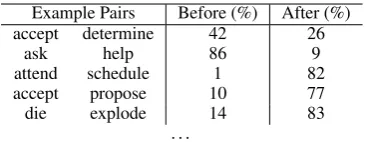
Example Pairs Before (%) After (%)
accept determine 42 26
ask help 86 9
attend schedule 1 82
accept propose 10 77
die explode 14 83
[image:2.595.90.273.61.132.2]. . .
Table 1: TEMPROB is a unique source of
informa-tion of the temporal order that events usually fol-low. The probabilities below do not add up to 100% because less frequent relations are omitted. The word sense numbers are not shown here for convenience.
about these events and their “typical” order. As a result, existing systems almost always attempt to solve the situations shown in Example1, even when they are actually presented with input as in Example2. Thefirst contributionof this work is thus the construction of such a resource in the form of a probabilistic knowledge base, constructed from a large New York Times (NYT) corpus. We hereafter name our resource TEMporal rela-tion PRObabilistic knowledge Base (TEMPROB),
which can potentially benefit many time-aware tasks. A few example entries of TEMPROB are
shown in Table 1. Second, we show that exist-ing TempRel extraction systems can be improved using TEMPROB, either in a local method or in
a global method (explained later), by a signif-icant margin in performance on the benchmark TimeBank-Dense dataset (Cassidy et al.,2014).
Example 2: The original sentences in Example1.
More than 10 people have (e1:died), police said. A car (e2:exploded) on Friday in the middle of a group of men playing volleyball.
The first thing I (e3:ask) is that they (e4:help) writing this column.
The rest of the paper is organized as follows. Section2provides a literature review of TempRels extraction in NLP. Section3describes in detail the construction of TEMPROB. In Sec. 4, we show
that TEMPROBcan be used in existing TempRels
extraction systems and lead to significant improve-ment. Finally, we conclude in Sec.5.
2 Related Work
The TempRels between events can be represented by an edge-labeled graph, where the nodes are events, and the edges are labeled with TempRels (Chambers and Jurafsky, 2008; Do et al., 2012;
Ning et al.,2017). Given all the nodes, we work on the TempRel extraction task, which is to assign
labels to the edges in a temporal graph (a “vague” or “none” label is often included to account for the non-existence of an edge).
Early work includesMani et al.(2006); Cham-bers et al.(2007);Bethard et al.(2007);Verhagen and Pustejovsky (2008), where the problem was formulated as learning a classification model for determining the label of every edgelocally with-out referring to other edges (i.e., local methods). The predicted temporal graphs by these methods may violate the transitive properties that a tempo-ral graph should possess. For example, given three nodes, e1, e2, and e3, a local method can pos-sibly classify (e1,e2)=before, (e2,e3)=before, and (e1,e3)=after, which is obviously wrong since be-foreis a transitive relation and (e1,e2)=beforeand (e2,e3)=beforedictate that (e1,e3)=before. Recent state-of-the-art methods, (Chambers et al., 2014;
Mirza and Tonelli, 2016), circumvented this is-sue by growing the predicted temporal graph in a multi-step manner, where transitive graph closure is performed on the graph every time a new edge is labeled. This is conceptually solving the struc-tured prediction problem greedily. Another fam-ily of methods resorted to Integer Linear Program-ming (ILP) (Roth and Yih,2004) to get exact infer-ence to this problem (i.e., global methods), where the entire graph is solved simultaneously and the transitive properties are enforced naturally via ILP constraints (Bramsen et al., 2006;Chambers and Jurafsky,2008;Denis and Muller,2011;Do et al.,
2012). A most recent work brought this idea even further, by incorporating structural constraints into the learning phase as well (Ning et al.,2017).
The TempRel extraction task has a strong de-pendency on prior knowledge, as shown in our earlier examples. However, very limited atten-tion has been paid to generating such a resource and to make use of it; to our knowledge, the TEMPROB proposed in this work is completely
new. We find that thetime-sensitive relations pro-posed inJiang et al.(2016) is a close one in litera-ture (although it is still very different).Jiang et al.
be-fore.
Our work significantly differs from the time-sensitive relations in Jiang et al. (2016) in the following aspects. First, scale difference: Jiang et al. (2016) can only extract a small number of relations (<100), but we work on general
seman-tic frames (tens of thousands) and the relations between any two of them, which we think has broader applications. Second, granularity differ-ence: the smallest granularity inJiang et al.(2016) is one year2, i.e., only when two events happened
in different years can they know the temporal or-der of them, but we can handle implicit temporal orders without having to refer to the physical time points of events (i.e., the granularity can be ar-bitrarily small). Third, domain difference: while
Jiang et al.(2016) extracts time-sensitive relations from structured knowledge bases (where events are explicitly anchored to a time point), we extract relations from unstructured natural language text (where the physical time points may not even ex-ist in text). Our task is more general and it allows us to extract much more relations, as reflected by the 1st difference above.
Another related work is the VerbOcean (Chklovski and Pantel, 2004), which extracts temporal relations between pairs of verbs using manually designed lexico-syntactic patterns (there are in total 12 such patterns), in contrast to the automatic extraction method proposed in this work. In addition, the only termporal relation considered in VerbOceans is before, while we also consider relations such as after, includes,
included, equal, and vague. As expected, the total numbers of verbs and before relations in VerbOcean is about 3K and 4K, respectively, both of which are much smaller than TEMPROB, which
contains 51K verb frames (i.e., disambiguated verbs), 9.2M (verb1, verb2, relation) entries,
and up to 80M temporal relations altogether. All these differences necessitate the construc-tion of a new resource for TempRel extracconstruc-tion, which we explain below.
3 TEMPROB: A Probabilistic Resource
for TempRels
In the TempRel extraction task, people have usu-ally assumed that events are already given. How-ever, to construct the desired resource, we need
2We notice that the smallest granularity in Freebase itself is one day, butJiang et al.(2016) only used years.
to extract events (Sec.3.1) and extract TempRels (Sec. 3.2), from a large, unannotated3 corpus
(Sec.3.3). We also show some interesting statis-tics discovered in TEMPROB that may benefit
other tasks (Sec. 3.4). In the next, we describe each of these elements.
3.1 Event Extraction
Extracting events and the relations between them (e.g., coreference, causality, entailment, and tem-poral) have long been an active area in the NLP community. Generally speaking, an event is con-sidered to be an action associated with corre-sponding participants involved in this action. In this work, following (Peng and Roth,2016;Peng et al., 2016; Spiliopoulou et al., 2017) we con-sider semantic-frame based events, which can be directly detected via off-the-shelf semantic role la-beling (SRL) tools. This aligns well with previous works on event detection (Hovy et al.,2013;Peng et al.,2016).
Depending on the events of interest, the SRL results are often a superset of events and need to be filtered afterwards (Spiliopoulou et al.,2017). For example, in ERE (Song et al.,2015) and Event Nugget Detection (Mitamura et al.,2015), events are limited to a set of predefined types (such as “Business”, “Conflict”, and “Justice”); in the con-text of TempRels, existing datasets have focused more on predicate verbs rather than nominals4
(Pustejovsky et al.,2003;Graff, 2002;UzZaman et al.,2013). Therefore, we only look at verb se-mantic frames in this work due to the difficulty of getting TempRel annotation for nominal events, and we will use “verb (semantic frames)” inter-changeably with “events” hereafter in this paper.
3.2 TempRel Extraction
Given the events extracted in a given article (i.e., given the nodes in a graph), we next explain how the TempRels are extracted (that is, the edge labels in the graph).
3.2.1 Features
We adopt the commonly used feature set in TempRel extraction (Do et al.,2012;Ning et al.,
2017) and here we simply list them for repro-ducibility. For each pair of nodes, the
follow-3Unannotated with TempRels.
ing features are extracted. (i) The part-of-speech (POS) tags from each individual verb and from its neighboring three words. (ii) The distance be-tween them in terms of the number of tokens. (iii) The modal verbs between the event mention (i.e.,
will, would, can, could, may and might). (iv) The temporal connectives between the event men-tions (e.g.,before, afterandsince). (v) Whether the two verbs have a common synonym from their synsets in WordNet (Fellbaum, 1998). (vi) Whether the input event mentions have a common derivational form derived from WordNet. (vii) The head word of the preposition phrase that covers each verb, respectively.
3.2.2 Learning
With the features defined above, we need to train a system that can annotate the TempRels in each document. The TimeBank-Dense dataset (TB-Dense) (Cassidy et al., 2014) is known to have the best quality in terms of its high density of TempRels and is a benchmark dataset for the TempRel extraction task. It contains 36 docu-ments from TimeBank (Pustejovsky et al., 2003) which were re-annotated using the dense event ordering framework proposed in (Cassidy et al.,
2014). We follow its label set (denoted byR) of before,after,includes,included,equal, andvague
in this study.
Due to the slight event annotation difference in TBDense, we collect our training data as follows. We first extract all the verb semantic frames from the raw text of TBDense. Then we only keep those semantic frames that are matched to an event in TBDense (about 85% semantic frames are kept in this stage). By doing so, we can simply use the TempRel annotations provided in TBDense. Here-after the TBDense dataset used in this paper refers to this version unless otherwise specified.
We group the TempRels by the sentence dis-tance of the two events of each relation5. Then
we use the averaged perceptron algorithm (Freund and Schapire, 1998) implemented in the Illinois LBJava package (Rizzolo and Roth,2010) to learn from the training data described above. Since only relations that have sentence distance 0 or 1 are an-notated in TBDense, we will have two classifiers, one for same sentence relations, and one for neigh-boring sentence relations, respectively.
5That is, the difference of the appearance order of the sen-tence(s) containing the two target events.
Note that TBDense was originally split into Train (22 docs), Dev (5 docs), and Test (9 docs). In all subsequent analysis, we combined Train and Dev and we performed 3-fold cross validation on the 27 documents (in total about 10K relations) to tune the parameters in any classifier.
3.2.3 Inference
When generating TEMPROB, we need to
pro-cess a large number of articles, so we adopt the greedy inference strategy described earlier due to its computational efficiency (Chambers et al.,
2014;Mirza and Tonelli,2016). Specifically, we apply the same-sentence relation classifier before the neighboring-sentence relation classifier; when-ever a new relation is added in this article, a tran-sitive graph closure is performed immediately. By doing this, if an edge is already labeled during the closure phase, it will not be labeled again, so con-flicts are avoided.
3.3 Corpus
As mentioned earlier, the source corpus on which we are going to construct TEMPROBis comprised
of NYT articles from 20 years (1987-2007)6. It
contains more than 1 million documents and we extract events and corresponding features from each document using the Illinois Curator pack-age (Clarke et al.,2012) on Amazon Web Services (AWS) Cloud. In total, we discovered 51K unique verb semantic frames and 80M relations among them in the NYT corpus (15K of the verb frames had more than 20 relations extracted and 9K had more than 100 relations).
3.4 Interesting Statistics
We first describe the notations that we are going to use. We denote the set of all verb semantic frames byV. LetDi, i = 1, . . . , N be thei-th document in our corpus, whereN is the total number of
doc-uments. LetGi = (Vi, Ei)be the temporal graph inferred from Di using the approach described above, where Vi ⊆ V is the set of verbs/events extracted inDiandEi ={(vm, vn, rmn)}m<n ⊆
Vi ×Vi×Ris the edge set ofDi, which is com-posed of TempRel triplets; specifically, a TempRel triplet(vm, vn, rmn)∈Eirepresents that in docu-mentDi, the TempRel betweenvmandvnisrmn. Due to the symmetry in TempRels, we only keep the triplets withm < ninEi. Assuming that the
verbs inVi are ordered by their appearance order in text, thenm < n means that in thei-th
docu-ment,vmappears earlier in text thanvndoes. Given the usual confusion between that one event is temporally before another and that one event is physically appearing before another in text, we will refer to temporally before as T-Before and physically before as P-Before. Us-ing this language, for example,Ei only keeps the triplets thatvmis P-BeforevninDi.
3.4.1 Extreme cases
We first show extreme cases that some events are
almost always labeled as T-Before or T-After in the corpus. Specifically, for each pair of verbs
vi, vj ∈V, we define the following ratios:
ηb= C(vi, vj, bef ore)
C(vi, vj, bef ore) +C(vi, vj, af ter), ηa= 1−ηb, (1)
where C(vi, vj, r) is the count ofvi P-Before vj with TempRelr∈R:
C(vi, vj, r) = N ∑
i=1
∑
(vm,vn,rmn)∈Ei
I{vm=vi&vn=vj&rmn=r},
(2)
where I{·} is the indicator function. Add-one
smoothing technique from language modeling is used to avoid divided-by-zero errors. In Table2, we show some event pairs with either ηb > 0.9 (upper part) orηa>0.9(lower part).
We think the examples from Table 2 are in-tuitively appealing: chop happens before taste,
clean happens after contaminate, etc. More in-terestingly, in the lower part of the table, we show pairs in which the physical order is different from the temporal order: for example, when achieve
is P-Beforedesire, it is still labeled as T-After in most cases (104 out of 111 times), which is cor-rect intuitively. In practice, e.g., in the TBDense dataset (Cassidy et al., 2014), roughly 30%-40% of the P-Before pairs are T-After. Therefore, it is important to be able to capture their temporal or-der rather than simply taking their physical oror-der if one wants to understand the temporal implication of verbs.
3.4.2 Distribution of Following Events
For each verbv, we define the marginal count of vbeing P-Before to arbitrary verbs with TempRel r ∈RasC(v, r) =∑v
i∈V C(v, vi, r). Then for
every other verbv′, we define
P(vT-Beforev′|vT-Before)≜ C(v, v′, bef ore) C(v, bef ore) , (3)
Example Pairs #T-Before #T-After
chop.01 taste.01 133 8
concern.01 protect.01 110 10
conspire.01 kill.01 113 6
debate.01 vote.01 48 5
dedicate.01 promote.02 67 7
fight.01 overthrow.01 98 8
achieve.01 desire.01 7 104
admire.01 respect.01 7 121
clean.02 contaminate.01 3 82
defend.01 accuse.01 13 160
die.01 crash.01 8 223
[image:5.595.309.526.60.195.2]overthrow.01 elect.01 3 100
Table 2: Several extreme cases from TEMPROB, where some event is almost always labeled to be T-Before or T-After throughout the NYT corpus. By “ex-treme”, we mean that either the probability of T-Before or T-After is larger than 90%. The upper part of the table shows the pairs that are both P-Before and T-Before, while the lower part shows the pairs that are P-Before but T-After. In TEMPROB, there are about
7K event pairs being extreme cases.
which is the probability ofv T-Before v′,
condi-tioned onv T-Before anything. Similarly, we
de-fine
P(vT-Afterv′|vT-After)≜ C(v, v′, af ter) C(v, af ter) . (4)
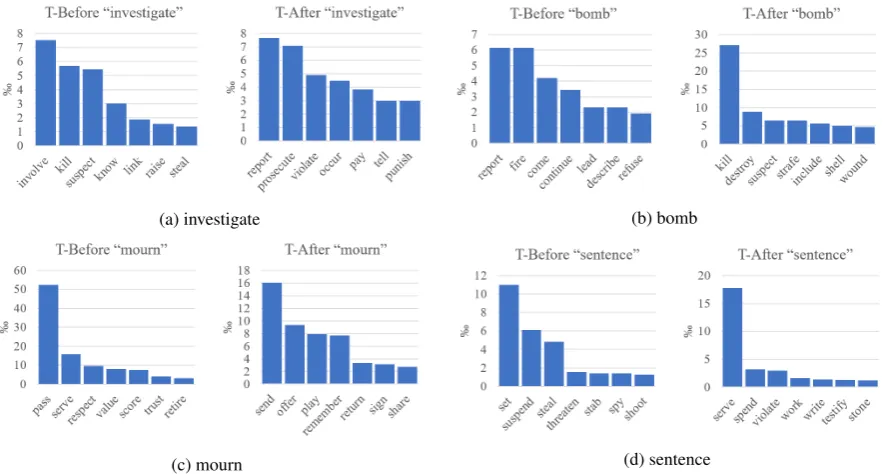
For a specific verb, e.g., v=investigate, each verb v′ ∈ V is sorted by the two conditional
probabilities above. Then the most probable verbs that temporally precede or follow v are
shown in Fig.1, where the y-axes are the corre-sponding conditional probabilities. We can see reasonable event sequences like {involve, kill,
suspect,steal}→investigate→{report,prosecute,
pay, punish}, which indicates the possibility of
using TEMPROB for event sequence predictions
or story cloze tasks. There are also suspicious pairs like know in the T-Before list of investi-gate(Fig.1a),reportin the T-Before list ofbomb
(Fig. 1b), and play in the T-After list of mourn
(Fig. 1c). Since the arguments of these verb frames are not considered here, whether these few seemingly counter-intuitive pairs come from sys-tem error or from a special context needs further investigation.
4 Experiments
In the above, we have explained the construction of TEMPROB and shown some interesting
(a) investigate (b) bomb
[image:6.595.80.522.65.302.2](c) mourn (d) sentence
Figure 1:Top events that most frequently precede or follow “investigate”, “bomb”, “mourn”, or “sentence” in time, sorted by their conditional probabilities inh. Word senses have been disambiguated and the “bomb” and “sentence” here are their verb meanings. There are some possible errors (e.g.,reportis T-Beforebomb) and some unclear pairs (e.g.,knowis T-Beforeinvestigateandplayis T-Aftermourn), but overall the event sequences discovered here are reasonable. More examples can be found in the appendix.
then show TEMPROB can be used to improve
ex-isting TempRel extraction systems.
4.1 Quality Analysis of TEMPROB
In Table2, we showed examples with eitherηb or
ηa>0.9. We argued that theyseemcorrect. Here we quantify the “correctness” ofηb andηa based on TBDense. Specifically, we collected all the gold T-Before and T-After pairs. Letτ ∈ [0.5,1)
be a constant threshold. Imagine a naive predic-tor such that for each pair of events vi andvj, if
ηb > τ, it predicts thatviis T-Beforevj; ifηa> τ, it predicts thatvi is T-Aftervj; otherwise, it pre-dicts that vi is T-Vague to vj. We expect that a higherηb(orηa) represents a higher confidence for an instance to be labeled T-Before (or T-After).
Table3shows the performance of this predictor, which meets our expectation and thus justifies the validity of TEMPROB. As we gradually increase
the value of τ in Table 3, the precision increases
in roughly the same pace withτ, which indicates that the values ofηb andηa7 from TEMPROB in-deed represent the confidence level. The decrease in recall is also expected because more examples are labeled as T-Vague whenτ is larger.
To further justify the quality, we also used
7Recall the definitions ofηbandηain Eq. (1).
Thresholdτ PDist=0R PDist=1R
[image:6.595.332.501.392.464.2]0.5 65.6 61.3 58.5 53.3 0.6 69.8 44.5 60.5 36.9 0.7 74.6 29.2 63.6 18.7 0.8 81.0 13.9 64.8 6.9 0.9 82.9 5.0 76.9 1.2
Table 3:Validatingηbandηafrom TEMPROBbased
on the T-Before and T-After examples in TBDense. Performances are decomposed into same sentence ex-amples (Dist=0) and contiguous sentence exex-amples (Dist=1). A larger threshold leads to a higher precision, soηbandηaindeed represent a notion of confidence.
another dataset that is not in the TempRel do-main. Instead, we downloaded the EventCausality dataset8 (Do et al., 2011). For each causally
re-lated paire1 ande2, if EventCausality annotates thate1 causes e2, we changed it to be T-Before; if EventCausality annotates that e1 is caused by
e2, we changed it to be T-after. Therefore, based on the assumption that the cause event is T-Before the result event, we converted the EventCausality dataset to be a TempRel dataset and it thus could also be used to evaluate the quality of TEMPROB.
We adopted the same predictor used in Table 3
8http://cogcomp.org/page/resource_
with τ = 0.5 and in Table 4, we compared it with two baselines: (i) always predicting T-Before and (ii) always predicting T-After. First, the accu-racy (66.2%) in Table4is rather consistent with its counterpart in Table3, confirming the stability of statistics from TEMPROB. Second, by directly
us-ing the prior statisticsηb andηafrom TEMPROB, we can improve the precision of both labels with a significant margin relative to the two baselines (17.0% for “T-Before” and 15.9% for “T-After”). Overall, the accuracy was improved by 11.5%.
System PT-BeforeR PT-AfterR Acc. T-Before Only 54.7 100.0 0 0 54.7 T-After Only 0 0 45.3 100 45.3
[image:7.595.78.285.223.276.2]τ = 0.5 71.7 63.3 61.2 69.8 66.2 Table 4: Further justification of ηb and ηa from
TEMPROB on the EventCausality dataset. The thresholding predictor from Table 3 withτ = 0.5 is
used here. Compared to always predicting the major-ity label (i.e., T-Before in this case),τ = 0.5
signifi-cantly improved the performance for both labels, with the overall accuracy improved by 11.5%.
4.2 Improving TempRel Extraction
The original purpose of TEMPROBwas to improve
TempRel extraction. We show it from two per-spectives: How effective the prior distributions ob-tained from TEMPROBare (i) as features in local
methods and (ii) as regularization terms in global methods. The results below were evaluated on the test split of TB-Dense (Cassidy et al.,2014).
4.2.1 Improving Local Methods
We first test how well the prior distributions from TEMPROB can be used as features in improving
local methods for TempRel extraction. In Ta-ble 5, we used the original feature set proposed in Sec.3.2.1as the baseline, and added the prior distribution obtained from TEMPROB on top of
it. Specifically, we added ηb (see Eq. (1)) and
{fr}r∈R, respectively, where{fr}r∈Ris the prior distributions of all labels, i.e.,
fr(vi, vj) =
C(vi, vj, r)
∑
r′∈RC(vi, vj, r′)
, r∈R. (5)
Recall functionC is defined in Eq. (2). All
com-parisons were decomposed to same sentence rela-tions (Dist=0) and neighboring sentence relarela-tions (Dist=1) for a better understanding of the behav-ior. All classifiers were trained using the averaged
perceptron algorithm (Freund and Schapire,1998) and tuned by 3-fold cross validation.
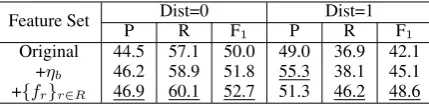
From Table5, we can see that simply addingηb into the feature set could improve the original sys-tem F1by 1.8% (Dist=0) and 3.0% (Dist=1). If we
further add as features the full set of prior distri-butions{fr}r∈R, the improvement comes to 2.7% and 6.5%, respectively. Noticing that the feature is more helpful for Dist=1, we think that it is because distant pairs usually have less lexical dependency and thus need more prior information provided by our new feature. With Dist=0 and Dist=1 com-bined (numbers not shown in the Table), the 3rd line improved the ”original” by 4.7% in F1and by
5.1% in the temporal awareness F-score (another metric used in the TempEval3 workshop).
Feature Set P Dist=0R F Dist=1
1 P R F1
Original 44.5 57.1 50.0 49.0 36.9 42.1 +ηb 46.2 58.9 51.8 55.3 38.1 45.1
+{fr}r∈R 46.9 60.1 52.7 51.3 46.2 48.6
Note The performances here are consistently lower than those in Table3because in Table3, only Before and T-After examples are considered, but here all labels are taken into account and the problem is more practical and harder. Table 5: Using prior distributions derived from TEMPROBas features in an example local method. Incorporating ηb to the original feature set already
yields better performance. By using the full set of prior distributions, {fr}r∈R, the final system improves the
original in almost all metrics, and the improvement is statistically significant with p<0.005 per the McNe-mar’s test.
4.2.2 Improving Global Methods
As mentioned earlier in Sec. 2, many systems adopt a global inference method via integer lin-ear programming (ILP) (Roth and Yih, 2004) to enforce transitivity constraints over an entire tem-poral graph (Bramsen et al.,2006;Chambers and Jurafsky,2008;Denis and Muller,2011;Do et al.,
2012; Ning et al., 2017). In addition to the us-age shown in Sec. 4.2.1, the prior distributions from TEMPROB can also be used to regularize
[image:7.595.309.524.298.351.2]formulated as follows.
ˆ
I =argmax I
∑
ij∈E ∑
r∈R
(xr(ij) +λfr(ij))Ir(ij) (6)
s.t. ΣrIr(ij) = 1
(uniqueness) , Ir(ij(symmetry)) =I¯r(ji), Ir1(ij) +Ir2(jk)−Σ
M m=1Irm
3 (ik)≤1,
(transitivity)
for all distinct events i, j, and k, where E =
{ij |sentence dist(i, j)≤1}, λ adjusts the regu-larization term and was heuristically set to 0.5 in this work,r¯is the reverse relation ofr, andM is
the number of possible relations for r3 when r1
andr2are true. Note our difference from the ILP
in (Ning et al.,2017) is the underlined regulariza-tion termfr(ij)(which itself is defined in Eq. (5)) obtained from TEMPROB.
No. System P R F1 Faware
1 Baseline 48.1 44.4 46.2 42.5
2 +Feature:{fr}r∈R 50.6 52.0 51.3 49.1
[image:8.595.355.480.60.134.2]3 +Regularization 51.3 53.0 52.1 49.6 Table 6: Regularizing global methods by the prior distribution derived from TEMPROB. The “+” means adding a component on top of its preceding line. Fawareis the temporal awareness F-score, another eval-uation metric used in TempEval3. The baseline sys-tem is to use (unregularized) ILP on top of the original system in Table5. System 3 is the proposed. Per the McNemar’s test, System 3 is significantly better than System 1 with p<0.0005.
We present our results on the test split of TB-Dense in Table6, which is an ablation study show-ing step-by-step improvements in two metrics. In addition to the straightforward precision, recall, and F1metric, we also compared the F1of the
tem-poral awareness metric used in TempEval3 ( UzZa-man et al.,2013). The awareness metric performs graph reduction and closure before evaluation so as to better capture how useful a temporal graph is. Details of this metric can be found inUzZaman and Allen (2011); UzZaman et al. (2013); Ning et al.(2017).
In Table 6, the baseline used the original fea-ture set proposed in Sec.3.2.1and applied global ILP inference with transitivity constraints. Tech-nically, it is to solve Eq. (6) withλ= 0(i.e.,
un-regularized) on top of the original system in Ta-ble 5. Apart from some implementation details, this baseline is also the same as many existing global methods asChambers and Jurafsky(2008);
Do et al.(2012). System 2, “+Feature: {fr}r∈R”,
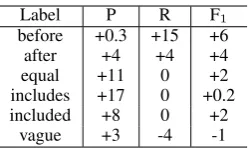
Label P R F1
before +0.3 +15 +6
after +4 +4 +4
equal +11 0 +2
includes +17 0 +0.2
included +8 0 +2
[image:8.595.71.293.307.349.2]vague +3 -4 -1
Table 7: Label-wise performance improvement of System 3 over System 1 in Table6. We can see that incorporating TEMPROBimproves the recall ofbefore
andafter, and improves the precision of all labels, with a slight drop in the recall ofvague.
is to add prior distributions as features when train-ing the local classifiers. Technically, the scores
xr(ij)’s in Eq. (6) used by baseline were changed. We know from Table5that adding{fr}r∈Rmade the local decisions better. Here the performance of System 2 shows that this was also the case for the global decisions made via ILP: both pre-cision and recall got improved, and F1and
aware-ness were both improved by a large margin, with 5.1% in F1 and 6.6% in awareness F1. On top
of this, System 3 sets λ = 0.5in Eq. (6) to add
regularizations to the conventional ILP formula-tion. The sum of these regularization terms resents a confidence score of how coherent the pre-dicted temporal graph is to our TEMPROB, which
we also want to maximize. Even though a con-siderable amount of information from TEMPROB
had already been encoded as features (as shown by the large improvements by System 2), these regu-larizations were still able to further improve the precision, recall and awareness scores. To sum up, the total improvement over the baseline sys-tem brought by TEMPROBis 5.9% in F1and 7.1%
in awareness F1, both with a notable margin.
Ta-ble 7 furthermore decomposes this improvement into each TempRel label.
To compare with state-of-the-art systems, which all used gold event properties (i.e., Tense, Aspect, Modality, and Polarity), we retrained Sys-tem 3 in Table 6 with these gold properties and show the results in Table 8. We reproduced the results of CAEVO9 (Chambers et al., 2014) and
Ning et al.(2017)10and evaluated them on the
par-tial TBDense test split11. Under both metrics, the
9https://github.com/nchambers/caevo 10http://cogcomp.org/page/publication_ view/822
proposed system achieved the best performance. An interesting fact is that even without these gold properties, our System 3 in Table 6 was already better than CAEVO (on Line 1) and Ning et al.
(2017) (on Line 2) in both metrics. This is appeal-ing because in practice, those gold properties may not exist, but our proposed system can still gener-ate stgener-ate-of-the-art performance without them.
No. System P R F1 Faware
Partial TBDense*: Focus of this work.
1 CAEVO 52.3 43.7 47.6 46.7
2 Ning et al.(2017) 47.4 56.3 51.5 49.1
3 Proposed 50.0 62.4 55.5 52.8 Complete TBDense: Naive augmentation.
4 CAEVO 51.8 32.6 40.0 45.7
5 Ning et al.(2017) 46.2 40.6 43.2 48.5
6 Proposed** 47.2 42.4 44.7 49.2 *Note that TEMPROBis only available for events extracted by SRL (See Sec.3.2.2for details).
[image:9.595.75.289.201.307.2]**Augment the output of Line 3 with predictions fromNing et al.(2017).
Table 8: Comparison of the proposed TempRel ex-traction method with two best-so-far systems us-ing two metrics. Since TEMPROB is only on SRL verb events,PartialTBDense is the focus of our work, where we can see significant improvement brought by simply using the prior knowledge from TEMPROB. Per
the McNemar’s test, Line 3 is better than Line 2 with p<0.0005. For interested readers, we also naively
aug-mented the proposed method to thecompleteTBDense and show state-of-the-art performance on it.
For readers who are interested in the complete TBDense dataset, we also performed a naive aug-mentation as follows. Recall that System 3 only makes predictions to a subset of the complete TB-Dense dataset. We kept this subset of predictions, and filled the missing predictions by Ning et al.
(2017). Performances of this naively augmented proposed system is compared with CAEVO and
Ning et al. (2017) on the complete TBDense dataset. We can see that by replacing with predic-tions from our proposed system,Ning et al.(2017) got a better precision, recall, F1, and awareness F1,
which is the new state-of-the-art on all reported performances on this dataset. Note that the aware-ness F1scores on Lines 4-5 are consistent with
re-ported values inNing et al.(2017). To our knowl-edge, the results in Table8is the first in literature that reports performances in both metrics, and it is promising to see that the proposed method outper-formed state-of-the-art methods in both metrics.
5 Conclusion
Temporal relation (TempRel) extraction is an im-portant and challenging task in NLP, partly due to its strong dependence on prior knowledge. Moti-vated by practical examples, this paper argues that a resource of the temporal order that eventsusually
follow is helpful. To construct such a resource, we automatically processed a large corpus from NYT with more than 1 million documents using an ex-isting TempRel extraction system and obtained the
TEMporal relation PRObabilistic knowledge Base
(TEMPROB). The TEMPROB is a good
show-case of the capability of such prior knowledge, and it has shown its power in improving exist-ing TempRel extraction systems on a benchmark dataset, TBDense. The resource and the system reported in this paper are both publicly available12
and we hope that it can foster more investigations into time-related tasks.
Acknowledgements
We thank all the reviewers for providing useful comments. This research is supported in part by a grant from the Allen Institute for Artificial In-telligence (allenai.org); the IBM-ILLINOIS Cen-ter for Cognitive Computing Systems Research (C3SR) - a research collaboration as part of the IBM AI Horizons Network; by DARPA under agreement number FA8750-13-2-0008; and by the Army Research Laboratory (ARL) under agree-ment W911NF-09-2-0053.
The U.S. Government is authorized to repro-duce and distribute reprints for Governmental purposes notwithstanding any copyright notation thereon. The views and conclusions contained herein are those of the authors and should not be interpreted as necessarily representing the official policies or endorsements, either expressed or im-plied, of DARPA or the U.S. Government. Any opinions, findings, conclusions or recommenda-tions are those of the authors and do not neces-sarily reflect the view of the ARL.
References
Steven Bethard, Leon Derczynski, Guergana Savova, James Pustejovsky, and Marc Verhagen. 2015. SemEval-2015 Task 6: Clinical TempEval. In Pro-ceedings of the 9th International Workshop on Se-mantic Evaluation (SemEval 2015). Association for
12http://cogcomp.org/page/publication_
Computational Linguistics, Denver, Colorado, pages 806–814.
Steven Bethard, James H Martin, and Sara Klingen-stein. 2007. Timelines from text: Identification of syntactic temporal relations. InIEEE International Conference on Semantic Computing (ICSC). pages 11–18.
Steven Bethard, Guergana Savova, Wei-Te Chen, Leon Derczynski, James Pustejovsky, and Marc Verhagen. 2016. SemEval-2016 Task 12: Clinical TempEval. In Proceedings of the 10th International Workshop on Semantic Evaluation (SemEval-2016). Associa-tion for ComputaAssocia-tional Linguistics, San Diego, Cal-ifornia, pages 1052–1062.
Steven Bethard, Guergana Savova, Martha Palmer, and James Pustejovsky. 2017. SemEval-2017 Task 12: Clinical TempEval. In Proceedings of the 11th International Workshop on Semantic Evalu-ation (SemEval-2017). Association for Computa-tional Linguistics, pages 565–572.
Kurt Bollacker, Colin Evans, Praveen Paritosh, Tim Sturge, and Jamie Taylor. 2008. Freebase: a collab-oratively created graph database for structuring hu-man knowledge. In Proceedings of the 2008 ACM SIGMOD international conference on Management of data. ACM, pages 1247–1250.
P. Bramsen, P. Deshpande, Y. K. Lee, and R. Barzilay. 2006. Inducing temporal graphs. InProceedings of the Conference on Empirical Methods for Natural Language Processing (EMNLP). pages 189–198.
Taylor Cassidy, Bill McDowell, Nathanel Chambers, and Steven Bethard. 2014. An annotation frame-work for dense event ordering. In Proceedings of the Annual Meeting of the Association for Computa-tional Linguistics (ACL). pages 501–506.
N. Chambers and D. Jurafsky. 2008. Jointly combining implicit constraints improves temporal ordering. In
Proceedings of the Conference on Empirical Meth-ods for Natural Language Processing (EMNLP).
Nathanael Chambers, Taylor Cassidy, Bill McDowell, and Steven Bethard. 2014. Dense event ordering with a multi-pass architecture. Transactions of the Association for Computational Linguistics 2:273– 284.
Nathanael Chambers, Shan Wang, and Dan Juraf-sky. 2007. Classifying temporal relations between events. InProceedings of the 45th Annual Meeting of the ACL on Interactive Poster and Demonstration Sessions. pages 173–176.
T. Chklovski and P. Pantel. 2004. VerbOcean: Min-ing the Web for Fine-Grained Semantic Verb Re-lations. InProceedings of the Conference on Em-pirical Methods for Natural Language Processing (EMNLP). pages 33–40.
J. Clarke, V. Srikumar, M. Sammons, and D. Roth. 2012. An nlp curator (or: How i learned to stop worrying and love nlp pipelines). InProc. of the In-ternational Conference on Language Resources and Evaluation (LREC).
Pascal Denis and Philippe Muller. 2011. Predicting globally-coherent temporal structures from texts via endpoint inference and graph decomposition. In
Proceedings of the International Joint Conference on Artificial Intelligence (IJCAI). volume 22, page 1788.
Q. Do, Y. Chan, and D. Roth. 2011. Minimally super-vised event causality identification. InProc. of the Conference on Empirical Methods in Natural Lan-guage Processing (EMNLP). Edinburgh, Scotland.
Q. Do, W. Lu, and D. Roth. 2012. Joint inference for event timeline construction. In Proc. of the Con-ference on Empirical Methods in Natural Language Processing (EMNLP).
C. Fellbaum. 1998. WordNet: An Electronic Lexical Database. MIT Press.
Y. Freund and R. Schapire. 1998. Large margin clas-sification using the Perceptron algorithm. In Pro-ceedings of the Annual ACM Workshop on Compu-tational Learning Theory (COLT). pages 209–217.
David Graff. 2002. The AQUAINT corpus of english news text. Linguistic Data Consortium, Philadel-phia.
Johannes Hoffart, Fabian M. Suchanek, Klaus Berberich, and Gerhard Weikum. 2013. Yago2: A spatially and temporally enhanced knowledge base from wikipedia (extended abstract). InProceedings of the International Joint Conference on Artificial Intelligence (IJCAI).
Eduard Hovy, Teruko Mitamura, Felisa Verdejo, Jun Araki, and Andrew Philpot. 2013. Events are not simple: Identity, non-identity, and quasi-identity. In
Workshop on Events.
Tingsong Jiang, Tianyu Liu, Tao Ge, Lei Sha, Baobao Chang, Sujian Li, and Zhifang Sui. 2016. Towards time-aware knowledge graph completion. In Pro-ceedings of COLING 2016, the 26th International Conference on Computational Linguistics: Techni-cal Papers. The COLING 2016 Organizing Commit-tee, Osaka, Japan, pages 1715–1724.
Hector Llorens, Nathanael Chambers, Naushad UzZa-man, Nasrin Mostafazadeh, James Allen, and James Pustejovsky. 2015. SemEval-2015 Task 5: QA TEMPEVAL - evaluating temporal information un-derstanding with question answering. In Proceed-ings of the 9th International Workshop on Semantic Evaluation (SemEval 2015). pages 792–800.
Machine learning of temporal relations. In Proceed-ings of the Annual Meeting of the Association for Computational Linguistics (ACL). pages 753–760.
Anne-Lyse Minard, Manuela Speranza, Eneko Agirre, Itziar Aldabe, Marieke van Erp, Bernardo Magnini, German Rigau, Ruben Urizar, and Fon-dazione Bruno Kessler. 2015. SemEval-2015 Task 4: TimeLine: Cross-document event ordering. In
Proceedings of the 9th International Workshop on Semantic Evaluation (SemEval 2015). pages 778–786.
Paramita Mirza and Sara Tonelli. 2016. CATENA: CAusal and TEmporal relation extraction from NAt-ural language texts. InThe 26th International Con-ference on Computational Linguistics. pages 64–75.
T. Mitamura, Y. Yamakawa, S. Holm, Z. Song, A. Bies, S. Kulick, and S. Strassel. 2015. Event nugget anno-tation: Processes and issues. InProceedings of the Workshop on Events at NAACL-HLT.
Qiang Ning, Zhili Feng, and Dan Roth. 2017. A struc-tured learning approach to temporal relation extrac-tion. In Proceedings of the Conference on Em-pirical Methods for Natural Language Processing (EMNLP). Copenhagen, Denmark.
Haoruo Peng and Dan Roth. 2016. Two discourse driven language models for semantics. In Proc. of the Annual Meeting of the Association for Computa-tional Linguistics (ACL).
Haoruo Peng, Yangqiu Song, and Dan Roth. 2016. Event detection and co-reference with minimal su-pervision. In Proc. of the Conference on Em-pirical Methods in Natural Language Processing (EMNLP).
James Pustejovsky, Patrick Hanks, Roser Sauri, An-drew See, Robert Gaizauskas, Andrea Setzer, Dragomir Radev, Beth Sundheim, David Day, Lisa Ferro, et al. 2003. The TIMEBANK corpus. In Cor-pus linguistics. volume 2003, page 40.
N. Rizzolo and D. Roth. 2010. Learning based java for rapid development of nlp systems. InProc. of the In-ternational Conference on Language Resources and Evaluation (LREC). Valletta, Malta.
D. Roth and W. Yih. 2004. A linear programming formulation for global inference in natural language tasks. In Hwee Tou Ng and Ellen Riloff, editors,
Proc. of the Conference on Computational Natural Language Learning (CoNLL). pages 1–8.
Zhiyi Song, Ann Bies, Stephanie Strassel, Tom Riese, Justin Mott, Joe Ellis, Jonathan Wright, Seth Kulick, Neville Ryant, and Xiaoyi Ma. 2015. From light to rich ere: Annotation of entities, relations, and events. InProceedings of the The 3rd Workshop on EVENTS: Definition, Detection, Coreference, and Representation. Association for Computational Lin-guistics, Denver, Colorado, pages 89–98.
Evangelia Spiliopoulou, Eduard Hovy, and Teruko Mi-tamura. 2017. Event detection using frame-semantic parser. InProceedings of the Events and Stories in the News Workshop. Association for Computational Linguistics, Vancouver, Canada, pages 15–20. Naushad UzZaman and James F Allen. 2011.
Tempo-ral evaluation. InProceedings of the Annual Meet-ing of the Association for Computational LMeet-inguistics (ACL). pages 351–356.
Naushad UzZaman, Hector Llorens, James Allen, Leon Derczynski, Marc Verhagen, and James Pustejovsky. 2013. SemEval-2013 Task 1: TempEval-3: Evaluat-ing time expressions, events, and temporal relations. InSecond Joint Conference on Lexical and Compu-tational Semantics. volume 2, pages 1–9.
Marc Verhagen, Robert Gaizauskas, Frank Schilder, Mark Hepple, Graham Katz, and James Pustejovsky. 2007. SemEval-2007 Task 15: TempEval temporal relation identification. InSemEval. pages 75–80.
Marc Verhagen and James Pustejovsky. 2008. Tem-poral processing with the TARSQI toolkit. In22nd International Conference on on Computational Lin-guistics: Demonstration Papers. pages 189–192.