Combining Input-Output (IO) analysis
with Global Vector Autoregressive
(GVAR) modeling: Evidence for the
USA (1992-2006)
Konstantakis, Konstantinos and Michaelides, Panayotis G.
National Technical University of Athens
2014
Online at
https://mpra.ub.uni-muenchen.de/67111/
Combining Input-Output (IO) analysis with Global Vector
Autoregressive (GVAR) modeling: Evidence for the USA (1992-2006)
Konstantinos N. Konstantakis and Panayotis G. Michaelides
National Technical University of Athens, Greece
Abstract: The purpose of this paper is to assess the interdependencies among the eight (8) main sectors of economic activity in the US economy, using quarterly data on output and labor fora period of fifteen years (1992-2006), just before the first signs of the global recession made their appearance. In this context, we set up a novel methodological framework which combines Input-Output (IO) analysis with state of the art Global Vector Autoregressive (GVAR) modeling. In addition, we use the IO matrices to provide a procedure in order to test for the existence of dominant sector(s) in the USA and estimate a GVAR model with dominant sector(s) and the exogenous variables of Global Credit and Global Trade acting as the transmission channels. Our results seem to suggest that the US economy has relatively limited connectivity, in terms of sectoral output and
labor, among the various sectors.
Keywords: GVAR, Input Output, US sectors, Weight Matrix
The authors would like to thank Theodore Mariolis for a fruitful discussion. Corresponding author: Panayotis G. Michaelides, Assistant Professor of Economics, Laboratory of Theoretical and Applied Economics, School of Applied
1.
Introduction
The VAR approach and especially the Global VAR (GVAR) model, provide
nowadays a very useful framework for assessing the transmission of shocks among
economic entities.1 The GVAR framework was introduced by Pesaran et al. (2004) and
developed through several quality theoretical contributions such as Pesaran and Smith
(2006), Dées et al. (2007b) Chudik and Pesaran (2011a), (2011b) as well as empirical ones
such as Dées et al. (2005), (2007a), Pesaran et al. (2006), Pesaran et al. (2007), Bussière et
al. (2012), Konstantakis and Michaelides (2014).
The GVAR model is suitable for assessing relationships between economic
entities while its methodology provides a general, yet practical, modeling framework for
the quantitative analysis of the relative importance of different shocks and channels of
transmission. In fact, it consists of a compact econometric model of the economic
entities involved which is specifically designed to model the economic interdependencies
among economic entities, e.g. at both the national and international level.
The GVAR framework is structured upon observables, which typically include
economic aggregates, trade and financial variables, with other unit-specific variables
serving as proxies for common unobserved factors. It is exactly this characteristic that
constitutes an important input in the so-called “decoupling” of the US sectoral economy.
The purpose of this paper is to assess the interdependencies among the eight (8) main sectors of economic activity in the US economy, using quarterly data on output and labor for a period of fifteen years (1992-2006), just before the first signs of the global recession made their appearance.
We have chosen the variables of output and labor because they are probably the major economic variables at the sectoral level which are able to express, in a nutshell, the economic conditions of each sector. More precisely, we take into consideration the production of each sector through the variable of output as well as the main factor of production (i.e. input) through the variable of labor. Additionally, we have chosen to use the variables of Global Trade and Global Credit instead of their domestic counterparts i.e. US Credit and US Trade, due to the high degree of opennessof the US economy.
The present paper is the first, to the best of our knowledge, which provides a simple and practical framework for applying the GVAR approach at the sectoral level. In this framework, we propose combining the traditional Input Output (IO) Leontief methodology with the state of the art GVAR approach. To this end, we set out a detailed methodological framework for constructing the sectoral weight matrix of the GVAR model, which builds on the IO technical coefficients matrix. Next, we provide a procedure in order to test for the existence of dominant entities and we implement the proposed novel sectoral methodology to the US economy.
The proposed framework which combines the traditional IO methodology with the state of the art GVAR modeling has considerable advantages with respect to either of the two approaches upon whichit builds. With respect to the GVAR approach, the weight matrix constructed in this work,which is derived based on Leontief’s IOmatrix,is perfectly capable of capturing the linkages between the various sectors of the economy. Hence, the modeling of the economy is complete since there are no missing relationships due to the fact that all sectors are explicitly included in the GVAR model. With respect to the IO approach, our proposed framework acts as a state of the art econometric technique which is capable of producing robust statistical estimates based on real–world
data on economic aggregates instead of mere point calculations, while incorporating the
The remainder of the paper is structured as follows: section 2 sets out the proposed methodology, section 3 presents the data and the variables; section 4 describes the empirical analysis; section 5 presents the estimation results; section 6 offers a brief discussion; finally, section 7 concludes.
2. Methodology
2.1 GVAR Analysis
The Global VAR model consists of eight (8) major economic entities, namely the eight
economic sectors of the US economy. Each sector i, 1, 2, … , 8 follows a VAR
model, augmented by the so-called exogenous variables of global trade (T) and credit
(D), expressing the transmission channels through which the various economic
transactions and shocks take place. The endogenous variables denote a 8×2 vector of
macroeconomic variables belonging to each sector i, consisting of the sectoral Output
(Y) and Labor (L).
We use the variables of output and labor as the model’s endogenous variables because they are probably the major economic variables at the sectoral level which are able to express, in a nutshell, the economic conditions of each sector. In fact, we take into consideration the production of each sector through the variable of output as well as the main factor of production (i.e. input) of each sector through the variable of labor.
The foreign variables ∗, represent a weighted average of the other sectors’
variables that are regarded to be weakly exogenous in each sector’s model, whose weights
are pre-determined. Mathematically, the VAR model for each sector is:
, , ∗ [1]
For 1, 2, … ,8 1. . . . where is the set of sectoral domestic
is a vector of fixed intercept; is a set of the Global Variables and is a vector of
their respective coefficients ∗ is the set of weighted foreign variables and
, is the matrix of lag polynomial of the associated coefficients.Matrix is a8 × 8
dimensional matrix of weights and ~ . . 0, with mean zero and the
variance-covariance matrix Σi.
The implementation of the GVAR methodology has two steps. Firstly, each
sector’s VARX model is constructed treating the variables of global Trade and global
Credit as exogenous. After the construction of each VARX model we relate their
corresponding estimates through link matrices by stacking them together to obtain our
GVAR model. In particular, we consider the following model for country i:
∗ ∗ [2]
To begin with, we group all foreign and domestic variables together as:
∗ Therefore, for each sector i the respective model becomes:
. .
where: , , , , .
By gathering all the domestic endogenous variables together, we define the
following global vector and we obtain the identity: , ∀ 1, …,8
where W is the weight matrix. Thus, by using the former identity in the i-thsector-
specific model, we get:
, , ,
By combining each sector model with the later equation weobtain the GVAR:
, , ,
If the M matrix is non-singular, then we obtain the reduced form of the GVAR
model:
, ,
where: . and
Furthermore, following Chudik and Smith (2013), in the potential presence of a
dominant entity we transform each i-thVARX model of the GVAR to account for this
dominant sectoras follows2:
, , , ∗, , ∗, [3]
where , , , , is a 2x1 vector of variables of the dominant sector and
={1,..7}.
We examine the dynamic characteristic of our GVAR model through the
so-called Generalized Impulse Response Functions (GIRFs) following Koop et al. (1996)
and Pesaran and Shin (1998).Analytically, a positive standard error (σ) unit shock is
examined on every variable in the universe of our model aiming at determining the
extent to which each economic sector, responds to a shock. Also, we study the extent to
which these shocks have persistent effects. The (Generalized) Impulse Response
Function (GIRF) is as follows:
/ ∀ 1, 2, … [4]
where is the Impulse Response Function n periods after a positive standard error
unit shock; is the jth row and jth column element of the variance–covariance matrix
Σ of the lower Cholesky decomposition matrix of the error term which is assumed to be
2 Note that despite the insightful suggestion by Chudik and Smith (2013) to use a dominant entity, they do
normally distributed; B is the coefficients’ matrix when inversely expressing the VAR
model as an equivalent MA process and is the column vector of a unity matrix. See
further Koop et al. (1996) and Pesaran and Shin (1998).
2.2 Input Output Analysis
(A) Constructing the sectoral weight matrix in an IO framework
Ιn the core of the GVAR methodologyat the international level is the so-called trade weight matrix(see e.g. the seminal work by Pesaran et al. 2004). To this end, we use the IOmatrix3 of the US economy to serve as the means to create the sectoral weight matrix4.
As is well known, the IO model is based on the following equation for the
various (n) economic sectors:
= + + ... + + , i= 1, 2, ..., n[5]
where: ≥0 is the output of sector i, is the final demand for the product of sector i,
is the product of sector i used by sector j.
Equation (5) can be written as follows, in matrix form:
Χ = ΑΧ + Υ[6]
where: X is the vector of outputs, Y is the vector of final demand, and A is the so-called
input or technicalcoefficients matrix whose typical element is equal to:
[7]
where: ≥0 is interpreted as the quantity of output from sector i required to produce
one unitof output in sector j.
Solving the balance equation [6] for X, we obtain:
3
Instead of the standard technical coefficients matrix A, we could also use the tailored hybrid technology-based product IO tables constructed in the spirit of Rueda-Cantuche and ten Raa (2013).
4
X = Y[8]
in which is then × n identity matrix, is the so-called Leontief inverse and Y is the column vector of final demand.
As we know, in the IO approach, the main tools of analysis are the technical
coefficients matrix A and the Leontief inversematrix , namely the matrix of
input-output multipliers of changes in final demand into levels of outputs.
Now, based on the fundamental IO matrix of technical coefficients A, we
constructmatrix , which has the following form:
≡ ⋮ …⋱ ⋮
…
where each element of is given by the expression:
≡ [9]
and the element of matrix expresses the product of sector i that is used from sector
j, is the total output of the j-th sector and is interpreted as the quantity of output
from sector i required to produce one unit of output in sector j, as we have seen earlier.
Notice that, in general, , ∀ , ∈ 1, … , .
In the IO matrix , the row elements express the quantities of goods and
services, in value terms, supplied by one sector to itself and all others. Similarly, column
elements express quantities obtained by a sector from itself and all others. In general,
Next, we construct the transpose of matrix Q, i.e. . In matrix , the row
elements express quantities obtained by a sector from itself and all other sectors, whereas
the column elements express quantities supplied by a sector to itself and all others.
Now, let matrix P be defined as the difference between matrix Q and its
transpose, , or in matrix notation:
≡
Thus, the typical element, , of matrix P is equal to :
≡
Each element, , measures the net amount of goods and services of a sector, in value
terms, that flows between itself and each other sector, in a respective year.
Obviously, P is a matrix with zeros in the main diagonal. In matrix form:
≡ 0⋮ …⋱ ⋮
… 0
since, by definition, every element of its main diagonalindicates the quantities that each
sector obtains and supplies to itself, which, in a general equilibrium framework, are equal
to each other. Hence, 0, , ∀ , ∈ 1, … , . Apparently, P
represents a net (intermediate) intra-sectoral flow matrix.
Since we are interested in constructing the so-called weight matrix, close to the
spirit of the GVAR model at the international level (Pesaran et al.2004), we proceed as
follows:Let NQ, be the IO matrix whose typical element, , is given by the following
expression:
A net intra-sectoral flow weight is defined as the ratio of flows of goods and services
between sector i and sector j, over the total absolute flows of goods and services realized
by sector i. Or in mathematical terms:
≡∑ [11]
Obviously, W is a matrix with zeros in the main diagonal. Or, in matrix form:
≡ 0⋮ …⋱ ⋮
… 0
since 0 as discussed above, and, in general, , ∀ .
For instance, the element indicates the flows of goods and services, between
sector 1 and sector 2 as a proportion of the total flows of sector 1.
Apparently, W represents an intermediate net intra-sectoral flow weight matrix.
Ιf the net intra-sectoral flow weights of a sector tend to remain stable over time
this would imply a situation of structural stability. On the other hand, if the weights were
found to be unstable over time, an instability situation might be indicated.
The proposed weights can be computed from the data contained in IO Tables
and National Accounts and the derived net intra-sectoral flow weight matrix W is directly
(B) Testing for Dominant Sector(s) in an IO framework
In order to test for the number of dominant sectors, wecalculate the eigenvalues of Input
Output matrix A5. However, in what follows, we focus on matrix Q(instead of A), since
its eigenvalue distribution expresses the dynamic behavior of any given economy in
terms of net intermediate intra-sectoral flows, which is the focus of our analysis.6The
eigenvalues λ(i), i=1,..,8 of matrix Q are such that | | 0 where is the n × n
identity matrix and each eigenvalue is considered to have multiplicity equal to 1. In
general: λ(i)=a ± bj, where j =-1, a, b ∈ , and the modulus of λ(i)is equal to:| |
√ 0, i=1,...,8.Now, let λ(pf) = λ(1) denote the Perron–Frobenius (P–F)
eigenvalue of the n × n matrix Q. We divide each eigenvalue’s modulus with the P-F
eigenvalue’s modulus to get the normalized eigenvalue: | | ⋅ | | ,
i=1,...,8. The normalized eigenvalues: ρ(i), i=2,...,8are the so-called non-dominant
eigenvalues, since ρ(pf)=ρ(1)=1.
Following common practice, the number of dominant sectors implied by the
economy’s structure is equal to i*, for which ρ(i*)>0.4-0.3 approximately,since values of
ρ(i*)less than 0.40–0.30 might be considered negligible from a practical point of view
(Mariolis and Tsoulfidis, 2014).
3. Data and Variables
We have chosen to apply the proposed methodology to the US economy because: (i) it is
the largest economy in the world in terms of output produced and, probably, (ii) the
world’s dominant economy in terms of power and influence. Also, the US economy
5 An interesting approach would also be the investigation of a dominant region in the Input-Output
multiregional analysis concept proposed by Canning (2013).
presents (iii) interesting connectivity among its economic sectors (e.g. Acemoglou et
al.2012), as well as (iv) very good data availability.
We use an eight-sector classification of the US economy because: (i) it avoids
large data requirements, a characteristic which is highly desirable for the expository
nature of our work, (ii) it avoids large computational complexity related to the already
heavy structure of the econometric representation of the GVAR model, (iii) it provides a
compact and practical representation of the country’s economy, and, (iv) it is consistent
with the findings by other researchers highlighting the need for compact classification
formats of the US economy (see e.g. Mariolis and Tsoulfidis, 2014). Our classification
builds on the respective compact US classification by the Bureau of Labor Statistics
(BLS) (2014) and the Canadian classification by the Canadian Industry Statistics (2012).
For the detailed industry classification, see Table A1 (Appendix).
The data are quarterly and stop in 2006, just before the first signs of the US
recession made their appearance. The model incorporates two (2) sector-specific variables: Output (Y) and Labor (L) that were obtained from the Bureau of Economic
Activity (BEA) and the Bureau of Labor Statistics (BLS), respectively.Regarding the
global variables, we use the aggregate values of (i) Global Trade and also (ii) Global
Credit, both in millions of dollars, which were obtained in constant prices from the
World Data Bank.
is considered to be the main locomotive of global demand of goods and services which in turn dictates the use of Global Trade; (c) an increasing percentage of US firms operate at a multinational level and thus they have access to financial markets around the globe and not only to the US market, which in turn implies that the use of Global Credit is preferable. Due to the openness of the US economy, we used IO matrices which contain information on both domestically produced as well as imported inputs, which is consistent with the spirit of the original GVAR model.7The Leontief Inverse matrices for the USA are those of years 1995, 2000 and 2005 and come from the OECD (STAN)
database.For the Leontief Inverse matrices in the adopted industry classification, see
Tables A2-A4.All variables are expressed in constant prices.
The weightsare computed using the detailed methodology set out earlier where -
for the calculation of the weights - the time span is split into three sub-periods (1992–
1997, 1998-2002 and 2003–2007) and for each sub-period we use a representative
domestic IO table, assuming that the production technology for the US remains constant
during the sub-periods.
4. Empirical Analysis
4.1 GVAR Empirical Analysis
Stationarity
A number of relevant econometric tests need to be carried out first. We start by testing
for stationarity based on the ADF methodology following Pesaran et al. (2004). In case
the time series employed are not stationary, we induce stationarity following, among
others, Koop (2013). As we know, there are several ways to test for the existence of a
unit root. In this paper, we use the popular Augmented Dickey-Fuller (ADF)
7
methodology (Dickey and Fuller. 1979) following Pesaran et al. (2004). The ADF test is
based on the following regression:
1 1
1 m
t t t
i
bt Y
[12]
whereΔ is the first difference operator, t the time and ε the error term:
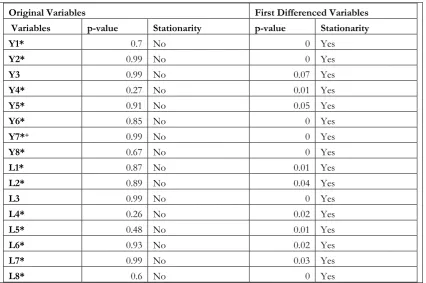
The original time series were found to be non-stationary. In fact, all the variables
were I(1). Thus, stationarity was induced by means of first differencing (Tables A5-A11).
Asymptotic Properties
For the purpose of estimation and inference in stationary models, Chudik and Pesaran
(2011a) showed that the relevant asymptotics are: → ∞[13]
where T denotes the time dimension and N is the number of endogenous variables in the
model. Our model clearly complies with thisasymptotic conditionT/N< ∞.
Cointegration
Also, we have to check for cointegration between the different variables that enter the
model. We employ the popular Johansen (1988) methodology that allows for more than
one cointegrating relationship, in contrast to other tests. The methodology is based on
the following equation: ∑ [14]
where: ∑ ∑ [15]
The existence of cointegration depends upon the rank of the coefficient matrix Π which
is tested through the likelihood ratio, namely the trace test described by the following
formulas: ∑ log 1 [16]
where: T is the sample size and is the largest canonical correlation.
The trace test tests the null hypothesis of r<n cointegrating vectors and the
The results of testing for cointegration, which are available upon request by the
authors, suggest that no cointegration is present in any of the US economic sectors
leading us to apply the GVAR methodology using a VARX model for each sector with
stationary variables, i.e. the first differences8 enter the VARX model of each sector.
4.2 Input Output Empirical Analysis
Testing for Dominant Sector(s)
Close to the spirit of Chudik and Smith (2013), we proceed by investigating the existence
of dominant sector(s) in the GVAR model. In this context, we divide each eigenvalue’s
modulus with the P-F eigenvalue’s modulus to get the normalized eigenvalue:
| | ⋅ | | , i=1,...,8. The normalized eigenvalues: ρ(i), i=2,...,8 are the so-called
non-dominant eigenvalues, since ρ(pf)=ρ(1)=1.
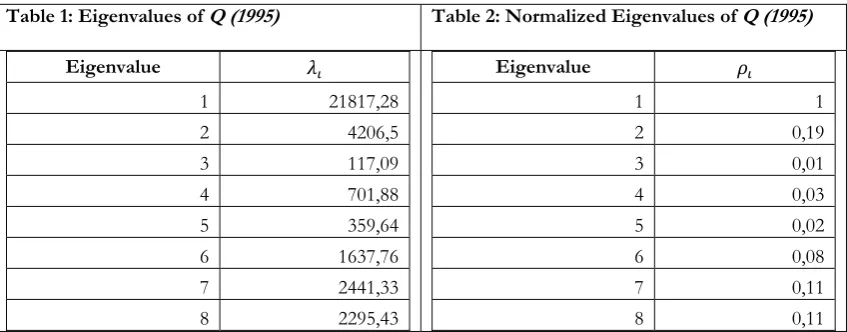
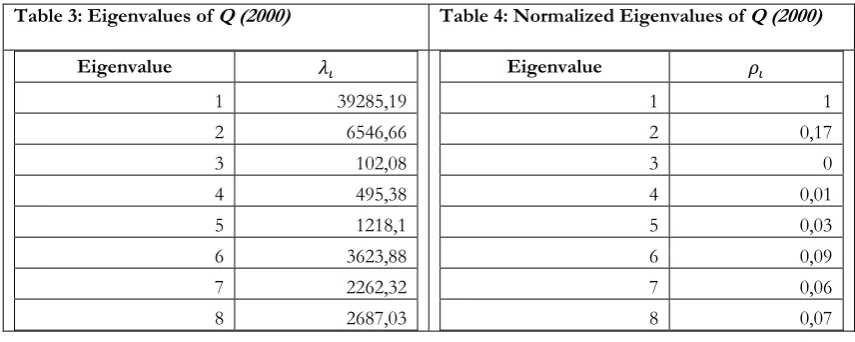
Tables 1,3 and 5 present the eigenvalues of the US matrix Q for the years
1995,2000 and 20059respectively, whereas Tables 2,4 and 6 presentthe normalized
[image:16.595.87.511.504.670.2]eigenvalues for the respective years.
Table 1: Eigenvalues of Q (1995) Table 2: Normalized Eigenvalues of Q (1995)
Eigenvalue
1 21817,28 2 4206,5
3 117,09 4 701,88 5 359,64 6 1637,76
7 2441,33 8 2295,43
Eigenvalue
1 1
2 0,19
3 0,01
4 0,03
5 0,02
6 0,08
7 0,11
8 0,11
8Of course, for the variables that were found to be I(2) we used second differences so as to ensure that all
the variables in the model are stationary.
9The same procedure was applied to the technical coefficients matrix A for years 1995, 2000 and 2005, and
Table 3: Eigenvalues of Q (2000) Table 4: Normalized Eigenvalues of Q (2000)
Eigenvalue
1 39285,19 2 6546,66
3 102,08 4 495,38 5 1218,1 6 3623,88
7 2262,32 8 2687,03
Eigenvalue
1 1
2 0,17
3 0
4 0,01
5 0,03
6 0,09
7 0,06
8 0,07
Table 5: Eigenvalues of Q (2005) Table 6: Normalized Eigenvalues of Q (2005)
Eigenvalue
1 7313.01 2 9930.26 3 9081.20 4 5932.55 5 184.24 6 3182.29 7 2102.92 8 741.30
Eigenvalue
1 1 2 0.14 3 0.13 4 0.08 5 0.02 6 0.04 7 0.03 8 0.01
Following common practice, the number of dominant sectors implied by the
economy’s structure is equal to i*, for which ρ(i*)>0.4-0.3 approximately, since values of
ρ(i*)less than 0.40–0.30 might be considered negligible from a practical point of view, as
we have seen earlier. Hence, the results of Tables 2,4 and 6 suggest the existence of
onedominant sector in the US economy, throughout the period of our investigation.
Constructing the sectoral weight matrix
Next, we proceed by constructing the weight matrix of our GVAR model using the
methodology described earlier. As we have seen, a net intra-sectoral flow weight matrix
W has the form:
0 …
⋮ ⋱ ⋮
[image:17.595.83.511.76.247.2]
since 0 as explained earlier and, in general, , ∀ . The typical element
is defined as the ratio of flows of goods and services between sector i and sector j,
over the total flows of goods and services realized by sector i: ∑
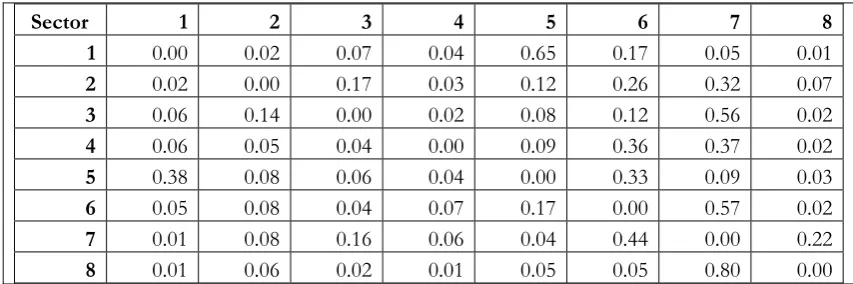
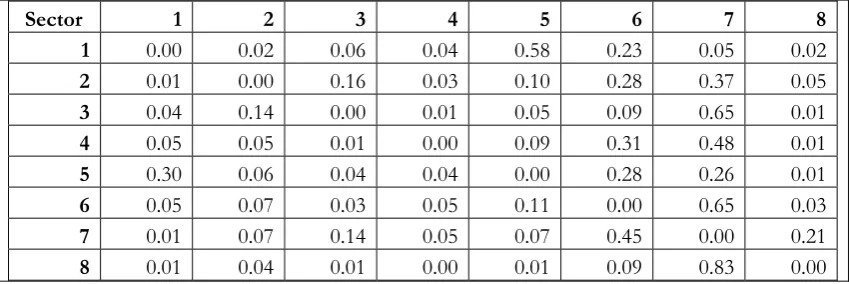
In our investigation, we construct three weight matrices for the years 1995, 2000
and 2005, respectively(see Tables 7-9), based on the IO inverse matrices for the US
economy (see Tables A2-A4, Appendix) and the respective flow matrices Q (see Tables
[image:18.595.84.512.336.488.2]A12-A14, Appendix)
Table 7: Weight Matrix (1995)
Sector 1 2 3 4 5 6 7 8
1 0.00 0.02 0.05 0.03 0.53 0.20 0.16 0.00
2 0.02 0.00 0.16 0.02 0.20 0.34 0.18 0.07
3 0.01 0.03 0.00 0.02 0.03 0.05 0.83 0.03
4 0.03 0.01 0.08 0.00 0.02 0.08 0.71 0.07
5 0.23 0.07 0.07 0.01 0.00 0.35 0.25 0.02
6 0.04 0.05 0.04 0.02 0.14 0.00 0.67 0.05
7 0.02 0.01 0.40 0.09 0.06 0.37 0.00 0.05
8 0.00 0.05 0.13 0.08 0.03 0.23 0.47 0.00
Table 8: Weight Matrix (2000)
Sector 1 2 3 4 5 6 7 8
1 0.00 0.02 0.07 0.04 0.65 0.17 0.05 0.01
2 0.02 0.00 0.17 0.03 0.12 0.26 0.32 0.07
3 0.06 0.14 0.00 0.02 0.08 0.12 0.56 0.02
4 0.06 0.05 0.04 0.00 0.09 0.36 0.37 0.02
5 0.38 0.08 0.06 0.04 0.00 0.33 0.09 0.03
6 0.05 0.08 0.04 0.07 0.17 0.00 0.57 0.02
7 0.01 0.08 0.16 0.06 0.04 0.44 0.00 0.22
[image:18.595.83.510.544.686.2]
Table 9: Weight Matrix (2005)
Sector 1 2 3 4 5 6 7 8
1 0.00 0.02 0.06 0.04 0.58 0.23 0.05 0.02
2 0.01 0.00 0.16 0.03 0.10 0.28 0.37 0.05
3 0.04 0.14 0.00 0.01 0.05 0.09 0.65 0.01
4 0.05 0.05 0.01 0.00 0.09 0.31 0.48 0.01
5 0.30 0.06 0.04 0.04 0.00 0.28 0.26 0.01
6 0.05 0.07 0.03 0.05 0.11 0.00 0.65 0.03
7 0.01 0.07 0.14 0.05 0.07 0.45 0.00 0.21
8 0.01 0.04 0.01 0.00 0.01 0.09 0.83 0.00
As we have seen, if the net intra-sectoral flow weights of a sector tend to remain
stable over time this would imply a situation of structural stability. On the other hand, if
the weights were found to be unstable over time, an instability situation might be
indicated. Based on the calculated weight matrices, we find evidence of increased
structural stability over time, with very few exceptions.
By means of the matrices W we proceed with estimating the GVAR model, using
sector 7 (information technology, finance and communications), as the dominant sector
in the US economybecause: (a) it is the largest sector in terms of output produced, as
well as the (b) the largest sector in terms of the output exchanged.
5. Estimation Results and Stability
Next, for the implementation of our model we have to determine the optimum lag length
for each sector’s variables.
Optimum Lag Length of the GVAR model
We make use of the so-called Schwartz-Bayes Information criterion (SBIC) introduced
by Schwartz (1978), where the optimum lag length is given by the objective function:
where LL(k) is the log-likelihood function of a VAR(k) model, n is the number of
observations and k is the number of lags and k is the optimum lag length selected. As the
works of Breiman and Freedman (1983) and Speed and Yu (1992) have shown, SBIC is
an optimal selection criterion when used in finite samples.
The optimum lag length for each sector was equal to two (2) quarters (Pesaran et
al. 2005). Therefore, the VARX model for each sector , 7is as follows:
. ,
, , . , ,
. , ,
,
, ∑ , ,
.∗ , ∗ ,
. ∗ , ∗
[18]
while, for the dominant sector, i=7, its VARX model is the following:
.
, , ,
.
, ,
,
. ∗ , ∗ ,
. ∗ ,∗
where Δis the first differencing operator, , , , is the 1x2 vector representing
output and labor, respectively, for all sectors 1, … ,8, p is the lag length that is p=2,
, are the exogenous variables of global Trade and global Credit
with the respective coefficients, , , , and , are the matrices of lagged polynomials,
, and , are the coefficient matrices of the dominant sector and the other sectors
respectively and , is the intercept, while is a vector of idiosyncratic, serially
uncorrelated sector-specific shocks with mean zero and the variance-covariance matrix
Σi, ~ . . 0, .
The effect of the foreign variables on their sector-specific counterpart is
presented in Table A16, Appendix. The results suggest that in all sectors labor seems to
the dominant sector 7, as expected, appears to have the most significant interconnections
with the rest of the sectors, a fact that seems to be consistent with our choice of the
dominant sector. Additionally, we witness relatively limited interconnectivity among the
various sectors mainly with respect to their output, a fact which is consistent with the
findings by other researches (e.g. Mariolis and Tsoulfidis, 2014).
GVAR Stability Conditions
Also, in order to determine whether the model is stable, we have to check the stability of
the sector-by-sector models, separately. However, following Pesaran et al. (2004) and
Mutl (2009) it is not sufficient to examine the sector-by-sector stability, ignoring the
endogeneity of the other variables ∗ , . Hence, it does not suffice to require that ρ( ) <
1 for stability, where ) is the spectral radius of the matrix , 1, … ,8. Instead,
Mutl (2009, p. 9) derived a sufficient condition for the model to be stable, namely that
the maximum absolute row sums of W are less or equal to , that is:
‖ ‖ [19]
where is the uniform bound of absolute row and column sums of the weight matrix
W: ∑ ∑ , ∞[20]
where does not depend on T or N and the choice of indexes i and q, but can
potentially depend on other parameters of the model; and , denotes the (q, m)-th
element of W .Finally, note that if r is the maximum number of eigenvalues of Φ, then
The results of our analysis are consistent with the stability of each sector’s VARX
model (see Figure 1), based on the eigenvalues lying on or inside the unit circle, and
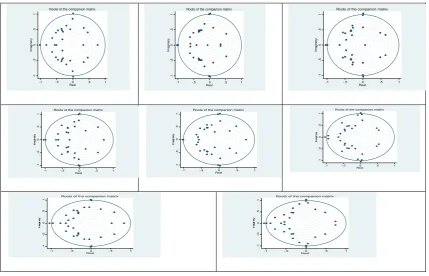
[image:22.595.84.514.183.459.2]imply stability of the estimated model and of the various sectors of the US economy.
Figure 1: Stability of the VARX models
6. Discussion
It should be noted that the aim of the empirical analysis is not to provide a deep and
sophisticated analysis of the US sectoral economy, but rather to provide an illustration of
the methodology proposed in this paper including a brief discussion of its main results.
In this framework, we base our detailed analysis on Generalized Impulse
Response Function (GIRFs) and, more precisely, on the robust Confidence Intervals
(C.I.) (bootstrapped, 10.000 iterations) rather than the point estimates in order to avoid
any possible structural instability. Each GIRF shows the dynamic response of the
variable of each sector to unit shocks to: (i) Output and (ii) Labor on each one of the rest
of the sectors, for up to 8 periods, i.e. 2 years.
-1 -.5 0 .5 1 Im a g in a ry
-1 -.5 0 .5 1 Real Roots of the companion matrix
-1 -.5 0 .5 1 Im a g in a ry
-1 -.5 0 .5 1 Real Roots of the companion matrix
-1 -. 5 0 .5 1 Im a g in a ry
-1 -.5 0 .5 1
Real Roots of the companion matrix
-1 -. 5 0 .5 1 Im agi nar y
-1 -.5 0 .5 1 Real
Roots of the companion matrix
-1 -. 5 0 .5 1 Im agi nar y
-1 -.5 0 .5 1 Real
Roots of the companion matrix
-1 -. 5 0 .5 1 Im agi nar y
-1 -.5 0 .5 1 Real Roots of the companion matrix
-1 -. 5 0 .5 1 Im agi n ar y
-1 -.5 0 .5 1 Real
Roots of the companion matrix
-1 -. 5 0 .5 1 Im agi n ar y
-1 -.5 0 .5 1 Real
In the exposition of the results, the reader can focus on the first two years
following the shock, which is a reasonable time horizon over which the model presents
credible results (Dees et al. 2007a). Figure A1 (Appendix) shows the estimates of the
GIRFs and their associated 90% C.I. For instance, a positive shock of one standard
deviation on the output of sector 2 (Y2*) affects positively the output of sector 1 (Y1), in
the short run i.e. 2-3 quarters. This effect, after approximately 4 quarters, becomes
negative and it dies out at the end of the period investigated, i.e. after eight quarters. The
effect is not persistent since the output of sector 1 (Y1) returns back to its initial
equilibrium position.
In general, the GIRFs suggest relativelylimited interconnectivity, in terms of both
sectoral output and labor, between the various sectors of the US economy, a finding
which is consistentwith previous finding based on the results of Table A.2. All the effects
seem to have a temporary character since they die out rather quickly, in less than eight (8)
quarters. It is worth noticing that we do not witness any persistent effect, since in all
cases all variables return back to their initial equilibrium position, implying relatively
increased stability of the US sectoral economy.
In detail, the GIRFs suggest that sectors 1,3,4,5 and 7 that account for the
primary production of goods (sector 1), primary production of energy (sector 3),
constructions (sector 4), final products (sector 5) and information technology, finance
and communications (sector 7),are the sectors with the highest connectivity, in terms of
output, with the rest of the sectors. This could be attributed to the nature of these
specific sectors since they act either as the main supplier for the production of other
goods e.g. sector 1 and 3, or as leading demand sectors for goods e.g. sectors 3, 5 and 7.
Either way, most of the above sectors exhibit relatively significant connectivity with at
findings of Jianxi (2013), regarding the influence of these sectors on the economy of the
US, as a whole.
Moreover, sectors 3, 5, 6 and 8 that account for the production of energy (sector
3), final products (sector 5), trade (sector 6) and education and health services (sector 8),
are the sectors with the highest connectivity, in terms of labor, with the rest of the
sectors in the economy. This, in turn, could be attributed to the fact that employees in
these sectors exhibit increased diversification in terms of skills and specialization, in the
sense that all other sectors could easily act as employee suppliers for these specific
sectors. It is worth noticing that each of the aforementioned sectors exhibits considerable
connectivity with over four sectors.
Of course, using one of the most important tools of IO analysis, i.e. the matrix of
technical coefficients A, we can easily observe that, in general, the leading sectors in
terms of connectivity are sectors 3, 6, and 7 that account for primary production of
energy (sector 3), trade (sector 6) and information technology, finance and
communications (sector 7). These sectors are consistent with the findings of our GVAR
model.
7. Conclusion
analysis of the US sectoral economy, but rather to provide an illustration of the
methodology proposed including a brief discussion of its main results.
In a novel approach, we used the GVAR methodology at the sectoral level and suggested using the IO matrices of the economy to serve as the means to construct the GVAR weight matrix. To this end, we proposed and derived a simple yet practical framework for constructing the weight matrix based on the technical coefficients matrix, for the years 1995, 2000 and 2005, respectively.
In addition, we used the IO matrices and offered a procedure to examine for the existence of dominant sector(s) in the US sectoral economy. The empirical analysis suggested the existence of one dominant sector in our dataset. Hence, we employed the model using a dominant sector and the results of our econometric investigation suggested that the US economy has relatively limited connectivity among its sectors, in terms of both sectoral output and labor. Additionally, it is worth noticing that we did not
witness any persistent effect since, in finite time, all the variables returned back to their
initial equilibrium positions. This finding could be viewed as an expression of the increased stability of the US economy.
Our combined GVAR-IO findings are, in general terms, consistent with the
connectivity links pictured through the IO technical coefficients matrix of the US
economy. In this context, our results clearly imply that a combination of IO and GVAR
is highly desirable because it is capable of providing very useful insights, since it is able of decomposing the connection between the various sectors in terms of all the variables
that enter the model. A good example for future research, besides widening the database
and accounting for additional variables, would be the construction of a GVAR model at
References
Acemoglu, D., V.M. Carvalho, A. Ozdaglar and A. Tahbaz-Salehi (2012), “The Network Origins of Aggregate Fluctuations”,Econometrica, 80, 1977–2016.
Bernanke, B., Boivin, J., and Eliasz, P. (2005),"Measuring the effects of monetary policy: a
factor-augmented vector autoregressive (FAVAR) approach", Quarterly Journal of Economics, 120(1):387
Breiman, L. A. and Freedman, D. F. (1983), "How many variables should be entered in a
regression equation?",Journal of American Statistics Association, 78: 131-136.
Bussière M. and A. Chudik and G. Sestieri(2012), "Modelling global trade flows: results from a
GVAR model," Globalization and Monetary Policy Institute Working Paper 119, Federal Reserve Bank of Dallas. Canning P. (2013), “Maximum Likelihood Estimates of a US Multiregional Household
Expenditure System”, Economic Systems Research, 25(2):245-264.
Chudik A. & Vanessa Smith, (2013)."The GVAR approach and the dominance of the U.S.
economy," Globalization and Monetary Policy Institute Working Paper 136, Federal Reserve Bank of Dallas. Chudik, A. and Fratzscher, M. (2011a), "Identifying the global transmission of the 2007-2009
financial crisis in a GVAR model",European Economic Review, 55:325-339.
Chudik, A. and M. H. Pesaran (2011b), "Infinite dimensional VARs and factor models, ",Journal of Econometrics”, 163: 4-22.
Dées, S. di Mauro, F., Pesaran, H. and Smith, V. (2005), Exploring the International Linkages of
the Euro Area: A Global VAR Analysis, Working Paper Series, No 56 European Central Bank December. Dées, S., F. di Mauro, M. H. Pesaran, and L. V. Smith (2007b)," Exploring the international
linkages of the euro area: a Global VAR analysis", Journal of Applied Econometrics 22: 1-38.
Dees, S., Pesaran, M., Smith, L., and Smith, R. (2010), "Supply, demand and monetary policy
shocks in a multi-country New Keynesian model", .European Central Bank Working Paper, 1239.
Dées, S., S. Holly, M. H. Pesaran, and L. V. Smith (2007a), "Long-run macroeconomic relations in
the global economy",Economics, the Open Access, Open Assessment E-Journal, Kiel Institute for the World Economy.
Dickey, D.A. and W.A. Fuller (1979), “Distribution of the estimators for autoregressive time
series with a unit root”,Journal of the American Statistical Association, 74: 427-431.
Dietzenbacher, E. (1992) The Measurement of Interindustry Linkages: Key Sectors in the
Netherlands, Economic Modeling, 9, 419–437.
Edwards, S. (1998), “Openness, productivity and growth: What do we really know?”, Economic
Journal, 108, 383-398.
Grossman, G. M. &Helpman, E., (1991),"Trade, knowledge spillovers, and growth," European
Economic Review, vol. 35(2-3), pages 517-526, April.
Jianxi L. (2013), “ Which industries to bail out first in economic recessions: Ranking US sectors
by the Power-of-Pull’’, Economic Systems Research, 25:2, 157-169.
Johansen, S. and Juselius, K. (1990), “Maximum Likelihood Estimation and Inference on
Cointegration with Applications to the Demand for Money,” Oxford Bulletin of Economics and Statistics, 52(2):169–210.
Kapetanios, G., Pesaran, M. Hashem and Yamagata, T. (2011), "Panels with non-stationary
multifactor error structures," Journal of Econometrics, 160(2): 326-348.
Kim K.Y. (2013), “Household Debt, Financialization, and Macroeconomic Performance in the
U.S., 1951-2009”, Journal of Post Keyenesian Economics, 35(4):675-694.
Konstantakis, K. and Michaelides, P. (2014), Tansmission of the Debt Crisis: Fro, US to Eu-15 or
vice versa?, A GVAR approach, Journal of Economics and Business (forthcoming) doi: http://dx.doi.org/10.1016/j.jeconbus.2014.04.001.
Koop, G. (2013), “Forecasting with Medium and Large Bayesian VARs”, Journal of Applied Econometrics, 28: 177–203.
Koop, G., M. H. Pesaran and S. M. Potter.(1996), "Impulse Response Analysis in Nonlinear
Multivariate Models," Journal of Econometrics, 74: 119–147.
Korobilis D. (2013), "Bayesian forecasting with highly correlated predictors," Economics Letters, 118(1):148-150.
Kose, M., C. Otrok, and C. Whiteman (2003), "International Business Cycles: World, Region, and
Country-Specific Factors", American Economic Review, 93(4): 1216-1239.
Los, B. (2004),“Identification of Strategic Industries: A Dynamic Perspective”,Papers in Regional Science, 83:669–698.
Mariolis T, and Tsoulfids L. (2014), “On Brody’s Conjecture: Theory, Facts and Figures about
instability of the US economy’’, Economic Systems Research, 26(2):209-223.
Mutl, J. (2009), "Consistent Estimation of Global VAR Models," Economics Series 234, Institute
for Advanced Studies.
Pesaran M.H. and R. Smith, (2006), "MacroeconometricModellingWith A Global
Perspective," Manchester School, University of Manchester, Vol. 74(s1):24-49.
Pesaran M.H and Y. Shin (1998), "Generalized impulse response analysis in linear multivariate
models", Economics Letters, 58:17.
Pesaran, M. H., L. V. Smith, and R. P. Smith (2007), "What if the UK or Sweden had joined the
Euro in 1999? an empirical evaluation using a Global VAR.", International Journal of Finance and Economics12:55-87.
Pesaran, M. H., Schuermann, T. & Weiner, S. M. (2004), "Modelling Regional Interdependencies
using a Global Error-Correcting macro-econometric model’, Journal of Business and Economic Statistics,
22(2):129–162.
Pesaran, M. H., T. Schuermann, B.J.Treutler, and S. M. Weiner (2006),"Macroeconomic dynamics
and credit risk: A global perspective",,Journal of Money Credit and Banking 38 (5): 211-262.
Pesaran, M.H., Shin, Y. and Smith, R. (2000), "Structural Analysis of Vector Error Correction
Models with Exogenous I(1) Variables", Journal of Econometrics, 97:293-343.
Romer P.M(1992), "Increasing Returns and New Developments in the Theory of Growth,"
Rueda-Cantuche J. and ten Raa T. (2013), “Testing Assumption made in the Construction of
Input Output Tables”, Economics Systems Research, 25(2):170-181.
Schwarz, G. E. (1978), "Estimating the dimension of a model”, Annals of Statistics,6 (2): 461-464. Speed T.P and Yu Bin (1992), "Model selection and Prediction: Normal Regression", Annals of the Institute of Statistical Mathematics, 45:35-54.
GIRF sector 1: Response of Y1
GIRF sector 1: Response of L1
-40 -20 0 20 40 -40 -20 0 20 40 -40 -20 0 20 40 -40 -20 0 20 40
0 2 4 6 8 0 2 4 6 8 0 2 4 6 8 0 2 4 6 8
sector1, Y7 sector1, L1 sector1, L2* sector1, L3*
sector1, L4* sector1, L5* sector1, L6* sector1, L7
sector1, L8* sector1, Y1 sector1, Y2* sector1, Y3*
sector1, Y4* sector1, Y5* sector1, Y6* sector1, Y8*
90% CI Generalized Impulse Response Function (GIRF)
step -200 -100 0 100 200 -200 -100 0 100 200 -200 -100 0 100 200 -200 -100 0 100 200
0 2 4 6 8 0 2 4 6 8 0 2 4 6 8 0 2 4 6 8
sector1, Y7 sector1, L1 sector1, L2* sector1, L3*
sector1, L4* sector1, L5* sector1, L6* sector1, L7
sector1, L8* sector1, Y1 sector1, Y2* sector1, Y3*
sector1,Y4* sector1, Y5* sector1, Y6* sector1, Y8*
90% CI Global Impulse Response Function (GIRF)
GIRF sector 2: Response of Y1
GIRF sector 2: Response of L2
-50 0 50 100
-50 0 50 100
-50 0 50 100
-50 0 50 100
0 2 4 6 8 0 2 4 6 8 0 2 4 6 8 0 2 4 6 8
sector2, Y7 sector2, L1* sector2, L2 sector2, L3*
sector2, L4* sector2, L5* sector2, L6* sector2, L7
sector2, L8* sector2, Y1* sector2, Y2 sector2, Y3*
sector2, Y4* sector2, Y5* sector2, Y6* sector2, Y8*
95% CI Generalized Impulse Response Function (GIRF)
step
-100 0 100
-100 0 100
-100 0 100
-100 0 100
0 2 4 6 8 0 2 4 6 8 0 2 4 6 8 0 2 4 6 8
sector2, Y7 sector2, L1* sector2, L2 sector2, L3*
sector2, L4* sector2, L5* sector2, L6* sector2, L7
sector2, L8* sector2, Y1* sector2, Y2 sector2, Y3*
sector2, Y4* sector2, Y5* sector2, Y6* sector2, Y8*
90% CI Generalized Impulse Response Function (GIRF)
GIRF sector 3: Response of Y3
GIRF sector 3: Response of L3
-20 0 20 40
-20 0 20 40
-20 0 20 40
-20 0 20 40
0 2 4 6 8 0 2 4 6 8 0 2 4 6 8 0 2 4 6 8
sec3, Y7 sec3, L1* sec3, L2* sec3, L3*
sec3, L4* sec3, L5* sec3, L6* sec3, L7
sec3, L8* sec3, Y1* sec3, Y2* sec3, Y3
sec3, Y4* sec3, Y5* sec3, Y6* sec3, Y8*
90% CI Generalized Impulse Response Function (GIRF)
step
-100 0 100 200
-100 0 100 200
-100 0 100 200
-100 0 100 200
0 2 4 6 8 0 2 4 6 8 0 2 4 6 8 0 2 4 6 8
sec3, Y7 sec3, L1* sec3, L2* sec3, L3
sec3, L4* sec3, L5* sec3, L6* sec3, L7
sec3, L8* sec3, Y1* sec3, Y2* sec3, Y3
sec3, Y4* sec3, Y5* sec3, Y6* sec3, Y8*
90% CI Generalized Impulse Response Function (GIRF)
GIRF sector 4: Response of Y4
GIRF sector 4: Response of L4
-200 -100 0 100 200 -200 -100 0 100 200 -200 -100 0 100 200 -200 -100 0 100 200
0 2 4 6 8 0 2 4 6 8 0 2 4 6 8 0 2 4 6 8
sec4, Y4 sec4, Y7 sec4, L1* sec4, L2*
sec4, L3* sec4, L4* sec4, L5* sec4, L6*
sec4, L7 sec4, L8* sec4, Y1* sec4, Y2*
sec4, Y3* sec4, Y5* sec4, Y6* sec4, Y8*
90% CI Generalized Impulse Response Function (GIRF)
step -2000 -1000 0 1000 2000 -2000 -1000 0 1000 2000 -2000 -1000 0 1000 2000 -2000 -1000 0 1000 2000
0 2 4 6 8 0 2 4 6 8 0 2 4 6 8 0 2 4 6 8
sec4, Y4 sec4, Y7 sec4, L1* sec4, L2*
sec4, L3* sec4, L4 sec4, L5* sec4, L6*
sec4, L7 sec4, L8* sec4, Y1* sec4, Y2*
sec4, Y3* sec4, Y5* sec4, Y6* sec4, Y8*
90% CI Generalized Impulse Response Function (GIRF)
GIRF sector 5: Response of Y5
GIRF sector 5: Response of L5
-100 -50 0 50 100 -100 -50 0 50 100 -100 -50 0 50 100 -100 -50 0 50 100
0 2 4 6 8 0 2 4 6 8 0 2 4 6 8 0 2 4 6 8
sec5, Y7 sec5, L1* sec5, L2* sec5, L3*
sec5, L4* sec5, L5 sec5, L6* sec5, L7
sec5, L8* sec5, Y1* sec5, Y2* sec5, Y3*
sec5, Y4* sec5, Y5 sec5, Y6* sec5, Y8*
90% CI Generalized Impulse Response Function (GIRF)
step -1000 -500 0 500 1000 -1000 -500 0 500 1000 -1000 -500 0 500 1000 -1000 -500 0 500 1000
0 2 4 6 8 0 2 4 6 8 0 2 4 6 8 0 2 4 6 8
sec5, Y7 sec5, L1* sec5, L2* sec5, L3*
sec5, L4* sec5, L5 sec5, L6* sec5, L7
sec5, L8* sec5, Y1* sec5, Y2* sec5, Y3*
sec5, Y4* sec5, Y5 sec5, Y6* sec5, Y8*
90% CI Generalized Impulse Response Function (GIRF)
GIRF sector 6: Response of Y6
GIRF sector 6: Response of L6
-50 0 50
-50 0 50
-50 0 50
-50 0 50
0 2 4 6 8 0 2 4 6 8 0 2 4 6 8 0 2 4 6 8
sec6, Y6 sec6, Y7 sec6, L1* sec6, L2*
sec6, L3* sec6, L4* sec6, L5* sec6, L6
sec6, L7 sec6, L8* sec6, Y1* sec6, Y2*
sec6, Y3* sec6, Y4* sec6, Y5* sec6, Y8*
90% CI Generalized Impulse Response Function (GIRF)
step
-2000 0 2000 4000
-2000 0 2000 4000
-2000 0 2000 4000
-2000 0 2000 4000
0 2 4 6 8 0 2 4 6 8 0 2 4 6 8 0 2 4 6 8
sec6, Y6 sec6, Y7 sec6, L1* sec6, L2*
sec6, L3* sec6, L4* sec6, L5* sec6, L6
sec6, L7 sec6, L8* sec6, Y1* sec6, Y2*
sec6, Y3* sec6, Y4* sec6, Y5* sec6, Y8*
90% CI Generalized Impulse Response Function (GIRF)
GIRF sector 7: Response of Y7
GIRF sector 7: Response of Y7
-100 -50 0 50 100 -100 -50 0 50 100 -100 -50 0 50 100 -100 -50 0 50 100
0 2 4 6 8 0 2 4 6 8 0 2 4 6 8 0 2 4 6 8
sec7, Y6* sec7, Y7 sec7, Y8* sec7, L1*
sec7, L2* sec7, L3* sec7, L4* sec7, L5*
sec7, L6* sec7, L7 sec7, L8* sec7, Y1*
sec7, Y2* sec7, Y3* sec7, Y4* sec7, Y5*
90% CI Generalized Impulse Response Function (GIRF)
step -400 -200 0 200 -400 -200 0 200 -400 -200 0 200 -400 -200 0 200
0 2 4 6 8 0 2 4 6 8 0 2 4 6 8 0 2 4 6 8
sec7, Y6* sec7, L7* sec7, Y8* sec7, L1*
sec7, L2* sec7, L3* sec7, L4* sec7, L5*
sec7, L6* sec7, L7 sec7, L8* sec7, Y1*
sec7, Y2* sec7, Y3* sec7, Y4* sec7, Y5*
90% CI Generalized Impulse Response Function (GIRF)
GIRF sector 8: Response of Y8
GIRF sector 8: Response of L8
-400 -200 0 200 400 -400 -200 0 200 400 -400 -200 0 200 400 -400 -200 0 200 400
0 2 4 6 8 0 2 4 6 8 0 2 4 6 8 0 2 4 6 8
sec8, L8 sec8, Y7 sec8, Y8 sec8, L1*
sec8, L2* sec8, L3* sec8, L4* sec8, L5*
sec8, L6* sec8, L7 sec8, Y1* sec8, Y2*
sec8, Y3* sec8, Y4* sec8, Y5* sec8, Y6*
90% CI Generalized Impulse Response Function (GIRF)
step -2000 -1000 0 1000 2000 -2000 -1000 0 1000 2000 -2000 -1000 0 1000 2000 -2000 -1000 0 1000 2000
0 2 4 6 8 0 2 4 6 8 0 2 4 6 8 0 2 4 6 8
sec8, L8 sec8, Y7 sec8, Y8 sec8, L1*
sec8, L2* sec8, L3* sec8, L4* sec8, L5*
sec8, L6* sec8, L7 sec8, Y1* sec8, Y2*
sec8, Y3* sec8, Y4* sec8, Y5* sec8, Y6*
90% CI Generalized Impulse Response Function (GIRF)
Table A1: Industry Classification
INDUSTRIAL SECTORS (U.S. ECONOMY)
SECTORS DESCRIPTION NACE CLASSIFICATION
1 AGRICULTURE, FORESTRY
AND FISHING A01,A02,A03
2 MINING, PETROLEUM AND COAL PRODUCTS
B, C10-C12, C13-C15, C16, C17, C18, C19, C20, C21,C22, C23, C24, C25, C26, C27, C28,
C29, C30, C31-C32, C33
3 ELECTRICITY, GAS, WATER,
TRANSPORT AND STORAGE D, E36, E37-E39, H49, H50, H51, H52, H53
4 CONSTRUCTION F
5
FOOD & BEVERAGES, WOOD PRODUCTS AND FURNITURE,
METAL PRODUCTS
I
6 WHOLESALE & RETAIL TRADE G45, G46, G47
7
INFORMATION, TECHNOLOGY REAL ESTATE,
FINANCE AND INSURANCE, COMMUNICATION AND
PERSONAL SERVICES
J58, J59-J60, J61, J62-J63, S95, K64, K65, K66, L, L68A, M71, M72, N77, M73, M74-M75, N79, N80-N82, O, Q87-Q88, R90-R92, R93,
S94, S96, T, U, M69-M70, N78
8
EDUCATIONAL ORGANIZATIONS & HEALTH
SERVICES
P, Q86
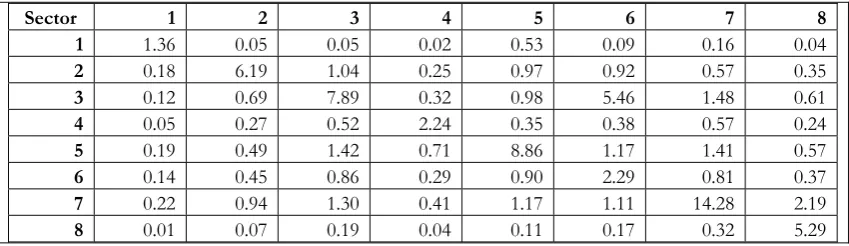
Table A2: Leontief Inverse matrix of the US economy for the year 1995
Sector 1 2 3 4 5 6 7 8
1 1.36 0.05 0.05 0.02 0.53 0.09 0.16 0.04
2 0.18 6.19 1.04 0.25 0.97 0.92 0.57 0.35
3 0.12 0.69 7.89 0.32 0.98 5.46 1.48 0.61
4 0.05 0.27 0.52 2.24 0.35 0.38 0.57 0.24
5 0.19 0.49 1.42 0.71 8.86 1.17 1.41 0.57
6 0.14 0.45 0.86 0.29 0.90 2.29 0.81 0.37
7 0.22 0.94 1.30 0.41 1.17 1.11 14.28 2.19
[image:37.595.86.511.597.720.2]
Table A3: Leontief Inverse matrix of the US economy for the year 2000
Sector 1 2 3 4 5 6 7 8
1 1.32 0.03 0.04 0.02 0.62 0.07 0.11 0.02
2 0.22 6.14 1.06 0.23 0.84 0.84 0.47 0.21
3 0.12 0.45 7.49 0.27 0.85 5.31 0.64 0.23
4 0.03 0.10 0.19 2.13 0.13 0.16 0.15 0.06
5 0.17 0.43 1.29 0.60 8.31 1.01 0.87 0.30
6 0.10 0.37 0.65 0.25 0.67 1.97 0.46 0.15
7 0.28 1.22 1.79 0.56 1.80 1.63 12.87 1.53
[image:38.595.87.513.275.398.2]8 0.05 0.31 0.44 0.17 0.45 0.40 0.82 4.36
Table A4: Leontief Inverse matrix of the US economy for the year 2005
Sector 1 2 3 4 5 6 7 8
1 1.32 0.03 0.04 0.02 0.62 0.08 0.11 0.03
2 0.23 6.37 1.30 0.27 0.95 1.04 0.69 0.33
3 0.10 0.39 7.34 0.25 0.86 5.21 0.72 0.30
4 0.03 0.09 0.20 2.13 0.12 0.17 0.19 0.08
5 0.15 0.37 1.26 0.58 8.07 1.01 1.01 0.43
6 0.08 0.36 0.66 0.26 0.68 1.89 0.59 0.27
7 0.26 1.13 1.61 0.53 1.68 1.46 14.55 2.07
8 0.05 0.34 0.55 0.19 0.50 0.51 1.11 5.58
Table A5: ADF test Sector 1 (Note: + denotes second difference)
Original Variables First Differenced Variables
Variables p-value Stationarity p-value Stationarity
Y1 0.78 No 0 Yes
Y2* 0.86 No 0 Yes
Y3* 0.8 No 0.01 Yes
Y4* 0.83 No 0.02 Yes
Y5* 0.92 No 0.02 Yes
Y6* 0.98 No 0.1 Yes
Y7*+ 0.86 No 0 Yes
Y8* 0.98 No 0.05 Yes
L1 0.91 No 0 Yes
L2* 0.43 No 0 Yes
L3* 0.84 No 0 Yes
L4* 0.83 No 0 Yes
L5* 0.92 No 0 Yes
L6* 0.96 No 0 Yes
L7* 0.99 No 0.03 Yes
L8* 0.67 No 0 Yes
Credit 0.1 Yes
Table A6: ADF test Sector 2 (Note: + denotes second difference)
Original Variables First Differenced Variables
Variables p-value Stationarity p-value Stationarity
Y1* 0.7 No 0 Yes
Y2 0.99 No 0.04 Yes
Y3* 0.63 No 0 Yes
Y4* 0.68 No 0 Yes
Y5* 0.99 No 0.02 Yes
Y6* 0.85 No 0 Yes
Y7*+ 0.99 No 0.02 Yes
Y8* 0.91 No 0 Yes
L1* 0.92 No 0 Yes
L2 0.78 No 0 Yes
L3* 0.74 No 0 Yes
L4* 0.67 No 0 Yes
L5* 0.89 No 0.02 Yes
L6* 0.97 No 0.04 Yes
L7* 0.99 No 0.03 Yes
L8* 0.7 No 0 Yes
Credit 0.1 Yes
Trade 0.89 No 0 Yes
Table A7: ADF test Sector 3 (Note: + denotes second difference)
Original Variables First Differenced Variables
Variables p-value Stationarity p-value Stationarity
Y1* 0.7 No 0 Yes
Y2* 0.99 No 0 Yes
Y3 0.99 No 0.07 Yes
Y4* 0.27 No 0.01 Yes
Y5* 0.91 No 0.05 Yes
Y6* 0.85 No 0 Yes
Y7*+ 0.99 No 0 Yes
Y8* 0.67 No 0 Yes
L1* 0.87 No 0.01 Yes
L2* 0.89 No 0.04 Yes
L3 0.99 No 0 Yes
L4* 0.26 No 0.02 Yes
L5* 0.48 No 0.01 Yes
L6* 0.93 No 0.02 Yes
L7* 0.99 No 0.03 Yes
[image:39.595.87.514.474.757.2]
Credit 0.1 Yes
[image:40.595.86.511.76.111.2]Trade 0.89 No 0 Yes
Table A8: ADF test Sector 4 (Note: + denotes second difference)
Original Variables First Differenced Variables
Variables p-value Stationarity p-value Stationarity
Y1* 0.57 No 0 Yes
Y2* 0.99 No 0 Yes
Y3* 0.6 No 0.01 Yes
Y4+ 0.99 No 0.01 Yes
Y5* 0.59 No 0.01 Yes
Y6* 0.81 No 0.01 Yes
Y7*+ 0.99 No 0 Yes
Y8* 0.52 No 0 Yes
L1* 0.88 No 0 Yes
L2* 0.93 No 0.01 Yes
L3* 0.58 No 0 Yes
L4 0.98 No 0.04 Yes
L5* 0.82 No 0 Yes
L6* 0.97 No 0.03 Yes
L7* 0.99 No 0.03 Yes
L8* 0.55 No 0 Yes
Credit 0.1 Yes
Trade 0.89 No 0 Yes
Table A9: ADF test Sector 5 (Note: + denotes second difference)
Original Variables First Differenced Variables
Variables p-value Stationarity p-value Stationarity
Y1* 0.64 No 0 Yes
Y2* 0.99 No 0 Yes
Y3* 0.84 No 0.01 Yes
Y4*+ 0.61 No 0.01 Yes
Y5* 0.99 No 0.02 Yes
Y6* 0.85 No 0.02 Yes
Y7*+ 0.99 No 0 Yes
Y8* 0.78 No 0 Yes
L1* 0.88 No 0 Yes
L2* 0.68 No 0.01 Yes
L3* 0.86 No 0 Yes
[image:40.595.87.513.164.483.2]
L5* 0.95 No 0.04 Yes
L6* 0.85 No 0 Yes
L7* 0.99 No 0.03 Yes
L8* 0.75 No 0 Yes
Credit 0.1 Yes
[image:41.595.83.515.77.172.2]Trade 0.89 No 0 Yes
Table A10: ADF test Sector 6 (Note: + denotes second difference)
Original Variables First Differenced Variables
Variables p-value Stationarity p-value Stationarity
Y1* 0.95 No 0 Yes
Y2* 0.99 No 0.02 Yes
Y3* 0.83 No 0.02 Yes
Y4* 0.74 No 0 Yes
Y5* 0.99 No 0.02 Yes
Y6+ 0.99 No 0.02 Yes
Y7*+ 0.99 No 0 Yes
Y8* 0.99 No 0.03 Yes
L1* 0.99 No 0.01 Yes
L2* 0.86 No 0 Yes
L3* 0.95 No 0.01 Yes
L4* 0.85 No 0 Yes
L5* 0.78 No 0 Yes
L6 0.74 No 0 Yes
L7* 0.99 No 0.03 Yes
L8* 0.86 No 0.01 Yes
Credit 0.1 Yes
[image:41.595.87.513.228.548.2]Trade 0.89 No 0 Yes
Table A11: ADF test Sector 7 (Note: + denotes second difference)
Original Variables First Differenced Variables
Variables p-value Stationarity p-value Stationarity
Y1* 0.82 No 0 Yes
Y2* 0.97 No 0 Yes
Y3* 0.99 No 0,09 Yes
Y4* 0.99 No 0,05 Yes
Y5* 0.97 No 0,02 Yes
Y6*+ 0.99 No 0 Yes
Y7+ 0.99 No 0 Yes
Y8*+ 0.99 No 0 Yes
L2* 0.67 No 0 Yes
L3* 0.94 No 0,01 Yes
L4* 0.92 No 0,01 Yes
L5* 0.82 No 0 Yes
L6* 0.99 No 0,01 Yes
L7 0.99 No 0,03 Yes
L8* 0.29 No 0,01 Yes
Credit 0.1 Yes
[image:42.595.87.514.275.602.2]Trade 0.89 No 0 Yes
Table A12: ADF test Sector 8 (Note: + denotes second difference)
Original Variables First Differenced Variables
Variables p-value Stationarity p-value Stationarity
Y1* 0.73 No 0 Yes
Y2* 0.99 No 0 Yes
Y3* 0.56 No 0.01 Yes
Y4* 0.26 No 0 Yes
Y5* 0.82 No 0.01 Yes
Y6* 0.98 No 0.03 Yes
Y7*+ 0.99 No 0 Yes
Y8*+ 0.99 No 0 Yes
L1* 0.54 No 0 Yes
L2* 0.23 No 0 Yes
L3* 0.31 No 0 Yes
L4* 0.3 No 0 Yes
L5* 0.84 No 0 Yes
L6* 0.56 No 0.04 Yes
L7* 0.99 No 0.03 Yes
L8*+ 0.99 No 0.01 Yes
Credit 0.1 Yes
Table A13: Matrix Q for US economy for the year 1995
Sector
s 1 2 3 4 5 6 7 8
1 119.14 0.57 -14.71 -8.81 208.63 107.03 71.75 1.89
2 8.10 361.77 61.34 12.97 65.26 125.08 70.09 23.10
3 5.57 11.94 2283.96 36.87 107.24 124.43 1660.22 76.99
4 4.02 5.64 78.71 710.01 50.34 63.89 391.24 36.29
5 5.38 1.96 49.69 42.92 4201.09 31.22 323.00 24.60
6 29.11 20.27 210.50 103.96 336.25 1694.70 1789.44 121.36
7 11.43 12.67 99.72 41.08 100.82 343.09 21769.84 429.05
[image:43.595.83.512.316.467.2]8 0.02 0.66 20.40 3.39 9.96 21.76 227.25 2436.41
Table A14: Matrix Q for US economy for the year 2000
Sector
s 1 2 3 4 5 6 7 8
1 141.85 0.04 -35.90 -22.26 426.81 137.01 47.84 -2.11
2 14.20 498.28 124.65 23.80 87.58 204.53 249.20 50.48
3 10.32 8.94 3601.53 61.45 158.50 179.77 758.83 64.46
4 4.92 3.36 45.71 1223.40 29.96 29.65 273.54 23.39
5 6.85 3.16 96.31 69.36 6539.99 56.71 458.88 35.48
6 28.68 25.63 273.95 182.63 427.18 2321.09 2035.91 125.59
7 17.14 28.98 308.70 115.12 353.68 806.56 39202.54 695.52
[image:43.595.88.510.556.706.2]8 2.43 5.55 46.91 32.42 69.69 163.60 1304.63 2691.96
Table A15: Matrix Q for US economy for the year 2005
Sector
s 1 2 3 4 5 6 7 8
1 187.10 0.51 -63.43 -39.46 674.51 296.24 -37.25 -25.71
2 18.76 748.28 251.14 46.89 146.51 442.32 580.00 83.78
3 10.29 11.42 5905.73 92.61 252.55 310.14 1393.11 131.49
4 5.41 4.01 80.68 2116.26 38.70 48.22 558.65 58.66
5 8.17 4.08 161.22 122.39 9904.94 78.39 966.18 90.77
6 29.24 36.79 467.39 328.61 691.09 3296.05 4550.47 450.53
7 20.77 34.37 265.89 128.83 385.76 990.89 72175.80 1248.84
Table A16: GVAR Estimation Effects of Foreign Variables on their sector-specific counterparts
Y1 L1 Y2 L2 Y3 L3 Y4 L4 Y5 L5 Y6 L6 Y7 L7 Y8 L8 Y1* -14.59 -68.02 -5.86 22.21 38.17 263.71 -1.34 10.49 -3.68 -453.7 23.8 -70.17 -50.77 -14.47 t-stat -0.57 -2.14* -1.03 0.7 3.64* 1.89* -0.75 0.55 -1.4 -3.57* 1.2 -0.62 -1.27 -0.17 L1* -3.4 -18.5 0.92 27.43 22.9 162.55 0.54 8 -1.77 -241.07 -11.59 25.57 -41.51 -115.45
t-stat -0.36 -1.58 0.23 1.78* 5.11* 2.72* 0.69 1.07 -1.74* -4.92* -2.59* 0.75 -1.51 -2.09* Y2* 7.84 83.5 3.01 6.32 21.48 112.63 9.86 -14.59 1.11 88.42 11.85 25.17 116.59 27.23 t-stat 0.7 1.71* 1.87* 0.71 2.28* 0.9 -1.45 -0.2 0.89 1.48 4.07* 1.34 9.45* 1.1 L2* 3.2 4.83 -1.9 20.72 21.63 117.7 -12.74 54.57 4.56 -560.17 20.03 -13.84 -126.65 -260.9
t-stat 0.4 0.14 -0.46 0.98 1.34 0.54 -1.09 0.44 2.34* -5.06* 3.71* -0.43 -2.99* -3.05* Y3* 4.12 -83.78 -2.95 8.93 65.14 1080.94 49.15 480.62 5.34 1933.26 -14.68 -20.03 386.1 404.18 t-stat 0.37 -2.13* -0.64 1.47 1.77* 2.33* 1.48 1.36 0.46 3.05* -4.46* -0.94 1.84* 1.24 L3* -0.42 6.84 0.71 -1.31 -4.67 -110.98 -14.67 -57.05 -2.68 -342.28 0.11 -3.14 -25.68 -75.82
t-stat -0.36 1.33 0.79 -1.41 -0.97 -1.73* -1.74* -0.57 -1.17 -3.09* 0.22 -0.97 -1.58 -2.32* Y4* -2.35 25.33 -6.04 -4.67 -5.17 109.75 21.17 222.44 -1.46 375.77 -2.75 7.35 48.64 287.05 t-stat -2.11* 5.24* -2.87* -1.78* -1.79* 6.8 1.33 6.16* -2.76* 14.78* -3.04* 1.25 2.44* 7.14* L4* 0.45 -4.33 -0.61 2.32 0.81 -8.32 2.69 -12.12 0.24 -33.5 1.61 -1.26 11.54 -7.02
t-stat 0.66 -1.44 -0.49 1.49 0.91 -1.68* 1.91* -0.81 1.38 -3.89* 5.58* -0.52 2.76* -1.09 Y5* -0.42 4.07 2.17 -2.73 -10.66 38.03 13.42 -13.09 -5.2 -262.43 3.38 23.95 -123.88 -131.49 t-stat -0.38 1.74* 0.6 -0.6 -1.47 1.09 1.91* -0.14 -4.05* -3.98* 1.17 1.28 -3.04* -1.6 L5* 0.03 -0.36 -0.39 -0.45 0.74 2.65 -1.22 23.77 0.5 9.97 -0.58 -1.62 7.77 6.92
t-stat 0.48 -1.22 -0.73 -0.9 1.29 0.82 -1.38 2.13* 3.69* 1.51 -2.11* -0.9 3.5* 1.51 Y6* 0.09 50.1 1.47 -9.85 3.3 -71.82 -8.09 -115.04 -7.18 -76.66 0.92 -1.27 -66.83 -57.98 t-stat 1.12 1.76* 0.29 -1.27 0.35 -1.73* -1.2 -1.14 -0.95 -0.95 2.17* -0.46 -3.82* -1.64* L6* 0.09 -0.77 -0.71 0.17 0.15 0.14 -0.79 0.53 0.11 0.91 0.17 0.27 3.02 -0.98
Y8* 26.4 -217.92 2.48 27.1 3.78 -27.71 -26.44 -255.7 -39.06 47.87 4.29 306.78 4.45 -8.84 t-stat 1.36 -2.59* 0.29 1.65* 0.45 -0.59 -3.13* -2.27* -1.83* 0.24 1.32 2.01* 2.17* -4.71* L8* -1.48 11.27 0.17 -0.6 -0.22 1.43 1.67 21.1 4.68 8.94 -0.42 -30.5 -0.92 -1.65 t-stat -1.22 2.13* 0.29 -0.66 -0.62 0.7 2.22* 2.09* 1.8* 0.31 -1.5 -2.22* -3.27* -0.91
Trade 0 -0.01 0.01 0.01 0 0 0 -0.01 0 0 -0.01 0.01 -0.01 0 -0.01 0 t-stat 0.48 -4.05* 1.55 2.35* 0.2 -1.12 -1.32 -1.67* 0.45 0.04 -2.77* 2.56* -5.01* -0.08 -3.36* 0.12 Credit 0 0 0 -0.01 0.01 0.01 0 0.01 0 0 0.01 -0.01 0.01 0 0.01 0 t-stat 0.1 0.42 0.36 -2.83* 2.16* 2.16* -0.28 3.22* 0.45 -0.32 4.28* -3.39* 4.22* 0.55 5.01* 0.41