ISSN Print: 2156-8553
A Brief Study on Using
pH
H O
2
to Predict pH
KCl
for Acid Soils
Anqi Wang
1,2, Decheng Li
1*, Biao Huang
3, Yin Lu
41State Key Laboratory of Soil and Sustainable Agriculture, Institute of Soil Science, Chinese Academy of Sciences, Nanjing, China 2University of the Chinese Academy of Sciences, Beijing, China
3Key Laboratory of Soil Environment and Pollution Remediation, Institute of Soil Science, Chinese Academy of Sciences, Nanjing,
China
4College of Natural Resources and Environment, South China Agricultural University, Guangzhou, China
Abstract
pHKCl and pHH O2 are two basic necessary indexes to reflect the acidity of
asoil. Predicting pHKCl directly from pHH O2 could save the cost of laboratory
work. In this study, the values of pHKCl and pHH O2 of 442 and 310 horizon
samples from 126 and 98 soil profiles (0 - 120 cm in depth) surveyed from 2014 to 2015 in Guangxi and Yunnan were used to establish the optimal cor-relation model between pHKCl and pHH O2 . The results showed that: 1) pHKCl
is lower than pHH O2 , pHKCl was 0.07 - 1.99 units with a mean of 0.99 units
lower than pHH O2 for Guangxi, while 0.03 - 1.90 units with a mean of 0.89
lower than pHH2O for Yunan. 2) There is significant positive correlation
be-tween pHKCl and pHH O2 , the optimal correlation models between pHKCl (y)
and pHH O2 (x) for Guangxi and Yunnan are y = 0.1963x
2 − 1.0512x + 4.338,
R2 = 0.836, p < 0.01 and y = 1.5882e0.1859x, R2 = 0.769, p < 0.01, respectively,
and the values of MAE and RSME of the models are 0.13 and 0.36 for Gua-ngxi, 0.08 and 0.28 for Yunnan, respectively. There are significant negative correlations between pHKCl with exchangeable H+ and Al3+ (R2 = 0.487, 0.716,
p < 0.01), and pHKCl is dominated by exchangeable Al3+, followed by
exchan-geable H+, and their contribution to pH
KCl were 71.1% and 28.7%, respectively.
Keywords
Predicting Model, pHKCl, pHH O2 , Correlation, Influential Factors, Acid Soil
1. Introduction
pH is a basic but important property of soil, it can influence soil other
physico-How to cite this paper: Wang, A.Q., Li, D.C., Huang, B. and Lu, Y. (2019) A Brief Study on Using pHH O2 to Predict pHKCl
for Acid Soils. Agricultural Sciences, 10, 142-149.
https://doi.org/10.4236/as.2019.102012
Received: December 5, 2018 Accepted: February 18, 2019 Published: February 21, 2019
Copyright © 2019 by author(s) and Scientific Research Publishing Inc. This work is licensed under the Creative Commons Attribution International License (CC BY 4.0).
http://creativecommons.org/licenses/by/4.0/
Open Access
the laboratory. However, it is still worthy predicating pHKCl directly from pHH O2
on the special conditions, for examples, when there is no information of pHKCl
for soils in the historical literatures, or to save time and cost for a massive mea-surement in the laboratory. Meanwhile, some studies showed that soil pH is dominated by exchangeable Al3+, followed by the exchangeable H+ for acid soils
in south China [4] [5], and exchangeable base, the contents of SOC and clays may also influence soil pH [6] [7] [8] [9], however, it is still unclear that the quantitative contribution of these influential factors to soil pH.
Thus, soil dada of Guangxi and Yunnan in South China obtained in 2014-2015 were used in this study in order to: 1) establish the optimal correla-tion model between pHKCl and pHH O2 , and 2) to quantitatively identity the
con-tribution of exchangeable H+, exchangeable Al3+, exchangeable base, SOC and
clay contents to soil pH.
2. Methods and Materials
2.1. Data of Soil Indexes
Soil Series Database of the National S & T Special Basic Project of Soil Series Survey and Compilation of Soil Series of China (Nos. 2008FY110600 & 2014FY110200) were used in this study. After the comparison of the data com-pleteness of pHKCl, pHH O2 , exchangeable H
+, exchangeable Al3+, exchangeable
base, SOC and clay contents, and the elimination of abnormal data according to method of μ ± 3σ, 442 and 310 horizon samples from 126 and 98 soil profiles (0 - 120 cm in depth) surveyed from 2014 to 2015 in Guangxi and Yunnan (see Fig-ure 1) were used to setup the optimal correlation model between pHKCl and
2
H O
pH , while 110 horizon samples from 30 soil profiles in Yunnan were adopted to quantitatively disclose the influence of exchangeable H+, exchangeable Al3+,
exchangeable base, SOC and clay contents on soil pH.
2.2. Methods to Determine Soil Indexes
For soil indexes adopted in this study, pHH O2 and pHKCl were determined by
potentiometer method after water extraction (soil: water is 1:2.5) and 1 mol∙L−1
KCl extraction, respectively. Exchangeable H+ and Al3+ by neutralization
titra-tion method after 1 mol∙L−1 KCl extraction, exchangeable base by drying
neutra-lization titration method after 1 mol∙L−1 NH
4OAc extraction, SOC by volume
method after K2CrO4 digestion, and clay content by pipet method [1].
Figure 1. Sites of soil profiles in Guangxi (left) and Yunnan (right) surveyed from 2014 to 2015.
2.3. Data Processing, Modeling and Mapping
Microsoft Excel 2016 and IBM Statistics SPSS 20.0 were used for data processing, modeling and mapping.
3. Results
3.1. Statistical Information of Soil Indexes
Table 1 showed that soil pHKCl ranged from 2.41 to 6.51 for Guangxi and from
3.21 to 5.91 for Yunnan, with a mean of 4.27 for Guangxi and 4.20 for Yunnan, respectively, which prove further that the soils in South China are generally acid
[10] [11].
It is well known that pHKCl is lower than pHH O2 because KCl could extract
more Al3+ from soil particles than water [1], however, Table 1 showed that the
lower extents are different in different regions, for examples, pHKCl was 0.07 -
1.99 units with a mean of 0.99 units lower than pHH O2 for Guangxi, while 0.03 -
1.90 units with a mean of 0.89 units lower than pHH O2 for Yunnan.
Table 1 also showed that only pHH O2 of Guangxi presented as normal
dis-tribution (±0.1 < skewness < ±0.1), while pHH O2 of Yunnan, pHKCl of Guangxi
and Yunnan as extremely-skewed normal distribution (skewness > ±0.3), The values of kurtoses of pHH O2 and pHKCl of both Guangxi and Yunnan ranged
from −0.44 to 0.42, indicating the probability density curves of pHH O2 and
pHKCl were very flat (kurtosis < 0.67) [12].
3.2. Optimal Correlation Model between pH
KCland
pH
H O2IBM Statistics SPSS 20.0 is used to find the optimal correlation between pHKCl
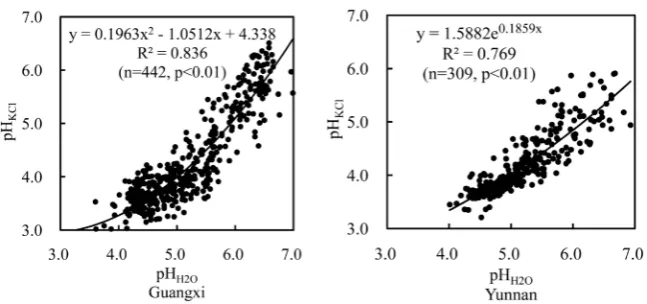
and pHH O2 . It can be seen from Figure 2 that: 1) The values of R2 showed again
that there was significant positive correlation between pHKCl and pHH O2 for
both Guangxi and Yunnan (p < 0.01). 2) The optimal correlation models were
Figure 2. Optimal correlation models between measured pHKCl and pHH O2 .
Table 1. Statistical information of measured soil pHKCl and pHH O2 .
Region Parameter Minimum Maximum Mean St. D Skewness Kurtosis
Guangxi pHH O2 2.77 6.99 5.16 0.82 0.01 −0.36
(n = 442) pHKCl 2.41 6.51 4.27 0.89 0.74 −0.44
Yunnan pHH O2 4.01 6.93 5.19 0.60 0.68 −0.21
(n = 310) pHKCl 3.21 5.91 4.20 0.56 1.05 0.42
different in Guangxi and Yunnan, quadratic model is found for Guangxi while exponential model for Yunnan, which may be attributed to the differences in climatic condition, soil types and land use types of the two regions. Values of MAE and RSME showed that the model accuracies were different in Guangxi and Yunnan, and the model accuracy is higher for Guangxi than Yunnan (Figure 3).
3.3.
pH
H O2Threshold for pH
KCl≤
4.0 or 4.5
It is our concern to know pHH O2 corresponding to pHKCl ≤ 4.0 or 4.5, which is
the threshold of Alice property or Alice evidence in soil taxonomy. It can be seen from Table 2 that the estimated pHKCl would be most likely lower than 4.0 or 4.5
when the measured pHH O2 ≤ 5.0 or 5.5 for a soil in south China judged from
the optimal correlation models in Figure 2.
Here, pHH O2 and pHKCl dada of 211horizons of 58 acid soil profiles surveyed
from 2009 to 2010 in Guangdong were used to validate the proposed pHH O2
threshold (≤5.0 or ≤5.5), the results showed that pHKCl was within 3.08 - 4.21
(n = 173, pHKCl of 98.6% soil samples lower than 4.0) and from 3.08 - 5.00 (n =
202, pHKCl of all soil samples lower than 4.5) with a mean of 3.67 or 3.74
respec-tively when pHH O2 ≤ 5.5 or 5.0, indicating the proposed pHH O2 thresholds are
reliable.
3.4. Contribution of Influential Factors to Soil pH
Table 3 showed the statistical information of values of pHKCl, clay, SOC, free
Fe2O3, exchangeable H+, Al3+ and base of 110 horizon samples of 30 soil profiles
Figure 3. Comparison between simulated and measured pHKCl. MAE is mean absolute
[image:5.595.208.539.289.358.2]error, while RMSE is root mean square error.
Table 2. pHH O2 thresholds for pHKCl ≤ 4.5 or 4.0.
pHKCl pHH O2
Guangxi Yunnan
≤4.5 5.51 5.60
≤4.0 5.02 4.97
Table 3. Statistics of basic properties of soil samples of Yunnan (n = 110).
Soil indexes pHKCl Clay g∙kg−1 g∙kgSOC −1 Free Fe2O3 g∙kg−1 H +
cmol (+) kg−1 Al 3+
cmol (+) kg−1 Exchangeable base cmol (+) kg−1
Mean 3.81 413 11.01 52.27 0.25 5.29 2.47
S.D. 0.22 102 8.85 29.50 0.41 2.93 2.14
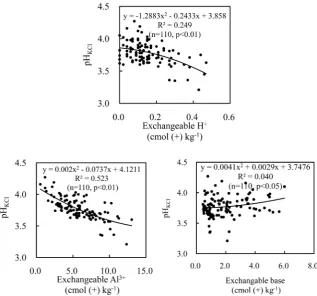
in Yunnan. Table 4 showed Pearson correlation coefficients between pHKCl with
other soil indexes. It can be seen that there were extremely significant correla-tions between pHKCl with exchangeable H+ and Al3+, while significant correlation
between pHKCl with exchangeable base, which indicate that exchangeable Al3+,
H+ and base are the influential factors of soil pH, and their optimal correlation
models with pHKCl were all in quadratic form (see Table 3 and Figure 4).
The linear regression model between pHKCl with exchangeable Al3+, H+ and
base was obtained by using IBM Statistics SPSS 20.0 as pHKCl = 4.087 − 0.448H+
− 0.042Al3+ − 0.001 Base (R = 0.764, R2 = 0.583, F = 49.41, p < 0.01), which could
be simplified as pHKCl = 4.087 − 0.448H+ − 0.042Al3+ since the exchangeable base
could be neglected.
The linear regression model between pHKCl with the normalized exchangeable
H+ and Al3+ was obtained as pH
KCl = 4.064 − 0.211H+ − 0.522 Al3+ (R = 0.763,
R2 = 0.581, F = 49.08, p < 0.01). The contribution of Al3+ and H+ to pH
KCl were
71.1% and 28.7% after normalizing the coefficients of Al3+ and H+, which
indi-cate further pHKCl is mainly dominated by exchangeable Al3+, followed by
ex-changeable H+[4]-[9].
[image:5.595.209.540.392.456.2]Figure 4. Optimal correlation models between pHKCl with exchangeable H+, Al3+ and
base.
Table 4. Pearson correlation coefficients between pHKCl and other indexes (n = 110).
Soil indexes Clay SOC H+ Al3+ BS Free Fe2O3
pHKCl 0.011 −0.048 −0.487** −0.716** 0.194* 0.117
**Significant at 0.01 level, *Significant at 0.05 level.
3.5. Discussion
Soil acidification is a natural process in tropical and subtropical regions due to higher rate of weathering and leaching under hot and humid climatic conditions
[13] [14] [15], it is accelerated greatly due to acidic deposition and excess appli-cation of acid fertilizer in agricultural system [16] [17] [18] [19]. Our data showed that soil pHKCl ranged from 2.41 to 6.51 for Guangxi and from 3.21 to
5.91 for Yunnan, which proves further that the soils in South China are generally acid [6] [10] [11].
Although it is well known that pHKCl certainly has inner relation with pHH O2 ,
so far there is no quantitative model between the two indexes. Our study not only proved further the quantitative relation between pHKCl and pHH O2 , but also
established the correlation models and further found that the correlation models are different in different regions, it is useful to predict soil pHKCl directly from
2
H O
pH when there is no available information of pHKCl or to save time and cost
for a massive measurement in the laboratory.
[image:6.595.206.541.430.469.2]Our study found the optimal correlation models between soil pH and ex-changeable Al3+ and H+ are in quadratic form, other studies showed the optimal
correlation models between soil pH and exchangeable acid are different, which include power [8] or quadratic forms [9]. Different optimal models may be at-tributed to the differences in climatic conditions, soil types and land use types for the different studied regions.
Studies already proved that the main form of exchangeable acidity is found in the form of exchangeable Al3+ in acid soils and disclosed the mechanism of soil
acidification [6] [19] [20] [21] [22]. Our study showed that the content of Al3+ of
soil samples in Yunnan were 5.29 ± 2.93 cmol (+) kg−1, higher than H+, which
was 0.25 ± 0.41 cmol (+) kg−1, meanwhile, exchangeable Al3+ has more
signifi-cant correlation (R2 = 0.716) with soil pH compared with exchangeable H+ (R2 =
0.487), Thus, it is normal that exchangeable Al3+contributes more (71.1%) to soil
pH compared to exchangeable H+ (28.7%).
4. Conclusion
By using the database of soil properties of Guangxi and Yunnan, this study dis-closes that pHKCl is meanly 1.0 unit lower than pHH O2 . There is significant
posi-tive correlation between pHKCl and pHH O2 , but the optimal correlation models
are in quadratic or exponential forms for different regions. There are significant negative correlations between pHKCl with exchangeable H+ and Al3+, and
ex-changeable Al3+ and H+ contribute 71.1% and 28.7% to soil pH, respectively.
Acknowledgements
This study was supported by projects of the National Natural Science Founda-tion of China (Grant No. 41877008) and the NaFounda-tional S & T Basic Special Foun-dation Project (No. 2014FY110200). We would like to express thanks to the con-tribution from all the participants in field soil survey and laboratory work.
Conflicts of Interest
The authors declare no conflicts of interest regarding the publication of this paper.
References
[1] Zhang, G.L. and Gong, Z.T., Eds. (2012) Soil Survey Laboratory Methods. Science Press, Beijing. (In Chinese)
[2] Soil Survey Staff (2010) Keys to Soil Taxonomy. 11th Edition, USDA, Washington DC.
[3] Cooperative Research Group on Chinese Soil Taxonomy (2001) Chinese Soil Tax-onomy. Science Press, Beijing & New York.
[4] Lin, Y.X. and Yu, T.R. (1958) Relationship between Acidity with Exchangeable H+
and Al3+. Acta Pedologica Sinica, 5, 234-246. (in Chinese)
[5] Kong, X. L. and Ji, G.L. (1992) Relationship between Acidity with Exchangeable H+
and Al3+ of Soils in South Chinese. Chinese Journal of Soil Science, 23, 203-204. (In
Chinese)
[9] Sun, H.D., Liu, B., Wu, B.S., et al. (2016) Characteristics and Causes of Soil Acidifi-cation in the Rubber Plantation. Journal of Northwest Forestry University, 31, 49-54. (In Chinese)
[10] Xiong, Y. and Li, Q.K. (1990) Soil of China. 2nd Edition, Science Press, Beijing. (In Chinese)
[11] Huang, C.Y. (2000) Soil Science. China Agriculture Press, Beijing. (In Chinese) [12] Yu, J.Y. and He, X.X. (2006) Data Statistical Analysis and SPSS Application. Posts &
Telecommunications Press, Beijing. (In Chinese)
[13] Krug, E.C. and Frink, C.R. (1983) Acid Rain on Acid Soil—A New Perspective.
Science, 221, 520-525. https://doi.org/10.1126/science.221.4610.520
[14] van Breemen, N., Driscoll, C.T. and Mulder, J. (1984) Acidic Deposition and Inter-nal Proton Sources in Acidification of Soils and Waters. Nature, 307, 599-604. [15] Ulrich, B. and Sumner, M. E. (1991) Soil Acidity. Springer-Verlag, Berlin.
https://doi.org/10.1007/978-3-642-74442-6
[16] Xu, R.K., Coventry, D.R., Farhoodi, A., et al. (2002) Soil Acidification as Influenced by Crop Rotations, Stubble Management, and Application of Nitrogenous Fertiliser, Tarlee, South Australia. Australian Journal of Soil Research, 40, 483-496.
https://doi.org/10.1071/SR00104
[17] Schroder, J.L., Zhang, H.L., Girma, K., et al. (2011) Soil Acidification from Long-Term Use of Nitrogen Fertilizers on Winter Wheat. Soil Science Society of America Journal, 75, 957-964. https://doi.org/10.2136/sssaj2010.0187
[18] Guo, J.H., Liu, X.J., Zhang, Y., et al. (2010) Significant Acidification in Major Chi-nese Croplands. Science, 327, 1008-1010. https://doi.org/10.1126/science.1182570 [19] Xu, R.K. (2015) Research Progresses in Soil Acidification and Its Control. Soils, 47,
238-244. (In Chinese)
[20] Reuss, J.O. and Johnson, D.W. (1986) Acid Deposition and the Acidification of Soils and Waters. Springer-Verlag, Berlin. https://doi.org/10.1007/978-1-4419-8536-1 [21] Huang, P.M. (1997) Mechanism of Soil Acidification. In: Dahama, A.K., Ed., Agro’s
Ann. Rev. of Crop Ecology, Agro Botanica, Bikaner, 79-100.
[22] Yu, T.R. (1997) Chemistry of Variable Charge Soils. Oxford University Press, New York.