A STUDY OF PERSONALITY OF CHILDREN WITH LEARNING DISABILITY
Research Scholar, Dept of Psychology
ARTICLE INFO ABSTRACT
Children are the most precious assets of any nations; every nation is investing heavily in the education of its system.
children have different personality character than normal children
fit together in a meaningful way. It is to be kept in mind that the nature of behaviors is dynamic and there may occur changes in the or
this sense that
person of the psychophysical systems that determine the unique ad
Here study of personality character of children with learning disability. Used test for measureme personality
Cattell, and IPAT Staff (1972).the main finding are objective, cool
mental ability, unable to handle abstract problem.
Copyright©2017, Rajiv Ranjan. This is an open access article distributed under the Creative Commons Att distribution, and reproduction in any medium, provided the original work is properly cited.
INTRODUCTION
The definition of Learning Disability as per the Diagnostic and Statistical Manual—V (American Psychiatric Association, 2013): A neurodevelopment disorder of
manifested in learning difficulty and problems in acquiring academic skills markedly below age level and manifested in the early school years, lasting for at least 6
attributed to intellectual disabilities, developmental disorder, or neurological or motor disorders. Many brain problems result in learning inefficiencies. a collection of symptoms that often occur together form a syndrome. Syndromes are gi
and are studied by scientists and educators.
everyone in every field of study agrees on the same definitions, terms, and group of symptoms that are used to describe a syndrome. In fact, the terms, definitions, causes, symptoms, and treatments frequently differ among fields of study or thought: education, law, and science. Even within a field, definitions and terms differ (ex. neurology, neuropsychology, psychology, educational psychology, etc.) Learning disabled children have following characteristic -:Difficulty producing speech sounds (articulation disorder) Difficulty putting ideas into spoken form (expressive disorder Difficulty perceiving or understanding what other people say (receptive disorder). difficulty in phonetic mapping, where sufferers have difficulty with matching various orthographic representations to specific sounds.
*Corresponding author: Rajiv Ranjan
Research Scholar, Dept of Psychology, MU
Bodh-ISSN: 0975-833X
Article History:
Received 28th June, 2017
Received in revised form 29th July, 2017
Accepted 18th August, 2017 Published online 29th September, 2017
Citation: Rajiv Ranjan.2017. “A study of personality
Available online at http://www.journal
Key words:
Learning disability, Intelligence level, Mental ability, Personality character, Children with learning disability, Non learning disabled children.
RESEARCH ARTICLE
A STUDY OF PERSONALITY OF CHILDREN WITH LEARNING DISABILITY
*
Rajiv Ranjan
Research Scholar, Dept of Psychology, MU Bodh-Gaya
ABSTRACT
Children are the most precious assets of any nations; every nation is investing heavily in the education of its system. The children’s educational need full fill from special education.
children have different personality character than normal children
fit together in a meaningful way. It is to be kept in mind that the nature of behaviors is dynamic and there may occur changes in the organization and structure of behaviors over a period of
this sense that Allport (1937, 1961), defined personality as the dynamic organization within the person of the psychophysical systems that determine the unique ad
Here study of personality character of children with learning disability. Used test for measureme personality Children personality questionnaire (CPQ) by Rutherford B. Porter, and Raymond B. Cattell, and IPAT Staff (1972).the main finding are Learning disabled children are rigi
objective, cool, and critical. The children with learning disability have low intelligence level, low mental ability, unable to handle abstract problem.
access article distributed under the Creative Commons Attribution License, which distribution, and reproduction in any medium, provided the original work is properly cited.
The definition of Learning Disability as per the Diagnostic and (American Psychiatric Association, A neurodevelopment disorder of biological origin manifested in learning difficulty and problems in acquiring academic skills markedly below age level and manifested in the early school years, lasting for at least 6 months; not attributed to intellectual disabilities, developmental disorder, or Many brain problems result in a collection of symptoms that often Syndromes are given terms and are studied by scientists and educators. Usually, not everyone in every field of study agrees on the same definitions, terms, and group of symptoms that are used to describe a syndrome. In fact, the terms, definitions, causes, symptoms, frequently differ among fields of study or education, law, and science. Even within a field, definitions and terms differ (ex. neurology, neuropsychology, earning disabled Difficulty producing Difficulty putting ideas into spoken form (expressive disorder Difficulty perceiving or understanding what other people say (receptive disorder). g, where sufferers have difficulty with matching various orthographic representations to specific
-Gaya
Some claim that dyslexia involves a difficulty with sequential ordering such that a person can see a combination of letters but not perceive them in the correct order. Difficulty in physical writing, usually linked to problems with visual motor integration or fine motor skills.
achieve in mathematics commensurate with chronological age, normal intelligence, and adequate instruction. It is marked by difficulties with visualization; visual
processing and discrimination; recognition; sequential memory;
numbers; retrieval of learned facts and procedures; confusion; quantitative processing speed; sequences; and perception of time
Review of literature: Clark (1970) in his study of nineteen
children of normal intelligence who were severely backward in reading found out that twelve showed poor auditory discrimination and ten had associated speech difficulties. Slad and Russell (1971) in their stu
more difficult operation than addition or subtraction. In their cases, the relative deficiency in multiplication has stemmed from a faulty grasp of multiplication tables
conducted a study to find out how far in
Piagetian tasks are effective as diagnostic instruments to asses kindergarten and primary school arithmetic disabled children McGee et al. (1988) in the study on reading disabled groups of boys and girls found that during the early sch
was a significant relationship between behavior problems and reading disability in both sexes.
International Journal of Current Research Vol. 9, Issue, 09, pp.57274-57278, September, 2017
A study of personality of children with learning disability”, International Journal of Current Research
Available online at http://www.journalcra.com
z
A STUDY OF PERSONALITY OF CHILDREN WITH LEARNING DISABILITY
Children are the most precious assets of any nations; every nation is investing heavily in the education The children’s educational need full fill from special education. Learning disabled children have different personality character than normal children behaviors of an individual seem to fit together in a meaningful way. It is to be kept in mind that the nature of behaviors is dynamic and ganization and structure of behaviors over a period of time. It is in Allport (1937, 1961), defined personality as the dynamic organization within the person of the psychophysical systems that determine the unique adjustments to one’s environment. Here study of personality character of children with learning disability. Used test for measurement of
Rutherford B. Porter, and Raymond B. Learning disabled children are rigid, distrustful, , and critical. The children with learning disability have low intelligence level, low
ribution License, which permits unrestricted use,
Some claim that dyslexia involves a difficulty with sequential ordering such that a person can see a combination of letters but not perceive them in the correct order. Difficulty in physical writing, usually linked to problems with visual motor n or fine motor skills. In dyscalculia a failure to achieve in mathematics commensurate with chronological age, normal intelligence, and adequate instruction. It is marked by difficulties with visualization; visual-spatial perception, scrimination; counting; pattern sequential memory; working-memory for retrieval of learned facts and procedures; directional confusion; quantitative processing speed; kinesthetic
and perception of time
Clark (1970) in his study of nineteen children of normal intelligence who were severely backward in reading found out that twelve showed poor auditory discrimination and ten had associated speech difficulties. Slad and Russell (1971) in their study find multiplication to be a more difficult operation than addition or subtraction. In their cases, the relative deficiency in multiplication has stemmed from a faulty grasp of multiplication tables. Kingma (1984) conducted a study to find out how far intelligence tests and Piagetian tasks are effective as diagnostic instruments to asses kindergarten and primary school arithmetic disabled children McGee et al. (1988) in the study on reading disabled groups of boys and girls found that during the early school years, there was a significant relationship between behavior problems and reading disability in both sexes.
INTERNATIONAL JOURNAL OF CURRENT RESEARCH
MATERIALS AND METHODS
[image:2.595.107.219.250.361.2]The sample for the study was collected on the basis of interview sampling in the first stage rural and urban Govt. elementary school in and around the Gaya district, Bihar were enlisted from 50 school were drawn randomly in second stage a group of 100 boys and 100 girls twenty boys and 20 girls each classes were selected randomly from the attendance register of 1 to V th class of each school was selected. Thus general sample of the study comparison of 2000 pupils (1000 boys and 1000 girls). In the last stage entire sample was subjected to psychological testing in order to identify the children with learning disability. Results indicate that out of 2000 pupils 200 pupils were with learning disability.
Table 1. Sample of Learning disable children and non learning disable children on basis of gender
Class Gender LD NLD
I Girls 20 20
I Boys 20 20
II Girls 20 20
II Boys 20 20
III Girls 20 20
III Boys 20 20
IV Girls 20 20
IV Boys 20 20
V Girls 20 20
[image:2.595.100.226.396.505.2]V Boys 20 20
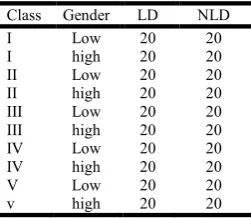
Table 2. Sample of Learning disable children and non learning disable children on basis of socio-economic status
Class Gender LD NLD
I Low 20 20
I high 20 20
II Low 20 20
II high 20 20
III Low 20 20
III high 20 20
IV Low 20 20
IV high 20 20
V Low 20 20
v high 20 20
Tools 1: Verbal learning disability checklist develop by Dr
Vishal Sood for person who is diagnosed with learning disability.
Children personality Questionnaire (CPQ)-This questionnaire developed by Rutherford B. Porter, and Raymond B. Cattell, and IPAT Staff (1972).That the CPQ measures a set of fourteen factorials independent dimensions of personality has already been stated. What is now necessary is that the psychologist gets a thorough grasp of their nature, and appreciates more precisely the research foundations on which they stand.
DATA ANALYSIS AND RESULTS DISCUSSSION
Factor – A
Table 3. Presentation of factor-A in children with LD and NLD on Basis of SES and Gender
LD NLD
Gender SES N M SD M SD t-ratio Significance
Boys Low 50 4.5 1.2 2.5 1.02 2.8 P>.01
High 50 4.8 2.1 3.6 1.4 3.4 p> .01
Girls Low 50 4.3 2.5 3.2 2.1 2.4 P< .01
High 50 4.2 2.1 3.2 2.5 5.7 P>.01
Children learning disable shows low stern score in CPQ characteristic factor A . Here children with learning disability show the major behavior critical, stands by its own idea, and cool. In non learning disable children shows high stern score they shows the behavior good natured easy going. Ready to cooperate, likes to participate some character varies from gender and socio-economic status. Here I observed and test finds results. In low socio-economic children with learning disability show low stern score in high socioeconomic status children with learning disability show average stern scores. They show the behavior that is common easy to going ready to co-operate.in gender issue boy have better stern score than girls. statical it represents significance difference as in low SES of boys LD and NLD t-ratio is 2.8. It find on df 98. It find on high SES t-ratio 3.4 .similarly in low SES girls on df 98 t-ratio is 2.4.In higher SES girls find t-ratio 5.7 on df 98.
[image:2.595.308.557.601.656.2]Factor-B
Table 4. Presentation of factor-B in children with LD and NLD on basis of SES and Gender
LD NLD
Gender SES N M SD M SD t-ratio Significance
Boys Low 50 4.9 2.1 3.2 2.2 4.3 P>.01
High 50 2.1 1.7 3.1 1.9 2.7 P<.01
Girls Low 50 4.3 2.5 3.0 2.1 2.8 p<.01
High 50 3.5 2.1 2.6 2.4 2.9 p<.01
In children with learning disability in low SES boys shows low stern score and represent main personality character as get emotional when frustrated. Warring in higher SES boys shows low stern score but dominant behavior shows evasive of responsibility and not adjusts to fact.In low SES girls shows also low stern score and shows most dominant personality character it easily perturbed changeable in attitude and interests. In children with non learning disability show high stern score they show emotionally mature, stable, and constant in interest shows restraint in avoiding difficulties. Statically data represent difference in LD and NLD in low SES boy on df 98 find t-ratio is 4.3. In high SES boys shows on df 98 t-ratio is 2.7.similarly in low SES girls find t-ratio is 2.8 and in high SES girls find t-ratio 2.9.
Factor-C
Table 5. Presentation of factor-C in children with LD and NLD on basis of SES and Gender
LD NLD
Gender SES N M SD M SD t-ratio Significance
Boys Low 50 4.8 3.1 4.1 2.1 3.21 p> .01
High 50 3.1 2.1 3.41 3.4 1.14 P<.05
Girls Low 50 4.4 2.5 3.9 2.4 .50 p <.05
High 50 4.2 2.1 2.8 2.2 3.3 p>.01
[image:2.595.31.289.730.788.2]high SES boys on df 98 find t-ratio 1.41.in low SES girls df 98 find t-ratio 0.05 and In high SES girls on df 98 find t-ratio 3.3
[image:3.595.35.289.150.210.2]Factor - D
Table 6. Presentation of factor-D in children with LD and NLD on basis of SES and Gender
LD NLD
Gender SES N M SD M SD t-ratio Significance
Boys Low 50 3.9 1.7 3.0 2.4 2.2 P<.01
High 50 4.9 3.1 3.1 2.2 3.5 p>.01
Girls Low 50 3.2 2.2 2.4 1.7 0.8 P<..05
High 50 2.4 1.2 3.2 2.0 4.4 p>.01
Here stern score of learning disabled and non learning disabled children find behavior as In low SES boys & girls high stern score. They shows behaviors and personality character demanding impatient, attention , getting , showing off etc. but in non learning disabled children both higher and lower SES personality character, statically complecement , deliberate not easily jealous .In girls of both lower and higher SES shows most prominent personality behaviors is constant not restless. The statically data represent significance different between learning disabled and non learning disabled is on df 98 t-ratio is respectively following 2.25 , 3.5 , 0.8 ,and 4.4.
[image:3.595.307.559.191.249.2]Factor - E
Table 7. Presentation of factor-E in children with LD and NLD on basis of SES and Gender
LD NLD
Gender SES N M SD M SD t-ratio Significance
Boys Low 50 4.3 2.1 3.1 2.0 2.9 P >.01
High 50 2.7 1.2 2.1 1.44 2.4 P <.01
Girls Low 50 4.1 2.1 3.2 1.07 2.9 P >.01
High 50 2.9 2.3 2.4 1.02 1.6 P <.05
Here boys and girls of low and high SES children with learning disability show low stern score . They show behavior submissive, dependent, considerate, and expressive easily upset. In non learning disabled children show average stern score. Show the personality character assertive, self assured, independent minded stern, hostel. Statically representation on significance different between learning disable and non learning disabled it find on df 98 t-ratio is 2.9 in low SES boy. in high SES boys t-ratio is 2.4 in low SES girls t-ratio is 2.9 and high SES girls t-ratio is 1.6.
Factor – F
Table 7. Presentation of factor-F in children with LD and NLD on Basis of SES and Gender
LD NLD
Gender SES N M SD M SD t-ratio Significance
Boys Low 50 3.2 1.9 2.98 1.4 1.21 P<.05
High 50 4.2 2.1 3.1 2.44 2.5 p<.01
Girls Low 50 3.4 2.4 3.00 1.7 3.4 P>.05
High 50 2.9 1.97 2.4 2.01 1.81 P<.05
Here in low SES boys & girls with learning disabled show low stern score show the behavior submissiveness, dependent but in high SES show average stern score show behaviors pressive, independent minded admiration demanding. In non learning disabled children show average stern score all case high and low SES and gender. They show prominent behavior
independent minded unconventional, and rebellious. Statical representation shown significance difference between learning disabled and non learning disabled boys & girls on base of SES and gender. In low SES boys shows on df 98 t-ratio is 1.21,In high SES boys shows on df 98 ratio is 2.5,In low SES girls shows on df 98 ratio is 3.4 and in high SES girls shows on df 98 on t-ratio is 1.81.
Factor - G
Table 8. Presentation of factor-G in children with LD and NLD on basis of SES and Gender
LD NLD
Gender SES N M S M S t-ratio Significance
Boys Low 50 4.8 2.5 3.9 1.4 2.2 P<.01
High 50 2.7 1.5 3.4 2.1 1.9 P<.05
Girls Low 50 2.9 1.2 3.1 1.2 2.8 p>.01
High 50 3.2 2.1 4.6 1.0 1.4 P<.05
Here show stern score of learning disabled is low of both SES and gender due to low stern score. They shows personality behaviors quitting, fickle, frivolous, self indulgent, undependent, but in case of non learning disability if show behavior, persevering, determined , responsible, emotionally, disciplined, consistent ordered and determined by sense of duty. Statical representation show significant between learning disabled and non learning disabled children as following In low SES boys shows on df 98 on t- ratio is 2.25, In high SES boys shows on df 98 t-ratio is 1.9.In low SES girls shows on df 98 t-ratio is 2.8 ,In high SES girls shows on df 98 t-ratio is 1.4.
[image:3.595.305.562.453.516.2]Factor - H
Table 9. Presentation of factor-H in children with LD and NLD on basis of SES and Gender
LD NLD
Gender SES N M SD M SD t-ratio Significance
Boys Low 50 3.2 2.7 2.6 1.2 1.7 P<.05
High 50 4.0 2.1 3.0 1.6 4.0 p>.01
Girls Low 50 4.3 2.1 3.2 1.4 3.1 p>.01
High 50 2.7 1.1 3.0 2.5 2.1 p<.01
Here is children with learning disability show low stern score in all aspect SES and gender only slightly varies stern score . Here prominent, personality , character and behavior show as shy, withdrawn , retiring in face of opposite sex emotionally, restricted interest. In non learning disabled children show average stern in all aspect SES and gender, they show the behavior adventurous, like meeting people, active, overt, interest in opposite sex responsive, friendly. Statical representation shows the different between learning disability and non learning disability show as respectively. In low SES boys find t-ratio on df 98 on 1.7.in high SES boys find t-ratio on df 98 on 4.0 In low SES girls find t-ratio on df 98 ,3.1 and in high SES girls find t-ratio on df 98 2.1,So all the difference is significance level.
Factor – I
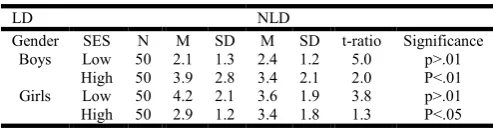
Table 10. Presentation of factor-I in children with LD and NLD on basis of SES and Gender
LD NLD
Gender SES N M SD M SD t-ratio Significance
Boys Low 50 2.1 1.3 2.4 1.2 5.0 p>.01
High 50 3.9 2.8 3.4 2.1 2.0 P<.01
Girls Low 50 4.2 2.1 3.6 1.9 3.8 p>.01
High 50 2.9 1.2 3.4 1.8 1.3 P<.05
[image:3.595.309.556.738.802.2]Here in learning disabled children stern score is average in aspect SES and gender. They shown behaviors and personality character kindly, general, attention seeking help and sympathy is prominently. In case of non learning disable show low stern score. The show prominent behaviors self reliant, taking responsibility and action practical. The Significant difference between learning disabled children and non learning disabled as In low SES boy, high SES boy , Low SES girls and high SES girls find t-ratio on df 98 is respectively5.0,2.0,3.8 and 1.3.
Factor – J
Table 11. Presentation of factor-J in children with LD and NLD on basis of SES and Gender
LD NLD
Gender SES N M SD M SD t-ratio Significance
Boys Low 50 4.2 2.5 3.5 2.1 1.55 P<.05
High 50 3.8 1.3 3.2 1.4 2.30 p<.01
Girls Low 50 2.7 1.0 3.2 1.4 2.08 P<.01
High 50 4.2 2.8 3.4 1.7 1.77 P<.05
Here in children with learning disability of low -high and boys -girls all show high stern score due to high stern score represent most prominent behaviors is act individual static guarded , wrapped , up in self fastidiously obstructive and neurasthenic ally fatigues. In non learning disabled children shown low stern score show personality behavior like attention, accept common standards. Here difference between learning disabled and non disabled in significant. Statically data represent t-ratio for measurement of significance level of difference as shown below in low SES of boy, girls, high SES
boys and girls respectively on df 98, 1.55, 2.30, 2.08 and 1.77.
[image:4.595.307.560.235.293.2] [image:4.595.32.290.235.292.2]Factor - N
Table 12. Presentation of factor-N in children with LD and NLD on basis of SES and Gender
LD NLD
Gender SES N M SD M SD t-ratio Significance
Boys Low 50 4.2 2.3 3.4 1.7 2.0 P<.01
High 50 3.5 1.3 2.5 2.6 2.5 p<.01
Girls Low 50 4.3 2.1 3.4 1.8 2.3 p<.01
High 50 3.1 1.7 2.5 1.6 1.87 P<.05
Here in learning disability stern score is low in aspect of SES and gender due to stern score show behavior socially glumly, injudicious mind, spontaneous, lack self insight has blind trust human nature. In case of non learning disability show high stern score due to high stern score shown behaviors polished, socially aware, has exact, calculating mind, emotionally defaced and disciplined. Statically Data show significant different between learning disabled and Non learning disabled children on SES and gender is respectively here find t-ratio on df 98 is 2.0, 2.5, 2.3 and 1.87
Factor – O
Table 12. Presentation of factor-O in children with LD and NLD on basis of SES and Gender
LD NLD
Gender SES N M SD M SD t-ratio Significance
Boys Low 50 3.3 1.9 4.2 1.7 2.6 p<.01
High 50 2.5 1.7 3.1 2.3 1.5 p<.05
Girls Low 50 2.8 1.7 3.4 2.1 1.7 p<.05
High 50 3.1 2.1 2.1 2.1 2.4 p<.01
Here in learning disabled children shown average stern score in both aspect SES and gender. They most prominent behavior is depressed tendency and insecure and worrying. In children with non disability show the high stern score. They behavior strong serest obligation, sensitive to people arrival and disapproval. In statically data represent significant difference between learning disabled and non learning disabled children. Statically Data show significant different between learning disabled and Non learning disabled. Here find t-ratio on df 98 is respectively 2.6, 1.5, 1.7 and 2.4.
[image:4.595.306.560.463.522.2]Factor - Q3
Table 14. Presentation of factor - Q3 in children with LD and NLD on basis of SES and Gender
LD NLD
Gender SES N M SD M SD t-ratio Significance
Boys Low 50 4.2 1.5 3.4 1.3 2.96 p>.01
High 50 2.5 1.7 3.1 2.1 1.62 P<.05
Girls Low 50 4.5 2.7 3.7 2.3 1.63 P<.05
High 50 3.2 1.7 2.8 1.8 1.21 P<.05
Here in learning disabled children show average stern score aspect of low and high SES and gender issue. Most prominent behavior in uncontrolled and careless of social rules and compulsive. In non learning disabled children show high stern score. Here show behaviors controlled exacting will power, socially precise. Statically Data show significant different between learning disabled and Non learning disabled. Here find t-ratio on df 98 is respectively 2.96, 1.62, 1.63 and 1.21.
[image:4.595.35.289.498.556.2]Factor - Q4
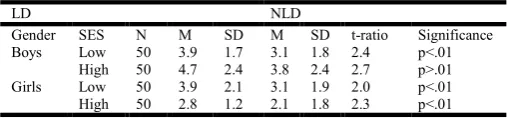
Table 15. Presentation of factor-Q4 in children with LD and NLD on basis of SES and Gender
LD NLD
Gender SES N M SD M SD t-ratio Significance
Boys Low 50 3.9 1.7 3.1 1.8 2.4 p<.01
High 50 4.7 2.4 3.8 2.4 2.7 p>.01
Girls Low 50 3.9 2.1 3.1 1.9 2.0 p<.01
High 50 2.8 1.2 2.1 1.8 2.3 p<.01
Here show test reports children with learning disability high stern score due to high stern score show following behavior. Tense, frustrated, driven, in case of Non learning disabled children stern score in low. It show behavior relaxed, torpid and composed. Statically representation show different in personality of learning disabled and non learning disabled children. on df 98 t-ratio is respectively is 2.4,2.7,2.0,and 2.3.
Conclusion
I find personality character of Learning disabled children are rigid, distrustful, objective, cool , and critical.
The children with learning disability have low intelligence level, low mental ability, unable to handle abstract problem.
They are low emotional strength, worrying, attention seeking, destructible, slow, in communication, submission, dependent, disregard, obligations etc.
compulsive. Most prominent behavior is depressed tendency and insecure and worry.
The behavior of learning disability show strong serest obligation, sensitive to people arrival and disapproval. Most prominent behaviors is act individual static guarded, wrapped, up in self fastidiously obstructive and neurasthenic ally fatigues.
They shows behaviors and personality character demanding impatient, attention, getting, showing off. They shows personality behaviors quitting, fickle, frivolous, self indulgent, independent. Here prominent, personality, character and behavior show as shy, withdrawn, retiring in face of opposite sex emotionally, restricted interest. Here children with learning disability show the major behavior critical, stands by its own idea, and cool
REFERENCES
Bateman, B. 1965. An educator’s view of a diagnostic approach to learning disorders. In J. Hellmuth (Ed.), Learning disorders (Vol. 1). Seattle, WA: Special Child Publication
Porter, R. B. and Cattell, R. B. 1972. Handbook for the Children’sPersonality Questionnaire.Champaign, IL: Institute for Personality and Ability Testing.
Share, D.L., and Stanovich, K.E. Cognitive processes in early reading development: Accommodating individual differences into a mode of acquisition. Education: Contributions for Educational Psychology, 1995. 1:34–36. Sharma, G. 1992. A study of certain factors related to the
learning disabilities among primary school children. Unpublished doctoral dissertation, S.V. University, Tirupati, India
Siddamma, T. 1977. Reliability of Children’s Personality Questionnaire (CPQ). Child Psychiatry Quarterly, 2, 13-17. Snowling et. al. 1983. The role of working memory in skilled
and less readers comprehension, intelligence vol. 21 issue 1 page 183.
Steven R. Forness, Kenneth A. 1996. Treating social skills deficits in children with learning disabilities: A meta analysis of research, Leaf Disability Quarterly Feb1996 Vol19 no12-13.
57278 International Journal of Current Research, Vol. 9, Issue, 09, pp.57274-57278, September, 2017